REVIEW 4 major objections 3 minor 59 references
Quantum geometry and elliptic optical dichroism in $p$-wave magnets
T0 review · 4 major / 3 minor · reviewed 2026-08-16 · deepseek-v4-flash
Pith's one-line read A p-wave magnet with its Néel vector along y shows an exact zero in band-edge optical absorption for one ellipticity of light, and the dark angle encodes the ratio $(\lambda+J_y)/\lambda$.
desk verdict Plausible and useful idea, but the central derivation is self-inconsistent and the zero-dichroism protocol is not supported by the paper's own equations. read the letter →
The pith
A machine-rendered reading of the paper's core claim, the machinery that carries it, and where it could break.
The reading
What carries the argument
The load-bearing object is the quantum geometric tensor, whose real part is the quantum metric $g_{\mu\nu}$ and whose imaginary part is the Berry curvature $\Omega_{xy}$. For a two-band model, the optical matrix element for elliptically polarized light decomposes into $|P_{\vartheta}|^2\propto g_{xx}\cos^2\vartheta+g_{yy}\sin^2\vartheta+\Omega_{xy}\sin\vartheta\cos\vartheta$. At the optical band edge only the $\mathbf{k}=0$ values survive, and when the Néel vector is along $y$, those three geometric terms merge into a single perfect square, producing the null absorption angle.
What would settle it
Measure the band-edge optical conductivity of a candidate p-wave magnet as a function of the ellipticity angle and look for the exact zero at $\vartheta=-\arctan((\lambda+J_y)/\lambda)$. If no ellipticity produces strictly zero absorption while the material is gapped, or if the value of $J_y$ extracted from the dark angle disagrees with an independent measurement of the Néel vector, the minimal single-band description is falsified.
Extended reading notes
Core claim
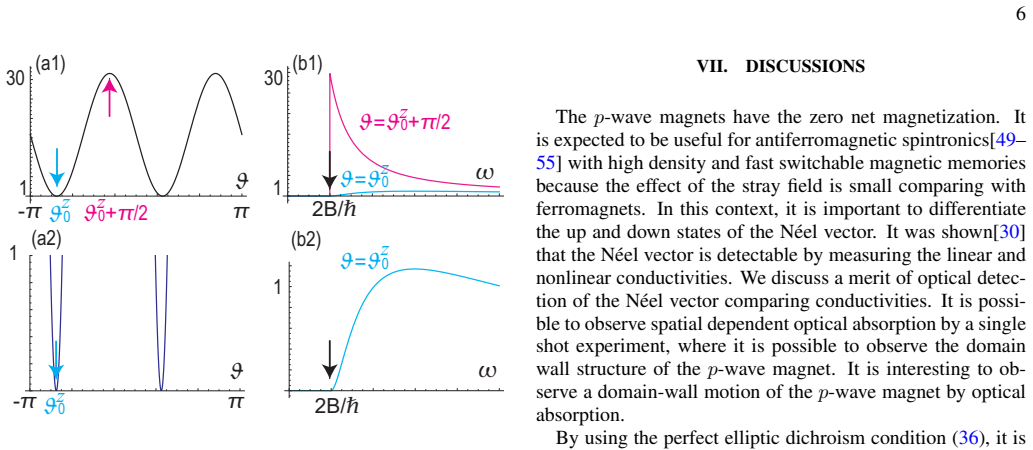
On its own terms, the paper establishes a perfect elliptic dichroism for a y-aligned p-wave magnet. The band-edge optical conductivity is proportional to $G(0;\vartheta)=g_{xx}(0)\cos^2\vartheta+g_{yy}(0)\sin^2\vartheta+\Omega_{xy}(0)\sin\vartheta\cos\vartheta$, and for $\mathbf{J}=(0,J_y,0)$ the quantum metric and Berry curvature at zero momentum combine so that $G(0;\vartheta)\propto\sin^2(\vartheta-\vartheta_{y0})$ with $\vartheta_{y0}=-\arctan((\lambda+J_y)/\lambda)$. Hence the absorption has an exact zero at $\vartheta=\vartheta_{y0}$, and the paper argues that locating this zero determines $(\lambda+J_y)/\lambda$ experimentally, allowing the Néel vector and its sign to be read out optically.
Load-bearing premise
The results assume that a real p-wave magnet is captured by the minimal two-band Hamiltonian with the p-wave Néel term, Rashba coupling, and Zeeman gap, with $J<|\lambda|$; if additional orbital or magnetic terms enter, the exact dark angle and the extraction formula for $J_y$ would no longer hold.
Editorial extensions
If this is right
- The dark angle directly measures $(\lambda+J_y)/\lambda$, so an optical experiment at the band edge can extract the p-wave Néel coupling strength without transport contacts.
- Combined with the gap $2|B|$ and the conductivity maximum at $\vartheta_{y0}\pm\pi/2$, the same data determine $B$, $\lambda$, and $J_y$ separately.
- The two Néel states $+J_y$ and $-J_y$ give distinguishable band-edge absorption curves, enabling optical readout of the Néel-vector sign.
- Because optical absorption can be spatially resolved in one shot, the ellipticity contrast can image p-wave Néel domain walls and their motion.
Reading between the lines
- Beyond the paper: an exact zero is an intensity-independent null, so the dark-angle measurement is more robust to laser-power fluctuations than a conductivity peak; this makes it a practical metrological observable.
- Beyond the paper: if the same geometric decomposition is applied to other zero-magnetization magnets, the combination of $g_{xx}$, $g_{yy}$, and $\Omega_{xy}$ into a perfect square is special to the $y$-aligned configuration, so the dark angle is a fingerprint of that specific Néel orientation rather than a generic effect.
- Beyond the paper: scanning frequency just above the gap would test whether the cancellation persists away from $\mathbf{k}=0$; since the quantum metric and Berry curvature have different momentum dependences, any residual absorption at $\vartheta_{y0}$ would carry information about the dispersion outside the Dirac point.
Signed reviews
Editorial analysis
A structured set of objections, weighed in public.
Referee Report
Summary. The manuscript studies optical absorption of elliptically polarized light in a Rashba two-dimensional electron gas with a k-linear p-wave Néel coupling and a Zeeman gap B. It rewrites the interband optical conductivity at the band edge in terms of the quantum metric and Berry curvature, obtains analytic formulas for the Néel vector along the x, y, and z axes, and claims a 'perfect elliptic dichroism' when the Néel vector is along y: at the band edge the conductivity vanishes at the polarization angle ϑ_y0 = -arctan((λ+J_y)/λ). This null is proposed as an all-optical way to determine (λ+J_y)/λ and to distinguish the two states J_y and -J_y.
Significance. The idea of reading the quantum geometric tensor through the ellipticity dependence of optical absorption in a p-wave magnet is timely, and a sharp polarization null would be a clean experimental signature for the Néel vector in a compensated magnet. The paper is a self-contained analytic derivation with a concrete material context and no fitting parameters. However, several load-bearing algebraic relations in Sections IV-VI are internally inconsistent, so the quantitative central claim as printed is not established; a careful re-derivation is needed before the protocol can be used.
major comments (4)
- [Sec. IV, Eq. (15)] Equation (15) states |P_μ|² = -Δ² g_μμ. The Hellmann-Feynman theorem with P_μ = ℏ⟨ψ_+|v_μ|ψ_-⟩ gives ⟨ψ_+|v_μ|ψ_-⟩ = -(2Δ/ℏ)⟨ψ_+|∂_μ ψ_-⟩, hence |P_μ|² = 4Δ² g_μμ, which is positive. The printed sign and missing factor of 4 are not harmless notational choices: Eq. (17) and all of the numerical formulas in Section VI inherit them, and a negative G would imply negative absorption.
- [Sec. V and Sec. VI, Eqs. (23)-(24) vs. (33)-(34)] Directly setting k=0 and J_z=0 in Eq. (23) gives g_xx(0) = (J_x² + (λ+J_y)²)/(2B²), whereas Eq. (33) quotes (J_x² + (λ+J_y)²)/(32B²), a factor-of-16 discrepancy. Similarly, Eq. (24) at k=0 gives Ω_xy(0) = -λ(λ+J_y)/(2B²), whereas Eq. (34) quotes -λ(λ+J_y)/(16B²), a factor-of-8 discrepancy. Because the relative weight of the metric and Berry-curvature terms controls the position of the null of G, these factors are load-bearing; the band-edge expressions in Section VI.C do not follow from the preceding formulas.
- [Sec. VI.C, Eqs. (36), (38), (39)] The exact-looking result Eq. (38) contains a negative sinθ cosθ term. Evaluated at ℏω = 2|B|, its angular factor is proportional to ((λ+J_y) cosθ - λ sinθ)², whose zero is at tanθ = (λ+J_y)/λ, i.e. at +arctan((λ+J_y)/λ), not at the negative angle of Eq. (36). Moreover, the factorization in Eq. (39) with ϑ_y0 = -arctan((λ+J_y)/λ) is algebraically wrong: (a cosθ - λ sinθ)² = (a²+λ²) sin²(θ - arctan(a/λ)), not θ + arctan(a/λ). A direct evaluation of P_θ at k=0 for J=(0,J_y,0) gives P_θ = -i[(λ+J_y) cosθ + λ sinθ], whose squared modulus has a positive cross term and vanishes at the angle in Eq. (36). Thus the physical claim is plausible, but the manuscript's own exact formulas are mutually contradictory, and the experimental protocol in Section VI.C is supported only after a sign correction.
- [Sec. VI.A, Eq. (31)] The band-edge evaluation in Eq. (31) is not a valid limit of Eq. (25). At the threshold k_0=0, ∂_k Δ vanishes linearly in k, and the angular integral involves the anisotropic factor f(φ) = (λ+J_y)² cos²φ + λ² sin²φ appearing in Eq. (32). Replacing 2|∂_k Δ| by the constant 2|λ(λ+J_y)| omits this factor, so the claimed 'exactly obtained' coefficient in Eq. (38) is not established. The location of the polarization null is unaffected by this issue, but the proposed extraction of B, λ, and J_y from the maximum of σ(2|B|) would be.
minor comments (3)
- [Abstract and Sec. III] The polarization convention is confusing: Eq. (7) defines right polarization as 0<ϑ<π and left polarization as -π<ϑ<0, but the text after Eq. (7) says 'P_{π/4}(k) corresponds to the right circularly polarized right', which appears to be garbled.
- [Sec. VI, Eqs. (38)-(40) and Figs. 3-5] Once the cross-term sign is corrected, the figures and captions must be re-checked, because the null shown as ϑ_y0 in Fig. 3 would occur at a different angle if plotted from Eq. (38) as printed.
- [Throughout] There are several typographical errors, including 'ellipcit' in the abstract, 'absorpition' in Section I, and 'J²_x' in the discussion of the z-axis case in Section VI.E, which should be 'J²_z'.
Circularity Check
No circularity: the optical-dichroism predictions follow algebraically from the assumed model Hamiltonian without fitting or self-referential input.
full rationale
The paper's central predictions are derived from the explicit effective Hamiltonian Eq. (1) via standard quantum-geometric optical-conductivity formulas (Eqs. (8), (17), (21)-(24), and (25)). No parameter is fitted to the quantity being predicted; in particular, the perfect elliptic dichroism condition ϑ_y0 of Eqs. (35)-(39) is obtained by factoring the model's quantum metric and Berry curvature at k=0, and is not assumed as an input. The self-citations ([16], [28], [30], [31]) provide the form of the model and the standard formalism, but the target results (e.g., the exact conductivity Eq. (38) and its zero at ϑ_y0) are explicitly derived from the stated Hamiltonian and would change if the Hamiltonian changed, so the citations are not load-bearing in a circular sense. The apparent sign mismatch between Eq. (36) and the factorization in Eq. (39) noted by a careful reader is an internal algebraic/correctness issue, not a circularity: the derivation chain is still one-directional from model to prediction. The proposal that (λ+J_y)/λ can be read out from the null angle is a model-based prediction, not a renaming of a fitted parameter. The paper also notes its own limitation that elliptic dichroism alone cannot fully determine all Néel-vector directions (Sec. VII), which is consistent with the derivation being a straightforward consequence of the model rather than a circular claim. Hence no circular step is present.
Assumptions & free parameters
assumptions (3)
- domain assumption The p-wave magnet is described by the single-band Rashba model with p-wave Néel coupling, Eq. (1), with J < |λ|.
- domain assumption Optical absorption is given by the zero-temperature Fermi golden rule formula, Eq. (8), in the clean limit.
- domain assumption The free-electron parabolic term does not affect the interband optical absorption.
Cite this review
Pith. "Pith review of Quantum geometry and elliptic optical dichroism in $p$-wave magnets." pith.science (2026). https://pith.science/paper/5CBYCAY7
@misc{pith2026250417206,
  author       = {Pith},
  title        = {Pith review of: Quantum geometry and elliptic optical dichroism in $p$-wave magnets},
  year         = {2026},
  howpublished = {\url{https://pith.science/paper/5CBYCAY7}},
  note         = {Machine review of arXiv:2504.17206}
}
abstract
The quantum geometric tensor is composed of the Berry curvature and the quantum metric, which is observable by means of optical absorption of elliptically polarized light. Especially, the quantum geometric tensor at the zero-momentum is observable by the optical absorption at the optical band edge. In this context, we study optical absorption of a $p$-wave magnet under irradiation of elliptically polarized light. The $p$-wave magnet has a band splitting along one axis, which we choose the $x$ axis. We obtain analytic formulae for the optical conductivity up to the second order in the magnitude of the N\'{e}el vector. In particular, the optical conductivity is exactly obtained when the N\'{e}el is along the $x$, $y$ and $z$ axis. It shows strong ellipticity a dependence of the light polarization, which is an elliptic dichroism. Especially, there is a perfect elliptic optical dichroism when the N\'{e}el vector is along the $y$ axis. It is possible to determine the N\'{e}el vector by measuring the ellipticity of the perfect elliptic dichroism.
Figures


Figures from the paper (1 more)
Reference graph
Works this paper leans on
-
[1]
(a2) and (b2) are the enlarged figures of (a1) and (b1) showing σ (2|B|/ℏ;ϑy
-
[2]
= 0 . The horizontal axis is ℏω. We have setJ = 0.1ε0/k0,λ =ε0/k0 andB = 0.1ε0, where ε0 is a unit of the energy andk0 is a unit of the momentum. A. General case First we study the general case, where all of Jx,Jy andJz are nonzero. The optical conductivity is given by σ (ω;ϑ) σ0 = π 2λ2ℏω3 hn λ2 +λJy +J 2 x− J 2 z 2 (ℏ2ω2 + 4B2) + 4πB 2J 2 z o cos2ϑ + n ...
-
[3]
(35) with ϑy 0 =− arctan λ +Jy λ . (36) It becomes zero for ϑ =ϑy 0, J x = 0, (37) where a perfect elliptic dichroism occurs. On the other hand, the perfect elliptic dichroism does not occur for Jx ̸= 0 , but we will soon show that the optical conductivity depends strongly onϑ. C. The case of J = (0,J y, 0) We study a specific case, where the Néel vector ...
-
[4]
= πℏ2 2B 2λ2 +J 2 x + p 4λ4 +J 4x > 0. (45) It does not become zero as shown in Fig.4(a2). The σ (ω) is shown in Fig.4(b). The behaviour is almost similar to that of the case where the Néel vector is along the y axis although there is a tiny nonzero contributionσ (ω;ϑ0 +π/2) at the op- tical band edge as shown in Fig.4(b2). E. The case of J = (0, 0,J z) W...
-
[5]
W. Yao, D. Xiao, and Q. Niu, Phys. Rev. B 77, 235406 (2008)
2008
-
[6]
D. Xiao, G.-B. Liu, W. Feng, X. Xu, and W. Yao, Coupled Spin and Valley Physics in Monolayers of MoS2 and Other Group- VI Dichalcogenides, Phys. Rev. Lett. 108, 196802 (2012)
work page 2012
-
[7]
Ezawa, Spin-valley optical selection rule and strong circular dichroism in silicene, Phys
M. Ezawa, Spin-valley optical selection rule and strong circular dichroism in silicene, Phys. Rev. B 86, 161407(R) (2012)
work page 2012
-
[8]
X. Li, T. Cao, Q. Niu, J. Shi, and J Feng, Coupling the valley degree of freedom to antiferromagnetic order, PNAS 110 (10) 3738 (2013)
work page 2013
Show all 59 references
-
[9]
Ezawa, Elliptic Dichroism and Valley-Selective Optical Pumping in the Surface of Topological Crystalline Insulator, Phys
M. Ezawa, Elliptic Dichroism and Valley-Selective Optical Pumping in the Surface of Topological Crystalline Insulator, Phys. Rev. B 89, 195413 (2014)
2014
-
[10]
Ahn, G.-Y
J. Ahn, G.-Y . Guo, N. Nagaosa, Low-Frequency Divergence and Quantum Geometry of the Bulk Photovoltaic Effect in Topological Semimetals, Phys. Rev. X 10, 041041 (2020)
2020
-
[11]
Holder, D
T. Holder, D. Kaplan, B. Yan, Consequences of time-reversal- symmetry breaking in the light-matter interaction: Berry curva- ture, quantum metric, and diabatic motion, Phys. Rev. Res. 2, 033100 (2020)
2020
-
[12]
Bhalla, K
P. Bhalla, K. Das, D. Culcer, A. Agarwal, Resonant Second- Harmonic Generation as a Probe of Quantum Geometry, Phys. Rev. Lett. 129, 227401 (2022)
2022
-
[13]
Ahn, G.-Y
J. Ahn, G.-Y . Guo, N. Nagaosa, A. Vishwanath, Riemannian geometry of resonant optical responses, Nature Physics 18, 290 (2022)
2022
-
[14]
Martin, Polarization and localization in insulators: Generating function approach, Phys
Ivo Souza, Tim Wilkens, and Richard M. Martin, Polarization and localization in insulators: Generating function approach, Phys. Rev. B 62, 1666 (2000)
2000
-
[15]
Chen and G
W. Chen and G. von Gersdorff, Measurement of interaction- dressed Berry curvature and quantum metric in solids by optical absorption, SciPost Phys. Core 5, 040 (2022)
2022
-
[16]
Matheus S. M. de Sousa, Antonio L. Cruz, and Wei Chen, Map- ping quantum geometry and quantum phase transitions to real space by a fidelity marker, Phys. Rev. B 107, 205133 (2023)
2023
-
[17]
Barun Ghosh, Yugo Onishi, Su-Yang Xu, Hsin Lin, Liang Fu and Arun Bansil, Probing quantum geometry through opti- cal conductivity and magnetic circular dichroism, Science Ad- vances: sciadv.ado1761 (2024)
2024
-
[18]
Yugo Onishi and Liang Fu, Fundamental Bound on Topological Gap, Phys. Rev. X 14, 011052 (2024)
2024
-
[19]
Phys.: Condens
Wei Chen, Quantum geometrical properties of topological ma- terials, J. Phys.: Condens. Matter 37 025605 (2025) 7
2025
-
[20]
Ezawa, Analytic approach to quantum metric and optical conductivity in Dirac models with parabolic mass in arbitrary dimensions, Phys
M. Ezawa, Analytic approach to quantum metric and optical conductivity in Dirac models with parabolic mass in arbitrary dimensions, Phys. Rev. B 110, 195437 (2024)
2024
-
[21]
Chang-geun Oh, Sun-Woo Kim, Kun Woo Kim, Bartomeu Monserrat, and Jun-Won Rhim, Universal Optical Conduc- tivity from Quantum Geometry in Quadratic Band-Touching Semimetals, arXiv:2503.18372
-
[22]
Ma, et al., Observation of the nonlinear Hall effect under time-reversal-symmetric conditions, Nature 565, 337 (2019)
Q. Ma, et al., Observation of the nonlinear Hall effect under time-reversal-symmetric conditions, Nature 565, 337 (2019)
2019
-
[23]
C. Wang, Y . Gao, and D. Xiao, Intrinsic nonlinear Hall effect in antiferromagnetic tetragonal cumnas, Phys. Rev. Lett. 127, 277201 (2021)
2021
-
[24]
Kamal Das, Shibalik Lahiri, Rhonald Burgos Atencia, Dimitrie Culcer, and Amit Agarwal, Intrinsic nonlinear conductivities induced by the quantum metric, Phys. Rev. B 108, L201405 (2023)
2023
-
[25]
Gao, Y .-F
A. Gao, Y .-F. Liu, J.-X. Qiu, B. Ghosh, T.V . Trevisan, Y . On- ishi, C. Hu, T. Qian, H.-J. Tien, S.-W. Chen et al., Quantum metric nonlinear Hall effect in a topological antiferromagnetic heterostructure, Science 381, eadf1506 (2023)
2023
-
[26]
N. Wang, D. Kaplan, Z. Zhang, T. Holder, N. Cao, A. Wang, X. Zhou, F. Zhou, Z. Jiang, C. Zhang et al., Quantum metric- induced nonlinear transport in a topological antiferromagnet, Nature (London) 621, 487 (2023)
2023
-
[27]
Daniel Kaplan, Tobias Holder and Binghai Yan, Unification of Nonlinear Anomalous Hall Effect and Nonreciprocal Magne- toresistance in Metals by the Quantum Geometry, Phys. Rev. Lett. 132, 026301 (2024)
2024
-
[28]
Giacomo Sala, et.al., The quantum metric of electrons with spin-momentum locking, arXiv:2407.06659
-
[29]
Yuan Fang, Jennifer Cano, and Sayed Ali Akbar Ghorashi, Quantum Geometry Induced Nonlinear Transport in Altermag- nets, Phys. Rev. Lett. 133, 106701 (2024)
2024
-
[30]
M. Ezawa. Detecting the Neel vector of altermagnets in het- erostructures with a topological insulator and a crystalline valley-edge insulator, Phys. Rev. B 109 (24), 245306 (2024)
2024
-
[31]
Anna Birk Hellenes, Tomas Jungwirth, Jairo Sinova, Libor Šmejkal, Unconventional p-wave magnets, arXiv:2309.01607
-
[32]
Birch, Priya R
Rinsuke Yamada, Max T. Birch, Priya R. Baral, Shun Oku- mura, Ryota Nakano, Shang Gao, Yuki Ishihara, Kamil K. Kolincio, Ilya Belopolski, Hajime Sagayama, Hironori Nakao, Kazuki Ohishi, Taro Nakajima, Yoshinori Tokura, Taka-hisa Arima, Yukitoshi Motome, Moritz M. Hirschmann, a...
-
[33]
Ezawa, Topological insulators based on p-wave altermag- nets; Electrical control and detection of the altermagnetic do- main wall, Phys
M. Ezawa, Topological insulators based on p-wave altermag- nets; Electrical control and detection of the altermagnetic do- main wall, Phys. Rev. B 110, 165429 (2024)
2024
-
[34]
Ezawa, Purely electrical detection of the Neel vector of p-wave magnets based on linear and nonlinear conductivities, arXiv:2410.21854
M. Ezawa, Purely electrical detection of the Neel vector of p-wave magnets based on linear and nonlinear conductivities, arXiv:2410.21854
-
[35]
Ezawa, Out-of-plane Edelstein effects: Electric-field in- duced magnetization in p-wave magnets, Phys
M. Ezawa, Out-of-plane Edelstein effects: Electric-field in- duced magnetization in p-wave magnets, Phys. Rev. B 111, L161301 (2025)
2025
-
[36]
Smejkal, A
L. Smejkal, A. H. MacDonald, J. Sinova, S. Nakatsuji and T. Jungwirth, Anomalous Hall antiferromagnets, Nat. Rev. Mater. 7, 482 (2022)
2022
-
[37]
Libor Šmejkal, Jairo Sinova, and Tomas Jungwirth, Emerg- ing Research Landscape of Altermagnetism, Phys. Rev. X 12, 040501 (2022)
2022
-
[38]
Di Zhu, Zheng-Yang Zhuang, Zhigang Wu, and Zhongbo Yan, Topological superconductivity in two-dimensional altermag- netic metals, Phys. Rev. B 108, 184505 (2023)
2023
-
[39]
Chi Sun, Jacob Linder, Spin pumping from a ferromagnetic in- sulator into an altermagnet, Phys. Rev. B 108, L140408 (2023)
2023
-
[40]
G. S. Diniz and E. Vernek, Suppressed Kondo screening in two- dimensional altermagnets, Phys. Rev. B 109, 155127 (2024)
2024
-
[41]
Peng Rao, Alexander Mook, Johannes Knolle, Tunable band topology and optical conductivity in altermagnets, Phys. Rev. B 110, 024425 (2024)
2024
-
[42]
Morten Amundsen, Arne Brataas, Jacob Linder, RKKY interac- tion in Rashba altermagnets, Phys. Rev. B 110, 054427 (2024)
2024
-
[43]
Shun Okumura, Takahiro Morimoto, Yasuyuki Kato, and Yuk- itoshi Motome, Quadratic optical responses in a chiral magnet, Phys. Rev. B 104, L180407 (2023)
2023
-
[44]
Bjonulf Brekke, Pavlo Sukhachov, Hans Glokner Giil, Arne Brataas, Jacob Linder, Minimal models and transport proper- ties of unconventional p-wave magnets, Phys. Rev. Lett. 133, 236703 (2024)
2024
-
[45]
Ezawa, Third-order and fifth-order nonlinear spin-current generation in g-wave and i-wave altermagnets and perfect spin- current diode based on f-wave magnets, Phys
M. Ezawa, Third-order and fifth-order nonlinear spin-current generation in g-wave and i-wave altermagnets and perfect spin- current diode based on f-wave magnets, Phys. Rev. B 111, 125420 (2025)
2025
-
[46]
J. P. Provost and G. Vallee, Riemannian structure on manifolds of quantum states, Comm. Math. Phys. 76, 289 (1980)
1980
-
[47]
Yu-Quan Ma, Shu Chen, Heng Fan, and Wu-Ming Liu, Abelian and non-Abelian quantum geometric tensor, Phys. Rev. B 81, 245129 (2010)
2010
-
[48]
Shunji Matsuura and Shinsei Ryu, Momentum space metric, nonlocal operator, and topological insulators, Phys. Rev. B 82, 245113 (2010)
2010
-
[49]
von Gersdorff and W
G. von Gersdorff and W. Chen, Measurement of topological order based on metric-curvature correspondence, Phys. Rev. B 104, 195133 (2021)
2021
-
[50]
Hsiang and D.-H
W.-Y . Hsiang and D.-H. Lee, Chern-Simons invariant in the Berry phase of a 2×2 Hamiltonians, Phys. Rev. A 64, 052101 (2001)
2001
-
[51]
Doru Sticlet, Frederic Piechon, Jean-Noel Fuchs, Pavel Kalu- gin, and Pascal Simon, Geometrical engineering of a two-band Chern insulator in two dimensions with arbitrary topological index, Phys. Rev. B 85, 165456 (2012)
2012
-
[52]
Status Solidi RRL 7, 154 (2013)
Chao-Ming Jian, Zheng-Cheng Gu, and Xiao-Liang Qi, Momentum-space instantons and maximally localized flat-band topological Hamiltonians, Phys. Status Solidi RRL 7, 154 (2013)
2013
-
[53]
Jungwirth, X
T. Jungwirth, X. Marti, P. Wadley and J. Wunderlich, Antiferro- magnetic spintronics, Nature Nanotechnology 11, 231 (2016)
2016
-
[54]
Baltz, A
V . Baltz, A. Manchon, M. Tsoi, T. Moriyama, T. Ono, and Y . Tserkovnyak Antiferromagnetic spintronics, Rev. Mod. Phys. 90, 015005 (2018)
2018
-
[55]
Jiahao Han, Ran Cheng, Luqiao Liu, Hideo Ohno and Shunsuke Fukami, Coherent antiferromagnetic spintronics Nature Mate- rials 22, 684 (2023)
2023
-
[56]
Zhuoliang Ni, A. V . Haglund, H. Wang, B. Xu, C. Bernhard, D. G. Mandrus, X. Qian, E. J. Mele, C. L. Kane and Liang Wu , Imaging the Neel vector switching in the monolayer anti- ferromagnet MnPSe3 with strain-controlled Ising order Nature Nanotechnology 16, 782 (2021)
2021
-
[57]
Godinho, H
J. Godinho, H. Reichlov, D. Kriegner, V . Novak, K. Olejnik, Z. Kašpar, Z. Šoban, P. Wadley, R. P. Campion, R. M. Otxoa, P. E. Roy, J. Železnny, T. Jungwirth and J. Wunderlich, Electrically induced and detected Neel vector reversal in a collinear antifer- romagnet, Nature Comm...
2018
-
[58]
Kenta Kimura, Yutaro Otake and Tsuyoshi Kimura, Visualizing rotation and reversal of the Neel vector through antiferromag- netic trichroism, Nature Communications, 13, 697 (2022). 8
2022
-
[59]
Yi-Hui Zhang, Tsao-Chi Chuang, Danru Qu, and Ssu-Yen Huang, Detection and manipulation of the antiferromagnetic Neel vector in Cr2O3 Phys. Rev. B 105, 094442 (2022)
2022
Reviewed August 16, 2026 · model on record in the stance chip above.
Discussion (0). Continue with ORCID to comment.