REVIEW 4 major objections 6 minor 49 references
A Perturbatively Stable Non-Supersymmetric String Model with AdS Vacuum
T0 review · 4 major / 6 minor · reviewed 2026-08-16 · deepseek-v4-flash
Pith's one-line read This paper constructs a four-dimensional type II string vacuum with supersymmetry broken by a freely acting Scherk-Schwarz deformation that is tachyon-free at tree level and whose one-loop potential stabilizes all identified massless…
desk verdict A real, explicit one-loop computation showing positive masses for all tree-level massless scalars in a non-supersymmetric type II model, but the AdS vacuum headline is conditional on dilaton stabilization the paper does not construct. read the letter →
The pith
A machine-rendered reading of the paper's core claim, the machinery that carries it, and where it could break.
The reading
What carries the argument
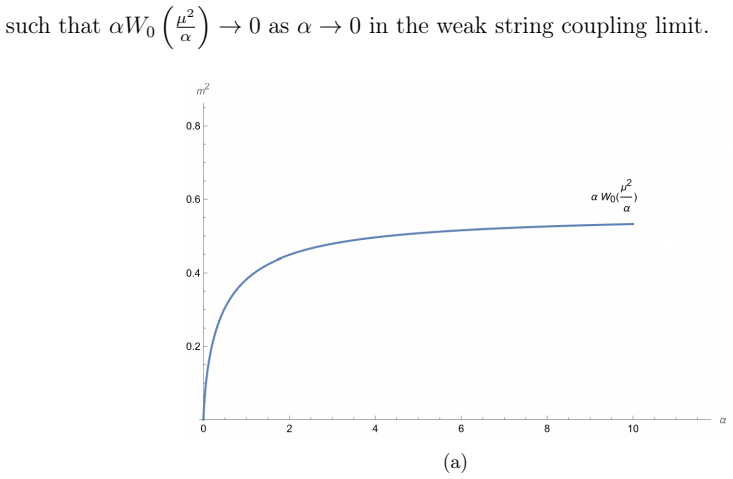
The load-bearing mechanism is the modular-invariant one-loop partition function of a $\mathbb{Z}_2\times\mathbb{Z}_2$ type II orbifold in the free-fermionic formulation, with the $T^2$ moduli reinserted by Poisson resummation and the Scherk-Schwarz deformation implemented as phase factors that shift lattice momenta. The central object is the moduli-dependent potential $V(T^{(i)},U^{(i)})$; its defining feature is a global minimum at the self-dual point $T^{(i)}=U^{(i)}=1+i$, where the Hessian is positive definite, while the unbounded directions have a maximum protected by the Breitenlohner-Freedman bound. The scalar masses are computed from one-loop two-point functions of the massless vertex operators, with the infrared-divergent double-charged and twisted scalar contributions regularized by a subtraction that leads to masses given by the Lambert $W$ function. Misaligned supersymmetry — the alternating sign of the boson-minus-fermion level difference — is the spectral property accompanying the tachyon-free tree-level spectrum.
What would settle it
Treat the dilaton as a dynamical field and evaluate the one-loop potential in the Einstein frame: if the resulting dilaton potential is a runaway that never stabilizes, or if a flux/orientifold completion of the construction pushes any tree-level massless scalar's squared mass negative at the self-dual point, the claimed stable AdS vacuum is ruled out.
Extended reading notes
Core claim
On its own terms, the central discovery is that a carefully chosen Scherk-Schwarz phase deformation — a freely acting $\mathbb{Z}_2$ action with momentum shifts on each $T^2$ — can break all supersymmetry without introducing tachyons anywhere in the $(T^2)^3$ moduli space, and that the same one-loop corrections that create a negative cosmological constant also give positive squared masses to the tree-level massless scalars in the model. The minimum of the one-loop potential sits at the self-dual free-fermionic point $T^{(i)} = U^{(i)} = 1+i$ for each torus, which is a fixed point of a $\Gamma_1(2)$ T-duality subgroup. The paper reports explicit one-loop masses and vacuum energy, for example $m^2_{T^{(1)}} = m^2_{T^{(3)}} = 0.031316...\, M_s^2 g_s^2$, $m^2_{T^{(2)}} = 0.055884...\, M_s^2 g_s^2$, and $\Lambda = -0.0078897...\, M_s^4$, and it shows that the only tachyonic directions are maxima whose curvature lies within the Breitenlohner-Freedman bound. The authors state plainly that an extra dilaton-stabilization mechanism is needed before the vacuum can be regarded as a genuine AdS vacuum.
Load-bearing premise
The one-loop calculation holds the dilaton fixed; if the dilaton is allowed to move, the negative vacuum energy turns into a runaway potential, so the stable AdS vacuum depends on an extra dilaton-stabilization mechanism that is not constructed and could change the scalar masses.
Editorial extensions
If this is right
- The construction provides a proof of concept that non-supersymmetric string vacua can avoid the generic one-loop tachyonic instability, so broken supersymmetry does not automatically doom a vacuum at leading order.
- The six toroidal moduli $T^{(i)},U^{(i)}$ are stabilized at the self-dual point by the one-loop potential, so the vacuum energy selects a definite point in the moduli space rather than a flat direction.
- The negative one-loop cosmological constant makes the model an AdS vacuum in the string frame; in the Einstein frame the dilaton runs, so a complete stable vacuum requires an additional stabilization mechanism, as the paper itself states.
- The double-charged and twisted scalar sectors contain infrared logarithms whose resummation via the Lambert $W$ function still yields positive masses, extending stability beyond the sectors with convergent integrals.
- The model exhibits misaligned supersymmetry, the alternating-sign boson-fermion level pattern that accompanies the tachyon-free spectrum in the $q$-expansion.
Reading between the lines
- Beyond the paper: if the same freely acting Scherk-Schwarz mechanism removes tachyons generically, perturbatively stable non-supersymmetric vacua may exist in a much larger family of $\mathbb{Z}_2\times\mathbb{Z}_2$ orbifolds than the one constructed here.
- Beyond the paper: the one-loop selection of the self-dual point suggests that T-duality fixed points can act as dynamical attractors for moduli in non-supersymmetric strings, a mechanism worth testing in other compactifications.
- Beyond the paper: a natural stress test is a two-loop computation, since without supersymmetry there is no non-renormalisation theorem protecting the one-loop result; stability at higher orders remains open.
- Beyond the paper: completing the sketched flux/orientifold dilaton stabilization could turn this into an explicit AdS vacuum, and then the Breitenlohner-Freedman-protected maximum would provide a locally stable AdS saddle.
Signed reviews
Editorial analysis
A structured set of objections, weighed in public.
Referee Report
Summary. The paper constructs a four-dimensional type II closed string model by applying a freely acting Scherk-Schwarz Z2 deformation to an N=2 supersymmetric Z2 x Z2 orbifold, and claims that the resulting non-supersymmetric model is tree-level tachyon-free for all moduli, exhibits misaligned supersymmetry, and has a one-loop scalar potential with a negative-energy minimum at the self-dual free-fermionic point. The authors further compute one-loop corrections to all tree-level massless bosonic fields and state that all of them acquire positive masses, concluding that the model is perturbatively stable with an AdS vacuum. The manuscript contains detailed partition function definitions, GSO phase data, numerical evaluations of the potential and its Hessian, and one-loop two-point function computations for moduli, charged scalars, and twisted scalars.
Significance. The technical content is substantial and mostly explicit: the model is defined without free parameters, the tree-level tachyon analysis is concrete, and the one-loop mass computations are carried out in detail with numerical results. If the fixed-dilaton computations are correct, the paper provides a useful proof of concept that non-supersymmetric string models can have positive one-loop masses for many moduli and charged scalars at a local minimum. However, the advertised central result, namely a perturbatively stable AdS vacuum, is not established because the dilaton is not stabilized; the negative string-frame vacuum energy becomes an Einstein-frame dilaton runaway. The paper should therefore be judged on its more modest fixed-dilaton claims rather than on the title and abstract.
major comments (4)
- [Abstract, Section 4] The central claim that the model is a perturbatively stable AdS vacuum is not established because the dilaton is not stabilized. The potential V(T^(i), U^(i)) in Eq. (2.26) is computed in the string frame with the dilaton held fixed; the negative vacuum energy at the self-dual point becomes a runaway dilaton potential in the Einstein frame that vanishes at zero string coupling, so the self-dual point is not an extremum of the full potential. Section 4 explicitly states that 'one has to stabilise the dilaton in order to draw a definite conclusion on the vacuum of the theory,' and the proposed flux/orientifold mechanism is not constructed and would modify the mass spectrum. The abstract and title should be reframed to state the result as a fixed-dilaton analysis, or the stabilization mechanism must be constructed and the masses recomputed.
- [Section 2.5, Figs. 2-4] The terminology is internally inconsistent: the self-dual point is called a 'global minimum' while simultaneously the text says 'the vacuum is metastable' and the figures show unbounded directions in T^(1)_2 and T^(3)_2. A global minimum cannot coexist with unbounded directions. The subsequent BF-bound check at the maximum, Eq. (3.16), assumes an AdS background, which is not established once the dilaton is included; moreover, the maximum is computed in the string frame and should be reinterpreted in the Einstein frame before applying the Breitenlohner-Freedman criterion.
- [Sections 3.4-3.5, Eqs. (3.57)-(3.64)] The positive masses for the double charged and twisted scalars depend on removing an IR-divergent piece by hand and resumming via the Lambert W gap equation. The finite parts quoted in Eqs. (3.41), (3.42), (3.54), and (3.56) are presented as numerical results without a demonstration of regulator independence. Because these masses are part of the claim that all tree-level massless scalars acquire positive masses, the subtraction prescription needs further justification, for example by exhibiting a different regulator or by showing explicitly that the finite part is scheme-independent.
- [Section 3.1, Abstract] The abstract states that 'all tree-level massless scalars acquire positive masses,' but the dilaton is not among the scalars that receive a positive one-loop mass. Section 3.1 only identifies an 'apparent' graviton/axio-dilaton/antisymmetric-tensor mass equal to the cosmological constant contribution, which is not a physical stabilizing mass, and no one-loop dilaton potential is computed. The claim should be restricted to the moduli and charged scalars at fixed dilaton, with the dilaton sector explicitly acknowledged as un stabilized.
minor comments (6)
- [Eq. (2.2)] The GSO projection matrix is presented in a garbled table format; it should be typeset as a proper matrix so that the entries C(vi,vj) can be read unambiguously.
- [Eq. (3.16)] The BF bound is quoted as m^2 >= (3/4) Lambda / M_p^2; please state the spacetime dimension and sign conventions used, and specify that the bound is applied in the Einstein frame after the dilaton is stabilized.
- [Section 2.5] The phrase 'global minimum' should be replaced by 'local minimum' or qualified by specifying the restricted domain, since the potential has unbounded directions in other moduli regions.
- [References] Reference [44] lists the same arXiv identifier twice; this should be corrected to a single entry.
- [Figures 1-4] The figures lack labeled axes and units; adding axes labels with string mass units would improve readability.
- [Eq. (3.64)] The solution uses the Lambert function W0; please explicitly state that W0 is the principal branch and discuss the condition for the argument mu^2/alpha to lie in the principal branch region.
Circularity Check
No significant circularity: the moduli potential and one-loop masses are computed from the partition function, not fitted or imported.
full rationale
The central derivation is self-contained. The model is defined by a free-fermionic basis and GSO matrix (2.1)-(2.2); the one-loop scalar potential is computed from the modular-invariant partition function via (2.4)-(2.26); the minimum at the self-dual point is established by explicit evaluation of the potential and its Hessian (2.27); and the one-loop mass corrections for moduli, charged scalars, and twisted scalars are obtained from explicit two-point correlator computations in Sections 3.2-3.5, with the IR-divergent pieces regularized in a stated way leading to positive masses through the Lambert function (3.57)-(3.64). No free parameter is fitted to data, and no prediction is identified with an input by construction. Citations to the authors' earlier work, such as the free-fermionic formulation [1-3] and the lattice form of the partition function [7-13], supply standard technology rather than the load-bearing result; the claimed minimum and spectrum are computed, not imported. The admitted dilaton-stabilization gap in Section 4 ('one has to stabilise the dilaton in order to draw a definite conclusion on the vacuum of the theory') limits the reach of the headline claim about an AdS vacuum, but that is an incompleteness or overinterpretation, not circular reasoning. Therefore the circularity score is 0.
Assumptions & free parameters
assumptions (4)
- domain assumption The free-fermionic formulation of string theory provides a consistent definition of the model at the fermionic point.
- domain assumption The one-loop effective potential is given by the integral of the partition function over the fundamental domain (Eq. 2.26).
- ad hoc to paper The physical mass is defined by the pole of the two-point function, and IR divergences can be subtracted and resummed via the gap equation (Section 3.4, Eq. 3.63).
- ad hoc to paper The Breitenlohner-Freedman bound applies to the maximum of the potential as a stability criterion (Section 3.2, Eq. 3.16).
Cite this review
Pith. "Pith review of A Perturbatively Stable Non-Supersymmetric String Model with AdS Vacuum." pith.science (2026). https://pith.science/paper/3KMLDVK6
@misc{pith2026250419364,
  author       = {Pith},
  title        = {Pith review of: A Perturbatively Stable Non-Supersymmetric String Model with AdS Vacuum},
  year         = {2026},
  howpublished = {\url{https://pith.science/paper/3KMLDVK6}},
  note         = {Machine review of arXiv:2504.19364}
}
read the original abstract
We present a construction of a perturbatively stable non-supersymmetric type II closed string model in four dimensions. It is based on a freely acting Scherk-Schwarz Z2-deformation of a supersymmetric construction which is recovered in appropriate decompactification limits. The model exhibits also the so-called misaligned supersymmetry with alternating signs for the number difference between bosons and fermions at successive mass levels. The tree-level spectrum is tachyon free for any value of the radii and moduli. At one loop level, the scalar potential has a non-supersymmetric minimum at the self-dual (free fermionic) point with negative energy, around which all tree-level massless scalars acquire positive masses. The model is thus non-supersymmetric and perturbatively stable.
Figures


Figures from the paper (5 more)


Reference graph
Works this paper leans on
-
[1]
Four-Dimensional Superstrings,
I. Antoniadis, C. P. Bachas and C. Kounnas, “Four-Dimensional Superstrings,” Nucl. Phys. B 289 (1987), 87
work page 1987
-
[2]
Construction of Fermionic String Models in Four-Dimensions,
H. Kawai, D. C. Lewellen and S. H. H. Tye, “Construction of Fermionic String Models in Four-Dimensions,” Nucl. Phys. B288 (1987), 1
work page 1987
-
[3]
4-D Fermionic Superstrings with Arbitrary Twists,
I. Antoniadis and C. Bachas, “4-D Fermionic Superstrings with Arbitrary Twists,” Nucl. Phys. B298 (1988), 586-612
work page 1988
-
[4]
Heterotic free fermionic and symmetric toroidal orbifold models
P. Athanasopoulos, A. E. Faraggi, S. Groot Nibbelink and V. M. Mehta, “Het- erotic free fermionic and symmetric toroidal orbifold models,” JHEP04 (2016), 038 [arXiv:1602.03082 [hep-th]]
work page Pith review arXiv 2016
-
[5]
Stability in Gauged Extended Supergravity,
P. Breitenlohner and D. Z. Freedman, “Stability in Gauged Extended Supergravity,” Annals Phys. 144 (1982), 249
1982
-
[6]
Classification of the N=2, Z2 X Z2-symmetric type II orbifolds and their type II asymmetric duals
A. Gregori, C. Kounnas and J. Rizos, “Classification of theN = 2,Z2×Z2 symmetric type II orbifolds and their type II asymmetric duals,” Nucl. Phys. B549(1999), 16-62 [arXiv:hep-th/9901123 [hep-th]]
work page Pith review arXiv 1999
-
[7]
R2 corrections and non perturbative dualities ofN = 4 string ground states,
A. Gregori, E. Kiritsis, C. Kounnas, N.A. Obers, P.M. Petropoulos, “R2 corrections and non perturbative dualities ofN = 4 string ground states,” Nucl. Phys. B510 (1998) 423
work page 1998
-
[8]
OnR4 threshold corrections in type IIB string theory and (p,q )-string instantons,
E. Kiritsis, B. Pioline, “OnR4 threshold corrections in type IIB string theory and (p,q )-string instantons,” Nucl. Phys. B508 (1997) 509
work page 1997
Show all 49 references
-
[9]
Super no-scale models in string theory,
C. Kounnas, H. Partouche, “Super no-scale models in string theory,” Nucl. Phys. B913 (2016) 593
2016
-
[10]
Perturbative and non-perturbative partial supersymmetry breaking: N = 4→N = 2→N = 1,
E. Kiritsis, C. Kounnas, “Perturbative and non-perturbative partial supersymmetry breaking: N = 4→N = 2→N = 1,” Nucl. Phys. B503 (1997) 117
1997
-
[11]
N = 2→ 0 super no-scale models and moduli quantum stability,
C. Kounnas, H. Partouche, “N = 2→ 0 super no-scale models and moduli quantum stability,” Nucl. Phys. B919 (2017) 41
2017
-
[12]
D-term uplifts in non- supersymmetric heterotic string models,
A.R. Diaz Avalos, A. E. Faraggi, V. G. Matyas, B. Percival “D-term uplifts in non- supersymmetric heterotic string models,” Phys. Rev. D108 (2023) 8
2023
-
[13]
Fayet-Iliopoulos D-term in non-supersymmetric heterotic string orbifolds,
A.R. Diaz Avalos, A. E. Faraggi, V. G. Matyas, B. Percival, “Fayet-Iliopoulos D-term in non-supersymmetric heterotic string orbifolds,” Eur. Phys. J. C83 (2023) 10, 926
2023
-
[14]
On orbifolds with discrete torsion,
C. Vafa and E. Witten,“On orbifolds with discrete torsion,” J. Geom. Phys.15 (1995) 189 [arXiv:hep-th/9409188 [hep-th]]
1995 arXiv
-
[15]
String theory, misaligned supersymmetry, and the supertrace constraints,
K. R. Dienes, M. Moshe, R. C. Myers, “String theory, misaligned supersymmetry, and the supertrace constraints,” Phys. Rev. Lett. 74 (1995) 4767
1995
-
[16]
Chiral bosonization, determinants and the string partition function,
E. Verlinde, H. Verlinde, “Chiral bosonization, determinants and the string partition function,” Nucl. Phys. B288 (1987) 357. 36
1987
-
[17]
C = 1 Conformal Field Theories on Riemann Surfaces,
R. Dijkgraaf, E. Verlinde, H. Verlinde, “C = 1 Conformal Field Theories on Riemann Surfaces,” Commun. Math. Phys. 115 (1988) 649
1988
-
[18]
Conformal Field Theory and its Applications to Strings
E. Verlinde, “Conformal Field Theory and its Applications to Strings”
-
[19]
INTRODUCTION TO CONFORMAL FIELD THEORY AND STRING THEORY
L. J. Dixon, “INTRODUCTION TO CONFORMAL FIELD THEORY AND STRING THEORY”
-
[20]
Covariant one-loop fermion emission amplitudes in closed string theories,
J. J. Atick, A. Sen, “Covariant one-loop fermion emission amplitudes in closed string theories,” Nucl. Phys. B293 (1987) 317
1987
-
[21]
Covariant higher spin vertex operators in the Ramond sector,
I. G. Koh, W. Troost, A. Van Proeyen, “Covariant higher spin vertex operators in the Ramond sector,” Nucl. Phys. B292 (1987) 201
1987
-
[22]
The Conformal Field Theory of Orbifolds,
L. J. Dixon, D. Friedan, E. J. Martinec, S. H. Shenker, “The Conformal Field Theory of Orbifolds,” Nucl. Phys. B282 (1987) 13
1987
-
[23]
Z2 Twisted Fields and Bosonization on Riemann Surfaces,
D. Bernard, “Z2 Twisted Fields and Bosonization on Riemann Surfaces,” Nucl. Phys. B302 (1988) 251
1988
-
[24]
Multi-loop twist field correlation functions forZN orbifolds,
J. J. Atick, L. J. Dixon, P. A. Griffin, D. D. Nemeschansky, “Multi-loop twist field correlation functions forZN orbifolds,” Nucl. Phys. B298 (1988) 1
1988
-
[25]
Calculation of the one-loop graviton mass shift in bosonic string theory,
J. A. Minahan, “Calculation of the one-loop graviton mass shift in bosonic string theory,” Nucl. Phys. B333 (1990) 525
1990
-
[26]
ONE-LOOP STRING CORRECTIONS TO GAUGE CHARGE,
L. V. Rozhansky, “ONE-LOOP STRING CORRECTIONS TO GAUGE CHARGE,” Int. Journal of Modern Physics A Vol. 05, No. 03 (1990) 571
1990
-
[27]
Correlation functions of spin operators on a torus,
J. J. Atick, A. Sen, “Correlation functions of spin operators on a torus,” Nucl. Phys. B286 (1987) 189
1987
-
[28]
Flux vacua in type IIB compactifications on orbifolds: their finiteness and minimal string coupling,
I. Antoniadis, A. Guillen and O. Lacombe, “Flux vacua in type IIB compactifications on orbifolds: their finiteness and minimal string coupling,” JHEP 09 (2024), 016 [arXiv:2404.18995 [hep-th]]
2024 arXiv
-
[29]
Chiral Heterotic Strings with Positive Cosmological Con- stant,
I. Florakis and J. Rizos, “Chiral Heterotic Strings with Positive Cosmological Con- stant,” Nucl. Phys. B913 (2016), 495-533 [arXiv:1608.04582 [hep-th]]
2016 arXiv
-
[30]
String Theories in Ten-Dimensions Without Space-Time Supersymmetry,
L.J. Dixon, J.A. Harvey, “String Theories in Ten-Dimensions Without Space-Time Supersymmetry,” Nucl. Phys. B274 (1986) 93
1986
-
[31]
AnO(16)×O(16) Heterotic String,
L. Alvarez–Gaume, P.H. Ginsparg, G.W. Moore and C. Vafa, “AnO(16)×O(16) Heterotic String,” Phys. Lett. B171 (1986) 155
1986
-
[32]
Classification of Closed Fermionic String Models,
H. Kawai, D.C. Lewellen and S.H.H. Tye, “Classification of Closed Fermionic String Models,” Phys. Rev. D34 (1986) 3794
1986
-
[33]
Toroidal Compactification of Nonsupersymmetric Het- erotic Strings,
P.H. Ginsparg and C. Vafa, “Toroidal Compactification of Nonsupersymmetric Het- erotic Strings,” Nucl. Phys. B289 (1986) 414
1986
-
[34]
Supersymmetry Restoration in the Compactified O(16)×O(16)′ Heterotic String Theory,
H. Itoyama and T.R. Taylor, “Supersymmetry Restoration in the Compactified O(16)×O(16)′ Heterotic String Theory,”Phys. Lett. B186 (1987) 129. 37
1987
-
[35]
Non- supersymmetric heterotic model building,
M. Blaszczyk, S. Groot Nibbelink, O. Loukas and S. Ramos-Sanchez, “Non- supersymmetric heterotic model building,”JHEP 10 (2014) 119
2014
-
[36]
Towards a nonsupersymmetric string phe- nomenology,
S. Abel, K.R. Dienes and E. Mavroudi, “Towards a nonsupersymmetric string phe- nomenology,” Phys. Rev. D91 (2015) 126014
2015
-
[37]
Non-Tachyonic Semi-Realistic Non-Supersymmetric Heterotic String Vacua,
J.M. Ashfaque, P. Athanasopoulos, A.E. Faraggi and H.Sonmez, “Non-Tachyonic Semi-Realistic Non-Supersymmetric Heterotic String Vacua,”Eur. Phys. Jour. C76 (2016) 208
2016
-
[38]
String Phenomenology From a Worldsheet Perspective,
A.E. Faraggi, “String Phenomenology From a Worldsheet Perspective,”Eur. Phys. Jour. C79 (2019) 703
2019
-
[39]
Classification of nonsupersymmetric Pati-Salam heterotic string models,
A.E. Faraggi, V.G. Matyas and B. Percival, “Classification of nonsupersymmetric Pati-Salam heterotic string models,”Phys. Rev. D104 (2021) 046002
2021
-
[40]
Towards classification of N=1 and N=0 flipped SU(5) asymmetricZ2×Z2 heterotic string orbifolds,
A.E. Faraggi, V.G. Matyas and B. Percival, “Towards classification of N=1 and N=0 flipped SU(5) asymmetricZ2×Z2 heterotic string orbifolds,”Phys. Rev. D106 (2022) 026011
2022
-
[41]
Moduli fixing in realistic string vacua,
A.E. Faraggi, “Moduli fixing in realistic string vacua,”Nucl. Phys. B728 (2005) 83
2005
-
[42]
An Alternative for Moduli Stabilisation,
C. Angelantonj, M. Cardella and N. Irges, “An Alternative for Moduli Stabilisation,” Phys. Lett. B641 (2006) 474
2006
-
[43]
Stable Three Generation Standard–like Model From a Tachyonic Ten Dimensional Heterotic–String Vacuum,
A.E. Faraggi, V.G. Matyas and B. Percival, “Stable Three Generation Standard–like Model From a Tachyonic Ten Dimensional Heterotic–String Vacuum,”Eur. Phys. Jour. C80 (2020) 337
2020
-
[44]
The Quasicrystalline String Landscape,
Z.K. Baykara, H.C. Tarazi and C. Vafa, “The Quasicrystalline String Landscape,” arXiv:2406.00129; “The Quasicrystalline String Landscape,” arXiv:2406.00129
-
[45]
Vac- uum energy in non-supersymmetric quasi-realistic heterotic-string vacua with fixed moduli,
E. Basaad, L. A. Detraux, A. R. D. Avalos, A. E. Faraggi and B. Percival, “Vac- uum energy in non-supersymmetric quasi-realistic heterotic-string vacua with fixed moduli,” Eur. Phys. Jour. C85 (2025) 209
2025
-
[46]
Non-supersymmetric non- tachyonic heterotic vacua with reduced rank in various dimensions,
C. Angelantonj, I. Florakis, G. Leone and D. Perugini, “Non-supersymmetric non- tachyonic heterotic vacua with reduced rank in various dimensions,”JHEP 10 (2024) 216
2024
-
[47]
Asymmetric Orbifolds, Rank Reduction and Heterotic Islands,
G. Aldazabal, E. Andrés, A. Font, K. Narain and I.G. Zadeh, “Asymmetric Orbifolds, Rank Reduction and Heterotic Islands,” arXiv:2501.17228
-
[48]
Banks-Zaks stabilisation of non-SUSY strings,
S. Abel, I. Basile and V.G. Matyas, “Banks-Zaks stabilisation of non-SUSY strings,” JHEP 04 (2025) 107
2025
-
[49]
Stable Vacua for Tachyonic Strings,
J. Kaidi, “Stable Vacua for Tachyonic Strings,”Phys. Rev. D103 (2021) 106026. 38
2021
Reviewed August 16, 2026 · model on record in the stance chip above.
Discussion (0). Continue with ORCID to comment.