REVIEW 4 major objections 5 minor 121 references
Shear and bulk viscosity for a pure glue theory using an effective matrix model
T0 review · 4 major / 5 minor · reviewed 2026-08-16 · deepseek-v4-flash
Pith's one-line read This paper claims that in a pure-glue matrix model with teen ghost fields, the bulk viscosity-to-entropy ratio peaks at the deconfinement transition at values comparable to shear viscosity, then falls rapidly to negligible by about twice…
desk verdict Careful new transport calculation in the semi-QGP matrix model with teen ghosts, but the headline ζ/s peak sits in a regime where the leading-log expansion is not controlled (α_s N_c ≈ 1.5 at T_d). read the letter →
The pith
A machine-rendered reading of the paper's core claim, the machinery that carries it, and where it could break.
The reading
What carries the argument
The central object is the large-$N_c$ matrix model of deconfinement, whose eigenvalue density has the form $\rho(q)=1+b(T)\cos(d(T)q)$ and determines the Polyakov loops $\ell_k$ as well as the free energy. The load-bearing new ingredient is the teen field, defined as a two-dimensional adjoint ghost whose negative pressure cancels the leading gluon pressure near $T_d$; teen propagators and vertices enter the scattering amplitudes on the same footing as gluons. Transport is computed from the linearized Boltzmann equation at leading logarithmic order, keeping only $2\to 2$ forward scattering with a soft gluon exchanged at momentum $k\sim gT$, which produces the logarithm $\ln(\kappa/g^2 N_c)$ after angular integration. For the bulk viscosity, the source term is proportional to $2p^2(1/3-v_s^2)$, so the deviation of the speed of sound from the conformal value drives the result.
What would settle it
A next-to-leading-logarithmic computation of the same matrix-model Boltzmann equation would settle the leading-log prediction, but the sharpest test is a lattice extraction of the pure-glue $\zeta/s$ near $1.1T_d$: if the ratio remains below about $0.3$ instead of rising toward the model's $1.6$ to $1.7$, the central claim would be contradicted.
Extended reading notes
Core claim
The central claim is that, in an SU($N_c$) pure glue theory described by an effective matrix model for the thermal holonomy, the shear and bulk viscosities can be computed to leading logarithmic order in weak coupling using gluons and teen ghost fields as quasiparticles. The paper finds that $\eta/s$ is moderately suppressed toward $T_d$ but remains well above the conjectured lower bound of $1/4\pi$, whereas $\zeta/s$ is largest at $T_d$, around $1.6$ to $1.7$ for the central parameter choices, comparable to $\eta/s$, and then drops sharply so that bulk dissipation is negligible by roughly $2T_d$. The origin of the large bulk viscosity is the nonconformal equation of state, measured by $\Delta v_s^2 = 1/3 - v_s^2$, rather than thermal masses, so the result differs strongly from ordinary perturbative estimates where the bulk viscosity is strongly suppressed.
Load-bearing premise
The argument depends on the gauge coupling being moderate even at $T_d$, so that gluons and teen fields are well-defined quasiparticles whose leading-logarithmic $2\to 2$ scattering controls transport; if the effective coupling is large near $T_d$, the Boltzmann computation and the predicted large $\zeta/s$ do not follow.
Editorial extensions
If this is right
- At $T_d$, $\zeta/s \approx 1.6$ to $1.7$ for the central parameters, comparable to $\eta/s$; near $1.5T_d$, $\eta/s \approx 0.38$ to $0.4$ and $\zeta/s \approx 0.076$ to $0.087$, with the shear value at the high end of current lattice estimates.
- $\zeta/s$ increases strongly as $T\to T_d$ and becomes negligible by about $2T_d$, so bulk dissipation is a near-transition phenomenon in this model.
- The inclusion of gluon-teen and teen-teen scattering raises the shear viscosity near $T_d$ by about six percent relative to gluon-gluon scattering alone, because the ghost fields act as additional scatterers.
- The temperature-dependent ratio $\zeta/\eta$ divided by $(1/3-v_s^2)^2$ lies around $56$ to $65$ at $T_d$, larger than the relaxation-time-approximation rule of thumb, and rises to a maximum near $2.5T_d$ before falling.
- Even with large choices of the logarithmic parameter $\kappa$, the model keeps $\eta/s$ above the conjectured $1/4\pi$ bound throughout the deconfined phase.
Reading between the lines
- If a large $\zeta/s$ near $T_d$ is real, hydrodynamic simulations of deconfined matter that currently employ small bulk viscosity near the transition may need revision; a testable signature would be enhanced entropy production or modified radial flow in the near-transition region.
- The same machinery, applied to QCD with dynamical quarks where the Polyakov loop at the chiral transition is much smaller, should produce a substantially smaller $\eta/s$; computing $\zeta/s$ in that chiral semi-QGP is the natural next step.
- The quoted values at $T_d$ span roughly $\zeta/s \approx 1.1$ to $7$ when the parameters $\kappa$ and $w$ are varied within the ranges considered, so a next-to-leading-logarithmic computation is the cleanest way to sharpen the prediction.
- Because the model's bulk viscosity is driven by the equation of state rather than by scattering dynamics, lattice determinations of the pure-glue speed of sound near $T_d$ directly constrain the magnitude of the predicted $\zeta/s$.
Signed reviews
Editorial analysis
A structured set of objections, weighed in public.
Referee Report
Summary. The paper extends a large-N_c effective matrix model of the SU(N_c) holonomy potential by adding adjoint two-dimensional ghost fields, called 'teens,' whose parameters are adjusted to reproduce the lattice Polyakov loop. The authors then compute the shear and bulk viscosities from a linearized Boltzmann equation with 2-to-2 scattering at leading logarithmic order in the presence of nonzero holonomy. The central reported result is that η/s remains above the AdS/CFT bound while ζ/s is largest at T_d, with values near ζ/s ≈ 1.6–1.7, and falls off rapidly by about 2T_d.
Significance. If the calculation were controlled, it would provide a concrete transport framework for the semi-quark-gluon plasma and a falsifiable prediction that the bulk viscosity peaks at deconfinement in pure-glue theory. The manuscript has genuine strengths: the matrix elements are written out explicitly, the sign structure for ghost fields is treated carefully in Appendix A, the cancellation of the δΓ terms through the equations of motion is a nontrivial consistency check around Eq. (59), and the zero-mode problem in the bulk-viscosity collision kernel is addressed numerically in Appendix C. However, the significance is conditional on several heuristic ingredients, and one of them—the validity of the weak-coupling leading-log expansion at T_d—is load-bearing for the main quantitative claim.
major comments (4)
- [Sec. V.C, Eq. (138) and Sec. VII, Eq. (196)] The leading-logarithmic expansion is not controlled at the temperatures where the headline prediction is made. With the values used for the figures, w = 0.5 and κ = 64, Eq. (165) gives g^2 N_c = 24π^2/[11 ln(π)] ≈ 18.8 at T = T_d, i.e., α_s N_c ≈ 1.5. The 'soft' momentum scale is then gT > T, so the HTL separation P ~ gT ≪ T used in Sec. IV is absent. Moreover, ln(κ/g^2 N_c) = ln(64/18.8) ≈ 1.2, so the logarithm that controls the truncation in Eq. (138) is not large and the leading-log approximation is not justified. The quoted value ζ/s ≈ 1.6–1.7 at T_d, and the associated claim that ζ/s peaks at T_d, are therefore not established by the calculation as presented.
- [Sec. VI, Eqs. (168), (27), and (196)] The bulk viscosity is largely inherited from lattice thermodynamics rather than derived from teen quasiparticle dynamics. The source term in Eq. (168) is proportional to Δv_s^2 = 1/3 − v_s^2, and v_s^2 is computed from the lattice pressure fit in Eq. (27). Consequently, the near-T_d enhancement of ζ/s is controlled by the input lattice equation of state. The manuscript should quantify how much of the peak survives if Δv_s^2 is instead computed self-consistently from the matrix model, and should avoid presenting the ζ/s peak as an independent prediction of the teen kinetic theory.
- [Appendix B and Sec. VI] The kinetic-theory and thermodynamic descriptions of the teen fields are not mutually consistent. Appendix B shows that kinetic theory gives E_kt = −T^2 T_d^2/24 and P_kt = −T^2 T_d^2/72, hence E_kt = 3P_kt, while direct thermodynamics gives E_th = P_th = −T^2 T_d^2/24. The bulk-viscosity calculation uses the thermodynamic Δv_s^2 while using teen quasiparticles with kinetic-theory dispersion in the collision kernel. This acknowledged mismatch means the computation is not a closed derivation from a single kinetic model; its quantitative output should be labeled accordingly.
- [Sec. IV.A and Sec. V.A] The teen-field action in Eq. (33) contains a transverse momentum cutoff at T_d that explicitly violates gauge invariance. The paper argues that the teen self-energy does not enter at leading logarithmic order, but the teen-gluon and teen-teen scattering amplitudes used in Secs. V and VI do rely on the teen propagator with this gauge-violating cutoff. A more explicit demonstration is needed that the gauge-violating terms cannot affect the leading-log results for η/s and ζ/s; otherwise the transport coefficients also rest on an unquantified model assumption.
minor comments (5)
- [Sec. VI.B, Fig. 15] The text near Fig. 15 states that the parameters are chosen with w = 1 and κ = 64, while the figure caption and Eq. (196) use w = 0.5 and κ = 64; these must be reconciled.
- [Eq. (165)] The running coupling is written in an ambiguous form; please display g^2 N_c explicitly and state the renormalization scheme and scale used.
- [Abstract and Sec. III] The abstract emphasizes the large-N_c limit, but several comparisons are made to lattice data for N_c = 3 and N_c = 5; the large-N_c status of the final results should be stated more precisely.
- [Sec. IV.A] The use of the Bengali character for the teen field is likely to be confusing to readers; a table of symbols or an alternative notation would improve readability.
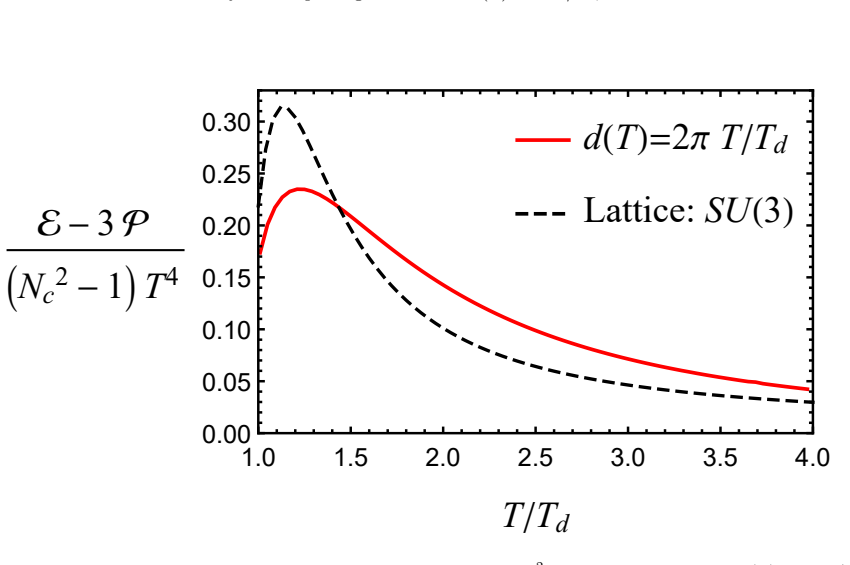
- [Sec. VI.B and Fig. 3] The matrix model does not reproduce the sharp peak in the interaction measure near 1.1T_d, and this limitation should be explicitly connected to the reliability of ζ/s in that temperature region.
Circularity Check
No significant circularity: the viscosities are computed from a Boltzmann equation with matrix-model input, not fitted to transport data.
full rationale
The central claims (eta/s and zeta/s values and their temperature dependence) are outputs of the leading-log Boltzmann calculation in Secs. V and VI, and are never fit to viscosity data. The matrix-model parameters are calibrated to lattice Polyakov loops and pressure, but the transport coefficients are then computed from the resulting quasiparticle spectra and 2-to-2 scattering amplitudes. The bulk viscosity uses Delta v_s^2 taken from the lattice equation of state, Eq. (27), and from the fitted dA/dB ansatze; this is an external thermodynamic input used in the standard kinetic-theory source term, not a redefinition of the target quantity. Appendix B's acknowledged discrepancy between the kinetic-theory teen pressure and the thermodynamic pressure, and the zero-mode regularization of Appendix C, are internal consistency and approximation limitations rather than circular reductions. The parameters w and kappa are presented as uncertainties in the leading-log calculation, with ranges shown in Figs. 12, 13 and 16, rather than as fitted predictions. No equation in the paper reduces a claimed prediction to its input by construction, and no load-bearing premise is justified solely by a self-citation whose content is the target result.
Assumptions & free parameters
free parameters (4)
- c (coefficient of V2 term) =
not specified
- d(T) ansatz coefficients for d_A and d_B =
d_A = 1.08 t + 5.2032; d_B = 0.26/t^3 + 1.105 t + 4.9182
- kappa (beyond-LO log scale) =
chosen as 32, 64, 128
- w (coupling scale) =
0.5, 1.0, 2.0
assumptions (7)
- domain assumption Non-perturbative potential is ~ T^2 with second Bernoulli polynomial B2
- ad hoc to paper Teen fields are 2D adjoint ghosts with transverse momentum cutoff at T_d
- domain assumption Gluons and teens are well-defined quasiparticles down to T_d; coupling is moderate
- domain assumption Large N_c limit with spectral density rho(q) = 1 + b cos(d q)
- domain assumption Kinetic theory with sign functions for ghost absorption is valid for teens
- domain assumption Teen self-energy and gauge-variant terms do not contribute at leading log
- ad hoc to paper Bulk viscosity uses Delta v_s^2 from thermodynamics (lattice fit) rather than from teen kinetic theory
invented entities (1)
-
Teen ghost fields (denoted by Bengali character 3)
Cite this review
Pith. "Pith review of Shear and bulk viscosity for a pure glue theory using an effective matrix model." pith.science (2026). https://pith.science/paper/BRTHCUA4
@misc{pith2026250420138,
  author       = {Pith},
  title        = {Pith review of: Shear and bulk viscosity for a pure glue theory using an effective matrix model},
  year         = {2026},
  howpublished = {\url{https://pith.science/paper/BRTHCUA4}},
  note         = {Machine review of arXiv:2504.20138}
}
abstract
At nonzero temperatures, the deconfining phase transition can be analyzed using an effective matrix model to characterize the change in holonomy. The model includes gluons and two-dimensional ghost fields in the adjoint representation, or ``teens''. As ghosts, the teen fields are responsible for the decrease of the pressure as $T \rightarrow T_d$, with $T_d$ the transition temperature for deconfinement. Using the solution of this matrix model for a large number of colors, the parameters of the teen fields are adjusted so that the expectation value of the Polyakov loop is close to the values from the lattice. The shear, $\eta$, and bulk, $\zeta$, viscosities are computed in weak coupling but nonzero holonomy. In the pure glue theory, the value of the Polyakov loop is relatively large in the deconfined phase, $\approx 1/2$ at $T_d$. Consequently, if $s$ is the entropy density, while $\eta/s$ decreases as $T\rightarrow T_d$, it is still well above the conformal bound. In contrast, $\zeta/s$ is largest at $T_d$, comparable to $\eta/s$, then falls off rapidly with increasing temperature and is negligible by $\sim 2 T_d$.
Figures


Figures from the paper (15 more)




Reference graph
Works this paper leans on
-
[1]
9a, is Mgg→gg =ϵµ1 1 (Pa1b1 1 )ϵ∗µ3 3 (Pa3b3 3 ) Jµ,ab g,µ1µ3(Pa1b1 1 ,P a3b3 3 )Dba,dc µν (Kba) × Jν,cd g,µ2µ4(Pa2b2 2 ,P a4b4 4 )ϵµ2 2 (Pa2b2 2 )ϵ∗µ4 4 (Pa4b4 4 )
Exchange of a soft, virtual gluon The amplitude for two gluons scattering into two gluons, Fig. 9a, is Mgg→gg =ϵµ1 1 (Pa1b1 1 )ϵ∗µ3 3 (Pa3b3 3 ) Jµ,ab g,µ1µ3(Pa1b1 1 ,P a3b3 3 )Dba,dc µν (Kba) × Jν,cd g,µ2µ4(Pa2b2 2 ,P a4b4 4 )ϵµ2 2 (Pa2b2 2 )ϵ∗µ4 4 (Pa4b4 4 ). (70) Here Pµ,ai,bi i are the momenta for particles i = 1,..., 4. The polarization tensor are ϵµ...
-
[2]
One contribution is where a teen plus a gluon scatters into a gluon plus a teen, Fig
Exchange of a soft teen field There are two diagrams involving the exchange of a teen particle. One contribution is where a teen plus a gluon scatters into a gluon plus a teen, Fig. 10a. This is analogous to Compton scattering. The amplitude is M3 g→g3 =ϵµ(Pa1b1 1 )Jµ,ab 3 (Pa1b1 1 ,P a3b3 3 )Dba,dc 3 (Kba)Jν,cd 3 (Pa2b2 2 ,P a4b4 4 )ϵ∗ν(Pa4b4 4 ). (77) L...
-
[3]
Gluon-gluon scattering At nonzero holonomy, the matrix elements for gg → gg are Λgg nm = 2 g4 (2π)5 4Y i=1 X aibi ∞X n1,n2=1 ∞X n3,n4=0 G(Q,n 1,...,n 4)tab 13tba 24tcd 13tdc 24 Z ∞ 0 dpp 2e−βp(n1+n3) × Z ∞ 0 dp′p′2e−βp′(n2+n4) Z 1 −1 dx (F g nm(p,x ) +F g nm(p′,x ))cg ncg m Z π −π dϕ 2π Z ∞ 0 dkk 3 × Dab L (K) + (1−x2) cosϕDab T (K) Dcd L (K) + (1−x2) cos...
-
[4]
Gluon-teen scattering For gluon-teen scattering, Fig. 9b, Λg3 nm =−1 22 g4 (2π)5 4Y i=1 X aibi ∞X n1,n2=1 ∞X n3,n4=0 G(Q,n 1,...,n 4)tab 13tba 24tcd 13tdc 24 Z Td 0 p⊥dp⊥ Z ∞ 0 dp∥ × e−βp(n1+n3) Z ∞ 0 dp′p′2e−βp′(n2+n4) Z 1 −1 dx (F 3 nm(p,x )c3 nc3 m +F g nm(p′,x )cg ncg m) Z π −π dϕ 2π × Z ∞ 0 dkk 3 Dab L (K) + (1−x2) cosϕDab T (K) Dcd L (K) + (1−x2) co...
-
[5]
T 8X gg nm +T 6T 2 dX ′gg nm 0 0 T 4T 4 dX 33 nm +T 6T 2 dX ′33 nm #
Teen-teen scattering We next turn to teen-teen scattering. The matrix elements in this case is Λ33 nm = 2 1 4 g4 (2π)5 4Y i=1 X aibi ∞X n1,n2=1 ∞X n3,n4=0 G(Q,n 1,...,n 4)tab 13tba 24tcd 13tdc 24 Z Td 0 p⊥dp⊥ Z ∞ 0 dp∥e−βp(n1+n3) × Z Td 0 p′ ⊥dp′ ⊥ Z ∞ 0 dp′ ∥e−βp′(n2+n4) Z 1 −1 dx (F 3 nm(p,x ) +F 3 nm(p′,x ))c3 nc3 m Z π −π dϕ 2π Z ∞ 0 dkk 3 × Dab L (K)...
-
[6]
Gluon-gluon scattering For the gluon-gluon scattering, at nonzero holonomy, the matrix element from Eq. (183) becomes ¯Λgg mn = g4N4 c 2(2π)5 log κ g2Nc ∞X m1,m2=1 m1X m3=1 m2X m4=1 ℓm1ℓm2 ℓm1,m2,m3,m4 Z ∞ 0 dpp 2 × Z ∞ 0 dp′p′2e−β(m1p+m2p′)¯cg m¯cg n[(ψg m(p))′− (ψg m(p′))′][(ψg n(p))′− (ψg n(p′))′] = g4N4 c 2(2π)5 log κ g2Nc ¯cg m¯cg nT 6Y gg mn , (185)...
-
[7]
Gluon-teen scattering Analogous to the gluon-gluon scattering, the matrix element for gluon-teen scattering at nonzero holonomy is ¯Λg3 mn = −1 2 g4N4 c 2(2π)5 log κ g2Nc ∞X m1,m2=1 m1X m3=1 m2X m4=1 ℓm1ℓm2 ℓm1,m2,m3,m4 T 2 d 2 Z ∞ 0 dp × Z ∞ 0 dp′p′2e−β(m1p+m2p′)[¯c3 m (ψ3 m(p))′− ¯cg m(ψg m(p′))′][¯c3 n(ψ3 n(p))′− ¯cg n(ψg n(p′))′] = g4N4 c 2(2π)5 log κ...
-
[8]
Teen-Teen scattering The matrix element for teen-teen scattering is ¯Λ33 mn = 1 4 g4N4 c 2(2π)5 log κ g2Nc ∞X m1,m2=1 m1X m3=1 m2X m4=1 ℓm1ℓm2 ℓm1,m2,m3,m4 T 2 d 2 Z ∞ 0 dp ×T 2 d 2 Z ∞ 0 dp′ e−β(m1p+m2p′)¯c3 m¯c3 n[(ψ3 m(p))′− (ψ3 m(p′))′][(ψ3 n(p))′− (ψ3 n(p′))′] = g4N4 c 2(2π)5 log κ g2Nc ¯c3 m¯c3 nT 4 dT 2Y 33 mn , (189) where Y 33 mn = 1 4 1 T 2 ∞X m...
Show all 121 references
-
[9]
Keeping the energy density E constant, analogous to constant magnetic field B
-
[10]
In the first case, at constant E , the pressure is Pth i = T V ∂ logZ ∂ logLi =− 1 24T 2 dT 2
Keeping the longitudinal energy density ELxLy constant, which is analogous to constant magnetic flux Φ. In the first case, at constant E , the pressure is Pth i = T V ∂ logZ ∂ logLi =− 1 24T 2 dT 2. (B7) The second case, with constant longitudinal energy density, corresponds t...
-
[11]
D. J. Gross, R. D. Pisarski, and L. G. Yaffe, QCD and Instantons at Finite Temperature, Rev.Mod.Phys. 53, 43 (1981)
1981
-
[12]
Weiss, The Effective Potential for the Order Parameter of Gauge Theories at Finite Temperature, Phys
N. Weiss, The Effective Potential for the Order Parameter of Gauge Theories at Finite Temperature, Phys. Rev. D 24, 475 (1981)
1981
-
[13]
Enqvist, K
K. Enqvist, K. Kajantie, L. Karkkainen, and K. Rummukainen, Constant field modes in lattice SU(3) gauge theory at large T, Phys. Lett. B 249, 107 (1990)
1990
-
[14]
Bhattacharya, A
T. Bhattacharya, A. Gocksch, C. P. Korthals Altes, and R. D. Pisarski, Interface tension in an SU(N) gauge theory at high temperature, Phys.Rev.Lett. 66, 998 (1991)
1991
-
[15]
Bhattacharya, A
T. Bhattacharya, A. Gocksch, C. Korthals Altes, and R. D. Pisarski, Z(N) interface tension in a hot SU(N) gauge theory, Nucl. Phys. B 383, 497 (1992), arXiv:hep-ph/9205231
1992 arXiv
-
[16]
Gocksch and R
A. Gocksch and R. D. Pisarski, Partition function for the eigenvalues of the Wilson line, Nucl. Phys. B 402, 657 (1993), arXiv:hep-ph/9302233. 41
1993 arXiv
-
[17]
C. P. Korthals Altes, R. D. Pisarski, and A. Sinkovics, The Potential for the phase of the Wilson line at nonzero quark density, Phys. Rev. D 61, 056007 (2000), arXiv:hep-ph/9904305
2000 arXiv
-
[18]
R. D. Pisarski, Quark gluon plasma as a condensate of SU(3) Wilson lines, Phys.Rev. D62, 111501 (2000), arXiv:hep- ph/0006205 [hep-ph]
2000
-
[19]
Dumitru and R
A. Dumitru and R. D. Pisarski, Two point functions for SU(3) Polyakov loops near T(c), Phys. Rev. D 66, 096003 (2002), arXiv:hep-ph/0204223
2002 arXiv
-
[20]
Dumitru, Y
A. Dumitru, Y. Hatta, J. Lenaghan, K. Orginos, and R. D. Pisarski, Deconfining phase transition as a matrix model of renormalized Polyakov loops, Phys. Rev. D 70, 034511 (2004), arXiv:hep-th/0311223
2004 arXiv
-
[21]
Dumitru, J
A. Dumitru, J. Lenaghan, and R. D. Pisarski, Deconfinement in matrix models about the Gross-Witten point, Phys. Rev. D 71, 074004 (2005), arXiv:hep-ph/0410294
2005 arXiv
-
[22]
Dumitru, R
A. Dumitru, R. D. Pisarski, and D. Zschiesche, Dense quarks, and the fermion sign problem, in a SU(N) matrix model, Phys. Rev. D 72, 065008 (2005), arXiv:hep-ph/0505256
2005 arXiv
-
[23]
Oswald and R
M. Oswald and R. D. Pisarski, Beta-functions for a SU(2) matrix model in 2 + epsilon dimensions, Phys. Rev. D 74, 045029 (2006), arXiv:hep-ph/0512245
2006 arXiv
-
[24]
R. D. Pisarski, Effective Theory of Wilson Lines and Deconfinement, Phys.Rev. D74, 121703 (2006), arXiv:hep-ph/0608242 [hep-ph]
2006 arXiv
-
[25]
R. D. Pisarski, Scattering Amplitudes in Hot Gauge Theories, Phys. Rev. Lett. 63, 1129 (1989)
1989
-
[26]
Braaten and R
E. Braaten and R. D. Pisarski, Soft Amplitudes in Hot Gauge Theories: A General Analysis, Nucl. Phys. B 337, 569 (1990)
1990
-
[27]
Braaten and R
E. Braaten and R. D. Pisarski, Resummation and Gauge Invariance of the Gluon Damping Rate in Hot QCD, Phys. Rev. Lett. 64, 1338 (1990)
1990
-
[28]
Braaten and R
E. Braaten and R. D. Pisarski, Calculation of the gluon damping rate in hot QCD, Phys. Rev. D 42, 2156 (1990)
1990
-
[29]
Braaten and R
E. Braaten and R. D. Pisarski, Simple effective Lagrangian for hard thermal loops, Phys. Rev. D 45, R1827 (1992)
1992
-
[30]
P. F. Kelly, Q. Liu, C. Lucchesi, and C. Manuel, Deriving the hard thermal loops of QCD from classical transport theory, Phys. Rev. Lett. 72, 3461 (1994), arXiv:hep-ph/9403403
1994 arXiv
-
[31]
P. F. Kelly, Q. Liu, C. Lucchesi, and C. Manuel, Classical transport theory and hard thermal loops in the quark - gluon plasma, Phys. Rev. D 50, 4209 (1994), arXiv:hep-ph/9406285
1994 arXiv
-
[32]
Blaizot and E
J.-P. Blaizot and E. Iancu, The Quark gluon plasma: Collective dynamics and hard thermal loops, Phys. Rept. 359, 355 (2002), arXiv:hep-ph/0101103
2002 arXiv
-
[33]
M. L. Bellac, Thermal Field Theory , Cambridge Monographs on Mathematical Physics (Cambridge University Press, 2011)
2011
-
[34]
Haque, A
N. Haque, A. Bandyopadhyay, J. O. Andersen, M. G. Mustafa, M. Strickland, and N. Su, Three-loop HTLpt thermodynamics at finite temperature and chemical potential, JHEP 05, 027, arXiv:1402.6907 [hep-ph]
-
[35]
Haque and M
N. Haque and M. G. Mustafa, Hard Thermal Loop—Theory and applications, Prog. Part. Nucl. Phys. 140, 104136 (2025), arXiv:2404.08734 [hep-ph]
2025 arXiv
-
[36]
Hidaka and R
Y. Hidaka and R. D. Pisarski, Suppression of the Shear Viscosity in a ”semi” Quark Gluon Plasma, Phys. Rev. D 78, 071501 (2008), arXiv:0803.0453 [hep-ph]
2008 arXiv
-
[37]
Hidaka and R
Y. Hidaka and R. D. Pisarski, Small shear viscosity in the semi quark gluon plasma, Phys. Rev. D 81, 076002 (2010), arXiv:0912.0940 [hep-ph]
2010 arXiv
-
[38]
Hidaka and R
Y. Hidaka and R. D. Pisarski, Hard thermal loops, to quadratic order, in the background of a spatial ’t Hooft loop, Phys. Rev. D 80, 036004 (2009), [Erratum: Phys.Rev.D 102, 059902 (2020)], arXiv:0906.1751 [hep-ph]
2009 arXiv
-
[39]
Hidaka and R
Y. Hidaka and R. D. Pisarski, Zero Point Energy of Renormalized Wilson Loops, Phys. Rev. D 80, 074504 (2009), arXiv:0907.4609 [hep-ph]
2009 arXiv
-
[40]
Dumitru, Y
A. Dumitru, Y. Guo, Y. Hidaka, C. P. K. Altes, and R. D. Pisarski, How Wide is the Transition to Deconfinement?, Phys. Rev. D 83, 034022 (2011), arXiv:1011.3820 [hep-ph]
2011 arXiv
-
[41]
Dumitru, Y
A. Dumitru, Y. Guo, Y. Hidaka, C. P. K. Altes, and R. D. Pisarski, Effective Matrix Model for Deconfinement in Pure Gauge Theories, Phys. Rev. D 86, 105017 (2012), arXiv:1205.0137 [hep-ph]
2012 arXiv
-
[42]
Kashiwa, R
K. Kashiwa, R. D. Pisarski, and V. V. Skokov, Critical endpoint for deconfinement in matrix and other effective models, Phys.Rev. D85, 114029o (2012), arXiv:1205.0545 [hep-ph]
2012 arXiv
-
[43]
R. D. Pisarski and V. V. Skokov, Gross-Witten-Wadia transition in a matrix model of deconfinement, Phys. Rev. D 86, 081701 (2012), arXiv:1206.1329 [hep-th]
2012 arXiv
-
[44]
Bicudo, R
P. Bicudo, R. D. Pisarski, and E. Seel, Matrix model for deconfinement in a SU(2) gauge theory in 2+1 dimensions, Phys. Rev. D 88, 034007 (2013), arXiv:1306.2943 [hep-ph]
2013 arXiv
-
[45]
Kashiwa and R
K. Kashiwa and R. D. Pisarski, Roberge-Weiss transition and ’t Hooft loops, Phys. Rev. D 87, 096009 (2013), arXiv:1301.5344 [hep-ph]
2013 arXiv
-
[46]
S. Lin, R. D. Pisarski, and V. V. Skokov, Collisional energy loss above the critical temperature in QCD, Phys. Lett. B 730, 236 (2014), arXiv:1312.3340 [hep-ph]
2014 arXiv
-
[47]
S. Lin, R. D. Pisarski, and V. V. Skokov, Zero interface tension at the deconfining phase transition for a matrix model of a SU (∞) gauge theory, Phys. Rev. D 87, 105002 (2013), arXiv:1301.7432 [hep-ph]
2013 arXiv
-
[48]
Smith, A
D. Smith, A. Dumitru, R. Pisarski, and L. von Smekal, Effective potential for SU(2) Polyakov loops and Wilson loop eigenvalues, Phys. Rev. D 88, 054020 (2013), arXiv:1307.6339 [hep-lat]
2013 arXiv
-
[49]
Bicudo, R
P. Bicudo, R. D. Pisarski, and E. Seel, Matrix model for deconfinement in a SU(Nc) gauge theory in 2+1 dimensions, Phys. Rev. D 89, 085020 (2014), arXiv:1402.5137 [hep-ph]
2014 arXiv
-
[50]
C. Gale, Y. Hidaka, S. Jeon, S. Lin, J.-F. Paquet, R. D. Pisarski, D. Satow, V. V. Skokov, and G. Vujanovic, Production 42 and Elliptic Flow of Dileptons and Photons in a Matrix Model of the Quark-Gluon Plasma, Phys. Rev. Lett. 114, 072301 (2015), arXiv:1409.4778 [hep-ph]
2015 arXiv
-
[51]
Hidaka, S
Y. Hidaka, S. Lin, R. D. Pisarski, and D. Satow, Dilepton and photon production in the presence of a nontrivial Polyakov loop, JHEP 10, 005, arXiv:1504.01770 [hep-ph]
-
[52]
R. D. Pisarski and V. V. Skokov, Chiral matrix model of the semi-QGP in QCD, Phys. Rev. D 94, 034015 (2016), arXiv:1604.00022 [hep-ph]
2016 arXiv
-
[53]
C. P. Korthals Altes, H. Nishimura, R. D. Pisarski, and V. V. Skokov, Free energy of a Holonomous Plasma, Phys. Rev. D 101, 094025 (2020), arXiv:2002.00968 [hep-ph]
2020 arXiv
-
[54]
Hidaka and R
Y. Hidaka and R. D. Pisarski, Effective models of a semi-quark-gluon plasma, Phys. Rev. D 104, 074036 (2021), arXiv:2009.03903 [hep-ph]
2021 arXiv
-
[55]
P. B. Arnold, G. D. Moore, and L. G. Yaffe, Transport coefficients in high temperature gauge theories. 1. Leading log results, JHEP 11, 001, arXiv:hep-ph/0010177
-
[56]
P. B. Arnold, G. D. Moore, and L. G. Yaffe, Transport coefficients in high temperature gauge theories. 2. Beyond leading log, JHEP 05, 051, arXiv:hep-ph/0302165
-
[57]
P. B. Arnold, C. Dogan, and G. D. Moore, The Bulk Viscosity of High-Temperature QCD, Phys. Rev. D 74, 085021 (2006), arXiv:hep-ph/0608012
2006 arXiv
-
[58]
Braaten and A
E. Braaten and A. Nieto, Free energy of QCD at high temperature, Phys. Rev. D 53, 3421 (1996), arXiv:hep-ph/9510408
1996 arXiv
-
[59]
Laine and Y
M. Laine and Y. Schroder, Two-loop QCD gauge coupling at high temperatures, JHEP 03, 067, arXiv:hep-ph/0503061
-
[60]
Ghosh, pdfLaTeX Bengali (2022)
A. Ghosh, pdfLaTeX Bengali (2022)
2022
-
[61]
Nishimura, R
H. Nishimura, R. D. Pisarski, and V. V. Skokov, Finite-temperature phase transitions of third and higher order in gauge theories at large N, Phys. Rev. D97, 036014 (2018), arXiv:1712.04465 [hep-th]
2018 arXiv
-
[62]
C. P. Korthals Altes, H. Nishimura, R. D. Pisarski, and V. V. Skokov, Conundrum for the free energy of a holonomous gluonic plasma at cubic order, Phys. Lett. B 803, 135336 (2020), arXiv:1911.10209 [hep-th]
2020 arXiv
-
[63]
Gaiotto, A
D. Gaiotto, A. Kapustin, N. Seiberg, and B. Willett, Generalized Global Symmetries, JHEP 02, 172, arXiv:1412.5148 [hep-th]
-
[64]
Gupta, K
S. Gupta, K. Huebner, and O. Kaczmarek, Renormalized Polyakov loops in many representations, Phys. Rev. D 77, 034503 (2008), arXiv:0711.2251 [hep-lat]
2008 arXiv
-
[65]
Fukushima, Chiral effective model with the Polyakov loop, Phys
K. Fukushima, Chiral effective model with the Polyakov loop, Phys. Lett. B 591, 277 (2004), arXiv:hep-ph/0310121
2004 arXiv
-
[66]
Korthals-Altes, A
C. Korthals-Altes, A. Kovner, and M. A. Stephanov, Spatial ’t Hooft loop, hot QCD and Z(N) domain walls, Phys. Lett. B 469, 205 (1999), arXiv:hep-ph/9909516
1999 arXiv
-
[67]
Mykkanen, M
A. Mykkanen, M. Panero, and K. Rummukainen, Casimir scaling and renormalization of Polyakov loops in large-N gauge theories, JHEP 05, 069, arXiv:1202.2762 [hep-lat]
-
[68]
Caselle, A
M. Caselle, A. Nada, and M. Panero, QCD thermodynamics from lattice calculations with nonequilibrium methods: The SU(3) equation of state, Phys. Rev. D 98, 054513 (2018), arXiv:1801.03110 [hep-lat]
2018 arXiv
-
[69]
Datta and S
S. Datta and S. Gupta, Continuum Thermodynamics of the GluoNc Plasma, Phys.Rev. D82, 114505 (2010), arXiv:1006.0938 [hep-lat]
2010 arXiv
-
[70]
Giusti, M
L. Giusti, M. Hirasawa, M. Pepe, and L. Virz` ı, A precise study of the SU(3) Yang-Mills theory across the deconfinement transition, (2025), arXiv:2501.10284 [hep-lat]
2025
-
[71]
Jackson and A
G. Jackson and A. Peshier, Re-running the QCD shear viscosity, J. Phys. G 45, 095001 (2018), arXiv:1711.02119 [hep-ph]
2018 arXiv
-
[72]
Ghiglieri, G
J. Ghiglieri, G. D. Moore, and D. Teaney, QCD Shear Viscosity at (almost) NLO, JHEP 03, 179, arXiv:1802.09535 [hep-ph]
-
[73]
G. D. Moore, Shear viscosity in QCD and why it’s hard to calculate, in Criticality in QCD and the Hadron Resonance Gas (2020) arXiv:2010.15704 [hep-ph]
2020 arXiv
-
[74]
Danhoni and G
I. Danhoni and G. D. Moore, Hot and dense QCD shear viscosity at leading log, JHEP 02, 124, arXiv:2212.02325 [hep-ph]
-
[75]
Danhoni and G
I. Danhoni and G. D. Moore, Hot and dense QCD shear viscosity at (almost) NLO, JHEP 09, 075, arXiv:2408.00524 [hep-ph]
-
[76]
N. M. MacKay, Shear Viscosity of Collider-Produced QCD Matter I: AMY Formalism vs. A Modified Relaxation Time Approximation in 0-flavor SU(3) Theory, (2024), arXiv:2407.16856 [nucl-th]
2024 arXiv
-
[77]
P. B. Arnold and C.-X. Zhai, The Three loop free energy for pure gauge QCD, Phys. Rev. D50, 7603 (1994), arXiv:hep- ph/9408276 [hep-ph]
1994
-
[78]
P. B. Arnold and L. G. Yaffe, The NonAbelian Debye screening length beyond leading order, Phys. Rev. D 52, 7208 (1995), arXiv:hep-ph/9508280
1995 arXiv
-
[79]
G. Baym, H. Monien, C. J. Pethick, and D. G. Ravenhall, Transverse Interactions and Transport in Relativistic Quark - Gluon and Electromagnetic Plasmas, Phys. Rev. Lett. 64, 1867 (1990)
1990
-
[80]
Fukushima and N
K. Fukushima and N. Su, Stabilizing perturbative Yang-Mills thermodynamics with Gribov quantization, Phys. Rev. D 88, 076008 (2013), arXiv:1304.8004 [hep-ph]
2013 arXiv
-
[81]
Madni, A
S. Madni, A. Mukherjee, A. Bandyopadhyay, and N. Haque, Estimation of the diffusion coefficient of heavy quarks in light of Gribov-Zwanziger action, Phys. Lett. B 838, 137714 (2023), arXiv:2210.03076 [hep-ph]
2023 arXiv
-
[82]
Z. Xu, C. Greiner, and H. Stocker, PQCD calculations of elliptic flow and shear viscosity at RHIC, Phys. Rev. Lett. 101, 082302 (2008), arXiv:0711.0961 [nucl-th]
2008 arXiv
-
[83]
M. E. Carrington and E. Kovalchuk, Leading order QCD shear viscosity from the three-particle irreducible effective action, Phys. Rev. D 80, 085013 (2009), arXiv:0906.1140 [hep-ph]
2009 arXiv
-
[84]
J.-W. Chen, H. Dong, K. Ohnishi, and Q. Wang, Shear Viscosity of a Gluon Plasma in Perturbative QCD, Phys. Lett. B 685, 277 (2010), arXiv:0907.2486 [nucl-th]. 43
2010 arXiv
-
[85]
J.-W. Chen, J. Deng, H. Dong, and Q. Wang, Shear and bulk viscosities of a gluon plasma in perturbative QCD: Comparison of different treatments for the gg↔ggg process, Phys. Rev. C 87, 024910 (2013), arXiv:1107.0522 [hep-ph]
2013 arXiv
-
[86]
Kovtun, D
P. Kovtun, D. T. Son, and A. O. Starinets, Holography and hydrodynamics: Diffusion on stretched horizons, JHEP 10, 064, arXiv:hep-th/0309213
-
[87]
Jaiswal and N
A. Jaiswal and N. Haque, Covariant kinetic theory and transport coefficients for Gribov plasma, Phys. Lett. B 811, 135936 (2020), arXiv:2005.01303 [hep-ph]
2020 arXiv
-
[88]
Luzum and P
M. Luzum and P. Romatschke, Conformal Relativistic Viscous Hydrodynamics: Applications to RHIC results at s(NN)**(1/2) = 200-GeV, Phys. Rev. C 78, 034915 (2008), [Erratum: Phys.Rev.C 79, 039903 (2009)], arXiv:0804.4015 [nucl-th]
2008 arXiv
-
[89]
Casalderrey-Solana, H
J. Casalderrey-Solana, H. Liu, D. Mateos, K. Rajagopal, and U. A. Wiedemann, Gauge/String Duality, Hot QCD and Heavy Ion Collisions (Cambridge University Press, 2014) arXiv:1101.0618 [hep-th]
2014 arXiv
-
[90]
C. Gale, S. Jeon, and B. Schenke, Hydrodynamic Modeling of Heavy-Ion Collisions, Int. J. Mod. Phys. A 28, 1340011 (2013), arXiv:1301.5893 [nucl-th]
2013 arXiv
-
[91]
Romatschke and U
P. Romatschke and U. Romatschke, Relativistic Fluid Dynamics In and Out of Equilibrium , Cambridge Monographs on Mathematical Physics (Cambridge University Press, 2019) arXiv:1712.05815 [nucl-th]
2019 arXiv
-
[92]
J. L. Nagle and W. A. Zajc, Small System Collectivity in Relativistic Hadronic and Nuclear Collisions, Ann. Rev. Nucl. Part. Sci. 68, 211 (2018), arXiv:1801.03477 [nucl-ex]
2018 arXiv
-
[93]
Policastro, D
G. Policastro, D. T. Son, and A. O. Starinets, The Shear viscosity of strongly coupled N=4 supersymmetric Yang-Mills plasma, Phys. Rev. Lett. 87, 081601 (2001), arXiv:hep-th/0104066
2001 arXiv
-
[94]
Kovtun, D
P. Kovtun, D. T. Son, and A. O. Starinets, Viscosity in strongly interacting quantum field theories from black hole physics, Phys. Rev. Lett. 94, 111601 (2005), arXiv:hep-th/0405231
2005 arXiv
-
[95]
D. T. Son and A. O. Starinets, Viscosity, Black Holes, and Quantum Field Theory, Ann. Rev. Nucl. Part. Sci. 57, 95 (2007), arXiv:0704.0240 [hep-th]
2007 arXiv
-
[96]
Altenkort, A
L. Altenkort, A. M. Eller, A. Francis, O. Kaczmarek, L. Mazur, G. D. Moore, and H.-T. Shu, Viscosity of pure-glue QCD from the lattice, Phys. Rev. D 108, 014503 (2023), arXiv:2211.08230 [hep-lat]
2023 arXiv
-
[97]
G. D. Moore and O. Saremi, Bulk viscosity and spectral functions in QCD, JHEP 09, 015, arXiv:0805.4201 [hep-ph]
-
[98]
H. B. Meyer, Energy-momentum tensor correlators and spectral functions, JHEP 08, 031, arXiv:0806.3914 [hep-lat]
-
[99]
Hong and D
J. Hong and D. Teaney, Spectral densities for hot QCD plasmas in a leading log approximation, Phys. Rev. C 82, 044908 (2010), arXiv:1003.0699 [nucl-th]
2010 arXiv
-
[100]
Akamatsu, A
Y. Akamatsu, A. Mazeliauskas, and D. Teaney, Bulk viscosity from hydrodynamic fluctuations with relativistic hydrokinetic theory, Phys. Rev. C 97, 024902 (2018), arXiv:1708.05657 [nucl-th]
2018 arXiv
-
[101]
Bluhm, B
M. Bluhm, B. Kampfer, and K. Redlich, Viscosities in the Gluon-Plasma within a Quasiparticle Model, Nucl. Phys. A 830, 737C (2009), arXiv:0907.3841 [hep-ph]
2009 arXiv
-
[102]
Bluhm, B
M. Bluhm, B. Kampfer, and K. Redlich, Bulk and shear viscosities of the gluon plasma in a quasiparticle description, Phys. Rev. C 84, 025201 (2011), arXiv:1011.5634 [hep-ph]
2011 arXiv
-
[103]
Buchel, Bulk viscosity of gauge theory plasma at strong coupling, Phys
A. Buchel, Bulk viscosity of gauge theory plasma at strong coupling, Phys. Lett. B 663, 286 (2008), arXiv:0708.3459 [hep-th]
2008 arXiv
-
[104]
Yarom, Notes on the bulk viscosity of holographic gauge theory plasmas, JHEP 04, 024, arXiv:0912.2100 [hep-th]
A. Yarom, Notes on the bulk viscosity of holographic gauge theory plasmas, JHEP 04, 024, arXiv:0912.2100 [hep-th]
-
[105]
Buchel, Violation of the holographic bulk viscosity bound, Phys
A. Buchel, Violation of the holographic bulk viscosity bound, Phys. Rev. D 85, 066004 (2012), arXiv:1110.0063 [hep-th]
2012 arXiv
-
[106]
Buchel, U
A. Buchel, U. Gursoy, and E. Kiritsis, Holographic bulk viscosity: GPR versus EO, JHEP 09, 095, arXiv:1104.2058 [hep-th]
-
[107]
Rebhan and D
A. Rebhan and D. Steineder, Violation of the Holographic Viscosity Bound in a Strongly Coupled Anisotropic Plasma, Phys. Rev. Lett. 108, 021601 (2012), arXiv:1110.6825 [hep-th]
2012 arXiv
-
[108]
Dusling and T
K. Dusling and T. Sch¨ afer, Bulk viscosity, particle spectra and flow in heavy-ion collisions, Phys. Rev. C85, 044909 (2012), arXiv:1109.5181 [hep-ph]
2012 arXiv
-
[109]
Florkowski, R
W. Florkowski, R. Ryblewski, N. Su, and K. Tywoniuk, Bulk viscosity in a plasma of Gribov-Zwanziger gluons, Acta Phys. Polon. B 47, 1833 (2016), arXiv:1504.03176 [hep-ph]
2016 arXiv
-
[110]
Madni, A
S. Madni, A. Mukherjee, A. Jaiswal, and N. Haque, Shear and bulk viscosity of the quark-gluon plasma with Gribov gluons and quasiparticle quarks, Phys. Rev. D 110, 116035 (2024), arXiv:2401.08384 [hep-ph]
2024 arXiv
-
[111]
DeWolfe, TASI Lectures on Applications of Gauge/Gravity Duality, PoS TASI2017, 014 (2018), arXiv:1802.08267 [hep-th]
O. DeWolfe, TASI Lectures on Applications of Gauge/Gravity Duality, PoS TASI2017, 014 (2018), arXiv:1802.08267 [hep-th]
2018 arXiv
-
[112]
K. A. Mamo, Holographic RG flow of the shear viscosity to entropy density ratio in strongly coupled anisotropic plasma, JHEP 10, 070, arXiv:1205.1797 [hep-th]
-
[113]
Cremonini, U
S. Cremonini, U. Gursoy, and P. Szepietowski, On the Temperature Dependence of the Shear Viscosity and Holography, JHEP 08, 167, arXiv:1206.3581 [hep-th]
-
[114]
D. Li, S. He, and M. Huang, Temperature dependent transport coefficients in a dynamical holographic QCD model, JHEP 06, 046, arXiv:1411.5332 [hep-ph]
-
[115]
S. I. Finazzo, R. Rougemont, H. Marrochio, and J. Noronha, Hydrodynamic transport coefficients for the non-conformal quark-gluon plasma from holography, JHEP 02, 051, arXiv:1412.2968 [hep-ph]
-
[116]
Yaresko and B
R. Yaresko and B. Kampfer, Bulk viscosity of the gluon plasma in a holographic approach, Acta Phys. Polon. Supp. 7, 137 (2014), arXiv:1403.3581 [hep-ph]
2014 arXiv
-
[117]
Attems, J
M. Attems, J. Casalderrey-Solana, D. Mateos, I. Papadimitriou, D. Santos-Oliv´ an, C. F. Sopuerta, M. Triana, and M. Zilh˜ ao, Thermodynamics, transport and relaxation in non-conformal theories, JHEP10, 155, arXiv:1603.01254 [hep-th]
-
[118]
K. A. Mamo, Strongly coupledN = 4 supersymmetric Yang-Mills plasma on the Coulomb branch. II. Transport coefficients 44 and hard probe parameters, Phys. Rev. D 100, 066011 (2019), arXiv:1610.09793 [hep-th]
2019 arXiv
-
[119]
Ballon-Bayona, L
A. Ballon-Bayona, L. A. H. Mamani, A. S. Miranda, and V. T. Zanchin, Effective holographic models for QCD: Thermodynamics and viscosity coefficients, Phys. Rev. D 104, 046013 (2021), arXiv:2103.14188 [hep-th]
2021 arXiv
-
[120]
Petreczky and H
P. Petreczky and H. P. Schadler, Renormalization of the Polyakov loop with gradient flow, Phys. Rev. D 92, 094517 (2015), arXiv:1509.07874 [hep-lat]
2015 arXiv
-
[121]
Bazavov, N
A. Bazavov, N. Brambilla, H. T. Ding, P. Petreczky, H. P. Schadler, A. Vairo, and J. H. Weber, Polyakov loop in 2+1 flavor QCD from low to high temperatures, Phys. Rev. D 93, 114502 (2016), arXiv:1603.06637 [hep-lat]
2016 arXiv
Reviewed August 16, 2026 · model on record in the stance chip above.
Discussion (0). Continue with ORCID to comment.