REVIEW 3 major objections 4 minor 65 references
Quantized resonant tunneling effect in Josephson junctions with ferromagnetic bilayers
T0 review · 3 major / 4 minor · reviewed 2026-08-16 · deepseek-v4-flash
Pith's one-line read A potential barrier at the F1/F2 interface makes the Josephson critical current of an SF1F2S junction peak at the quantization conditions Q1d1=(n1+1/2)π and Q2d2=(n2+1/2)π, through resonant tunneling of zero-spin-projection spin-triplet…
desk verdict Solid numerical finding on quantized Ic resonances in SF1F2S junctions under a barrier; the triplet-filtering mechanism is asserted rather than computed and sits in tension with the paper's own pair-evolution formulas. read the letter →
The pith
A machine-rendered reading of the paper's core claim, the machinery that carries it, and where it could break.
The reading
What carries the argument
The load-bearing object is the pair-decomposition identity that tracks how a Cooper pair evolves through the two ferromagnets, $(\uparrow\downarrow)e^{iQ_1d_1}-(\downarrow\uparrow)e^{-iQ_1d_1}\to(\uparrow\downarrow-\downarrow\uparrow)\cos(Q_1d_1\pm Q_2d_2)+i(\uparrow\downarrow+\downarrow\uparrow)\sin(Q_1d_1\pm Q_2d_2)$, with signs and prefactors set by the relative magnetization angle. The paper reads this identity as a filter: the barrier is claimed to block the spin-singlet term $(\uparrow\downarrow-\downarrow\uparrow)$ while transmitting the zero-spin-projection triplet term $(\uparrow\downarrow+\downarrow\uparrow)$, whose magnitude is controlled by $\sin(Q_1d_1)$ in F$_1$ and $\sin(Q_2d_2)$ in F$_2$. That product is maximized exactly when $Q_id_i=(n_i+1/2)\pi$, and the sum or difference of the two layer phases, $\varphi_t=Q_1d_1\pm Q_2d_2$, is what selects the 0- or $\pi$-state. The numerical engine is a solution of the Bogoliubov–de Gennes equations with continuity and barrier boundary conditions, giving two Andreev bound-state energies from $\det\Lambda=0$, from which the Josephson current is computed through the thermodynamic potential.
What would settle it
Use the same numerics to extract spin-resolved singlet and triplet pair amplitudes inside the ferromagnets at $Z=3$: the paper's mechanism requires the $(\uparrow\downarrow+\downarrow\uparrow)$ amplitude to peak at $Q_1d_1=(n_1+1/2)\pi$ and $Q_2d_2=(n_2+1/2)\pi$ while the singlet amplitude is suppressed there. If the critical-current peaks survive but the pair decomposition does not show that pattern, the resonant-triplet attribution fails.
Extended reading notes
Core claim
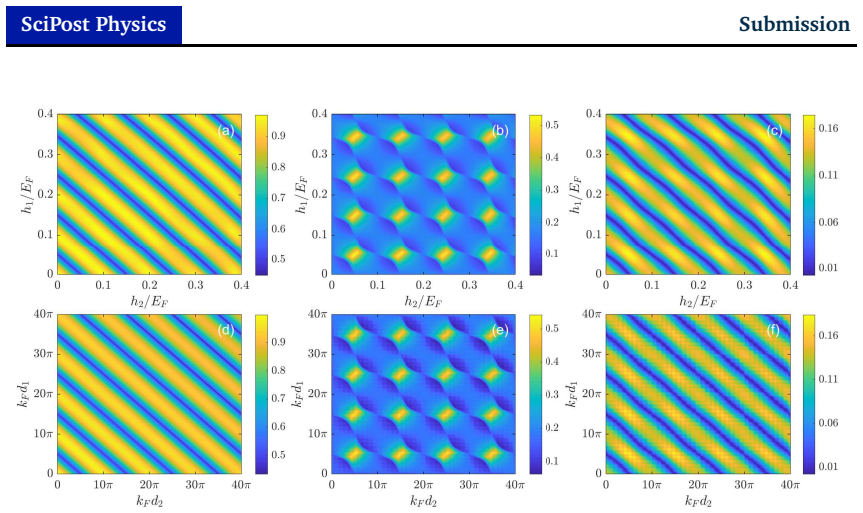
The central discovery is that adding a spin-independent $\delta$-function barrier at the F$_1$/F$_2$ interface qualitatively changes the Josephson transport of an SF$_1$F$_2$S junction. Without the barrier, the critical current oscillates smoothly with exchange fields and layer thicknesses because spin-singlet pairs $(\uparrow\downarrow-\downarrow\uparrow)$ pass through the ferromagnets and accumulate a phase $Q_1d_1\pm Q_2d_2$, producing the familiar 0-$\pi$ oscillations. With a sufficiently strong barrier ($Z=3$) at low temperature, the singlet channel is suppressed and the current is carried by zero-spin-projection triplet pairs $(\uparrow\downarrow+\downarrow\uparrow)$, whose amplitude in each layer is $\sin(Q_i d_i)$. The current then shows resonance peaks exactly at $Q_1d_1=(n_1+1/2)\pi$ and $Q_2d_2=(n_2+1/2)\pi$, with the total triplet phase $\varphi_t=Q_1d_1+Q_2d_2$ in parallel magnetizations and $Q_1d_1-Q_2d_2$ in antiparallel magnetizations fixing the ground state. In perpendicular configurations the same quantization conditions hold but the surviving current is dominated by the second harmonic $I_2\sin(2\varphi)$; when both layers are identical the barrier suppresses the 0-state current in parallel alignment while preserving it in antiparallel alignment.
Load-bearing premise
The load-bearing premise is that the barrier acts as a clean spin-singlet filter, transmitting zero-spin-projection triplet pairs with amplitude $\sin(Q_id_i)$; this filtering mechanism is imported from standard pair-decomposition formulas rather than being derived from the numerical wave functions.
Editorial extensions
If this is right
- At sufficiently strong barrier and low temperature in perpendicular magnetization configurations, the first harmonic is filtered out and the current-phase relation becomes dominated by $I_2\sin(2\varphi)$, giving a response with period $\pi$.
- When the two ferromagnetic layers are identical, parallel alignment yields resonance peaks with $\varphi_t=(2n_1+1)\pi$, locking the junction into the $\pi$-state, while antiparallel alignment gives $\varphi_t=0$ and keeps the 0-state.
- The quantization condition $Q_id_i=(n_i+1/2)\pi$ locates the current maxima in parallel, perpendicular, and antiparallel configurations alike, so the resonance condition is robust to the relative magnetization direction.
- Raising the temperature suppresses the resonant tunneling peaks and restores the smooth 0-$\pi$ oscillation pattern, so the effect is confined to low temperatures.
Reading between the lines
- Beyond the paper: if the barrier is a genuine spin-singlet filter, the observed peak positions give an in situ measurement of the Cooper-pair center-of-mass momentum $Q_i=2h_i/(\hbar v_F)$ in each ferromagnetic layer, so a thickness scan of the critical current could map the exchange splitting directly.
- Beyond the paper: the predicted magnetization-controlled 0- and $\pi$-state selection in identical layers suggests a Josephson phase switch operated by rotating one magnetization by $180^\circ$, which could be tested in nanopillar spin-valve junctions with switchable magnetic layers.
- Beyond the paper: replacing the idealized $\delta$-barrier with a finite-width or spin-dependent interface, or moving to a quasi-one-dimensional wire, would test whether the resonance positions and the 0/$\pi$ rule survive beyond the paper's minimal model.
Signed reviews
Editorial analysis
A structured set of objections, weighed in public.
Referee Report
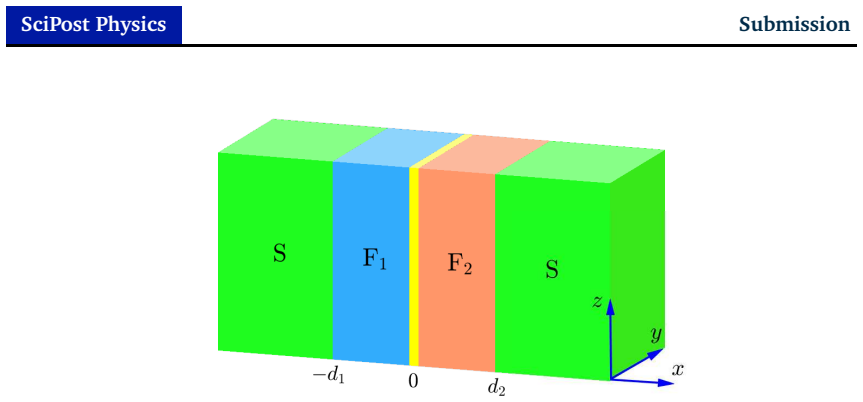
Summary. This manuscript studies a one-dimensional SF1F2S Josephson junction with a delta-function potential barrier at the F1/F2 interface. The authors numerically solve the Bogoliubov–de Gennes equations in the short-junction limit, obtain the Andreev bound-state energies from the characteristic equation det(Lambda)=0, and compute the current-phase relation and critical current from the thermodynamic potential. The central numerical observation is that, for a sufficiently strong barrier (Z=3) and low temperature, the critical current exhibits periodic peaks whenever Q1d1=(n1+1/2)pi and Q2d2=(n2+1/2)pi, in parallel, perpendicular, and antiparallel magnetization configurations. The paper interprets these peaks as quantized resonant tunneling of spin-triplet pairs (up-down + down-up), with a total phase phi_t=Q1d1 +/- Q2d2 determining whether the junction is in a 0- or pi-state, and proposes that for equal ferromagnetic layers the barrier can act as a magnetization-controlled 0/pi switch.
Significance. The numerical procedure is standard, and the reported peak positions are not fitted to the analytical sin/cos decomposition; they follow directly from the BdG characteristic equation. If the mechanism claim were established, the simple quantization condition and the magnetization-controlled 0/pi switching would be interesting for superconducting spintronics. However, the paper's physical interpretation is not derived from the BdG solution and, as detailed below, is contradicted at face value by the paper's own pair-evolution formulas. The numerical observation of resonances may survive, but the abstract's and conclusions' attribution to spin-triplet tunneling requires substantial additional support.
major comments (3)
- [Sec. 3.1, Eqs. (16) and (18)] The central mechanistic claim, that the barrier transmits the m=0 triplet pair (up-down + down-up) and that the peaks occur where its amplitude sin(Q_i d_i) is maximal, is contradicted by the pair-evolution formulas used in the paper. Inserting Q1d1=(n1+1/2)pi and Q2d2=(n2+1/2)pi into Eq. (16) gives a triplet amplitude sin(Q1d1+Q2d2)=0 and a singlet amplitude cos(Q1d1+Q2d2)=+/-1, i.e., the opposite of the claimed mechanism. For the antiparallel case, Eq. (18) gives sin(Q1d1-Q2d2)=0 at the same resonance conditions. Since the paper never computes singlet/triplet pair amplitudes from the BdG solution in the presence of the barrier, the load-bearing attribution of the resonance peaks to (up-down + down-up) tunneling is unsupported and, at the level of the paper's own formulas, incorrect. The authors should either compute the anomalous Green's function components or revise the interpretation accordingly.
- [Sec. 3.2, Eq. (17)] For perpendicular magnetizations, Eq. (17) shows that at the resonance values Q1d1=(n1+1/2)pi and Q2d2=(n2+1/2)pi the singlet amplitude cos(Q1d1)cos(Q2d2) and the opposite-spin triplet amplitude cos(Q1d1)sin(Q2d2) both vanish; the only surviving single-pass pair amplitude in the F2 basis is the equal-spin triplet i sin(Q1d1). The text nonetheless claims that the barrier filters out singlet pairs and that the remaining pairs are (up-down + down-up) in F1 transforming into (up-up - down-down) in F2. This is inconsistent with Eq. (17) and with the abstract's statement that pairs with zero spin projection are selected. The origin of the second-harmonic current at the resonance peaks therefore needs a direct derivation from the BdG solution rather than the imported single-pass formula.
- [Abstract and Sec. 3.1 (first paragraphs)] The proposed spin-filter action is not explained: U(r)=V delta(x) is spin-independent and therefore cannot by itself distinguish singlet from triplet pairs. Any spin selectivity must arise from the spin-dependent Fermi wave vectors combined with the boundary conditions, and this needs to be shown explicitly. Furthermore, the 0/pi phase rule phi_t=Q1d1 +/- Q2d2 does not discriminate between the singlet and triplet interpretations: the singlet amplitudes in Eqs. (16) and (18) oscillate as cos(Q1d1 +/- Q2d2), whose sign produces exactly the same alternation of 0- and pi-states claimed for the triplet phase. A direct computation of the spin-resolved anomalous pair amplitudes from the BdG eigenfunctions at the F1/F2 interface (or an equivalent Green's-function calculation) is required before the abstract and conclusions can claim that the resonance peaks are caused by resonant tunneling of spin-triplet pairs.
minor comments (4)
- [Sec. 3.1, paragraph defining phi_t] The sentence 'When phi_t is an even number...' is ambiguous; since phi_t is a phase, the text should state 'an even/odd multiple of pi' or 'phi_t/pi is an even/odd integer.'
- [Sec. 2, short-junction criterion] The short-junction condition is stated as kF d1, kF d2 << 1000; it would be more precise to express the criterion as d1, d2 << xi_S = hbar v_F / Delta, which for EF=1000 Delta means kF d << 2000.
- [Sec. 3.2, Fig. 5(d) discussion] The text says 'at h2/EF = 1.0, the current amplitude is diminished,' but the context and Fig. 5(d) indicate that this should be h2/EF = 0.10.
- [Author affiliations and Ref. [63]] There are minor typographical errors: 'Shaa nxi' in the affiliation should be 'Shaanxi,' and 'Kümel' in Ref. [63] should likely be 'Kümmel.'
Circularity Check
No significant circularity: the resonance peaks are computed from the BdG determinant, not fitted to the analytical pair decomposition, though the spin-triplet mechanism is an imported interpretation.
full rationale
The paper's central numerical result — the periodic resonance peaks of the critical current at Q_i d_i = (n_i + 1/2)π — is obtained by solving det(Λ)=0 for the Andreev bound-state energies and then computing I(φ) from the thermodynamic potential via Eqs. (10)-(12). No parameter in this calculation is fitted to the analytical sin/cos pair decomposition of Eqs. (13)-(18); those formulas are introduced only after the numerical maps are shown, to interpret the peaks as arising from zero-spin-projection triplet transport. The self-citation to Ref. [58] is methodological (the BdG framework) and is not used as a uniqueness argument or as a substitute for the numerical solution. The 0/π classification via φ_t is an interpretation of the observed current-phase behavior, not a quantity that was inserted into the calculation. There is a genuine internal consistency concern — at the collinear resonances, the paper's own Eq. (16) gives triplet amplitude sin(Q_1 d_1 + Q_2 d_2) = 0 and maximal singlet amplitude cos(Q_1 d_1 + Q_2 d_2) = ±1, which contradicts the stated triplet mechanism — but this is a correctness/physical-mechanism issue, not circularity: the numerical prediction does not reduce to the imported formulas or to a fitted parameter. No step in the derivation chain is equivalent by construction to its input.
Assumptions & free parameters
assumptions (6)
- standard math Bogoliubov-de Gennes mean-field Hamiltonian with an s-wave pair potential and uniform effective mass (Eq. 1).
- domain assumption Short-junction limit d1,d2 << ξS, so only two Andreev bound states contribute and continuum states are neglected (Sec. 2, after Eq. 10).
- domain assumption Rigid step-function pair potential in the superconducting electrodes (Sec. 2, Eq. 1 text).
- domain assumption Spin-independent delta-function barrier at the F1/F2 interface with dimensionless strength Z=2mV/(ℏ²kF) (Sec. 2, Eq. 7).
- domain assumption Cooper-pair decomposition into singlet and zero-spin-projection triplet parts with phase factors e^{±iQ_i d_i}, imported from Refs [5,6] (Sec. 3.1, Eqs. 13-18).
- domain assumption Uniform Fermi energy EF=1000Δ across S and F regions (Sec. 3, first paragraph).
Cite this review
Pith. "Pith review of Quantized resonant tunneling effect in Josephson junctions with ferromagnetic bilayers." pith.science (2026). https://pith.science/paper/WHWFVAQY
@misc{pith2026250420366,
  author       = {Pith},
  title        = {Pith review of: Quantized resonant tunneling effect in Josephson junctions with ferromagnetic bilayers},
  year         = {2026},
  howpublished = {\url{https://pith.science/paper/WHWFVAQY}},
  note         = {Machine review of arXiv:2504.20366}
}
abstract
We study the Josephson effect in one-dimensional SF$_1$F$_2$S junctions, which consist of conventional s-wave superconductors (S) connected by two ferromagnetic layers (F$_1$ and F$_2$). At low temperatures, the potential barrier at the F$_1$/F$_2$ interface can induce a quantized resonant tunneling effect. This effect not only modifies the amplitude of the critical current but also affects the phase of the Josephson current. As the exchange fields ($h_1$, $h_2$) and thicknesses ($d_1$, $d_2$) of the F$_1$ and F$_2$ layers vary, the critical current displays periodic resonance peaks. These peaks occur under the quantization conditions $Q_{1(2)} d_{1(2)} = \left(n_{1(2)} + 1/2\right) \pi$, where $Q_{1(2)} = 2h_{1(2)}/(\hbar v_F)$ is the center-of-mass momentum carried by Cooper pairs, with $v_F$ being the Fermi velocity, and $n_{1(2)} = 0, 1, 2, \cdots$. It can be inferred that the potential barrier suppresses the transport of spin-singlet pairs while allowing spin-triplet pairs with zero spin projection along the magnetization axis to pass through. As these spin-triplet pairs traverse the F$_1$ and F$_2$ layers, the total phase they acquire determines the ground state of the Josephson junction. At the resonance peaks, the Josephson current primarily arises from the first harmonic in both the parallel and antiparallel magnetization configurations. However, in perpendicular configurations, the second harmonic becomes more significant. In scenarios where both ferromagnetic layers have identical exchange fields and thicknesses, the potential barrier selectively suppresses the current in the 0-state while allowing it to persist in the $\pi$-state for parallel configurations. Conversely, in antiparallel configurations, the current in the 0-state is consistently preserved.
Figures

Figures from the paper (4 more)


Reference graph
Works this paper leans on
-
[58]
H. Meng, Y . Ren, J. E. Villegas, and A. I. Buzdin, Josephson current through a ferromag- netic bilayer: Beyond the quasiclassical approximation , Phys. Rev . B100, 224514 (2019), doi:10.1103/PhysRevB.100.224514 [preprint doi:10.48550/arXiv .1912.04447]
work page Pith review arXiv doi:10.48550/arxiv.1912.04447 2019
-
[59]
D. Nikoli ´c, M. V anevi ´c, A. I. Buzdin, and Z. Radovi ´c, Interference phenomena in Josephson junctions with ferromagnetic bilayers: Spin-triplet co rrelations and reso- nances, Phys. Rev . B 106, 054513 (2022), doi: 10.1103/PhysRevB.106.054513 [preprint doi:10.48550/arXiv .2206.05770]
work page Pith review arXiv doi:10.48550/arxiv.2206.05770 2022
-
[1]
A. A. Golubov , M. Yu. Kupriyanov , and E. Ilichev ,The current-phase relation in Josephson junctions, Rev . Mod. Phys. 76, 411 (2004), doi: 10.1103/RevModPhys.76.411
-
[2]
A. I. Buzdin, Proximity effects in superconductor-ferromagnet heterostructur es, Rev . Mod. Phys. 77, 935 (2005), doi: 10.1103/RevModPhys.77.935 [preprint doi:10.48550/arXiv .cond-mat/0505583]
work page Pith review arXiv doi:10.48550/arxiv.cond-mat/0505583 2005
-
[3]
F . S. Bergeret, A. F . Volkov , and K. B. Efetov , Odd triplet superconductivity and related phenomena in superconductor-ferromagnet structures , Rev . Mod. Phys. 77, 1321 (2005), doi:10.1103/RevModPhys.77.1321 [preprint doi:10.48550/arXiv .cond-mat/0506047]
work page Pith review arXiv doi:10.48550/arxiv.cond-mat/0506047 2005
-
[4]
J. Linder and J. W . A. Robinson, Superconducting spintronics, Nat. Phys. 11, 307 (2015), doi:10.1038/nphys3242 [preprint doi:10.48550/arXiv .1510.00713]
work page Pith review arXiv doi:10.48550/arxiv.1510.00713 2015
-
[5]
Eschrig, Spin-polarized supercurrents for spintronics , Phys
M. Eschrig, Spin-polarized supercurrents for spintronics , Phys. Today 64(1), 43 (2011), doi:10.1063/1.3541944
-
[6]
Eschrig, Spin-polarized supercurrents for spintronics: a review of current progress, Rep
M. Eschrig, Spin-polarized supercurrents for spintronics: a review of current progress, Rep. Prog. Phys. 78, 104501 (2015), doi: 10.1088/0034-4885/78/10/104501 [preprint doi:10.48550/arXiv .1509.02242]
Show all 65 references
- [7]
-
[8]
Y . M. Shukrinov , Anomalous Josephson effect , Phys. Usp. 65, 317 (2022), doi:10.3367/UFNe.2020.11.038894
2022 doi
- [9]
-
[10]
A. S. Mel’nikov , S. V . Mironov , A. V . Samokhvalov , and A. I. Bu zdin, Supercon- ducting spintronics: State of the art and prospects , Phys. Usp. 65, 1248 (2022), doi:10.3367/UFNe.2021.07.039020
2022 doi
- [11]
- [12]
- [13]
-
[14]
Kadigrobov , R
A. Kadigrobov , R. I. Shekhter , and M. Jonson, Quantum spin fluctuations as a source of long-range proximity effects in diffusive ferromagnet -superconductor struc- tures, Europhys. Lett. 54, 394 (2001), doi: 10.1209/epl/i2001-00107-2 [preprint doi:10.48550/arXiv .cond-mat/0012437]
- [15]
- [16]
- [17]
- [18]
- [19]
- [20]
- [21]
- [22]
- [23]
- [24]
- [25]
-
[26]
J. W . A. Robinson, J. D. S. Witt, and M. G. Blamire, Controlled injection of spin-triplet supercurrents into a strong ferromagnet , Science 329, 59 (2010), doi:10.1126/science.1189246
2010 doi
- [27]
-
[28]
Klose, T
C. Klose, T . S. Khaire, Y . Wang, W . P . Pratt, Jr ., N. O. Birge, B. J. McMorran, T . P . Ginley , J. A. Borchers, B. J. Kirby , B. B. Maranville, and J. Unguris, Optimization of Spin-Triplet Supercurrent in Ferromagnetic Josephson Junctions , Phys. Rev . Lett.108, 127002 (...
- [29]
- [30]
- [31]
- [32]
-
[33]
Sanchez-Manzano, S
D. Sanchez-Manzano, S. Mesoraca, F . A. Cuellar et al. , Extremely long-range, high- temperature Josephson coupling across a half-metallic ferromagnet , Nat. Mater . 21, 188 (2022), doi:10.1038/s41563-021-01162-5
2022 doi
- [34]
- [35]
- [36]
-
[37]
J. W . A. Robinson, G. B. Halasz, A. I. Buzdin, and M. G. Blamire , Enhanced Supercurrents in Josephson Junctions Containing Nonparallel Ferromagnetic Dom ains, Phys. Rev . Lett. 104, 207001 (2010), doi: 10.1103/PhysRevLett.104.207001
2010 doi
- [38]
- [39]
- [40]
- [41]
- [42]
- [43]
- [44]
-
[45]
M. A. E. Qader , R. K. Singh, S. N. Galvi, L. Yu, J. M. Rowell, and N. Newman, Switching at small magnetic fields in Josephson junctions fabricated with ferr omagnetic barrier layers, Appl. Phys. Lett. 104, 022602 (2014), doi: 10.1063/1.4862195
2014 doi
- [46]
- [47]
- [48]
- [49]
- [50]
- [51]
-
[52]
Koshina and V
E. Koshina and V . Krivoruchko, Spin polarization and π-phase state of the Josephson con- tact: Critical current of mesoscopic SFIFS and SFIS junctions , Phys. Rev . B 63, 224515 (2001), doi:10.1103/PhysRevB.63.224515
2001 doi
- [53]
- [54]
- [55]
-
[56]
Xiaowei Li, Zhiming Zheng, D. Y . Xing, Guoya Sun, and Zhengch ao Dong, Josephson current in ferromagnet-superconductor tunnel junctions , Phys. Rev . B 65, 134507 (2002), doi:10.1103/PhysRevB.65.134507
2002 doi
-
[57]
Pajovi ´c, M
Z. Pajovi ´c, M. Božovi ´c, Z. Radovi ´c, J. Cayssol, and A. Buzdin, Josephson coupling through ferromagnetic heterojunctions with noncollinear magnetizations, Phys. Rev . B 74, 184509 (2006), doi: 10.1103/PhysRevB.74.184509 [preprint doi:10.48550/arXiv .cond-mat/0605562]
-
[60]
P . G. de Gennes, Superconductivity of Metals and Alloys (Benjamin, New York, 1966), Chap. 5
1966
-
[61]
P . F . Bagwell, Suppression of the Josephson current through a narrow, mesoscop ic, semiconductor channel by a single impurity , Phys. Rev . B 46, 12573 (1992), doi:10.1103/PhysRevB.46.12573. 19 SciPost Physics Submission
1992 doi
-
[62]
C. W . J. Beenakker ,Universal limit of critical-current fluctuations in mesoscopic J osephson junctions, Phys. Rev . Lett. 67, 3836 (1991), doi: 10.1103/PhysRevLett.67.3836
1991 doi
-
[63]
Bardeen, R
J. Bardeen, R. Kümel, A. E. Jacobs, and L. Tewordt, Structure of Vortex Lines in Pure Superconductors, Phys. Rev .187, 556 (1969), doi: 10.1103/PhysRev .187.556
1969 doi
- [64]
-
[65]
L. N. Bulaevskii, A. I. Buzdin, M. L. Kuli ´c, and S. V . Panyukov ,Coexistence of superconduc- tivity and magnetism theoretical predictions and experimental resu lts, Adv . Phys. 34, 175 (1985), doi:10.1080/00018738500101741. 20
1985 doi
Reviewed August 16, 2026 · model on record in the stance chip above.
Discussion (0). Continue with ORCID to comment.