REVIEW 3 major objections 5 minor 66 references
Dust density enhancements and the direct formation of planetary cores in gravitationally unstable discs
T0 review · 3 major / 5 minor · reviewed 2026-08-16 · deepseek-v4-flash
Pith's one-line read The paper argues that self-gravitating spiral density waves in young protoplanetary discs can concentrate a broad size range of dust enough for the solid component to collapse directly into bound planetary cores of 1 to 10 Earth masses.
desk verdict Solid multi-size extension of the GI-dust story, but the 'bound clumps' claim rests on a Roche threshold rather than a binding check, so the strongest conclusion is one step ahead of the evidence. read the letter →
The pith
A machine-rendered reading of the paper's core claim, the machinery that carries it, and where it could break.
The reading
What carries the argument
The mechanism is the coupling between self-gravitating spiral density waves and aerodynamic drag. The Stokes number, $\mathrm{St}=\tau_s\Omega$, measures how long a particle's drag stopping time $\tau_s$ is relative to the orbital time; particles with $\mathrm{St}\sim 1$ feel gas drag strongly enough to drift toward the spiral's pressure maxima but not so strongly that they diffuse away. These particles also settle to a thin layer near the midplane, so their local surface density can be enhanced by two orders of magnitude. Collapse is diagnosed with the Hill/Roche surface density, $\Sigma_R\simeq 8.8\,\Omega^2 H_d/G$ (with $H_d$ the dust scaleheight), approximated as ten times the mean gas surface density; the simulated clump masses are then converted to Earth masses through a shearing-box scaling to a 50 AU disc around a solar-mass star.
What would settle it
Submillimetre and radio surveys of the youngest Class 0/I protostellar discs at tens of AU that rule out millimetre- to centimetre-sized grains would directly test the premise, because without those large grains the spirals never receive the particles they need to concentrate.
Extended reading notes
Core claim
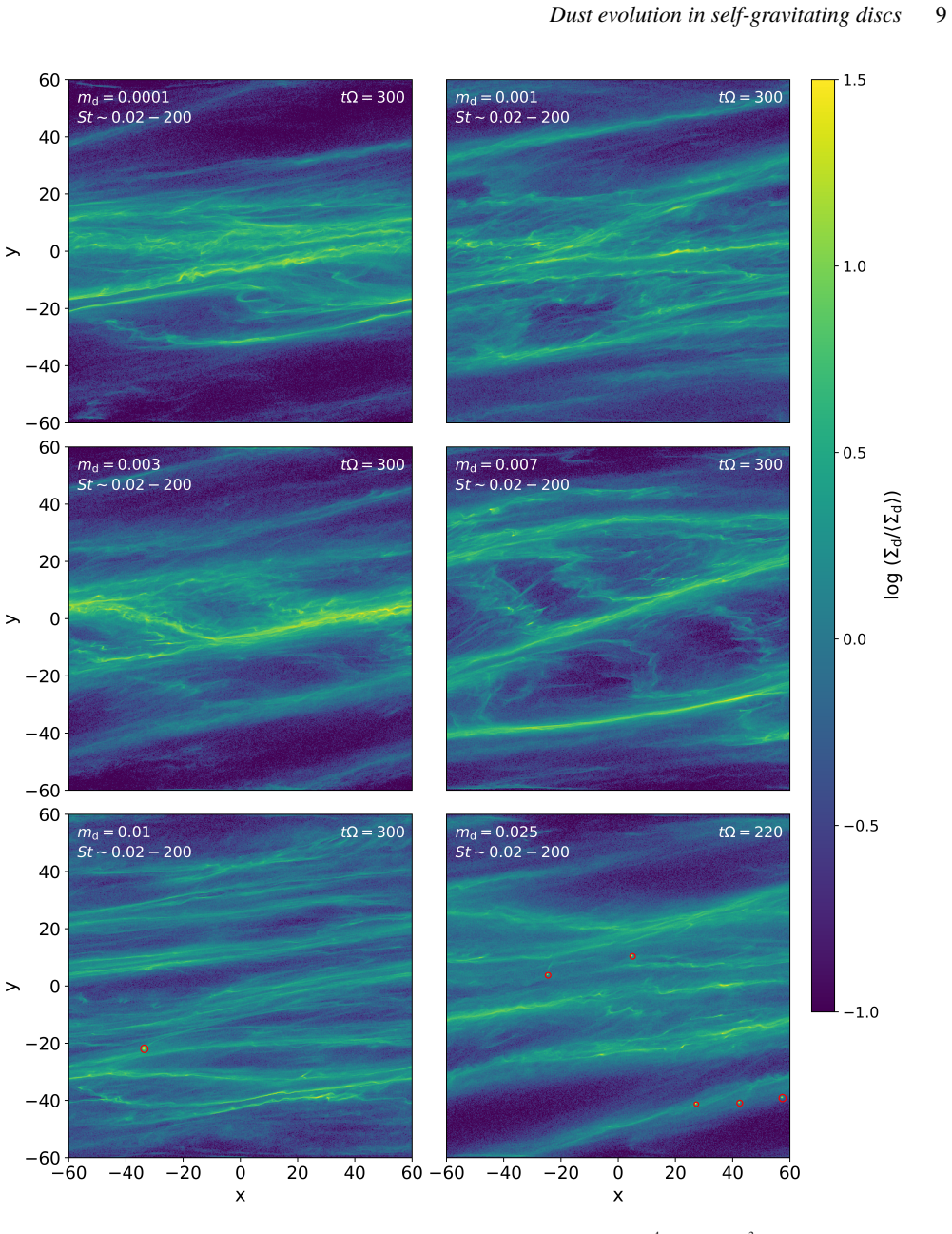
The paper's central claim is that gravitational collapse of the solid component can occur inside the spiral density waves of a self-gravitating disc even when the dust has a broad size distribution. In the simulations, the dust follows a power-law size distribution $n(a)\propto a^{-4}$ spanning four orders of magnitude in particle size (representative Stokes numbers $0.02$ to $200$), yet the spirals still increase the local particle surface density by more than an order of magnitude. Particles with $\mathrm{St}\sim 1$ settle into a thin midplane layer and drift toward pressure maxima, producing the strongest enhancements. When the dust-to-gas ratio is $\sim 0.01$ for the full size range, or when particles with Stokes numbers between roughly $0.5$ and $5$ carry a few times $10^{-3}$ of the gas mass, local surface densities exceed the Roche value and collapse into bound clumps. Across the runs that formed clumps, 42 clumps emerged with masses from $0.6$ to $7.15\,M_\oplus$ (mean $2.2\,M_\oplus$), in line with the 1–10 Earth-mass cores predicted by two-fluid disc studies.
Load-bearing premise
The whole route depends on dust grains growing to roughly centimetre sizes during the first 100,000 years of disc life, when the disc is still self-gravitating; the paper itself cautions that it is not clear grain growth can be that fast.
Editorial extensions
If this is right
- If the mechanism operates, planetary cores of roughly $1{-}10\,M_\oplus$ can appear within the first $\sim 10^5$ years, before the disc loses its self-gravitating state.
- The metre barrier stops being fatal: grains need only reach centimetre sizes to be concentrated, after which direct collapse can form cores instead of a long collisional cascade.
- Even when no clumps form, spiral-induced enhancements of more than an order of magnitude could accelerate grain growth by raising local dust densities and collision rates.
- Formation of super-Earths and of the solid cores of giant planets becomes possible during the Class 0 phase, matching observations of accreting protoplanets in slightly older discs.
- The required dust-to-gas ratio is close to the canonical value of $0.01$ for a broad size range, and only about $0.003$ for particles with Stokes numbers between $1$ and $10$.
Reading between the lines
- A testable extension of this result is that if direct collapse is the main core-forming route, the observed super-Earth mass distribution should peak near a few Earth masses, echoing the simulated clump-mass mean of about $2\,M_\oplus$.
- The concentration mechanism may bootstrap grain growth: even small grains are gathered by the spirals, so a disc that starts with only micron dust could raise its own largest grain sizes into the $\mathrm{St}\sim 1$ regime during the self-gravitating epoch.
- The same pressure-maximum concentration logic might operate in other gravitoturbulent environments, but the required particle sizes and cooling times there would have to be evaluated independently.
- Because the simulations use a shearing box, whether the collapsed clumps survive tidal shear when followed through a full orbit in a global disc remains an open extension of this work.
Signed reviews
Editorial analysis
A structured set of objections, weighed in public.
Referee Report
Summary. The paper presents 3D shearing-box simulations with the Pencil Code of a dust population in a self-gravitating protostellar disc, using a multi-size particle distribution n(a)∝a^-4 with representative Stokes numbers spanning about 0.02–200, and including particle self-gravity and back-reaction. The test-particle run shows that spiral density waves enhance the local dust surface density by more than an order of magnitude, with the strongest concentration for particles near St~1. In runs with total dust-to-gas ratio of order 0.01, or about 0.003 for narrow Stokes-number ranges centred near unity, the simulations produce regions where the projected particle surface density exceeds about 10 times the mean gas surface density; 42 such regions are identified as clumps and, under a scaling to a 1 M_sun star at 50 AU, have masses between 0.6 and 7.15 M_earth. The authors conclude that self-gravitating spirals can directly form bound planetary cores, bypassing the metre barrier, while acknowledging in Section 5 that it is not clear whether grain growth can reach cm sizes within the short (~1e5 yr) self-gravitating phase.
Significance. If the central claim is established, the paper offers a credible route to forming ~1–10 M_earth cores in the first ~1e5 yr of disc evolution, potentially explaining early planet formation and bypassing the drift barrier. The study's strengths are the multi-size dust treatment, the systematic parameter sweep over dust-to-gas ratio and Stokes-number range, and the inclusion of particle self-gravity and back-reaction; the authors also state that data and scripts will be archived and that the Pencil Code is public. The significance is, however, conditional: the direct-collapse conclusion rests on a projected surface-density threshold rather than on a dynamical demonstration of boundness, no convergence study is reported, and the applicability to real discs depends on cm-sized grains being present during the brief self-gravitating phase, a caveat the paper states honestly.
major comments (3)
- [Section 3.2.3, Eq. (14)] The only clump-identification criterion is a projected particle surface density exceeding Σ_R≈10⟨Σ_g⟩. This is a Roche/tidal threshold, not a demonstration that the region has undergone gravitational collapse and is bound. A transient aerodynamic concentration in a spiral arm can satisfy this projected-density criterion while remaining unbound in three dimensions, supported by gas drag or diffusion, or subject to tidal shear. Because the simulations include particle self-gravity and gas gravity, this can be tested directly: for each candidate, compute the particle self-binding energy or a virial-type ratio, compare the three-dimensional particle density with the Hill density of Eq. (12), and follow the clump evolution to see whether it contracts and survives. The abstract's 'bound clumps' and the conclusion's 'gravitationally collapse to directly form dense clumps' are stronger than what a surface-density threshold demonstrates, so this point is load-bearing for the central claim.
- [Section 3.2.3, Fig. 10] The clump masses are obtained by summing superparticles within a Hill radius defined around each density peak, and the Hill radius is itself a function of the clump mass (R_Hill=(m_cl/3)^{1/3} in code units). The reported mass range 0.6–7.15 M_earth is therefore partly set by the detection algorithm rather than by a dynamically determined bound state. Please provide radial enclosed-mass profiles, the peak volume density relative to the Hill density, and a binding-energy estimate for representative clumps, so that the '1–10 M_earth planetary cores' claim is supported by clump structure rather than by the threshold geometry.
- [Sections 2 and 3] No resolution or particle-number convergence study is reported; all runs use a 256×256×128 grid and 10^7 superparticles, and clump detection uses a 1000×1000 surface-density grid. It is therefore not established that the super-Roche regions survive as bound clumps at higher resolution or with different particle sampling, and the clump masses could be resolution-dependent. Please add at least one clump-forming case at higher grid resolution and particle number, and show that the clump-formation criterion and the mass distribution are stable; ideally also test a different box size to check that the periodic shearing box does not artificially promote clumping.
minor comments (5)
- [Section 3.2.2, Eq. (13)] The conversion from Hill volume density to surface density uses Σ_Hill∼2H_dρ_Hill; for a Gaussian vertical profile the numerical factor is sqrt(2π)≈2.51, and the resulting value Σ_Hill≈1.4 should be derived explicitly for the assumed H_d=1.
- [Section 3.2.3] The threshold is rounded from Σ_R=8.8 to 10, and the text states that this corresponds to an enhancement of 8.8/0.01=880 times the mean dust surface density for m_d/m_g=0.01; with the adopted threshold of 10 the required enhancement is 1000. Please make the final threshold and its normalization consistent.
- [Section 3.1.1] The statement that 'if the Stokes number 1 particles have sizes of order a cm, then our broad size distribution extends from about 0.1 mm to about 1 m' does not match the stated Stokes range 0.02–200, which would extend to about 2 m for a 1 cm St=1 grain; please check the size conversion.
- [Figure 9 caption] The caption of Figure 9 appears truncated in the version I reviewed, with the bottom-panel sentence ending at 'mean gas surface density' and an uncompleted formula; please ensure the published caption is complete.
- [Data availability statement] The data availability statement contains a grammatical error ('will be archived will be publicly available') and should be corrected.
Circularity Check
No significant circularity: the Roche/Hill threshold used to identify clumps is an externally motivated physical criterion, not a fitted input.
full rationale
The derivation chain is not circular. The clump-formation claim is tested by comparing the simulated dust surface-density field with the Roche/Hill surface-density threshold (Eqs. 12-14), which is a standard physical criterion for a self-gravitating patch to resist tidal shear; it is not a parameter fitted to the simulation output. The only simulation-derived quantity entering the threshold is the dust scale height H_d≈1, used to convert volume density to surface density; using a measured property of the simulated layer to evaluate a physical criterion is legitimate and does not make the outcome an input. The clump masses (0.6-7.15 M⊕) are measured by summing superparticles inside Hill radii around the identified density peaks, so the mass range is an emergent product of the simulations rather than a pre-supplied answer. The citations to Baehr et al. (2022) and Schäfer et al. (2017) supply standard Roche and scaling relations rather than a self-referential uniqueness argument. The abstract's 'bound clumps' wording is stronger than what a surface-density-threshold check alone demonstrates - no virial or binding-energy verification or convergence study is reported - but that is an over-interpretation or correctness caveat, not a reduction of the conclusion to its inputs by construction.
Assumptions & free parameters
free parameters (6)
- Beta cooling timescale =
10
- Irradiation sound speed c_s,irr =
c_s,0 = pi
- Dust size distribution index =
n(a) proportional to a^-4
- Stokes number range =
0.02 to 200
- Clump detection threshold =
Sigma_R = 10
- Physical scaling parameters =
M*=1 Msun, R=50 AU, Sigma0=53 g/cm2, T=11.25 K, mu=2.33
assumptions (6)
- domain assumption The local shearing-box approximation with imposed vertical sinusoidal gravity captures the relevant dynamics of self-gravitating spirals and dust concentration.
- domain assumption Dust particles interact with gas only via Epstein drag and gravity; coagulation, fragmentation, and porosity are neglected.
- domain assumption The Epstein drag regime applies to all particle sizes considered.
- domain assumption The gas disc reaches a quasi-steady self-gravitating state before drag is activated at tOmega=40, so initial transients do not determine the enhancement.
- domain assumption The particle back-reaction and self-gravity are correctly represented by 10^7 superparticles at 256x256x128 resolution.
- ad hoc to paper Clumps identified by surface density exceeding 10 times the mean gas surface density are gravitationally bound.
Cite this review
Pith. "Pith review of Dust density enhancements and the direct formation of planetary cores in gravitationally unstable discs." pith.science (2026). https://pith.science/paper/JFWB77N4
@misc{pith2026250500363,
  author       = {Pith},
  title        = {Pith review of: Dust density enhancements and the direct formation of planetary cores in gravitationally unstable discs},
  year         = {2026},
  howpublished = {\url{https://pith.science/paper/JFWB77N4}},
  note         = {Machine review of arXiv:2505.00363}
}
abstract
Planet formation via core accretion involves the growth of solids that can accumulate to form planetary cores. There are a number of barriers to the collisional growth of solids in protostellar discs, one of which is the drift, or metre, barrier. Solid particles experience a drag force that will tend to cause them to drift towards the central star in smooth, laminar discs, potentially removing particles before they grow large enough to decouple from the disc gas. Here we present 3-dimensional, shearing box simulations that explore the dynamical evolution of solids in a protostellar disc that is massive enough for the gravitational instability to manifest as spiral density waves. We expand on earlier work by considering a range of particle sizes and find that the spirals can still enhance the local solid density by more than an order of magnitude, potentially aiding grain growth. Furthermore, if solid particles have enough mass, and the particle size distribution extends to sufficiently large particle sizes, the solid component of the disc can undergo direct gravitational collapse to form bound clumps with masses typically between $1$ and $10$ M$_\oplus$. Thus, the concentration of dust in a self-gravitating disc could bypass the size barrier for collisional growth and directly form planetary cores early in the lifetime of the disc.
Figures


Figures from the paper (8 more)




Reference graph
Works this paper leans on
-
[1]
Baehr H., Zhu Z., 2021, @doi [ ] 10.3847/1538-4357/abddb3 , https://ui.adsabs.harvard.edu/abs/2021ApJ...909..135B 909, 135
-
[2]
Baehr H., Klahr H., Kratter K. M., 2017, @doi [ ] 10.3847/1538-4357/aa8a66 , https://ui.adsabs.harvard.edu/abs/2017ApJ...848...40B 848, 40
-
[3]
Baehr H., Zhu Z., Yang C.-C., 2022, @doi [ ] 10.3847/1538-4357/ac7228 , https://ui.adsabs.harvard.edu/abs/2022ApJ...933..100B 933, 100
-
[4]
Bai X.-N., Stone J. M., 2010, @doi [ ] 10.1088/0004-637X/722/2/1437 , https://ui.adsabs.harvard.edu/abs/2010ApJ...722.1437B 722, 1437
-
[5]
Bate M. R., 2022, @doi [ ] 10.1093/mnras/stac1391 , https://ui.adsabs.harvard.edu/abs/2022MNRAS.514.2145B 514, 2145
-
[6]
Birnstiel T., Klahr H., Ercolano B., 2012, @doi [ ] 10.1051/0004-6361/201118136 , https://ui.adsabs.harvard.edu/abs/2012A&A...539A.148B 539, A148
-
[7]
Blum J., Wurm G., 2008, @doi [ ] 10.1146/annurev.astro.46.060407.145152 , https://ui.adsabs.harvard.edu/abs/2008ARA&A..46...21B 46, 21
arXiv 2008
-
[8]
Booth R. A., Clarke C. J., 2016, @doi [ ] 10.1093/mnras/stw488 , https://ui.adsabs.harvard.edu/abs/2016MNRAS.458.2676B 458, 2676
Show all 66 references
-
[9]
A., Clarke C
Booth R. A., Clarke C. J., 2019, @doi [ ] 10.1093/mnras/sty3340 , https://ui.adsabs.harvard.edu/abs/2019MNRAS.483.3718B 483, 3718
2019 doi
-
[10]
P., 1997, @doi [Science] 10.1126/science.276.5320.1836 , https://ui.adsabs.harvard.edu/abs/1997Sci...276.1836B 276, 1836
Boss A. P., 1997, @doi [Science] 10.1126/science.276.5320.1836 , https://ui.adsabs.harvard.edu/abs/1997Sci...276.1836B 276, 1836
1997
-
[11]
Brandenburg A., 2003, in Ferriz-Mas A., N \'u \ n ez M., eds, , Advances in Nonlinear Dynamics. p. 269, @doi 10.1201/9780203493137.ch9
2003 doi
-
[12]
J., Lodato G., 2009, @doi [ ] 10.1111/j.1745-3933.2009.00695.x , https://ui.adsabs.harvard.edu/abs/2009MNRAS.398L...6C 398, L6
Clarke C. J., Lodato G., 2009, @doi [ ] 10.1111/j.1745-3933.2009.00695.x , https://ui.adsabs.harvard.edu/abs/2009MNRAS.398L...6C 398, L6
2009
- [13]
-
[14]
H., Hall C., Meru F., Rice W
Forgan D. H., Hall C., Meru F., Rice W. K. M., 2018, @doi [ ] 10.1093/mnras/stx2870 , https://ui.adsabs.harvard.edu/abs/2018MNRAS.474.5036F 474, 5036
2018 doi
-
[15]
J., Valdivia V., Testi L., Belloche A., Andr \'e P., 2019, @doi [ ] 10.1051/0004-6361/201936342 , https://ui.adsabs.harvard.edu/abs/2019A&A...632A...5G 632, A5
Galametz M., Maury A. J., Valdivia V., Testi L., Belloche A., Andr \'e P., 2019, @doi [ ] 10.1051/0004-6361/201936342 , https://ui.adsabs.harvard.edu/abs/2019A&A...632A...5G 632, A5
2019 doi
-
[16]
F., 2001, @doi [ ] 10.1086/320631 , https://ui.adsabs.harvard.edu/abs/2001ApJ...553..174G 553, 174
Gammie C. F., 2001, @doi [ ] 10.1086/320631 , https://ui.adsabs.harvard.edu/abs/2001ApJ...553..174G 553, 174
2001 doi
-
[17]
G., Rice W
Gibbons P. G., Rice W. K. M., Mamatsashvili G. R., 2012, @doi [ ] 10.1111/j.1365-2966.2012.21731.x , https://ui.adsabs.harvard.edu/abs/2012MNRAS.426.1444G 426, 1444
2012
-
[18]
G., Mamatsashvili G
Gibbons P. G., Mamatsashvili G. R., Rice W. K. M., 2014, @doi [ ] 10.1093/mnras/stu809 , https://ui.adsabs.harvard.edu/abs/2014MNRAS.442..361G 442, 361
2014 doi
-
[19]
G., Mamatsashvili G
Gibbons P. G., Mamatsashvili G. R., Rice W. K. M., 2015, @doi [ ] 10.1093/mnras/stv1766 , https://ui.adsabs.harvard.edu/abs/2015MNRAS.453.4232G 453, 4232
2015 doi
-
[20]
Godon P., Livio M., 1999, @doi [ ] 10.1086/307720 , https://ui.adsabs.harvard.edu/abs/1999ApJ...523..350G 523, 350
1999 doi
-
[21]
P., 2003, @doi [ ] 10.1086/378950 , https://ui.adsabs.harvard.edu/abs/2003ApJ...598.1301H 598, 1301
Haghighipour N., Boss A. P., 2003, @doi [ ] 10.1086/378950 , https://ui.adsabs.harvard.edu/abs/2003ApJ...598.1301H 598, 1301
2003 doi
-
[22]
J., Najita J., Alexander R., Brittain S., 2019, @doi [ ] 10.3847/1538-4357/aafac2 , https://ui.adsabs.harvard.edu/abs/2019ApJ...871..228H 871, 228
Hall C., Dong R., Rice K., Harries T. J., Najita J., Alexander R., Brittain S., 2019, @doi [ ] 10.3847/1538-4357/aafac2 , https://ui.adsabs.harvard.edu/abs/2019ApJ...871..228H 871, 228
2019 doi
-
[23]
Harsono D., Bjerkeli P., van der Wiel M. H. D., Ramsey J. P., Maud L. T., Kristensen L. E., J rgensen J. K., 2018, @doi [Nature Astronomy] 10.1038/s41550-018-0497-x , https://ui.adsabs.harvard.edu/abs/2018NatAs...2..646H 2, 646
2018 doi
-
[24]
Johansen A., Youdin A., 2007, @doi [ ] 10.1086/516730 , https://ui.adsabs.harvard.edu/abs/2007ApJ...662..627J 662, 627
2007 doi
-
[25]
C., Brandenburg A., 2004, @doi [ ] 10.1051/0004-6361:20034417 , https://ui.adsabs.harvard.edu/abs/2004A&A...417..361J 417, 361
Johansen A., Andersen A. C., Brandenburg A., 2004, @doi [ ] 10.1051/0004-6361:20034417 , https://ui.adsabs.harvard.edu/abs/2004A&A...417..361J 417, 361
2004 doi
-
[26]
Johansen A., Klahr H., Henning T., 2006, @doi [ ] 10.1086/498078 , https://ui.adsabs.harvard.edu/abs/2006ApJ...636.1121J 636, 1121
2006 doi
-
[27]
Johansen A., Youdin A., Mac Low M.-M., 2009, @doi [ ] 10.1088/0004-637X/704/2/L75 , https://ui.adsabs.harvard.edu/abs/2009ApJ...704L..75J 704, L75
2009 doi
-
[28]
Klahr H., Schreiber A., 2020, @doi [ ] 10.3847/1538-4357/abac58 , https://ui.adsabs.harvard.edu/abs/2020ApJ...901...54K 901, 54
2020 doi
-
[29]
Kratter K., Lodato G., 2016, @doi [ ] 10.1146/annurev-astro-081915-023307 , https://ui.adsabs.harvard.edu/abs/2016ARA&A..54..271K 54, 271
2016 doi
-
[30]
M., Murray-Clay R
Kratter K. M., Murray-Clay R. A., Youdin A. N., 2010, @doi [ ] 10.1088/0004-637X/710/2/1375 , https://ui.adsabs.harvard.edu/abs/2010ApJ...710.1375K 710, 1375
2010 doi
-
[31]
P., 1951, @doi [Proceedings of the National Academy of Science] 10.1073/pnas.37.1.1 , https://ui.adsabs.harvard.edu/abs/1951PNAS...37....1K 37, 1
Kuiper G. P., 1951, @doi [Proceedings of the National Academy of Science] 10.1073/pnas.37.1.1 , https://ui.adsabs.harvard.edu/abs/1951PNAS...37....1K 37, 1
1951 doi
-
[32]
Laibe G., 2014, @doi [ ] 10.1093/mnras/stt1928 , https://ui.adsabs.harvard.edu/abs/2014MNRAS.437.3037L 437, 3037
2014 doi
-
[33]
Lin D. N. C., Pringle J. E., 1990, @doi [ ] 10.1086/169004 , https://ui.adsabs.harvard.edu/abs/1990ApJ...358..515L 358, 515
1990 doi
-
[35]
J., 2023a, @doi [ ] 10.1093/mnras/stac3653 , https://ui.adsabs.harvard.edu/abs/2023MNRAS.519.2017L 519, 2017
Longarini C., Lodato G., Bertin G., Armitage P. J., 2023a, @doi [ ] 10.1093/mnras/stac3653 , https://ui.adsabs.harvard.edu/abs/2023MNRAS.519.2017L 519, 2017
2017 doi
-
[36]
J., Lodato G., Price D
Longarini C., Armitage P. J., Lodato G., Price D. J., Ceppi S., 2023b, @doi [ ] 10.1093/mnras/stad1400 , https://ui.adsabs.harvard.edu/abs/2023MNRAS.522.6217L 522, 6217
-
[37]
S., Rumpl W., Nordsieck K
Mathis J. S., Rumpl W., Nordsieck K. H., 1977, @doi [ ] 10.1086/155591 , https://ui.adsabs.harvard.edu/abs/1977ApJ...217..425M 217, 425
1977 doi
-
[38]
Mizuno H., 1980, @doi [Progress of Theoretical Physics] 10.1143/PTP.64.544 , https://ui.adsabs.harvard.edu/abs/1980PThPh..64..544M 64, 544
1980 doi
-
[39]
M \"u ller S., Helled R., Mayer L., 2018, @doi [ ] 10.3847/1538-4357/aaa840 , https://ui.adsabs.harvard.edu/abs/2018ApJ...854..112M 854, 112
2018 doi
-
[40]
E., 2009, @doi [ ] 10.1088/0004-637X/702/2/L163 , https://ui.adsabs.harvard.edu/abs/2009ApJ...702L.163N 702, L163
Nero D., Bjorkman J. E., 2009, @doi [ ] 10.1088/0004-637X/702/2/L163 , https://ui.adsabs.harvard.edu/abs/2009ApJ...702L.163N 702, L163
2009 doi
-
[41]
J., King A
Nixon C. J., King A. R., Pringle J. E., 2018, @doi [ ] 10.1093/mnras/sty593 , https://ui.adsabs.harvard.edu/abs/2018MNRAS.477.3273N 477, 3273
2018 doi
-
[42]
Pencil Code Collaboration et al., 2021, @doi [The Journal of Open Source Software] 10.21105/joss.02807 , https://ui.adsabs.harvard.edu/abs/2021JOSS....6.2807P 6, 2807
2021 doi
-
[43]
B., Hubickyj O., Bodenheimer P., Lissauer J
Pollack J. B., Hubickyj O., Bodenheimer P., Lissauer J. J., Podolak M., Greenzweig Y., 1996, @doi [ ] 10.1006/icar.1996.0190 , https://ui.adsabs.harvard.edu/abs/1996Icar..124...62P 124, 62
1996
-
[44]
Rice W. K. M., Lodato G., Pringle J. E., Armitage P. J., Bonnell I. A., 2004, @doi [ ] 10.1111/j.1365-2966.2004.08339.x , https://ui.adsabs.harvard.edu/abs/2004MNRAS.355..543R 355, 543
2004
-
[45]
Rice W. K. M., Lodato G., Armitage P. J., 2005, @doi [ ] 10.1111/j.1745-3933.2005.00105.x , https://ui.adsabs.harvard.edu/abs/2005MNRAS.364L..56R 364, L56
2005
-
[46]
Rice W. K. M., Lodato G., Pringle J. E., Armitage P. J., Bonnell I. A., 2006, @doi [ ] 10.1111/j.1745-3933.2006.00215.x , https://ui.adsabs.harvard.edu/abs/2006MNRAS.372L...9R 372, L9
2006
-
[47]
Rice W. K. M., Mayo J. H., Armitage P. J., 2010, @doi [ ] 10.1111/j.1365-2966.2009.15992.x , https://ui.adsabs.harvard.edu/abs/2010MNRAS.402.1740R 402, 1740
2010
-
[48]
Rice K., Lopez E., Forgan D., Biller B., 2015, @doi [ ] 10.1093/mnras/stv1997 , https://ui.adsabs.harvard.edu/abs/2015MNRAS.454.1940R 454, 1940
2015 doi
-
[49]
J., 2017, @doi [ ] 10.1093/mnras/stx1548 , https://ui.adsabs.harvard.edu/abs/2017MNRAS.471..317R 471, 317
Riols A., Latter H., Paardekooper S. J., 2017, @doi [ ] 10.1093/mnras/stx1548 , https://ui.adsabs.harvard.edu/abs/2017MNRAS.471..317R 471, 317
2017 doi
-
[50]
Riols A., Roux B., Latter H., Lesur G., 2020, @doi [ ] 10.1093/mnras/staa567 , https://ui.adsabs.harvard.edu/abs/2020MNRAS.493.4631R 493, 4631
2020 doi
-
[51]
A., 2024a, @doi [ ] 10.1093/mnras/stae167 , https://ui.adsabs.harvard.edu/abs/2024MNRAS.528.2490R 528, 2490
Rowther S., Nealon R., Meru F., Wurster J., Aly H., Alexander R., Rice K., Booth R. A., 2024a, @doi [ ] 10.1093/mnras/stae167 , https://ui.adsabs.harvard.edu/abs/2024MNRAS.528.2490R 528, 2490
-
[52]
J., Pinte C., Nealon R., Meru F., Alexander R., 2024b, @doi [ ] 10.1093/mnras/stae2167 , https://ui.adsabs.harvard.edu/abs/2024MNRAS.534.2277R 534, 2277
Rowther S., Price D. J., Pinte C., Nealon R., Meru F., Alexander R., 2024b, @doi [ ] 10.1093/mnras/stae2167 , https://ui.adsabs.harvard.edu/abs/2024MNRAS.534.2277R 534, 2277
-
[53]
Sch \"a fer U., Yang C.-C., Johansen A., 2017, @doi [ ] 10.1051/0004-6361/201629561 , https://ui.adsabs.harvard.edu/abs/2017A&A...597A..69S 597, A69
2017 doi
-
[54]
C., 2018, @doi [ ] 10.3847/1538-4357/aa961c , https://ui.adsabs.harvard.edu/abs/2018ApJ...853...37S 853, 37
Schlaufman K. C., 2018, @doi [ ] 10.3847/1538-4357/aa961c , https://ui.adsabs.harvard.edu/abs/2018ApJ...853...37S 853, 37
2018 doi
-
[55]
M., Chiang E., 2016, @doi [ ] 10.1093/mnras/stw692 , https://ui.adsabs.harvard.edu/abs/2016MNRAS.459..982S 459, 982
Shi J.-M., Zhu Z., Stone J. M., Chiang E., 2016, @doi [ ] 10.1093/mnras/stw692 , https://ui.adsabs.harvard.edu/abs/2016MNRAS.459..982S 459, 982
2016 doi
-
[56]
B., Armitage P
Simon J. B., Armitage P. J., Li R., Youdin A. N., 2016, @doi [ ] 10.3847/0004-637X/822/1/55 , https://ui.adsabs.harvard.edu/abs/2016ApJ...822...55S 822, 55
2016 doi
-
[57]
Steinacker J., et al., 2015, @doi [ ] 10.1051/0004-6361/201425434 , https://ui.adsabs.harvard.edu/abs/2015A&A...582A..70S 582, A70
2015 doi
-
[58]
Toomre A., 1964, @doi [ ] 10.1086/147861 , https://ui.adsabs.harvard.edu/abs/1964ApJ...139.1217T 139, 1217
1964 doi
-
[59]
H., 2022, @doi [ ] 10.1093/mnras/stac2030 , https://ui.adsabs.harvard.edu/abs/2022MNRAS.515.4780T 515, 4780
Tu Y., Li Z.-Y., Lam K. H., 2022, @doi [ ] 10.1093/mnras/stac2030 , https://ui.adsabs.harvard.edu/abs/2022MNRAS.515.4780T 515, 4780
2022 doi
-
[60]
Tychoniec ., et al., 2020, @doi [ ] 10.1051/0004-6361/202037851 , https://ui.adsabs.harvard.edu/abs/2020A&A...640A..19T 640, A19
2020 doi
-
[61]
Vigan A., et al., 2017, @doi [ ] 10.1051/0004-6361/201630133 , https://ui.adsabs.harvard.edu/abs/2017A&A...603A...3V 603, A3
2017 doi
-
[62]
I., Kulikov I., Elbakyan V
Vorobyov E. I., Kulikov I., Elbakyan V. G., McKevitt J., G \"u del M., 2024, @doi [ ] 10.1051/0004-6361/202348023 , https://ui.adsabs.harvard.edu/abs/2024A&A...683A.202V 683, A202
2024 doi
-
[63]
J., 1977, @doi [ ] 10.1093/mnras/180.2.57 , https://ui.adsabs.harvard.edu/abs/1977MNRAS.180...57W 180, 57
Weidenschilling S. J., 1977, @doi [ ] 10.1093/mnras/180.2.57 , https://ui.adsabs.harvard.edu/abs/1977MNRAS.180...57W 180, 57
1977 doi
-
[64]
Yang C.-C., Johansen A., 2016, @doi [The Astrophysical Journal Supplement Series] 10.3847/0067-0049/224/2/39 , 224, 39
2016 doi
-
[65]
Yang C.-C., Krumholz M., 2012, @doi [ ] 10.1088/0004-637X/758/1/48 , https://ui.adsabs.harvard.edu/abs/2012ApJ...758...48Y 758, 48
2012 doi
-
[66]
Youdin A., Johansen A., 2007, @doi [ ] 10.1086/516729 , https://ui.adsabs.harvard.edu/abs/2007ApJ...662..613Y 662, 613
2007 doi
-
[67]
N., Lithwick Y., 2007, @doi [ ] 10.1016/j.icarus.2007.07.012 , https://ui.adsabs.harvard.edu/abs/2007Icar..192..588Y 192, 588
Youdin A. N., Lithwick Y., 2007, @doi [ ] 10.1016/j.icarus.2007.07.012 , https://ui.adsabs.harvard.edu/abs/2007Icar..192..588Y 192, 588
2007 doi
Reviewed August 16, 2026 · model on record in the stance chip above.
Discussion (0). Continue with ORCID to comment.