REVIEW 5 major objections 5 minor 1 cited by
Gluon Parts of Gravitational Form Factors and Mass Distribution
T0 review · 5 major / 5 minor · reviewed 2026-08-16 · deepseek-v4-flash
Pith's one-line read A Dyson-Schwinger model in rainbow-ladder truncation produces realistic gluon contributions to the nucleon and pion gravitational form factors and mass/energy distributions.
desk verdict Genuinely new DSE-RL results for the Q^2 dependence of gluon gravitational form factors and radii, with a plausible central claim and one load-bearing assumption—the 7%/27% Landau-gauge compensation—deserves a serious referee. read the letter →
The pith
A machine-rendered reading of the paper's core claim, the machinery that carries it, and where it could break.
The reading
What carries the argument
The central object is the identification of the energy-momentum tensor matrix element $\langle P'|T^{aa}_p(0)|P\rangle$ with the generalized momentum-fraction moment $\langle k\cdot a/K\cdot a\rangle_p(Q^2)$, evaluated through DSE-RL dressed vertices $\Gamma^a_p(p,Q)$ that solve a Bethe-Salpeter equation with the rainbow-ladder kernel $K(q^2)=D_{RL}^2 e^{-q^2/\omega^2}+F(q^2)\,4\pi\bar\alpha_s(q^2)$. Choosing $a=n$ (light-like) yields the standard light-cone momentum fractions, while $a=e$ (rest-frame) yields the mass/energy density; both come from the same dressed vertices, with the gluon case entering through the gluon-in-quark inhomogeneous term built from the kernel $\Delta_g(q)^2=K_g(q^2)$. This identity lets the calculation reach gravitational form factors without adding explicit gluon degrees of freedom beyond those generated by quark dressing.
What would settle it
Directly compute the $Q^\mu T^{\mu\nu}_g Q^\nu/Q^2$ projection in the same DSE-RL framework to obtain $\bar C_g(Q^2)$; if $\bar C_g(0)$ comes out far from the estimated $0.08$ (nucleon) or $0.02$ (pion), or if the reconstructed gluon mass radius moves outside the lattice-QCD uncertainty band around $0.81\,\mathrm{fm}$, the claim that quark dressing alone reproduces the gluon mass distribution would be falsified.
Extended reading notes
Core claim
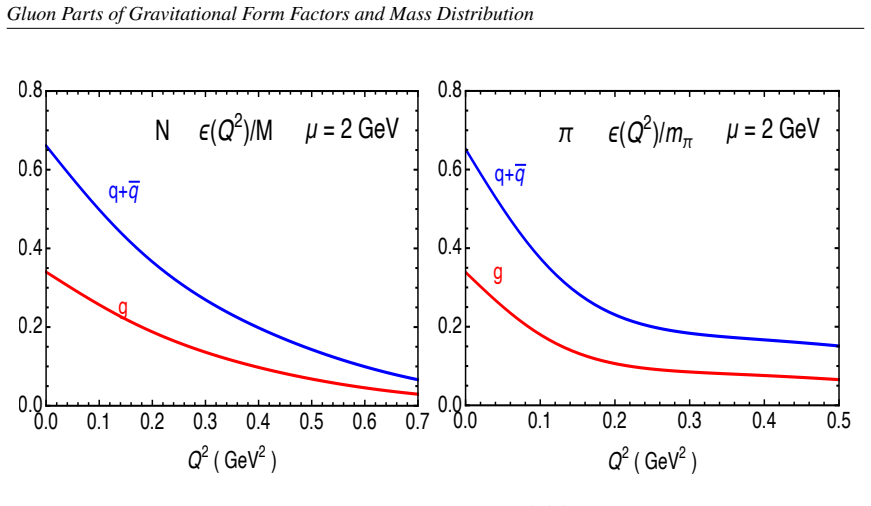
At the model scale ($\mu_0^N=0.64\,\mathrm{GeV}$, $\mu_0^\pi=0.9\,\mathrm{GeV}$), the DSE-RL calculation yields quark and gluon components of the gravitational form factors $A_p(Q^2)$, $B_p(Q^2)$, $J_p(Q^2)$, the mass/energy distributions $E_p(Q^2)/M$, and the summed $D(Q^2)$, with the gluon contributions generated entirely by quark dressing. After applying the 1-loop-estimated Landau-gauge compensation factors (a $7\%$ decrease of $\langle x\rangle_q$ and a $27\%$ increase of $\langle x\rangle_g$ at the model scale) and evolution to $2\,\mathrm{GeV}$, the gluon momentum fractions agree with a global data analysis, the nucleon gluon mass radius is $R_g^{E}=0.765\,\mathrm{fm}$ (compared with the lattice value $0.81\,\mathrm{fm}$ and a data-based value $0.778\,\mathrm{fm}$), and the pion ratio $R_g/R_q=1.22$ for $A(Q^2)$ is close to the lattice value $1.1$ and algebraic-model value $1.31$. The extracted D-term values are $D_\pi(0)=-0.89$ and $D_N(0)=-1.73$. The radii hierarchy $R_A<R_T<R_E$ indicates that the form factor $A_p(Q^2)$ alone does not represent the mass/energy distribution.
Load-bearing premise
The load-bearing premise is the paper's Section 4 assumption that the fixed 1-loop-estimated Landau-gauge compensation factors --- a $7\%$ decrease of $\langle x\rangle_q(\mu_0)$ and a $27\%$ increase of $\langle x\rangle_g(\mu_0)$ --- correctly convert the gauge-dependent DSE-RL model-scale results into the light-cone quantities compared with data and lattice QCD.
Editorial extensions
If this is right
- The nucleon gluon mass radius is $R_g^E=0.765\,\mathrm{fm}$ at $2\,\mathrm{GeV}$, essentially equal to the quark mass radius ($R_g/R_q=0.998$), so gluonic energy is spread as widely as quark energy.
- In the pion, the gluon radius exceeds the quark radius by $22\%$ for the $A(Q^2)$ form factor, matching the pattern seen in lattice QCD and in algebraic GPD models.
- The mass/energy radius $R_E$ exceeds the $A(Q^2)$ radius $R_A$ for both hadrons, dramatically so for the pion ($R_q^E=1.178\,\mathrm{fm}$ versus $R_q^A=0.397\,\mathrm{fm}$), so $A_p(Q^2)$ alone is not a reliable proxy for mass distribution.
- The total D-term is fixed by the radius relations: $D_\pi(0)=-0.89$ and $D_N(0)=-1.73$, giving scale-invariant targets for lattice and experiment.
- Quark dressing already produces more than half of the 2 GeV gluon momentum fraction at the model scale, indicating that perturbative evolution adds to, but does not create, most of the gluon strength.
Reading between the lines
- A direct calculation of the $\bar C_g(Q^2)$ form factor via the $Q^\mu T^{\mu\nu}_g Q^\nu/Q^2$ projection, which the paper flags as future work, would convert the estimated $\bar C_g(0)$ values into a testable prediction and could shift the quoted radii.
- If the compensation factors are actually scale-dependent rather than constant, the close agreement with lattice values could be accidental; a lattice calculation of quark and gluon momentum fractions at the model scale would settle this.
- Because the pion fixes the gluon-in-quark kernel and the nucleon uses it unchanged, extending the same calculation to the $\rho$ meson would test whether the dressing mechanism remains sufficient outside the pseudoscalar channel.
- The joint agreement of two very different hadrons with one shared kernel is a stronger constraint than either alone, so the next natural check is whether higher Mellin moments (beyond the second) preserve the pattern.
Signed reviews
Editorial analysis
A structured set of objections, weighed in public.
Referee Report
Summary. This manuscript presents an exploratory application of the Dyson-Schwinger/Bethe-Salpeter rainbow-ladder truncation to the quark and gluon components of the hadron energy-momentum tensor (EMT) for the pion and the nucleon. The author derives a formal connection between EMT matrix elements and generalized momentum-fraction moments of GPDs, then computes the gravitational form factors A_p(Q^2), the energy distributions E_p(Q^2), the angular-momentum form factor J_p(Q^2), and the D-term, together with associated radii. The gluon-in-quark kernel is calibrated using the pion momentum fractions with a 7%/27% Landau-gauge compensation and is then applied unchanged to the nucleon, with model scales μ_0^π = 0.9 GeV and μ_0^N = 0.64 GeV. The main numerical results include a nucleon gluon mass radius R_g^E = 0.765 fm, close to the LQCD value 0.81 fm, and quark/gluon radius ratios for the pion. The paper argues that the results support the idea that quark dressing alone can generate realistic gluon contributions to hadron structure.
Significance. If correct, the central claim is significant because it would provide a single non-perturbative mechanism, quark dressing in rainbow-ladder truncation, that accounts simultaneously for gluon momentum fractions, gravitational form factors, mass/energy radii, and the D-term for both the nucleon and the pion. The formal connection in Eqs. (7)-(9) is clearly laid out, the nucleon results are not directly fit to nucleon gluon data, and the model generates a wide range of observables (A, E, J, D, radii) within one framework. The comparison between the predicted R_g^E = 0.765 fm and the LQCD result 0.81 fm is a useful benchmark. However, the calibration of the gluon-in-quark kernel via the pion and the use of an external 7%/27% compensation make the pion agreement partly circular; the independent support comes mainly from the nucleon and from the Q^2-dependent quantities, so the significance will be fully established only after the sensitivity issues described in the major comments are addressed.
major comments (5)
- [§4, gluon-in-quark kernel and compensation] The constant Landau-gauge compensation is load-bearing. The gluon-in-quark kernel strength is set so that the compensated pion model-scale momentum fractions match global PDF data after evolution, and that same kernel is then applied unchanged to the nucleon; consequently the nucleon gluon momentum fraction at 2 GeV, the mass radius R_g^E = 0.765 fm quoted in Table 1, and the comparison with the LQCD value 0.81 fm all inherit the 7% and 27% factors. The paper does not quantify the sensitivity of these outputs to the magnitude of the compensation or to its possible scale dependence between μ0^π = 0.9 GeV and μ0^N = 0.64 GeV, nor does it assess whether a constant rescaling can correct a Q^2-dependent gauge or Wilson-line omission that would feed the radii extracted from slopes. Without such a sensitivity analysis, the central claim that quark dressing alone produces realistic gluon contributions is not fully established.
- [§5, Eq. (17)] The values of \bar{C}^{N}_{q/g}(0) and \bar{C}^{π}_{q/g}(0) in Eq. (17) are introduced as an 'estimate' with no derivation, formula, or uncertainty. These constants directly control the difference between the parton energy fractions E_p(0)/M and A_p(0), and through Eq. (3) and the subsequent radius relations they affect the E_r radii in Table 1 and the D(0) values quoted in §5. Please either derive these estimates from the model or provide a sensitivity study showing that the quoted radii and D-terms are robust to their variation.
- [§4-§5, scale evolution] No evolution scheme is specified for promoting the model-scale results at μ0^π = 0.9 GeV and μ0^N = 0.64 GeV to μ = 2 GeV. For the Q^2-dependent form factors A_p(Q^2), E_p(Q^2), and J_p(Q^2), this is not the same as evolving forward PDFs; the manuscript should state the order of the evolution, the treatment of the non-forward matrix elements, and the matching conventions, or restrict the comparisons to the model scale.
- [§5, Table 1 and D-term paragraph] No uncertainties are quoted for any quantitative result, e.g., R_g^E = 0.765 fm, R_g/R_q = 1.22, D_π(0) = −0.89, and D_N(0) = −1.73. Since the model contains fitted parameters (the kernel strength, model scales, nucleon wavefunction parameters) plus the external 7%/27% compensation, the claimed agreement with LQCD cannot be evaluated without parameter and model uncertainties or at least a sensitivity analysis.
- [§1, §4, §6] The pion comparison is partly circular: the gluon-in-quark kernel is fixed by requiring the pion's model-scale momentum fractions to evolve to global PDF data, so the pion agreement is imposed rather than predicted. The genuinely independent support for the central claim comes from the nucleon and from the Q^2-dependence, radii, and D-terms, which were not used in the fit. The manuscript should state this limitation explicitly and frame the pion results as a consistency check rather than as independent evidence.
minor comments (5)
- [Eq. (7)] The notation i\partial_a(z) and the action of the derivative on the Wilson line are not defined; please spell out the integration-by-parts step leading to Eq. (8).
- [Eq. (5)] The definition of t^{\mu\nu} uses curly-brace symmetrization; please state the convention used for the symmetrization.
- [Figure 3] The caption should state explicitly whether the displayed D(Q^2) curves are the total (summed parton) form factors and at which scale; the text says D is scale invariant, but the figure does not indicate this.
- [Eq. (17)] The table of \bar{C} estimates in Eq. (17) would be easier to read as a numbered table rather than an unnumbered inline matrix.
- [§4, references [13] and [26]] The paper repeatedly refers to Ref. [13] for kernel parameters and the compensation estimate; a brief recapitulation of these inputs would improve the self-containedness of the proceedings article.
Circularity Check
Pion gluon momentum fractions are calibrated, not independently predicted; the nucleon results are not fit and provide the independent test, so circularity is partial.
-
fitted input called prediction
[Section 4, paragraph following Eq. (15)]
"The DSE-RL gluon-in-quark kernel Kg(q^2) generates the gluon momentum fraction and its strength is set [13] so that the pion's model scale momentum fractions <x>q and <x>g lead to a minimized RMS departure from global data analysis results at upper scales. Due to the Landau gauge of the DSE-RL approach and its lack of an explicit Wilson line integral, we employ the 1-loop estimated compensation [13] of a 7% decrease of <x>q(mu0) and a 27% increase of <x>g(mu0) to maintain the fit to data at higher scales."
The kernel Kg is the dynamical input that produces the model's gluon momentum fraction. Its strength is explicitly tuned so that the pion's model-scale <x>q and <x>g, after the 7%/27% compensation taken from the author's [13], evolve to match global PDF fits. Any agreement between the pion's gluon momentum fraction and global fits is therefore enforced by construction rather than tested. The genuinely independent content is the nucleon, where the same kernel is applied without refitting, and the Q^2-dependence, gravitational form factors, and radii that were not used in the calibration.
full rationale
The paper is transparent about its calibration: the pion is used to fix the gluon-in-quark kernel and the Landau-gauge compensation factors, and only then is that kernel applied unchanged to the nucleon. Thus the pion light-cone momentum fractions are not an independent prediction of the model; they are inputs to the fit. However, the headline nucleon results — A_g(Q^2), E_g(Q^2), J_g(Q^2), the gluon mass radius R_g^E = 0.765 fm, and the comparison to LQCD — are not used in the fit and provide genuine out-of-sample evidence for the claim that quark dressing generates realistic gluon structure. The 7%/27% compensation factors from [13] are load-bearing for every quantitative output and are a robustness risk rather than a demonstrated circularity, since they are stated as a 1-loop estimate rather than fitted here. Overall the central nucleon claim has independent content, but the pion momentum-fraction comparison reduces partly to the calibration, giving a partial-circularity score of 4 rather than 0.
Assumptions & free parameters
free parameters (5)
- Gluon-in-quark kernel strength (Delta_g / K_g) =
Set in Ref [13] to minimize RMS departure from global PDF data
- Model scales mu_0^pi and mu_0^N =
0.9 GeV and 0.64 GeV
- Landau-gauge compensation for <x>_q and <x>_g =
-7% and +27%
- Nucleon valence-quark wavefunction parameters (R, M_D) =
Fit to Faddeev calculations in Ref [31]
- DSE-RL kernel parameters D_RL and omega =
From Refs [22,27,28]
assumptions (5)
- domain assumption Rainbow-Ladder truncation captures gluon parton content generated from quark dressing.
- ad hoc to paper The gauge-invariant light-cone momentum fractions are related to Landau-gauge DSE-RL results by the constant 7%/27% compensation.
- domain assumption 1-loop pQCD evolution is valid from model scales (0.64 to 0.9 GeV) to 2 GeV.
- domain assumption The nucleon is described by a pure SU(6) spin-isospin quark-diquark state.
- standard math Eqs. (8)-(9) correctly generalize the DIS momentum-fraction relation to the EMT for spacelike Q.
Cite this review
Pith. "Pith review of Gluon Parts of Gravitational Form Factors and Mass Distribution." pith.science (2026). https://pith.science/paper/JU4R7YO3
@misc{pith2026250500583,
  author       = {Pith},
  title        = {Pith review of: Gluon Parts of Gravitational Form Factors and Mass Distribution},
  year         = {2026},
  howpublished = {\url{https://pith.science/paper/JU4R7YO3}},
  note         = {Machine review of arXiv:2505.00583}
}
read the original abstract
The parton structure of the nucleon and pion is investigated in an exploratory model that allows one to assess whether the dressing of quarks can, by itself, produce realistic gluon contributions to light-cone momentum fractions, gravitational form factors, mass/energy distributions and their radii. The model is the Dyson-Schwinger Equations in Rainbow-Ladder truncation. For the parton mass/energy distributions as a function of momentum transfer, we directly calculate matrix elements of the Energy-Momentum Tensor by utilizing its similarity to the momentum fraction moment of GPDs associated with deep inelastic scattering. A variety of gravitational form factors are obtained including the D-term.
Figures


Forward citations
Cited by 1 Pith paper
-
Mechanical properties of the $\Omega^-$ baryon from gravitational form factors
Using QCD sum rules, the authors extract seven gravitational form factors of the Omega baryon and derive its internal energy, angular momentum, pressure, shear, radii, and D-terms.
Reference graph
Works this paper leans on
- [1]
- [2]
-
[3]
M. Diehl, Phys. Rept.388, 41 (2003), arXiv:hep-ph/0307382 [hep-ph] . 9 Gluon Parts of Gravitational Form Factors and Mass Distribution
arXiv 2003
-
[4]
E. Leader and C. Lorcé, Phys. Rept.541, 163 (2014), arXiv:1309.4235 [hep-ph]
arXiv 2014
-
[5]
M.V.PolyakovandP.Schweitzer,Int.J.Mod.Phys.A 33,1830025(2018),arXiv:1805.06596 [hep-ph]
arXiv 2018
-
[6]
D. C. Hackett, D. A. Pefkou, and P. E. Shanahan, Phys. Rev. Lett.132, 251904 (2024), arXiv:2310.08484 [hep-lat]
arXiv 2024
-
[7]
D.C.Hackett,P.R.Oare,D.A.Pefkou, andP.E.Shanahan,Phys.Rev.D 108,114504(2023), arXiv:2307.11707 [hep-lat]
arXiv 2023
-
[8]
A. V. Radyushkin, Phys. Lett. B380, 417 (1996), arXiv:hep-ph/9604317
arXiv 1996
Show all 32 references
- [9]
-
[10]
C.Lorcé,H.Moutarde, andA.P.Trawiński,Eur.Phys.J.C 79,89(2019),arXiv:1810.09837 [hep-ph]
2019 arXiv
-
[11]
Hatta, A
Y. Hatta, A. Rajan, and K. Tanaka, JHEP12, 008 (2018), arXiv:1810.05116 [hep-ph]
2018 arXiv
-
[12]
A. V. Radyushkin, Phys. Rev. D56, 5524 (1997), arXiv:hep-ph/9704207
1997 arXiv
-
[13]
P. C. Tandy, Phys. Lett. B842, 137972 (2023), arXiv:2302.07473 [hep-ph]
2023 arXiv
-
[14]
W.-Y. Liu, E. Shuryak, C. Weiss, and I. Zahed, Phys. Rev. D 110, 054021 (2024), arXiv:2405.14026 [hep-ph]
2024 arXiv
-
[15]
S. Xu, C. Mondal, X. Zhao, Y. Li, and J. P. Vary (BLFQ), Phys. Rev. D108, 094002 (2023), arXiv:2209.08584 [hep-ph]
2023 arXiv
-
[16]
M. A. Sultan, Z. Xing, K. Raya, A. Bashir, and L. Chang, Phys. Rev. D110, 054034 (2024), arXiv:2407.10437 [hep-ph]
2024 arXiv
-
[17]
Raya, Z.-F
K. Raya, Z.-F. Cui, L. Chang, J.-M. Morgado, C. D. Roberts, and J. Rodriguez-Quintero, Chin. Phys. C46, 013105 (2022), arXiv:2109.11686 [hep-ph]
2022 arXiv
-
[18]
Bashir, L
A. Bashir, L. Chang, I. C. Cloët, B. El-Bennich, Y.-X. Liu,et al., Commun.Theor.Phys.58, 79 (2012), arXiv:1201.3366 [nucl-th]
2012 arXiv
-
[19]
77,1(2014),arXiv:1310.2651[nucl-th]
I.C.CloëtandC.D.Roberts,Prog.Part.Nucl.Phys. 77,1(2014),arXiv:1310.2651[nucl-th]
2014 arXiv
-
[20]
P. C. Tandy, Few Body Syst.55, 357 (2014), arXiv:1407.0494 [hep-ph]
2014 arXiv
-
[21]
Horn and C
T. Horn and C. D. Roberts, J. Phys.G43, 073001 (2016), arXiv:1602.04016 [nucl-th]
2016 arXiv
- [22]
- [23]
-
[24]
F. J. Belinfante, Phys. Rev.128, 2832 (1962). 10 Gluon Parts of Gravitational Form Factors and Mass Distribution
1962
-
[25]
Houet al., Phys
T.-J. Houet al., Phys. Rev. D103, 014013 (2021), arXiv:1912.10053 [hep-ph]
2021 arXiv
-
[26]
Freese, I
A. Freese, I. C. Cloët, and P. C. Tandy, Phys. Lett. B823, 136719 (2021), arXiv:2103.05839 [hep-ph]
2021 arXiv
-
[27]
Nguyen, A
T. Nguyen, A. Bashir, C. D. Roberts, and P. C. Tandy, Phys. Rev.C83, 062201 (2011), arXiv:nucl-th/1102.2448 [nucl-th]
2011 arXiv
-
[28]
S.-x. Qin, L. Chang, Y.-x. Liu, C. D. Roberts, and D. J. Wilson, Phys.Rev.C84, 042202 (2011), arXiv:1108.0603 [nucl-th]
2011 arXiv
-
[29]
K. D. Bednar, I. C. Cloët, and P. C. Tandy, Phys. Rev. Lett. 124, 042002 (2020), arXiv:1811.12310 [nucl-th]
2020 arXiv
-
[30]
Alexandrou, S
C. Alexandrou, S. Bacchio, M. Constantinou, J. Finkenrath, K. Hadjiyiannakou, K. Jansen, G. Koutsou, H. Panagopoulos, and G. Spanoudes, Phys. Rev. D 101, 094513 (2020), arXiv:2003.08486 [hep-lat]
2020 arXiv
-
[31]
K. D. Bednar, I. C. Cloët, and P. C. Tandy, Phys. Lett.B782, 675 (2018), arXiv:1803.03656 [nucl-th]
2018 arXiv
-
[32]
Meziani, PoSSPIN2023, 168 (2024), arXiv:2403.08423 [nucl-ex]
Z.-E. Meziani, PoSSPIN2023, 168 (2024), arXiv:2403.08423 [nucl-ex] . 11
2024 arXiv
Reviewed August 16, 2026 · model on record in the stance chip above.
Discussion (0). Continue with ORCID to comment.