REVIEW 4 major objections 5 minor 52 references
Where's the liability in the Generative Era? Recovery-based Black-Box Detection of AI-Generated Content
T0 review · 4 major / 5 minor · reviewed 2026-08-16 · deepseek-v4-flash
Pith's one-line read A black-box detector can tell AI-generated images from real photos by masking part of an image and measuring how well the suspected generative model repairs it, reaching 86.61% mean average precision across eight diffusion-model variants…
desk verdict A practical LoRA-aligned inpainting detector for black-box AI images, but the main result is not trustworthy until the alignment/test split is clarified and DIRE is added as a baseline. read the letter →
The pith
A machine-rendered reading of the paper's core claim, the machinery that carries it, and where it could break.
The reading
What carries the argument
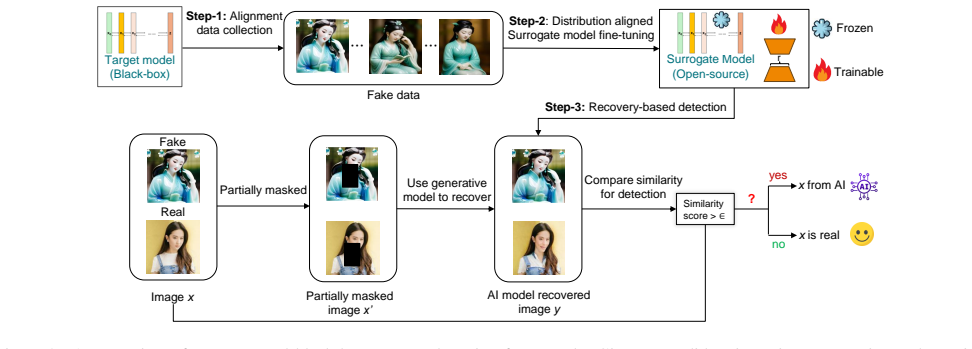
The load-bearing object is the corrupt-and-recover discrepancy score: for an image x, a binary mask m splits it into known pixels X=(1−m)⊙x and unknown pixels Y0=m⊙x; the model samples K reconstructions Y′∼G(·|X), and the PSNR (Peak Signal-to-Noise Ratio) between Y0 and the recovered region is the detection statistic. It is paired with the Likelihood-Gap Hypothesis, which asserts that E_{Y∼G(·|X)}[log p(Y|X)]−E_{Y∼H(·|X)}[log p(Y|X)]>Δ, the formal reason a model should repair its own outputs better. The third component is distribution alignment: LoRA fine-tuning of an open surrogate on fewer than 1,000 target-API samples synchronizes the surrogate's distribution with the closed target model, letting the recovery test work when the API only generates from scratch. The theory also fixes the number of recovery samples at K=Ω(σ log(1/δ)/$Δ^{2}$) via a Hoeffding and sub-Gaussian argument.
What would settle it
Take the paper's paired DALL-E 3 benchmark, mask half of each image, compute PSNR recovery scores with a surrogate aligned to DALL-E 3, and estimate the likelihood-gap Δ between fake and real images; if the AUROC of the recovery score approaches 0.5 (or Δ is statistically indistinguishable from zero) once image resolution and photorealism are high enough, the central claim is falsified for that model.
Extended reading notes
Core claim
On the paper's own terms, the discovery is that a generative model should more easily recover its own generated images when corrupted than it would with real images. The detector masks a region, samples K recoveries from the model conditioned on the unmasked pixels, and scores the discrepancy with PSNR; a high recovery score marks the image as machine-generated. For black-box APIs that do not accept masked inputs, the paper aligns an open-source surrogate (Stable Diffusion) to the target distribution by LoRA fine-tuning on a small set of API samples, then runs the same recovery test with the surrogate. The formal statement is the Likelihood-Gap Hypothesis: conditioned on the known pixels, the expected log-likelihood of the machine generation process exceeds that of the real-image process by a positive gap $\Delta$, and the paper argues this gap makes reliable detection possible even when the total-variation distance is small. Empirically the framework reports 86.61% mean average precision across eight diffusion-model variants (Guided, LDM, Glide, DALL-E, DALL-E 3), including a new paired DALL-E 3 benchmark on which human accuracy is about 72%.
Load-bearing premise
The entire detector depends on the assumption that a machine generation process assigns measurably higher conditional likelihood to its own masked images than the real-photo process does; for a photorealistic model such as DALL-E 3, if this likelihood gap shrinks to zero, the recovery score no longer separates fake from real.
Editorial extensions
If this is right
- AI-content detection no longer requires white-box access: any model reachable through an API can be tested by its own repair behavior, so detectors scale to closed commercial generators.
- A single open surrogate (Stable Diffusion) aligned with a small API sample set detects images from many unseen diffusion architectures, so per-model retraining is unnecessary.
- The choice of discrepancy metric matters materially: PSNR outperforms SSIM, L1, and L2 by large margins, so future detectors should treat the scoring function as a first-class design choice.
- In the white-box setting, using the target model itself for recovery gives the strongest separation (e.g., FPR 10.80% and AUROC 97.18% on Guided Diffusion), so the same framework covers both settings.
- Detection accuracy falls on photorealistic DALL-E 3 images (75.98% AP) even though humans only reach about 72% accuracy, indicating the recovery signal survives but weakens as generation quality improves.
Reading between the lines
- If the Likelihood-Gap Hypothesis generalizes, the same mask-and-repair principle could be applied to video, audio, and text by substituting a domain-appropriate recovery model and scoring function; the paper only demonstrates images.
- The paper's own DALL-E 3 numbers suggest the gap Δ shrinks as generators approach the real-image manifold; a testable prediction is that for future photorealistic models, the PSNR separation will narrow and LoRA alignment will become the dominant factor.
- The recovery score could be repurposed as a model-attribution or membership test: among several candidate APIs, the model that repairs an image best is likely its source, which would extend binary fake/real detection to source identification.
- An adversary aware of the detector could potentially craft images whose masked regions are hard to repair, so robustness of the recovery score under adversarial generation is an open question the paper does not address.
Signed reviews
Editorial analysis
A structured set of objections, weighed in public.
Referee Report
Summary. The manuscript proposes a black-box detector for AI-generated images based on a corrupt-and-recover principle: a surrogate generative model, aligned to the target model via LoRA fine-tuning on a small set of API-generated images, reconstructs masked regions, and a PSNR-based score separates real from generated images. Experiments report 86.61% mean average precision across eight diffusion-model variants using a Stable Diffusion surrogate, with less than 1,000 alignment samples and under two GPU hours. The paper also introduces a paired DALL-E 3 benchmark and a human-evaluation study, and releases code.
Significance. If the empirical claims hold with a clean evaluation protocol, the method is practically valuable: it removes the need for model weights and large real-image corpora, and it offers a resource-efficient black-box detection route. The idea of aligning a surrogate by parameter-efficient fine-tuning is sound and the reported gains over the included baselines are substantial. The paper also ships code and a new paired benchmark, which are useful community resources. However, the central empirical claim currently rests on an unstated train/test split for the alignment set, and the most relevant baseline, DIRE, is missing; both issues must be resolved before the stated performance numbers can be taken at face value.
major comments (4)
- [§3.2 and §4.1, Table 1] The manuscript never states whether the alignment dataset S, collected from the target-model API in Section 3.2, is disjoint from the fake test images used to compute the detection scores in Table 1. This is load-bearing: if S contains or overlaps the test generated images, the LoRA-fine-tuned surrogate is evaluated on images it was fine-tuned on, so the reported 86.61 mAP and the Table 2 improvement from 86.74 to 92.97 AP after fine-tuning could reflect memorization rather than generalization. Please specify the exact split (e.g., generate a fresh set of target-model images for testing after collecting S) and rerun Table 1 and Table 2 on a truly held-out set of target-generated images, reporting the numbers for both the overlapped and disjoint settings.
- [§2.2 and §4.2, Table 1] DIRE [43] is cited in Related Work as observing that diffusion-generated images can be approximately reconstructed by a diffusion model while real images cannot, which is the same recovery-based principle used here. DIRE is therefore the most directly relevant baseline, yet it is not included in Table 1 or anywhere in the experiments. Without a DIRE comparison, the claim of outperforming baseline methods by 4.31% mAP is not fully supported. Please add DIRE to Table 1 and to the new DALL-E 3 benchmark, using the same evaluation protocol.
- [§3.3 and Appendix A.1] The Likelihood-Gap Hypothesis assumes a positive gap Delta between the expected log-likelihood of the machine generation process G and the real process H, but Delta is not derived and H is not defined as a concrete process for real photographs. Appendix A.1 then uses this hypothesis to conclude that detection is always possible, but the conclusion is conditional on the assumed gap, not a guarantee. Please clarify the status of the hypothesis: state explicitly that it is an assumption, provide a definition of H, and either prove or empirically test the existence of the gap for the models considered, or weaken the theoretical claims accordingly.
- [§4.2, DALL-E 3 benchmark] The paper introduces a new paired DALL-E 3 benchmark, but no detector results are reported on it. The benchmark is only used for the human-preference study in Section 4.4. Since the DALL-E 3 setting is described as especially challenging and the paper claims a practical detector, please report the proposed method's AP/AUROC/FPR95 on this benchmark and compare with at least the strongest baselines from Table 1, or explicitly state that the benchmark is released for future work only.
minor comments (5)
- [§3, Preliminary on Diffusion Models] The word 'numerious' should be 'numerous'.
- [§4.3, Visualization] The word 'obervations' should be 'observations' in the visualization paragraph.
- [§4.1, Metrics] The threshold definition 'selected based on the fake data when 95% of fake test data points are declared as fake' is ambiguous; please clarify whether this is FPR at 95% recall on the fake class or another convention, and state the threshold-selection protocol used for the other metrics.
- [Table 1 and Table 2] The manuscript alternates between 'AP' and 'mAP' for the same column; please use one consistent notation and define it in the caption.
- [§4.2, New dataset for DALL-E 3] The paper does not specify how many image pairs are in the new DALL-E 3 benchmark or how the LLaVA-generated captions were filtered; please add dataset statistics and a brief filtering description.
Circularity Check
No circularity found: the recovery hypothesis is explicit and empirically supported, and LoRA alignment is a transfer step rather than a fitted prediction.
full rationale
The paper's claimed derivation chain is: (1) a generative model recovers its own outputs better than real images (an explicit hypothesis); (2) this recovery gap is measured by a discrepancy score; (3) for black-box APIs, a surrogate is LoRA-tuned on target-model images; (4) the resulting score is evaluated for real-vs-fake discrimination. Step (1) is labeled a hypothesis, not derived from the detection target, and it is supported by Figure 1 and the ablations in Tables 2 and 3. Step (3) is a genuine transfer step: the surrogate is fine-tuned on target images and then tested on the real-vs-fake classification task, so the target quantity is the gap between classes, not the fine-tuning loss itself. The single self-citation [46] is used only to motivate the intuition and is not load-bearing for the empirical claims, which are compared against external baselines. The theoretical appendix explicitly calls the gap a hypothesis and derives only conditional guarantees, such as the sample complexity of K; no equation in the paper reduces to its own input by construction. The one serious concern is experimental hygiene: the paper does not state whether the alignment set S is disjoint from the fake test images in Table 1. If S overlapped the test fake set, the reported AP could be inflated by memorization, but the paper does not define the test set as a subset of S, so this remains a reproducibility risk rather than an in-text circular reduction. Under the hard rule requiring quoted evidence of a specific construction, no circular step is established.
Assumptions & free parameters
free parameters (3)
- Decision threshold tau =
not reported
- Recovery sample count K =
not reported
- Alignment dataset size N =
claimed under 1,000
assumptions (4)
- domain assumption Likelihood-Gap Hypothesis: E_Y~G[log p(Y|X)] - E_Y~H[log p(Y|X)] > Delta > 0 for masked inputs.
- domain assumption Assumption 1: the distances D(Y0,Y') and D(~Y0,Y') are sigma-sub-Gaussian with a positive distance gap Delta.
- domain assumption LAION images represent the real-world distribution H for all tested domains.
- domain assumption A LoRA fine-tuned open-source surrogate faithfully approximates the target model's distribution for masked recovery.
Cite this review
Pith. "Pith review of Where's the liability in the Generative Era? Recovery-based Black-Box Detection of AI-Generated Content." pith.science (2026). https://pith.science/paper/PI2H6TLP
@misc{pith2026250501008,
  author       = {Pith},
  title        = {Pith review of: Where's the liability in the Generative Era? Recovery-based Black-Box Detection of AI-Generated Content},
  year         = {2026},
  howpublished = {\url{https://pith.science/paper/PI2H6TLP}},
  note         = {Machine review of arXiv:2505.01008}
}
read the original abstract
The recent proliferation of photorealistic images created by generative models has sparked both excitement and concern, as these images are increasingly indistinguishable from real ones to the human eye. While offering new creative and commercial possibilities, the potential for misuse, such as in misinformation and fraud, highlights the need for effective detection methods. Current detection approaches often rely on access to model weights or require extensive collections of real image datasets, limiting their scalability and practical application in real world scenarios. In this work, we introduce a novel black box detection framework that requires only API access, sidestepping the need for model weights or large auxiliary datasets. Our approach leverages a corrupt and recover strategy: by masking part of an image and assessing the model ability to reconstruct it, we measure the likelihood that the image was generated by the model itself. For black-box models that do not support masked image inputs, we incorporate a cost efficient surrogate model trained to align with the target model distribution, enhancing detection capability. Our framework demonstrates strong performance, outperforming baseline methods by 4.31% in mean average precision across eight diffusion model variant datasets.
Figures


Figures from the paper (3 more)


Reference graph
Works this paper leans on
-
[43]
Dire for diffusion-generated image detection
Zhendong Wang, Jianmin Bao, Wengang Zhou, Weilun Wang, Hezhen Hu, Hong Chen, and Houqiang Li. Dire for diffusion-generated image detection. In Proceedings of the IEEE/CVF International Conference on Computer Vision , pages 22445–22455, 2023. 3
2023
-
[1]
Feed two birds with one scone: Exploiting wild data for both out-of-distribution gen- eralization and detection
Haoyue Bai, Gregory Canal, Xuefeng Du, Jeongyeol Kwon, Robert D Nowak, and Yixuan Li. Feed two birds with one scone: Exploiting wild data for both out-of-distribution gen- eralization and detection. In International Conference on Machine Learning, pages 1454–1471. PMLR, 2023. 2
2023
-
[2]
Synthbuster: Towards detection of diffu- sion model generated images
Quentin Bammey. Synthbuster: Towards detection of diffu- sion model generated images. IEEE Open Journal of Signal Processing, 2023. 2
work page 2023
-
[3]
James Betker, Gabriel Goh, Li Jing, Tim Brooks, Jianfeng Wang, Linjie Li, Long Ouyang, Juntang Zhuang, Joyce Lee, Yufei Guo, Wesam Manassra, Prafulla Dhariwal, Casey Chu, and Yunxin Jiao. https://openai.com/dall-e-3 ,
-
[4]
Improving image generation with better captions
James Betker, Gabriel Goh, Li Jing, Tim Brooks, Jianfeng Wang, Linjie Li, Long Ouyang, Juntang Zhuang, Joyce Lee, Yufei Guo, et al. Improving image generation with better captions. Computer Science. https://cdn. openai. com/papers/dall-e-3. pdf, 2(3):8, 2023. 1, 2
2023
-
[5]
Large scale gan training for high fidelity natural image synthesis
Andrew Brock, Jeff Donahue, and Karen Simonyan. Large scale gan training for high fidelity natural image synthesis. arXiv preprint arXiv:1809.11096, 2018. 2
arXiv 2018
-
[6]
What makes fake images detectable? understanding proper- ties that generalize
Lucy Chai, David Bau, Ser-Nam Lim, and Phillip Isola. What makes fake images detectable? understanding proper- ties that generalize. In Computer Vision–ECCV 2020: 16th European Conference, Glasgow, UK, August 23–28, 2020, Proceedings, Part XXVI 16, pages 103–120. Springer, 2020. 1, 2, 5, 6
work page 2020
-
[7]
Muse: Text-to-image generation via masked generative transform- ers
Huiwen Chang, Han Zhang, Jarred Barber, AJ Maschinot, Jose Lezama, Lu Jiang, Ming-Hsuan Yang, Kevin Mur- phy, William T Freeman, Michael Rubinstein, et al. Muse: Text-to-image generation via masked generative transform- ers. arXiv preprint arXiv:2301.00704, 2023. 2
arXiv 2023
Show all 52 references
-
[8]
Stargan: Unified genera- tive adversarial networks for multi-domain image-to-image translation
Yunjey Choi, Minje Choi, Munyoung Kim, Jung-Woo Ha, Sunghun Kim, and Jaegul Choo. Stargan: Unified genera- tive adversarial networks for multi-domain image-to-image translation. In Proceedings of the IEEE conference on computer vision and pattern recognition, pages 8789–8797,
-
[9]
On the detection of synthetic images generated by diffusion mod- els
Riccardo Corvi, Davide Cozzolino, Giada Zingarini, Gio- vanni Poggi, Koki Nagano, and Luisa Verdoliva. On the detection of synthetic images generated by diffusion mod- els. In ICASSP 2023-2023 IEEE International Conference on Acoustics, Speech and Signal Processing (ICASSP), p...
2023
-
[10]
Forensictrans- fer: Weakly-supervised domain adaptation for forgery detec- tion
Davide Cozzolino, Justus Thies, Andreas R ¨ossler, Christian Riess, Matthias Nießner, and Luisa Verdoliva. Forensictrans- fer: Weakly-supervised domain adaptation for forgery detec- tion. arXiv preprint arXiv:1812.02510, 2018. 3
2018 arXiv
-
[11]
Diffusion models beat gans on image synthesis, 2021
Prafulla Dhariwal and Alex Nichol. Diffusion models beat gans on image synthesis, 2021. 5
2021
-
[12]
Diffusion models beat gans on image synthesis
Prafulla Dhariwal and Alexander Nichol. Diffusion models beat gans on image synthesis. Advances in neural informa- tion processing systems, 34:8780–8794, 2021. 2, 12
2021
-
[13]
Lighting (in) consistency of paint by text
Hany Farid. Lighting (in) consistency of paint by text. arXiv preprint arXiv:2207.13744, 2022. 3
2022 arXiv
-
[14]
Perspective (in) consistency of paint by text
Hany Farid. Perspective (in) consistency of paint by text. arXiv preprint arXiv:2206.14617, 2022. 3
2022 arXiv
-
[15]
Are gan generated im- ages easy to detect? a critical analysis of the state-of-the-art
Diego Gragnaniello, Davide Cozzolino, Francesco Marra, Giovanni Poggi, and Luisa Verdoliva. Are gan generated im- ages easy to detect? a critical analysis of the state-of-the-art. In 2021 IEEE international conference on multimedia and expo (ICME), pages 1–6. IEEE, 2021. 3
2021
-
[16]
Denoising diffusion models for out-of-distribution detection
Mark S Graham, Walter HL Pinaya, Petru-Daniel Tudosiu, Parashkev Nachev, Sebastien Ourselin, and Jorge Cardoso. Denoising diffusion models for out-of-distribution detection. In Proceedings of the IEEE/CVF Conference on Computer Vision and Pattern Recognition, pages 2948–2957, ...
2023
-
[17]
Deep residual learning for image recognition
Kaiming He, Xiangyu Zhang, Shaoqing Ren, and Jian Sun. Deep residual learning for image recognition. In Proceed- ings of the IEEE conference on computer vision and pattern recognition, pages 770–778, 2016. 5
2016
-
[18]
Denoising dif- fusion probabilistic models
Jonathan Ho, Ajay Jain, and Pieter Abbeel. Denoising dif- fusion probabilistic models. Advances in neural information processing systems, 33:6840–6851, 2020. 3, 4
2020
-
[19]
Lora: Low-rank adaptation of large language models
Edward J Hu, Yelong Shen, Phillip Wallis, Zeyuan Allen- Zhu, Yuanzhi Li, Shean Wang, Lu Wang, and Weizhu Chen. Lora: Low-rank adaptation of large language models. arXiv preprint arXiv:2106.09685, 2021. 4
2021 arXiv
-
[20]
Fake trump arrest photos: How to spot an ai-generated image
Kayleen Devlin and Joshua Cheetham. Fake trump arrest photos: How to spot an ai-generated image. BBC News ,
-
[21]
Single-model attribution of generative models through final-layer inversion
Mike Laszkiewicz, Jonas Ricker, Johannes Lederer, and Asja Fischer. Single-model attribution of generative models through final-layer inversion. arXiv preprint arXiv:2306.06210, 2023. 1
2023 arXiv
-
[22]
Asymptotic methods in statistical decision theory
Lucien Le Cam. Asymptotic methods in statistical decision theory. Springer Science & Business Media, 2012. 11
2012
-
[23]
Detecting gan-generated images by orthogo- nal training of multiple cnns
Sara Mandelli, Nicol `o Bonettini, Paolo Bestagini, and Ste- fano Tubaro. Detecting gan-generated images by orthogo- nal training of multiple cnns. In 2022 IEEE International Conference on Image Processing (ICIP), pages 3091–3095. IEEE, 2022. 3
2022
-
[24]
Do gans leave artificial fingerprints? In 2019 IEEE conference on multimedia information process- ing and retrieval (MIPR), pages 506–511
Francesco Marra, Diego Gragnaniello, Luisa Verdoliva, and Giovanni Poggi. Do gans leave artificial fingerprints? In 2019 IEEE conference on multimedia information process- ing and retrieval (MIPR), pages 506–511. IEEE, 2019. 2
2019
-
[25]
Ex- ploiting visual artifacts to expose deepfakes and face manip- ulations
Falko Matern, Christian Riess, and Marc Stamminger. Ex- ploiting visual artifacts to expose deepfakes and face manip- ulations. In 2019 IEEE Winter Applications of Computer Vision Workshops (WACVW), pages 83–92. IEEE, 2019. 2
2019
-
[26]
Detecting gan- generated imagery using color cues
Scott McCloskey and Michael Albright. Detecting gan- generated imagery using color cues. arXiv preprint arXiv:1812.08247, 2018. 2
2018 arXiv
-
[27]
Glide: Towards photorealistic image generation and editing with text-guided diffusion models.arXiv preprint arXiv:2112.10741, 2021
Alex Nichol, Prafulla Dhariwal, Aditya Ramesh, Pranav Shyam, Pamela Mishkin, Bob McGrew, Ilya Sutskever, and Mark Chen. Glide: Towards photorealistic image generation and editing with text-guided diffusion models.arXiv preprint arXiv:2112.10741, 2021. 2, 3, 5, 12
2021 arXiv
-
[28]
Towards uni- versal fake image detectors that generalize across genera- tive models
Utkarsh Ojha, Yuheng Li, and Yong Jae Lee. Towards uni- versal fake image detectors that generalize across genera- tive models. In Proceedings of the IEEE/CVF Conference on Computer Vision and Pattern Recognition, pages 24480– 24489, 2023. 2, 3, 5
2023
-
[29]
Im- age transformer
Niki Parmar, Ashish Vaswani, Jakob Uszkoreit, Lukasz Kaiser, Noam Shazeer, Alexander Ku, and Dustin Tran. Im- age transformer. In International conference on machine learning, pages 4055–4064. PMLR, 2018. 2
2018
-
[30]
Zero-shot text-to-image generation
Aditya Ramesh, Mikhail Pavlov, Gabriel Goh, Scott Gray, Chelsea V oss, Alec Radford, Mark Chen, and Ilya Sutskever. Zero-shot text-to-image generation. In International confer- ence on machine learning, pages 8821–8831. Pmlr, 2021. 1, 5, 12
2021
-
[31]
Hierarchical text-conditional image gener- ation with clip latents
Aditya Ramesh, Prafulla Dhariwal, Alex Nichol, Casey Chu, and Mark Chen. Hierarchical text-conditional image gener- ation with clip latents. arXiv preprint arXiv:2204.06125, 1 (2):3, 2022. 2, 3
2022 arXiv
-
[32]
Towards the detection of diffusion model deepfakes
Jonas Ricker, Simon Damm, Thorsten Holz, and Asja Fis- cher. Towards the detection of diffusion model deepfakes. arXiv preprint arXiv:2210.14571, 2022. 3
2022 arXiv
-
[33]
High-resolution image syn- thesis with latent diffusion models, 2021
Robin Rombach, Andreas Blattmann, Dominik Lorenz, Patrick Esser, and Bj¨orn Ommer. High-resolution image syn- thesis with latent diffusion models, 2021. 12
2021
-
[34]
High-resolution image synthesis with latent diffusion models
Robin Rombach, Andreas Blattmann, Dominik Lorenz, Patrick Esser, and Bj ¨orn Ommer. High-resolution image synthesis with latent diffusion models. In Proceedings of the IEEE/CVF Conference on Computer Vision and Pattern Recognition (CVPR), pages 10684–10695, 2022. 4
2022
-
[35]
High-resolution image synthesis with latent diffusion models
Robin Rombach, Andreas Blattmann, Dominik Lorenz, Patrick Esser, and Bj ¨orn Ommer. High-resolution image synthesis with latent diffusion models. In Proceedings of the IEEE/CVF conference on computer vision and pattern recognition, pages 10684–10695, 2022. 1, 2, 3, 5
2022
-
[36]
Can ai-generated text be reliably detected? arXiv preprint arXiv:2303.11156,
Vinu Sankar Sadasivan, Aounon Kumar, Sriram Balasubra- manian, Wenxiao Wang, and Soheil Feizi. Can ai-generated text be reliably detected? arXiv preprint arXiv:2303.11156,
-
[37]
Laion-400m: Open dataset of clip-filtered 400 million image-text pairs
Christoph Schuhmann, Richard Vencu, Romain Beaumont, Robert Kaczmarczyk, Clayton Mullis, Aarush Katta, Theo Coombes, Jenia Jitsev, and Aran Komatsuzaki. Laion-400m: Open dataset of clip-filtered 400 million image-text pairs. arXiv preprint arXiv:2111.02114, 2021. 5
2021 arXiv
-
[38]
Laion-5b: An open large-scale dataset for training next generation image-text models
Christoph Schuhmann, Romain Beaumont, Richard Vencu, Cade Gordon, Ross Wightman, Mehdi Cherti, Theo Coombes, Aarush Katta, Clayton Mullis, Mitchell Worts- man, et al. Laion-5b: An open large-scale dataset for training next generation image-text models. Advances in Neural In- f...
2022
-
[39]
De-fake: Detection and attribution of fake images generated by text- to-image generation models
Zeyang Sha, Zheng Li, Ning Yu, and Yang Zhang. De-fake: Detection and attribution of fake images generated by text- to-image generation models. In Proceedings of the 2023 ACM SIGSAC Conference on Computer and Communica- tions Security, pages 3418–3432, 2023. 3
2023
-
[40]
Gemini 1.5: Unlocking multimodal understanding across millions of tokens of con- text
Gemini Team, Petko Georgiev, Ving Ian Lei, Ryan Burnell, Libin Bai, Anmol Gulati, Garrett Tanzer, Damien Vincent, Zhufeng Pan, Shibo Wang, et al. Gemini 1.5: Unlocking multimodal understanding across millions of tokens of con- text. arXiv preprint arXiv:2403.05530, 2024. 2
2024 arXiv
-
[41]
Uk engineering giant arup falls victim to deepfake scam in hong kong
The Guardian. Uk engineering giant arup falls victim to deepfake scam in hong kong. The Guardian, 2024. 1
2024
-
[42]
Cnn-generated images are surprisingly easy to spot
Sheng-Yu Wang, Oliver Wang, Richard Zhang, Andrew Owens, and Alexei A Efros. Cnn-generated images are surprisingly easy to spot... for now. In Proceedings of the IEEE/CVF conference on computer vision and pattern recognition, pages 8695–8704, 2020. 2, 3, 5, 6
2020
-
[44]
Where did i come from? origin attribution of ai-generated images
Zhenting Wang, Chen Chen, Yi Zeng, Lingjuan Lyu, and Shiqing Ma. Where did i come from? origin attribution of ai-generated images. Advances in neural information pro- cessing systems, 36, 2024. 1, 3
2024
-
[45]
Lecture notes for stat 705: Advanced data analysis, 2023
Larry Wasserman. Lecture notes for stat 705: Advanced data analysis, 2023. 11
2023
-
[46]
Dna-gpt: Divergent n-gram analysis for training-free detection of gpt-generated text
Xianjun Yang, Wei Cheng, Yue Wu, Linda Ruth Petzold, William Yang Wang, and Haifeng Chen. Dna-gpt: Divergent n-gram analysis for training-free detection of gpt-generated text. In The Twelfth International Conference on Learning Representations. 2
-
[47]
Attributing fake images to gans: Learning and analyzing gan fingerprints
Ning Yu, Larry S Davis, and Mario Fritz. Attributing fake images to gans: Learning and analyzing gan fingerprints. In Proceedings of the IEEE/CVF international conference on computer vision, pages 7556–7566, 2019. 2
2019
-
[48]
Styleswin: Transformer-based gan for high-resolution image genera- tion
Bowen Zhang, Shuyang Gu, Bo Zhang, Jianmin Bao, Dong Chen, Fang Wen, Yong Wang, and Baining Guo. Styleswin: Transformer-based gan for high-resolution image genera- tion. In Proceedings of the IEEE/CVF conference on com- puter vision and pattern recognition , pages 11304–11314,
-
[49]
Detecting and simulating artifacts in gan fake images
Xu Zhang, Svebor Karaman, and Shih-Fu Chang. Detecting and simulating artifacts in gan fake images. In2019 IEEE in- ternational workshop on information forensics and security (WIFS), pages 1–6. IEEE, 2019. 2, 3, 5, 6
2019
-
[50]
Unpaired image-to-image translation using cycle- consistent adversarial networks
Jun-Yan Zhu, Taesung Park, Phillip Isola, and Alexei A Efros. Unpaired image-to-image translation using cycle- consistent adversarial networks. In Proceedings of the IEEE international conference on computer vision , pages 2223– 2232, 2017. 2
2017
-
[51]
Genimage: A million-scale benchmark for de- tecting ai-generated image
Mingjian Zhu, Hanting Chen, Qiangyu Yan, Xudong Huang, Guanyu Lin, Wei Li, Zhijun Tu, Hailin Hu, Jie Hu, and Yunhe Wang. Genimage: A million-scale benchmark for de- tecting ai-generated image. Advances in Neural Information Processing Systems, 36, 2024. 2
2024
-
[52]
Conditional text image generation with diffu- sion models
Yuanzhi Zhu, Zhaohai Li, Tianwei Wang, Mengchao He, and Cong Yao. Conditional text image generation with diffu- sion models. In Proceedings of the IEEE/CVF Conference on Computer Vision and Pattern Recognition, pages 14235– 14245, 2023. 2 A. Theoretical Analysis A.1. Is it alw...
2023
Reviewed August 16, 2026 · model on record in the stance chip above.
Discussion (0). Continue with ORCID to comment.