REVIEW 5 major objections 4 minor 21 references
Quantum Energy Teleportation across Multi-Qubit Systems using W-State Entanglement
T0 review · 5 major / 4 minor · reviewed 2026-08-16 · deepseek-v4-flash
Pith's one-line read The paper claims that a W-state circuit enables the first multi-qubit quantum energy teleportation, with one sender's injected energy harvested in decreasing shares by several receivers.
desk verdict The paper's quantitative core is internally inconsistent — the tabulated values cannot be expectation values of the defined Hamiltonians — so the claimed multi-qubit QET demonstration is unsupported. read the letter →
The pith
A machine-rendered reading of the paper's core claim, the machinery that carries it, and where it could break.
The reading
What carries the argument
The engine of the protocol is the n-qubit W state, |W_n> = (|100...0> + |010...0> + ... + |00...01>)/$\sqrt$(n), which keeps all qubits entangled in a single-excitation superposition and, unlike the GHZ state, retains entanglement of the unmeasured parties after one qubit is measured. The energy bookkeeping runs on the single-qubit projectors H_i = |1><1|_i and their partial sums H_subm, with the total Hamiltonian H_total = sum H_i + V and E0 = $h^{2}$/($h^{2}$+$k^{2}$) determined by the weights of the vacuum and W components of the initial state. The circuit preparation uses an efficient W-state construction whose gate count scales logarithmically in the number of qubits.
What would settle it
The decisive calculation is to take the prepared W-state circuit with the stated h,k, run Alice's X measurement and each receiver's conditional unitary, then evaluate Tr(rho_i |1><1|_i) on each receiver's reduced state; the paper's Eq. (5) identity H_sub1 = H_1 + H_2 can then be checked against Tables 1-3 in one pass, and the tables already contain all quantities needed to see whether the numbers are consistent with the operators they are named after.
Extended reading notes
Core claim
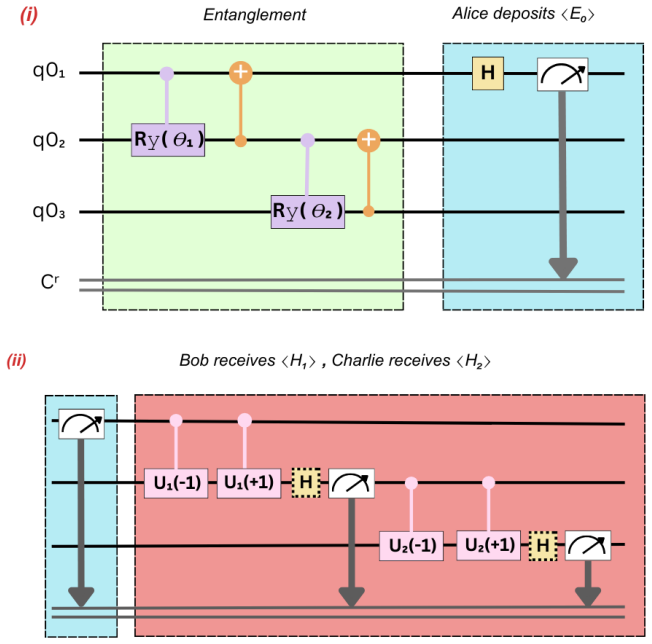
On the paper's own terms, the discovery is that a W-state multipartite entangled channel supports a multi-receiver QET protocol: after preparing a W state with tunable weight of the single-excitation term, Alice performs a projective measurement with outcome mu = +/-1, sends that bit over a classical channel, and each receiver applies a conditional unitary (identity for mu = +1, Z for mu = -1) before measuring the local energy. The measured subsystem Hamiltonians H_subm decrease monotonically with m, so the injected energy E0 appears to be distributed decrementally across the network. The paper reports this pattern both in noiseless simulation and on a real superconducting device, and says the protocol passes translational-symmetry and exchange-symmetry checks, confirming that the decrement is intrinsic to the W-state resource rather than an artifact of a particular ordering.
Load-bearing premise
The load-bearing premise is that the values reported as H_n and H_subm in Tables 1-3 are energies in the QET sense, i.e., expectation values of H_n=|1><1|_n and the subsystem sums defined in Eq. (5); the paper's own numbers (e.g., H_1=1.0531 in Table 1, which exceeds the maximum eigenvalue of |1><1|) show this identification cannot be taken for granted, so if it fails the central claim collapses.
Editorial extensions
If this is right
- If the claim holds, QET moves from a two-party effect to a network effect: energy injected at one node can be split among any number of entangled receivers.
- The protocol conserves energy: the sum of all harvested subsystem energies stays below E0, and causality is preserved because each receiver needs the classical bit before acting.
- Because the W state survives single-qubit measurement, the remaining receivers can still harvest after one measurement, which the paper argues is impossible with GHZ-type states.
- The measured translational and exchange symmetry of the harvest pattern means the decremental distribution is a property of the W-state protocol, not of a specific measurement order.
- The reduced-gate W-state preparation gives a practical logarithmic circuit depth, so the scheme is not limited to three qubits and extends to larger registers.
Reading between the lines
- A test the paper does not run is to reconstruct the post-feed-forward density matrix of each receiver and compute Tr(rho_i |1><1|_i) directly from the circuit; matching the tabulated decrement would confirm the numbers are expectation values of the stated operators.
- Sweeping the h,k parameters beyond the two values used here would probe whether the decrement scales linearly with E0 as the paper's formula implies; a nonlinear scaling would point to the tables' numbers being operator-independent artifacts.
- If the identification of H_n with |1><1|_n is maintained, the protocol is actually teleporting an excitation of the computational basis, and the connection to thermodynamic energy would require adding a genuine interaction term V rather than setting it to zero after measurement.
- The same W-state architecture could be used for multi-receiver entanglement-assisted communication tasks beyond energy, such as broadcast remote state preparation, since only one classical bit and the same conditional unitaries are involved.
Signed reviews
Editorial analysis
A structured set of objections, weighed in public.
Referee Report
Summary. The paper claims to realize the first multi-qubit quantum energy teleportation (QET) protocol using W-state entanglement. It presents three-, four-, and five-qubit circuits executed on a noiseless simulator and on the IBMQ Lagos hardware. The central claim is that a single sender injects an energy E0, which is then deterministically and decrementally harvested by several remote receivers, with energy conservation and causality respected. The manuscript reports energy tables for each system size, two symmetry tests, and a graphical comparison of simulator versus hardware results. The authors argue that their reduced-gate W-state preparation gives logarithmic circuit depth and that the protocol is robust enough for NISQ-era hardware.
Significance. If the central claim were correct, this would be the first experimental multi-qubit QET demonstration and would be a useful step toward energy-aware quantum networks. The paper has constructive elements: it addresses a meaningful multipartite generalization, uses W-state entanglement for robustness against single-qubit measurement, provides explicit circuits, and includes both simulator and real-hardware runs. However, the quantitative core of the paper is internally inconsistent: the tabulated energy values do not follow from the operators and formulas defined in the text, the stated injected energy E0 disagrees with Eq. (8), the subsystem Hamiltonians violate Eq. (5), and no extractable-work observable or interaction Hamiltonian V is defined. Because the central energy-distribution claim rests entirely on these numbers, the result is not supported by the manuscript as written. The significance of the paper is therefore contingent on a major revision that supplies a consistent energy accounting and a genuine QET observable.
major comments (5)
- [§5, Table 1; §3.2, Eq. (10)] The entries labelled H_n are not expectation values of the operator defined in Eq. (10). That operator, H_n = |1><1|_n = (I-Z_n)/2, has spectrum {0,1}, so any valid expectation value must lie in [0,1]. For the qasm simulator with (h,k)=(2,1), Table 1 reports H1 = 1.0531, which exceeds the maximum eigenvalue of the operator. The same table gives H2 = 0.3396 for the same settings, which is not inconsistent by itself, but the H1 value cannot be an expectation value of the defined Hamiltonian. This invalidates the identification of the tabulated numbers with the energies of the protocol.
- [§3.2, Eq. (8); §5, Table 1] The reported injected energy E0 does not follow from the stated formula. Equation (8) gives E0 = h^2/(h^2+k^2), which for (h,k)=(2,1) equals 0.8, whereas Table 1 reports E0 = 1.7888. For (h,k)=(1,1), Eq. (8) gives 0.5, while the table reports 0.7071. The discrepancy is systematic and large, so the claim that E0 is the injected energy and that the harvested energies conserve energy against E0 cannot be checked from the equations given.
- [§3.1, Eq. (5); §5, Table 1] The subsystem Hamiltonians violate their defining relation. Equation (5) defines H_subm = sum_{i=m}^{N-1} H_i, so for three qubits H_sub1 = H1 + H2. For the qasm simulator with (h,k)=(2,1), Table 1 gives H_sub1 = 0.7314 while H1 + H2 = 1.0531 + 0.3396 = 1.3927. The (h,k)=(1,1) row gives H_sub1 = 0.1809 versus H1 + H2 = 0.5255 + 0.1702 = 0.6957. Thus the decremental pattern in the tables is not the sum of the individual qubit energies, contradicting the manuscript's own definition.
- [§3.3 and §3.4] No genuine QET energy-extraction mechanism is defined. The only receiver operation is the conditional feed-forward U_mu = I or Z on each receiver qubit. Since Z commutes with the local Hamiltonian H_n = |1><1|_n and the spectrum of H_n is nonnegative, applying this unitary cannot change the expectation value of H_n in the post-measurement state. The protocol also never specifies the interaction Hamiltonian V appearing in Eq. (3), which is the term responsible for negative-energy pockets in standard QET. Consequently, the paper provides no calculation showing that energy can be extracted from the receivers under the stated operators.
- [§4, Symmetry Test] The symmetry tests are built into the construction and do not provide independent support for the QET claim. The W state is permutation-symmetric by construction, so exchange symmetry under swapping receiver order is guaranteed for any symmetric observable and does not test the protocol. Similarly, H_subm is defined as a sum of identical local projectors over the remaining qubits, so measuring this sum from different nodes trivially gives the same value. Passing these checks therefore says nothing about whether energy was teleported.
minor comments (4)
- [§3.2, Eq. (7)] The state in Eq. (7) is written with h and k as real nonnegative parameters, but the text does not state their normalization convention beyond the denominator sqrt(h^2+k^2); please clarify whether the parameters are meant to be directly comparable to the experimental amplitudes or are simply circuit angles.
- [§5, Table headings] The tables use inconsistent notation: the total Hamiltonian is called Htot in Tables 1–3 but H_total in Eq. (3); the injected energy is E0 in Eq. (8) and Eo in the tables. Please unify the notation.
- [§6 and Figure 9] The device name is written both as 'IBMQ Lagos' and 'ibm lagos'; please use a single consistent name. The error map in Figure 9 is not clearly connected to the measured energy deviations, and its role in the analysis should be stated.
- [§7] The conclusion repeats the claim of 'first experimental realisation' and 'energy conservation' without referring to the specific equations that would back these statements; please cite the relevant calculations or data tables explicitly.
Circularity Check
Central 'predictions' are definitional artifacts: E0 is an input parameter, Hsub decrements are partial sums, and the symmetry tests restate W-state symmetry.
-
self definitional
[Sec. 3.2, Eqs. (7)-(9)]
"The real parameters h and k tune the relative weight of the true vacuum and the single-excitation WN component; they completely determine the energy that can be unlocked in the subsequent QET protocol. ... E0 = h^2/(h^2+k^2). ... Htotal = E0"
Eq. (8) does not predict E0 from the QET protocol; it defines E0 as the squared amplitude of the single-excitation component in the prepared initial state |psi_init> of Eq. (7). Eq. (9) then identifies the total Hamiltonian with this same input parameter. Any later statement that the injected energy E0 is 'conserved' or 'distributed' reduces to this definition: the 'harvested' energy is the number inserted by the choice of h and k, not an independently measured or derived consequence of the protocol.
-
renaming known result
[Sec. 4.1, Translational Symmetry]
"After measuring Alice's energy, the remaining subsystem has a Hamiltonian of Hsub1, which is measured to be the same from any node of the subsystem. So, our design passes the test."
The W state is, by definition, completely symmetric under permutation of its qubits. Therefore any node-independent expectation value of a permutation-invariant local Hamiltonian is automatically the same from every node. The 'translational symmetry test' is a restatement of the known permutation symmetry of the input W state, not a check of the QET feed-forward or of energy transfer. Passing this test is guaranteed by the choice of input state, so it cannot confirm the QET mechanism.
1 more flagged steps
-
self definitional
[Eq. (5) and Sec. 5, Results Analysis]
"Hsubm = sum_{i=m}^{N-1} H_i ... the energy readings ... gradually decrease according to who measures first. This is because each Hamiltonian incorporates the Hamiltonians of their substructures."
Hsubm is defined as a tail sum starting at index m. Consequently Hsub1, Hsub2, ... are successive partial sums of the same sequence, and the chain Htot > Hsub1 > Hsub2 > ... holds identically whenever the H_i are nonnegative. The observed 'decremental energy distribution' is therefore a mathematical property of the partial-sum definition in Eq. (5), not an empirical consequence of energy being redistributed among entangled receivers by the QET protocol.
full rationale
The paper's central demonstration rests on Tables 1-3 being 'energy readings' of the operators H_n = |1><1| and Hsubm = sum H_i. Those identifications are internally impossible: for h=2, k=1, Eq. (8) gives E0 = 4/5, while Table 1 lists E0 = 1.7888; H1 = 1.0531 exceeds the spectral bound of 1 for the projector |1><1|; and Hsub1 = 0.7314 does not equal the required H1 + H2 = 1.3927. These are failures of internal consistency and correctness, not circularity by themselves. What is circular is the structure presented as confirmation: E0 is defined, not measured, by the chosen (h,k); the monotone decrease of Hsub values is an identity from the tail-sum definition in Eq. (5); and the translational and exchange symmetry checks follow automatically from the known permutation symmetry of the W state, so they do not test the LOCC feed-forward or the energy-extraction mechanism. Additionally, the conditional I/Z feed-forward cannot increase the expectation of the nonnegative local projector H_n, so no QET energy extraction is demonstrated under the paper's own definitions. Since some of the paper's 'predictions' reduce to its inputs by construction, while the central empirical claim fails on independent consistency grounds, the circularity score is 6.
Assumptions & free parameters
free parameters (2)
- h =
2 and 1
- k =
1
assumptions (4)
- ad hoc to paper The projective measurement by the sender (Eq. 6) injects an energy E0 = h^2/(h^2+k^2) into the entire entangled system.
- domain assumption The conditional operation U_mu = I or Z on each receiver implements sigma_mu^{-1} and converts a negative-energy pocket into positive local excitation (Section 3.3).
- domain assumption After Alice's measurement, the remaining qubits remain entangled so that each subsequent receiver can harvest energy (Section 3.1).
- ad hoc to paper The subsystem Hamiltonian H_subm = sum_{i=m}^{N-1} H_i (Eq. 5) obeys the decremental pattern in Tables 1-3.
Cite this review
Pith. "Pith review of Quantum Energy Teleportation across Multi-Qubit Systems using W-State Entanglement." pith.science (2026). https://pith.science/paper/3QVEGKMV
@misc{pith2026250501863,
  author       = {Pith},
  title        = {Pith review of: Quantum Energy Teleportation across Multi-Qubit Systems using W-State Entanglement},
  year         = {2026},
  howpublished = {\url{https://pith.science/paper/3QVEGKMV}},
  note         = {Machine review of arXiv:2505.01863}
}
read the original abstract
Quantum-energy teleportation (QET) has so far only been realised on a two-qubit platform. Real-world communication, however, typically involves multiple parties. Here we design and experimentally demonstrate the first multi-qubit QET protocol using a robust W-state multipartite entanglement. Three-, four- and five-qubit circuits were executed both on noiseless simulators and on IBM superconducting hardware. In every case a single sender injects an energy E0 that is then deterministically and decrementally harvested by several remote receivers, confirming that energy introduced at one node can be redistributed among many entangled subsystems at light-speed-limited classical latency. Our results open a practical route toward energy-aware quantum networks.
Figures


Figures from the paper (6 more)


Reference graph
Works this paper leans on
-
[14]
Efficient quantum algo- rithms for GHZ and W states, and implementation on the IBM quantum computer
Diogo Cruz, Romain Fournier, Fabien Gremion, Alix Jeannerot, Kenichi Komagata, Tara Tosic, Jarla Thiesbrummel, Chun Lam Chan, Nicolas Macris, Marc-Andr´ e Dupertuis, and others. Efficient quantum algo- rithms for GHZ and W states, and implementation on the IBM quantum computer. Advanced Quantum Technologies, 2(5-6):1900015, 2019
work page 2019
-
[1]
Quantum energy tele- portation without a limit of distance
Masahiro Hotta, Jiro Matsumoto, and Go Yusa. Quantum energy tele- portation without a limit of distance. Physical Review A, 89(1):012311, 2014
work page 2014
-
[2]
Quantum energy teleportation: an introductory review
Masahiro Hotta. Quantum energy teleportation: an introductory review. arXiv preprint arXiv:1101.3954 , 2011
arXiv 2011
-
[3]
Quantum energy teleportation in spin chain systems
Masahiro Hotta. Quantum energy teleportation in spin chain systems. Journal of the Physical Society of Japan , 78(3):034001, 2009
work page 2009
-
[4]
Demonstration of quantum energy teleporta- tion on superconducting quantum hardware
Kazuki Ikeda and others. Demonstration of quantum energy teleporta- tion on superconducting quantum hardware. Physical Review Applied , 20(2):024051, 2023
work page 2023
-
[5]
First realization of quantum energy teleportation on quantum hardware
Kazuki Ikeda. First realization of quantum energy teleportation on quantum hardware. arXiv preprint arXiv:2301.02666 , 2023
arXiv 2023
-
[6]
Bennett, Gilles Brassard, Claude Cr´ epeau, Richard Jozsa, Asher Peres, and William K
Charles H. Bennett, Gilles Brassard, Claude Cr´ epeau, Richard Jozsa, Asher Peres, and William K. Wootters. Teleporting an unknown quan- tum state via dual classical and Einstein-Podolsky-Rosen channels. Physical Review Letters, 70(13):1895, 1993
work page 1993
-
[7]
Preparation of partially entangled W state and deterministic multi-controlled teleportation
Ya-Hong Wang and He-Shan Song. Preparation of partially entangled W state and deterministic multi-controlled teleportation. Optics Com- munications, 281(3):489–493, 2008
work page 2008
Show all 21 references
-
[8]
Everything you always wanted to know about LOCC (but were afraid to ask)
Eric Chitambar, Debbie Leung, Laura Manˇ cinska, Maris Ozols, and Andreas Winter. Everything you always wanted to know about LOCC (but were afraid to ask). Communications in Mathematical Physics , 328:303–326, 2014
2014
-
[9]
Quantum entanglement and information
Jeffrey Bub. Quantum entanglement and information. 2001
2001
-
[10]
Wu, Marcelo S
L.-A. Wu, Marcelo S. Sarandy, and D. A. Lidar. Quantum phase transitions and bipartite entanglement. Physical Review Letters , 93(25):250404, 2004
2004
-
[11]
Panigrahi
Rajiuddin Sk, Tadasha Dash, and Prasanta K. Panigrahi. Quantum information splitting of an arbitrary three-qubit state by using three sets of GHZ states. IET Quantum Communication, 2(3):122–135, 2021. 20
2021
-
[12]
Ignacio Cirac
Wolfgang D¨ ur, Guifre Vidal, and J. Ignacio Cirac. Three qubits can be entangled in two inequivalent ways. Physical Review A , 62(6):062314, 2000
2000
-
[13]
Generating multi-atom entangled W states via light-matter inter- face based fusion mechanism
Xue-Ping Zang, Ming Yang, Fatih Ozaydin, Wei Song, and Zhuo-Liang Cao. Generating multi-atom entangled W states via light-matter inter- face based fusion mechanism. Scientific Reports, 5(1):16245, 2015
2015
-
[15]
The compositional structure of multi- partite quantum entanglement
Bob Coecke and Aleks Kissinger. The compositional structure of multi- partite quantum entanglement. arXiv preprint arXiv:1002.2540 , 2010
2010 arXiv
-
[16]
The computational power of the W and GHZ states
Ellie D’Hondt and Prakash Panangaden. The computational power of the W and GHZ states. arXiv preprint quant-ph/0412177 , 2006
2006 arXiv
-
[17]
Ground-state entanglement gives birth to quantum energy teleportation
Masahiro Hotta. Ground-state entanglement gives birth to quantum energy teleportation. In Quantum Communication and Quantum Net- working: First International Conference, QuantumComm 2009, Naples, Italy, October 26-30, 2009, Revised Selected Papers 1 , pages 66–73. Springer, 2010
2009
-
[18]
Probing many-body localization by excited-state variational quan- tum eigensolver
Shuo Liu, Shi-Xin Zhang, Chang-Yu Hsieh, Shengyu Zhang, and Hong Yao. Probing many-body localization by excited-state variational quan- tum eigensolver. Physical Review B, 107(2):024204, 2023
2023
-
[19]
Entanglement in many-body systems
Luigi Amico, Rosario Fazio, Andreas Osterloh, and Vlatko Vedral. Entanglement in many-body systems. Reviews of Modern Physics , 80(2):517, 2008
2008
-
[20]
Energy entanglement relation for quantum energy tele- portation
Masahiro Hotta. Energy entanglement relation for quantum energy tele- portation. Physics Letters A , 374(34):3416–3421, 2010
2010
-
[21]
Funda- mental limits of quantum error mitigation
Ryuji Takagi, Suguru Endo, Shintaro Minagawa, and Mile Gu. Funda- mental limits of quantum error mitigation. npj Quantum Information , 8(1):114, 2022. 21
2022
Reviewed August 16, 2026 · model on record in the stance chip above.
Discussion (0). Continue with ORCID to comment.