REVIEW 3 major objections 3 minor 82 references
Hole-spin qubits in germanium beyond the single-particle regime
T0 review · 3 major / 3 minor · reviewed 2026-08-16 · deepseek-v4-flash
Pith's one-line read Three holes make germanium spin qubits up to 100 times faster
desk verdict Solid first pass at three-hole Ge qubits, but the two-orders Rabi claim is anchored to a narrow harmonic-dot anticrossing and needs a robustness check before I'd bet on it. read the letter →
The pith
A machine-rendered reading of the paper's core claim, the machinery that carries it, and where it could break.
The reading
What carries the argument
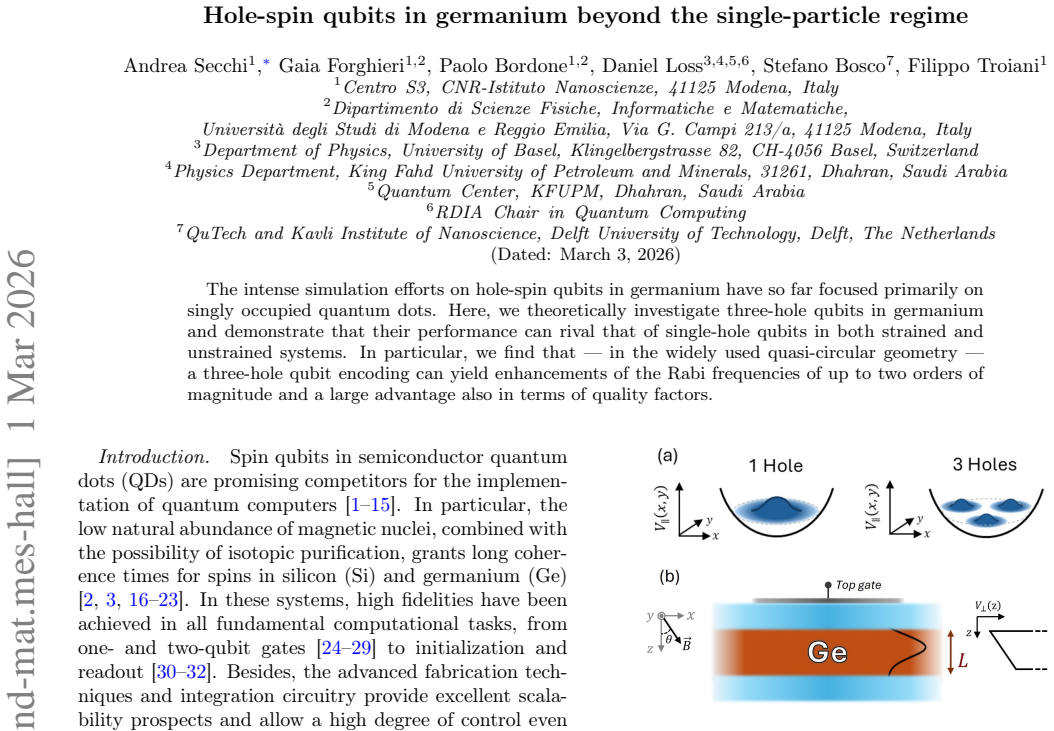
The calculation is built on a six-band Luttinger-Kohn envelope-function (k·p) Hamiltonian for single holes in a Ge quantum dot, including Zeeman and Peierls couplings, and on full configuration interaction: the three-hole Slater determinants are formed from 64 converged single-particle states and diagonalized with the Coulomb interaction. The qubit is the ground Kramers doublet split by a magnetic field; the Rabi frequency is $f_R^{(k)}=(e/h)\,|\delta\mathbf E_R\cdot\langle0^{(k)}|\hat{\mathbf r}|1^{(k)}\rangle|$ and the dephasing time is set by the charge-noise matrix-element difference of $\hat{\mathbf r}$ between the two qubit states. The key comparison is between the interacting three-hole qubit, the noninteracting three-hole state, and the single-hole qubit, which isolates the role of Pauli-exclusion-driven orbital occupation from the role of hole-hole Coulomb interactions.
What would settle it
Measure the Rabi frequency as a function of the dot's in-plane shape in a single three-hole germanium dot: the theory predicts a non-monotonic curve with a large enhancement near circular shape and sharp peaks near $\hbar\omega_x\approx3.8$ meV, while a monotonic curve would refute the mechanism. A second check is to repeat the calculation with more than the 64 single-particle states used here; if the Rabi matrix elements shift substantially, the enhancement estimate is not converged.
Extended reading notes
Core claim
The central discovery is a performance crossover: for dots with nearly equal in-plane confinement energies ($\hbar\omega_x\gtrsim5$ meV, with $\hbar\omega_y=6$ meV), the three-hole qubit has Rabi frequencies that exceed the single-hole qubit's by up to two orders of magnitude, while its $g$ factor stays comparable and the dephasing time under charge noise is shortened only modestly, so the quality factor $Q_x\equiv f_{R,x}\tau$ is larger. The enhancement is traced to the Pauli principle: the third hole must occupy an excited orbital, and the resulting orbital structure, with an antiferromagnetic ordering of the heavy-hole pseudospin components, makes the ground-state doublet far more sensitive to the in-plane electric field. Comparing against a noninteracting three-hole system shows that most of the gain is Pauli-driven, with Coulomb interactions a smaller but non-negligible contributor. Sharp additional peaks near $\hbar\omega_x\approx3.8$ meV are attributed to a narrow anticrossing between the first and second excited doublets.
Load-bearing premise
The prediction assumes that an idealized harmonic dot described by 64 single-particle states is a faithful stand-in for a real germanium dot; a real potential with disorder could wash out the narrow level crossing that produces the largest Rabi peaks.
Editorial extensions
If this is right
- Three-hole dots become a viable qubit platform without needing to reach the single-occupation regime, which is experimentally easier to realize.
- In quasi-circular dots, Rabi frequencies up to about 100 times larger than in single-hole dots imply faster gates at the same drive amplitude.
- Biaxial strain reduces absolute Rabi frequencies and lengthens dephasing times by comparable factors, so strain does not decide the single-versus-three-hole comparison.
- The $g$-factor anisotropy of the three-hole qubit follows the same $\cos\theta$ law as the single-hole qubit, so established magnetic-field-control procedures transfer directly.
- The sharp Rabi peaks at $\hbar\omega_x\approx3.8$ meV identify a specific dot-aspect-ratio sweet spot tied to an excited-state anticrossing.
Reading between the lines
- Beyond the paper: if Pauli-enforced occupation of excited orbitals is the cause, similar Rabi enhancements should appear for five- and seven-hole dots and possibly in silicon hole dots; this is a direct, testable extension.
- Beyond the paper: the predicted antiferromagnetic ordering of the heavy-hole pseudospin along the weak-confinement axis could be probed with spin-dependent tunneling or charge-sensing experiments; confirming it would independently test the mechanism.
- Beyond the paper: the narrow-anticrossing Rabi peaks near $\hbar\omega_x\approx3.8$ meV are the least robust predictions, since a realistic non-harmonic potential or disorder will shift or broaden them; the broad quasi-circular enhancement is the safer design target.
Signed reviews
Editorial analysis
A structured set of objections, weighed in public.
Referee Report
Summary. The manuscript studies three-hole spin qubits in Ge quantum dots using a six-band k.p envelope-function model with full configuration interaction, and compares their g-factors, Rabi frequencies, and charge-noise dephasing times with single-hole qubits in the same dots. It considers both unstrained MOS-like dots and strained Ge/SiGe heterostructures, with a harmonic in-plane confinement potential and magnetic fields oriented parallel or perpendicular to the growth direction. The central claim is that, in quasi-circular dots, the three-hole encoding can yield Rabi frequencies up to two orders of magnitude larger than the single-hole one, with a quality-factor advantage; the enhancement is attributed mostly to Pauli-driven occupation of excited orbitals, with a quantitatively smaller but non-negligible Coulomb-interaction contribution. The paper reports strong g-factor anisotropy, non-monotonic dependence of the three-hole Rabi frequency on dot aspect ratio, and a strain-induced reduction of Rabi frequencies that is partly balanced by longer dephasing times.
Significance. The question addressed is timely and experimentally relevant: whether going beyond single-hole occupancy can improve qubit figures of merit in Ge. The theoretical framework is standard and transparent, combining a six-band k.p model with full configuration interaction, and the inclusion of the noninteracting three-hole system as a diagnostic cleanly separates Pauli and Coulomb effects. No fitting to the claimed enhancement is involved; material parameters come from the literature and device parameters are scanned. If the central quantitative claims survive robustness checks, the work would give a concrete motivation for three-hole single-dot encodings as a practical alternative to single-hole qubits. However, the headline two-orders-of-magnitude enhancement and the quality-factor advantage presently rest on convergence and potential-robustness assertions that are not fully demonstrated in the submitted material.
major comments (3)
- [Quantum-dot model, methods paragraph] The statement that 'a set of 64 single-particle states ... ensures the convergence of the relevant quantities' is not demonstrated in the main text for the quantities that actually carry the central claims: the off-diagonal position matrix elements in Eqs. (3) and (5) and the excited doublets involved in the narrow anticrossing near 3.8 meV. The Supplemental Material containing the numerical details is not included in the version under review, so this assertion cannot be checked. I request a convergence study (for example, 64 vs 96 vs 128 single-particle states) reporting f_R and tau at the QD1 and QD2 parameter points and near the 3.8 meV feature, or an explicit statement that the Supplemental Material will be supplied with the resubmission.
- [Single- and three-hole spin qubits, Fig. 3 discussion] The sharp Rabi peaks near hbar*omega_x ≈ 3.8 meV are attributed to a narrow anticrossing between the first and second excited doublet. The in-plane potential of Eq. (1) is an exact 2D harmonic trap, where single-particle level degeneracies occur at rational aspect ratios such as 3.8/6 = 19/30; a weak anharmonicity, a finite-barrier correction, or a realistic gate-defined potential can generically shift or close such an anticrossing. Because the same feature is invoked in the dephasing section to explain the strong variation of tau near 3.8 meV, the two-orders-of-magnitude Rabi claim and the quality-factor advantage inherit this model sensitivity. I ask for a robustness test with a small anharmonic term or a realistic confinement profile, or alternatively for a quantitative statement of the enhancement in the quasi-circular region (hbar*omega_x > 5 meV) that does not rely on the 3.8 meV feature.
- [Abstract, Table II, Fig. 3 discussion] The abstract states that the quasi-circular geometry yields a Rabi-frequency enhancement of up to two orders of magnitude. In the numerical tables, the quasi-circular point QD2 (hbar*omega_x = 5.5 meV) shows strained f_R,x ratios of roughly 14 for theta=0 deg and 13.5 for theta=90 deg (Table II), i.e., about one order, and Table I lists only three-hole Rabi frequencies, so the unstrained two-orders ratio cannot be checked against single-hole values from the provided tables. The text instead ties the two-orders enhancement to the sharp 3.8 meV peak, which is not in the quasi-circular regime. Please specify explicitly where the two-orders enhancement occurs and report the corresponding single-hole Rabi values, so that the headline claim is verifiable and not overbroad.
minor comments (3)
- [Table I caption] The caption says that parenthetical values are the Rabi frequencies of the noninteracting three-hole qubit, but parenthetical entries also appear in the g-factor columns; please clarify what the parenthetical numbers mean for each column.
- [Introduction vs. Single- and three-hole spin qubits section] The Introduction says the Rabi gain is caused for the largest part by Pauli occupation with a smaller Coulomb contribution, while the later section says the difference between interacting and noninteracting cases is 'always remarkable' and that Rabi frequencies are 'strongly affected' by Coulomb interactions; please reconcile these statements with a quantitative example.
- [Text and captions (various)] There are several typos: 'ovecompensates' should be 'overcompensates' in the dephasing paragraph, and 'out fo plane' should be 'out of plane' in the Fig. 5 caption; please also check for other similar errors.
Circularity Check
No significant circularity: the Rabi-frequency and dephasing results are obtained by direct diagonalization of a k·p Hamiltonian with externally fixed parameters, with no fitted input feeding the predicted enhancement.
full rationale
The central quantities—g-factors, Rabi frequencies, and dephasing times—are all computed from the eigenvalues and matrix elements of the few-hole Hamiltonian, with material parameters (Luttinger parameters, spin-orbit gap, elastic constants, and strain) taken from the literature and device parameters (ℏωx, ℏωy, B, δE_R, and E_cn) chosen as independent swept amplitudes rather than fitted to the target enhancement. Equation (3) defines the Rabi frequency from the computed dipole matrix element ⟨0^(k)|r|1^(k)⟩, and Eq. (5) defines dephasing from a charge-noise matrix element; neither equation receives the reported two-orders-of-magnitude result as an input. The paper does invoke earlier work by the same authors for the k·p and configuration-interaction methodology, but the claimed three-hole-over-single-hole enhancement is computed in this paper, not imported from those citations, and no uniqueness theorem or fitted ansatz is used to force the comparison. The statements that deserve scrutiny are robustness caveats rather than circular reductions: the claim that 64 single-particle states 'ensures the convergence of the relevant quantities' is asserted without a published convergence study for the off-diagonal Rabi matrix elements, and the sharp Rabi peaks at ℏωx ≈ 3.8 meV are explicitly attributed to a 'narrow anticrossing between the first and second excited doublet,' whose model sensitivity is a correctness risk. Neither of these makes the derivation equivalent to its inputs. I therefore find no circularity in the paper's derivation chain.
Assumptions & free parameters
free parameters (7)
- In-plane confinement energies =
hbar omega_y = 6 meV; hbar omega_x = 3 to 5.5 meV
- Out-of-plane well parameters =
L = 10 nm, s = 0.02 nm, e_perp = 1 meV/nm; W not specified in main text
- Magnetic field amplitude and orientation =
B = 0.05 T, phi = 45 degrees, theta = 0 or 90 degrees
- Oscillating electric field amplitude =
|delta E_R| = 1 mV/nm
- Charge-noise induced electric field =
|E_cn| = 10^-2 mV/nm
- Single-particle basis size =
64 states
- Biaxial strain parameter =
epsilon_parallel = -0.0063
assumptions (6)
- domain assumption The six-band Luttinger-Kohn k.p model with parameters gamma1 = 13.38, gamma2 = 4.24, gamma3 = 5.69 captures the valence-band structure near the Gamma point.
- domain assumption The FCI basis of 64 single-particle states is complete enough for converged Rabi frequencies and g-factors.
- domain assumption Charge noise is modeled as a homogeneous quasi-static electric field, and dephasing is given by the first-order energy difference in Eq. (5).
- standard math The qubit is defined by the ground Kramers doublet split by the magnetic field, and the Rabi frequency is computed for a resonant drive.
- domain assumption The in-plane potential is a two-dimensional anisotropic harmonic well and the vertical confinement is a smooth tanh well with a linear dc electric field.
- domain assumption The Bir-Pikus linear strain Hamiltonian with the given diagonal strain tensor describes the biaxial strain effect.
Cite this review
Pith. "Pith review of Hole-spin qubits in germanium beyond the single-particle regime." pith.science (2026). https://pith.science/paper/LFAUIDQV
@misc{pith2026250502449,
  author       = {Pith},
  title        = {Pith review of: Hole-spin qubits in germanium beyond the single-particle regime},
  year         = {2026},
  howpublished = {\url{https://pith.science/paper/LFAUIDQV}},
  note         = {Machine review of arXiv:2505.02449}
}
read the original abstract
The intense simulation efforts on hole-spin qubits in germanium have so far focused primarily on singly occupied quantum dots. Here, we theoretically investigate three-hole qubits in germanium and demonstrate that their performance can rival that of single-hole qubits in both strained and unstrained systems. In particular, we find that -- in the widely used quasi-circular geometry -- a three-hole qubit encoding can yield enhancements of the Rabi frequencies of up to two orders of magnitude and a large advantage also in terms of quality factors.
Figures


Figures from the paper (2 more)


Reference graph
Works this paper leans on
-
[1]
Loss and D
D. Loss and D. P. DiVincenzo, Quantum computation with quantum dots, Phys. Rev. A57, 120 (1998)
1998
-
[2]
Burkard, T
G. Burkard, T. D. Ladd, A. Pan, J. M. Nichol, and J. R. Petta, Semiconductor spin qubits, Rev. Mod. Phys.95, 025003 (2023)
2023
-
[3]
Stano and D
P. Stano and D. Loss, Review of performance metrics of spin qubits in gated semiconducting nanostructures, Nature Reviews Physics4, 672 (2022)
2022
-
[4]
Ishihara, A
L.M.K.Vandersypen, H.Bluhm, J.S.Clarke, A.S.Dzu- rak, R. Ishihara, A. Morello, D. J. Reilly, L. R. Schreiber, and M. Veldhorst, Interfacing spin qubits in quantum dots and donors—hot, dense, and coherent, npj Quan- tum Information3, 34 (2017)
2017
-
[5]
Y. Fang, P. Philippopoulos, D. Culcer, W. A. Coish, and S. Chesi, Recent advances in hole-spin qubits, Materials for Quantum Technology3, 012003 (2023)
2023
-
[6]
Scappucci, C
G. Scappucci, C. Kloeffel, F. A. Zwanenburg, D. Loss, M. Myronov, J.-J. Zhang, S. De Franceschi, G. Katsaros, and M. Veldhorst, The germanium quantum information route, Nature Reviews Materials6, 926 (2021)
2021
-
[7]
R. Maurand, X. Jehl, D. Kotekar-Patil, A. Corna, H. Bo- huslavskyi, R. Laviéville, L. Hutin, S. Barraud, M. Vinet, M. Sanquer, and S. De Franceschi, A cmos silicon spin qubit, Nature Communications7, 13575 (2016)
work page 2016
-
[8]
Jirovec, A
D. Jirovec, A. Hofmann, A. Ballabio, P. M. Mutter, G. Tavani, M. Botifoll, A. Crippa, J. Kukucka, O. Sagi, F. Martins, J. Saez-Mollejo, I. Prieto, M. Borovkov, J. Arbiol, D. Chrastina, G. Isella, and G. Katsaros, A singlet-triplet hole spin qubit in planar Ge, Nature Ma- terials20, 1106 (2021)
2021
Show all 82 references
-
[9]
Steinacker, N
P. Steinacker, N. D. Stuyck, W. H. Lim, T. Tanttu, M. Feng, A. Nickl, S. Serrano, M. Candido, J. D. Ci- fuentes, F. E. Hudson, K. W. Chan, S. Kubicek, J. Jus- sot, Y. Canvel, S. Beyne, Y. Shimura, R. Loo, C. God- frin, B. Raes, S. Baudot, D. Wan, A. Laucht, C. H. Yang, A. Sara...
2024 arXiv
-
[10]
S. D. Liles, D. J. Halverson, Z. Wang, A. Shamim, R. S. Eggli, I. K. Jin, J. Hillier, K. Kumar, I. Vorreiter, M. J. Rendell, J. Y. Huang, C. C. Escott, F. E. Hudson, W. H. Lim, D. Culcer, A. S. Dzurak, and A. R. Hamilton, A singlet-triplet hole-spin qubit in mos silicon, Natur...
2024
-
[11]
L. C. Camenzind, S. Geyer, A. Fuhrer, R. J. Warburton, D. M. Zumbühl, and A. V. Kuhlmann, A hole spin qubit in a fin field-effect transistor above 4Kelvin, Nature Elec- tronics5, 178 (2022)
2022
-
[12]
Geyer, B
S. Geyer, B. Hetényi, S. Bosco, L. C. Camenzind, R. S. Eggli, A. Fuhrer, D. Loss, R. J. Warburton, D. M. Zum- bühl, and A. V. Kuhlmann, Anisotropic exchange inter- action of two hole-spin qubits, Nature Physics20, 1152 (2024)
2024
-
[13]
Neyens, O
S. Neyens, O. K. Zietz, T. F. Watson, F. Luthi, A. Neth- wewala, H. C. George, E. Henry, M. Islam, A. J. Wag- ner, F. Borjans, E. J. Connors, J. Corrigan, M. J. Curry, D. Keith, R. Kotlyar, L. F. Lampert, M. T. Mądzik, K. Millard, F. A. Mohiyaddin, S. Pellerano, R. Pil- larise...
2024
-
[14]
X. Xue, B. Patra, J. P. G. van Dijk, N. Samkharadze, S. Subramanian, A. Corna, B. Paquelet Wuetz, C. Jeon, F. Sheikh, E. Juarez-Hernandez, B. P. Esparza, H. Ram- purawala, B. Carlton, S. Ravikumar, C. Nieva, S. Kim, H.-J. Lee, A. Sammak, G. Scappucci, M. Veldhorst, F. Sebastia...
2021
-
[15]
A. M. J. Zwerver, T. Krähenmann, T. F. Watson, L. Lampert, H. C. George, R. Pillarisetty, S. A. Bojarski, P. Amin, S. V. Amitonov, J. M. Boter, R. Caudillo, D. Correas-Serrano, J. P. Dehollain, G. Droulers, E. M. Henry, R. Kotlyar, M. Lodari, F. Lüthi, D. J. Michalak, B. K. Mu...
2022
-
[16]
Kobayashi, J
T. Kobayashi, J. Salfi, C. Chua, J. van der Heijden, M. G. House, D. Culcer, W. D. Hutchison, B. C. Johnson, J. C. McCallum, H. Riemann, N. V. Abrosimov, P. Becker, H.-J. Pohl, M. Y. Simmons, and S. Rogge, Engineering long spin coherence times of spin–orbit qubits in silicon, ...
2021
-
[17]
N. Piot, B. Brun, V. Schmitt, S. Zihlmann, V. P. Michal, 6 A. Apra, J. C. Abadillo-Uriel, X. Jehl, B. Bertrand, H. Niebojewski, L. Hutin, M. Vinet, M. Urdampilleta, T. Meunier, Y.-M. Niquet, R. Maurand, and S. D. Franceschi, A single hole spin with enhanced coherence in natura...
2022
-
[18]
J. Y. Huang, R. Y. Su, W. H. Lim, M. Feng, B. van Straaten, B. Severin, W. Gilbert, N. Dumoulin Stuyck, T. Tanttu, S. Serrano, J. D. Cifuentes, I. Hansen, A. E. Seedhouse, E. Vahapoglu, R. C. C. Leon, N. V. Abrosi- mov, H.-J. Pohl, M. L. W. Thewalt, F. E. Hudson, C. C. Escott,...
2024
-
[19]
S. G. J. Philips, M. T. Madzik, S. V. Amitonov, S. L. de Snoo, M. Russ, N. Kalhor, C. Volk, W. I. L. Lawrie, D. Brousse, L. Tryputen, B. P. Wuetz, A. Sammak, M. Veldhorst, G. Scappucci, and L. M. K. Vandersypen, Universal control of a six-qubit quantum processor in sil- icon, ...
2022
-
[20]
Zhang, E
X. Zhang, E. Morozova, M. Rimbach-Russ, D. Jirovec, T.-K. Hsiao, P. C. Fariña, C.-A. Wang, S. D. Oosterhout, A. Sammak, G. Scappucci, M. Veldhorst, and L. M. K. Vandersypen, Universal control of four singlet–triplet qubits, Nature Nanotechnology20, 209 (2025)
2025
-
[21]
N. W. Hendrickx, W. I. L. Lawrie, M. Russ, F. van Rigge- len, S. L. de Snoo, R. N. Schouten, A. Sammak, G. Scap- pucci, and M. Veldhorst, A four-qubit germanium quan- tum processor, Nature591, 580 (2021)
2021
-
[22]
C.-A. Wang, V. John, H. Tidjani, C. X. Yu, A. S. Ivlev, C.Déprez, F.vanRiggelen-Doelman, B.D.Woods, N. W. Hendrickx, W. I. L. Lawrie, L. E. A. Stehouwer, S. D. Oosterhout, A. Sammak, M. Friesen, G. Scappucci, S. L. de Snoo, M. Rimbach-Russ, F. Borsoi, and M. Veld- horst,Operat...
2024
-
[23]
H. C. George, M. T. Mądzik, E. M. Henry, A. J. Wag- ner, M. M. Islam, F. Borjans, E. J. Connors, J. Corrigan, M. Curry, M. K. Harper, D. Keith, L. Lampert, F. Luthi, F.A.Mohiyaddin, S.Murcia, R.Nair, R.Nahm, A.Neth- wewala, S. Neyens, B. Patra, R. D. Raharjo, C. Rogan, R. Savy...
2025
-
[24]
Scappucci, and S
A.Noiri, K.Takeda, T.Nakajima, T.Kobayashi, A.Sam- mak, G. Scappucci, and S. Tarucha, Fast universal quan- tum gate above the fault-tolerance threshold in silicon, Nature601, 338 (2022)
2022
-
[25]
Yoneda, K
J. Yoneda, K. Takeda, T. Otsuka, T. Nakajima, M. R. Delbecq, G. Allison, T. Honda, T. Kodera, S. Oda, Y. Hoshi, N. Usami, K. M. Itoh, and S. Tarucha, A quantum-dot spin qubit with coherence limited by charge noise and fidelity higher than 99.9%, Nature Nanotech- nology13, 102 (2018)
2018
-
[26]
X. Xue, M. Russ, N. Samkharadze, B. Undseth, A. Sam- mak, G. Scappucci, and L. M. K. Vandersypen, Quantum logic with spin qubits crossing the surface code threshold, Nature601, 343 (2022)
2022
-
[27]
W. I. L. Lawrie, M. Russ, F. van Riggelen, N. W. Hendrickx, S. L. de Snoo, A. Sammak, G. Scap- pucci, and M. Veldhorst, Simultaneous driving of semi- conductor spin qubits at the fault-tolerant threshold, arXiv:2109.07837 (2021)
2021 arXiv
-
[28]
A. R. Mills, C. R. Guinn, M. J. Gullans, A. J. Sigillito, M. M. Feldman, E. Nielsen, and J. R. Petta, Two-qubit silicon quantum processor with operation fidelity exceed- ing 99%, Science Advances8, eabn5130 (2022)
2022
-
[29]
A. J. Weinstein, M. D. Reed, A. M. Jones, R. W. An- drews, D. Barnes, J. Z. Blumoff, L. E. Euliss, K. Eng, B. H. Fong, S. D. Ha, D. R. Hulbert, C. A. C. Jack- son, M. Jura, T. E. Keating, J. Kerckhoff, A. A. Kiselev, J. Matten, G. Sabbir, A. Smith, J. Wright, M. T. Rakher, T. ...
2023
-
[30]
Mills, C
A. Mills, C. Guinn, M. Feldman, A. Sigillito, M. Gullans, M. Rakher, J. Kerckhoff, C. Jackson, and J. Petta, High- fidelity state preparation, quantum control, and readout of an isotopically enriched silicon spin qubit, Phys. Rev. Appl.18, 064028 (2022)
2022
-
[31]
Kobayashi, T
T. Kobayashi, T. Nakajima, K. Takeda, A. Noiri, J. Yoneda, and S. Tarucha, Feedback-based active reset of a spin qubit in silicon, npj Quantum Information9, 52 (2023)
2023
-
[32]
Takeda, A
K. Takeda, A. Noiri, T. Nakajima, L. C. Camen- zind, T. Kobayashi, A. Sammak, G. Scappucci, and S. Tarucha, Rapid single-shot parity spin readout in a silicon double quantum dot with fidelity exceeding 99%, npj Quantum Information10, 22 (2024)
2024
-
[33]
M. D. Michielis, E. Ferraro, E. Prati, L. Hutin, B. Bertrand, E. Charbon, D. J. Ibberson, and M. F. Gonzalez-Zalba,Siliconspinqubitsfromlaboratorytoin- dustry, Journal of Physics D: Applied Physics56, 363001 (2023)
2023
-
[34]
Saraiva, W
A. Saraiva, W. H. Lim, C. H. Yang, C. C. Escott, A. Laucht, and A. S. Dzurak, Materials for silicon quan- tum dots and their impact on electron spin qubits, Ad- vanced Functional Materials32, 2105488 (2022)
2022
-
[35]
Bellentani, M
L. Bellentani, M. Bina, S. Bonen, A. Secchi, A. Bertoni, S. P. Voinigescu, A. Padovani, L. Larcher, and F. Troiani, Toward hole-spin qubits inSip-MOSFETs within a pla- nar CMOS foundry technology, Phys. Rev. Applied16, 054034 (2021)
2021
-
[36]
Petit, M
L. Petit, M. Russ, G. H. G. J. Eenink, W. I. L. Lawrie, J. S. Clarke, L. M. K. Vandersypen, and M. Veldhorst, Design and integration of single-qubit rotations and two- qubit gates in silicon above one Kelvin, Communications Materials3, 82 (2022)
2022
-
[37]
D. V. Bulaev and D. Loss, Spin relaxation and deco- herence of holes in quantum dots, Phys. Rev. Lett.95, 076805 (2005)
2005
-
[38]
D. V. Bulaev and D. Loss, Electric dipole spin resonance for heavy holes in quantum dots, Phys. Rev. Lett.98, 097202 (2007)
2007
-
[39]
Bosco, B
S. Bosco, B. Hetényi, and D. Loss, Hole spin qubits in SiFinFETs with fully tunable spin-orbit coupling and sweet spots for charge noise, PRX Quantum2, 010348 (2021)
2021
-
[40]
Bosco, M
S. Bosco, M. Benito, C. Adelsberger, and D. Loss, Squeezed hole spin qubits in Ge quantum dots with ul- trafast gates at low power, Phys. Rev. B104, 115425 (2021)
2021
-
[41]
S. D. Liles, F. Martins, D. S. Miserev, A. A. Kiselev, I. D. Thorvaldson, M. J. Rendell, I. K. Jin, F. E. Hudson, M. Veldhorst, K. M. Itoh, O. P. Sushkov, T. D. Ladd, A. S. Dzurak, and A. R. Hamilton, Electrical control of thegtensor of the first hole in a silicon MOS quantum ...
2021
-
[42]
V. P. Michal, B. Venitucci, and Y.-M. Niquet, Longi- tudinal and transverse electric field manipulation of hole spin-orbit qubits in one-dimensional channels, Phys. Rev. B103, 045305 (2021)
2021
-
[43]
V. John, F. Borsoi, Z. György, C.-A. Wang, G. Széchenyi, F. van Riggelen-Doelman, W. I. L. Lawrie, N. W. Hen- drickx, A. Sammak, G. Scappucci, A. Pályi, and M. Veld- horst, Bichromatic Rabi control of semiconductor qubits, Phys. Rev. Lett.132, 067001 (2024)
2024
-
[44]
Bosco, S
S. Bosco, S. Geyer, L. C. Camenzind, R. S. Eggli, A. Fuhrer, R. J. Warburton, D. M. Zumbühl, J. C. Egues, A. V. Kuhlmann, and D. Loss, Phase-driving hole spin qubits, Phys. Rev. Lett.131, 197001 (2023)
2023
-
[45]
M. J. Carballido, S. Svab, R. S. Eggli, T. Patlatiuk, P. C. Kwon, J. Schuff, R. M. Kaiser, L. C. Camenzind, A. Li, N. Ares, E. P. A. M. Bakkers, S. Bosco, J. C. Egues, D. Loss, and D. M. Zumbühl, Compromise-free scaling of qubit speed and coherence, arXiv.2402.07313 (2024)
2024 arXiv
-
[46]
Kloeffel, M
C. Kloeffel, M. J. Rančić, and D. Loss, Direct rashba spin-orbit interaction in Si and Ge nanowires with differ- ent growth directions, Phys. Rev. B97, 235422 (2018)
2018
-
[47]
Adelsberger, M
C. Adelsberger, M. Benito, S. Bosco, J. Klinovaja, and D. Loss, Hole-spin qubits in Ge nanowire quantum dots: Interplay of orbital magnetic field, strain, and growth direction, Phys. Rev. B105, 075308 (2022)
2022
-
[48]
J. C. Abadillo-Uriel, E. A. Rodríguez-Mena, B. Mar- tinez, and Y.-M. Niquet, Hole-spin driving by strain- induced spin-orbit interactions, Phys. Rev. Lett.131, 097002 (2023)
2023
-
[49]
Fischer, W
J. Fischer, W. A. Coish, D. V. Bulaev, and D. Loss, Spin decoherence of a heavy hole coupled to nuclear spins in a quantum dot, Phys. Rev. B78, 155329 (2008)
2008
-
[50]
S.BoscoandD.Loss,Fullytunablehyperfineinteractions of hole spin qubits in Si and Ge quantum dots, Phys. Rev. Lett.127, 190501 (2021)
2021
-
[51]
Cvitkovich, P
L. Cvitkovich, P. Stano, C. Wilhelmer, D. Waldhör, D. Loss, Y.-M. Niquet, and T. Grasser, Coherence limit due to hyperfine interaction with nuclei in the barrier material ofSispin qubits, Phys. Rev. Appl.22, 064089 (2024)
2024
-
[52]
Venitucci, L
B. Venitucci, L. Bourdet, D. Pouzada, and Y.-M. Niquet, Electrical manipulation of semiconductor spin qubits within theg-matrix formalism, Phys. Rev. B98, 155319 (2018)
2018
-
[53]
Secchi, L
A. Secchi, L. Bellentani, A. Bertoni, and F. Troiani, In- teracting holes in Si and Ge double quantum dots: From a multiband approach to an effective-spin picture, Phys. Rev. B104, 035302 (2021)
2021
-
[54]
Stano and D
P. Stano and D. Loss, Quantification of the heavy-hole– light-hole mixing in two-dimensional hole gases, Phys. Rev. B111, 115301 (2025)
2025
-
[55]
N.Ares, V.N.Golovach, G.Katsaros, M.Stoffel, F.Four- nel, L. I. Glazman, O. G. Schmidt, and S. De Franceschi, Nature of tunable holegfactors in quantum dots, Phys. Rev. Lett.110, 046602 (2013)
2013
-
[56]
Forghieri, A
G. Forghieri, A. Secchi, A. Bertoni, P. Bordone, and F. Troiani, Quantum estimation and remote charge sens- ing with a hole-spin qubit in silicon, Phys. Rev. Res.5, 043159 (2023)
2023
-
[57]
Malkoc, P
O. Malkoc, P. Stano, and D. Loss, Charge-noise-induced dephasing in silicon hole-spin qubits, Phys. Rev. Lett. 129, 247701 (2022)
2022
-
[58]
C.-A. Wang, H. E. Ercan, M. F. Gyure, G. Scappucci, M. Veldhorst, and M. Rimbach-Russ, Modeling of planar germanium hole qubits in electric and magnetic fields, npj Quantum Information10, 102 (2024)
2024
-
[59]
Hetényi, S
B. Hetényi, S. Bosco, and D. Loss, Anomalous zero-field splitting for hole spin qubits in Si and Ge quantum dots, Phys. Rev. Lett.129, 116805 (2022)
2022
-
[60]
P. M. Mutter and G. Burkard, All-electrical control of hole singlet-triplet spin qubits at low-leakage points, Phys. Rev. B104, 195421 (2021)
2021
-
[61]
Jirovec, P
D. Jirovec, P. M. Mutter, A. Hofmann, A. Crippa, M. Rychetsky, D. L. Craig, J. Kukucka, F. Martins, A. Ballabio, N. Ares, D. Chrastina, G. Isella, G. Burkard, and G. Katsaros, Dynamics of hole singlet-triplet qubits with largeg-factor differences, Phys. Rev. Lett.128, 126803 (2022)
2022
-
[62]
Fernández-Fernández, Y
D. Fernández-Fernández, Y. Ban, and G. Platero, Quan- tum control of hole spin qubits in double quantum dots, Phys. Rev. Appl.18, 054090 (2022)
2022
-
[63]
Saez-Mollejo, D
J. Saez-Mollejo, D. Jirovec, Y. Schell, J. Kukucka, S. Calcaterra, D. Chrastina, G. Isella, M. Rimbach- Russ, S. Bosco, and G. Katsaros, Exchange anisotropies in microwave-driven singlet-triplet qubits, arXiv.2408.03224 (2024)
2024 arXiv
-
[64]
Bosco and M
S. Bosco and M. Rimbach-Russ, Exchange-only spin-orbit qubits in silicon and germanium (2024), arXiv:2410.05461 [cond-mat.mes-hall]
2024
-
[65]
W. I. L. Lawrie, N. W. Hendrickx, F. van Riggelen, M. Russ, L. Petit, A. Sammak, G. Scappucci, and M. Veldhorst, Spin relaxation benchmarks and individ- ual qubit addressability for holes in quantum dots, Nano Letters20, 7237 (2020)
2020
-
[66]
Voisin, R
B. Voisin, R. Maurand, S. Barraud, M. Vinet, X. Jehl, M. Sanquer, J. Renard, and S. De Franceschi, Electrical control of g-factor in a few-hole silicon nanowire MOS- FET, Nano Letters16, 88 (2016)
2016
-
[67]
H. Liu, T. Zhang, K. Wang, F. Gao, G. Xu, X. Zhang, S.- X. Li, G. Cao, T. Wang, J. Zhang, X. Hu, H.-O. Li, and G.-P. Guo, Gate-tunable spin-orbit coupling in a germa- nium hole double quantum dot, Physical Review Applied 17, 044052 (2022)
2022
-
[68]
V. John, C. X. Yu, B. van Straaten, E. A. Rodríguez- Mena, M. Rodríguez, S. D. Oosterhout, L. E. A. Ste- houwer, G. Scappucci, M. Rimbach-Russ, S. Bosco, F. Borsoi, Y.-M. Niquet, and M. Veldhorst, Robust and localised control of a 10-spin qubit array in germanium, Nature Commu...
2025
-
[69]
V. John, C. X. Yu, B. van Straaten, E. A. Rodríguez- Mena, M. Rodríguez, S. Oosterhout, L. E. A. Stehouwer, G. Scappucci, S. Bosco, M. Rimbach-Russ, Y.-M. Niquet, F. Borsoi, and M. Veldhorst, A two-dimensional 10-qubit array in germanium with robust and localised qubit con- tr...
2025
-
[70]
De Palma, F
F. De Palma, F. Oppliger, W. Jang, S. Bosco, M. Janík, S. Calcaterra, G. Katsaros, G. Isella, D. Loss, and P. Scarlino, Strong hole-photon coupling in planar Ge for probing charge degree and strongly correlated states, Nature Communications15, 10177 (2024)
2024
-
[71]
J. M. Luttinger and W. Kohn, Motion of electrons and holes in perturbed periodic fields, Phys. Rev.97, 869 (1955)
1955
-
[72]
L. C. L. Y. Voon and M. Willatzen,The k·p Method (Springer Berlin, 2009)
2009
-
[73]
L. A. Terrazos, E. Marcellina, Z. Wang, S. N. Copper- smith, M. Friesen, A. R. Hamilton, X. Hu, B. Koiller, 8 A. L. Saraiva, D. Culcer, and R. B. Capaz, Theory of hole-spin qubits in strained germanium quantum dots, Phys. Rev. B103, 125201 (2021)
2021
-
[74]
David Sherrill and H
C. David Sherrill and H. F. Schaefer, The configuration interaction method: Advances in highly correlated ap- proaches (Academic Press, 1999) pp. 143–269
1999
-
[75]
A.Secchi, L.Bellentani, A.Bertoni,andF.Troiani,Inter- and intraband Coulomb interactions between holes in sil- icon nanostructures, Phys. Rev. B104, 205409 (2021)
2021
-
[76]
See the Supplemental Material at ... for further details on: Luttinger-Kohn Hamiltonian (with Bir-Pikus terms); single- and three-hole states calculation; classical equilib- rium configurations of the three-hole states
-
[77]
Fanucchi, G
E. Fanucchi, G. Forghieri, A. Secchi, P. Bordone, and F. Troiani, Giant Rabi frequencies between qubit and excited hole states in silicon quantum dots, Phys. Rev. B 111, 205409 (2025)
2025
-
[78]
G. L. Bir and G. E. Pikus,Symmetry and strain-induced effects in semiconductors(Wiley, 1974)
1974
-
[79]
C. Y.-P. Chao and S. L. Chuang, Spin-orbit-coupling ef- fects on the valence-band structure of strained semicon- ductor quantum wells, Phys. Rev. B46, 4110 (1992)
1992
-
[80]
Secchi and F
A. Secchi and F. Troiani, Envelope-function theory of inhomogeneous strain in semiconductor nanostructures, Phys. Rev. B110, 045420 (2024)
2024
-
[81]
Sverdlov,Strain-Induced Effects in Advanced MOS- FETs(Springer, 2011)
V. Sverdlov,Strain-Induced Effects in Advanced MOS- FETs(Springer, 2011)
2011
-
[82]
Sammak, D
A. Sammak, D. Sabbagh, N. W. Hendrickx, M. Lodari, B. Paquelet Wuetz, A. Tosato, L. Yeoh, M. Bollani, M. Virgilio, M. A. Schubert, P. Zaumseil, G. Capellini, M. Veldhorst, and G. Scappucci, Shallow and undoped germanium quantum wells: A playground for spin and hybrid quantum t...
2019
Reviewed August 16, 2026 · model on record in the stance chip above.
Discussion (0). Continue with ORCID to comment.