REVIEW 3 major objections 6 minor 53 references
Electron density modulation in monolayer $MoS_{2}$ along the phase transition of a relaxor ferroelectric substrate
T0 review · 3 major / 6 minor · reviewed 2026-08-16 · deepseek-v4-flash
Pith's one-line read Monolayer MoS2 on a relaxor ferroelectric loses about 6 µC/cm² of electron density as the substrate turns paraelectric, reversibly and with thermal memory.
desk verdict First TMD/relaxor-ferroelectric study with a solid qualitative PL observation, but the absolute doping numbers rest on an unjustified inversion of a domain-averaged spectrum. read the letter →
The pith
A machine-rendered reading of the paper's core claim, the machinery that carries it, and where it could break.
The reading
What carries the argument
The operative mechanism is the charge balance at the MoS$_2$/SBN interface: in the ferroelectric phase, bound polarization charge on the SBN surface is partially screened by charges in the monolayer, and as the spontaneous polarization $P_S$ vanishes across the relaxor transition, that bound charge disappears and re-weights the electron population in the MoS$_2$. The quantitative tool is a mass-action formula, Eq. (1), that converts the measured trion-to-exciton intensity ratio into an absolute electron density $n_e$ using the trion binding energy ($E_b \simeq 20$ meV), MoS$_2$ effective masses, and a fixed relative quantum yield $\eta_r = 20/3$. This conversion is combined with independent second-harmonic-generation tracking of the SBN phase transition and with a SiO$_2$-supported MoS$_2$ reference sample that supplies the temperature baseline, so the reported doping change is attributed to the substrate transition rather than to ordinary thermal effects.
What would settle it
Perform Hall-effect or capacitance-based carrier-density measurements on the same MoS2/SBN stack while sweeping 30–90 °C and check whether the carrier density drops by about $6\ \mu\mathrm{C}/\mathrm{cm}^2$ with the same hysteresis; a reversible change of comparable size and sign would support the mechanism, while no change or an opposite sign would falsify it. A second check is to measure the photoluminescence at sub-500 nm resolution on a single ferroelectric domain, where the model predicts larger and opposite-sign doping swings on up versus down domains than the averaged value.
Extended reading notes
Core claim
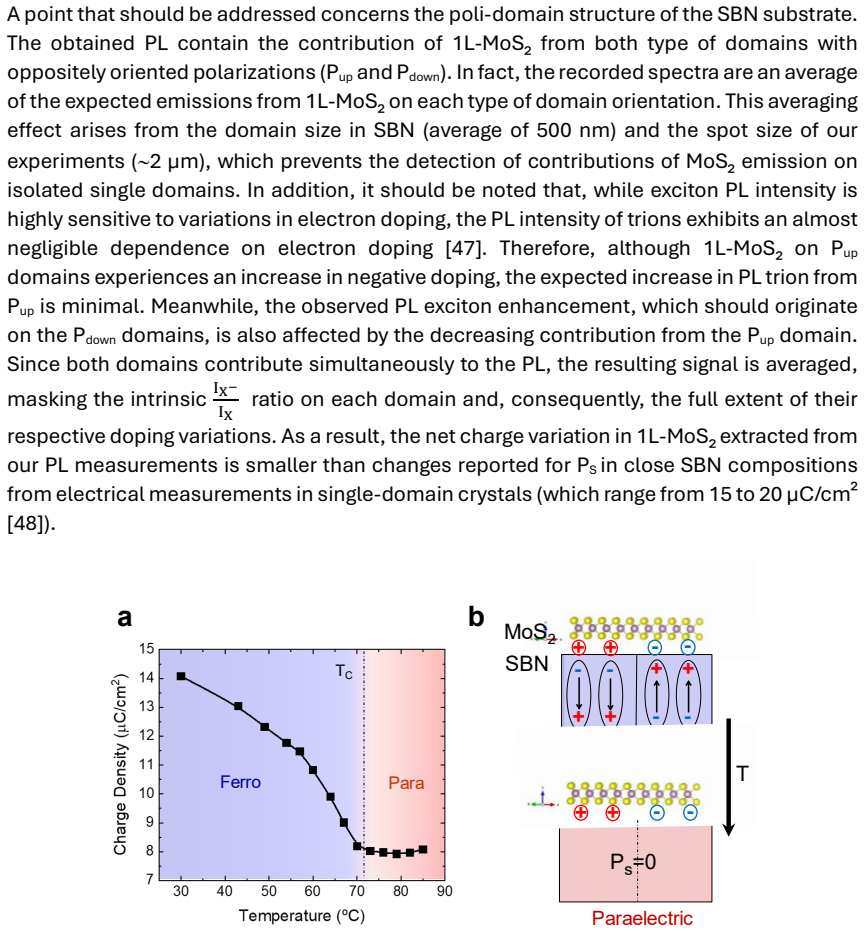
The central claim is that the relaxor character of SBN, a smeared phase transition instead of a sharp Curie point, turns the substrate into a continuously tunable electrostatic gate for monolayer MoS$_2$. As the substrate is heated from 30 °C through the transition at about 73 °C, its spontaneous polarization gradually vanishes; the screening-charge balance at the interface changes; and the net electron density in the MoS$_2$ monolayer decreases from about $14\ \mu\mathrm{C}/\mathrm{cm}^2$ ($9\times10^{13}\ \mathrm{e}/\mathrm{cm}^2$) to about $8\ \mu\mathrm{C}/\mathrm{cm}^2$, while the exciton-to-trion photoluminescence ratio rises monotonically and then plateaus above the transition. The modulation is reversible on cooling and exhibits hysteresis, which the paper traces to the known thermally hysteretic phase transition of SBN. Because the optical measurement averages over oppositely polarized ferroelectric domains, the authors argue that the observed net change of about $6\ \mu\mathrm{C}/\mathrm{cm}^2$ is a lower bound on the local polarization-driven doping change, comparing it with spontaneous-polarization values of 15–20 $\mu\mathrm{C}/\mathrm{cm}^2$ reported for single-domain SBN.
Load-bearing premise
The load-bearing premise is that the trion-to-exciton brightness ratio follows a fixed mass-action conversion with a temperature-independent relative quantum yield of 20/3, and that the collected photoluminescence is a fair average over the up- and down-polarized ferroelectric domains; if either of those fails, the absolute electron densities and the sign and size of the reported modulation are not reliable.
Editorial extensions
If this is right
- Monolayer MoS$_2$ on SBN can be continuously electron-doped by temperature alone, from about $14$ to about $8\ \mu\mathrm{C}/\mathrm{cm}^2$, across the 30–90 °C range, with no gate electrode or chemical processing.
- The doping modulation is reversible and hysteretic, so the same heterostructure can hold two different electron densities at the same temperature depending on whether it was heated or cooled, a property suited to memory or synaptic-type devices.
- Because the phase transition raises exciton emission while leaving trion emission nearly constant, the exciton-to-trion ratio can serve as an all-optical thermometer or a probe of the relaxor transition.
- The net measured charge swing being smaller than the spontaneous polarization of single-domain SBN implies that on a single ferroelectric domain the local doping change in MoS$_2$ is expected to be larger than the observed $6\ \mu\mathrm{C}/\mathrm{cm}^2$.
Reading between the lines
- The same mechanism should transfer to other monolayer transition-metal dichalcogenides whose emission shows resolvable exciton and trion peaks, such as WS$_2$ or WSe$_2$, although their trion binding energies and band alignments will shift the quantitative doping scale.
- Because relaxor transition temperatures depend on composition, choosing a different SBN stoichiometry or another relaxor ferroelectric could move the doping-modulation window to higher or lower temperatures, extending the idea beyond the 30–90 °C range reported here.
- If the local polarization state can be switched optically or electrically, the bistability seen in the heating-cooling cycle suggests a route to persistent, locally patterned doping in the monolayer; this goes beyond what the paper demonstrates.
- A transport measurement across the same temperature range should reveal a comparable reversible change in sheet carrier density or conductivity if the polarization-charge mechanism dominates, giving a non-optical check that the PL-derived densities do not provide.
Signed reviews
Editorial analysis
A structured set of objections, weighed in public.
Referee Report
Summary. The paper reports temperature-dependent photoluminescence (PL) measurements of monolayer MoS₂ transferred onto a relaxor ferroelectric Sr₀.₆₁Ba₀.₃₉Nb₂O₆ (SBN) substrate. As the SBN undergoes its ferro-to-paraelectric phase transition between 30 and 90 °C, the authors observe a reversible PL enhancement and a trion-to-exciton conversion, correlated with the substrate's transition temperature independently determined by second-harmonic generation. Using a mass-action model (Eq. 1) with literature parameters, they convert the exciton/trion intensity ratio into an absolute electron density, reporting a decrease from about 14 µC/cm² at room temperature to about 8 µC/cm² above the transition, with thermal hysteresis between heating and cooling cycles. The modulation is attributed to the vanishing spontaneous polarization of the SBN substrate, which changes the screening-charge balance at the MoS₂/SBN interface. The authors compare with a SiO₂ substrate to separate intrinsic MoS₂ thermal effects from the phase-transition effect.
Significance. If the quantitative interpretation is accepted, this work introduces relaxor ferroelectrics as a reconfigurable platform for gradually tuning the electronic and optical properties of monolayer TMDs, with potential applications in temperature-responsive optoelectronics and memories. The qualitative phenomenology—PL enhancement and trion-to-exciton conversion linked to the independently measured transition temperature—is well supported by the SiO₂ comparison. The paper also includes a thoughtful discussion of the polydomain averaging effect, which is a strength. The potential significance is genuine but rests on the reliability of the absolute electron-density extraction.
major comments (3)
- [Eq. (1) and Fig. 3a] The quantitative extraction of n_e from a PL spectrum that averages over anti-parallel ferroelectric domains is not justified. The paper states that the ~2 μm PL spot averages over ~500 nm domains of opposite polarization, and that the recorded spectrum is an average of the emissions from both domain types. Since Eq. (1) is linear in n_e for each individual domain but is applied to the intensity-weighted average of the two populations, the extracted n_e is a weighted mean whose weights (the exciton PL intensities) depend on the doping level of each domain. Consequently, the reported decrease from about 14 to about 8 µC/cm² cannot be directly read as a net electron-density change; it could be substantially influenced by the temperature-dependent redistribution of the weights. The paragraph acknowledging the polydomain structure states that the extracted net variation is smaller than the single-domain polarization change, but this is only a qualitative statement and does not quantify the weighting effect. To support the quantitative claim, the authors should either perform a domain-resolved measurement or construct a explicit two-domain model with area fractions and intensity weights, and show that the extracted Δσ is robust to reasonable assumptions about these parameters.
- [Eq. (1) and the paragraph following it] The assumption that the relative quantum yield η_r = 20/3 and the trion binding energy E_b = 20 meV are constant over the full 30–90 °C range is unjustified. The extracted n_e is proportional to η_r and depends exponentially on E_b/k_BT through C(T). If either parameter varies with temperature, the inferred n_e and hence the reported Δσ will be in error. The paper states that η_r is 'kept fixed' but provides no sensitivity analysis or literature support for the temperature independence of these quantities. At minimum, the authors should discuss the possible temperature dependence of η_r and E_b and estimate the resulting uncertainty in the reported electron-density values.
- [Results, reproducibility statement] The sentence 'Similar ∆σ values have been obtained for a different 1L-MoS2 with higher initial electron doping' is presented as a reproducibility check, but no data for this second sample are shown in any figure or table. This claim is currently not verifiable; it should either be documented with a figure or removed from the text.
minor comments (6)
- [Eq. (1)] Equation (1) is typeset incorrectly: the ratio I_{X^-}/I_X is missing the division slash, making the equation appear as a product. It should read I_{X^-}/I_X = n_e/(η_r C(T)).
- [Polydomain paragraph] The word 'poli-domain' in the paragraph beginning 'A point that should be addressed...' is a typo; it should be 'polydomain'.
- [Figure 3b caption] The caption contains the typo 'paralectric' for 'paraelectric'.
- [Figure 3a vs. Figure 3b] Figure 3b caption states 'The net electron doping of 1L-MoS2 is not represented', yet Figure 3a presents a curve labeled as electron doping. The relationship between the plotted quantity in Fig. 3a and the statement in Fig. 3b should be clarified; if the plotted n_e is a domain-averaged value, this should be stated explicitly for both figures.
- [Figure 4] The sign convention for Δσ in Figure 4 is not defined. The text says 'the gradual decrease in Δσ is observed until it becomes zero', implying Δσ is a positive quantity that vanishes above TC; please define Δσ and its sign clearly in the figure caption or text.
- [References] Reference 19 appears to have an incorrect volume number: 'Nano Lett. 2, 959 (2021)' should probably be 'Nano Lett. 21, 959 (2021)'.
Circularity Check
No significant circularity: the reported doping trend is derived from measured PL ratios via literature-based mass-action parameters and independently corroborated by SHG.
full rationale
The derivation chain is self-contained and not circular. The electron density is obtained by inverting Eq. (1), where the trion/exciton ratio is measured and all parameters (masses, E_b = 20 meV, eta_r = 20/3, C(T)) are taken from external literature [43,46,22], not fitted to the target data. The claimed transition temperature is independently determined by SHG measurements on the same substrate (Figure 1c), and the PL ratio trend (Figure 2c) is compared to that independent thermometer rather than being forced to it. The hysteresis and reversibility are presented as directly observed PL-ratio and derived n_e cycles, with prior SBN hysteresis work cited as supporting context; even if some of those citations are from the same group, the present observation is made in this paper and does not reduce to the citations. The paper also explicitly acknowledges the polydomain averaging limitation, noting that the recorded spectra average over opposite domains and that the extracted net charge variation is therefore smaller than single-domain polarization values; that is a model-inversion caveat, not a circular step. No fitted parameter is renamed as a prediction, no uniqueness theorem is imported from the authors' prior work, and no known result is repackaged under new coordinates. The quantitative scale of n_e depends on the validity of the mass-action model and the fixed eta_r, but that is a correctness or robustness concern, not circularity. Therefore the score is 0.
Assumptions & free parameters
assumptions (5)
- domain assumption The mass action law relation (Eq. 1) correctly gives the equilibrium electron density from the trion/exciton PL intensity ratio.
- domain assumption The relative quantum yield eta_r is constant at 20/3 over the 30 to 90 degree Celsius range.
- domain assumption The PL signal is a simple average over P_up and P_down domains, and the extracted net n_e is meaningful.
- domain assumption The SiO2 reference substrate controls for all temperature effects unrelated to the SBN phase transition.
- domain assumption The band parameters used in C(T) (m_X = 0.8 m0, m_X- = 1.15 m0, m_e = 0.35 m0, E_b = 20 meV) are valid for the transferred monolayer.
Cite this review
Pith. "Pith review of Electron density modulation in monolayer $MoS_{2}$ along the phase transition of a relaxor ferroelectric substrate." pith.science (2026). https://pith.science/paper/CC7PQX3H
@misc{pith2026250502454,
  author       = {Pith},
  title        = {Pith review of: Electron density modulation in monolayer $MoS_2$ along the phase transition of a relaxor ferroelectric substrate},
  year         = {2026},
  howpublished = {\url{https://pith.science/paper/CC7PQX3H}},
  note         = {Machine review of arXiv:2505.02454}
}
abstract
The integration of transition metal dichalcogenides (TMDs) with ferroelectric substrates is a powerful strategy to modulate their electronic and optical properties. However, the use of relaxor ferroelectrics for this purpose remains unexplored. Here, we demonstrate a reversible photoluminescence (PL) and charge density modulation of monolayer $MoS_{2}$ on a $Sr_{0.61}Ba_{0.39}Nb_{2}O_{6}$ (SBN) substrate, a prototypical relaxor ferroelectric. The smearing of the phase transition in SBN enables continuous tuning of $MoS_{2}$ electronic properties over a broad temperature range ($30-90{\deg}C$). A pronounced PL enhancement occurs as the substrate transitions from ferro-to-paraelectric phase due to the vanishing spontaneous polarization and the consequent change in charge balance at the $MoS_{2}-SBN$ interface. Moreover, thermal hysteresis in the electron density modulation is observed during heating and cooling cycles. These findings highlight the potential of relaxor ferroelectrics as reconfigurable platforms for electron doping and light-emission control in 2D materials, opening avenues for temperature-responsive optoelectronic and nanophotonic applications.
Figures

Reference graph
Works this paper leans on
-
[1]
S. Manzeli, D. Ovchinnikov, D. Pasquier, O. V . Yazyev, A. Kis. 2D transition metal dichalcogenides. Nat. Rev. Mater. 2, 17033 (2017). DOI: 10.1038/natrevmats.2017.33
-
[2]
A. Ahmed, M. Z. Iqbal, A. Dahshan, S. Aftab, H. H. Hegazy, E. S. Yousef. Recent advances in 2D transition metal dichalcogenide -based photodetectors: a review. Nanoscale 16, 2097 (2024). DOI: 10.1039/D3NR04994A
-
[3]
J. Chen, M. Y . Sun, Z. H. Wang, Z. Zhang, K. Zhang, S. Wang, Y . Zhang, X. Wu, T. L. Ren, H. Liu, L. Han. Performance Limits and Advancements in Single 2D Transition Metal Dichalcogenide Transistor . Nanomicro Lett. 16, 264 (2024). DOI: 10.1007/s40820-024- 01461-x
- [4]
-
[5]
K. C. Kwon, J. H. Baek, K. Hong, S. Y . Kim, H. W. Jang. Memristive Devices Based on Two- Dimensional Transition Metal Chalcogenides for Neuromorphic Computing. Nanomicro Lett. 14, 58 (2022). DOI: 10.1007/s40820-021-00784-3
-
[6]
X. Tang, Q. Hao, X. Hou, L. Lan, M. Li, L. Yao, X. Zhao, Z. Ni, X. Fan, T. Qiu. Exploring and Engineering 2D Transition Metal Dichalcogenides toward Ultimate SERS Performance. Adv. Mater. 36, 2312348 (2024). DOI: 10.1002/adma.202312348
-
[7]
D. Thureja, A. Imamoglu, T. Smoleński, I. Amelio, A. Popert, T. Chervy, X. Lu, S. Liu, K. Barmak, K. Watanabe, T. Taniguchi, D. J. Norris, M. Kroner, P . A. Murthy. Electrically tunable quantum confinement of neutral excitons. Nature 606, 298 (2022). DOI: 10.1038/s41586-022-04634-z
-
[8]
G. Kim, B. Huet, C. E. Stevens, K. Jo, J. Y . Tsai, S. Bachu, M. Leger, S. Song, M. Rahaman, K. Y . Ma, N. R. Glavin, H. S. Shin, N. Alem, Q. Yan, J. R. Hendrickson, J. M. Redwing, D. Jariwala. Confinement of excited states in two -dimensional, in -plane, quan tum heterostructures. Nat. Commun. 15, 6361 (2024). DOI: 10.1038/s41467-024-50653-x
Show all 53 references
-
[9]
J. Kim, M. Jung, D. U. Lim, D. Rhee, S. H. Jung, H. K. Cho, H. K. Kim, J. H. Cho, J. Kang. Area-Selective Chemical Doping on Solution- Processed MoS 2 Thin-Film for Multi - Valued Logic Gates; Nano Lett. 22 (2), 570 (2022). DOI: 10.1021/acs.nanolett.1c02947
2022 doi
-
[10]
Castellanos-Gomez, R
A. Castellanos-Gomez, R. Roldán, E. Cappelluti, M. Buscema, F. Guinea, H. S. J. van der Zant, G. A. Steele. Local Strain Engineering in Atomically Thin MoS2. Nano Lett. 13 (11), 5361 (2013). DOI: 10.1021/nl402875m
2013 doi
-
[11]
B. W. H. Baugher, H. O. H. Churchill, Y. Yafang, P . Jarillo-Herrero. Optoelectronic devices based on electrically tunable p –n diodes in a monolayer dichalcogenide. Nat. Nanotechnol. 9, 262 (2014). DOI: 10.1038/nnano.2014.25
2014 doi
-
[12]
P. G. Pacchioni. Ferroelectrics meet transition metal dichalcogenides. Nat. Rev. Mater. 8, 644 (2023). DOI: 10.1038/s41578-023-00602-9
2023 doi
-
[13]
Kamaei, X
S. Kamaei, X. Liu, A. Saeidi, Y . Wei, C. Gastaldi, J. Brugger, A. M. Ionescu. Ferroelectric gating of two-dimensional semiconductors for the integration of steep-slope logic and neuromorphic devices. Nat. Electron. 6, 658 (2023). DOI: 10.1038/s41928-023-01018- 7
2023 doi
-
[14]
Lipatov, P
A. Lipatov, P . Sharma, A. Gruverman, A. Sinitskii. Optoelectrical Molybdenum Disulfide (MoS2)-Ferroelectric Memories, ACS Nano 9, 8089 (2015). DOI: 10.1021/acsnano.5b02078
2015 doi
-
[15]
Y . Sun, G. Niu, W. Ren, X. Meng, J. Zhao, W. Luo, Z. G. Ye, Y . H. Xie. Hybrid System Combining Two -Dimensional Materials and Ferroelectrics and Its Application in Photodetection. ACS Nano 15, 10982 (2021). DOI: 10.1021/acsnano.1c01735
2021 doi
-
[16]
Liang, H
X. Liang, H. Guan, K. Luo, Z. He, A. Liang, W. Zhang, Q. Lin, Z. Yang, H. Zhang, C. Xu, H. Xie, F. L i u , F. M a , T. Yang, H. Lu. Van der Waals Integrated LiNbO 3/WS2 for High - Performance UV –Vis–NIR Photodetection. Laser Photonics Rev. 17, 2300286 (2013). DOI: 10.1002/lpo...
2013 doi
-
[17]
Baeumer, D
C. Baeumer, D. Saldana -Greco, J. M. P . Martirez, A. M. Rappe, M. Shim, L. W. Martin. Ferroelectrically driven spatial carrier density modulation in graphene. Nat. Commun. 6, 6136 (2015). DOI: 10.1038/ncomms7136
2015 doi
-
[18]
B. Wen, Y . Zhu, D. Yudistira, A. Boes, L. Zhang, T. Yidirim, B. Liu, H. Yan, X. Sun, Y . Zhou, Y . Xue, Y . Zhang, L. Fu, A. Mitchell, H. Zhang, Y . Lu. Charged Exciton Kinetics in Monolayer MoSe2 near Ferroelectric Domain Walls in Periodically Poled LiNbO 3. ACS Nano 13, 533...
2019 doi
-
[19]
Soubelet, J
P . Soubelet, J. Klein, J. Wierzbowski, R. Silvioli, F . Sigger, A. V . Stier, K. Gallo, J. J. Finley. Nano Lett. 2, 959 (2021). DOI: 10.1021/acs.nanolett.0c03810
2021 doi
-
[20]
M. O. Ramirez, J. Fernandez -Tejedor, D. Gallego, J. Fernández -Martinez, P . Molina, D. Hernández-Pinilla, J. Gómez-Herrero, P. A r e s , L. E. Bausá, Light-Induced Ferroelectric Modulation of p -n Homojunctions in Monolayer MoS
-
[21]
Adv. Opt. Mater. 12, 2400624 (2024). DOI: 10.1002/adom.202400624
2024 doi
-
[22]
Fernández-Martínez, J
J. Fernández-Martínez, J. J. Ronquillo, G. López -Polín, H. P . van der Meulen, M. O Ramírez, L. E. Bausá. Pyroelectric doping reversal of MoS2 p-n junctions on ferroelectric domain walls probed by photoluminescence. arXiv: 2504.04886v2 [cond-mat.mtrl-sci] (2025). DOI: 10.4855...
-
[23]
Y . Mou, Q . Liu, J. Liu, Y . Xia, Z. Guo , W . Song, J. Gu, Z. Xu, W . W ang, H. Guo , W . Shi, J. Shen, C. Zhang. Unexpected Large Electrostatic Gating by Pyroelectric Charge Accumulation. Nano Lett. 25 (10), 4029 (2025). DOI: 10.1021/acs.nanolett.5c00099
2025 doi
-
[24]
J. W. Chen, S. T. Lo, S. C. Ho, S. S. Wong, T. H. Y . Vu, X. Q. Zhang, Y . D. Liu, Y . Y . Chiou, Y . X. Chen, J. C. Yang, Y . C. Chen, Y . H. Chu, Y . H. Lee, C. J. Chung, T. M. Chen, C. H. Chen, C. L. Wu. A gate -free monolayer WSe 2 pn diode. Nat. Commun. 9, 3143 (2018). DO...
2018 doi
-
[25]
Q. Liu, S. Cui, R. Bian, E. Pan, G. Cao, W. Li, F . Liu. The Integration of Two-Dimensional Materials and Ferroelectrics for Device Applications . ACS Nano 18 (3), 1778 (2024). DOI: 10.1021/acsnano.3c05711
2024 doi
-
[26]
Puebla, T
S. Puebla, T. Pucher, V . Rouco, G. Sanchez-Santolino, Y . Xie, V . Zamora, F . A. Cuellar, F . J. Mompean, C. Leon, J. O. Island, M. Garcia-Hernandez, J. Santamaria, C. Munuera, A. Castellanos-Gomez. Combining Freestanding Ferroelectric Perovskite Oxides with Two-Dimensional ...
2022 doi
-
[27]
Ayoub, J
M. Ayoub, J. Imbrock, C. Denz. Ferroelectric domain diagnostics near the phase transition by Čerenkov second -harmonic generation. Opt. Mater. Express 7, 3448 (2017). DOI: 10.1364/OME.7.003448
2017 doi
-
[28]
H. Pan, S. Lan, S. Xu, Q. Zhang, H. Yao, Y . Liu, F . Meng, E. J. Guo, L. Gu, D. Yi, X. R. Wang, H. Huang, J. L. MacManus -Driscoll, L. Q. Chen, K. J. Jin, C. W. Nan, Y . H. Lin. Ultrahigh energy storage in superparaelectric relaxor ferroelectrics. Science 374,100 (2021). DOI:...
2021 doi
-
[29]
M. O. Ramírez, D. Jaque, L. E. Bausá, J. G. Solé, A. A. Kaminskii. Coherent Light Generation from a Nd ∶SBN Nonlinear Laser Crystal through its Ferroelectric Phase Transition. Phys. Rev. Lett. 95, 267401 (2005). DOI: 10.1103/PhysRevLett.95.267401
2005 doi
-
[30]
O Ramírez, L
M. O Ramírez, L. E. Bausá, A. Speghini, M. Bettinelli, L. I. Ivleva, J. G. Solé. Thermal hysteresis in the luminescence of Yb 3+ ions in Sr0.6Ba0.4Nb2O6. Phys. Rev. B. 73, 035119 (2006). DOI: 0.1103/PhysRevB.73.035119
2006
-
[31]
L. E. Cross. Relaxor ferroelectrics: An overview. Ferroelectrics 151, 305 (1994). DOI: 10.1080/00150199408244755
1994 doi
-
[32]
R. R. Neurgaonkar, W. F . Hall, J. R. Oliver, W. H. Ho, W. K. Cory . Tungsten bronze Sr1-xBaxNb2O6: A case history of versatility. Ferroelectrics 87 , 167 (1988). DOI: 10.1080/00150198808201379
1988 doi
-
[33]
Demirbilek, S
R. Demirbilek, S. E. Kapphan, A. B. Kutsenko, R. Pankrath. Investigation of two -center holographic recording in SBN:Ce:Cr and SBN:Mn:Fe. P hys. Stat. Sol. C 2, 653 (2005). DOI: 10.1002/pssc.200460256
2005 doi
-
[34]
Ataei, P
A. Ataei, P . McManamon, C. Bradley, R. Neurgaonkar. An electro-optic continuous laser beam steering device based on an SBN75 crystal. Ferroelectrics 603, 34 (2023). DOI: 10.1080/00150193.2022.2159214
2023
-
[35]
X i a , D
S . X i a , D . J u k i ć , N . W a n g , D . S m i r n o v a , L . S m i r n o v , L . T a n g , D . S o n g , A . S z a m e i t , D . Leykam, J. Xu, Z. Chen, H. Buljan. Nontrivial coupling of light into a defect: the interplay of nonlinearity and topology. Light Sci . App. 9...
2020 doi
-
[36]
J. Li, Z. Wang, Y. H u , J. Xu, Splitting of Optical Spatial Modes via Stern- Gerlach Effect. Laser Photonics Rev. 8, 2301055 (2024). DOI: 10.1002/lpor.202301055
2024 doi
-
[37]
Paszkowski, K.B
R. Paszkowski, K.B. Wokulska, J. Dec, T. Łukasiewicz. Precise lattice parameter measurements of Sr 0.72Ba0.25Nb2O5.97 single crystals. J. Cryst. Growth 401, 327 (2014). DOI: 10.1016/j.jcrysgro.2013.10.052
2014 doi
-
[38]
T. S. Chernaya, M. O. Marychev, V . A. Ivanov, N. J. Ivanov, E. V . Chuprunov, L. I. Ivleva, V . I. Simonov. Structural conditionality for the quadratic nonlinear susceptibility of Sr1−x Ba x Nb2O6 crystals. Crystallogr. Rep. 52, 1056 (2007). DOI: 10.1134/S106377450706020X
2007 doi
-
[39]
M. O. Ramirez, D. Jaque, M. Montes, J. G. Solé, L. E. Bausá, L. Ivleva; Thermal hysteresis in the luminescence of Cr3+ ions in Sr0.6Ba0.4(NbO3)2. Appl. Phys. Lett. 84 (15 ), 2787 (2004). DOI: 10.1063/1.1695631
2004 doi
-
[40]
Goulkov, T
M. Goulkov, T. Granzow, U. Dörfler, T. Woike, M. Imlau, R. Pankrath. Study of beam - fanning hysteresis in photo- refractive SBN:Ce: light-induced and primary scattering as functions of polar structure. Appl. Phys. B 76, 407 (2003). DOI: 10.1007/s00340 -003- 1116-8
2003 doi
-
[41]
Granzow, T
T. Granzow, T. Woike, M. Wöhlecke, M. Imlau, W. Kleemann. Polarization -Based Adjustable Memory Behavior in Relaxor Ferroelectrics. Phys. Rev. Lett. 89 (12), 127601 (2002). DOI: 10.1103/PhysRevLett.89.127601
2002 doi
-
[42]
Photonic Glass
P . Molina, M. O Ramírez, L. E. Bausá. Strontium Barium Niobate as a Multifunctional Two-Dimensional Nonlinear “Photonic Glass” . Adv. Funct. Mater. 18 , 709 (2008). DOI: 10.1002/adfm.200700905
2008 doi
-
[43]
J. Hou, X. Wang, X., D. Fu, C. Ko, Y . Chen, Y . Sun, S. Lee, K. X. Wang, K. Dong, Y . Sun, S. Tongay, L. Jiao, J. Yao, K. Liu, J. Wu. Modulating Photoluminescence of Monolayer Molybdenum Disulfide by Metal–Insulator Phase Transition in Active Substrates. Small 12, 3976 (2016)....
2016 doi
-
[44]
Mouri, Y
S. Mouri, Y . Miyauchi, K. Matsuda. Tunable Photoluminescence of Monolayer MoS 2 via Chemical Doping. Nano Lett. 13 (12), 5944 (2013). DOI: 10.1021/nl403036h
2013 doi
-
[45]
J. W. Christopher, B. B. Goldberg, A. K. Swan. Long tailed trions in monolayer MoS 2: Temperature dependent asymmetry and resulting red-shift of trion photoluminescence spectra. Sci. Rep. 7, 14062 (2017). DOI: 10.1038/s41598-017-14378-w
2017 doi
-
[46]
Buscema, G
M. Buscema, G. A. Steele, H. S. J. van der Zant, A. Castellanos-Gómez. The effect of the substrate on the Raman and photoluminescence emission of single -layer MoS2. Nano Res. 7, 561 (2014). DOI: 10.1007/s12274-014-0424-0
2014 doi
-
[47]
K. F . Mak, K. He, C . Lee, G . H. Lee, J. Hone, T . F . Heinz, J. Shan. Tightly bound trions in monolayer MoS2. Nat. Mater. 12(3), 207 (2013). DOI 10.1038/nmat3505
2013 doi
-
[48]
H. J. Conley, B. Wang, J. I. Ziegler, R. F . Haglund Jr., S. T. Pantelides, K. I. Bolotin. Bandgap Engineering of Strained Monolayer and Bilayer MoS 2. Nano Lett. 13 (8), 3626 (2013). DOI: 10.1021/nl4014748
2013 doi
-
[49]
J. J. Romero, C. Aragó, J. A. Gonzalo, D. Jaque, J. G. Solé. Spectral and thermal properties of quasiphase -matching second -harmonic-generation in Nd 3+:Sr0.6Ba0.4(NbO3)2 multiself-frequency-converter nonlinear crystals. J. Appl. Phys. 93, 3111 (2003). DOI: 10.1063/1.1539911
2003 doi
-
[50]
E. L. Venturini, E. G. Spencer, P . V . Lenzo, A. A. Ballman. Refractive indices of strontium barium niobate. J. Appl. Phys. 39 (1), 343 (1968). DOI: 10.1063/1.1655759
1968 doi
-
[51]
K. P . O’Donnell, X. Chen. Temperature dependence of semiconductor band gaps. Appl. Phys. Lett. 58, 2924 (1991). DOI: 10.1063/1.104723
1991 doi
-
[52]
C a d i z, E
F. C a d i z, E. Courtade, C. Robert, G. Wang, Y. Shen, H. Cai, T. Taniguchi, K. Watanabe, H. Carrere, D. Lagarde, M. Manca, T. Amand, P . Renucci, S. Tongay, X. Marie, B. Urbaszek. Excitonic Linewidth Approaching the Homogeneous Limit in MoS2-Based van der Waals Heterostructu...
2017 doi
-
[53]
Castellanos-Gómez, M
A. Castellanos-Gómez, M. Buscema, R. Molenaar, V . Singh, L. Janssen, H. S. J. van der Zant, G. A. Steele . Deterministic transfer of two -dimensional materials by all -dry viscoelastic stamping. 2D Mater. 1, 011002 (2014). DOI: 10.1088/2053- 1583/1/1/011002
2014 doi
Reviewed August 16, 2026 · model on record in the stance chip above.
Discussion (0). Continue with ORCID to comment.