REVIEW 4 major objections 4 minor 2 cited by
Matter-antimatter asymmetry in minimal inverse seesaw framework with $A_4$ modular symmetry
T0 review · 4 major / 4 minor · reviewed 2026-08-16 · deepseek-v4-flash
Pith's one-line read A minimal inverse seesaw model with A4 modular symmetry can fit neutrino mixing, evade charged-lepton flavor violation bounds, and generate the observed baryon asymmetry through resonant leptogenesis.
desk verdict Competent incremental A4 modular inverse seesaw paper; the Z' leptogenesis term is new, but the headline mixing-angle 'predictions' are scan-box artifacts until a wider scan proves otherwise. read the letter →
The pith
A machine-rendered reading of the paper's core claim, the machinery that carries it, and where it could break.
The reading
What carries the argument
The central object is the 7×7 neutral fermion mass matrix in the flavor basis (ν_L, N_R^c, S), whose block structure gives the inverse seesaw light neutrino mass formula m_ν = M_D $M_R^{{-1}}$ μ (M_R^T)^{-1} M_D^T. The A4 modular symmetry, with a single complex modulus τ controlling all Yukawa couplings, provides the flavor structure without a large flavon sector; the heavy sector splits into two nearly degenerate pairs, and the lightest pair's decay in the resonance regime generates the CP asymmetry for leptogenesis. The same modulus τ sets the Dirac CP phase in the PMNS matrix, so the model connects low-energy CP violation to the CP asymmetry relevant for baryogenesis.
What would settle it
A future measurement of sin² θ23 below 0.44 in the currently allowed 3σ range, or a dedicated scan covering the full fundamental domain of the modulus τ that finds oscillation-allowed points with sin² θ23 < 0.44, would falsify the model's lower-bound prediction. Similarly, a measured deviation from the predicted linear relation between sin² θ12 and sin² θ23 at the precision of upcoming experiments would rule out the correlation.
Extended reading notes
Core claim
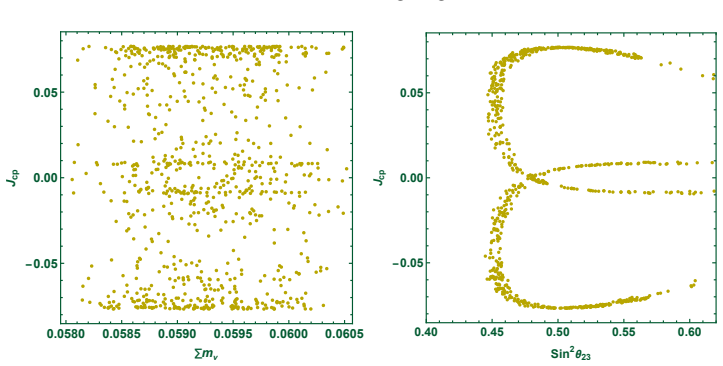
The paper's central claim is that an inverse seesaw extension of the Standard Model based on A4 modular symmetry, with two right-handed neutrinos and two singlet fermions plus a local U(1)_{B−L} symmetry, is enough to reproduce all current neutrino oscillation observables while making three testable predictions: a lower bound of 0.44 on sin² θ23, a linear correlation between sin² θ12 and sin² θ23 in the 3σ region, and a strong link between the Dirac CP phase, the Jarlskog invariant, and the atmospheric angle. Using the same parameter space that fits oscillations, the model respects all three measured charged lepton flavor violating branching ratios, places the effective neutrinoless double beta decay mass |m_ee| below the KamLAND-Zen and projected nEXO sensitivities, and yields the observed baryon asymmetry through resonant leptogenesis from the decay of the lightest nearly degenerate heavy neutrino pair, with the Z′-mediated lepton number conserving scatterings included but not spoiling the final asymmetry.
Load-bearing premise
The predictions depend on the randomly scanned parameter ranges for the modulus and couplings; if those ranges do not cover the model's full viable parameter space, the claimed exclusions and correlations could be artifacts of the scan rather than inherent predictions.
Editorial extensions
If this is right
- The model predicts a lower bound sin² θ23 > 0.44, which current global fits already permit but which next-generation long-baseline experiments can directly test.
- The linear relation between sin² θ12 and sin² θ23 in the 3σ region means a precise measurement of either angle sharpens the prediction for the other.
- Parameter points that fit neutrino oscillations automatically satisfy the current LFV bounds from MEG and BaBar, so the model makes the absence of observed charged lepton flavor violation a consequence of the same structure that fixes neutrino mixing.
- The final baryon asymmetry is essentially independent of the Z′ gauge coupling g_{B−L}, because stronger Z′-mediated scatterings delay the generation of asymmetry but do not suppress it, preserving Y_B ~ 8.6×10⁻¹¹.
- The model predicts restricted ranges for the CP observables, including J_CP in [-0.07,0.07] and δ_CP in the intervals 0°–85° and 279°–359°, which future CP-violation measurements can check.
Reading between the lines
- If the linear θ12–θ23 relation survives a scan over the full fundamental domain of τ rather than the chosen parameter box, it would provide a rare cross-check between two independent oscillation observables that JUNO and DUNE could test at the sub-percent level.
- The claimed insensitivity of the final baryon asymmetry to g_{B−L} suggests a general lesson: adding lepton number conserving Z′ interactions need not spoil low-scale resonant leptogenesis, a possibility worth testing in other inverse seesaw constructions.
- The paper's use of a single complex modulus τ as the only flavor source points toward a geometric program: map which regions of the fundamental domain of τ produce each phenomenological signature, turning the current scan box into a full characterization of the model.
- The combination of neutrino fit, LFV constraints, and leptogenesis within one parameter scan suggests that future data, especially a precise measurement of θ23 or the Dirac phase, could distinguish this A4 modular inverse seesaw from other TeV-scale seesaw frameworks.
Signed reviews
Editorial analysis
A structured set of objections, weighed in public.
Referee Report
Summary. The paper constructs a minimal inverse seesaw model with A4 modular symmetry and a local U(1)_{B-L} symmetry. Neutrino masses and mixing are generated through a 7x7 neutral fermion mass matrix depending on the modulus tau and four continuous parameters (alpha_p, beta_p, mu_0, v_phi). The authors scan these parameters, retain points consistent with the 3 sigma neutrino oscillation data, and report a lower bound sin^2(theta23) >= 0.44 and a linear correlation between sin^2(theta12) and sin^2(theta23). They then check charged lepton flavor violating decays, neutrinoless double beta decay, and compute the baryon asymmetry via resonant leptogenesis including Z'-mediated lepton-number-conserving scatterings, obtaining Y_B ~ 8.6e-11.
Significance. If the claimed predictions are robust, the model offers a simultaneous, economical explanation of neutrino oscillation parameters, charged lepton flavor violation, and the baryon asymmetry within a modular-symmetry framework. The paper provides explicit modular forms and covers a broad set of observables, which is a strength. However, because the results are derived from a filtered random scan over a restricted parameter box, the advertised 'predictions' need stronger support to be credible; the current analysis does not yet establish that the lower bound on sin^2(theta23) and the theta12-theta23 correlation are features of the model rather than of the scan.
major comments (4)
- [Sec. III.A, Eq. (17); Figs. 2 and 3] The claimed lower bound sin^2(theta23) > 0.44 and the linear correlation between sin^2(theta12) and sin^2(theta23) are derived from a random scan restricted to Re[tau] in [-0.5, 0.5], Im[tau] in [0.5, 1.5], alpha_p in [1e-4, 1e-3], beta_p in [1e-3, 1e-2], mu_0 in [0.1, 10] GeV, and v_phi in [1e5, 1e8] GeV. These intervals, especially for alpha_p, beta_p, mu_0, and v_phi, are not fixed by the A4 modular structure or the charge assignments; they are chosen for numerical convenience. The paper does not report the number of scan points, the sampling density, or any convergence test. Consequently, the reported exclusion of sin^2(theta23) < 0.44 and the narrow band in Fig. 3 could be artifacts of the chosen box. Since these are the headline claims of the abstract and conclusion, the authors must demonstrate robustness by substantially widening the scan, at least for the unconstrained continuous parameters, or provide an analytic argument that the features are inherent to the model.
- [Sec. IV.B, Eq. (41)] The Boltzmann equation for Y_{B-L} contains a sum over j = 1, 2 with a factor (Y_chi1/Y_chi1^eq - 1) inside the sum; for the j = 2 term this factor should be (Y_chi2/Y_chi2^eq - 1). As written (or as likely implemented), the decay term of chi2 is weighted by the abundance of chi1, which would spoil the CP-asymmetry contribution from chi2 and make the computed Y_B unreliable. The authors should correct the equation and re-run the numerical integration, or clarify that the printed equation is a typographical error and that the code uses the correct abundance for each species.
- [Sec. IV, text before Eq. (24)] The paper states that Delta L = 1 and Delta L = 2 scattering processes 'can be safely neglected in our study as in our work K >> 1' with references [73,74]. In the standard leptogenesis literature, K >> 1 denotes the strong-washout regime, where inverse decays and Delta L = 1 scatterings are typically important and must be included. The reasoning as stated appears to be the opposite of the usual expectation. Please justify the neglect quantitatively, e.g., by comparing the relevant reaction densities to the decay density gamma_D for the scanned parameter points, or modify the Boltzmann equations to include these processes. This is directly relevant to the reliability of the reported baryon asymmetry.
- [Sec. V, Conclusion] The conclusion states that the region Re[tau] in (-0.11, 0.98) is excluded by the model, but the scan in Sec. III.A only covers Re[tau] in [-0.5, 0.5]. Values of Re[tau] above 0.5 were never sampled, so the model cannot exclude them on the basis of the presented analysis. This claim should be corrected to the range actually scanned, or the scan must be extended beyond 0.5 to justify the exclusion.
minor comments (4)
- [Eq. (41)] The left-hand side of the equation is printed as 'YB-L/dz' rather than 'dY_{B-L}/dz'; the missing differential operator should be corrected.
- [Fig. 2, bottom panel] The text claims a lower limit sin^2(theta23) = 0.44, but the figure does not indicate this boundary explicitly; adding a horizontal guidance line would help the reader verify the claim.
- [Reference [55]] The table is labeled NuFIT 5.2 (2022), but the cited reference [55] is the 2020 JHEP paper by Esteban et al. Please update the reference to the NuFIT 5.2 publication or confirm that the numbers indeed correspond to the cited paper.
- [Sec. IV.B, after Eq. (43)] The notation gamma_D and gamma_z' is introduced without explicit definitions in the text; the reader is directed to Appendix C, but the definitions of gamma_D and gamma_z' in terms of Y_eq and cross sections should be stated at first use for clarity.
Circularity Check
No circular reduction: the theta23 lower bound and theta12-theta23 correlation are scan outputs conditional on NuFIT data, not inputs, and no load-bearing self-citation carries the derivation.
full rationale
The paper's derivation chain is self-contained against external data. Starting from the A4 modular charge assignments (Table I), it constructs the Dirac mass matrix MD (Eq. 5), the heavy mass matrix MR (Eq. 7), and the mu matrix (Eq. 9), then forms the light neutrino mass matrix m_nu = MD MR^{-1} mu (MR^T)^{-1} MD^T (Eq. 12). Neutrino observables are computed by diagonalizing this matrix and filtering against the NuFIT 5.2 3-sigma ranges in Table III. The asserted lower bound sin^2(theta23) > 0.44 and the linear sin^2(theta12)-sin^2(theta23) band are summaries of the accepted scan points; no equation imposes these values as inputs, so the claim is not circular. The LFV branching ratios (Eq. 21), the effective Majorana mass |m_ee| (Eq. 19), and the baryon asymmetry from the Boltzmann system (Eqs. 39-41) are evaluated at the same accepted parameter points and compared with independent experimental and observational limits; none of these outputs is used as a fitting target. Ref. [35] is a self-citation by one of the authors, but it appears only in a general list of inverse-seesaw literature and is not load-bearing for the present derivation. The central modular-form formalism is anchored in external references (Feruglio, NuFIT, MEG, BaBar, Planck, and Iso et al. for resonant leptogenesis), so the load-bearing chain does not reduce to the paper's own prior claims. A robustness caveat remains: the scan-box ranges in Eq. (17) may under-sample the model's full parameter space, making the reported lower bound and correlation dependent on the chosen ranges. That is a sampling or selection-effect concern, not a circularity.
Assumptions & free parameters
free parameters (7)
- alpha_p =
scanned in [1e-4, 1e-3]
- beta_p =
scanned in [1e-3, 1e-2]
- mu_0 =
scanned in [0.1, 10] GeV
- v_phi =
scanned in [1e5, 1e8] GeV
- tau (modulus) =
Re[tau] in [-0.5, 0.5], Im[tau] in [0.5, 1.5]
- tan(beta) =
5
- m_Z' =
4 TeV
assumptions (6)
- domain assumption A4 modular symmetry with a single modulus tau determines the Yukawa couplings.
- domain assumption U(1)_{B-L} gauge symmetry with the charge assignment in Table I.
- domain assumption Inverse seesaw hierarchy M_R >> M_D, mu.
- domain assumption Both Higgs doublets survive at sphaleron freeze-out, giving Y_B = 8/23 Y_{B-L}.
- ad hoc to paper Delta L = 1 and Delta L = 2 scattering processes are negligible because K >> 1.
- ad hoc to paper Superparticle contributions are negligible with mSUSY = 10^14 GeV and F = 10^18 GeV.
invented entities (4)
-
Z' gauge boson
independent evidence
-
Two right-handed neutrinos N_Ri
-
Two sterile singlet fermions S_i
-
Modulus tau
Cite this review
Pith. "Pith review of Matter-antimatter asymmetry in minimal inverse seesaw framework with $A_4$ modular symmetry." pith.science (2026). https://pith.science/paper/NLXN76GT
@misc{pith2026250503000,
  author       = {Pith},
  title        = {Pith review of: Matter-antimatter asymmetry in minimal inverse seesaw framework with $A_4$ modular symmetry},
  year         = {2026},
  howpublished = {\url{https://pith.science/paper/NLXN76GT}},
  note         = {Machine review of arXiv:2505.03000}
}
abstract
We propose a minimal inverse seesaw framework based on $A_4$ modular symmetry. We have studied the neutrino oscillation parameters in our work and our model excludes some $3 \sigma$ values of the mixing angle $\theta_{23}$. Also, there is a clear linear relation between the mixing angles $\theta_{12}$ and $\theta_{23}$ found in the allowed $3 \sigma$ region. We also examine whether the parameter points consistent with neutrino oscillation data simultaneously comply with the experimental limits on lepton flavor violating (LFV) decays, specifically: $\mu \longrightarrow e \gamma$, $\tau \longrightarrow e \gamma$, and $\tau \longrightarrow \mu \gamma$. We have also investigated the matter-antimatter asymmetry of our universe via the resonant leptogenesis mechanism. Here, we present the contribution of lepton number conserving scattering processes mediated by the $ Z' $ boson in the context of leptogenesis.
Figures


Figures from the paper (7 more)


Forward citations
Cited by 2 Pith papers
-
A Non-Holomorphic Modular $A_4$ Framework for Resonant Leptogenesis with Gravitational Wave Signatures
A non-holomorphic modular A4 seesaw model yields quasi-degenerate right-handed neutrinos, enabling resonant leptogenesis at ~10^6 GeV and a double-peaked gravitational-wave signature.
-
Froggatt-Nielsen like mechanism in the framework of Modular Symmetry for Neutrino Mass, Mixing and Leptogenesis
A T' modular-symmetry model with a 'weighton' scalar reproduces neutrino oscillation data within 3σ and gives predictions for neutrinoless double beta decay and leptogenesis.
Reference graph
Works this paper leans on
-
[1]
Baryon number (B) violation
-
[2]
ThesearerelatedtotheStandardModelHiggsVEV, vH, through the relation vH = p v2 u +v2 d and the ratio of their VEVs is expressed astanβ = vu vd = 5 [6, 56]. The input parameters are randomly scanned within the specified parameter ranges. The permitted regions are filtered based on the3σ limits of solar and atmospheric mass squared differences and mixing ang...
work page 2018
-
[3]
Out-of-equillibrium condition. The complex modulusτ is the source of CP-violation and out of equilibrium decay of heavy neutrinos produce the lepton asymmetry, which can be transformed into baryon asymmetry via the SM sphaleron process. This mechanism is known as leptogenesis [39–47]. If the mass-splitting of heavy neutrinos becomes comparable to their de...
work page 2022
-
[4]
Feruglio,Are neutrino masses modular forms?, pp
F. Feruglio,Are neutrino masses modular forms?, pp. 227–266. 2019.arXiv:1706.08749
arXiv 2019
- [5]
- [6]
-
[7]
D. Meloni and M. Parriciatu,A simplest modular S3 model for leptons, JHEP 09 (2023) 043, [arXiv:2306.09028]
arXiv 2023
-
[8]
H. Okada and Y. Orikasa,ModularS3 symmetric radiative seesaw model, Phys. Rev. D100 (2019), no. 11 115037, [arXiv:1907.04716]
arXiv 2019
Show all 79 references
-
[9]
Kashav and S
M. Kashav and S. Verma,Broken scaling neutrino mass matrix and leptogenesis based on A4 modular invariance, JHEP 09 (2021) 100, [arXiv:2103.07207]
2021 arXiv
-
[10]
Kashav and S
M. Kashav and S. Verma,On minimal realization of topological Lorentz structures with one-loop seesaw extensions in A4 modular symmetry, JCAP 03 (2023) 010, [arXiv:2205.06545]. 25
2023 arXiv
-
[11]
Singh, M
L. Singh, M. Kashav, and S. Verma,Minimal type-I Dirac seesaw and leptogenesis under A4 modular invariance, Nucl. Phys. B1007 (2024) 116666, [arXiv:2405.07165]
2024 arXiv
-
[12]
Nomura and H
T. Nomura and H. Okada,A modularA4 symmetric model of dark matter and neutrino, Phys. Lett. B797 (2019) 134799, [arXiv:1904.03937]
2019 arXiv
-
[13]
Nomura, H
T. Nomura, H. Okada, and S. Patra,An inverse seesaw model withA4 -modular symmetry, Nucl. Phys. B967 (2021) 115395, [arXiv:1912.00379]
2021 arXiv
-
[14]
M. K. Behera, S. Singirala, S. Mishra, and R. Mohanta,A modular A4 symmetric scotogenic model for neutrino mass and dark matter, J. Phys. G49 (2022), no. 3 035002, [arXiv:2009.01806]
2022 arXiv
-
[15]
Abbas,Fermion masses and mixing in modular A4 Symmetry, Phys
M. Abbas,Fermion masses and mixing in modular A4 Symmetry, Phys. Rev. D103 (2021), no. 5 056016, [arXiv:2002.01929]
2021 arXiv
-
[16]
Altarelli and F
G. Altarelli and F. Feruglio,Tri-bimaximal neutrino mixing, A(4) and the modular symmetry, Nucl. Phys. B741 (2006) 215–235, [hep-ph/0512103]
2006 arXiv
-
[17]
Kobayashi, Y
T. Kobayashi, Y. Shimizu, K. Takagi, M. Tanimoto, and T. H. Tatsuishi,A4 lepton flavor model and modulus stabilization fromS4 modular symmetry, Phys. Rev. D100 (2019), no. 11 115045, [arXiv:1909.05139]. [Erratum: Phys.Rev.D 101, 039904 (2020)]
2019 arXiv
-
[18]
J. T. Penedo and S. T. Petcov,Lepton Masses and Mixing from ModularS4 Symmetry, Nucl. Phys. B939 (2019) 292–307, [arXiv:1806.11040]
2019 arXiv
-
[19]
Wang and S
X. Wang and S. Zhou,The minimal seesaw model with a modular S4 symmetry, JHEP 05 (2020) 017, [arXiv:1910.09473]
2020 arXiv
-
[20]
Zhang and S
X. Zhang and S. Zhou,Inverse seesaw model with a modular S 4 symmetry: lepton flavor mixing and warm dark matter, JCAP 09 (2021) 043, [arXiv:2106.03433]
2021 arXiv
-
[21]
P. P. Novichkov, J. T. Penedo, S. T. Petcov, and A. V. Titov,Modular A5 symmetry for flavour model building, JHEP 04 (2019) 174, [arXiv:1812.02158]
2019 arXiv
-
[22]
G.-J. Ding, S. F. King, and X.-G. Liu,Neutrino mass and mixing withA5 modular symmetry, Phys. Rev. D100 (2019), no. 11 115005, [arXiv:1903.12588]
2019 arXiv
-
[23]
M. K. Behera and R. Mohanta,Inverse seesaw inA′ 5 modular symmetry, J. Phys. G49 (2022), no. 4 045001, [arXiv:2108.01059]
2022 arXiv
-
[24]
M. K. Behera and R. Mohanta,Linear Seesaw in A5’ Modular Symmetry With Leptogenesis, Front. in Phys.10 (2022) 854595, [arXiv:2201.10429]
2022 arXiv
-
[25]
Mishra, M
P. Mishra, M. K. Behera, and R. Mohanta,Neutrino phenomenology, W-mass anomaly, and 26 muon (g-2) in a minimal type-III seesaw model using a T’ modular symmetry, Phys. Rev. D 107 (2023), no. 11 115004, [arXiv:2302.00494]
2023 arXiv
-
[26]
Okada and Y
H. Okada and Y. Orikasa,Lepton mass matrix from double covering of A4 modular flavor symmetry*, Chin. Phys. C46 (2022), no. 12 123108, [arXiv:2206.12629]
2022 arXiv
-
[27]
X. Wang, B. Yu, and S. Zhou,Double covering of the modularA5 group and lepton flavor mixing in the minimal seesaw model, Phys. Rev. D103 (2021), no. 7 076005, [arXiv:2010.10159]
2021 arXiv
-
[28]
Brdar, A
V. Brdar, A. J. Helmboldt, S. Iwamoto, and K. Schmitz,Type-I Seesaw as the Common Origin of Neutrino Mass, Baryon Asymmetry, and the Electroweak Scale, Phys. Rev. D100 (2019) 075029, [arXiv:1905.12634]
2019 arXiv
-
[29]
Schechter and J
J. Schechter and J. W. F. Valle,Neutrino Decay and Spontaneous Violation of Lepton Number, Phys. Rev. D25 (1982) 774
1982
-
[30]
N. D. Barrie, C. Han, and H. Murayama,Type II Seesaw leptogenesis, JHEP 05 (2022) 160, [arXiv:2204.08202]
2022 arXiv
-
[31]
Sánchez Villamizar,Phenomenology of the type-II seesaw mechanism, Master’s thesis, Rio Grande do Norte U., 2019
Y. Sánchez Villamizar,Phenomenology of the type-II seesaw mechanism, Master’s thesis, Rio Grande do Norte U., 2019
2019
-
[32]
Rodejohann,Type II seesaw mechanism, deviations from bimaximal neutrino mixing and leptogenesis, Phys
W. Rodejohann,Type II seesaw mechanism, deviations from bimaximal neutrino mixing and leptogenesis, Phys. Rev. D70 (2004) 073010, [hep-ph/0403236]
2004 arXiv
-
[33]
C. H. Albright and S. M. Barr,Leptogenesis in the type III seesaw mechanism, Phys. Rev. D 69 (2004) 073010, [hep-ph/0312224]
2004 arXiv
-
[34]
Ashanujjaman and K
S. Ashanujjaman and K. Ghosh,Type-III see-saw: Phenomenological implications of the information lost in decoupling from high-energy to low-energy, Phys. Lett. B819 (2021) 136403, [arXiv:2102.09536]
2021 arXiv
-
[35]
Biswas, D
A. Biswas, D. Borah, and D. Nanda,Type III seesaw for neutrino masses inU (1)B−L model with multi-component dark matter, JHEP 12 (2019) 109, [arXiv:1908.04308]
2019 arXiv
-
[36]
A. G. Dias, C. A. de S. Pires, P. S. Rodrigues da Silva, and A. Sampieri,A Simple Realization of the Inverse Seesaw Mechanism, Phys. Rev. D86 (2012) 035007, [arXiv:1206.2590]
2012 arXiv
-
[37]
Chakraborty, H
I. Chakraborty, H. Roy, and T. Srivastava,Resonant leptogenesis in (2,2) inverse see-saw realisation, Nucl. Phys. B979 (2022) 115780, [arXiv:2106.08232]
2022 arXiv
-
[38]
Gogoi, L
J. Gogoi, L. Sarma, and M. K. Das,Leptogenesis and dark matter in minimal inverse seesaw using A4 modular symmetry, Eur. Phys. J. C84 (2024), no. 7 689, [arXiv:2311.09883]. 27
2024 arXiv
-
[39]
Borah and B
D. Borah and B. Karmakar,A4 flavour model for Dirac neutrinos: Type I and inverse seesaw, Phys. Lett. B780 (2018) 461–470, [arXiv:1712.06407]
2018 arXiv
-
[40]
Aghanim et al.,Planck 2018 results
Planck Collaboration, N. Aghanim et al.,Planck 2018 results. VI. Cosmological parameters, Astron. Astrophys.641 (2020) A6, [arXiv:1807.06209]. [Erratum: Astron.Astrophys. 652, C4 (2021)]
2020 arXiv
-
[41]
A. D. Sakharov,Violation of CP Invariance, C asymmetry, and baryon asymmetry of the universe, Pisma Zh. Eksp. Teor. Fiz.5 (1967) 32–35
1967
-
[42]
Davidson, E
S. Davidson, E. Nardi, and Y. Nir,Leptogenesis, Phys. Rept.466 (2008) 105–177, [arXiv:0802.2962]
2008 arXiv
-
[43]
Buchmuller, P
W. Buchmuller, P. Di Bari, and M. Plumacher,Leptogenesis for pedestrians, Annals Phys. 315 (2005) 305–351, [hep-ph/0401240]
2005 arXiv
-
[44]
Buchmuller, R
W. Buchmuller, R. D. Peccei, and T. Yanagida,Leptogenesis as the origin of matter, Ann. Rev. Nucl. Part. Sci.55 (2005) 311–355, [hep-ph/0502169]
2005 arXiv
-
[45]
Pilaftsis,CP violation and baryogenesis due to heavy Majorana neutrinos, Phys
A. Pilaftsis,CP violation and baryogenesis due to heavy Majorana neutrinos, Phys. Rev. D 56 (1997) 5431–5451, [hep-ph/9707235]
1997 arXiv
-
[46]
Blanchet, P
S. Blanchet, P. S. B. Dev, and R. N. Mohapatra,Leptogenesis with TeV Scale Inverse Seesaw in SO(10), Phys. Rev. D82 (2010) 115025, [arXiv:1010.1471]
2010 arXiv
-
[47]
Plumacher,Baryogenesis and lepton number violation, Z
M. Plumacher,Baryogenesis and lepton number violation, Z. Phys. C74 (1997) 549–559, [hep-ph/9604229]
1997 arXiv
-
[48]
Barbieri, P
R. Barbieri, P. Creminelli, A. Strumia, and N. Tetradis,Baryogenesis through leptogenesis, Nucl. Phys. B575 (2000) 61–77, [hep-ph/9911315]
2000 arXiv
-
[49]
Fileviez Perez, C
P. Fileviez Perez, C. Murgui, and A. D. Plascencia,Baryogenesis via leptogenesis: Spontaneous B and L violation, Phys. Rev. D104 (2021), no. 5 055007, [arXiv:2103.13397]
2021 arXiv
-
[50]
Flanz, E
M. Flanz, E. A. Paschos, U. Sarkar, and J. Weiss,Baryogenesis through mixing of heavy Majorana neutrinos, Phys. Lett. B389 (1996) 693–699, [hep-ph/9607310]
1996 arXiv
-
[51]
Asaka and T
T. Asaka and T. Yoshida,Resonant leptogenesis at TeV-scale and neutrinoless double beta decay, JHEP 09 (2019) 089, [arXiv:1812.11323]
2019 arXiv
-
[52]
S. Iso, N. Okada, and Y. Orikasa,Resonant Leptogenesis in the Minimal B-L Extended Standard Model at TeV, Phys. Rev. D83 (2011) 093011, [arXiv:1011.4769]
2011 arXiv
-
[53]
S. Iso, K. Shimada, and M. Yamanaka,Kadanoff-Baym approach to the thermal resonant leptogenesis, JHEP 04 (2014) 062, [arXiv:1312.7680]. 28
2014 arXiv
-
[54]
Granelli, K
A. Granelli, K. Moffat, and S. T. Petcov,Flavoured resonant leptogenesis at sub-TeV scales, Nucl. Phys. B973 (2021) 115597, [arXiv:2009.03166]
2021 arXiv
-
[55]
Davidson, B
S. Davidson, B. Echenard, R. H. Bernstein, J. Heeck, and D. G. Hitlin,Charged Lepton Flavor Violation, arXiv:2209.00142
-
[56]
B. J. P. Jones,The Physics of Neutrinoless Double Beta Decay: A Primer, inTheoretical Advanced Study Institute in Elementary Particle Physics: The Obscure Universe: Neutrinos and Other Dark Matters, 8, 2021. arXiv:2108.09364
2021 arXiv
-
[57]
Okada, Y
N. Okada, Y. Orikasa, and T. Yamada,Minimal Flavor Violation in the MinimalU (1)B−L Model and Resonant Leptogenesis, Phys. Rev. D86 (2012) 076003, [arXiv:1207.1510]
2012 arXiv
-
[58]
Esteban, M
I. Esteban, M. C. Gonzalez-Garcia, M. Maltoni, T. Schwetz, and A. Zhou,The fate of hints: updated global analysis of three-flavor neutrino oscillations, JHEP 09 (2020) 178, [arXiv:2007.14792]
2020 arXiv
-
[59]
Antusch and V
S. Antusch and V. Maurer,Running quark and lepton parameters at various scales, JHEP 11 (2013) 115, [arXiv:1306.6879]
2013 arXiv
-
[60]
Abe et al.,Search for the Majorana Nature of Neutrinos in the Inverted Mass Ordering Region with KamLAND-Zen, Phys
KamLAND-Zen Collaboration, S. Abe et al.,Search for the Majorana Nature of Neutrinos in the Inverted Mass Ordering Region with KamLAND-Zen, Phys. Rev. Lett.130 (2023), no. 5 051801, [arXiv:2203.02139]
2023
-
[61]
nEXO Collaboration, J. B. Albert et al.,Sensitivity and Discovery Potential of nEXO to Neutrinoless Double Beta Decay, Phys. Rev. C97 (2018), no. 6 065503, [arXiv:1710.05075]
2018 arXiv
-
[62]
Calibbi and G
L. Calibbi and G. Signorelli,Charged Lepton Flavour Violation: An Experimental and Theoretical Introduction, Riv. Nuovo Cim.41 (2018), no. 2 71–174, [arXiv:1709.00294]
2018 arXiv
-
[63]
Ardu and G
M. Ardu and G. Pezzullo,Introduction to Charged Lepton Flavor Violation, Universe 8 (2022), no. 6 299, [arXiv:2204.08220]
2022 arXiv
-
[64]
Deppisch and J
F. Deppisch and J. W. F. Valle,Enhanced lepton flavor violation in the supersymmetric inverse seesaw model, Phys. Rev. D72 (2005) 036001, [hep-ph/0406040]
2005 arXiv
-
[65]
D. V. Forero, S. Morisi, M. Tortola, and J. W. F. Valle,Lepton flavor violation and non-unitary lepton mixing in low-scale type-I seesaw, JHEP 09 (2011) 142, [arXiv:1107.6009]
2011 arXiv
-
[66]
Chekkal, A
M. Chekkal, A. Ahriche, A. B. Hammou, and S. Nasri,Right-handed neutrinos: dark matter, lepton flavor violation and leptonic collider searches, Phys. Rev. D95 (2017), no. 9 095025, [arXiv:1702.04399]. 29
2017 arXiv
-
[67]
Ilakovac and A
A. Ilakovac and A. Pilaftsis,Flavor violating charged lepton decays in seesaw-type models, Nucl. Phys. B437 (1995) 491, [hep-ph/9403398]
1995 arXiv
-
[68]
MEG Collaboration, A. M. Baldini et al.,Search for the lepton flavour violating decay µ+→ e+γ with the full dataset of the MEG experiment, Eur. Phys. J. C76 (2016), no. 8 434, [arXiv:1605.05081]
2016 arXiv
-
[69]
A. M. Baldini et al.,MEG Upgrade Proposal, arXiv:1301.7225
-
[70]
Aubert et al.,Searches for Lepton Flavor Violation in the Decays tau+- —> e+- gamma and tau+- —> mu+- gamma, Phys
BaBar Collaboration, B. Aubert et al.,Searches for Lepton Flavor Violation in the Decays tau+- —> e+- gamma and tau+- —> mu+- gamma, Phys. Rev. Lett.104 (2010) 021802, [arXiv:0908.2381]
2010 arXiv
-
[71]
S. Y. Khlebnikov and M. E. Shaposhnikov,The Statistical Theory of Anomalous Fermion Number Nonconservation, Nucl. Phys. B308 (1988) 885–912
1988
-
[72]
Fukugita and T
M. Fukugita and T. Yanagida,Baryogenesis Without Grand Unification, Phys. Lett. B174 (1986) 45–47
1986
-
[73]
Marciano, D
S. Marciano, D. Meloni, and M. Parriciatu,Minimal seesaw and leptogenesis with the smallest modular finite group, JHEP 05 (2024) 020, [arXiv:2402.18547]
2024 arXiv
-
[74]
J. C. Criado and F. Feruglio,Modular Invariance Faces Precision Neutrino Data, SciPost Phys. 5 (2018), no. 5 042, [arXiv:1807.01125]
2018 arXiv
-
[75]
Buchmuller and M
W. Buchmuller and M. Plumacher,Baryon asymmetry and neutrino mixing, Phys. Lett. B 389 (1996) 73–77, [hep-ph/9608308]
1996 arXiv
-
[76]
Buchmuller, P
W. Buchmuller, P. Di Bari, and M. Plumacher,The Neutrino mass window for baryogenesis, Nucl. Phys. B665 (2003) 445–468, [hep-ph/0302092]
2003 arXiv
-
[77]
Buchmuller, P
W. Buchmuller, P. Di Bari, and M. Plumacher,Cosmic microwave background, matter - antimatter asymmetry and neutrino masses, Nucl. Phys. B643 (2002) 367–390, [hep-ph/0205349]. [Erratum: Nucl.Phys.B 793, 362 (2008)]
2002 arXiv
-
[78]
M. K. Behera, S. Mishra, S. Singirala, and R. Mohanta,Implications of A4 modular symmetry on neutrino mass, mixing and leptogenesis with linear seesaw, Phys. Dark Univ.36 (2022) 101027, [arXiv:2007.00545]
2022 arXiv
-
[79]
Navas et al.,Review of particle physics, Phys
Particle Data GroupCollaboration, S. Navas et al.,Review of particle physics, Phys. Rev. D 110 (2024), no. 3 030001. 30
2024
Reviewed August 16, 2026 · model on record in the stance chip above.
Discussion (0). Continue with ORCID to comment.