REVIEW 4 major objections 7 minor 63 references
Surface Grafting of Graphene Flakes with Fluorescent Dyes: A Tailored Functionalization Approach
T0 review · 4 major / 7 minor · reviewed 2026-08-15 · deepseek-v4-flash
Pith's one-line read The paper reports a three-step covalent route that attaches fluorescent Atto dyes to low-defect graphene flakes by 1,3-dipolar cycloaddition of a Boc-protected ylide, followed by deprotection and NHS-ester coupling.
desk verdict A useful linker platform for dye-labeling low-defect graphene, but the covalent amide bond is inferred rather than directly shown. read the letter →
The pith
A machine-rendered reading of the paper's core claim, the machinery that carries it, and where it could break.
The reading
What carries the argument
The load-bearing object is the custom-synthesized Boc-protected azomethine ylide: a mono-Boc-protected diamine derivative that undergoes 1,3-dipolar cycloaddition with graphene to form a pyrrolidine ring, leaving a protected amine pointing away from the surface. Boc cleavage exposes the primary amine, which is then coupled to the NHS ester of the dye through an amide bond. The three-step scheme—ylide grafting, deprotection, NHS coupling—is what carries the argument, because each step is independently checkable by Raman, FT-IR, photoluminescence, or fluorescence-lifetime data.
What would settle it
A decisive experiment is to track the same flakes by Raman mapping before and after functionalization and to measure the wash supernatant: if the I(D)/I(G) drop is caused by selective removal of defective flakes, the missing D-band signal will appear in the removed material, whereas if grafting is the cause, the same flakes will show the lower ratio while still present. A complementary check is direct XPS measurement of nitrogen or dye loading on the final flakes, which would verify the assumed one-linker-per-170-carbons density rather than borrowing it from earlier work.
Extended reading notes
Core claim
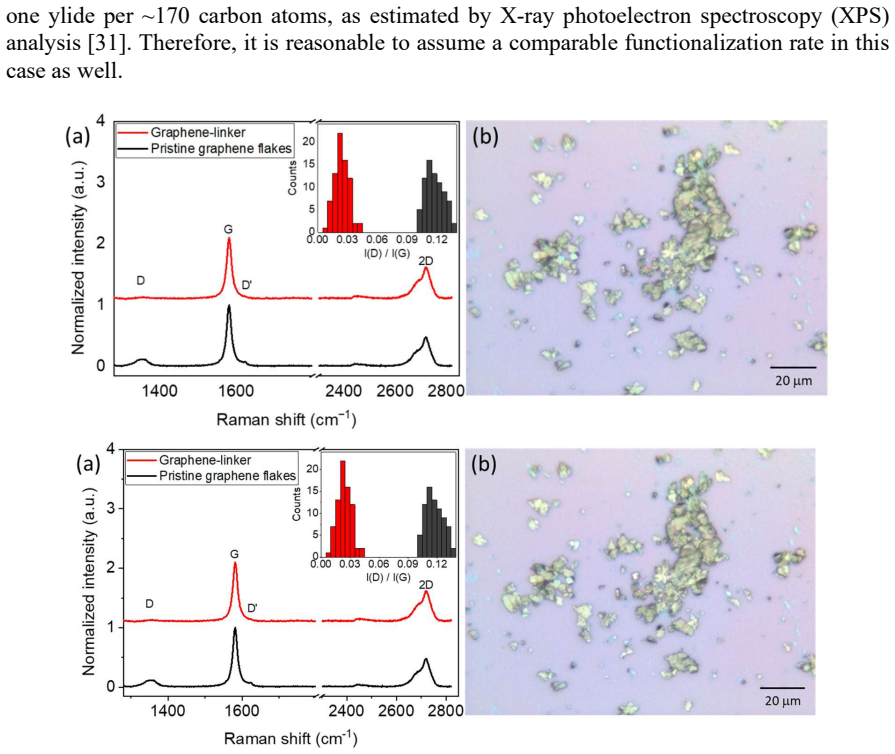
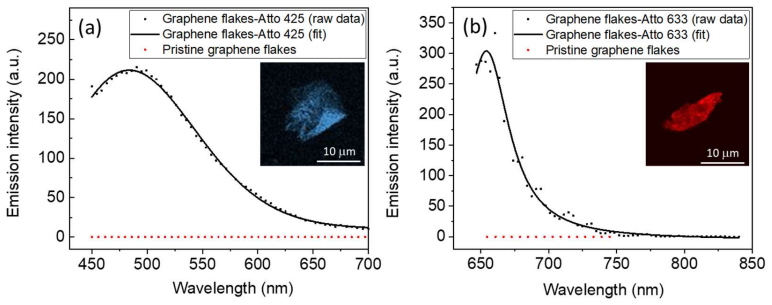
The central claim is that 1,3-dipolar cycloaddition—the same azomethine-ylide chemistry previously applied to carbon nanotubes—works on few-layer graphene flakes that have very few lattice defects, and that a Boc-protected amine built into the ylide leaves a handle for later conjugation. After grafting, acid deprotection exposes a primary amine, and an NHS-ester derivative of Atto 425, 465, or 633 forms an amide bond to that amine. The Raman signature of the functionalized flakes shows the D band intensity decreasing relative to the G band, which the authors interpret as the ylide saturating the reactive defect and edge sites; the 2D band is essentially unchanged, indicating that basal-plane order is preserved. Photoluminescence and confocal imaging show emission at the dyes' characteristic wavelengths, absent in controls lacking the linker or the cycloaddition step, and time-resolved fluorescence of the bound dyes becomes double-exponential, consistent with energy transfer from dye to graphene. The paper also states that the grafting density is about one linker per 170 carbon atoms, taken from a prior study using the same reaction, and that the labeled flakes remain fluorescent after more than a year of storage.
Load-bearing premise
The argument hinges on interpreting the drop in the Raman I(D)/I(G) ratio from about 0.11 to 0.022 as the ylide molecules saturating defects and edges; if defective flakes were instead removed during washing, or if laser exposure reorganized the lattice, the covalent-grafting conclusion would not follow.
Editorial extensions
If this is right
- Because the dye is attached through a primary amine, any NHS-ester-functionalized cargo—peptides, proteins, quantum dots, or nanoparticles—could be anchored to low-defect graphene by the same three-step sequence.
- Raman and fluorescence together let a user locate reactive sites: the D-band drop tracks defect and edge saturation, while fluorescence images show where the dye actually landed.
- The minimal change in the 2D Raman band suggests the graphene lattice remains largely intact, so functionalized flakes should retain more of graphene's conductivity and mechanical properties than radical-based functionalization would allow.
- The method works with three dyes spanning blue to red emission, so multicolor labeling of single flakes is within reach.
- Samples stored in the dark stayed fluorescent for over a year, which makes the route practical for real device or assay timelines.
Reading between the lines
- Not pursued in the paper: if grafting density tracks reactive sites, the confocal fluorescence intensity per flake area could be calibrated against Raman defect counts and become a quick, nondestructive assay for defect density in batch-produced graphene.
- A testable extension the paper leaves implicit is to vary linker length and measure the fluorescence-lifetime components: the observed double-exponential decay suggests distance-dependent energy transfer to graphene, so FLIM could serve as a ruler for dye–graphene separation.
- I infer from the control experiments that fluorescence appears only where a free amine is present, so the method could be spatially patterned by deprotecting or activating selected regions before dye coupling.
- If the one-per-170-carbons density carries over, adjacent linkers sit roughly 2 nm apart; at that spacing, energy transfer between neighboring dyes of different colors should be detectable, offering a way to test the assumed density without XPS.
Signed reviews
Editorial analysis
A structured set of objections, weighed in public.
Referee Report
Summary. The manuscript reports a three-step route for the covalent functionalization of low-defect, few-layer graphene flakes with three Atto fluorophores. Step I is a 1,3-dipolar cycloaddition of a custom Boc-protected azomethine ylide (formed in situ from a mono-Boc hexamethylenediamine-derived linker and 3,4-dihydroxybenzaldehyde), step II is Boc deprotection with phosphoric acid, and step III is coupling of Atto 425/465/633 NHS esters to the surface amines. Functionalization is argued from a decrease in the Raman I(D)/I(G) ratio (from about 0.11 to 0.022, Section 3.2), from dye-specific photoluminescence that is absent in control samples, from confocal fluorescence imaging, and from FLIM decays that become double-exponential after grafting. The authors conclude that the dyes are covalently attached via an amide linkage and that the platform can anchor other molecules such as quantum dots and nanoparticles.
Significance. If the covalent-attachment claim holds, the paper provides a useful proof of concept: a Boc-protected ylide strategy that decouples cycloaddition from payload attachment, demonstrated consistently with three spectrally distinct dyes on low-defect graphene flakes. The strengths are the two control experiments (dye on pristine graphene, linker without dye), the statistical Raman analysis over 75 spectra, the wavelength-consistent emission for all three dyes, and the reported one-year stability of the labeled flakes. The significance is incremental rather than transformative; the advance is a chemical-route demonstration, and the central claim currently rests on circumstantial rather than direct evidence of the amide bond. The manuscript is appropriate in scope for a materials-chemistry journal and is publishable if the covalent-linkage evidence is strengthened.
major comments (4)
- [Section 3.3, Figure 4b] The two control experiments rule out dye physisorption on pristine graphene and intrinsic fluorescence of the linker-graphene system, but neither control addresses the surface that actually exists after step II. After Boc deprotection the flakes carry free amine groups and an organic layer whose surface chemistry differs from pristine graphene, and dye molecules could adsorb on or become trapped in this layer even without forming an amide bond; the DMSO/acetonitrile/acetone rinses described in Section 2.3 may not remove such species. The final product is not characterized by any direct chemical signature of the amide bond: the FT-IR data in SI Figure S2 are taken after deprotection and before dye coupling, and no XPS, Raman, or mass-spectrometric evidence for the dye-linker linkage is presented. The abstract's statement that the dyes are 'covalently linked' therefore overstates what the data establish. Additional evidence is needed, for example XPS N 1s and C 1s analysis, or a control in which the deprotected linker-functionalized flakes are exposed to an Atto dye lacking the NHS ester, or to the NHS-ester dye under non-coupling conditions.
- [Section 3.2, Figure 3a] The decrease in I(D)/I(G) from about 0.11 to 0.022 is interpreted as grafting at defect sites and edge saturation, but alternative explanations are not excluded. The washing protocol (centrifugation at 13,000 rpm with resuspension, Section 2.3) can size-select or remove the most defective flakes, and the 75 spectra were acquired from different flakes before and after functionalization rather than from the same flakes in a paired measurement. The interpretation also sits in tension with the functionalization density assumed later in the same section: one ylide per about 170 carbon atoms would introduce roughly 1% sp3 carbon, which standard defect-activated Raman models (refs. [49,50]) would be expected to increase rather than reduce the D band. The authors should report paired same-flake spectra or a wash-only control, and should discuss quantitatively how edge passivation can outweigh the sp3 defects introduced by the claimed grafting density.
- [Section 3.2, 'The degree of functionalization...'] The quantitative claim of one ylide per about 170 carbon atoms is borrowed from ref. [31], where a 'closely similar' ylide was used, and is not measured in this work. The linker molecule, the reaction conditions (120 h at 150 °C with daily reagent addition), and the flake source are specific to the present study, so the transferred value carries substantial uncertainty. If a functionalization density is stated, it should be measured on the present samples (e.g., by XPS, as in ref. [31]); otherwise the statement should be reworded as an unverified assumption and the quantitative discussion adjusted accordingly.
- [Section 3.3, Figure 4d and Table S1] The double-exponential decays (tau1 about 0.5-0.8 ns, tau2 about 2.6-2.9 ns) are attributed to rapid energy transfer to graphene plus the intrinsic dye decay. This is plausible, but it does not discriminate between a covalently bound dye and a dye merely held in proximity to the graphene surface, since both would experience graphene-induced energy transfer; the conclusion that attachment to graphene alters the fluorescence dynamics does not by itself support the covalent-linkage claim. The fit model, amplitudes, and goodness-of-fit are not reported, and alternative interpretations (e.g., a distribution of dye-graphene distances or dye aggregation) are not discussed. These data should be presented as consistent with, rather than evidence for, covalent binding.
minor comments (7)
- [Section 2.1] The abbreviation 'DFM' for N,N-dimethylformamide is a typo for DMF, which is used correctly elsewhere.
- [Section 2.2] The text uses 'trimethylamine' where the reagent list and the reaction scheme require triethylamine; this should be corrected for consistency.
- [Reference [32]] The citation lists J. Mater. Chem. C with volume and page numbers but a preprint DOI (10.2139/ssrn.4039980); this should be reconciled with the published version.
- [SI Figure S2] Assigning the band at 1730 cm-1 to an amide C=O stretch in the product of the deprotection step is chemically questionable, since no amide is expected after Boc cleavage; a residual carbamate or other carbonyl assignment should be considered, and the confirmation of deprotection would be better supported by free-amine N-H bands.
- [Section 2.4] The laser irradiation is quoted in units of mJ per square micrometer as 'power'; this is a fluence, and the actual power or pulse parameters should be stated.
- [Section 3.3 and SI Figure S5] The text claims a 'uniform derivatization of both the edges and the basal plane' while also attributing fluorescence intensity variations to the 'random distribution of defects'; these statements should be reconciled.
- [SI Figure S3 caption] 'Atto 465 NSH' should read 'Atto 465 NHS'.
Circularity Check
No circularity found: the central dye-attachment claim rests on new fluorescence, confocal, and FLIM data with controls, not on a reduction of the inputs.
full rationale
The claimed derivation chain is experimental: synthesize a Boc-protected linker (UHPLC-MS), graft it to graphene by 1,3-dipolar cycloaddition (Raman and prior XPS/DFT work), deprotect the amine (FT-IR), and attach NHS-ester dyes (PL, confocal, FLIM). No quantity called a prediction is obtained by construction from the data used to define it. The one ylide per ~170 carbon atoms functionalization density is explicitly imported from prior self-cited work as an assumption ('therefore, it is reasonable to assume a comparable functionalization rate'), not fitted or renamed as a new result, and it does not feed back into the fluorescence evidence for dye attachment. The self-citations [31,32] concern the same cycloaddition chemistry and are externally evidenced (XPS, EDX, DFT); they are background support rather than a forced derivation of the new dye-labeling claim. The new controls (linker without dye, pristine graphene incubated with dye) independently show no fluorescence, which supports the attachment interpretation. The absence of a direct amide-bond signature is a real evidentiary limitation about covalent bonding, but it is not circularity, because the paper's positive fluorescence evidence is not equivalent to its own inputs.
Assumptions & free parameters
free parameters (2)
- FLIM fast lifetime tau1 =
0.5 to 0.8 ns depending on dye
- FLIM slow lifetime tau2 =
2.6 to 2.9 ns depending on dye
assumptions (5)
- domain assumption 1,3-dipolar cycloaddition of azomethine ylide occurs on graphene flakes as described in refs [31] and [32].
- domain assumption The decrease in I(D)/I(G) after functionalization is due to grafting at defects and edge saturation.
- domain assumption Functionalization density is comparable to that in ref [31], about one ylide per 170 carbon atoms.
- domain assumption FT-IR band assignments indicate complete Boc cleavage.
- domain assumption Fluorescence signal from dye-labeled graphene is due to covalent attachment, not physisorption.
Cite this review
Pith. "Pith review of Surface Grafting of Graphene Flakes with Fluorescent Dyes: A Tailored Functionalization Approach." pith.science (2026). https://pith.science/paper/EY6TSHLY
@misc{pith2026250503365,
  author       = {Pith},
  title        = {Pith review of: Surface Grafting of Graphene Flakes with Fluorescent Dyes: A Tailored Functionalization Approach},
  year         = {2026},
  howpublished = {\url{https://pith.science/paper/EY6TSHLY}},
  note         = {Machine review of arXiv:2505.03365}
}
read the original abstract
The controlled functionalization of graphene is critical for tuning and enhancing its properties, thereby expanding its potential applications. Covalent functionalization offers a deeper tuning of the geometric and electronic structure of graphene compared to non-covalent methods; however, the existing techniques involve side reactions and spatially uncontrolled functionalization, pushing research toward more selective and controlled methods. A promising approach is 1,3-dipolar cycloaddition, successfully utilized with carbon nanotubes. In the present work, this method has been extended to graphene flakes with low defect concentration. A key innovation is the use of a custom-synthesized ylide with a protected amine group (Boc), facilitating subsequent attachment of functional molecules. Indeed, after Boc cleavage, fluorescent dyes (Atto 425, 465, and 633) were covalently linked via NHS ester derivatization. This approach represents a highly selective method of minimizing structural damage. Successful functionalization was demonstrated by Raman spectroscopy, photoluminescence spectroscopy, and confocal microscopy, confirming the effectiveness of the method. This novel approach offers a versatile platform, enabling its use in biological imaging, sensing, and advanced nanodevices. The method paves the way for the development of sensors and devices capable of anchoring a wide range of molecules, including quantum dots and nanoparticles. Therefore, it represents a significant advancement in graphene-based technologies.
Figures


Figures from the paper (2 more)

Reference graph
Works this paper leans on
-
[31]
Basta, L.; Moscardini, A.; Fabbri, F.; Bellucci, L.; Tozzini, V.; Rubini, S.; Griesi, A.; Gemmi, M.; Heun, S.; Veronesi, S. Covalent organic functionalization of graphene nanosheets and reduced graphene oxide via1,3-dipolar cycloaddition of azomethine ylide. Nanoscale Adv. 2021, 3, 5841–5852. https://doi.org/10.1039/d1na00335f
-
[1]
Electric Field Effect in Atomically Thin Carbon Films
Novoselov, K.S.; Geim, A.K.; Morozov, S.V.; Jiang, D.; Zhang, Y.; Dubonos, S.V.; Grigorieva, I.V.; Firsov, A.A. Electric Field Effect in Atomically Thin Carbon Films. Science 2004, 306, 666–669. https://doi.org/10.1126/science.1102896
-
[2]
Production, properties and potential of graphene
Soldano, C.; Mahmood, A.; Dujardin, E. Production, properties and potential of graphene. Carbon 2010, 48, 2127–2150. https://doi.org/10.1016/j.carbon.2010.01.058
-
[3]
Electronic properties of graphene
Novoselov, K.S.; Morozov, S.V.; Mohinddin, T.M.G.; Ponomarenko, L.A.; Elias, D.C.; Yang, R.; Barbolina, I.I.; Blake, P.; Booth, T.J.; Jiang, D.; et al. Electronic properties of graphene. Phys. Status Solidi Basic Res . 2007, 244 , 4106–4111. https://doi.org/10.1002/pssb.200776208
-
[4]
Recent Progress in Graphene/Polymer Nanocomposites
Sun, X.; Huang, C.; Wang, L.; Liang, L.; Cheng, Y.; Fei, W.; Li, Y. Recent Progress in Graphene/Polymer Nanocomposites. Adv. Mater . 2021, 33 , 2001105. https://doi.org/10.1002/adma.202001105
-
[5]
Graphene-based materials for supercapacitor electrodes—A review
Ke, Q.; Wang, J. Graphene-based materials for supercapacitor electrodes—A review. J. Mater. 2016, 2, 37–54. https://doi.org/10.1016/j.jmat.2016.01.001
-
[6]
Graphene-based nanomaterials for drug delivery and tissue engineering
Goenka, S.; Sant, V.; Sant, S. Graphene-based nanomaterials for drug delivery and tissue engineering. J. Control. Release 2014, 173 , 75–88. https://doi.org/10.1016/j.jconrel.2013.10.017
-
[7]
Transparent, conductive graphene electrodes for dye-sensitized solar cells
Wang, X.; Zhi, L.; Müllen, K. Transparent, conductive graphene electrodes for dye-sensitized solar cells. Nano Lett. 2008, 8, 323–327. https://doi.org/10.1021/nl072838r. 16
Show all 63 references
-
[8]
Flexible organic memory devices with multilayer graphene electrodes
Ji, Y.; Lee, S.; Cho, B.; Song, S.; Lee, T. Flexible organic memory devices with multilayer graphene electrodes. ACS Nano 2011, 5, 5995–6000. https://doi.org/10.1021/nn201770s
2011 doi
-
[9]
A Flexible, Transparent Chemosensor Integrating an Inkjet-Printed Organic Field-Effect Transistor and a Non-Covalently Functionalized Graphene Electrode
Lai, S.; Vlamidis, Y.; Mishra, N.; Cosseddu, P.; Mišeikis, V.; Ricci, P.C.; Voliani, V.; Coletti, C.; Bonfiglio, A. A Flexible, Transparent Chemosensor Integrating an Inkjet-Printed Organic Field-Effect Transistor and a Non-Covalently Functionalized Graphene Electrode. Adv. Ma...
2021 doi
-
[10]
Probing the electrochemical properties of graphene nanosheets for biosensing applications
Alwarappan, S.; Erdem, A.; Liu, C.; Li, C.Z. Probing the electrochemical properties of graphene nanosheets for biosensing applications. J. Phys. Chem. C 2009, 113, 8853–8857. https://doi.org/10.1021/jp9010313
2009 doi
-
[11]
Manipulating the electronic and chemical properties of graphene via molecular functionalization
Mao, H.Y.; Lu, Y.H.; Lin, J.D.; Zhong, S.; Wee, A.T.S.; Chen, W. Manipulating the electronic and chemical properties of graphene via molecular functionalization. Prog. Surf. Sci. 2013, 88, 132–159. https://doi.org/10.1016/j.progsurf.2013.02.001
2013 doi
-
[12]
Controlling covalent chemistry on graphene oxide
Guo, S.; Garaj, S.; Bianco, A.; Ménard-Moyon, C. Controlling covalent chemistry on graphene oxide. Nat. Rev. Phys. 2022, 4, 247–262. https://doi.org/10.1038/s42254-022- 00422-w
2022 doi
-
[13]
Guiding graphene derivatization for covalent immobilization of aptamers
Rabchinskii, M.K.; Ryzhkov, S.A.; Besedina, N.A.; Brzhezinskaya, M.; Malkov, M.N.; Stolyarova, D.Y.; Arutyunyan, A.F.; Struchkov, N.S.; Saveliev, S.D.; Diankin, I.D.; et al. Guiding graphene derivatization for covalent immobilization of aptamers. Carbon 2022, 196, 264–279. htt...
2022 doi
-
[14]
Toward On-Chip Multisensor Arrays for Selective Methanol and Ethanol Detection at Room Temperature: Capitalizing the Graphene Carbonylation
Rabchinskii, M.K.; Sysoev, V.V.; Varezhnikov, A.S.; Solomatin, M.A.; Struchkov, N.S.; Stolyarova, D.Y.; Ryzhkov, S.A.; Antonov, G.A.; Gabrelian, V.S.; Cherviakova, P.D.; et al. Toward On-Chip Multisensor Arrays for Selective Methanol and Ethanol Detection at Room Temperature: ...
2023 doi
-
[15]
An Overview of Functionalized Graphene Nanomaterials for Advanced Applications
Maio, A.; Pibiri, I.; Morreale, M.; La Mantia, F.P.; Scaffaro, R. An Overview of Functionalized Graphene Nanomaterials for Advanced Applications. Nanomaterials 2021, 11,
2021
-
[16]
Chemical Functionalization of Graphene with Defects
Boukhvalov, D.W.; Katsnelson, M.I. Chemical Functionalization of Graphene with Defects. Nano Lett. 2008, 8, 4373–4379. https://doi.org/10.1021/nl802234n
2008 doi
-
[17]
Graphene and functionalized graphene: Extraordinary prospects for nanobiocomposite materials
Ioniţă, M.; Vlăsceanu, G.M.; Watzlawek, A.A.; Voicu, S.I.; Burns, J.S.; Iovu, H. Graphene and functionalized graphene: Extraordinary prospects for nanobiocomposite materials. Compos. Part B Eng. 2017, 121, 34–57. https://doi.org/10.1016/j.compositesb.2017.03.031
2017 doi
-
[18]
Water-soluble graphene covalently functionalized by biocompatible poly-L-lysine
Shan, C.; Yang, H.; Han, D.; Zhang, Q.; Ivaska, A.; Niu, L. Water-soluble graphene covalently functionalized by biocompatible poly-L-lysine. Langmuir 2009, 25 , 12030–12033. https://doi.org/10.1021/la903265p
2009 doi
-
[19]
Multifunctional organically modified graphene with super-hydrophobicity
Hu, H.; Allan, C.C.K.; Li, J.; Kong, Y.; Wang, X.; Xin, J.H.; Hu, H. Multifunctional organically modified graphene with super-hydrophobicity. Nano Res. 2014, 7, 418–433. https://doi.org/10.1007/s12274-014-0408-0
2014 doi
-
[20]
The chemistry of graphene
Loh, K.P.; Bao, Q.; Ang, P.K.; Yang, J. The chemistry of graphene. J. Mater. Chem. 2010, 20, 2277–2289. https://doi.org/10.1039/b920539j
2010 doi
-
[21]
Functionalization of Graphene and Applications of the Derivatives
Yang, G.-h.; Bao, D.-d., Liu, H.; Zhang, D.-q.; Wang, N.; Li, H.-t. Functionalization of Graphene and Applications of the Derivatives. J. Inorg. Organomet. Polym. Mater. 2017, 27, 1129–1141. https://doi.org/10.1007/s10904-017-0597-6
2017 doi
-
[22]
The Covalent Functionalization of Graphene on Substrates
Criado, A.; Melchionna, M.; Marchesan, S.; Prato, M. The Covalent Functionalization of Graphene on Substrates. Angew. Chem. Int. Ed . 2015, 54 , 10734–10750. https://doi.org/10.1002/anie.201501473. 17
2015 doi
-
[23]
The Covalent Functionalization of Surface-Supported Graphene: An Update
Wetzl, C.; Silvestri, A.; Garrido, M.; Hou, H.L.; Criado, A.; Prato, M. The Covalent Functionalization of Surface-Supported Graphene: An Update. Angew. Chem. Int. Ed. 2023, 62, e202212857. https://doi.org/10.1002/anie.202212857
2023 doi
-
[24]
Covalent functionalization of epitaxial graphene by azidotrimethylsilane
Choi, J.; Kim, K.J.; Kim, B.; Lee, H.; Kim, S. Covalent functionalization of epitaxial graphene by azidotrimethylsilane. J. Phys. Chem. C 2009, 113 , 9433–9435. https://doi.org/10.1021/jp9010444
2009 doi
-
[25]
N-Heterocyclic Carbene–Graphene Nanotransistor Based on Covalent Bond for Ultrastable Biosensors
Kim, K.H.; Seo, S.E.; Park, S.J.; Kim, J.; Park, C.S.; Le, T.H.; Lee, C.S.; Kim, Y.K.; Kim, H.Y.; Jun, S.; et al. N-Heterocyclic Carbene–Graphene Nanotransistor Based on Covalent Bond for Ultrastable Biosensors. Adv. Funct. Mater . 2024, 34 , 2310377. https://doi.org/10.1002/a...
2024 doi
-
[26]
Microwave- induced covalent functionalization of few-layer graphene with arynes under solvent-free conditions
Sulleiro, M.V.; Quiroga, S.; Peña, D.; Pérez, D.; Guitián, E.; Criado, A.; Prato, M. Microwave- induced covalent functionalization of few-layer graphene with arynes under solvent-free conditions. Chem. Commun. 2018, 54, 2086–2089. https://doi.org/10.1039/c7cc08676h
2018 doi
-
[27]
Organic functionalisation of graphenes
Georgakilas, V.; Bourlinos, A.B.; Zboril, R.; Steriotis, T.A.; Dallas, P.; Stubos, A.K.; Trapalis, C. Organic functionalisation of graphenes. Chem. Commun. 2010, 46, 1766–1768. https://doi.org/10.1039/b922081j
2010 doi
-
[28]
1,3-Dipolar cycloaddition of several azomethine ylides to [60]fullerene: Synthesis of derivatives of 2′,5′-dihydro-1′H- pyrrolo[3′,4′:1,2][60]fullerene 1
Wu, S.; Sun, W.; Zhang, D.; Shu, L.; Wu, H.; Xu, J.; Lao, X. 1,3-Dipolar cycloaddition of several azomethine ylides to [60]fullerene: Synthesis of derivatives of 2′,5′-dihydro-1′H- pyrrolo[3′,4′:1,2][60]fullerene 1. J. Chem. Soc., Perkin Trans. 1998, 1 , 1733–1738. https://doi...
1998 doi
-
[29]
Fluorescent single-walled carbon nanotubes following the 1,3- dipolar cycloaddition of pyridinium ylides
Bayazit, M.K.; Coleman, K.S. Fluorescent single-walled carbon nanotubes following the 1,3- dipolar cycloaddition of pyridinium ylides. J. Am. Chem. Soc. 2009, 131, 10670–10676. https://doi.org/10.1021/ja903712f
2009 doi
-
[30]
An efficient approach to chiral fullerene derivatives by catalytic enantioselective 1,3-dipolar cycloadditions
Filippone, S.; Maroto, E.E.; Martín-Domenech, Á.; Suarez, M.; Martín, N. An efficient approach to chiral fullerene derivatives by catalytic enantioselective 1,3-dipolar cycloadditions. Nat. Chem. 2009, 1, 578–582. https://doi.org/10.1038/nchem.361
2009 doi
-
[32]
Deterministic Covalent Organic Functionalization of Monolayer Graphene with 1,3- Dipolar Cycloaddition Via High Resolution Surface Engineering
Basta, L.; Bianco, F.; Moscardini, A.; Fabbri, F.; Bellucci, L.; Tozzini, V.; Heun, S.; Veronesi, S. Deterministic Covalent Organic Functionalization of Monolayer Graphene with 1,3- Dipolar Cycloaddition Via High Resolution Surface Engineering. J. Mater. Chem. C 2022, 11, 2630...
2022 doi
-
[33]
A multicolor fluorescence in situ hybridization approach using an extended set of fluorophores to visualize microorganisms
Lukumbuzya, M.; Schmid, M.; Pjevac, P.; Daims, H. A multicolor fluorescence in situ hybridization approach using an extended set of fluorophores to visualize microorganisms. Front. Microbiol. 2019, 10, 1383. https://doi.org/10.3389/fmicb.2019.01383
2019
-
[34]
Atto 465 Derivative Is a Nuclear Stain with Unique Excitation and Emission Spectra Useful for Multiplex Immunofluorescence Histochemistry
Dodge, J.T.; Doyle, A.D.; Costa-da-Silva, A.C.; Hogden, C.T.; Mezey, E.; Mays, J.W. Atto 465 Derivative Is a Nuclear Stain with Unique Excitation and Emission Spectra Useful for Multiplex Immunofluorescence Histochemistry. J. Histochem. Cytochem. 2022, 70, 211–223. https://doi...
2022 doi
-
[35]
Determining the In-Plane Orientation and Binding Mode of Single Fluorescent Dyes in DNA Origami Structures
Hübner, K.; Joshi, H.; Aksimentiev, A.; Stefani, F.D.; Tinnefeld, P.; Acuna, G.P. Determining the In-Plane Orientation and Binding Mode of Single Fluorescent Dyes in DNA Origami Structures. ACS Nano 2021, 15, 5109–5117. https://doi.org/10.1021/acsnano.0c10259. 18
2021 doi
-
[36]
Carbon Nanomaterial Fluorescent Probes and Their Biological Applications
Krasley, A.T.; Li, E.; Galeana, J.M.; Bulumulla, C.; Beyene, A.G.; Demirer, G.S. Carbon Nanomaterial Fluorescent Probes and Their Biological Applications. Chem. Rev. 2024, 124, 3085–3185. https://doi.org/10.1021/acs.chemrev.3c00581
2024 doi
-
[37]
Intracellular imaging with a graphene-based fluorescent probe
Peng, C.; Hu, W.; Zhou, Y.; Fan, C.; Huang, Q. Intracellular imaging with a graphene-based fluorescent probe. Small 2010, 6, 1686–1692. https://doi.org/10.1002/smll.201000560
2010 doi
-
[38]
Selective Functionalization of Graphene at Defect-Activated Sites by Arylazocarboxylic tert-Butyl Esters
Halbig, C.E.; Lasch, R.; Krüll, J.; Pirzer, A.S.; Wang, Z.; Kirchhof, J.N.; Bolotin, K.I.; Heinrich, M.R.; Eigler, S. Selective Functionalization of Graphene at Defect-Activated Sites by Arylazocarboxylic tert-Butyl Esters. Angew. Chem. Int. Ed. 2019, 58, 3599–3603. https://do...
2019 doi
-
[39]
Succinimidyl ester surface chemistry: Implications of the competition between aminolysis and hydrolysis on covalent protein immobilization
Lim, C.Y.; Owens, N.A.; Wampler, R.D.; Ying, Y.; Granger, J.H.; Porter, M.D.; Takahashi, M.; Shimazu, K. Succinimidyl ester surface chemistry: Implications of the competition between aminolysis and hydrolysis on covalent protein immobilization. Langmuir 2014, 30, 12868–12878. ...
2014 doi
-
[40]
Surface functionalization of graphene-based materials: Biological behavior, toxicology, and safe-by-design aspects
Guo, Z.; Chakraborty, S.; Monikh, F.A.; Varsou, D.-D.; Chetwynd, A.J.; Afantitis, A.; Lynch, I.; Zhang, P. Surface functionalization of graphene-based materials: Biological behavior, toxicology, and safe-by-design aspects. Adv. Biol. 2021, 5 , 2100637. https://doi.org/10.1002/...
2021 doi
-
[41]
Amino Acid-Protecting Groups
Isidro-Llobet, A.; Álvarez, M.; Albericio, F. Amino Acid-Protecting Groups. Chem. Rev. 2009, 109, 2455–2504. https://doi.org/10.1021/cr800323s
2009 doi
-
[42]
Versatile functionalization of 3,5- diamino-4-nitropyrazole for promising insensitive energetic compounds
Tang, Y.; Ma, J.; Imler, G.H.; Parrish, D.A.; Shreeve, J.M. Versatile functionalization of 3,5- diamino-4-nitropyrazole for promising insensitive energetic compounds. Dalt. Trans. 2019, 48, 14490–14496. https://doi.org/10.1039/c9dt03138c
2019 doi
-
[43]
Zwitterionic Halido Cyclopentadienone Iron Complexes and Their Catalytic Performance in Hydrogenation Reactions
Bütikofer, A.; Chen, P. Zwitterionic Halido Cyclopentadienone Iron Complexes and Their Catalytic Performance in Hydrogenation Reactions. Inorg. Chem. 2023, 62, 4188–4196. https://doi.org/10.1021/acs.inorgchem.2c04298
2023 doi
-
[44]
Selective mono-BOC protection of diamines
Lee, D.W.; Ha, H.J.; Lee, W.K. Selective mono-BOC protection of diamines. Synth. Commun. 2007, 37, 737–742. https://doi.org/10.1080/00397910601131403
2007 doi
-
[45]
Mild deprotection of the: N-tert- butyloxycarbonyl (N-Boc) group using oxalyl chloride
George, N.; Ofori, S.; Parkin, S.; Awuah, S.G. Mild deprotection of the: N-tert- butyloxycarbonyl (N-Boc) group using oxalyl chloride. RSC Adv. 2020, 10, 24017–24026. https://doi.org/10.1039/d0ra04110f
2020 doi
-
[46]
Amidation and esterification of carboxylic acids with amines and phenols by N,N′-diisopropylcarbodiimide: A new approach for amide and ester bond formation in water
Fattahi, N.; Ayubi, M.; Ramazani, A. Amidation and esterification of carboxylic acids with amines and phenols by N,N′-diisopropylcarbodiimide: A new approach for amide and ester bond formation in water. Tetrahedron 2018, 74 , 4351–4356. https://doi.org/10.1016/j.tet.2018.06.064
2018 doi
-
[47]
Fluorescence lifetime imaging microscopy: Fundamentals and advances in instrumentation, analysis, and applications
Datta, R.; Heaster, T.M.; Sharick, J.T.; Gillette, A.A.; Skala, M.C. Fluorescence lifetime imaging microscopy: Fundamentals and advances in instrumentation, analysis, and applications. J. Biomed. Opt. 2020, 25, 071203. https://doi.org/10.1117/1.JBO.25.7.071203
2020 doi
-
[48]
High-yield production of 2D crystals by wet- jet milling
Del Rio Castillo, A.E.; Pellegrini, V.; Ansaldo, A.; Ricciardella, F.; Sun, H.; Marasco, L.; Buha, J.; Dang, Z.; Gagliani, L.; Lago, E.; et al. High-yield production of 2D crystals by wet- jet milling. Mater. Horizons 2018, 5, 890–904. https://doi.org/10.1039/c8mh00487k
2018 doi
-
[49]
Raman Spectrum of Graphene and Graphene Layers
Ferrari, A.C.; Meyer, J.C.; Scardaci, V.; Casiraghi, C.; Lazzeri, M.; Mauri, F.; Piscanec, S.; Jiang, D.; Novoselov, K.S.; Roth, S.; et al. Raman Spectrum of Graphene and Graphene Layers. Phys. Rev. Lett. 2006, 97, 187401. https://doi.org/10.1103/PhysRevLett.97.187401
2006 doi
-
[50]
Quantifying Defects in Graphene via Raman 19 Spectroscopy at Different Excitation Energies
Jorio, A.; Ferreira, E.H.M.; Stavale, F.; Achete, C.A.; Capaz, R.B.; Moutinho, M.V.O.; Lombardo, A.; Kulmala, T.S.; Ferrari, A.C. Quantifying Defects in Graphene via Raman 19 Spectroscopy at Different Excitation Energies. Nano Lett. 2011, 12, 3190–3196. https://doi.org/10.1021...
2011 doi
-
[51]
Probing the nature of defects in graphene by Raman spectroscopy
Eckmann, A.; Felten, A.; Mishchenko, A.; Britnell, L.; Krupke, R.; Novoselov, K.S.; Casiraghi, C. Probing the nature of defects in graphene by Raman spectroscopy. Nano Lett. 2012, 12, 3925–3930. https://doi.org/10.1021/nl300901a
2012 doi
-
[52]
Raman study on defective graphene: Effect of the excitation energy , type , and amount of defects
Eckmann, A.; Felten, A.; Verzhbitskiy, I.; Davey, R.; Casiraghi, C. Raman study on defective graphene: Effect of the excitation energy , type , and amount of defects. Phys. Rev. B 2013, 88, 035426. https://doi.org/10.1103/PhysRevB.88.035426
2013 doi
-
[53]
Formation of arenicin-1 microdomains in bilayers and their specific lipid interaction revealed by Z-scan FCS
MacHáň, R.; Hof, M.; Chernovets, T.; Zhmak, M.N.; Ovchinnikova, T.V.; Sýkora, J. Formation of arenicin-1 microdomains in bilayers and their specific lipid interaction revealed by Z-scan FCS. Anal. Bioanal. Chem. 2011, 399, 3547–3554. https://doi.org/10.1007/s00216- 011-4694-z
2011 doi
-
[54]
Delamination and defects in graphene nanosheets exfoliated from 3D precursors
Sethurajaperumal, A.; Ravichandran, V.; Merenkov, I.; Ostrikov (Ken), Varrla, E. Delamination and defects in graphene nanosheets exfoliated from 3D precursors. Carbon 2023, 213, 118306. https://doi.org/10.1016/j.carbon.2023.118306
2023
-
[55]
Nature of graphene edges: A review
Acik, M.; Chabal, Y.J. Nature of graphene edges: A review. Jpn. J. Appl. Phys. 2011, 50, 070101. https://doi.org/10.1143/JJAP.50.070101
2011 doi
-
[56]
Characterization of new fluorescent labels for ultra-high resolution microscopy
Chmyrov, A.; Arden-Jacob, J.; Zilles, A.; Drexhage, K.H.; Widengren, J. Characterization of new fluorescent labels for ultra-high resolution microscopy. Photochem. Photobiol. Sci. 2008, 7, 1378–1385. https://doi.org/10.1039/b810991p
2008 doi
-
[57]
Ultrafast photoinduced dynamics of the 3,6-diaminoacridinium derivative ATTO 465 in solution
Arden-Jacob, J.; Drexhage, K.H.; Druzhinin, S.I.; Ekimova, M.; Flender, O.; Lenzer, T.; Oum, K.; Scholz, M. Ultrafast photoinduced dynamics of the 3,6-diaminoacridinium derivative ATTO 465 in solution. Phys. Chem. Chem. Phys. 2013, 15 , 1844–1853. https://doi.org/10.1039/c2cp43493h
2013 doi
-
[58]
Fluorescence-Lifetime-Sensitive Probes for Monitoring ATP Cleavage
Hammler, D.; Marx, A.; Zumbusch, A. Fluorescence-Lifetime-Sensitive Probes for Monitoring ATP Cleavage. Chem. Eur. J . 2018, 24 , 15329–15335. https://doi.org/10.1002/chem.201803234
2018 doi
-
[59]
Measuring sub-nanometer undulations at microsecond temporal resolution with metal- and graphene-induced energy transfer spectroscopy
Chen, T.; Karedla, N.; Enderlein, J. Measuring sub-nanometer undulations at microsecond temporal resolution with metal- and graphene-induced energy transfer spectroscopy. Nat. Commun. 2024, 15, 1789. https://doi.org/10.1038/s41467-024-45822-x
2024 doi
-
[60]
Xin, G.; Gong, S.; Kim, N.; Kim, J.; Hwang, W.; Nam, J.; Cho, Y.H.; Cho, S.M.; Chae, H.; Graphene oxide/N-methyl-2-pyrrolidone charge-transfer complexes for molecular detection. Sens. Actuators B Chem. 2013, 176, 81–85. https://doi.org/10.1016/j.snb.2012.09.003
2013 doi
-
[61]
Fluorescence lifetime measurements and biological imaging
Berezin, M.Y.; Achilefu, S. Fluorescence lifetime measurements and biological imaging. Chem. Rev. 2010, 110, 2641–2684. https://doi.org/10.1021/cr900343z. 20 Supporting Information for Surface grafting of graphene flakes with fluorescent dyes: a tailored functionalization appr...
2010 doi
-
[63]
Analytical techniques and equipment 1.1 UHPLC-MS analysis of the linker molecule The linker molecule was analyzed and purified with an Ultra High Performance Liquid Chromatography (UHPLC) system (Shimadzu Nexera). The analyte was identified through a diode-array detector using...
2015
-
[1717]
https://doi.org/10.3390/nano11071717
Reviewed August 15, 2026 · model on record in the stance chip above.
Discussion (0). Continue with ORCID to comment.