REVIEW 4 major objections 5 minor 106 references
Non-local correlations of a test quantum field in gravitational collapse
T0 review · 4 major / 5 minor · reviewed 2026-08-15 · deepseek-v4-flash
Pith's one-line read In a dynamical collapse to a black hole, the vacuum correlations of a test quantum field develop non-local peaks that join points inside the horizon to points outside, and the exterior peak travels outward as the spacetime settles toward…
desk verdict A genuinely new numerical observation of across-horizon correlation peaks in a dynamical collapse, but the initial state is a quench, so the Hawking-pair attribution is not yet established. read the letter →
The pith
A machine-rendered reading of the paper's core claim, the machinery that carries it, and where it could break.
The reading
What carries the argument
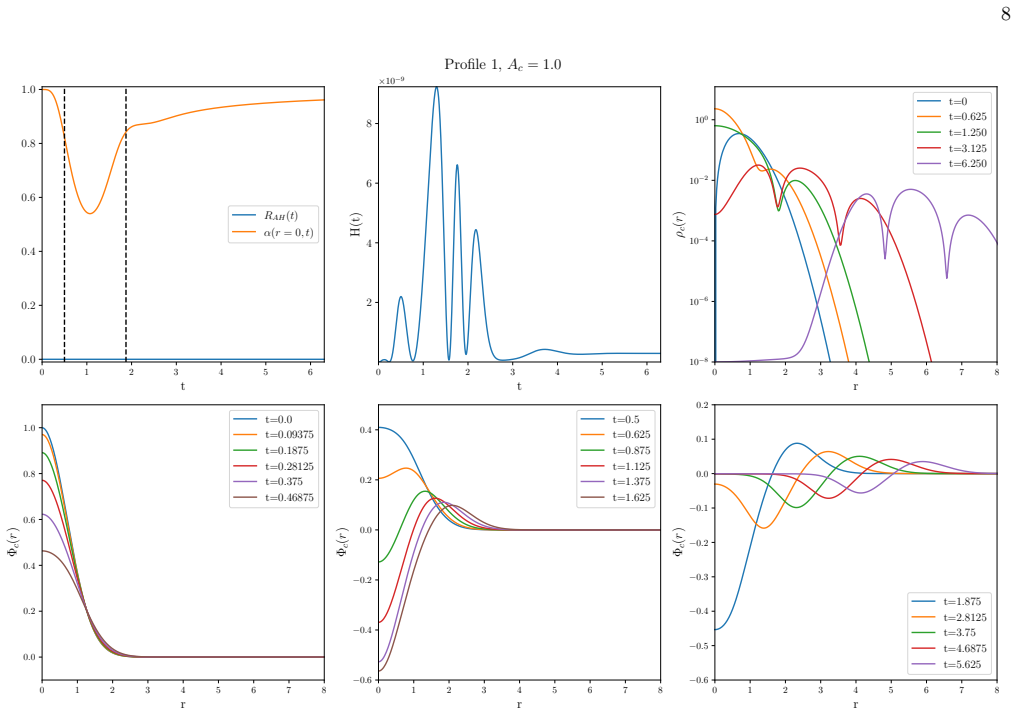
The load-bearing object is the regularized equal-time two-point function of the test field, expressed as a mode sum over spherical-harmonic modes, $$\langle 0|\hat\Phi_q(t,r)\hat\Phi_q(t,r')|0\rangle_{\rm reg} = \frac{\hbar $c^{2}$}{4\pi}\sum_{l}(2l+1)\int dk \sum_{n=0}^{5}(-1)^n \tilde u_{k,l;n}(t,r')\tilde u^*_{k,l;n}(t,r),$$ with a parallel expression for the conjugate momentum $\hat\Pi_q$. The $\tilde u_{k,l;n}$ are rescaled mode functions, initialized as Minkowski modes and evolved together with the Einstein-Klein-Gordon system for the collapsing background. The numerical core is a tenth-order finite-difference evolution with Kreiss-Oliger dissipation on a uniform grid, with the mode sums truncated at $N_k=N_l=50$ and infrared cutoff $k_{\min}=\pi/15$. The argument runs through the correlation maps this mode sum produces at successive times: the evolving lapse freezes dynamics inside the horizon, while the off-diagonal structure outside builds up and moves outward. The Pauli-Villars subtraction with five auxiliary fields makes the correlation finite on the lattice, and the particular grid choices define the domain on which the claim is made.
What would settle it
Repeat the same collapse with doubled mode counts ($N_k=N_l=100$), a halved infrared cutoff ($k_{\min}=\pi/30$), a smaller grid spacing, and at least two regulator masses ($m_1=0.5$ and $2$), and check whether the across-horizon peak's position, sign, and outward speed survive within a few percent; if the peak shifts, shrinks, or vanishes under any change, the claimed non-local correlations are numerical artifacts rather than Hawking-pair structure.
Extended reading notes
Core claim
On the paper's own terms, the central discovery is that the regularized equal-time correlators $\langle 0|\hat\Phi_q(t,r)\hat\Phi_q(t,r')|0\rangle_{\rm reg}$ and the corresponding momentum correlator acquire off-diagonal structure once the collapsing matter forms an apparent horizon. For a supercritical Gaussian profile, a valley of negative correlation develops just inside the apparent-horizon radius while a positive peak appears outside, and the outside peak's location increases with time, with amplitude of the same order as the local peak. The authors interpret the inside-outside pair as an entangled Hawking partner pair, in the terminology of a toy model with an event horizon, and the outward motion as outgoing Hawking flux. They emphasize that the exterior peak first appears at a macroscopic distance from the apparent horizon, which they take as evidence for a quantum atmosphere rather than emission at the horizon. In a subcritical collapse that disperses without forming a horizon, no such non-local across-horizon peaks develop, so the effect is tied to horizon formation.
Load-bearing premise
The load-bearing premise is that the non-local correlation peaks and their outward motion are properties of the quantum state on the collapsing spacetime, not artifacts of the finite grid, the truncation to fifty $k$- and $l$-modes, the infrared cutoff, or the Pauli-Villars ghost mass.
Editorial extensions
If this is right
- Equal-time vacuum correlations can carry the Hawking-pair signal during collapse itself, so the phenomenon is not confined to asymptotic late-time fluxes.
- The first exterior peak appears a macroscopic distance outside the apparent horizon, supporting the quantum-atmosphere picture over emission at the horizon.
- The gravitational correlation maps reproduce the qualitative shape of the analogue black hole density correlations, giving a common language between gravitational and condensed-matter Hawking experiments.
- The off-diagonal correlations reach the same order as the local diagonal peak, illustrating how the neglected cross terms in the reduced density matrix could matter for information recovery.
- The momentum correlator shows fringes perpendicular to the diagonal outside the horizon, offering a second observable with the same partner structure.
Reading between the lines
- Tracking the exterior peak's location as a function of time during the stationary phase and comparing its growth rate with the surface gravity $\kappa$ of the apparent horizon would turn the reported outward motion into a quantitative test of the Hawking-flux prediction.
- A natural next step, not taken in the paper, is to compute the entanglement entropy after tracing out the interior degrees of freedom and check whether its growth follows a Page-curve-like pattern.
- Varying the initial Gaussian amplitude across the critical threshold and recording the peak amplitude or onset time could connect the correlation signal to the scaling laws of critical collapse.
- Applying the same correlation diagnostic to the field that sources the collapse would separate features generic to horizon formation from features caused by backreaction between the field and geometry.
Signed reviews
Editorial analysis
A structured set of objections, weighed in public.
Referee Report
Summary. The manuscript studies the equal-time vacuum correlations of a test quantum scalar field on a dynamical, spherically symmetric spacetime undergoing gravitational collapse sourced by a classical massless scalar field. The test field is quantized on the evolving background and regularized with Pauli-Villars fields, and its mode functions are initialized as flat-space spherical Bessel functions and evolved with a modified version of the Berczi et al. code. For a supercritical Gaussian profile, the authors find that after an apparent horizon forms, non-local positive correlation peaks appear with one member inside and one outside the horizon, and the exterior peak moves outward during the stationary-horizon phase; these features are interpreted as entangled Hawking partners and as evidence for a quantum atmosphere. A subcritical profile is used as a control, and correlations of both the field and its conjugate momentum are presented.
Significance. If the reported across-horizon correlations were robust, the paper would provide a useful first-principles dynamical demonstration of pair-correlation structure in a collapsing geometry, with direct connections to the quantum-atmosphere proposal and to analogue black-hole experiments. The authors give a detailed account of the numerical implementation, report small Hamiltonian-constraint violations (L2 norm at most 0.02), and state that the qualitative features persist for a second initial profile, which are genuine strengths. However, the central physical interpretation is not yet established because the initial state is imposed as a flat-space vacuum on a curved slice, no convergence or truncation study is presented for the correlation observables, and the subcritical control already shows non-trivial moving oscillatory structure in flat spacetime.
major comments (4)
- [II.B and V, Eq. (33)] The in-vacuum is not the vacuum of the initial hypersurface. Eq. (33) sets the mode functions to flat-space spherical Bessel functions at t=0, but for the supercritical Gaussian amplitude A=5 the Hamiltonian constraint, Eq. (25), gives an initial metric function A(r) that differs substantially from unity, so the initial slice carries nontrivial curvature. The Conclusion's assertion that the Minkowski-mode vacuum is 'equivalent to the Unruh vacuum' is therefore unsupported; the state is better described as a quench from a flat-mode basis on a curved slice. Since the subcritical run in Fig. 4 already shows a moving, reflected diagonal peak and outward-propagating oscillatory tails, the across-horizon peaks in Fig. 5 cannot be uniquely attributed to Hawking pair creation without isolating the quench contribution. A concrete test would be to evolve the same initial modes on an exactly flat background and subtract the resulting correlations, or to initialize with an adiabatic vacuum adapted to the initial A(r).
- [II.C] No convergence or robustness study is given for the correlation observables. The simulation fixes N_k=N_l=50, kmin=pi/15, dr=0.025, the box size, the Kreiss-Oliger coefficients, and the Pauli-Villars mass m1=1, and the text itself notes that high-l modes develop instabilities and that the parameter domain is limited. The central claim that the peak structure and its outward motion are physical rather than numerical artifacts requires a resolution study, a mode-truncation study, and sensitivity checks with respect to kmin and m1; none is reported.
- [IV, Figs. 4 and 5] The subcritical control does not quantitatively isolate the effect of horizon formation. Both the subcritical and supercritical runs show a local diagonal peak that moves and develops oscillatory tails; in the supercritical case the fork and outward-moving peaks appear after the horizon forms, but no comparison of the same observables at matched times, and no subtraction of the subcritical or flat-background correlation, is provided. The claim that the non-local features are specifically correlated with horizon formation needs such a comparison.
- [IV and V] The identification of the outward-moving exterior peak with outgoing Hawking flux rests on the coordinate r and the chosen 1+log slicing. Because the apparent-horizon location and the lapse behavior are gauge-dependent, the outward motion of the peak should be checked in an invariant way, for example by computing the peak position in proper distance along the slice or by repeating the run in a different gauge, before it is interpreted as physical outgoing flux.
minor comments (5)
- [II.B, Eqs. (27)-(28)] There are typographical artifacts in Eqs. (27) and (28): '\hat dk' should be 'dk' and '\hat X_l' should be a summation symbol.
- [II.B, Eq. (31)] The regularized momentum correlation in Eq. (31) is not labeled with a 'reg' subscript, unlike Eq. (30); please make the notation uniform.
- [II.C] The value of the width D used for the A=5 and A=1 runs is not stated explicitly; please give the full parameter set for both runs.
- [Figures 5-7] The color scale changes from row to row in Figs. 5-7, making it difficult to compare amplitudes quantitatively; a common scale or normalized color map would help.
- [References] Reference [96] points to a GitHub repository; please consider citing an archived version or a published companion paper for reproducibility.
Circularity Check
No significant circularity: the correlation functions are evolved from the stated initial state and background, and the Hawking-pair interpretation is an external analogy rather than a derived input.
full rationale
The paper's derivation chain is self-contained with respect to circularity. The quantities claimed as results, equal-time vacuum correlations of the test field and its conjugate momentum in eqs. (30) and (31), are computed by numerically evolving the mode functions of eq. (32) on the background obtained from the Einstein-Klein-Gordon system; no parameter is fitted to produce the non-local peaks, and no output is fed back into the input. The initial conditions for the modes, eq. (33), are taken as Minkowski spherical-Bessel profiles on the t=0 hypersurface; this is an explicit modeling choice, and the paper's statement that this gives the in-state equivalent to the Unruh vacuum is an interpretive claim rather than a reduction of the output to the input. The conclusion's identification of the observed correlations with entangled Hawking partners explicitly 'follow[s] the terminology in [28]', so it is an external analogy, not a quantity derived from itself. The absence of a convergence study for the mode truncation, IR cutoff, regulator mass, and box size, noted in Section II.C, is a robustness and correctness concern, not a circularity. There are no load-bearing self-citations: the cited code and formalism of Berczi et al. supply numerical infrastructure, while the target correlations are obtained by this paper's own evolution and are not assumed as inputs. Hence, under the rule that only exhibited reductions by construction count as circularity, the score is 0.
Assumptions & free parameters
free parameters (6)
- Amplitude A of initial Gaussian (supercritical run) =
5
- Width D of initial Gaussian =
1
- Pauli-Villars ghost mass m1 =
1 (Planck units)
- kmin (IR mode cutoff) =
pi/15
- Mode truncation N_k = N_l =
50
- Kreiss-Oliger dissipation amplitudes =
0.5 for quantum modes, 0.1 for metric and classical field
assumptions (4)
- domain assumption Semiclassical test-field approximation: the classical scalar field sources the geometry; the test quantum field has no backreaction.
- domain assumption Pauli-Villars regularization with five ghost fields with masses m1=m3, m2=m4=sqrt(3)m1, m5=2m1 renders the equal-time correlators finite.
- domain assumption The apparent horizon, located by the vanishing of the null expansion (Eq. 36), is the correct proxy for the event horizon for defining inside/outside and for the Hawking-pair interpretation.
- ad hoc to paper The initial Minkowski vacuum on the initial slice is equivalent to the Unruh vacuum for the collapsing spacetime.
Cite this review
Pith. "Pith review of Non-local correlations of a test quantum field in gravitational collapse." pith.science (2026). https://pith.science/paper/2R6QXY3U
@misc{pith2026250504701,
  author       = {Pith},
  title        = {Pith review of: Non-local correlations of a test quantum field in gravitational collapse},
  year         = {2026},
  howpublished = {\url{https://pith.science/paper/2R6QXY3U}},
  note         = {Machine review of arXiv:2505.04701}
}
read the original abstract
Quantum correlations across the horizon could be pivotal in unveiling the puzzles surrounding quantum aspects of black holes and Hawking radiation. The peaks in the equal time correlation function are typically attributed to the entangled particle excitations. In this work, we have investigated the evolution of the correlations of a test quantum field on a dynamical background spacetime undergoing gravitational collapse. In the case of super-critical collapse, as the black hole and its horizon forms, correlated peaks are seen to appear across the horizon, representing an entangled Hawking pair. The outside peak moves away from the horizon as the system evolves, possibly representing outgoing Hawking flux. The implications of these non-local correlations are discussed in light of information paradox, quantum atmosphere and analogue black holes.
Figures


Figures from the paper (4 more)


Reference graph
Works this paper leans on
-
[1]
S. W. Hawking, Communications In Mathematical Physics43, 199 (1975)
1975
-
[2]
R. M. Wald, Commun. Math. Phys.45, 9 (1975)
1975
-
[3]
W. G. Unruh, Phys. Rev. D14, 870 (1976)
1976
-
[4]
N. D. Birrell and P. C. W. Davies,Quantum Fields in Curved Space, Cambridge Monographs on Mathematical Physics (Cambridge University Press, Cambridge, UK, 1982)
1982
-
[5]
B. S. Kay and R. M. Wald, Phys. Rept.207, 49 (1991)
1991
-
[6]
Fulling and S
S. Fulling and S. Ruijsenaars, Physics Reports152, 135 (1987)
1987
-
[7]
R. M. Wald, Class. Quant. Grav.16, A177 (1999), arXiv:gr-qc/9901033
arXiv 1999
- [8]
Show all 106 references
-
[9]
A. D. Helfer, Rept. Prog. Phys.66, 943 (2003), arXiv:gr-qc/0304042
2003 arXiv
- [10]
-
[11]
Fabbri and J
A. Fabbri and J. Navarro-Salas,Modeling black hole evaporation(World Scientific, Singapore, 2005)
2005
-
[12]
Padmanabhan, Rept
T. Padmanabhan, Rept. Prog. Phys.73, 046901 (2010), arXiv:0911.5004 [gr-qc]
2010 arXiv
-
[13]
Visser, JHEP07, 009 (2015), arXiv:1409.7754 [gr-qc]
M. Visser, JHEP07, 009 (2015), arXiv:1409.7754 [gr-qc]
2015 arXiv
-
[14]
S. D. Mathur, Class. Quant. Grav.26, 224001 (2009), arXiv:0909.1038 [hep-th]
2009 arXiv
- [15]
-
[16]
Harlow, Reviews of Modern Physics88 (2016), 10.1103/revmodphys.88.015002
D. Harlow, Reviews of Modern Physics88 (2016), 10.1103/revmodphys.88.015002
2016 doi
-
[17]
W. G. Unruh and R. M. Wald, Rept. Prog. Phys.80, 092002 (2017), arXiv:1703.02140 [hep-th]
2017 arXiv
-
[18]
where does the Hawking radiation originate?
and epistemological aspects of the Hawking process [19]. Owing to the weak intensity of Hawking radiation [18], a direct observation of this phenomenon is strikingly difficult. On the second front lies the information paradox, which has captivated researchers for decades [14–1...
2025 arXiv
-
[19]
W. G. Unruh, Phys. Rev. Lett.46, 1351 (1981)
1981
-
[20]
S. W. Hawking, Phys. Rev. D14, 2460 (1976)
1976
-
[21]
D. N. Page, Phys. Rev. Lett.71, 1291 (1993), arXiv:gr-qc/9305007
1993 arXiv
-
[22]
D. N. Page, Phys. Rev. Lett.71, 3743 (1993), arXiv:hep-th/9306083
1993 arXiv
- [23]
-
[24]
Chakraborty and K
S. Chakraborty and K. Lochan, Universe3, 55 (2017)
2017
-
[25]
Almheiri, R
A. Almheiri, R. Mahajan, J. Maldacena, and Y. Zhao, Journal of High Energy Physics 2020 (2020), 10.1007/jhep03(2020)149
2020 doi
-
[26]
Almheiri, T
A. Almheiri, T. Hartman, J. Maldacena, E. Shaghoulian, and A. Tajdini, Rev. Mod. Phys. 93, 035002 (2021), arXiv:2006.06872 [hep-th]
2021 arXiv
-
[27]
W. G. Unruh, Phys. Rev. D15, 365 (1977)
1977
-
[28]
Schutzhold and W
R. Schutzhold and W. G. Unruh, Phys. Rev. D78, 041504 (2008), arXiv:0804.1686 [gr-qc]
2008 arXiv
-
[29]
Schutzhold and W
R. Schutzhold and W. G. Unruh, Phys. Rev. D81, 124033 (2010), arXiv:1002.1844 [gr-qc]
2010 arXiv
-
[30]
Balbinot and A
R. Balbinot and A. Fabbri, Phys. Rev. D105, 045010 (2022), arXiv:2107.00702 [gr-qc]
2022 arXiv
-
[31]
Fontana and M
M. Fontana and M. Rinaldi, Phys. Rev. D108, 125003 (2023), arXiv:2302.08804 [gr-qc]
2023 arXiv
-
[32]
A. Z. Kaczmarek and D. Szczęśniak, Phys. Lett. B848, 138364 (2024), arXiv:2306.09941 [gr-qc]
2024 arXiv
-
[33]
S. B. Giddings, Phys. Lett. B754, 39 (2016), arXiv:1511.08221 [hep-th]
2016 arXiv
-
[34]
R. Dey, S. Liberati, and D. Pranzetti, Phys. Lett. B774, 308 (2017), arXiv:1701.06161 [gr-qc]
2017 arXiv
-
[35]
R. Dey, S. Liberati, Z. Mirzaiyan, and D. Pranzetti, Phys. Lett. B797, 134828 (2019), arXiv:1906.02958 [gr-qc]
2019 arXiv
-
[36]
Barcelo, S
C. Barcelo, S. Liberati, and M. Visser, Living Rev. Rel.8, 12 (2005), arXiv:gr-qc/0505065
2005 arXiv
-
[37]
Novello, M
M. Novello, M. Visser, and G. Volovik,Artificial Black Holes, edited by M. Novello, M. Visser, and G. E. Volovik (World Scientific Publishing, Singapore, Singapore, 2002)
2002
- [38]
-
[39]
T. A. Jacobson and G. E. Volovik, Phys. Rev. D58, 064021 (1998), arXiv:cond-mat/9801308
1998 arXiv
-
[40]
Leonhardt and P
U. Leonhardt and P. Piwnicki, Phys. Rev. Lett.84, 822 (2000), arXiv:cond-mat/9906332. 20
2000 arXiv
-
[41]
W. G. Unruh and R. Schutzhold, Phys. Rev. D68, 024008 (2003), arXiv:gr-qc/0303028
2003 arXiv
-
[42]
Giovanazzi, C
S. Giovanazzi, C. Farrell, T. Kiss, and U. Leonhardt, Phys. Rev. A70, 063602 (2004), arXiv:cond-mat/0405007
2004 arXiv
-
[43]
Schutzhold and W
R. Schutzhold and W. G. Unruh, Phys. Rev. Lett.95, 031301 (2005), arXiv:quant-ph/0408145
2005 arXiv
-
[44]
T. G. Philbin, C. Kuklewicz, S. Robertson, S. Hill, F. Konig, and U. Leonhardt, Science319, 1367 (2008), arXiv:0711.4796 [gr-qc]
2008 arXiv
-
[45]
Rousseaux, C
G. Rousseaux, C. Mathis, P. Maissa, T. G. Philbin, and U. Leonhardt, New J. Phys.10, 053015 (2008), arXiv:0711.4767 [gr-qc]
2008 arXiv
-
[46]
Weinfurtner, E
S. Weinfurtner, E. W. Tedford, M. C. J. Penrice, W. G. Unruh, and G. A. Lawrence, Phys. Rev. Lett.106, 021302 (2011), arXiv:1008.1911 [gr-qc]
2011 arXiv
-
[47]
Belgiorno, S
F. Belgiorno, S. L. Cacciatori, M. Clerici, V. Gorini, G. Ortenzi, L. Rizzi, E. Rubino, V. G. Sala, and D. Faccio, Phys. Rev. Lett.105, 203901 (2010), arXiv:1009.4634 [gr-qc]
2010 arXiv
-
[48]
Horstmann, B
B. Horstmann, B. Reznik, S. Fagnocchi, and J. I. Cirac, Phys. Rev. Lett.104, 250403 (2010)
2010
-
[49]
F. C. Lombardo and G. J. Turiaci, Physical Review Letters108 (2012), 10.1103/physrevlett.108.261301
2012 doi
-
[50]
Busch and R
X. Busch and R. Parentani, Physical Review D89 (2014), 10.1103/physrevd.89.105024
2014 doi
-
[51]
M. J. Jacquet, M. Joly, L. Giacomelli, F. Claude, Q. Glorieux, A. Bramati, I. Carusotto, and E. Giacobino, Eur. Phys. J. D76, 152 (2022), [Erratum: Eur.Phys.J.D 76, 247 (2022)], arXiv:2201.02038 [quant-ph]
2022 arXiv
-
[52]
M. J. Jacquet, L. Giacomelli, Q. Valnais, M. Joly, F. Claude, E. Giacobino, Q. Glorieux, I. Carusotto, and A. Bramati, Phys. Rev. Lett.130, 111501 (2023)
2023
-
[53]
Berti, L
A. Berti, L. Fernandes, S. G. Butera, A. Recati, M. Wouters, and I. Carusotto, Comptes Rendus Physique25, 1 (2025), arXiv:2408.17292 [cond-mat.quant-gas]
2025 arXiv
-
[54]
L. J. Garay, J. R. Anglin, J. I. Cirac, and P. Zoller, Phys. Rev. Lett.85, 4643 (2000), arXiv:gr-qc/0002015
2000 arXiv
-
[55]
Barcelo, S
C. Barcelo, S. Liberati, and M. Visser, Int. J. Mod. Phys. A18, 3735 (2003), arXiv:gr-qc/0110036
2003 arXiv
- [56]
-
[57]
Lahav, A
O. Lahav, A. Itah, A. Blumkin, C. Gordon, and J. Steinhauer, Phys. Rev. Lett.105, 240401 (2010), arXiv:0906.1337 [cond-mat.quant-gas]
2010 arXiv
-
[58]
Macher and R
J. Macher and R. Parentani, Phys. Rev. A80, 043601 (2009), arXiv:0905.3634 [cond-mat.quant-gas]
2009 arXiv
-
[59]
Recati, N
A. Recati, N. Pavloff, and I. Carusotto, Phys. Rev. A80, 043603 (2009), arXiv:0907.4305 [cond-mat.quant-gas]
2009 arXiv
-
[60]
Giovanazzi, Physical Review Letters106 (2011), 10.1103/physrevlett.106.011302
S. Giovanazzi, Physical Review Letters106 (2011), 10.1103/physrevlett.106.011302
2011 doi
-
[61]
Larré, A
P.-E. Larré, A. Recati, I. Carusotto, and N. Pavloff, Phys. Rev. A85, 013621 (2012)
2012
-
[62]
Finazzi and I
S. Finazzi and I. Carusotto, Phys. Rev. A90, 033607 (2014), arXiv:1309.3414 [cond-mat.quant-gas]
2014 arXiv
-
[63]
Boiron, A
D. Boiron, A. Fabbri, P. E. Larré, N. Pavloff, C. I. Westbrook, and P. Ziń, Physical Review Letters 115 (2015), 10.1103/physrevlett.115.025301
2015 doi
-
[64]
R. A. Dudley, P. R. Anderson, R. Balbinot, and A. Fabbri, Phys. Rev. D98, 124011 (2018), arXiv:1809.03569 [gr-qc]
2018 arXiv
-
[65]
R. A. Dudley, A. Fabbri, P. R. Anderson, and R. Balbinot, Phys. Rev. D102, 105005 (2020), arXiv:2008.01433 [gr-qc]
2020 arXiv
-
[66]
Palan and S
Y. Palan and S. Wüster, Physical Review A106 (2022), 10.1103/physreva.106.053317
2022 doi
-
[67]
The peaks of the correlation function in acoustic black holes,
P. R. Anderson, R. Balbinot, R. A. Dudley, and A. Fabbri, “The peaks of the correlation function in acoustic black holes,” (2024), arXiv:2410.02700 [gr-qc]
2024 arXiv
-
[68]
Hotta, R
M. Hotta, R. Schützhold, and W. G. Unruh, Phys. Rev. D91, 124060 (2015), arXiv:1503.06109 [gr-qc]
2015 arXiv
-
[69]
Balbinot and A
R. Balbinot and A. Fabbri, Phys. Rev. D108, 045004 (2023), arXiv:2303.11039 [gr-qc]
2023 arXiv
-
[70]
Balbinot, A
R. Balbinot, A. Fabbri, S. Fagnocchi, A. Recati, and I. Carusotto, Phys. Rev. A78, 021603 (2008)
2008
-
[71]
Carusotto, S
I. Carusotto, S. Fagnocchi, A. Recati, R. Balbinot, and A. Fabbri, New J. Phys.10, 103001 (2008), arXiv:0803.0507 [cond-mat.other]
2008 arXiv
-
[72]
Michel, J.-F
F. Michel, J.-F. m. c. Coupechoux, and R. Parentani, Phys. Rev. D94, 084027 (2016)
2016
-
[73]
Steinhauer, Nature Phys.10, 864 (2014), arXiv:1409.6550 [cond-mat.quant-gas]
J. Steinhauer, Nature Phys.10, 864 (2014), arXiv:1409.6550 [cond-mat.quant-gas]
2014 arXiv
- [74]
-
[75]
Steinhauer, Nature Phys.12, 959 (2016), arXiv:1510.00621 [gr-qc]
J. Steinhauer, Nature Phys.12, 959 (2016), arXiv:1510.00621 [gr-qc]
2016 arXiv
-
[76]
J. R. Muñoz de Nova, K. Golubkov, V. I. Kolobov, and J. Steinhauer, Nature569, 688 (2019), arXiv:1809.00913 [gr-qc]. 21
2019 arXiv
-
[77]
V. I. Kolobov, K. Golubkov, J. R. Muñoz de Nova, and J. Steinhauer, Nature Phys.17, 362 (2021), arXiv:1910.09363 [gr-qc]
2021
-
[78]
Fabbri and R
A. Fabbri and R. Balbinot, Phys. Rev. Lett.126, 111301 (2021)
2021
-
[79]
S. L. Braunstein, S. Pirandola, and K. Życzkowski, Phys. Rev. Lett.110, 101301 (2013), arXiv:0907.1190 [quant-ph]
2013 arXiv
-
[80]
S. D. Mathur and C. J. Plumberg, Journal of High Energy Physics2011 (2011), 10.1007/jhep09(2011)093
2011 doi
-
[81]
Alonso-Serrano and M
A. Alonso-Serrano and M. Visser, Phys. Lett. B776, 10 (2018), arXiv:1512.01890 [gr-qc]
2018
-
[82]
Alonso-Serrano and M
A. Alonso-Serrano and M. Visser, Physics Letters B757, 383–386 (2016)
2016
-
[83]
Lochan and T
K. Lochan and T. Padmanabhan, Phys. Rev. Lett.116, 051301 (2016), arXiv:1507.06402 [gr-qc]
2016 arXiv
-
[84]
Lochan, S
K. Lochan, S. Chakraborty, and T. Padmanabhan, Phys. Rev. D94, 044056 (2016), arXiv:1604.04987 [gr-qc]
2016 arXiv
-
[85]
S. K. Modak, L. Ortíz, I. Peña, and D. Sudarsky, Physical Review D91 (2015), 10.1103/physrevd.91.124009
2015 doi
-
[86]
Saini and D
A. Saini and D. Stojkovic, Physical Review Letters114 (2015), 10.1103/physrevlett.114.111301
2015 doi
-
[87]
Christodoulou, Commun
D. Christodoulou, Commun. Math. Phys.106, 587 (1986)
1986
-
[88]
Christodoulou, Commun
D. Christodoulou, Commun. Math. Phys.105, 337 (1986)
1986
-
[89]
Christodoulou, Commun
D. Christodoulou, Commun. Math. Phys.109, 591 (1987)
1987
-
[90]
Christodoulou, Commun
D. Christodoulou, Commun. Math. Phys.109, 613 (1987)
1987
-
[91]
D. S. Goldwirth and T. Piran, Phys. Rev. D36, 3575 (1987)
1987
-
[92]
M. W. Choptuik, Phys. Rev. Lett.70, 9 (1993)
1993
- [93]
- [94]
-
[95]
Gundlach and J
C. Gundlach and J. M. Martin-Garcia, Living Rev. Rel.10, 5 (2007), arXiv:0711.4620 [gr-qc]
2007 arXiv
-
[96]
Alcubierre,Introduction to 3+1 Numerical Relativity(International Series of Monographs on Physics, 2012)
M. Alcubierre,Introduction to 3+1 Numerical Relativity(International Series of Monographs on Physics, 2012)
2012
-
[97]
Gravitational collapse of quantum fields and Choptuik scaling,
B. Berczi, “Gravitational collapse of quantum fields and Choptuik scaling,”https://github.com/benjibrcz/PhD (2023)
2023
-
[98]
Berczi, P
B. Berczi, P. M. Saffin, and S.-Y. Zhou, Journal of High Energy Physics2022, 183 (2022)
2022
-
[99]
Berczi, P
B. Berczi, P. M. Saffin, and S.-Y. Zhou, Phys. Rev. D104, L041703 (2021), arXiv:2010.10142 [gr-qc]
2021 arXiv
-
[100]
J. N. Guenther, C. Hoelbling, and L. Varnhorst, Phys. Rev. D105, 105010 (2022), arXiv:2010.13215 [gr-qc]
2022 arXiv
-
[101]
Quantum correlations in a gravitational collapse simulation with SpheriCo.jl,
B. Berczi, M. Eriksson, T. Giannakopoulos, and P. M. Saffin, “Quantum correlations in a gravitational collapse simulation with SpheriCo.jl,” (2024), arXiv:arXiv:2412.19722 [gr-qc]
2024 arXiv
-
[102]
C. Bona, J. Masso, E. Seidel, and J. Stela, Phys. Rev. Lett.75, 600 (1995)
1995
-
[103]
Pauli and F
W. Pauli and F. Villars, Rev. Mod. Phys. , 434 (1949)
1949
-
[104]
Visser, Particles1, 138 (2018), arXiv:1610.07264 [gr-qc]
M. Visser, Particles1, 138 (2018), arXiv:1610.07264 [gr-qc]
2018 arXiv
-
[105]
A. Y. Kamenshchik, A. A. Starobinsky, A. Tronconi, T. Vardanyan, and G. Venturi, Eur. Phys. J. C78, 200 (2018), arXiv:1801.08434 [hep-th]
2018 arXiv
-
[106]
Kreiss and J
H. Kreiss and J. Oliger,Methods for the approximate solution of time dependent problems, GARP Publications Series (SELBSTVERL.) FEBR, 1973)
1973
Reviewed August 15, 2026 · model on record in the stance chip above.
Discussion (0). Continue with ORCID to comment.