REVIEW 4 major objections 5 minor 56 references
Traversable wormholes from a smoothed string fluid in 4D Einstein-Gauss-Bonnet gravity
T0 review · 4 major / 5 minor · reviewed 2026-08-15 · deepseek-v4-flash
Pith's one-line read A smoothed string fluid in 4D Einstein-Gauss-Bonnet gravity can support zero-tidal-force traversable wormholes whose null energy condition holds at and outside the throat for \(\alpha\ge1\) and \(\varepsilon\le0.1\).
desk verdict The smoothed-string wormhole is a real, checkable construction, but the paper's own equations kill the two headline claims: the NEC is violated at every flaring throat and the spacetime is conical, not flat. read the letter →
The pith
A machine-rendered reading of the paper's core claim, the machinery that carries it, and where it could break.
The reading
What carries the argument
The central object is the shape function \(b(r)\), Eq. (22) of the paper, selected from the two branches of the EGB mass formula by requiring a smooth \(\$\alpha$\to0\) limit and built from the smoothed string-fluid mass \(m(r)\). Zero tidal force is imposed by taking the redshift function \(\Phi\) constant. The load-bearing mechanism is the appearance of the Gauss-Bonnet coupling \(\$\alpha$\) inside \(b(r)\) and in the effective stress-energy, which converts a geometry that would require NEC violation in general relativity into one where \(\rho+p_r\) and \(\rho+p_t\) are non-negative near and outside the throat; the variable transverse equation of state of the string fluid makes the source interpolate between a de Sitter-like core and a cosmic-string-like exterior.
What would settle it
Compute \(\lim_{r\to\infty} b(r)/r\) from Eqs. (21)-(23): the exponential factors vanish, the square root in (22) tends to \(1+2\$\alpha$\varepsilon/$r^{2}$\), and \(b(r)/r\) tends to \(\varepsilon\), not \(0\). This directly contradicts condition (26), so a reader can settle the asymptotic-flatness claim by evaluating the shape function numerically for, say, \(\varepsilon=0.1\), \(r_0=5\), \(a=1\).
Extended reading notes
Core claim
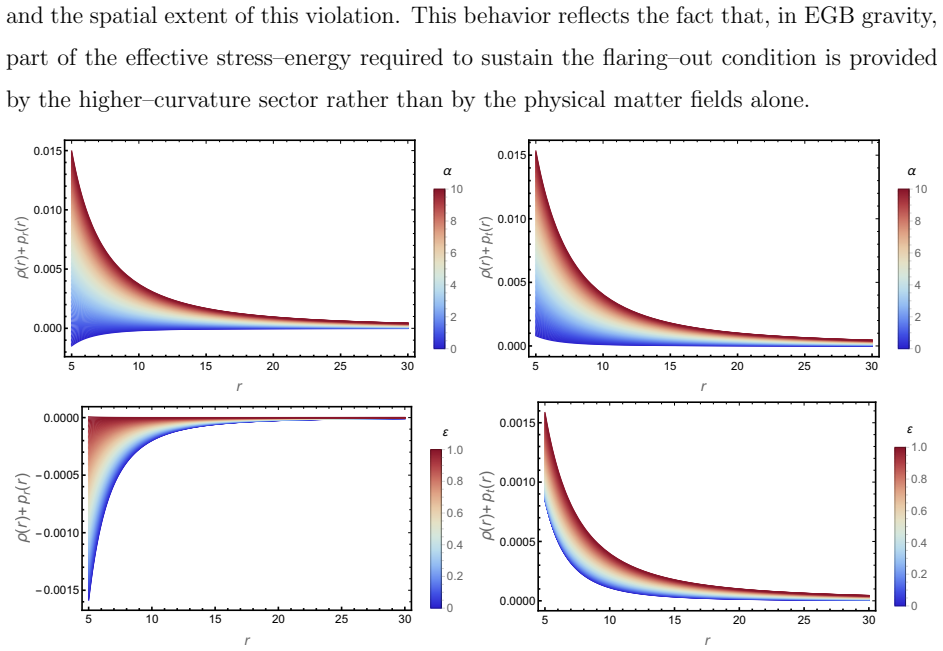
On the paper's own terms, the discovery is that the smoothed string-fluid density, with mass function \(m(r)=\frac12[\$\beta$+\varepsilon r-(\varepsilon r+r_0)$e^{{-r^3/a^3}}$]\), yields through the 4D EGB field equations a shape function \(b(r)\) with a genuine throat at \(r_0\), finite curvature invariants, and zero tidal force. In the parameter region \(\$\alpha$\ge1\), \(\varepsilon\le0.1\), the authors find that both \(\rho+p_r\ge0\) and \(\rho+p_t\ge0\) hold at and outside the throat, so the wormhole can be sustained with little or no exotic matter. They interpret this as the higher-curvature sector itself supplying part of the effective stress-energy that supports the flaring-out geometry, which also drives the volume integral quantifier toward zero and lowers the complexity factor as \(\$\alpha$\) grows.
Load-bearing premise
The load-bearing premise behind the claim that all traversability criteria are met is asymptotic flatness, \(b(r)/r\to0\), but substituting the mass function (21) into the shape function (22) gives \(b(r)/r\to\varepsilon\) for \(\varepsilon>0\), so the stated solution is asymptotically conical and that premise fails.
Editorial extensions
If this is right
- For \(\alpha\ge1\) and \(\varepsilon\le0.1\), a traversable wormhole can be supported without a region of NEC-violating matter immediately around the throat.
- The volume-integral quantifier can be made arbitrarily small by increasing \(\alpha\), meaning the integrated amount of exotic matter required is suppressed by higher-curvature corrections.
- The same smoothed string-fluid source that produces regular black holes also produces traversable wormholes when the radial equation of state is relaxed, unifying the two geometries.
- The Kretschmann scalar remains finite across the parameter space, so the wormhole is globally regular rather than singular.
- Stronger Gauss-Bonnet coupling lowers both the complexity factor and the NEC-violation measure, so the higher-curvature corrections simplify the internal structure while reducing exoticity.
Reading between the lines
- A direct check the paper does not make explicit: from Eq. (22), \(b(r)/r\to\varepsilon\) for \(\varepsilon>0\), so the spacetime is asymptotically conical, not flat; the traversability condition (26) would need to be replaced by a conical-asymptotics criterion.
- If conical asymptotics is accepted, the solution is naturally interpreted as a wormhole sitting in a cosmic-string-like environment, since \(\varepsilon\) is the string-fluid density parameter; this may yield distinctive lensing or Shapiro-delay signatures.
- A natural next test is linear stability of these wormholes under axial and polar perturbations; the paper leaves this to future work, and it would determine whether the non-exotic region around the throat survives dynamical evolution.
Signed reviews
Editorial analysis
A structured set of objections, weighed in public.
Referee Report
Summary. The paper constructs static, zero-tidal-force, spherically symmetric traversable wormhole solutions in regularized four-dimensional Einstein-Gauss-Bonnet gravity, sourced by a smoothed string fluid with a radially varying equation of state. It derives a mass function, fixes the shape function from the throat condition, and studies traversability conditions, curvature regularity, radial and transverse equations of state, a Kiselev-type effective EoS, the null energy condition, the volume integral quantifier, and the complexity factor. The central claims are that the wormhole satisfies all traversability criteria, that for Gauss-Bonnet coupling alpha >= 1 and string parameter epsilon <= 0.1 the null energy condition holds at and outside the throat so that little or no exotic matter is needed, and that the same smoothed string fluid unifies regular black holes and traversable wormholes.
Significance. If the central NEC claim were correct, the paper would be significant: it would show that higher-curvature corrections can remove NEC violations at a wormhole throat in four dimensions without sacrificing traversability. The manuscript is also commendably explicit: the field equations, shape function, and mass function are written out, and the numerical diagnostics (b/r, flaring-out, Kretschmann scalar, VIQ, complexity factor) are easy to follow and check. However, the main physical conclusion is contradicted by the paper's own exact field equations at the throat, and the asymptotic-flatness claim is likewise false. These are not presentation issues but load-bearing errors: the abstract and conclusion assert a NEC-satisfying region that cannot exist, and the traversability analysis relies on an asymptotically flat geometry that the solution does not have. The remaining useful content an explicit EGB wormhole sourced by this fluid and a quantitative study of the VIQ does not by itself establish the advertised new physics.
major comments (4)
- [Sec. IV, Eqs. (12)-(13); abstract and conclusion] The central NEC claim is internally inconsistent with the paper's own field equations. For the zero-tidal-force case Phi'=0, adding Eqs. (12) and (13) at the throat b(r0)=r0 gives 8*pi*(rho+p_r)(r0) = (1/r0^2)(1+2*alpha/r0^2)(b'(r0)-1). The flaring-out condition stated as condition 4 in Sec. IIIC requires b(r0)-r0*b'(r0)>0, i.e. b'(r0)<1, and the prefactor is positive for the admitted alpha>=0. Hence rho+p_r<0 at the throat for every alpha and every epsilon. This directly contradicts the abstract's parameter region alpha>=1, epsilon<=0.1 with the NEC satisfied 'in the vicinity of the throat', and the conclusion's statement that 'both rho+p_r and rho+p_t remain non-negative at and outside the throat'. The paper's own hedge in Sec. IV, that the NEC may still be locally violated near the throat, is the correct statement. This is a load-bearing error: it removes the paper's main physical result.
- [Sec. IIIB, Eq. (22); Sec. IIIC, condition (26)] The claimed asymptotic flatness is not correct. With beta from Eq. (23), the mass function satisfies m(r) ~ (beta+epsilon*r)/2 as r goes to infinity, so from Eq. (22) one obtains b(r)/r = (r^2/(2*alpha))(-1 + sqrt(1 + 4*alpha*(beta+epsilon*r+o(1))/r^3)) -> epsilon, not 0, whenever epsilon>0. The geometry is therefore asymptotically conical rather than asymptotically flat, and condition (26) is not satisfied for any positive epsilon. Since epsilon is the string-density parameter and is positive in every numerical example, the statement in Sec. IIIB that asymptotic flatness follows directly, and the corresponding claim in Sec. IIIC that condition (iii) is satisfied by construction, are both false.
- [Sec. IIIB, Eqs. (20)-(21)] As printed, the energy density (20) does not integrate to the mass function (21). Differentiating Eq. (21) gives m'(r) = (1/2)[epsilon(1-e^{-r^3/a^3}) + (3r^2/a^3)(epsilon*r+r0)e^{-r^3/a^3}], so the density required by Eq. (15) is rho = m'/(4*pi*r^2), which does not match Eq. (20). In particular, the first term of Eq. (20), epsilon*a^3*e^{r^3/a^3}, has the wrong dimension and grows exponentially with r, making it incompatible with a finite-mass function of the form (21). Since the shape function (22) is obtained by substituting Eq. (21) into Eq. (17), this discrepancy propagates into the throat condition and all subsequent traversability and NEC plots. The source-fluid identification needs to be corrected or the derivation of Eq. (21) needs to be shown explicitly.
- [Sec. IV, Eq. (36)] The claimed volume-integral expansion is dimensionally inconsistent and does not reproduce the exact leading behavior. The exact throat identity from Eqs. (12)-(13) gives I_v = 8*pi*integral_{r0}^r x^2(rho+p_r) dx ~ (1+2*alpha/r0^2)(b'(r0)-1)(r-r0) for r -> r0+, which is negative whenever the flaring-out condition b'(r0)<1 holds. Equation (36), by contrast, has a bracket containing a dimensionless term, a term with dimension L^{-2}, and another dimensionless term, and it can become positive for large alpha. A positive or vanishing VIQ in the strong-coupling regime therefore cannot be inferred from Eq. (36) without at the same time giving up the flaring-out condition. The VIQ discussion as presented reinforces the same incorrect NEC conclusion as the abstract.
minor comments (5)
- [Sec. II, around Eqs. (7)-(9)] The symbol \bar{\alpha} for the density-to-transverse-pressure ratio is easily confused with the Gauss-Bonnet coupling alpha; renaming this ratio (for example, to \lambda) would improve readability.
- [Fig. 7, bottom-left caption] The caption states epsilon in (0,10), while the text and the other panels use epsilon in [0,1]; please reconcile the range used in the plotting.
- [Abstract and Sec. VI] The abstract uses the phrase 'stable traversable wormholes', but no stability analysis is presented; Sec. VI explicitly defers linear stability to future work. The claim of stability should be removed or supported.
- [Sec. IIIF and Sec. V] There are minor typos: 'observational constrains' should be 'observational constraints', and 'the the degree' should be 'the degree'.
- [Sec. IIIA, Eq. (18)] The branch selection leading to Eq. (17) is standard, but the paper does not explain why the requirement of a smooth alpha->0 limit uniquely selects this branch for the wormhole boundary conditions; a brief justification would be helpful.
Circularity Check
No significant circularity: the construction integrates the EGB field equations with an imported source density; the self-citation to Ref. [10] supplies the ansatz but is not load-bearing for the central derivation.
full rationale
The paper's central derivation is self-contained: adopting the smoothed-string density ρ(r) (Eq. 20), it integrates to m(r) (Eq. 21), solves for b(r) (Eq. 22), fixes the integration constant β by the throat condition (Eq. 23), and then evaluates the NEC combinations (Eq. 34) from the EGB field equations (12)-(14). The NEC and VIQ statements are numerical/differential readouts of those equations, not restatements of the inputs; no parameter is fitted to a target output and then re-predicted. The only clearly self-referential element is the source density, taken from Ref. [10] by one of the present authors, but that is an external model imported as an ansatz, and the wormhole-specific results do not reduce to it. The 'unified framework' wording is a presentation choice, not a derivation from the prior paper. I therefore find no circular step. Correctness concerns exist but are distinct: at r0 with Φ=0, adding Eqs. (12) and (13) gives 8π(ρ+p_r)=(1/r0^2)(1+2α/r0^2)(b'(r0)-1), negative whenever flaring-out holds, contradicting the abstract; and Eq. (22) with β from (23) gives b(r)/r→ε, so the asymptotic-flatness condition (26) is not met. These are internal-consistency issues, not circularity.
Assumptions & free parameters
free parameters (4)
- epsilon (string density parameter) =
scanned in (0,1] and figures up to 10
- a (smoothing scale) =
a = 1 in most figures
- r0 (throat radius) =
r0 = 5 in most figures
- alpha (Gauss-Bonnet coupling) =
scanned in [0,10]; claim region alpha >= 1
assumptions (4)
- domain assumption The 4D Einstein-Gauss-Bonnet regularization via the Glavan-Lin/Aoki procedure is a valid gravitational theory.
- domain assumption The smoothed string fluid energy-momentum tensor (8) with the density (20) is a legitimate matter source.
- domain assumption The Morris-Thorne traversability conditions (throat, flaring-out, no horizon, asymptotic flatness) are the correct criteria.
- domain assumption Herrera's complexity factor Y_TF applies to wormhole configurations.
Cite this review
Pith. "Pith review of Traversable wormholes from a smoothed string fluid in 4D Einstein-Gauss-Bonnet gravity." pith.science (2026). https://pith.science/paper/BBGQQTEE
@misc{pith2026250507028,
  author       = {Pith},
  title        = {Pith review of: Traversable wormholes from a smoothed string fluid in 4D Einstein-Gauss-Bonnet gravity},
  year         = {2026},
  howpublished = {\url{https://pith.science/paper/BBGQQTEE}},
  note         = {Machine review of arXiv:2505.07028}
}
abstract
We investigate traversable wormhole solutions in four-dimensional Einstein-Gauss-Bonnet (EGB) gravity sourced by a smoothed string fluid. Originally proposed to model regular black holes, this energy density profile is adapted here to sustain wormhole geometries by allowing for a radially varying equation of state. We obtain zero-tidal-force solutions that satisfy all traversability criteria and remain globally regular. The Gauss-Bonnet (GB) coupling $\alpha$ plays a central role in shaping the throat geometry. We identify a parameter region ($\alpha \geq 1$, $\varepsilon \leq 0.1$) in which the null energy condition is satisfied in the vicinity of the throat, representing a significant improvement over general relativistic counterparts. The interplay between the smoothing scale $a$ and the string density $\varepsilon$ ensures finite curvature invariants while reducing the violation of energy conditions. An analysis of the volume integral quantifier and the complexity factor further shows that strong EGB coupling simultaneously suppresses gravitational complexity and the total amount of exotic matter. These results establish a unified framework in which the same string fluid source can generate both regular black holes and stable traversable wormholes, depending on the strength of higher-curvature corrections.
Figures


Figures from the paper (5 more)



Reference graph
Works this paper leans on
-
[10]
Santos L C N 2025Phys. Rev. D111064032 (Preprint2502.15846)
-
[1]
Caldwell R R, Dave R and Steinhardt P J 1998Phys. Rev. Lett.801582–1585 (Preprint astro-ph/9708069)
- [2]
- [3]
- [4]
- [5]
-
[6]
Sofue Y and Rubin V 2001Ann. Rev. Astron. Astrophys.39137–174 (Preprintastro- ph/0010594)
-
[7]
Vilenkin A 1981Phys. Rev. D242082–2089
Show all 56 references
-
[8]
Nemiroff R J and Patla B 2008Am. J. Phys.76265–276 (Preprintastro-ph/0703739)
-
[9]
Arshad S and Sheikh U 2024Int. J. Theor. Phys.6390
-
[11]
Morris M S and Thorne K S 1988Am. J. Phys.56395–412
-
[12]
Visser M 1995Lorentzian Wormholes: From Einstein to Hawking(AIP Press)
-
[13]
Richarte M G and Simeone C 2008Int. J. Mod. Phys. D171179–1196 (Preprint0711.2297)
-
[14]
Sheikh U, Arshad S and Pincak R 2023Can. J. Phys.101525–531
-
[15]
Mustafa G, Javed F, Maurya S K and Ray S 2024Chin. J. Phys.8832–54 (Preprint 2211.10778)
-
[16]
Gogoi D J and Goswami U D 2023JCAP02027 (Preprint2208.07055) 21
-
[17]
Waseem A, Javed F, Gul M Z, Mustafa G and Errehymy A 2023Eur. Phys. J. C831088
-
[18]
Lovelock D 1972J. Math. Phys.13874–876
-
[19]
Abbott B Pet al.(LIGO Scientific, Virgo) 2016Phys. Rev. Lett.116061102 (Preprint 1602.03837)
-
[20]
Riess A G, Filippenko A V, Challis P, Clocchiatti A, Diercks A, Garnavich P M, Gilliland R L, Hogan C J, Jha S, Kirshner R P, Leibundgut B, Phillips M M, Reiss D, Schmidt B P, Schommer R A, Smith R C, Spyromilio J, Stubbs C, Suntzeff N B and Tonry J 1998The Astronomical Journa...
-
[21]
Perlmutter S, Aldering G, Goldhaber G, Knop R A, Nugent P, Castro P G, Deustua S, Fabbro S, Goobar A, Groom D E, Hook I M, Kim A G, Kim M Y, Lee J C, Nunes N J, Pain R, Pennypacker C R, Quimby R, Lidman C, Ellis R S, Irwin M, McMahon R G, Ruiz-Lapuente P, Walton N, Schaefer B,...
-
[22]
Lovelock D 1971J. Math. Phys.12498–501
-
[23]
Boulware D G and Deser S 1985Phys. Rev. Lett.552656
-
[24]
Glavan D and Lin C 2020Phys. Rev. Lett.124081301 (Preprint1905.03601)
-
[25]
sciencedirect.com/science/article/pii/S0370269320305207
L¨ u H and Pang Y 2020Physics Letters B809135717 ISSN 0370-2693 URLhttps://www. sciencedirect.com/science/article/pii/S0370269320305207
-
[26]
G¨ urses M, S ¸i¸ sman T c and Tekin B 2020Eur. Phys. J. C80647 (Preprint2004.03390)
-
[27]
Ai W Y 2020Commun. Theor. Phys.72095402 (Preprint2004.02858)
-
[28]
Shu F W 2020Phys. Lett. B811135907 (Preprint2004.09339)
-
[29]
Mahapatra, Subhash 2020Eur. Phys. J. C80992 URLhttps://doi.org/10.1140/epjc/ s10052-020-08568-6
-
[30]
Hennigar R A, Kubizˇ n´ ak D, Mann R B and Pollack C 2020JHEP07027 (Preprint 2004.09472)
2004 arXiv
-
[31]
Fernandes P G S, Carrilho P, Clifton T and Mulryne D J 2020Phys. Rev. D102024025 (Preprint2004.08362)
-
[32]
Mann R B and Ross S F 1993Class. Quant. Grav.101405–1408 (Preprintgr-qc/9208004)
-
[33]
Gammon M and Mann R B 2024Phys. Rev. D110044004 (Preprint2210.01909)
-
[34]
Gammon M, Rourke S and Mann R B 2024Phys. Rev. D109024026 (Preprint2309.00703)
-
[35]
Jusufi K, Banerjee A and Ghosh S G 2020Eur. Phys. J. C80698 (Preprint2004.10750) 22
-
[36]
Zhang C Y, Niu C, Qian W L, Wang X and Liu P 2023Chin. J. Phys.83527–538 (Preprint 2004.14267)
2004 arXiv
-
[37]
Yang S J, Wan J J, Chen J C, Yang J and Wang Y Q 2020European Physical Journal C80 937 URLhttps://doi.org/10.1140/epjc/s10052-020-08511-9
-
[38]
Liu P, Niu C and Zhang C Y 2021Chin. Phys. C45025111
-
[39]
Mishra A K, Shweta and Sharma U K 2022Pramana96218 (Preprint2106.04369)
-
[40]
Oikonomou V K 2021Class. Quant. Grav.38195025 (Preprint2108.10460)
-
[41]
Godani N 2024Int. J. Geom. Meth. Mod. Phys.212450227
-
[42]
Hassan Z and Sahoo P K 2024Annalen Phys.5362400114 (Preprint2406.13224)
-
[43]
Dark Univ.47101793
Chakraborty M and Chakraborty S 2025Phys. Dark Univ.47101793
-
[44]
Muniz C R, Cruz M B, Neves R M P, Farooq M and Zubair M 2025JCAP07015 (Preprint 2503.12943)
-
[45]
Das B and Chandra Paul B 2025Classical and Quantum Gravity43015011 URLhttps: //doi.org/10.1088/1361-6382/ae2732
-
[46]
Letelier P S 1979Physical Review D201294
-
[47]
Letelier P S 1981Il Nuovo Cimento B (1971-1996)63519–528
1971
-
[48]
Farooq M and Zubair M 2023Annals Phys.459169542
-
[49]
Cunha M S, Tahim M O and Muniz C R 2025Commun. Theor. Phys.77085402
-
[50]
Scripta99065032 (Preprint2307.11611)
Ghosh S G, Islam S U and Maharaj S D 2024Phys. Scripta99065032 (Preprint2307.11611)
-
[51]
Bezerra V B, Lobo I P, Morais Gra¸ ca J P and Santos L C N 2019Eur. Phys. J. C79949
-
[52]
Nojiri S, Odintsov S and Oikonomou V 2017Physics Reports6921–104 ISSN 0370-1573 modified Gravity Theories on a Nutshell: Inflation, Bounce and Late-time Evolution URL https://www.sciencedirect.com/science/article/pii/S0370157317301527
-
[53]
Fern´ andez-N´ u˜ nez I and Bulashenko O 2016Phys. Lett. A3802897–2901 (Preprint 1605.03176)
-
[54]
Nandi K K, Zhang Y Z and Vijaya Kumar K B 2004Phys. Rev. D70127503 (Preprint gr-qc/0407079)
-
[55]
Elizalde E, Nojiri S, Odintsov S and Oikonomou V 2024Physics of the Dark Universe 45101536 ISSN 2212-6864 URLhttps://www.sciencedirect.com/science/article/pii/ S2212686424001183
-
[56]
Herrera L 2018Phys. Rev. D97044010 (Preprint1801.08358) 23
Reviewed August 15, 2026 · model on record in the stance chip above.
Discussion (0). Continue with ORCID to comment.