REVIEW 3 major objections 5 minor 67 references
Predictions for Identified Hadron ($\pi^\pm$, $K^\pm$ and $p(\overline{p})$) Production and Collective Dynamics in Oxygen-Oxygen Collisions at $\sqrt{s_{NN}}$= 7 TeV with EPOS4, AMPT-SM, and Angantyr in Pythia 8
T0 review · 3 major / 5 minor · reviewed 2026-08-15 · deepseek-v4-flash
Pith's one-line read The paper argues that in oxygen–oxygen collisions at 7 TeV, the three main generator families can be ranked by the strength of the collective radial flow they produce, with EPOS4's full hydrodynamics strongest, AMPT-SM intermediate, and…
desk verdict A useful three-generator benchmark for O+O, but the flow ranking is inferred, not isolated, and Table I has a real internal inconsistency. read the letter →
The pith
A machine-rendered reading of the paper's core claim, the machinery that carries it, and where it could break.
The reading
What carries the argument
The machinery is a three-way generator comparison built on two probes of radial flow: the $p_T$ spectra of pions, kaons, and protons, and the $p_T$-differential $K/\pi$ and $p/\pi$ ratios. The named models are EPOS4 (a Gribov–Regge multiple-scattering framework whose core–corona prescription sends dense string segments through hydrodynamics and a hadronic cascade), AMPT-SM (a transport model whose string-melting version converts hadrons to partons, runs a parton cascade, and recombines via quark coalescence), and Angantyr in Pythia 8 (a Glauber-based stacking of $pp$-like sub-collisions with no collective phase). The Bjorken formula converts measured transverse energy into an initial energy density and is used to compare the models against the lattice-QCD critical density. The argument works by attributing the systematic ordering of spectra, ratios, and energy densities across the three generators to the strength of collective flow each mechanism generates.
What would settle it
Measure the proton-to-pion ratio at mid-rapidity in 0–5% central oxygen–oxygen collisions at 7 TeV. If the ratio at intermediate $p_T$ (roughly 1.5–3 GeV/c) stays as flat and low as Angantyr/Pythia 8 predicts, the claim that EPOS4's full hydrodynamic flow is significantly more effective is contradicted; if the ratio follows EPOS4, the no-flow baseline is excluded.
Extended reading notes
Core claim
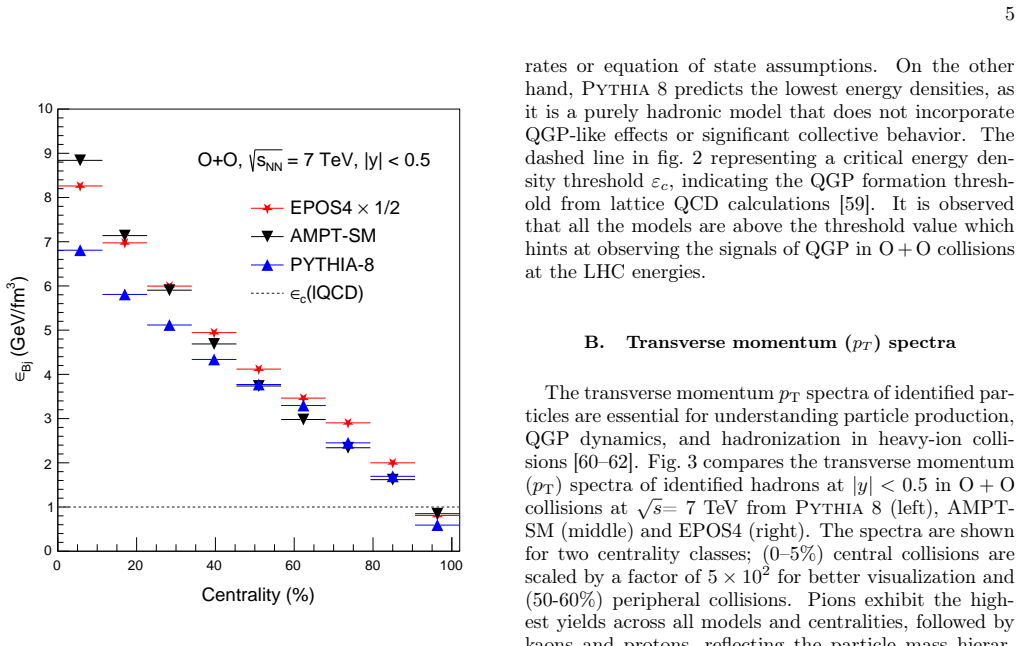
On the paper's own terms, the central discovery is a predicted ordering of the three generator families for oxygen–oxygen collisions at 7 TeV. EPOS4, which combines core–corona separation with full hydrodynamic evolution and a hadronic cascade, produces the flattest proton $p_T$ spectra and the steepest rise of $K/\pi$ and $p/\pi$ ratios at intermediate $p_T$, signatures the authors read as strong radial flow. AMPT-SM, with its string-melting partonic cascade and coalescence hadronization, sits between EPOS4 and Pythia 8, while Angantyr/Pythia 8, which stacks $pp$-like sub-collisions without a collective phase, produces the softest spectra and lowest ratios. The same ordering appears in the Bjorken energy density, where EPOS4 gives the highest values and all models remain above the lattice-QCD threshold for deconfinement. The authors conclude that the models' flow implementations, not just their particle-production details, will be distinguishable once oxygen–oxygen data arrive.
Load-bearing premise
The comparisons of spectra and ratios are interpreted as measuring collective flow strength, but the same differences could in principle come from the generators' independent treatments of initial geometry, string fragmentation, strangeness production, or hadronization.
Editorial extensions
If this is right
- Upcoming LHC oxygen–oxygen data at 7 TeV should separate the generator families: if the proton $p_T$ spectrum is flat and the $p/\pi$ ratio rises markedly at intermediate $p_T$, the hydrodynamic description is favored over the no-flow baseline.
- The $K/\pi$ ratio at intermediate $p_T$ is a direct test of strangeness enhancement: EPOS4 and AMPT-SM predict a stronger rise than Pythia 8, so data can indicate whether in-medium strange-quark production is needed even in a small system.
- Because all three models sit above the lattice-QCD critical energy density in central collisions, the paper predicts that QGP-like signals in oxygen–oxygen collisions should not be suppressed by lack of energy density; absence of such signals would challenge the threshold interpretation.
- The comparison with existing pp, p+Pb, and Pb+Pb data shows that none of the models reproduces the proton mean $p_T$ in p+Pb, so proton observables in oxygen–oxygen collisions are the most discriminating place to constrain hadronic transport and coalescence treatments.
Reading between the lines
- The authors do not explore the possibility that the same observable ordering could arise from differences in strangeness suppression or hadronization rather than from flow; a control simulation that fixes particle chemistry across the three generators would separate these effects.
- Their flow ranking implies a direct elliptic-flow prediction: if full hydrodynamics is the operative mechanism, EPOS4's $v_2(p_T)$ should exceed AMPT-SM's for the same centrality; the paper does not compute $v_2$, but that is a testable consequence.
- The claim that all models sit above the lattice-QCD threshold rests on the chosen formation time $\tau = 1$ fm/c; scanning smaller formation times would show how robust the QGP-signal hint is, since the Bjorken estimate diverges as $\tau \to 0$.
- If the measured proton-to-pion ratio lands between AMPT-SM and EPOS4, the natural reading is partial thermalization in a small system; extending the same comparison to proton–oxygen collisions, where the initial geometry is even more dilute, would sharpen that conclusion.
Signed reviews
Editorial analysis
A structured set of objections, weighed in public.
Referee Report
Summary. The paper presents a Monte Carlo comparison of identified hadron production (π±, K±, p/p̄) and collective-dynamics observables in O+O collisions at √sNN = 7 TeV using EPOS4, AMPT in string-melting mode, and Pythia8 with the Angantyr model. It reports centrality-dependent dNch/dη, transverse-momentum spectra, dN/dy, ⟨mT⟩, K/π and p/π ratios, ⟨pT⟩ as a function of mass, and Bjorken energy density. The central conclusion is that the three models display a hierarchy of collective-flow strength: EPOS4 has the strongest hydrodynamic flow, AMPT-SM is intermediate, and Pythia8 has the weakest flow; the authors argue that upcoming LHC O+O data will help constrain the generators.
Significance. The paper's value lies in providing independent, non-tuned predictions from three widely used event generators for a collision system that the LHC is expected to measure. The statistics are large (1.5–5 million events per generator), and no parameter is fitted to the target observables, so the comparison has a genuine benchmark character. If the flow hierarchy is correct, future data will discriminate between the generators' treatments of collective dynamics. However, the current analysis does not yet establish the claimed hierarchy rigorously: the observables shown are degenerate between flow and hadronization/initial-state effects, and one observable (⟨pT⟩ for protons) points opposite to the claimed EPOS4/AMPT ordering.
major comments (3)
- [Table I] Table I lists non-monotonic centrality dependence for EPOS4: the 20–30% value of ⟨dNch/dη⟩ is 72.190±0.013, identical to the Pythia 8 entry at the same centrality, and the 30–40% value (75.086±0.026) exceeds the 20–30% value. This is unphysical for a centrality-ordered observable and suggests a transcription or event-selection error. Because the centrality classes are used throughout the centrality-dependent results (Figs. 1–4) and in the Bjorken energy density in Sec. III.A, this error propagates into several conclusions and must be corrected before publication.
- [Sec. III.B–D and Fig. 5] The central claim that EPOS4's hydrodynamic flow is 'significantly more effective' than AMPT-SM's is not uniquely established by the presented observables. In Fig. 5, the mean transverse momentum of protons in 0–5% central collisions is equal or slightly higher for AMPT-SM than for EPOS4, which runs opposite to the expected ordering if EPOS4 had stronger radial flow. Section III.C itself concedes that the K/π and p/π differences could reflect 'more pronounced radial flow or different hadronization dynamics.' Because spectral slopes and particle ratios are degenerate between flow strength and hadronization/strangeness mechanisms, the paper should either add a direct flow-sensitive observable (e.g., harmonic flow coefficients or a quantitative mass-splitting analysis) or a controlled model comparison (e.g., hydro on/off) to support the stated ranking, or it should soften the abstract's claim to reflect the degeneracy.
- [Sec. II (Event Generators)] The manuscript does not specify the exact versions of EPOS4, AMPT, and Pythia/Angantyr used, nor the key parameter values (for example, the nuclear radius parameter R0 entering Eq. (2), the formation time τ in Eq. (1), and any generator-specific settings such as parton cross section or hydro parameters). The paper's stated purpose is to provide predictions that the upcoming LHC O+O data can test; without these details the predictions cannot be reproduced or meaningfully compared. In addition, the centrality definition is stated in Sec. II.C as using charged-particle multiplicity at |y|<0.5, whereas Table I reports |η|<0.5; this inconsistency must be clarified.
minor comments (5)
- [Eq. (4)] Equation (4) appears to have a typographical error: the left-hand side is written as dET/dy, but the equation is meant to give εBj; please correct this and ensure the exponent of (Npart/2) is presented unambiguously so that it matches the definition ST = πR0² (Npart/2)^(2/3) in Eq. (2).
- [Throughout] There are several typos: 'multipilicty' in Sec. II.C, 'throuout' in Sec. III, 'strongs' in Conclusions, 'T ransport' and 'T ransverse' in section headers, and inconsistent spelling of 'Pythia/Angantyar' in figures and text.
- [Sec. III.A] The formation time is given as 'τ = 1' without units; state explicitly that it is 1 fm/c, since the numerical value of εBj depends directly on this choice.
- [Fig. 2] The lattice QCD threshold εc from Ref. [59] is not quoted numerically; including its value would make the comparison in Fig. 2 more quantitative and would let the reader judge whether the peripheral points indeed lie above the threshold.
- [Fig. 5 and Sec. III.D] The figure legend appears to mislabel the ALICE data: the symbols labeled 'p+p' at 5.02 TeV should presumably be 'p+Pb' at 5.02 TeV and those labeled 'p+Pb' at 2.76 TeV should be 'Pb+Pb' at 2.76 TeV, matching the references cited in the text. Also, the sentence 'none of the model explain the ⟨pT⟩ of protons' has a subject–verb agreement error.
Circularity Check
No formal circularity: all three generators are external and no parameter is fitted to the target observables; the flow ranking is an interpretation of simulation output, not a derivation. The score reflects minor self-citations and a mild conceptual circularity in the EPOS4 flow interpretation.
full rationale
The paper's predictions are raw outputs of three external, independently developed event generators (EPOS4, AMPT-SM, and Pythia 8/Angantyr); no parameter is fitted to any target observable in this work, and the central observables (pT spectra, ratios, mean pT, multiplicity, and Bjorken energy density) are computed from the generators' default dynamics rather than derived from the conclusions. The self-citations, Refs. [19] and [20], are prior O+O studies by overlapping authors, but they are used only contextually (e.g., 'suggesting stronger radial flow [20]') and are not load-bearing for any uniqueness claim or to forbid alternative interpretations. The main interpretive step, attributing flatter proton spectra and enhanced K/pi and p/pi ratios to radial flow, is physically plausible but not a circular identity; indeed the paper itself concedes in Sec. III.C that the ratios could reflect 'more pronounced radial flow or different hadronization dynamics.' There is a mild conceptual circularity in concluding that EPOS4, which contains a hydrodynamic module by construction, exhibits the strongest flow, but that is a design consequence rather than an equation-level reduction. Separately, Table I contains an internal inconsistency (EPOS4 20-30% multiplicity identical to Pythia 8's value, and EPOS4 30-40% exceeding 20-30%), and Sec. III.D admits that none of the models explain proton mean pT; these are correctness and robustness concerns, not circularity.
Assumptions & free parameters
free parameters (2)
- R0 (nuclear radius parameter)
- Formation time tau =
1 fm/c
assumptions (5)
- domain assumption Bjorken boost-invariant formula (epsilon_BJ = (1/(tau S_T)) dE_T/dy) is a valid estimator for O+O collisions.
- domain assumption Transverse overlap area is given by S_T = pi R0^2 (Npart/2)^(2/3) with A = Npart/2.
- domain assumption Centrality classes defined separately by each model's charged multiplicity at |y|<0.5 correspond to comparable physical selections.
- domain assumption Differences in pT spectra and particle ratios across models are dominated by collective-flow strength rather than by other model differences (initial state, hadronization, strangeness production).
- domain assumption The generated samples faithfully represent the physics of EPOS4, AMPT-SM, and Pythia8/Angantyr as intended by their authors.
Cite this review
Pith. "Pith review of Predictions for Identified Hadron ($\pi^\pm$, $K^\pm$ and $p(\overline{p})$) Production and Collective Dynamics in Oxygen-Oxygen Collisions at $\sqrt{s_{NN}}$= 7 TeV with EPOS4, AMPT-SM, and Angantyr in Pythia 8." pith.science (2026). https://pith.science/paper/SOJ363J6
@misc{pith2026250507435,
  author       = {Pith},
  title        = {Pith review of: Predictions for Identified Hadron ($\pi^\pm$, $K^\pm$ and $p(\overlinep)$) Production and Collective Dynamics in Oxygen-Oxygen Collisions at $\sqrts_NN$= 7 TeV with EPOS4, AMPT-SM, and Angantyr in Pythia 8},
  year         = {2026},
  howpublished = {\url{https://pith.science/paper/SOJ363J6}},
  note         = {Machine review of arXiv:2505.07435}
}
abstract
We study the dynamics of identified hadrons ($\pi^\pm$, $K^\pm$ and $p(\overline{p})$) production in $O+O$ collisions at $\sqrt{s_{\mathrm{NN}}} = 7$TeV using recently updated version of EPOS4, string melting version of A Multi-Phase Transport Model (AMPT-SM) and Angantyr model, incorporated within Pythia 8. We examine the interplay between different mechanisms implemented in these models. Predictions for charged particle multiplicity ($dN_{ch}/d\eta$), transverse momentum ($p_T$) spectra of identified hadrons, particle yield ($dN/dy$) and mean transverse mass ($\langle m_T \rangle$) are presented. To probe the collective behavior of the produced particles, the $p_T$-differential kaons-to-pion and proton-to-pion ratios are studied. While AMPT incorporates some flow effects, EPOS4's implementation of full hydrodynamic flow proves significantly more effective. In contrast, the flow effects in Pythia 8 are substantially weaker compared to the other models. The upcoming $O+O$ data from the LHC will help constrain the parameters of these models.
Figures


Figures from the paper (2 more)


Reference graph
Works this paper leans on
-
[1]
Heavy Ion Collisions: The Big Picture, and the Big Questions
W. Busza, K. Rajagopal, and W. van der Schee, “Heavy Ion Collisions: The Big Picture, and the Big Questions”, Ann. Rev. Nucl. Part. Sci. 68 (2018) 339–376, arXiv:1802.04801 [hep-ph]
arXiv 2018
-
[2]
The Quark Gluon Plasma and relativistic heavy ion collisions in the LHC era
F. Becattini, “The Quark Gluon Plasma and relativistic heavy ion collisions in the LHC era”,J. Phys. Conf. Ser. 527 (2014) 012012
work page 2014
-
[3]
Y. Aoki, G. Endrodi, Z. Fodor, S. D. Katz, and K. K. Szabo, “The Order of the quantum chromodynamics transition predicted by the standard model of particle physics”, Nature 443 (2006) 675–678, arXiv:hep-lat/0611014
arXiv 2006
-
[4]
Collective flow and viscosity in relativistic heavy-ion collisions
U. Heinz and R. Snellings, “Collective flow and viscosity in relativistic heavy-ion collisions”,Ann. Rev. Nucl. Part. Sci. 63 (2013) 123–151, arXiv:1301.2826 [nucl-th]
arXiv 2013
-
[5]
Enhanced production of multi-strange hadrons in high-multiplicity proton-proton collisions
ALICE Collaboration, J. Adamet al., “Enhanced production of multi-strange hadrons in high-multiplicity proton-proton collisions”, Nature Phys. 13 (2017) 535–539, arXiv:1606.07424 [nucl-ex]
arXiv 2017
-
[6]
Evidence for collectivity in pp collisions at the LHC
CMS Collaboration, V. Khachatryanet al., “Evidence for collectivity in pp collisions at the LHC”,Phys. Lett. B 765 (2017) 193–220, arXiv:1606.06198 [nucl-ex]
arXiv 2017
-
[7]
W. Li, “Observation of a ’Ridge’ correlation structure in high multiplicity proton-proton collisions: A brief review”, Mod. Phys. Lett. A 27 (2012) 1230018, arXiv:1206.0148 [nucl-ex]
work page Pith review arXiv 2012
-
[8]
Long-range angular correlations ofπ, K and p in p-Pb collisions at√sNN = 5.02 TeV
ALICE Collaboration, B. B. Abelevet al., “Long-range angular correlations ofπ, K and p in p-Pb collisions at√sNN = 5.02 TeV”,Phys. Lett. B 726 (2013) 164–177, arXiv:1307.3237 [nucl-ex]
arXiv 2013
Show all 67 references
-
[9]
The ’Ridge’ in Proton-Proton Scattering at 7 TeV
K. Werner, I. Karpenko, and T. Pierog, “The ’Ridge’ in Proton-Proton Scattering at 7 TeV”,Phys. Rev. Lett. 106 (2011) 122004, arXiv:1011.0375 [hep-ph]
2011 arXiv
-
[10]
Evidence for hydrodynamic evolution in proton-proton scattering at 900 GeV
K. Werner, I. Karpenko, T. Pierog, M. Bleicher, and K. Mikhailov, “Evidence for hydrodynamic evolution in proton-proton scattering at 900 GeV”,Phys. Rev. C 83 (2011) 044915, arXiv:1010.0400 [nucl-th]
2011 arXiv
-
[11]
Opportunities of OO andpO collisions at the LHC
J. Brewer, A. Mazeliauskas, and W. van der Schee, “Opportunities of OO andpO collisions at the LHC”, in Opportunities of OO and pO collisions at the LHC . 3,
-
[12]
Glauber Monte Carlo predictions for ultrarelativistic collisions with 16O
M. Rybczyński and W. Broniowski, “Glauber Monte Carlo predictions for ultrarelativistic collisions with 16O”, Phys. Rev. C 100 no. 6, (2019) 064912, arXiv:1910.09489 [hep-ph]
2019 arXiv
-
[13]
Exploring New Small System Geometries in Heavy Ion Collisions
S. H. Lim, J. Carlson, C. Loizides, D. Lonardoni, J. E. Lynn, J. L. Nagle, J. D. Orjuela Koop, and J. Ouellette, “Exploring New Small System Geometries in Heavy Ion Collisions”, Phys. Rev. C 99 no. 4, (2019) 044904, arXiv:1812.08096 [nucl-th]
2019 arXiv
-
[14]
CERN Large Hadron Collider system size scan predictions for PbPb, XeXe, ArAr, and OO with relativistic hydrodynamics
M. D. Sievert and J. Noronha-Hostler, “CERN Large Hadron Collider system size scan predictions for PbPb, XeXe, ArAr, and OO with relativistic hydrodynamics”, Phys. Rev. C 100 no. 2, (2019) 024904, arXiv:1901.01319 [nucl-th]
2019 arXiv
-
[15]
Disentangling contributions to small-system collectivity via scans of light nucleus-nucleus collisions
S. Huang, Z. Chen, J. Jia, and W. Li, “Disentangling contributions to small-system collectivity via scans of light nucleus-nucleus collisions”,Phys. Rev. C 101 no. 2, (2020) 021901,arXiv:1904.10415 [nucl-ex]
2020 arXiv
-
[16]
Running the gamut of high energy nuclear collisions
B. Schenke, C. Shen, and P. Tribedy, “Running the gamut of high energy nuclear collisions”,Phys. Rev. C 102 no. 4, (2020) 044905,arXiv:2005.14682 [nucl-th]
2020 arXiv
-
[17]
Jet quenching from heavy to light ion collisions
B. G. Zakharov, “Jet quenching from heavy to light ion collisions”, JHEP 09 (2021) 087, arXiv:2105.09350 [hep-ph]
2021 arXiv
-
[18]
Predicting parton energy loss in small collision systems
A. Huss, A. Kurkela, A. Mazeliauskas, R. Paatelainen, W. van der Schee, and U. A. Wiedemann, “Predicting parton energy loss in small collision systems”,Phys. Rev. C 103 no. 5, (2021) 054903,arXiv:2007.13758 [hep-ph]
2021 arXiv
-
[19]
Dynamics of identified particles production in oxygen–oxygen collisions at√sNN = 7 TeV using EPOS4
A. M. Khan, M. U. Ashraf, H. M. Alfanda, and M. U. Aslam, “Dynamics of identified particles production in oxygen–oxygen collisions at√sNN = 7 TeV using EPOS4”, Eur. Phys. J. A 60 no. 10, (2024) 207, arXiv:2402.13843 [hep-ph]
2024 arXiv
-
[20]
Multiplicity dependence of (multi)strange hadrons in oxygen-oxygen collisions at√sNN = 7 TeV using EPOS4 and AMPT
M. U. Ashraf, A. M. Khan, J. Singh, G. Nigmatkulov, H. Roch, and S. Kabana, “Multiplicity dependence of (multi)strange hadrons in oxygen-oxygen collisions at√sNN = 7 TeV using EPOS4 and AMPT”, arXiv:2406.04096 [hep-ph]
-
[21]
Multiplicity Dependence of p(T) Spectrum as a Possible Signal for a Phase Transition in Hadronic Collisions
L. Van Hove, “Multiplicity Dependence of p(T) Spectrum as a Possible Signal for a Phase Transition in Hadronic Collisions”, Phys. Lett. B 118 (1982) 138
1982
-
[22]
A Multi-phase transport model for relativistic heavy ion collisions
Z.-W. Lin, C. M. Ko, B.-A. Li, B. Zhang, and S. Pal, “A Multi-phase transport model for relativistic heavy ion collisions”, Phys. Rev. C 72 (2005) 064901, arXiv:nucl-th/0411110
2005 arXiv
-
[23]
Predictions for√sN N = 5.02 TeV Pb+Pb Collisions from a Multi-Phase Transport Model
G.-L. Ma and Z.-W. Lin, “Predictions for√sN N = 5.02 TeV Pb+Pb Collisions from a Multi-Phase Transport Model”, Phys. Rev. C 93 no. 5, (2016) 054911, arXiv:1601.08160 [nucl-th]
2016 arXiv
-
[24]
The Angantyr model for Heavy-Ion Collisions in PYTHIA8
C. Bierlich, G. Gustafson, L. Lönnblad, and H. Shah, “The Angantyr model for Heavy-Ion Collisions in PYTHIA8”, JHEP 10 (2018) 134, arXiv:1806.10820 [hep-ph]
2018 arXiv
-
[25]
Producing Hard Processes Regarding the Complete Event: The EPOS Event Generator
S. Porteboeuf, T. Pierog, and K. Werner, “Producing Hard Processes Regarding the Complete Event: The EPOS Event Generator”, in45th Rencontres de Moriond on QCD and High Energy Interactions , pp. 135–140. Gioi Publishers, 2010. arXiv:1006.2967 [hep-ph] . 9
2010 arXiv
-
[26]
Perturbative QCD concerning light and heavy flavor in the EPOS4 framework
K. Werner and B. Guiot, “Perturbative QCD concerning light and heavy flavor in the EPOS4 framework”, Phys. Rev. C 108 no. 3, (2023) 034904, arXiv:2306.02396 [hep-ph]
2023 arXiv
-
[27]
Revealing a deep connection between factorization and saturation: New insight into modeling high-energy proton-proton and nucleus-nucleus scattering in the EPOS4 framework
K. Werner, “Revealing a deep connection between factorization and saturation: New insight into modeling high-energy proton-proton and nucleus-nucleus scattering in the EPOS4 framework”,Phys. Rev. C 108 no. 6, (2023) 064903,arXiv:2301.12517 [hep-ph]
2023 arXiv
-
[28]
Core-corona procedure and microcanonical hadronization to understand strangeness enhancement in proton-proton and heavy ion collisions in the EPOS4 framework
K. Werner, “Core-corona procedure and microcanonical hadronization to understand strangeness enhancement in proton-proton and heavy ion collisions in the EPOS4 framework”, Phys. Rev. C 109 no. 1, (2024) 014910, arXiv:2306.10277 [hep-ph]
2024 arXiv
-
[29]
K. Werner, “Parallel scattering, saturation, and generalized Abramovskii-Gribov-Kancheli (AGK) theorem in the EPOS4 framework, with applications for heavy-ion collisions at sNN of 5.02 TeV and 200 GeV”, Phys. Rev. C 109 no. 3, (2024) 034918, arXiv:2310.09380 [hep-ph]
2024 arXiv
-
[30]
Heavy ion collisions from sNN of 62.4 GeV down to 7.7 GeV in the EPOS4 framework
K. Werner, J. Jahan, I. Karpenko, T. Pierog, M. Stefaniak, and D. Vintache, “Heavy ion collisions from sNN of 62.4 GeV down to 7.7 GeV in the EPOS4 framework”, Phys. Rev. C 111 no. 1, (2025) 014903, arXiv:2401.11275 [hep-ph]
2025 arXiv
-
[31]
HIJING: A Monte Carlo model for multiple jet production in p p, p A and A A collisions
X.-N. Wang and M. Gyulassy, “HIJING: A Monte Carlo model for multiple jet production in p p, p A and A A collisions”, Phys. Rev. D 44 (1991) 3501–3516
1991
-
[32]
ZPC 1.0.1: A Parton cascade for ultrarelativistic heavy ion collisions
B. Zhang, “ZPC 1.0.1: A Parton cascade for ultrarelativistic heavy ion collisions”,Comput. Phys. Commun. 109 (1998) 193–206, arXiv:nucl-th/9709009
1998 arXiv
-
[33]
Formation of superdense hadronic matter in high-energy heavy ion collisions
B.-A. Li and C. M. Ko, “Formation of superdense hadronic matter in high-energy heavy ion collisions”, Phys. Rev. C 52 (1995) 2037–2063, arXiv:nucl-th/9505016
1995 arXiv
-
[34]
A Brief Introduction to PYTHIA 8.1
T. Sjostrand, S. Mrenna, and P. Z. Skands, “A Brief Introduction to PYTHIA 8.1”,Comput. Phys. Commun. 178 (2008) 852–867, arXiv:0710.3820 [hep-ph]
2008 arXiv
-
[35]
Partonic effects on the elliptic flow at RHIC
Z.-w. Lin and C. M. Ko, “Partonic effects on the elliptic flow at RHIC”,Phys. Rev. C 65 (2002) 034904, arXiv:nucl-th/0108039
2002 arXiv
-
[36]
Elliptic and triangular flow in p+Pb and peripheral Pb+Pb collisions from parton scatterings
A. Bzdak and G.-L. Ma, “Elliptic and triangular flow in p+Pb and peripheral Pb+Pb collisions from parton scatterings”, Phys. Rev. Lett. 113 no. 25, (2014) 252301, arXiv:1406.2804 [hep-ph]
2014 arXiv
-
[37]
Long-range azimuthal correlations in proton–proton and proton–nucleus collisions from the incoherent scattering of partons
G.-L. Ma and A. Bzdak, “Long-range azimuthal correlations in proton–proton and proton–nucleus collisions from the incoherent scattering of partons”, Phys. Lett. B 739 (2014) 209–213, arXiv:1404.4129 [hep-ph]
2014 arXiv
-
[38]
Color transparency, color opacity, and fluctuations in nuclear collisions
H. Heiselberg, G. Baym, B. Blaettel, L. L. Frankfurt, and M. Strikman, “Color transparency, color opacity, and fluctuations in nuclear collisions”,Phys. Rev. Lett. 67 (1991) 2946–2949
1991
-
[39]
Hadronic cross-section fluctuations
B. Blaettel, G. Baym, L. L. Frankfurt, H. Heiselberg, and M. Strikman, “Hadronic cross-section fluctuations”, Phys. Rev. D 47 (1993) 2761–2772
1993
-
[40]
Color fluctuation effects in proton-nucleus collisions
M. Alvioli and M. Strikman, “Color fluctuation effects in proton-nucleus collisions”,Phys. Lett. B 722 (2013) 347–354, arXiv:1301.0728 [hep-ph]
2013 arXiv
-
[41]
Revealing “flickering
M. Alvioli, L. Frankfurt, V. Guzey, and M. Strikman, “Revealing “flickering” of the interaction strength in pA collisions at the CERN LHC”,Phys. Rev. C 90 (2014) 034914, arXiv:1402.2868 [hep-ph]
2014 arXiv
-
[42]
Evidence forx-dependent proton color fluctuations in pA collisions at the CERN Large Hadron Collider
M. Alvioli, B. A. Cole, L. Frankfurt, D. V. Perepelitsa, and M. Strikman, “Evidence forx-dependent proton color fluctuations in pA collisions at the CERN Large Hadron Collider”, Phys. Rev. C 93 no. 1, (2016) 011902, arXiv:1409.7381 [hep-ph]
2016 arXiv
-
[43]
Energy conservation and saturation in small-x evolution
E. Avsar, G. Gustafson, and L. Lonnblad, “Energy conservation and saturation in small-x evolution”,JHEP 07 (2005) 062, arXiv:hep-ph/0503181
2005 arXiv
-
[44]
Small-x dipole evolution beyond the large-N(c) imit
E. Avsar, G. Gustafson, and L. Lonnblad, “Small-x dipole evolution beyond the large-N(c) imit”,JHEP 01 (2007) 012, arXiv:hep-ph/0610157
2007 arXiv
-
[45]
Inclusive and Exclusive Observables from Dipoles in High Energy Collisions
C. Flensburg, G. Gustafson, and L. Lonnblad, “Inclusive and Exclusive Observables from Dipoles in High Energy Collisions”,JHEP 08 (2011) 103, arXiv:1103.4321 [hep-ph]
2011 arXiv
-
[46]
An introduction to PYTHIA 8.2
T. Sjöstrand, S. Ask, J. R. Christiansen, R. Corke, N. Desai, P. Ilten, S. Mrenna, S. Prestel, C. O. Rasmussen, and P. Z. Skands, “An introduction to PYTHIA 8.2”, Comput. Phys. Commun. 191 (2015) 159–177, arXiv:1410.3012 [hep-ph]
2015 arXiv
-
[47]
A Model for Low p(t) Hadronic Reactions, with Generalizations to Hadron - Nucleus and Nucleus-Nucleus Collisions
B. Andersson, G. Gustafson, and B. Nilsson-Almqvist, “A Model for Low p(t) Hadronic Reactions, with Generalizations to Hadron - Nucleus and Nucleus-Nucleus Collisions”, Nucl. Phys. B 281 (1987) 289–309
1987
-
[48]
Multiplicity Distributions in Nucleus-Nucleus Collisions at High-Energies
A. Bialas, M. Bleszynski, and W. Czyz, “Multiplicity Distributions in Nucleus-Nucleus Collisions at High-Energies”, Nucl. Phys. B 111 (1976) 461–476
1976
-
[49]
Centrality and pseudorapidity dependence of the charged-particle multiplicity density in Xe–Xe collisions at√sNN =5.44TeV
ALICE Collaboration, S. Acharyaet al., “Centrality and pseudorapidity dependence of the charged-particle multiplicity density in Xe–Xe collisions at√sNN =5.44TeV”, Phys. Lett. B 790 (2019) 35–48, arXiv:1805.04432 [nucl-ex]
2019 arXiv
-
[50]
Parton based Gribov-Regge theory
H. J. Drescher, M. Hladik, S. Ostapchenko, T. Pierog, and K. Werner, “Parton based Gribov-Regge theory”, Phys. Rept. 350 (2001) 93–289, arXiv:hep-ph/0007198
2001 arXiv
-
[51]
Strings, pomerons, and the venus model of hadronic interactions at ultrarelativistic energies
K. Werner, “Strings, pomerons, and the venus model of hadronic interactions at ultrarelativistic energies”,Phys. Rept. 232 (1993) 87–299
1993
-
[52]
Core-corona separation in ultra-relativistic heavy ion collisions
K. Werner, “Core-corona separation in ultra-relativistic heavy ion collisions”,Phys. Rev. Lett. 98 (2007) 152301, arXiv:0704.1270 [nucl-th]
2007 arXiv
-
[53]
Event-by-Event Simulation of the Three-Dimensional Hydrodynamic Evolution from Flux Tube Initial Conditions in Ultrarelativistic Heavy Ion Collisions
K. Werner, I. Karpenko, T. Pierog, M. Bleicher, and K. Mikhailov, “Event-by-Event Simulation of the Three-Dimensional Hydrodynamic Evolution from Flux Tube Initial Conditions in Ultrarelativistic Heavy Ion Collisions”, Phys. Rev. C 82 (2010) 044904, arXiv:1004.0805 [nucl-th]
2010 arXiv
-
[54]
Analysing radial flow features in p-Pb and p-p collisions at several TeV by studying identified particle production in EPOS3
K. Werner, B. Guiot, I. Karpenko, and T. Pierog, “Analysing radial flow features in p-Pb and p-p collisions at several TeV by studying identified particle production in EPOS3”,Phys. Rev. C 89 no. 6, (2014) 064903, arXiv:1312.1233 [nucl-th]
2014 arXiv
-
[55]
Werner, B
K. Werner, B. Guiot, I. Karpenko, T. Pierog, G. Sophys, and M. Stefaniak, “Epos”,EPJ Web Conf. 208 (2019) 11005
2019
-
[56]
Highly Relativistic Nucleus-Nucleus Collisions: The Central Rapidity Region
J. D. Bjorken, “Highly Relativistic Nucleus-Nucleus Collisions: The Central Rapidity Region”,Phys. Rev. D 27 (1983) 140–151
1983
-
[57]
Measurement of transverse energy at midrapidity in Pb-Pb collisions at√sNN = 2.76 TeV
ALICE Collaboration, J. Adamet al., “Measurement of transverse energy at midrapidity in Pb-Pb collisions at√sNN = 2.76 TeV”, Phys. Rev. C 94 no. 3, (2016) 034903, arXiv:1603.04775 [nucl-ex] . 10
2016 arXiv
-
[58]
Systematic Measurements of Identified Particle Spectra inpp,d + Au and Au+Au Collisions from STAR
ST ARCollaboration, B. I. Abelevet al., “Systematic Measurements of Identified Particle Spectra inpp,d + Au and Au+Au Collisions from STAR”,Phys. Rev. C 79 (2009) 034909, arXiv:0808.2041 [nucl-ex]
2009 arXiv
-
[59]
Lattice results on QCD thermodynamics
F. Karsch, “Lattice results on QCD thermodynamics”, Nucl. Phys. A 698 (2002) 199–208, arXiv:hep-ph/0103314
2002 arXiv
-
[60]
An overview of the experimental study of quark-gluon matter in high-energy nucleus-nucleus collisions
A. Andronic, “An overview of the experimental study of quark-gluon matter in high-energy nucleus-nucleus collisions”, Int. J. Mod. Phys. A 29 (2014) 1430047, arXiv:1407.5003 [nucl-ex]
2014 arXiv
-
[61]
Decoding the phase structure of QCD via particle production at high energy
A. Andronic, P. Braun-Munzinger, K. Redlich, and J. Stachel, “Decoding the phase structure of QCD via particle production at high energy”,Nature 561 no. 7723, (2018) 321–330,arXiv:1710.09425 [nucl-th]
2018 arXiv
-
[62]
Influence of modified light-flavor hadron spectra on particle yields in the statistical hadronization model
A. Andronic, P. Braun-Munzinger, D. Gündüz, Y. Kirchhoff, M. K. Köhler, J. Stachel, and M. Winn, “Influence of modified light-flavor hadron spectra on particle yields in the statistical hadronization model”, Nucl. Phys. A 1010 (2021) 122176, arXiv:2011.03826 [nucl-th]
2021 arXiv
-
[63]
Production of pions, kaons and protons inpp collisions at√s = 900 GeV with ALICE at the LHC
ALICE Collaboration, K. Aamodtet al., “Production of pions, kaons and protons inpp collisions at√s = 900 GeV with ALICE at the LHC”,Eur. Phys. J. C 71 (2011) 1655, arXiv:1101.4110 [hep-ex]
2011 arXiv
-
[64]
Measurement of pion, kaon and proton production in proton–proton collisions at√s = 7 TeV
ALICE Collaboration, J. Adamet al., “Measurement of pion, kaon and proton production in proton–proton collisions at√s = 7 TeV”, Eur. Phys. J. C 75 no. 5, (2015) 226, arXiv:1504.00024 [nucl-ex]
2015 arXiv
-
[65]
Multiplicity dependence of charged pion, kaon, and (anti)proton production at large transverse momentum in p-Pb collisions at√sNN = 5.02 TeV
ALICE Collaboration, J. Adamet al., “Multiplicity dependence of charged pion, kaon, and (anti)proton production at large transverse momentum in p-Pb collisions at√sNN = 5.02 TeV”,Phys. Lett. B 760 (2016) 720–735, arXiv:1601.03658 [nucl-ex]
2016 arXiv
-
[66]
Centrality dependence ofπ, K, p production in Pb-Pb collisions at√sN N = 2.76 TeV
ALICE Collaboration, B. Abelevet al., “Centrality dependence ofπ, K, p production in Pb-Pb collisions at√sN N = 2.76 TeV”,Phys. Rev. C 88 (2013) 044910, arXiv:1303.0737 [hep-ex]
2013 arXiv
-
[2021]
arXiv:2103.01939 [hep-ph]
Reviewed August 15, 2026 · model on record in the stance chip above.
Discussion (0). Continue with ORCID to comment.