REVIEW 3 major objections 5 minor 43 references
The uniqueness of the driven $\varphi_0$ Josephson junction: when steps are not Shapiro
T0 review · 3 major / 5 minor · reviewed 2026-08-15 · deepseek-v4-flash
Pith's one-line read In a φ0 Josephson junction, magnetic-component locking produces Buzdin steps whose width is a product of two Bessel functions, unlike electric Shapiro steps.
desk verdict A solid analytic result for magnetically driven Buzdin steps, worth refereeing after the βc inconsistency is fixed; the stress-test worry about the homogeneous solution does not hold up. read the letter →
The pith
A machine-rendered reading of the paper's core claim, the machinery that carries it, and where it could break.
The reading
What carries the argument
The load-bearing object is the analytic solution for the $y$-component of the magnetization, $m_y(t)$, obtained from the linearized LLG equations under $m_x,m_y\ll 1$, $m_z\approx 1$, weak Gilbert damping, and small Josephson-to-magnetic energy ratio $G\ll 1$. This solution, Eq. (8), is a double Bessel-function series; inserting it into the RCSJ supercurrent term $r m_y\cos(\omega_J t+\phi_0)$ produces a nonvanishing time-averaged current only when the Buzdin condition $q\omega_R-2\omega_J=0$ holds, so the steps sit at $\omega_J=q\omega_R/2$. Selecting the resonant terms near $\omega_R\approx\omega_F$ yields the $J_2J_0$ product, while the near-half-resonance case yields $J_3J_1$; the same resonance selection also removes the two dominant oscillating terms from $m_y$, which is the mechanism behind the destructive-interference dip.
What would settle it
Solve the full, unlinearized LLG-RCSJ system at the parameters of the paper's comparison but with $G$ raised by an order of magnitude, and check whether the numerically observed Buzdin step width still vanishes at the zeros of $J_0(h_R/\omega_R)$ and follows Eq. (12) at small $h_R$; alternatively, keep the homogeneous coefficients $C_n$ in Eq. (B9) instead of setting them to zero and test whether the step width changes. Any non-negligible change in either test would show that the two-Bessel claim depends on the small-oscillation assumption.
Extended reading notes
Core claim
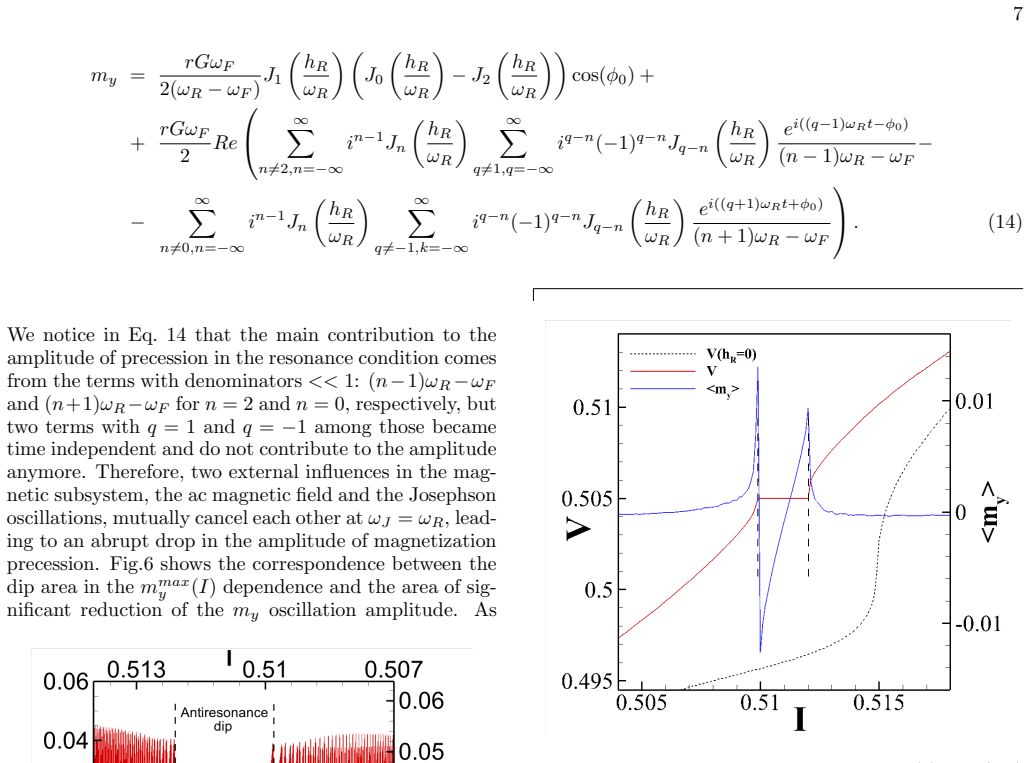
Working from the coupled Landau-Lifshitz-Gilbert and resistively-and-capacitively-shunted-junction equations in the weak-coupling limit, the paper derives the width of the first Buzdin step in closed form. For driving near the ferromagnetic resonance, $\omega_J=\omega_R\approx\omega_F$, the width is $\Delta j^{(1)} = [r^2 G \omega_F/(\omega_R-\omega_F)]\,J_2(h_R/\omega_R)J_0(h_R/\omega_R)$, and near $\omega_F/2$ it is $\Delta j^{(1)} = [r^2 G \omega_F/(2\omega_R-\omega_F)]\,J_3(h_R/\omega_R)J_1(h_R/\omega_R)$. The two-Bessel product is the paper's central explanation for why the amplitude dependence is anomalous: the first maximum is lower than the second, unlike the standard Shapiro Bessel pattern. At zero voltage the averaged magnetic contribution vanishes, so the critical current remains constant as the microwave amplitude is varied; at the lock point, the two dominant resonant terms in $m_y(t)$ become time-independent and drop out of the precession, which the paper reads as destructive interference, accompanied by a magnetization reorientation.
Load-bearing premise
The derivation assumes the magnetization stays almost aligned with the easy axis and the perpendicular components $m_x,m_y$ remain tiny, with small coupling $G$, weak damping, and the free homogeneous precession dropped by imposing a single initial condition $m_y=0$; if the homogeneous precession is non-negligible, the Bessel-product width formula and the destructive-interference picture fail.
Editorial extensions
If this is right
- If the paper is right, the first Buzdin step at resonance should have two Bessel factors in its amplitude dependence, so the step can be suppressed at amplitudes where $J_2$ alone is still large.
- Under magnetic-only drive, the critical current of the $\varphi_0$ junction should stay flat as the microwave amplitude is swept, in contrast to the correlated zero-step oscillations of electric Shapiro locking.
- At the locking condition, the maximum $m_y$ precession amplitude versus bias current should show a sharp dip at $\omega_J=\omega_R$, coinciding with the Buzdin step in the current-voltage characteristic.
- Near $\omega_R\approx\omega_F/2$, the step width should follow a $J_3J_1$ product at moderate amplitudes, while the low-amplitude regime is where the numerical and analytical results already deviate.
Reading between the lines
- The zeros of $J_0(h_R/\omega_R)$ in the step-width formula provide an amplitude knob at which magnetic locking collapses even though the drive is strong; the paper does not discuss using this as a controlled switch, but the formula implies it.
- Because the destructive-interference dip is a magnetic, not a transport, signature, a measurement of ferromagnetic-resonance precession amplitude while sweeping bias current would locate the Buzdin step without contacting the junction's electric leads; this is an experimental extension the paper leaves implicit.
- The two-Bessel structure should appear in any junction whose Josephson phase couples linearly to a driven oscillator through a term like $r m_y$, so the fingerprint may be shared by other anomalous Josephson systems; the paper restricts its claim to the $\varphi_0$ SFS junction in this geometry.
Signed reviews
Editorial analysis
A structured set of objections, weighed in public.
Referee Report
Summary. The paper studies a current-biased φ0 superconductor-ferromagnet-superconductor Josephson junction driven by the magnetic component of external radiation. Numerically, the authors find that locking of the Josephson oscillations with the magnetic component produces Buzdin steps whose width oscillates with the microwave amplitude in a way qualitatively different from Shapiro steps, and that the critical current remains unchanged. Analytically, using a harmonic perturbation theory in the large-capacitance limit, they derive the step width for the main resonance ω_J=ω_R≈ω_F as a product of two Bessel functions, Eq. (12), and a corresponding expression for the subharmonic ω_J=ω_R≈ω_F/2, Eq. (13). They also report a sudden drop in the magnetization-precession amplitude at locking, attributed to destructive interference, and magnetization reorientation. The analytic formulas are compared with direct numerical integration of the coupled LLG-RCSJ equations.
Significance. If the derivation is correct, the paper provides a useful analytic description of Buzdin steps in φ0 junctions, distinguishing magnetic locking from conventional Shapiro locking and giving a falsifiable prediction for the step-width oscillations. The result is not fitted to numerics; it follows from a perturbative treatment of the model equations, which is a strength. The claim that the critical current is unaffected by the magnetic drive, and the identification of destructive interference in the magnetic subsystem, are also of interest for experiments on SFS junctions. However, the analytic derivation has a load-bearing gap concerning the homogeneous solutions of the linearized LLG equation, and the parameter regimes stated in the text are inconsistent with those used in the numerical comparisons. These issues must be resolved before the central formula can be considered established.
major comments (3)
- [Appendix B, Eq. (B9)] The homogeneous solution of the linearized LLG equation is discarded incorrectly. The text states that substituting the initial condition m_y=0 gives C_n=0 for all n, but a single scalar initial condition cannot determine an infinite set of independent coefficients; more fundamentally, the homogeneous solution of Eq. (B3) is one free constant (or two real constants) before the Jacobi-Anger expansion, so the claim is not mathematically justified. This matters because, at the resonance ω_J=ω_R≈ω_F, the homogeneous term m_y^h(t)=Re[C exp(iω_F t - i(h_R/ω_R)cos ω_R t)] contributes a nonzero time average to r m_y(t) cos(ω_J t+φ_0), proportional to r J_0(h_R/ω_R) Re[C e^{-iφ_0}]. This is of the same order as the retained J_2 J_0 term in Eq. (12) unless a physical mechanism suppresses C. Since Eq. (7) contains no damping, no such mechanism is present in the analytic calculation. The authors should either include α in the linearized equations and take the steady-state limit, or explicitly show that homogeneous terms are transients whose contribution to the time-averaged step width vanishes in that limit. This point is load-bearing for Eq. (12).
- [Sec. II and Fig. 2] There is a direct inconsistency in the parameter values: Sec. II states that β_c=25 is used, while the caption of Fig. 2 and the subsequent numerical figures use β_c=2. The harmonic perturbation theory is justified by the condition β_c I ≫ 1 stated in Sec. IV and Appendix A. For the bias currents near the steps in the figures, β_c I is of order 1, not much larger than 1, so the nominal validity condition is not met by the parameters actually simulated. The authors should use consistent parameters or explain why the HPT result remains applicable when β_c I is not large.
- [Sec. IV, Eq. (13) and Fig. 4] For the subharmonic case ω_J=ω_R≈ω_F/2, the numerical step width deviates substantially from the analytic Bessel-product formula at low h_R, as shown in Fig. 4. The manuscript acknowledges the discrepancy with the word 'anomalies' but does not analyze its origin. Since the paper claims that the Buzdin-step width generally represents a product of two Bessel functions, the unexplained failure at the subharmonic should be addressed, for example by checking whether higher harmonics, finite damping, or the discarded homogeneous modes are responsible. Without this, the generality of the central claim is limited.
minor comments (5)
- [Sec. II (organization paragraph)] The paragraph describing the paper's organization says the model is introduced in Sec. III and the peculiarities of Buzdin steps are studied in Sec. III, but the model is in Sec. II and the Buzdin steps are analyzed in Sec. III; the section references should be corrected.
- [Eq. (13) and Appendix G] In Eq. (13) the argument of J_3 and J_1 is written as H_r/ω_R, whereas everywhere else the amplitude is denoted h_R; this notation should be made uniform.
- [Sec. IV, text near Eq. (7)] The sentence justifying the neglect of r m_y says 'since r<1 then r m_y is much smaller than m_y'; the logic is circular, since r m_y is smaller than m_y precisely by the factor r<1, not by an additional smallness. This should be rephrased.
- [Sec. IV, paragraph on Gilbert damping] The phrase 'Gilbert dumping' should be 'Gilbert damping'.
- [Appendix E] The argument that the zero-voltage state receives no magnetic contribution relies on the real part of i^{-1} times certain complex combinations vanishing; the presentation skips the intermediate algebra and would benefit from showing explicitly why the q=0 terms cancel or have vanishing real part.
Circularity Check
No significant circularity: the Buzdin-step width formula is derived from the model equations and checked against independent numerics, not fitted to them.
full rationale
The paper's central analytic result, Eq. (12), is obtained by substituting a particular solution of the linearized LLG equations (Eq. 8) into the first-order Josephson current correction and extracting the resonant constant term. The only inputs are the model parameters (r, G, omega_F, omega_R, h_R) and the resonance condition omega_J = omega_R approximately omega_F; no parameter is fitted to the numerical step widths, and the comparison in Figs. 3-4 is a genuine test. The critical-current independence claim is likewise derived in Appendix E by showing the time-average vanishes at omega_J = 0. Self-citations are present (notably Ref. [24] for the model and prior identification of Buzdin/Chimera steps), but they are not load-bearing for the new analytical derivation, which is self-contained given the standard LLG+RCSJ equations. The potential weakness identified by a skeptical reader, the discard of the homogeneous LLG solution via the initial condition m_y = 0 in Appendix B, is a physical and mathematical correctness question about the transient mode, not an instance of the paper's output being equivalent to its input by construction. Therefore no circularity step meets the evidentiary bar.
Assumptions & free parameters
free parameters (4)
- r (Rashba spin-orbit parameter) =
0.2 in main figures
- G (Josephson-to-anisotropy energy ratio) =
0.01
- α (Gilbert damping) =
0.01
- β_c (McCumber parameter) =
25 in text, 2 in Fig. 2 caption
assumptions (4)
- domain assumption Weak-coupling linearization: m_x, m_y ≪ 1, m_z ≈ 1, G ≪ 1.
- domain assumption Harmonic perturbation theory with β_c I ≫ 1 (large-capacitance limit near Ohm's law).
- ad hoc to paper Homogeneous LLG solutions vanish (C_n = 0 in Eq. B9) based on the initial condition m_y = 0.
- domain assumption α ≪ 1 and r ≪ 1, so ω_F/(1+α²) ≈ ω_F and the r m_y term in h_y is neglected.
Cite this review
Pith. "Pith review of The uniqueness of the driven $\varphi_0$ Josephson junction: when steps are not Shapiro." pith.science (2026). https://pith.science/paper/E3WKI5XQ
@misc{pith2026250507976,
  author       = {Pith},
  title        = {Pith review of: The uniqueness of the driven $\varphi_0$ Josephson junction: when steps are not Shapiro},
  year         = {2026},
  howpublished = {\url{https://pith.science/paper/E3WKI5XQ}},
  note         = {Machine review of arXiv:2505.07976}
}
abstract
The $\varphi_0$ superconductor-ferromagnet-superconductor Josephson junction exhibits unique locking phenomena under the external periodic signal when the magnetic component is taken into account. Contrary to the well-known Shapiro steps that come from the locking with the electric component, locking of the Josephson oscillations with the magnetic one results in the appearance of Buzdin steps in the current-voltage characteristic and a much more complex response of the system. These steps possess distinctive properties that are indications of their unique origins and locking mechanisms. The width of the Buzdin step oscillates with the amplitude of the magnetic component, nevertheless, it exhibits anomalies in the Bessel-like behavior. In addition, we perform an analytical analysis that supports the numerical results and shows that the width of the Buzdin step represents a product of two Bessel functions. Investigation of the effects that simultaneously appear in the magnetic subsystem reveals the presence of destructive interference and magnetization reorientation that accompany the appearance of Buzdin steps.
Figures


Figures from the paper (5 more)




Reference graph
Works this paper leans on
-
[1]
J. Linder and J. W. A. Robinson. Superconducting spin- tronics.Nature Physics, 11(4):307–315, 2015
work page 2015
-
[2]
M. Eschrig. Spin-polarized supercurrents for spintronics. Physics Today, 64(1):43–49, 2011
work page 2011
-
[3]
Con- trolling magnetism.Nature materials, 16(2):156–157, 2017
Alexander A Golubov and Mikhail Yu Kupriyanov. Con- trolling magnetism.Nature materials, 16(2):156–157, 2017
work page 2017
-
[4]
Unlike the results in Fig. 3, here at low values of hR, the amplitude dependence of BS does not correspond well to the product of two Bessel functions and exhibits anomalies. Another property that distinguishes the SFS JJ driven by the magnetic component from the systems driven by the electric component of external radiation is the crit- ical current (zer...
work page 2025
-
[5]
Superconducting spintronics: state of the art and prospects.Uspekhi Fiz
AS Mel’nikov, Sergei Viktorovich Mironov, Alek- sei Vladimirovich Samokhvalov, and Alexander Ivanovich Buzdin. Superconducting spintronics: state of the art and prospects.Uspekhi Fiz. Nauk, 192:1339–1384, 2022
work page 2022
-
[6]
Magnetic josephson junction technology for digital and memory applications
Valery V Ryazanov, Vitaly V Bol’ginov, Danila S Sobanin, Igor V Vernik, Sergey K Tolpygo, Alan M Kadin, and Oleg A Mukhanov. Magnetic josephson junction technology for digital and memory applications. Physics Procedia, 36:35–41, 2012
work page 2012
-
[7]
R. Cai, I. ˇZuti´ c, and W. Han. Superconduc- tor/ferromagnet heterostructures: a platform for super- conducting spintronics and quantum computation.Ad- vanced Quantum Technologies, 6(1):2200080, 2023
work page 2023
-
[8]
Cryogenic mem- ory element based on an anomalous josephson junction
Claudio Guarcello and FS Bergeret. Cryogenic mem- ory element based on an anomalous josephson junction. Physical Review Applied, 13(3):034012, 2020
work page 2020
Show all 43 references
-
[9]
Konschelle and A
F. Konschelle and A. I. Buzdin. Magnetic moment ma- nipulation by a josephson current.Physical Review Let- ters, 102(1):017001, 2009
2009
-
[10]
A. I. Buzdin. Direct coupling between magnetism and superconducting current in the josephsonφ0 junction. Physical review letters, 101(10):107005, 2008
2008
-
[11]
A. I. Buzdin. Proximity effects in superconductor- ferromagnet heterostructures.Reviews of modern physics, 77(3):935, 2005
2005
-
[12]
Yu. M. Shukrinov. Anomalous josephson effect.Physics- Uspekhi, 65(4):317, 2022
2022
-
[13]
Colloquium: Spin-orbit effects in superconducting hybrid structures.Reviews of Modern Physics, 96(2):021003, 2024
Morten Amundsen, Jacob Linder, Jason WA Robinson, Igor ˇZuti´ c, and Niladri Banerjee. Colloquium: Spin-orbit effects in superconducting hybrid structures.Reviews of Modern Physics, 96(2):021003, 2024
2024
-
[14]
Josephsonϕ0- junction in nanowire quantum dots.Nature Physics, 12 (6):568–572, 2016
DB Szombati, S Nadj-Perge, Diane Car, SR Plissard, EPAM Bakkers, and LP Kouwenhoven. Josephsonϕ0- junction in nanowire quantum dots.Nature Physics, 12 (6):568–572, 2016
2016
-
[15]
Assouline, C
A. Assouline, C. Feuillet-Palma, N. Bergeal, T. Zhang, A. Mottaghizadeh, A. Zimmers, E. Lhuillier, M. Eddrie, P. Atkinson, M. Aprili, et al. Spin-orbit induced phase- shift in bi2se3 josephson junctions.Nature communica- tions, 10(1):126, 2019
2019
-
[16]
Gate controlled anomalous phase shift in al/inas josephson junctions.Nature communications, 11 (1):212, 2020
William Mayer, Matthieu C Dartiailh, Joseph Yuan, Kaushini S Wickramasinghe, Enrico Rossi, and Javad Shabani. Gate controlled anomalous phase shift in al/inas josephson junctions.Nature communications, 11 (1):212, 2020
2020
-
[17]
Supercurrent pumping in josephson junc- tions with a half-metallic ferromagnet.Physical review letters, 99(5):057003, 2007
S Takahashi, S Hikino, M Mori, J Martinek, and S Maekawa. Supercurrent pumping in josephson junc- tions with a half-metallic ferromagnet.Physical review letters, 99(5):057003, 2007
2007
-
[18]
D. S. Rabinovich, I. V. Bobkova, A. M. Bobkov, and M. A. Silaev. Resistive state of superconductor- ferromagnet-superconductor josephson junctions in the presence of moving domain walls.Physical Review Let- ters, 123(20):207001, 2019
2019
-
[19]
Quantized josephson phase battery.arXiv preprint arXiv:1811.02484, 2018
Subhajit Pal and Colin Benjamin. Quantized josephson phase battery.arXiv preprint arXiv:1811.02484, 2018
2018 arXiv
-
[20]
Diode effect in josephson junctions with a single magnetic atom.Nature, 615(7953):628–633, 2023
Martina Trahms, Larissa Melischek, Jacob F Steiner, Bharti Mahendru, Idan Tamir, Nils Bogdanoff, Olof Pe- ters, Ga¨ el Reecht, Clemens B Winkelmann, Felix von Op- pen, et al. Diode effect in josephson junctions with a single magnetic atom.Nature, 615(7953):628–633, 2023. 14
2023
-
[21]
Field-free superconduct- ing diode effect in noncentrosymmetric superconduc- tor/ferromagnet multilayers.Nature Nanotechnology, 17 (8):823–828, 2022
Hideki Narita, Jun Ishizuka, Ryo Kawarazaki, Daisuke Kan, Yoichi Shiota, Takahiro Moriyama, Yuichi Shi- makawa, Alexey V Ognev, Alexander S Samardak, Youichi Yanase, et al. Field-free superconduct- ing diode effect in noncentrosymmetric superconduc- tor/ferromagnet multilayers...
2022
-
[22]
Chaotic dynamics from coupled magnetic monodomain and josephson current.Physical Review E, 107(2):024205, 2023
AE Botha, Yu M Shukrinov, J Teki´ c, and MR Kolahchi. Chaotic dynamics from coupled magnetic monodomain and josephson current.Physical Review E, 107(2):024205, 2023
2023
-
[23]
S. A. Abdelmoneim, Yu. M. Shukrinov, K. V. Kulikov, H. ElSamman, and M. Nashaat. Locking of magneti- zation and josephson oscillations at ferromagnetic reso- nance in aφ0 junction under external radiation.Physical Review B, 106(1):014505, 2022
2022
-
[24]
Yu. M. Shukrinov, I. R. Rahmonov, A. Janalizadeh, and M. R. Kolahchi. Anomalous gilbert damping and duffing features of the superconductor-ferromagnet- superconductorφ0 josephson junction.Physical Review B, 104(22):224511, 2021
2021
-
[25]
Buzdin, shapiro, and chimera steps inφ0 josephson junctions.Physical Review B, 109 (2):024511, 2024
Yu M Shukrinov, E Kovalenko, Jasmina Teki´ c, K Ku- likov, and M Nashaat. Buzdin, shapiro, and chimera steps inφ0 josephson junctions.Physical Review B, 109 (2):024511, 2024
2024
-
[26]
Magnetoelec- tric effects in josephson junctions.Journal of Physics: Condensed Matter, 34(35):353001, 2022
IV Bobkova, AM Bobkov, and MA Silaev. Magnetoelec- tric effects in josephson junctions.Journal of Physics: Condensed Matter, 34(35):353001, 2022
2022
-
[27]
Josephson currents in superconducting tunneling: The effect of microwaves and other observa- tions.Physical Review Letters, 11(2):80, 1963
Sidney Shapiro. Josephson currents in superconducting tunneling: The effect of microwaves and other observa- tions.Physical Review Letters, 11(2):80, 1963
1963
-
[28]
Resonance phenom- ena in a nanomagnet coupled to a josephson junction under external periodic drive.Physical Review B, 109 (1):014429, 2024
KV Kulikov, DV Anghel, M Nashaat, M Dolineanu, M Sameh, and Yu M Shukrinov. Resonance phenom- ena in a nanomagnet coupled to a josephson junction under external periodic drive.Physical Review B, 109 (1):014429, 2024
2024
-
[29]
Fractional giant shapiro steps and spatially correlated phase motion in 2d josephson arrays.Physical review letters, 64(6):693, 1990
SP Benz, MS Rzchowski, M Tinkham, and CJ Lobb. Fractional giant shapiro steps and spatially correlated phase motion in 2d josephson arrays.Physical review letters, 64(6):693, 1990
1990
-
[30]
Half-integer shapiro steps at the 0-π crossover of a ferromagnetic josephson junction.Physical review letters, 92(25):257005, 2004
Hermann Sellier, Claire Baraduc, Fran¸ cois Lefloch, and Roberto Calemczuk. Half-integer shapiro steps at the 0-π crossover of a ferromagnetic josephson junction.Physical review letters, 92(25):257005, 2004
2004
-
[31]
Giant fractional shapiro steps in anisotropic josephson junction arrays.Communications Physics, 3 (1):53, 2020
R Panghotra, B Raes, Cl´ ecio C de Souza Silva, I Cools, W Keijers, JE Scheerder, VV Moshchalkov, and J Van de Vondel. Giant fractional shapiro steps in anisotropic josephson junction arrays.Communications Physics, 3 (1):53, 2020
2020
-
[32]
Institut za nuklearne nauke VIN ˇCA, 2016
Jasmina Teki´ c and Petar Mali.The ac driven Frenkel- Kontorova model. Institut za nuklearne nauke VIN ˇCA, 2016
2016
-
[33]
Magnetization control of the critical current in a s-(s/f)-s superconduct- ing switch.Applied Physics Letters, 124(16), 2024
Lukas Kammermeier and Elke Scheer. Magnetization control of the critical current in a s-(s/f)-s superconduct- ing switch.Applied Physics Letters, 124(16), 2024
2024
-
[34]
Nanoscale spin ordering and spin screening effects in tunnel ferromagnetic josephson junctions.Communi- cations Materials, 5(1):67, 2024
Roberta Satariano, Anatoly Fjodorovich Volkov, Hal- ima Giovanna Ahmad, Luigi Di Palma, Raffaella Fer- raiuolo, Antonio Vettoliere, Carmine Granata, Domenico Montemurro, Loredana Parlato, Giovanni Piero Pepe, et al. Nanoscale spin ordering and spin screening effects in tunnel ...
2024
-
[35]
Ferromagnetic materials for josephson{\pi}junctions.arXiv preprint arXiv:2401.04219, 2024
Norman O Birge and Nathan Satchell. Ferromagnetic materials for josephson{\pi}junctions.arXiv preprint arXiv:2401.04219, 2024
2024 arXiv
-
[36]
E. M. Lifshitz and L. P. Pitaevskii. Course of theoretical physics, theory of the condensed state, 1991
1991
-
[37]
Tinkham.Introduction to superconductivity
M. Tinkham.Introduction to superconductivity. Courier Corporation, 2004
2004
-
[38]
Yu. M. Shukrinov, F. Mahfouzi, and N. F. Pedersen. In- vestigation of the breakpoint region in stacks with a finite number of intrinsic josephson junctions.Physical Review B, 75(10):104508, 2007
2007
-
[39]
Buckel and R
W. Buckel and R. Kleiner.Superconductivity: fundamen- tals and applications. John Wiley & Sons, 2008
2008
-
[40]
D. S. Mikhailov Ya. V. Fominov. Asymmetric higher- harmonic squid as a josephson diode.Physical Review B, 106:134514, 2022
2022
-
[41]
Ya. V. Fominov G. S. Seleznev. Influence of capacitance and thermal fluctuations on the josephson diode effect in asymmetric higher-harmonic squids.Physical Review B, 110:104508, 2024
2024
-
[42]
E. D. Thompson. Perturbation theory for a resistivity shunted josephson element.Journal of Applied Physics, 44:5587, 1973
1973
-
[43]
Elec- trical control of magnetization in superconduc- tor/ferromagnet/superconductor junctions on a three- dimensional topological insulator.Physical Review B, 100(5):054506, 2019
M Nashaat, IV Bobkova, AM Bobkov, Yu M Shukrinov, IR Rahmonov, and K Sengupta. Elec- trical control of magnetization in superconduc- tor/ferromagnet/superconductor junctions on a three- dimensional topological insulator.Physical Review B, 100(5):054506, 2019
2019
Reviewed August 15, 2026 · model on record in the stance chip above.
Discussion (0). Continue with ORCID to comment.