REVIEW 3 major objections 3 minor 1 cited by
Quartz fluorescence backgrounds in xenon particle detectors
T0 review · 3 major / 3 minor · reviewed 2026-08-15 · deepseek-v4-flash
Pith's one-line read A series of controlled tests in a liquid xenon cell traces the decade-old 'delayed photon noise' background to UV-stimulated fluorescence from quartz photosensor windows.
desk verdict First credible identification of quartz window fluorescence as the dominant ms-scale delayed photon background in LXe detectors; the case is strong for t<5 ms, but the abstract overreaches to longer times. read the letter →
The pith
A machine-rendered reading of the paper's core claim, the machinery that carries it, and where it could break.
The reading
What carries the argument
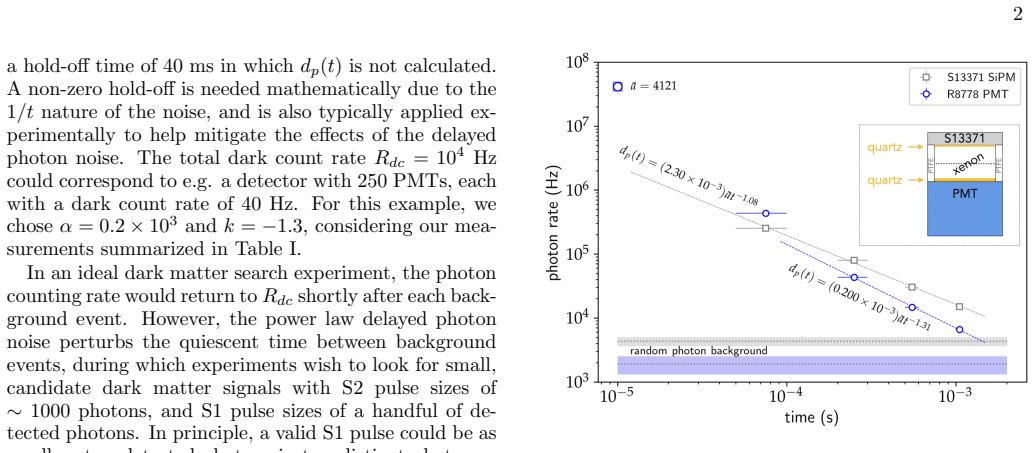
The central experimental device is a small cylindrical liquid xenon cell whose active volume is split by an aluminum divider into two optically isolated halves, one viewed by a quartz-windowed S13371 silicon photomultiplier and the other by a windowless S13370. A cascade trigger opens four successive 100 µs windows after each excitation pulse, letting the authors count individual delayed photons from about 10 µs out to several milliseconds. The decisive move is the paired comparison: with the quartz present, the delayed photon rate in the 50–100 µs bin is about a factor of 20 higher than without it, which isolates the quartz window as the dominant emitter. A separate vacuum measurement, using Cherenkov photons as the excitation pulse, confirms that quartz alone reproduces the measured magnitude and time profile.
What would settle it
Take the same optically isolated liquid xenon cell, place a removable fused-quartz plate in front of the windowless sensor, and measure the delayed photon rate with the plate present and absent; if the rate does not rise by roughly the factor of 20 shown in Fig. 4 when the quartz is added, the central attribution fails. As a second check, search operating xenon detector data for the per-sensor correlation between average excitation pulse size and delayed photon rate using the event-selection conditions the paper describes; a clean null result would contradict the claim.
Extended reading notes
Core claim
The paper claims that the delayed photon noise $d_p(t)=\alpha \bar a t^k$ seen after xenon scintillation pulses is dominated, on millisecond timescales, by ultraviolet-induced fluorescence of the quartz windows on the photosensors, rather than by the xenon, PTFE walls, electrodes, or impurities. The evidence is threefold: the power law survives every material substitution that leaves quartz in the light path; a similar power-law delayed photon signal is produced when PMT windows are excited by Cherenkov light in vacuum; and a windowless sensor in the same optically isolated liquid xenon cell measures a delayed photon rate about a factor of 20 lower than a quartz-windowed sensor. A residual component with a shallower exponent $k\simeq 1/4$ remains in the windowless sensor, which the authors suspect is fluorescence of the sensor's ceramic package. This identification gives the field a concrete, removable cause for a background that had been hypothesized to come from PTFE and had gone unexplained for years.
Load-bearing premise
The conclusion rests on the assumption that the quartz-windowed and windowless sensors differ in their delayed photon rates only because of the quartz window, with the aluminum divider giving complete optical isolation; if the windowless sensor's lower rate were instead due to its different package, leakage current, or dark rate, the attribution to quartz would weaken, and the residual $k\simeq 1/4$ component is assigned to ceramic fluorescence without a direct control measurement.
Editorial extensions
If this is right
- Replacing fused-quartz windows with low-fluorescence materials, or removing the window entirely with silicon photomultipliers, should reduce the delayed photon noise and hence the accidental-coincidence background in future xenon detectors.
- The amplitude and slope of the power law should track the amount of quartz and ceramic surface exposed to scintillation light, so different sensor layouts should show different delayed-noise parameters even for identical excitation pulses.
- A per-sensor correlation between the average excitation pulse size and the delayed photon rate should be observable, provided events are selected carefully to avoid the wash-out the paper describes.
- Because a residual ceramic-fluorescence component exists, windowless designs will still need to minimize exposed ceramic to fully suppress the background.
- The paper's comparison of its millisecond-timescale data with later-time data from large detectors offers suggestive evidence that the same quartz mechanism continues to dominate out to hundreds of milliseconds, which is the regime relevant for dark matter searches.
Reading between the lines
- If the mechanism is correct, the delayed photon noise amplitude in large detectors should scale with the total area of quartz exposed to scintillation light; a comparison of background rates across operating detectors with different photomultiplier models would test this scaling.
- The same charge-trapping power-law fluorescence may apply to other optical window materials, so future low-background detectors should screen candidate materials under 175 nm excitation specifically on millisecond timescales rather than only at steady state.
- The paper's own note that an anecdotal per-sensor correlation search reported no effect should be read as a test still to be done with the proper event selection; a clean null result would be a genuine falsifier, while a positive result would confirm the mechanism.
- A simple follow-up experiment could place a removable fused-quartz plate in front of a windowless sensor and toggle it in and out; if the factor-of-20 difference does not track the presence of the plate, the central attribution would be in doubt.
Signed reviews
Editorial analysis
A structured set of objections, weighed in public.
Referee Report
Summary. The paper addresses the long-standing puzzle of delayed photon noise in liquid xenon particle detectors, which follows a power-law time profile after scintillation pulses and currently limits low-threshold dark matter and neutrino experiments. The authors describe a series of tests in a small liquid xenon testbed at LBNL, in which they systematically remove or substitute materials suspected of fluorescing (PTFE, electrodes, sensor types) and show that the delayed photon rate is insensitive to all such changes except the photosensor itself. They then use a vacuum Cherenkov measurement to demonstrate that quartz fluoresces under UV excitation with a similar magnitude and time profile, and, in a key comparison, report that a windowless Hamamatsu S13370 SiPM observes a factor-20 smaller delayed photon rate than a quartz-windowed S13371 SiPM. On this basis they conclude that the dominant component of the delayed photon noise is UV-induced fluorescence of quartz photosensor windows.
Significance. If the central attribution is correct, this is an important result: it identifies a background mechanism that has become the dominant limitation in searches for low-mass dark matter and in 8B solar neutrino coherent-scattering measurements, and it points to a concrete design improvement for next-generation detectors such as XLZD. The paper is commendable for combining multiple material-substitution controls, a vacuum Cherenkov fluorescence measurement, and power-law characterization with explicit acknowledgment of systematic uncertainties in the fitted parameters. The authors also openly state the limitation that the direct measurement covers t < 5 ms and that the 5-1000 ms regime remains unprobed. The main weakness is that the central attribution rests on a single comparison between two different sensor products, and the paper's abstract draws a broader conclusion than the data directly support.
major comments (3)
- [Section II.C, Fig. 4] The central claim that quartz window fluorescence is the dominant source rests on a single comparison between the quartz-windowed Hamamatsu S13371 and the windowless S13370. These are different sensor families with different ceramic packages (the text notes roughly 4x more ceramic facing the xenon in the S13370), different dark-count and leakage-current behavior, and likely different photon detection efficiency and spectral response at 175 nm. The factor-20 reduction is therefore not uniquely attributable to the absence of the quartz window. A direct control is needed, for example adding a quartz plate to the windowless sensor or measuring a windowed and windowless version of the same sensor, to remove these confounds.
- [Section II.C] The aluminum divider is stated to optically isolate the two halves of the active region, but no test of that isolation is presented. If the isolation is imperfect, the lower rate in the S13370 could be affected by different optical coupling or by photons crossing the divider, rather than by the absence of quartz. A cross-check using a known light source in one half while monitoring the other, or instrumenting both halves with identical sensors, would make the comparison unambiguous.
- [Abstract and Section III] The abstract states that the dominant component of the delayed photon noise is due to UV-induced fluorescence of quartz photosensor windows, without time qualification. However, the direct measurement in this work extends only to t < 5 ms, and the paper itself says that the 5-1000 ms regime remains a key question with only 'suggestive if inconclusive' evidence. The abstract should be qualified to the measured timescale, or the later-time claim should be supported by a direct measurement, since the delayed-noise background in dark matter searches extends well beyond 5 ms.
minor comments (3)
- [Section II.A] The temperature is given as '(-99 +/- 1) C' with a calibration uncertainty of '1 C'; the degree symbol should be included consistently (e.g., '1 °C').
- [Section I] In the definition dp(t) = α a-bar t^k, the sign convention for k is not stated explicitly. Since k is negative, it would help to note that k < 0 for a decaying power law.
- [Section II.C] The sentence describing the S13370 sensor says 'the measured random photon background rate in the single S13371 sensor is an order of magnitude smaller than that of the S13370'; it would be clearer to state that this is the dark/random rate in the absence of an excitation pulse, since that is the relevant comparison for the delayed-photon measurement.
Circularity Check
No circularity: quartz-fluorescence attribution is supported by controlled measurements and the only self-citation is empirical, not load-bearing.
full rationale
The paper's argument is experimental rather than derivational. It identifies delayed photon noise dp(t) purely as an observed power-law rate, fits descriptive parameters alpha and k, and then uses material-substitution tests, a vacuum Cherenkov excitation test, and an optically isolated comparison between a quartz-windowed S13371 sensor and a windowless S13370 sensor to attribute the dominant component to quartz fluorescence. The fitted constants alpha and k describe the noise being studied; they are not re-labeled as predictions, nor is the conclusion defined in terms of the fit. The only notable self-citation is [24], used to state that the S13371 power law is unbroken to at least 5 ms and thereby to argue that the residual shallow component seen by the windowless sensor is not xenon-related. That cited fact is an empirical measurement from prior work, externally falsifiable and not a theorem imported to force the conclusion, so it does not create circularity. The weaker point in the paper, that the S13370 and S13371 differ in package, dark rate, and detection efficiency, is a control limitation affecting evidential strength, not a circularity in the derivation. The central attribution does not reduce by construction to any fitted input or self-citation, so the score is 0.
Assumptions & free parameters
free parameters (2)
- Power-law normalization alpha =
0.2e-3 to 1390e-3 (Table I)
- Power-law exponent k =
-1.41 to -0.238 (Table I)
assumptions (5)
- domain assumption Delayed photon noise follows the power law dp(t) = alpha * a_bar * t^k
- domain assumption The aluminum divider provides complete optical isolation between the two detector halves in Fig. 4
- domain assumption Cherenkov photons with a continuous spectrum (mostly 160-250 nm) excite the same quartz fluorescence mechanism as 175 nm xenon scintillation
- domain assumption The residual power law from the windowless S13370 is due to ceramic package fluorescence, not xenon or impurities
- domain assumption The 50-100 microsecond excess for PMT pulses above a few hundred photons is a delayed photocathode after-pulse effect, justifying exclusion of that data point from fits
invented entities (1)
-
Delayed photocathode after-pulse effect in PMTs
Cite this review
Pith. "Pith review of Quartz fluorescence backgrounds in xenon particle detectors." pith.science (2026). https://pith.science/paper/X2QIU4WO
@misc{pith2026250508067,
  author       = {Pith},
  title        = {Pith review of: Quartz fluorescence backgrounds in xenon particle detectors},
  year         = {2026},
  howpublished = {\url{https://pith.science/paper/X2QIU4WO}},
  note         = {Machine review of arXiv:2505.08067}
}
read the original abstract
It has been known for almost a decade that delayed photon noise with a power law time profile follows scintillation pulses in liquid xenon particle detectors. The origin of the noise has remained unknown, and in the past two years, has become an overwhelming background for low-threshold dark matter searches aimed at O(10) GeV dark matter particle masses, as well as measurements of coherent neutrino-nucleus scattering of 8B solar neutrinos. We have performed a comprehensive series of tests in a small liquid xenon cell at LBL, from which we conclude that the dominant component of this delayed photon noise is due to UV-induced fluorescence of quartz photosensor windows.
Figures


Figures from the paper (2 more)


Forward citations
Cited by 1 Pith paper
-
Operation of a dual-phase xenon detector with wavelength sensitivity from ultraviolet to infrared
A dual-phase xenon TPC with an infrared-sensitive PMT observes coincident IR emission with both scintillation (S1) and electroluminescence (S2) signals, with a distinct time structure and field-dependent yield.
Reference graph
Works this paper leans on
-
[1]
This should tend to flatten the time profile of dp(t), resulting in a larger k
higher event rates lead to shorter inter-event times, thus a larger measured α for any particular event, due to the receding power law tail. This should tend to flatten the time profile of dp(t), resulting in a larger k. The effect is evident in our mea- surements utilizing the S13371 sensors, with data shown in Fig. 2 having a factor ×2 higher source rat...
-
[2]
This effect moves in the same direction as (1), and is also evident in the two LZ fits cited
similarly, if smaller events are selected to comprise the excitation pulse ¯a, then larger events in the data stream present larger power law tails upon which dp(t) is measured. This effect moves in the same direction as (1), and is also evident in the two LZ fits cited. A solution to this systematic uncertainty 5 is described in Sec. 5.7.1 of [15], in wh...
-
[3]
If quartz fluorescence is the dominant source, this correlation should exist
the dark matter search experiments could attempt to correlate measured ¯a with dp(t) on a per-sensor basis. If quartz fluorescence is the dominant source, this correlation should exist. Anecdotally, this analysis has been attempted, and no effect has been seen. Such a null result should be expected in the absence of careful event selection. Specifically, ...
-
[4]
Bare silicon SiPM sensors should be studied, to mitigate the effect of ceramic fluorescence
additional small scale test bed studies are needed, with a lower background counting rate and a cas- cade trigger out to longer times. Bare silicon SiPM sensors should be studied, to mitigate the effect of ceramic fluorescence. If such an experimental configuration can be realized, it would be able to probe possible fluorescence from impurities within the...
-
[5]
N. Aghanim et al. (Planck), Planck 2018 results. VI. Cosmological parameters, Astron. Astrophys. 641, A6 (2020), [Erratum: Astron.Astrophys. 652, C4 (2021)], arXiv:1807.06209 [astro-ph.CO]
arXiv 2020
-
[6]
Y. Sofue and V. Rubin, Rotation curves of spiral galaxies, Ann. Rev. Astron. Astrophys. 39, 137 (2001), arXiv:astro-ph/0010594
arXiv 2001
-
[7]
Schumann, Direct Detection of WIMP Dark Mat- ter: Concepts and Status, J
M. Schumann, Direct Detection of WIMP Dark Mat- ter: Concepts and Status, J. Phys. G 46, 103003 (2019), arXiv:1903.03026 [astro-ph.CO]
arXiv 2019
-
[8]
J. Aalbers et al. (LZ), Dark Matter Search Results from 4.2 Tonne-Years of Exposure of the LUX-ZEPLIN (LZ) Experiment, (2024), arXiv:2410.17036 [hep-ex]
arXiv 2024
Show all 40 references
-
[9]
Aprile et al
E. Aprile et al. (XENON), WIMP Dark Matter Search using a 3.1 tonne × year Exposure of the XENONnT Experiment, (2025), arXiv:2502.18005 [hep-ex]
2025
-
[10]
Meng et al
Y. Meng et al. (PandaX-4T), Dark Matter Search Results from the PandaX-4T Commissioning Run, Phys. Rev. Lett. 127, 261802 (2021), arXiv:2107.13438 [hep-ex]
2021 arXiv
-
[11]
Baudis, Dual-phase xenon time projection chambers for rare-event searches, Phil
L. Baudis, Dual-phase xenon time projection chambers for rare-event searches, Phil. Trans. Roy. Soc. Lond. A 382, 20230083 (2023), arXiv:2311.05320 [physics.ins- det]
2023 arXiv
-
[12]
Szydagis et al
M. Szydagis et al. , A review of NEST models for liq- uid xenon and an exhaustive comparison with other ap- proaches, Front. Detect. Sci. Tech. 2, 1480975 (2024), arXiv:2211.10726 [hep-ex]
2024 arXiv
-
[13]
K. Abe, K. Hiraide, K. Ichimura, Y. Kishimoto, K. Kobayashi, M. Kobayashi, S. Moriyama, M. Naka- hata, H. Ogawa, K. Sato, H. Sekiya, T. Suzuki, O. Taka- chio, A. Takeda, S. Tasaka, M. Yamashita, B. Yang, N. Kim, Y. Kim, Y. Itow, K. Kanzawa, K. Masuda, K. Martens, Y. Suzuki, B....
-
[14]
Angle et al
J. Angle et al. (XENON10), A search for light dark mat- ter in XENON10 data, Phys. Rev. Lett. 107, 051301 (2011), [Erratum: Phys.Rev.Lett. 110, 249901 (2013)], arXiv:1104.3088 [astro-ph.CO]
2011 arXiv
-
[15]
Essig, A
R. Essig, A. Manalaysay, J. Mardon, P. Sorensen, and T. Volansky, First Direct Detection Limits on sub-GeV Dark Matter from XENON10, Phys. Rev. Lett. 109, 6 021301 (2012), arXiv:1206.2644 [astro-ph.CO]
2012 arXiv
-
[16]
Sorensen and K
P. Sorensen and K. Kamdin, Two distinct components of the delayed single electron noise in liquid xenon emis- sion detectors, JINST 13 (02), P02032, arXiv:1711.07025 [physics.ins-det]
-
[17]
D. S. Akerib et al. (LUX), Investigation of background electron emission in the LUX detector, Phys. Rev. D102, 092004 (2020), arXiv:2004.07791 [physics.ins-det]
2020 arXiv
-
[18]
G. R. Araujo, T. Pollmann, and A. Ulrich, Photolumi- nescence response of acrylic (pmma) and polytetraflu- oroethylene (ptfe) to ultraviolet light: Limits on low- intensity photoluminescence in support materials of rare- event search experiments, The European Physical Jour- na...
2019 doi
-
[19]
Anderson, The LZ dark matter WIMP search and treatment of fundamental signals, Stanford University (2023)
T.J. Anderson, The LZ dark matter WIMP search and treatment of fundamental signals, Stanford University (2023)
2023
-
[20]
D. E. Kaplan, M. A. Luty, and K. M. Zurek, Asym- metric Dark Matter, Phys. Rev. D 79, 115016 (2009), arXiv:0901.4117 [hep-ph]
2009 arXiv
-
[21]
D. E. L´ opez-Fogliani, A. D. Perez, and R. Ruiz de Aus- tri, Dark matter candidates in the nmssm with rh neu- trino superfields, Journal of Cosmology and Astroparticle Physics 2021 (04), 067
2021
-
[22]
K. Wang, J. Zhu, and Q. Jie, Higgsino asymmetry and direct-detection constraints of light dark matter in the nmssm with non-universal higgs masses *, Chinese Physics C 45, 041003 (2021)
2021
-
[23]
Ma et al
W. Ma et al. (PandaX), Search for Solar B8 Neutrinos in the PandaX-4T Experiment Using Neutrino-Nucleus Co- herent Scattering, Phys. Rev. Lett. 130, 021802 (2023), arXiv:2207.04883 [hep-ex]
2023 arXiv
-
[24]
Aprile et al
E. Aprile et al. (XENON), First Indication of Solar B8 Neutrinos via Coherent Elastic Neutrino-Nucleus Scat- tering with XENONnT, Phys. Rev. Lett. 133, 191002 (2024), arXiv:2408.02877 [nucl-ex]
2024
-
[25]
Aprile et al
E. Aprile et al. (XENON), The XENONnT dark mat- ter experiment, Eur. Phys. J. C 84, 784 (2024), arXiv:2402.10446 [physics.ins-det]
2024 arXiv
-
[26]
B. J. Mount et al. , LUX-ZEPLIN (LZ) Technical Design Report, (2017), arXiv:1703.09144 [physics.ins-det]
2017 arXiv
-
[27]
Gibbons, H
R. Gibbons, H. Chen, S. J. Haselschwardt, Q. Xia, and P. Sorensen, Why would you put a flashlight in a dark matter detector?, JINST 19 (01), P01013, arXiv:2309.07913 [physics.ins-det]
-
[28]
Gibbons and P
R. Gibbons and P. Sorensen, Towards discovery of hidden sector dark matter with liquid xenon TPCs, 15th Inter- national Workshop on the Identification of Dark Matter, L’Aquila, IT (2024)
2024
-
[29]
C. H. Faham, Prototype, Surface Commissioning and Photomultiplier Tube Characterization for the Large Un- derground Xenon (LUX) Direct Dark Matter Search Ex- periment, Ph.D. thesis, Brown U. (2014)
2014
-
[30]
D. N. McKinsey, C. R. Brome, S. N. Dzhosyuk, R. Golub, K. Habicht, P. R. Huffman, E. Korobkina, S. K. Lamore- aux, C. E. H. Mattoni, A. K. Thompson, L. Yang, and J. M. Doyle, Time dependence of liquid-helium fluores- cence, Phys. Rev. A 67, 062716 (2003)
2003
-
[31]
Navas et al
S. Navas et al. (Particle Data Group), Review of particle physics, Phys. Rev. D 110, 030001 (2024)
2024
-
[32]
A. Koo, J. Clare, K. Nield, A. Deadman, and E. Usadi, Fluorescence of ceramic color standards, Appl. Opt. 49, 2376 (2010)
2010
-
[33]
Jedamzik, F
R. Jedamzik, F. Elsmann, A. Engel, U. Petzold, and J. Pleitz, Introducing the quantum efficiency of fluores- cence of SCHOTT optical glasses, in Current Develop- ments in Lens Design and Optical Engineering XVIII , Vol. 10375, edited by R. B. Johnson, V. N. Mahajan, and S. Thi...
2017
-
[34]
D. J. Huntley, An explanation of the power-law decay of luminescence, Journal of Physics: Condensed Matter 18, 1359 (2006)
2006
-
[35]
Ltd., Synthetic Quartz Technical Datasheet, (2023), https://www.shinetsu.co.jp//wp- content/uploads/2019/05/Synthetic-Quartz-Glass- Substrates.pdf
Shin-etsu Chenical Co. Ltd., Synthetic Quartz Technical Datasheet, (2023), https://www.shinetsu.co.jp//wp- content/uploads/2019/05/Synthetic-Quartz-Glass- Substrates.pdf
2023
-
[36]
W. H. Coop and J. A. Hammond, Phosphorescence of fused quartz and sapphire, J. Opt. Soc. Am. 52, 835 (1962)
1962
-
[37]
Viehmann, A
W. Viehmann, A. Eubanks, G. Pieper, and J. Bre- dekamp, Photomultiplier window materials under elec- tron irradiation: fluorescence and phosphorescence, Ap- plied Optics 14, 2104 (1975)
1975
-
[38]
S. N. Osterman, Thermal and time dependence of radiation-induced phosphorescence in UV window mate- rials, in UV, X-Ray, and Gamma-Ray Space Instrumen- tation for Astronomy XIV , Vol. 5898, edited by O. H. W. Siegmund, International Society for Optics and Photon- ics (SPIE, 20...
2005
-
[39]
Aalbers et al
J. Aalbers et al. , A next-generation liquid xenon obser- vatory for dark matter and neutrino physics, J. Phys. G 50, 013001 (2023), arXiv:2203.02309 [physics.ins-det]
2023
-
[40]
Sakamoto, T
S. Sakamoto, T. Hasegawa, Y. Itow, S. Kazama, M. Kobayashi, and M. Yamashita, Development of a low-noise SiPM for the DARWIN experiment, PoS ICRC2023, 1435 (2023)
2023
Reviewed August 15, 2026 · model on record in the stance chip above.
Discussion (0). Continue with ORCID to comment.