REVIEW 4 major objections 5 minor 29 references
AdaFortiTran: An Adaptive Transformer Model for Robust OFDM Channel Estimation
T0 review · 4 major / 5 minor · reviewed 2026-08-15 · deepseek-v4-flash
Pith's one-line read A compact CNN-transformer that feeds SNR, Doppler, and delay spread into its attention reduces OFDM channel-estimation error by up to 6 dB versus state-of-the-art deep estimators.
desk verdict A credible empirical architecture paper whose 6 dB MSE claim holds inside the simulated training grid; the 'robustness' language oversells interpolation with oracle channel statistics. read the letter →
The pith
A machine-rendered reading of the paper's core claim, the machinery that carries it, and where it could break.
The reading
What carries the argument
The load-bearing mechanism is the channel-adaptivity-augmented attention: each (3x2) channel patch is concatenated with MLP-encoded scalars of SNR, maximum Doppler shift, and delay spread before linear projection and self-attention, so the attention map between patches is biased by the operating channel state. Small patches give finer dual-domain resolution than the (32x32) patches of vision-transformer baselines; the early CNN supplies locality bias and translation equivariance; a residual connection merges shallow and deep features; and a final CNN refines the reconstruction. The result is a hierarchical, statistics-conditioned mapping from LS pilot estimates to full channel estimates.
What would settle it
Feed the model deliberately wrong statistics (for example, SNR declared 10 dB higher than the channel actually has) or evaluate on a channel model and parameter range outside the training grid; if AdaFortiTran's advantage over FortiTran shrinks or reverses, the adaptivity is only interpolation within the simulated training distribution.
Extended reading notes
Core claim
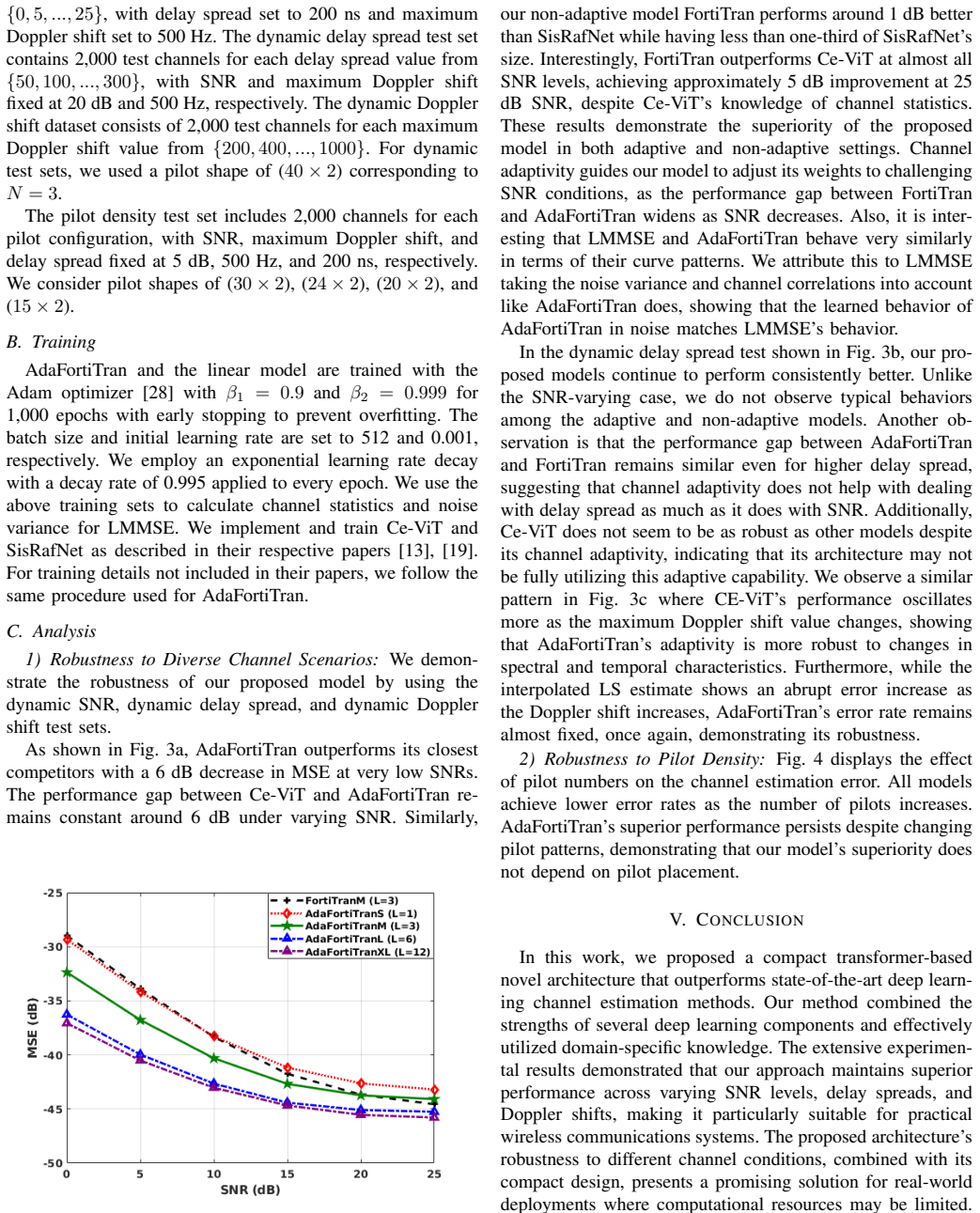
The central claim is that a transformer-based channel estimator which conditions its attention on explicit channel statistics can maintain near-constant estimation error across a wide range of channel conditions where existing estimators degrade. AdaFortiTran processes pilot-location LS estimates through a learned linear upsampler, a shallow CNN feature enhancer, then a six-layer transformer encoder operating on (3x2) channel patches; the Channel Adaptivity Module encodes SNR, maximum Doppler shift, and delay spread through MLPs and concatenates these encodings to each patch, so the attention maps are explicitly driven by channel state. The transformer's global output is added residually to the early convolutional features and passed through a reconstructor CNN to produce the final estimate. The authors report up to 6 dB lower MSE than Ce-ViT and SisRafNet at low SNR, with the gap to Ce-ViT roughly constant across SNR, and show that AdaFortiTran's error stays nearly flat as Doppler shift increases, while interpolated LS error rises sharply.
Load-bearing premise
The central assumption is that a simulated TDL-A channel, with the true SNR, maximum Doppler shift, and delay spread supplied to the model, behaves like a real fast-fading wireless channel; all of the reported robustness is measured inside that simulator's training distribution.
Editorial extensions
If this is right
- At equal or smaller parameter counts than the two deep baselines (Ce-ViT at 0.23M and SisRafNet at 0.43M), AdaFortiTranL (0.22M) reports up to 6 dB lower MSE, so estimation accuracy does not require a larger network.
- Across SNRs from 0 to 25 dB the reported gap over Ce-ViT stays near 6 dB, so the advantage is a broad bias reduction rather than a single operating point.
- Under Doppler shifts from 200 to 1000 Hz, AdaFortiTran's error remains nearly flat while interpolated LS degrades sharply, supporting the high-mobility claim.
- Removing the adaptivity module (FortiTran) still beats SisRafNet by about 1 dB at one-third the parameters, indicating the hybrid local-global architecture itself provides the core gain.
- FortiTran also beats Ce-ViT at most SNRs even though Ce-ViT receives channel statistics, suggesting small-patch attention and residual fusion carry more weight than knowing the statistics.
Reading between the lines
- A direct extension would test the model with mismatched, noisy, or missing channel statistics; the paper assumes SNR, maximum Doppler shift, and delay spread are known exactly, so robustness to imperfect statistics remains untested.
- The same architecture could be retrained for MIMO-OFDM, different subcarrier spacings, or other pilot lattices; only a SISO 5G-like frame is evaluated, so transfer across frame geometries is an open question.
- If the 6 dB gain persists across channel models beyond TDL-A, the model could allow sparser pilot patterns in high mobility, trading a small estimator cost for bandwidth.
- The reported constant gap to Ce-ViT might partly come from input handling (learned linear upsampling versus interpolated LS), so an ablation with identical inputs would isolate the attention-adaptivity contribution.
Signed reviews
Editorial analysis
A structured set of objections, weighed in public.
Referee Report
Summary. This manuscript introduces AdaFortiTran, a compact hybrid architecture for OFDM channel estimation that combines a learned linear upsampler, a shallow convolutional feature enhancer, a transformer encoder operating on 3x2 channel patches, and a Channel Adaptivity Module that injects SNR, delay spread, and Doppler shift as side information. The paper reports training on 3GPP TDL-A simulated channels and compares against LS, LMMSE, Ce-ViT, and SisRafNet, claiming up to 6 dB MSE improvement and better robustness to high mobility while using fewer parameters. The architecture ablations (FortiTran without CAM, and L=1,3,6,12) are analyzed, and code and dataset are released.
Significance. If the empirical claims are confirmed, the model is a useful contribution: the architectural combination is sensible, the model is compact, and the authors provide public reproducibility materials and honest comparisons with recent baselines. However, the headline robustness claim is currently supported only by interpolation within the simulated training distribution under oracle channel statistics, so the practical significance is not yet established.
major comments (4)
- [Section IV.A (Test Sets), Figs. 3 and 4] All test conditions are drawn from the same discrete parameter grid used to generate the training set: SNR is from {0,5,...,25}, delay spread from {50,100,...,300}, and Doppler from {200,400,...,1000}, which is a subset of the training Doppler values {50,100,...,1000}. The 'dynamic' test sets therefore measure interpolation within the training distribution, not robustness to unseen conditions, and the claim of 'superior robustness in high-mobility environments' is not supported by evidence of extrapolation. Please add out-of-distribution test points (e.g., SNR=3 dB, Doppler=1500 Hz, delay spread=350 ns) or temper the robustness claim to the tested grid.
- [Section III.A.2, Eq. (5)] The Channel Adaptivity Module consumes the exact values of SNR, maximum Doppler shift, and delay spread, which the manuscript states are 'already known in this setup' (Section III.A.2). The reported 6 dB improvement is therefore conditional on perfect a priori knowledge of three channel statistics. No experiment perturbs these inputs or substitutes estimates from a practical channel sounding procedure, so the adaptivity benefit in a realistic deployment is not demonstrated. Please include experiments with mismatched or noisy statistics (e.g., errors of a few dB/Hz/ns, or estimates from a preamble-based estimator).
- [Section IV.C (Analysis), Figs. 3 and 4] The MSE curves in Figs. 3 and 4 are reported without error bars, confidence intervals, or multiple-seed variance. Since the central claims are quantitative gaps (e.g., '6 dB decrease in MSE'), the current evidence does not establish that these gaps are statistically reliable rather than artifacts of a single training run. Please report the variance across several independent training runs (e.g., 5 random seeds) or provide bootstrap confidence intervals over the test channels.
- [Section IV.B (Training), Section IV.C (Analysis)] Section IV.B states that 'AdaFortiTran and the linear model are trained' with the Adam optimizer, and Section IV.C claims to compare against 'a linear model,' but this baseline is never defined and its performance never appears in the figures or tables. Please define the linear model (presumably a learned linear map from pilot LS estimates to the full channel) and either report its results or remove it from the comparison list.
minor comments (5)
- [Throughout] The spelling of 'Ce-ViT' is inconsistent; the text and references use 'Ce-ViT' while Figs. 3 and 4 use 'CE-ViT.' Please standardize.
- [Reference [20]] The TDL-A channel model is specified in 3GPP TR 38.901 as well as TR 38.900; please verify that the cited document is the correct one for the delay profile used in the simulations.
- [Section II.A] The pilot pattern description is somewhat terse: pilots are at the 3rd and 12th time indices and every Nth subcarrier, which yields the pilot shapes (40x2), (30x2), etc. Please clarify explicitly that these shapes correspond to the number of pilot subcarriers times the number of pilot symbols, and that the test sets use N=3 unless otherwise stated.
- [Abstract and Section IV.A] The abstract and Section I state the tested Doppler range as 200-1000 Hz, while the training set includes Doppler values from 50 Hz. The reader could misinterpret the absence of 50-100 Hz test results as a claim that those values were not used; please state more precisely that the dynamic Doppler test set uses 200-1000 Hz.
- [Section III.A.3 and Eq. (6)] The attention bias matrices B_Q_i, B_K_i, B_V_i are introduced with shapes (N_f N_t/6)x(d_enc/M), which is unusual because the biases are added before the softmax. A short explanation of the role of these additive biases (e.g., conditioning the attention on channel statistics) would improve clarity.
Circularity Check
No circularity: the MSE gains are measured on held-out TDL-A test data against an independently defined ground-truth channel, with no fitted parameter relabeled as a prediction.
full rationale
The paper's central claim is an empirical benchmark result: AdaFortiTran reduces channel-estimation MSE relative to Ce-ViT and SisRafNet on test channels generated from the 3GPP TDL-A model. The training objective (Eq. 4) minimizes MSE between the network output and the true channel realization, and the reported test errors are computed on separate test sets described in Section IV.A.2. No quantity in the paper is defined in terms of the target metric, and no fitted parameter is later renamed as a prediction. The Channel Adaptivity Module (Eq. 5) consumes SNR, maximum Doppler shift, and delay spread as inputs with the explicit assumption that these statistics are known in the setup, but the model is not used to predict those statistics, and the ground-truth channel remains independent of those inputs. The fact that training and test sets share the same TDL-A simulator and overlapping parameter ranges is a limitation on external validity and generalization, not a circular reduction: the evaluation is interpolation within the training distribution rather than a proof of robustness to out-of-distribution or imperfect-statistics conditions. There is no load-bearing self-citation, no uniqueness theorem imported from the authors' prior work, and no ansatz smuggled in via citation. Accordingly, the derivation is self-contained for what it actually demonstrates, and the circularity score is 0.
Assumptions & free parameters
free parameters (6)
- Transformer depth L =
6
- Number of attention heads M =
4
- Embedding dimension d_enc =
32
- Patch size =
3x2
- CAM MLP widths =
7, 42, Nf*Nt/3
- Feature enhancer and reconstructor widths =
8, 32, 8
assumptions (3)
- domain assumption The 3GPP TDL-A channel model is representative of real-world mobile OFDM fading.
- domain assumption SNR, maximum Doppler shift, and delay spread are known exactly at inference time.
- standard math Transformer, attention, and LayerNorm components operate as standard in the cited literature.
Cite this review
Pith. "Pith review of AdaFortiTran: An Adaptive Transformer Model for Robust OFDM Channel Estimation." pith.science (2026). https://pith.science/paper/NFDVWFFT
@misc{pith2026250509076,
  author       = {Pith},
  title        = {Pith review of: AdaFortiTran: An Adaptive Transformer Model for Robust OFDM Channel Estimation},
  year         = {2026},
  howpublished = {\url{https://pith.science/paper/NFDVWFFT}},
  note         = {Machine review of arXiv:2505.09076}
}
read the original abstract
Deep learning models for channel estimation in Orthogonal Frequency Division Multiplexing (OFDM) systems often suffer from performance degradation under fast-fading channels and low-SNR scenarios. To address these limitations, we introduce the Adaptive Fortified Transformer (AdaFortiTran), a novel model specifically designed to enhance channel estimation in challenging environments. Our approach employs convolutional layers that exploit locality bias to capture strong correlations between neighboring channel elements, combined with a transformer encoder that applies the global Attention mechanism to channel patches. This approach effectively models both long-range dependencies and spectro-temporal interactions within single OFDM frames. We further augment the model's adaptability by integrating nonlinear representations of available channel statistics SNR, delay spread, and Doppler shift as priors. A residual connection is employed to merge global features from the transformer with local features from early convolutional processing, followed by final convolutional layers to refine the hierarchical channel representation. Despite its compact architecture, AdaFortiTran achieves up to 6 dB reduction in mean squared error (MSE) compared to state-of-the-art models. Tested across a wide range of Doppler shifts (200-1000 Hz), SNRs (0 to 25 dB), and delay spreads (50-300 ns), it demonstrates superior robustness in high-mobility environments.
Figures


Figures from the paper (1 more)

Reference graph
Works this paper leans on
-
[1]
On channel estimation in OFDM systems,
J.-J. van de Beek, O. Edfors, M. Sandell, S. Wilson, and P. Borjesson, “On channel estimation in OFDM systems,” in1995 IEEE 45th V ehic- ular Technology Conference. Countdown to the Wireless Twenty-First Century, vol. 2, 1995, pp. 815–819 vol.2
work page 1995
-
[2]
Robust channel estimation for OFDM systems with rapid dispersive fading channels,
Y . Li, L. Cimini, and N. Sollenberger, “Robust channel estimation for OFDM systems with rapid dispersive fading channels,”IEEE Transac- tions on Communications, vol. 46, no. 7, pp. 902–915, 1998
work page 1998
-
[3]
Y . Liu, Z. Tan, H. Hu, L. J. Cimini, and G. Y . Li, “Channel estimation for OFDM,”IEEE Communications Surveys & Tutorials, vol. 16, no. 4, pp. 1891–1908, 2014
work page 1908
-
[4]
J.-C. Lin, “Least-squares channel estimation for mobile OFDM com- munication on time-varying frequency-selective fading channels,”IEEE Transactions on V ehicular Technology, vol. 57, no. 6, pp. 3538–3550, 2008
work page 2008
-
[5]
LMMSE channel estimation in OFDM context: a review,
V . Savaux and Y . Lou ¨et, “LMMSE channel estimation in OFDM context: a review,”IET Signal Processing, vol. 11, no. 2, pp. 123–134, 2017. [Online]. Avail- able: https://ietresearch.onlinelibrary.wiley.com/doi/abs/10.1049/iet- spr.2016.0185
arXiv 2017
-
[6]
Power of deep learning for channel estimation and signal detection in OFDM systems,
H. Ye, G. Y . Li, and B.-H. Juang, “Power of deep learning for channel estimation and signal detection in OFDM systems,”IEEE Wireless Communications Letters, vol. 7, no. 1, pp. 114–117, 2018
work page 2018
-
[7]
Deep learning for channel estimation: Interpretation, performance, and comparison,
Q. Hu, F. Gao, H. Zhang, S. Jin, and G. Y . Li, “Deep learning for channel estimation: Interpretation, performance, and comparison,”IEEE Transactions on Wireless Communications, vol. 20, no. 4, pp. 2398– 2412, 2021
work page 2021
-
[8]
Deep learning-based channel estimation,
M. Soltani, V . Pourahmadi, A. Mirzaei, and H. Sheikhzadeh, “Deep learning-based channel estimation,”IEEE Communications Letters, vol. 23, no. 4, pp. 652–655, 2019
2019
Show all 29 references
-
[9]
Deep residual learning meets OFDM channel estimation,
L. Li, H. Chen, H.-H. Chang, and L. Liu, “Deep residual learning meets OFDM channel estimation,”IEEE Wireless Communications Letters, vol. 9, no. 5, pp. 615–618, 2020
2020
-
[10]
Dual CNN-based channel estimation for MIMO-OFDM systems,
P. Jiang, C.-K. Wen, S. Jin, and G. Y . Li, “Dual CNN-based channel estimation for MIMO-OFDM systems,”IEEE Transactions on Commu- nications, vol. 69, no. 9, pp. 5859–5872, 2021
2021
-
[11]
Channel estimation using CNN-LSTM in RIS-NOMA assisted 6G network,
C. Nguyen, T. M. Hoang, and A. A. Cheema, “Channel estimation using CNN-LSTM in RIS-NOMA assisted 6G network,”IEEE Transactions on Machine Learning in Communications and Networking, vol. 1, pp. 43–60, 2023
2023
-
[12]
GRU-based deep learning channel estimation scheme for the IEEE 802.11p standard,
J. Hou, H. Liu, Y . Zhang, W. Wang, and J. Wang, “GRU-based deep learning channel estimation scheme for the IEEE 802.11p standard,” IEEE Wireless Communications Letters, vol. 12, no. 5, pp. 764–768, 2023
2023
-
[13]
Deep OFDM channel estimation: Capturing frequency recurrence,
A. S. M. M. Jameel, A. Malhotra, A. E. Gamal, and S. Hamidi-Rad, “Deep OFDM channel estimation: Capturing frequency recurrence,” IEEE Communications Letters, vol. 28, no. 3, pp. 562–566, 2024
2024
-
[14]
Attention is all you need,
A. Vaswani, N. Shazeer, N. Parmar, J. Uszkoreit, L. Jones, A. N. Gomez, L. Kaiser, and I. Polosukhin, “Attention is all you need,” inAdvances in Neural Information Processing Systems, I. Guyon, U. V . Luxburg, S. Bengio, H. Wallach, R. Fergus, S. Vishwanathan, and R. Garnett, ...
2017
-
[15]
BERT: Pre-training of deep bidirectional transformers for language understanding,
J. Devlin, M.-W. Chang, K. Lee, and K. Toutanova, “BERT: Pre-training of deep bidirectional transformers for language understanding,” 2019. [Online]. Available: https://arxiv.org/abs/1810.04805
2019 arXiv
-
[16]
An image is worth 16x16 words: Transformers for image recognition at scale,
A. Dosovitskiy, L. Beyer, A. Kolesnikov, D. Weissenborn, X. Zhai, T. Unterthiner, M. Dehghani, M. Minderer, G. Heigold, S. Gelly, J. Uszkoreit, and N. Houlsby, “An image is worth 16x16 words: Transformers for image recognition at scale,”ICLR, 2021
2021
-
[17]
Channel estimation method based on transformer in high dynamic environment,
Z. Chen, F. Gu, and R. Jiang, “Channel estimation method based on transformer in high dynamic environment,” in2020 International Con- ference on Wireless Communications and Signal Processing (WCSP), 2020, pp. 817–822
2020
-
[18]
Attention based neural networks for wireless channel estimation,
D. Luan and J. Thompson, “Attention based neural networks for wireless channel estimation,” 2022. [Online]. Available: https://arxiv.org/abs/2204.13465
2022 arXiv
-
[19]
Ce-ViT: A robust channel estimator based on vision transformer for OFDM systems,
F. Liu, J. Zhang, P. Jiang, C.-K. Wen, and S. Jin, “Ce-ViT: A robust channel estimator based on vision transformer for OFDM systems,” in GLOBECOM 2023 - 2023 IEEE Global Communications Conference, 2023, pp. 4798–4803
2023
-
[20]
Study on channel model for frequency spectrum above 6 GHz,
“Study on channel model for frequency spectrum above 6 GHz,” 3rd Generation Partnership Project (3GPP), Technical Report 138.900, 06 2017, version 14.2.0
2017
-
[21]
Physical channels and modulation,
“Physical channels and modulation,” 3rd Generation Partnership Project (3GPP), Technical Specification 138.211, 07 2020, version 16.2.0
2020
-
[22]
Two-dimensional pilot-symbol- aided channel estimation by wiener filtering,
P. Hoeher, S. Kaiser, and P. Robertson, “Two-dimensional pilot-symbol- aided channel estimation by wiener filtering,” in1997 IEEE Interna- tional Conference on Acoustics, Speech, and Signal Processing, vol. 3, 1997, pp. 1845–1848 vol.3
1997
-
[23]
Early convolutions help transformers see better,
T. Xiao, M. Singh, E. Mintun, T. Darrell, P. Doll ´ar, and R. Girshick, “Early convolutions help transformers see better,” 2021. [Online]. Available: https://arxiv.org/abs/2106.14881
2021 arXiv
-
[24]
Swin transformer: Hierarchical vision transformer using shifted windows,
Z. Liu, Y . Lin, Y . Cao, H. Hu, Y . Wei, Z. Zhang, S. Lin, and B. Guo, “Swin transformer: Hierarchical vision transformer using shifted windows,” 2021. [Online]. Available: https://arxiv.org/abs/2103.14030
2021 arXiv
-
[25]
Layer normalization,
J. L. Ba, J. R. Kiros, and G. E. Hinton, “Layer normalization,” 2016. [Online]. Available: https://arxiv.org/abs/1607.06450
2016 arXiv
-
[26]
Swinir: Image restoration using swin transformer,
J. Liang, J. Cao, G. Sun, K. Zhang, L. V . Gool, and R. Timofte, “Swinir: Image restoration using swin transformer,” 2021. [Online]. Available: https://arxiv.org/abs/2108.10257
2021 arXiv
-
[27]
DRCT: Saving image super-resolution away from information bottleneck,
C.-C. Hsu, C.-M. Lee, and Y .-S. Chou, “DRCT: Saving image super-resolution away from information bottleneck,” 2024. [Online]. Available: https://arxiv.org/abs/2404.00722
2024 arXiv
-
[28]
Adam: A method for stochastic optimization,
D. P. Kingma and J. Ba, “Adam: A method for stochastic optimization,”
-
[2017]
Available: https://arxiv.org/abs/1412.6980
[Online]. Available: https://arxiv.org/abs/1412.6980
Reviewed August 15, 2026 · model on record in the stance chip above.
Discussion (0). Continue with ORCID to comment.