REVIEW 4 major objections 6 minor 19 references
OFDM Based Bistatic Integrated Sensing and Communication: Sensing Beyond CP Limit
T0 review · 4 major / 6 minor · reviewed 2026-08-15 · deepseek-v4-flash
Pith's one-line read In a bistatic OFDM ISAC link, a sliding-window receiver that sees only pilot symbols estimates target range and velocity for delays beyond the cyclic prefix, approaching the Cramer-Rao bounds at high SNR.
desk verdict Plausible sliding-window extension for bistatic pilot-only ISAC, but the printed estimator equations drop the coarse delay and swap axes, so the central claim isn't reproducible. read the letter →
The pith
A machine-rendered reading of the paper's core claim, the machinery that carries it, and where it could break.
The reading
What carries the argument
The load-bearing mechanism is the sliding-window delay decomposition: $\tau_{\text{NLOS}} = \ell T_{cp} + \epsilon$ with $0 \le \epsilon < T_{cp}$, where each hypothesis $H_\ell$ corresponds to a different CP-length block. For each hypothesis the receiver shifts its FFT window by $\ell N_{cp}$ samples, which turns the long delay into a residual delay within the CP, so pilot-based LS channel estimates remain ISI-free. The decision metric is the peak of a 2D periodogram computed from the pilot-grid channel estimates, followed by a finer sliding window over sample indices and quadratic interpolation for sub-bin accuracy.
What would settle it
Fix a target with bistatic delay just above the CP duration, tell the receiver the true CP-block hypothesis $\ell_0$, and compare the pilot-only LS estimator RMSE to the Cramer-Rao bound from [5]; if the RMSE floor stays above the CRB at high SNR, the conditional-validity premise fails.
Extended reading notes
Core claim
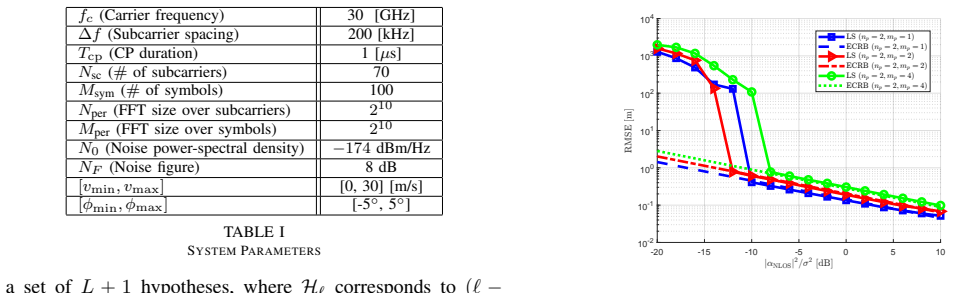
The central claim is that in a bistatic OFDM ISAC system, the sensing receiver can detect a target and estimate its bistatic range and projected velocity even when the NLOS echo delay exceeds the CP duration, using only the pilot symbols embedded in the time-frequency grid. The method decomposes the delay into CP-length blocks plus a residual, and for each block hypothesis computes LS channel estimates on the pilot subcarriers after shifting the FFT window. The decision metric is the peak of the resulting two-dimensional periodogram; after a coarse block-level search and a finer sample-level window, quadratic interpolation yields the range and velocity estimates. Numerical results show RMSE closely approaching the expected Cramer-Rao bounds in the high-SNR regime, for both the LOS-blocked and LOS-present scenarios, indicating the CP is no longer the limiting factor for sensing range.
Load-bearing premise
The whole performance comparison rests on assuming that the Cramer-Rao bound formulas from earlier work, derived for delays no longer than the CP, remain exact theoretical bounds when the estimator is first gated by the sliding-window hypothesis test, but the paper does not prove that conditional validity.
Editorial extensions
If this is right
- A bistatic OFDM sensing link can extend its ISI-free range from the CP-limited value $c T_{cp}$ (300 m in the paper's example) up to a chosen maximum range $R_{max}$ (3000 m), a tenfold extension, without changing the OFDM frame structure.
- Because only pilots are needed, the sensing receiver does not require full modulation-symbol knowledge or time-domain reconstruction, so the approach works with standard OFDM communication waveforms.
- Sparse pilot patterns with overhead 0.125 perform nearly as well as denser patterns with overhead 0.5, suggesting sensing can piggyback on existing pilot grids without major throughput loss.
- Velocity estimation is sensitive to angle-of-arrival error: range estimation stays accurate under AoA mismatch, but velocity degrades, so practical deployments need AoA estimation at the sensing receiver.
- When a LOS path is present, the method detects and subtracts it, but reliable NLOS estimation requires the NLOS echo to arrive within one CP after the LOS path; outside that delay difference the cancellation argument is not made.
Reading between the lines
- A natural test is to separate detection loss from estimation loss: compute an unconditional Cramer-Rao bound that accounts for the search over the hypothesis $\ell$, rather than conditioning on a correct hypothesis choice; this would show how much of the gap between RMSE and ECRB comes from the sliding-window decision itself.
- The same sliding-window idea could be applied to interference suppression in communication receivers, where a long-delay signal from a second transmitter could be treated as a target-like component and cancelled using only pilot positions.
- Combining the sliding window with coherent compensation of the residual delay, along the lines of the coherent-compensation approach cited in the paper, may improve SINR beyond what the current method achieves, since the current method discards energy outside the selected window.
- In a multi-static ISAC network, several transmitter-receiver pairs could share the same pilot grid and fuse their periodogram peaks to localize targets without exchanging full data symbols, an extension the paper explicitly leaves for future work.
Signed reviews
Editorial analysis
A structured set of objections, weighed in public.
Referee Report
Summary. The manuscript proposes a sliding-window, pilot-only receiver for bistatic OFDM ISAC that aims to estimate target range and velocity when the echo delay exceeds the cyclic prefix duration. The receiver divides the maximum sensing range into CP-length blocks, computes least-squares channel estimates on pilot subcarriers under each block hypothesis, and selects a refined window with the largest periodogram peak. Range and velocity are then read from the interpolated periodogram, and the results are compared with expected Cramér-Rao bounds (ECRBs) taken from the authors' prior work, for both LOS-blocked and LOS-present scenarios.
Significance. If the claims were fully established, the pilot-only sliding-window approach would be a useful contribution: bistatic sensing receivers generally lack access to the full transmitted modulation symbols, and several prior beyond-CP studies assume full symbol knowledge or monostatic operation. The paper identifies a real gap and the core mechanism is intuitively plausible. However, as written, the central validation rests on an incomplete range estimator and on a circular conditioning on correct hypothesis identification, so the significance is not yet demonstrated.
major comments (4)
- [Sec. III-C, Eq. (24)] The range estimator bRbis = ep c/(np Δf Np) does not include the coarse delay offset bkTs selected by the sliding-window search. The pilot-subcarrier periodogram is periodic in delay with a period determined by np Δf, so the interpolated peak ep identifies only the residual delay within one unambiguous interval. For delays spanning several CP blocks, as in Sec. IV where the bistatic range exceeds 2000 m and corresponds to at least the 7th CP block, the absolute range cannot be recovered from Eq. (24) alone. The printed estimator therefore cannot reproduce the RMSE curves in Figs. 3–5.
- [Sec. III-D, Eqs. (28)–(29)] The threshold computation uses the true hypothesis ell_0 to define the complementary window Wc_0 and the maximum statistic b_ell. This is circular and not implementable, because at the detection stage the receiver does not know ell_0. As a result, the false-alarm probability and the subsequent detection/estimation results are conditioned on information that is not available to the algorithm.
- [Sec. IV, CRB comparison] The statement that the CRBs derived in [5] under the condition tau_NLOS <= Tcp remain exact bounds when conditioned on correctly identifying the true hypothesis is asserted without proof. The windowed observation model involves a discrete coarse-delay selection and a residual-delay estimation problem, so the Fisher information and the resulting bound are not obviously the same as in the CP-limited model. Comparing conditional RMSE to these ECRBs is not a valid benchmark unless the conditional Cramér-Rao bound is derived. The sentence 'This is confirmed by the simulation results' is circular.
- [Sec. III-E, LOS gain estimate] The estimated LOS gain b_alpha_LOS = e^{-j2πfc b_tau_LOS} λ/(π b_tau_LOS c) does not match Eq. (14), where alpha_LOS = e^{-j2πfc tau_LOS} λ/(4π c tau_LOS). The factor-of-4 discrepancy in the denominator would directly affect the LOS cancellation step and hence the Scenario II range and velocity results shown in Fig. 5.
minor comments (6)
- [Eq. (9)] The denominator contains the typo '||p - p||' and should read '||p - p_rx||'.
- [Eqs. (24) and (27)] The mapping of the periodogram axes p and q to the interpolated indices ep and eq, and then to range and velocity, is confusing and should be stated explicitly. In particular, clarify that peak positions on the subcarrier axis are used for range and on the symbol-time axis for velocity.
- [Eq. (24)] The quantity Np is not defined in the manuscript. If it denotes the FFT size Nper, that should be stated; if it denotes the number of pilot subcarriers, its value and role in the estimator should be given.
- [Sec. III-C] The stopping rule 'let h be the smallest index such that eta_h >= kappa' is not clearly connected to the refined window selection. Explain how h, the window size W, and the search range W are related, and why W=2 is sufficient for the numerical setup.
- [Eq. (19)] The DFT expression uses the phase e^{-j2π(k-Ncp)n/Nsc} with k running from 0; the indexing should be checked and the relation between the CP-removal offset and the delay decomposition in Eq. (15) should be clarified.
- [Table I] The FFT sizes Nper and Mper are larger than Nsc and Msym, respectively. State explicitly whether zero-padding is used in the 2D periodogram and how the periodogram resolution is affected.
Circularity Check
Validation is partially circular: the threshold is set using the true hypothesis, and the beyond-CP validity of the self-cited CRB is confirmed by the same RMSE curves it benchmarks; the printed range estimate also drops the coarse window offset.
-
self definitional
[Sec. III-D, Threshold Computation (Scenario I), used in Sec. IV simulations.]
"Let ℓ0 denote the true hypothesis, meaning the bi-static range satisfies (ℓ0−1)Tcp ≤ Rbis < ℓ0Tcp. Then, given windowing size W, we define the complementary window of interest as Wc0 ≜{1,...,L}\{ℓ0−⌊W/2⌋,...,ℓ0+⌊(W+1)/2⌋}. The index corresponding to the maximum decision metric outside the window of interest is then defined as bℓ = arg max ℓ∈Wc0 ηℓ. The threshold κ is subsequently determined such that the probability of a false alarm satisfies Pr{η_bℓ≥κ} = Pf."
The detection threshold κ is computed from the true hypothesis ℓ0, which is exactly the unknown label the sliding-window detector is supposed to find. The numerical RMSEs are then evaluated 'conditioned on successful target detection' (Sec. IV). Thus the detector is tested only on outcomes that the oracle-informed threshold is constructed to admit; the event that the algorithm finds the correct hypothesis is built into the evaluation rather than being an independent, falsifiable outcome. The claimed detection and estimation performance therefore reduces, at the validation stage, to a decision rule whose design already knows the answer.
-
self citation load bearing
[Sec. IV, Numerical Results, paragraph following Table I.]
"To benchmark the performance of the proposed approach, we utilize the CRB expressions for range and velocity estimation derived in [5]. Although these CRBs are obtained under the assumption that the NLOS propagation delay satisfies τNLOS≤ Tcp, they remain valid as exact theoretical bounds when conditioned on correctly identifying the true hypothesis found via the procedures outlined in Secs. III-B, III-C, and III-D. This is confirmed by the simulation results shown in Figs. 3-4."
The CRB benchmark is taken from the authors' own prior work [5], where it was derived only for the CP-limited case τNLOS≤Tcp. The paper extends it to the sliding-window, beyond-CP problem by assertion, with no derivation of the conditional validity. The only evidence offered for that extension is the agreement of Figs. 3-4, which are exactly the curves that the CRB curves are being used to validate. The bound's applicability and the estimator's near-optimality are therefore mutually confirming: the estimator is said to approach the CRB because the CRB is said to be valid, and the CRB is said to be valid because the estimator approaches it. This circular confirmation is load-bearing for the central 'closely approaches the CRBs' conclusion.
full rationale
The sliding-window coarse-to-fine search itself is not circular: the algorithm genuinely evaluates multiple window offsets and selects one by a periodogram peak, and that component has independent algorithmic content. However, the paper's validation loop is partially circular. First, the threshold in Sec. III-D is defined using the true hypothesis ℓ0, i.e., oracle knowledge of the delay block, and the RMSE curves are conditioned on successful detection; the measured 'success' is therefore a built-in selection rather than an independent outcome. Second, the CRB benchmark is imported from the authors' own [5], where it holds only for τNLOS≤Tcp; the paper asserts without proof that it remains exact when conditioned on correct hypothesis identification, and supports that assertion by the same Figs. 3-4 that the CRB curves are supposed to benchmark. The estimator and the bound thus confirm each other in a closed loop. Separately, Eq. (24), bRbis = epc/(np∆fNp), contains no bk or hypothesis-index term, so the printed estimator cannot return the absolute beyond-CP range used in Sec. IV, where the delay spans 'at least the 7th CP block'; this is a correctness/reproducibility defect rather than a circularity, and it reinforces the need for caution but is not counted as a separate circular step. The score is 5 rather than higher because the central sliding-window mechanism is not inherently circular, and the original CP-limited CRB in [5] is a legitimate independent result for the regime in which it was derived.
Assumptions & free parameters
free parameters (4)
- Pilot spacing (np, mp) =
(2,4), (2,2), (2,1)
- Sliding-window size W =
2
- False alarm probability Pf =
1e-3
- Maximum sensing range Rmax =
3000 m
assumptions (6)
- domain assumption Single-target environment with only one NLOS path and optionally one LOS path
- domain assumption Bistatic Doppler model f_D = 2||v||/lambda cos(phi) cos(beta/2)
- ad hoc to paper Scenario II requires tau_NLOS - tau_LOS <= Tcp
- domain assumption CRB expressions from [5] remain valid as exact bounds when conditioned on correct hypothesis identification
- domain assumption Analysis window is restricted to a single OFDM frame
- domain assumption Perfect knowledge of pilot positions and pilot modulation at the sensing receiver
Cite this review
Pith. "Pith review of OFDM Based Bistatic Integrated Sensing and Communication: Sensing Beyond CP Limit." pith.science (2026). https://pith.science/paper/P6NDSMX6
@misc{pith2026250512166,
  author       = {Pith},
  title        = {Pith review of: OFDM Based Bistatic Integrated Sensing and Communication: Sensing Beyond CP Limit},
  year         = {2026},
  howpublished = {\url{https://pith.science/paper/P6NDSMX6}},
  note         = {Machine review of arXiv:2505.12166}
}
read the original abstract
This work investigates a bistatic OFDM-based integrated sensing and communication (ISAC) system under a single-target scenario, considering both line-of-sight (LOS) presence and LOS blockage cases. A sliding window-based sensing receiver architecture is proposed to extend the intersymbol interference (ISI)-free sensing range beyond the cyclic prefix (CP) duration by exploiting pilot symbols embedded in the time-frequency grid. The performance of the proposed receiver is evaluated in terms of range and velocity estimation accuracy and is compared against the Cramer-Rao bounds (CRBs) for the bi-static ISAC setting. Numerical results confirm that the proposed method achieves estimation performance that closely approaches the CRBs in the high signal-to-noise ratio (SNR) regime.
Figures


Figures from the paper (2 more)


Reference graph
Works this paper leans on
-
[17]
How does cp length affect the sensing range for ofdm-isac?
X. Xu, Z. Zhou, and Y . Zeng, “How does cp length affect the sensing range for ofdm-isac?” 2025. [Online]. Available: https://arxiv.org/abs/2503.08062
arXiv 2025
-
[5]
Impact of the Pilot Design for OFDM Based Bi-static Integrated Sensing and Communication System
C. Ozturk and C. Goken, “Impact of the pilot design for ofdm based bi-static integrated sensing and communication system,” 2025. [Online]. Available: https://arxiv.org/abs/2503.20288
work page Pith review arXiv 2025
-
[1]
The integrated sensing and communication revolution for 6g: Vision, techniques, and applications,
N. Gonzalez-Prelcic, M. Furkan Keskin, O. Kaltiokallio, M. Valkama, D. Dardari, X. Shen, Y . Shen, M. Bayraktar, and H. Wymeersch, “The integrated sensing and communication revolution for 6g: Vision, techniques, and applications,” Proceedings of the IEEE, vol. 112, no. 7, pp. 676–723, 2024
work page 2024
-
[2]
Fundamental trade- offs in monostatic isac: A holistic investigation towards 6g,
M. F. Keskin, M. M. Mojahedian, J. O. Lacruz, C. Marcus, O. Eriksson, A. Giorgetti, J. Widmer, and H. Wymeersch, “Fundamental trade- offs in monostatic isac: A holistic investigation towards 6g,” IEEE Transactions on Wireless Communications , pp. 1–1, 2025
work page 2025
-
[3]
A novel joint angle-range-velocity estimation method for mimo-ofdm isac systems,
Z. Xiao, R. Liu, M. Li, Q. Liu, and A. L. Swindlehurst, “A novel joint angle-range-velocity estimation method for mimo-ofdm isac systems,” IEEE Transactions on Signal Processing, vol. 72, pp. 3805–3818, 2024
work page 2024
-
[4]
System-level analysis of joint sensing and communication based on 5g new radio,
L. Pucci, E. Paolini, and A. Giorgetti, “System-level analysis of joint sensing and communication based on 5g new radio,” IEEE Journal on Selected Areas in Communications, vol. 40, no. 7, pp. 2043–2055, 2022
work page 2022
-
[6]
Bistatic sensing at thz frequencies via a two-stage ultra-wideband mimo-ofdm system,
T. Bacchielli, L. Pucci, D. Dardari, and A. Giorgetti, “Bistatic sensing at thz frequencies via a two-stage ultra-wideband mimo-ofdm system,”
-
[7]
Perfor- mance analysis of a bistatic joint sensing and communication system,
L. Pucci, E. Matricardi, E. Paolini, W. Xu, and A. Giorgetti, “Perfor- mance analysis of a bistatic joint sensing and communication system,” in 2022 IEEE International Conference on Communications Workshops (ICC Workshops), 2022, pp. 73–78
work page 2022
Show all 19 references
-
[8]
Bistatic ofdm-based isac with over-the-air synchronization: System concept and performance analysis,
D. Brunner, L. G. de Oliveira, C. Muth, S. Mandelli, M. Henninger, A. Diewald, Y . Li, M. B. Alabd, L. Schmalen, T. Zwick, and B. Nuss, “Bistatic ofdm-based isac with over-the-air synchronization: System concept and performance analysis,” 2024. [Online]. Available: https://arx...
2024 arXiv
-
[9]
Integrated sensing and communication (isac) for vehicles: Bistatic radar with 5g-nr signals,
N. K. Nataraja, S. Sharma, K. Ali, F. Bai, R. Wang, and A. F. Molisch, “Integrated sensing and communication (isac) for vehicles: Bistatic radar with 5g-nr signals,” IEEE Transactions on Vehicular Technology, pp. 1–16, 2024
2024
-
[10]
Enhancing battlefield awareness: An aerial ris-assisted isac system with deep reinforcement learning,
H. Cho, S. Yoo, B. C. Jung, and J. Kang, “Enhancing battlefield awareness: An aerial ris-assisted isac system with deep reinforcement learning,” in MILCOM 2024 - 2024 IEEE Military Communications Conference (MILCOM), 2024, pp. 469–474
2024
-
[11]
Multicarrier ds-cdma based integrated sensing and communication waveform designs,
S. Sharma and V . Koivunen, “Multicarrier ds-cdma based integrated sensing and communication waveform designs,” in MILCOM 2022 - 2022 IEEE Military Communications Conference (MILCOM) , 2022, pp. 95–101
2022
-
[12]
Ofdm radar algorithms in mobile communication net- works,
K. M. Braun, “Ofdm radar algorithms in mobile communication net- works,” Ph.D. dissertation, Karlsruhe, Karlsruher Institut für Technolo- gie (KIT), Diss., 2014, 2014
2014
-
[13]
Mimo-ofdm joint radar-communications: Is ici friend or foe?
M. F. Keskin, H. Wymeersch, and V . Koivunen, “Mimo-ofdm joint radar-communications: Is ici friend or foe?” IEEE Journal of Selected Topics in Signal Processing , vol. 15, no. 6, pp. 1393–1408, 2021
2021
-
[14]
Isi-resistant reference signal design and processing for ofdm integrated communications and long- range radar sensing,
A. Tang, Q. Zhao, X. Wang, and W. Qu, “Isi-resistant reference signal design and processing for ofdm integrated communications and long- range radar sensing,” IEEE Communications Letters, vol. 28, no. 6, pp. 1322–1326, 2024
2024
-
[15]
Coherent compensation-based sensing for long-range targets in integrated sensing and communication system,
L. Wang, Z. Wei, X. Chen, and Z. Feng, “Coherent compensation-based sensing for long-range targets in integrated sensing and communication system,” IEEE Transactions on Vehicular Technology, pp. 1–15, 2025
2025
-
[16]
Scalable long- distance isac signal design for ofdm systems with theoretical analysis and practical validation,
Q. Jiang, X. Sun, D. Wang, C. Pan, and J. Wang, “Scalable long- distance isac signal design for ofdm systems with theoretical analysis and practical validation,” IEEE Wireless Communications Letters , pp. 1–1, 2025
2025
-
[18]
Bistatic radar,
N. J. Willis, “Bistatic radar,” Scitech Publishing Inc. google scholar , vol. 2, pp. 604–612, 2005
2005
-
[2024]
Available: https://arxiv.org/abs/2405.17990
[Online]. Available: https://arxiv.org/abs/2405.17990
Reviewed August 15, 2026 · model on record in the stance chip above.
Discussion (0). Continue with ORCID to comment.