REVIEW 46 references
Electrical, thermal and thermoelectric transport in open long-range Kitaev chain
T0 review · reviewed 2026-08-07 · deepseek-v4-flash
Pith's one-line read Electrical, thermal, and thermoelectric currents in an open long-range Kitaev chain show distinct features from the short-range chain, including a voltage threshold that reflects the mass of the Dirac edge modes.
The pith
A machine-rendered reading of the paper's core claim, the machinery that carries it, and where it could break.
The reading
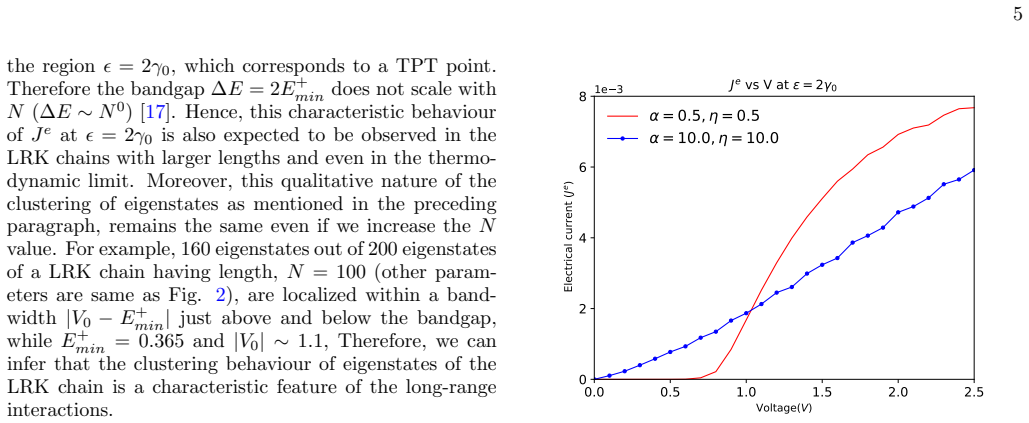
The results show several differences from the usual short-range Kitaev chain. For example, at the parameter point they call the topological phase transition, the short-range chain has a gapless spectrum and its current rises linearly with voltage, while the long-range chain has a finite gap and the current stays near zero until the voltage exceeds the gap, after which it rises steeply. The authors attribute this to the long-range interaction giving mass to the edge states and bunching the bulk states near the gap.
The central comparison, however, relies on identifying ε = 2γ0 as the topological phase transition. The Hamiltonian written in Eq. (1) has an on-site term -ε(2c†c - 1), which corresponds to a chemical potential of 2ε and a transition at ε = γ0. The paper's numerics show a gapless short-range spectrum at ε = 2γ0, which would only be true if the on-site term were -ε c†c. This internal inconsistency means a reader cannot reproduce the central transport curves from the written model, and the interpretation of the threshold as a probe of the missing gap closing is not firmly grounded.
Extended reading notes
Core claim
The central claim is that the transport characteristics of the long-range Kitaev chain are distinguishably different from its short-range counterpart, and in particular that at the topological phase transition point (ε = 2γ0), both the electric current and the thermal current remain almost zero at low bias, then rise faster than in the short-range chain once the bias exceeds the gap, revealing the absence of gap closing and the mass of the Dirac edge modes. Quote from Sec. V: 'At the TPT point, both electric currents (J_e) and thermal currents (J_u) in LRK chain remain almost zero in the initial part of the above-mentioned characteristic curves... as voltage or temperature biases become sufficiently large enough to excite the quasiparticles to overcome the energy bandgap which is directly proportional to the mass of the subgap state, both J_e and J_u start increasing with a faster rate as compared to that of SRK chain.'
Load-bearing premise
The identification of ε = 2γ0 as the topological phase transition point for the short-range Kitaev chain (used throughout Sec. IV, Figs. 2 and 3). The written Hamiltonian (Eq. 1) has an on-site term -ε(2c†c - 1), implying a chemical potential μ = 2ε and a transition at ε = γ0. The reported gapless SRK spectrum at ε = 2γ0 is only consistent with μ = ε. If this identification is wrong, the central comparison is not being performed at the SRK transition, and the proposed threshold signatures lose their interpretation as probes of the missing gap closing.
Editorial analysis
A structured set of objections, weighed in public.
Assumptions & free parameters
free parameters (3)
- power-law exponents α, η =
0.5 (LRK), 10.0 (SRK)
- on-site energy ε =
0, 0.2, 0.3, 2γ0=1.0
- system size N =
15 or 20
assumptions (4)
- standard math The quantum Langevin equations and Green's function (LEGF) method accurately describes non-equilibrium steady-state transport in this hybrid device.
- domain assumption The tunnel couplings do not contain long-range terms, so the current expressions are unchanged from the SRK case.
- ad hoc to paper The parameter value ε = 2γ0 is the topological phase transition point for the short-range Kitaev chain.
- domain assumption The band gap at ε = 2γ0 is independent of chain length N for the LRK chain (ΔE ~ N^0).
Cite this review
Pith. "Pith review of Electrical, thermal and thermoelectric transport in open long-range Kitaev chain." pith.science (2026). https://pith.science/paper/RJVV3VZR
@misc{pith2026250514004,
  author       = {Pith},
  title        = {Pith review of: Electrical, thermal and thermoelectric transport in open long-range Kitaev chain},
  year         = {2026},
  howpublished = {\url{https://pith.science/paper/RJVV3VZR}},
  note         = {Machine review of arXiv:2505.14004}
}
read the original abstract
We study electrical, thermal and thermoelectric transport in a hybrid device consisting of a long-range Kitaev chain coupled to two metallic leads at two ends. Electrical and thermal currents are calculated in this device under both voltage and thermal bias conditions. We find that the transport characteristics of the long-range Kitaev chain are distinguishably different from its short-range counterpart, which is well known for hosting zero energy Majorana edge modes under some specific range of values of the model parameters. The emergence of massive Dirac fermions, the absence of gap closing at the topological phase transition point and some special features of the energy spectrum which are unique to the long-range Kitaev chain, significantly alter electrical/thermal current vs. voltage/temperature bias characteristics in comparison with that of the short-range Kitaev chain. These novel transport characteristics of the long-range Kitaev model can be helpful in understanding nontrivial topological phases of the long-range Kitaev chain.
Figures


Figures from the paper (4 more)


Reference graph
Works this paper leans on
-
[1]
Alicea, Reports on Progress in Physics 75, 076501 (2012)
J. Alicea, Reports on Progress in Physics 75, 076501 (2012)
2012
-
[2]
Beenakker, Annual Review of Condensed Matter Physics 4, 113 (2013)
C. Beenakker, Annual Review of Condensed Matter Physics 4, 113 (2013)
2013
-
[3]
M. Leijnse and K. Flensberg, Semiconductor Science and Technology 27, 124003 (2012)
work page 2012
-
[4]
Sato and Y
M. Sato and Y. Ando, Reports on Progress in Physics 80, 076501 (2017)
2017
-
[5]
A. Y. Kitaev, Physics-Uspekhi 44, 131 (2001)
2001
-
[6]
However, in the case of the LRK chain, energy gap is not closed for ϵ = 2γ0 = 1.0. So, we observe that the J u remains almost zero till ∆ T ∼ 0.06, then it starts increasing, and around ∆ T = 0 .15 it overtakes that of the SRK chain owing to the excitations of bunched-up bulk states situated above the bandgap. 0.00 0.05 0.10 0.15 0.20 T 0 1 2 3 4 Junction...
- [7]
-
[8]
D. Roy, C. J. Bolech, and N. Shah, Phys. Rev. B 86, 094503 (2012)
work page 2012
Show all 46 references
-
[9]
Banerjee, M
M. Banerjee, M. Heiblum, A. Rosenblatt, O. Y., D. E. Feldman, A. Stern, and V. Umansky, Nature 545, 75 (2017)
2017
-
[10]
J. P. Ramos-Andrade, O. ´Avalos-Ovando, P. A. Orellana, and S. E. Ulloa, Phys. Rev. B 94, 155436 (2016)
2016
-
[11]
I. C. Fulga, F. Hassler, A. R. Akhmerov, and C. W. J. Beenakker, Phys. Rev. B 83, 155429 (2011)
2011
-
[12]
Li and Y
H. Li and Y. Y. Zhao, J. Phys. Condens. Matter 29, 465001 (2017)
2017
-
[13]
Smirnov, Phys
S. Smirnov, Phys. Rev. B 97, 165434 (2018)
2018
-
[14]
Smirnov, Phys
S. Smirnov, Phys. Rev. B 100, 245410 (2019)
2019
-
[15]
J. M. Bhat and A. Dhar, Phys. Rev. B 102, 224512 (2020)
2020
-
[16]
Bondyopadhaya and D
N. Bondyopadhaya and D. Roy, J. Stat. Phys. 187, 11 (2022)
2022
-
[17]
Campa, T
A. Campa, T. Dauxois, D. Fanelli, and S. Ruffo, Physics of Long-Range Interacting Systems (Oxford University Press, 2014)
2014
-
[18]
Viyuela, D
O. Viyuela, D. Vodola, G. Pupillo, and M. A. Martin- Delgado, Phys. Rev. B 94, 125121 (2016)
2016
-
[19]
DeGottardi, M
W. DeGottardi, M. Thakurathi, S. Vishveshwara, and D. Sen, Phys. Rev. B 88, 165111 (2013)
2013
-
[20]
Dutta and A
A. Dutta and A. Dutta, Phys. Rev. B 96, 125113 (2017)
2017
-
[21]
Long-range interacting quantum systems,
N. Defenu, T. Donner, T. Macr ` ı, G. Pagano, S. Ruffo, and A. Trombettoni, “Long-range interacting quantum systems,” (2021), arXiv:2109.01063 [cond-mat.quant- gas]
2021 arXiv
-
[22]
Solfanelli, S
A. Solfanelli, S. Ruffo, S. Succi, and N. Defenu, Journal of High Energy Physics 2023, 66 (2023)
2023
-
[23]
Francica and L
G. Francica and L. Dell’Anna, Phys. Rev. B 106, 155126 (2022)
2022
-
[24]
Tarantola and N
A. Tarantola and N. Defenu, Phys. Rev. B 107, 235146 (2023)
2023
-
[25]
Perczel, J
J. Perczel, J. Borregaard, D. E. Chang, H. Pichler, S. F. Yelin, P. Zoller, and M. D. Lukin, Phys. Rev. Lett. 119, 023603 (2017)
2017
-
[26]
R. J. Bettles, J. Minar, C. S. Adams, I. Lesanovsky, and B. Olmos, Phys. Rev. A 96, 041603 (2017)
2017
-
[27]
Pientka, L
F. Pientka, L. I. Glazman, and F. von Oppen, Phys. Rev. B 88, 155420 (2013)
2013
-
[28]
Pientka, L
F. Pientka, L. I. Glazman, and F. von Oppen, Phys. Rev. B 89, 180505 (2014)
2014
-
[29]
Periwal, E
A. Periwal, E. S. Cooper, P. Kunkel, J. F. Wienand, E. J. Davis, and M. Schleier-Snmith, Nature 600, 630 (2021)
2021
-
[30]
Jaschke, K
D. Jaschke, K. Maeda, J. D. Whalen, M. L. Wall, and L. D. Carr, New Journal of Physics 19, 033032 (2017)
2017
-
[31]
Benito, A
M. Benito, A. G´ omez-Le´ on, V. M. Bastidas, T. Brandes, and G. Platero, Phys. Rev. B 90, 205127 (2014)
2014
-
[32]
Vodola, L
D. Vodola, L. Lepori, E. Ercolessi, and G. Pupillo, New Journal of Physics 18, 015001 (2015)
2015
-
[33]
Patrick, T
K. Patrick, T. Neupert, and J. K. Pachos, Phys. Rev. Lett. 118, 267002 (2017)
2017
-
[34]
Giuliano, S
D. Giuliano, S. Paganelli, and L. Lepori, Phys. Rev. B 97, 155113 (2018)
2018
-
[35]
Abumwis, M
G. Abumwis, M. T. Eiles, and A. Eisfeld, Phys. Rev. Lett. 124, 193401 (2020)
2020
-
[36]
Dhar and D
A. Dhar and D. Sen, Phys. Rev. B 73, 085119 (2006)
2006
-
[37]
A. C. P. Lima, R. C. Bento Ribeiro, J. H. Correa, F. Deus, M. S. Figueira, and M. A. Continentino, Sci- 10 entific Reports 13, 1508 (2023)
2023
-
[38]
Vodola, L
D. Vodola, L. Lepori, E. Ercolessi, A. V. Gorshkov, and G. Pupillo, Phys. Rev. Lett. 113, 156402 (2014)
2014
-
[39]
Alecce and L
A. Alecce and L. Dell’Anna, Phys. Rev. B 95, 195160 (2017)
2017
-
[40]
Roy and A
D. Roy and A. Dhar, Phys. Rev. B 75, 195110 (2007)
2007
-
[41]
D. Roy, N. Bondyopadhaya, and S. Tewari, Phys. Rev. B 88, 020502 (2013)
2013
-
[42]
Dhar and D
A. Dhar and D. Roy, J. Stat. Phys. 125, 801 (2006)
2006
-
[43]
A. M. Lobos and S. D. Sarma, New Journal of Physics 17, 065010 (2015)
2015
-
[44]
J. D. Sau, S. Tewari, R. M. Lutchyn, T. D. Stanescu, and S. Das Sarma, Phys. Rev. B 82, 214509 (2010)
2010
-
[45]
Tewari, C
S. Tewari, C. Zhang, S. Das Sarma, C. Nayak, and D.-H. Lee, Phys. Rev. Lett. 100, 027001 (2008)
2008
-
[46]
R. H. French, V. A. Parsegian, R. Podgornik, R. F. Ra- jter, A. Jagota, J. Luo, D. Asthagiri, M. K. Chaud- hury, Y.-m. Chiang, S. Granick, S. Kalinin, M. Kar- dar, R. Kjellander, D. C. Langreth, J. Lewis, S. Lustig, D. Wesolowski, J. S. Wettlaufer, W.-Y. Ching, M. Fin- nis, F....
2010
Reviewed August 7, 2026 · model on record in the stance chip above.
Discussion (0). Continue with ORCID to comment.