REVIEW 4 major objections 6 minor 43 references
PINCH: Pipeline-Informed Noise Characterization in LIGO's Third Observing Run
T0 review · 4 major / 6 minor · reviewed 2026-08-07 · deepseek-v4-flash
Pith's one-line read PINCH claims that an SVM trained on clean GstLAL triggers can identify glitch-induced triggers, and that this classification exposes distinct, time-varying fingerprints of glitch classes in O3b.
desk verdict PINCH is a genuinely new pipeline-informed glitch diagnostic with solid qualitative O3b findings, but the unvalidated SVM threshold means the central 'glitch-induced' labeling rests on an assumption the paper never tests. read the letter →
The pith
A machine-rendered reading of the paper's core claim, the machinery that carries it, and where it could break.
The reading
What carries the argument
The load-bearing object is a Support Vector Machine—a supervised classifier that finds a boundary between classes—trained on clean GstLAL triggers in the two-dimensional space of matched-filter SNR rho and signal-consistency chi-squared, with one model per detector per O3b chunk. It learns the joint distribution of ordinary noise triggers; applying it to dirty triggers and inverting the score so that values above 1 mark deviations from clean behavior is what defines the glitch-induced population. Two summary statistics carry the analysis: the over-representation ratio, which compares a class's share of glitch-induced triggers with its share of all glitches, and the Bhattacharyya coefficient, which measures overlap between parameter distributions from different chunks.
What would settle it
Inject simulated glitches of known Gravity Spy classes into otherwise quiet O3b strain data and check whether the pipeline triggers they produce receive SVM scores above 1 and fall in the parameter-space regions the paper assigns to those classes.
Extended reading notes
Core claim
The central claim is that a one-class-style SVM trained per interferometer and per O3b chunk on 'clean' foreground triggers—those whose template duration overlaps no Omicron transient—can separate dirty triggers into glitch-induced (SVM score > 1) and merely coincident populations. Under this labeling, glitch classes show systematic structure in the GstLAL parameter space: Scattered Light triggers cluster at low SNR and high reduced chi-squared, Tomte triggers are stable and concentrated in mid-range SNR at Livingston, and Extremely Loud and Koi Fish dominate the highest SNR triggers at both detectors. The paper further claims that the over-representation ratio and the Bhattacharyya coefficient are the right metrics to quantify how disproportionately each class produces triggers and how consistent its fingerprint is over time, and that the RC tracking commissioning change at Hanford visibly shifted the Scattered Light fingerprint in the rho vs. chi-squared/rho-squared space.
Load-bearing premise
The clean/dirty split assumes Omicron detects every transient and that a trigger overlapping a glitch's template window was caused by that glitch, so any missed glitch or coincidental overlap contaminates both the training set and every reported fingerprint.
Editorial extensions
If this is right
- Glitch classes can be ranked by per-occurrence impact: Koi Fish and Extremely Loud are over-represented among glitch-induced triggers, while Scattered Light, despite its frequency, is under-represented, so mitigation priority need not follow glitch counts.
- Commissioning changes are visible from the pipeline side: the RC tracking shift in Scattered Light's rho and chi-squared/rho-squared distribution is a direct example of detector modifications changing noise fingerprints.
- Stable classes such as Tomte at Livingston produce repeatable trigger parameter distributions, making them candidates for fixed vetoes or gating tailored to their SNR and mass regions.
- The method is pipeline-agnostic and per-chunk, so the same procedure can be applied to O4 data or other matched-filter pipelines without retraining across runs.
- Blip over-representation in the BBH search region and Fast Scattering over-representation in the BNS region identify where sensitivity loss is concentrated, pointing to targeted mitigation.
Reading between the lines
- Going beyond the paper, the same per-chunk SVM design could be run in near-real time as data streams, turning the score-above-1 population into a live monitor of how each glitch class is coupling to the search.
- The paper notes that visually distinct classes can overlap in pipeline space; a further step would be to cluster triggers by their SVM-measured pipeline response and ask whether those clusters correspond to unknown common physical sources.
- A testable extension would be to apply PINCH to O4 and see whether the post-RC-tracking Scattered Light fingerprint persists, indicating whether that commissioning change removed a subpopulation or permanently changed the class's pipeline behavior.
- Because the method is pipeline-agnostic, running the same clean-trained SVM on another matched-filter search pipeline would show which fingerprints are intrinsic to glitch physics and which depend on GstLAL's template bank.
Editorial analysis
A structured set of objections, weighed in public.
Referee Report
Summary. The paper introduces PINCH, a method to classify GstLAL foreground triggers as glitch-induced or noise-like using Support Vector Machine (SVM) classifiers trained on triggers that do not overlap with Omicron-detected transients. For each O3b chunk and interferometer, an SVM is trained on the ρ and χ2 values of 'clean' triggers, and 'dirty' triggers (those overlapping Omicron glitches) are scored; triggers with SVM score above 1 are labeled as caused by glitches. The resulting glitch-induced triggers are then analyzed by Gravity Spy glitch class, in mass–mass space, ρ–χ2/ρ2 space, SNR distributions, over-representation ratios, and Bhattacharyya coefficients across chunks. The authors report class-specific fingerprints, time-varying behavior such as the Scattered Light shift after RC tracking at LHO, and discuss implications for detector characterization and pipeline mitigation.
Significance. If the classification step is valid, PINCH would provide a useful, pipeline-informed complement to existing glitch characterization tools, with the practical benefit of using production-pipeline triggers rather than synthetic glitch models. The paper is clearly written, the data handling is transparent, and the per-chunk, per-interferometer analysis is a strength. The method is also presented as pipeline-agnostic, which broadens its potential utility. However, the significance is conditional: the central classifier threshold is not validated against any ground truth, and the clean/dirty labeling rests on an untested completeness assumption about Omicron. The paper's main findings would be convincing only after these issues are addressed.
major comments (4)
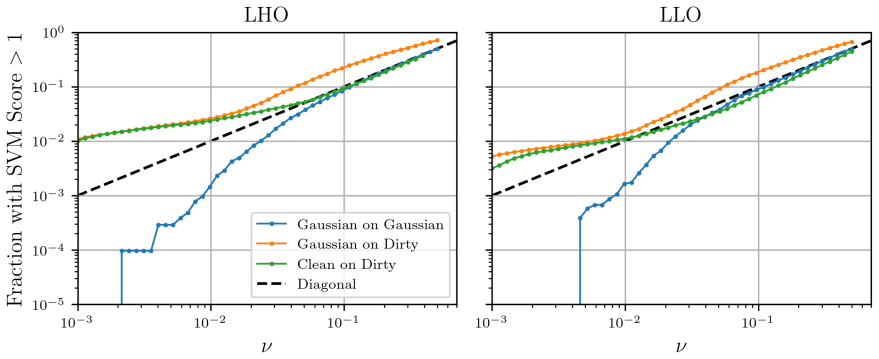
- [§3.1.3, Fig. 5] The SVM score threshold of 1 is adopted by convention ('it is common to use a value of ±1') with no independent validation. Since the true outlier fraction in the evaluation set is unknown, as acknowledged in §3.1.2, there is no evidence that score > 1 separates glitch-induced triggers from triggers that merely coincide with a glitch. This threshold is load-bearing for every downstream result, including Tables 1–2 and Figures 7–13. The paper should provide a calibration study, for example using hardware injections, simulated glitches, or an independent set of human/veto-confirmed glitch-induced triggers, and report accuracy, completeness, and stability of the classification.
- [§3.1.1] The clean/dirty label is defined by temporal overlap with Omicron triggers, which assumes Omicron detects all relevant transients and that overlap implies causation. If Omicron misses low-SNR or non-stationary glitches, the clean training set is contaminated; if a pipeline trigger overlaps a glitch for unrelated reasons, the dirty set is mislabeled. This assumption propagates through all subsequent analysis. The authors should quantify Omicron's sensitivity in the relevant SNR and frequency range, and ideally compare with an independent transient finder or injection study to bound the contamination rate.
- [§4.2, Fig. 10] The ρ vs χ2/ρ2 distribution is the same feature space (up to normalization) used to train the SVM, and the glitch-induced triggers are selected precisely because they are outliers in that space. Therefore, the finding that different glitch classes occupy distinct regions of ρ vs χ2/ρ2 is partly a restatement of the classifier's input rather than an independent measurement. The class-conditional distributions are also selection-biased: glitch types that produce triggers resembling clean triggers in this space are excluded by construction. The paper should acknowledge this circularity explicitly and, if possible, present fingerprints in parameter spaces not used for classification, such as template masses or other GstLAL output quantities.
- [§4, Tables 1–2, Fig. 13] The results are presented without any uncertainty quantification. The percentages in Tables 1–2, the over-representation ratios in Figure 11, and the Bhattacharyya coefficients in Figure 13 have no error bars or statistical significance tests, despite the fact that the classification threshold and the Omicron-based labeling both introduce substantial systematic uncertainty. The paper should include a sensitivity analysis varying ν and the score threshold, and report bootstrap or other uncertainties on the key metrics.
minor comments (6)
- [§1 and §4] The introduction says O3b corresponds to chunks 24 through 40, while Section 4 says O3b consisted of chunks 23 through 40; Tables 1–2 begin at chunk 23. This inconsistency should be corrected.
- [§3.2.1] The heading 'Battacharyya Coefficient' is misspelled; it should be 'Bhattacharyya Coefficient'. Also, in the text following Eq. (1), 'varible' should be 'variable'.
- [§3.1.2] The description of the 10,000 training samples is incomplete: it should state how these samples are selected from the clean population (random subsample? balanced across the chunk? with or without replacement?) and whether the same samples are used across the ν sweep.
- [§3.1.3] The SVM formulation is described loosely: a binary SVM normally has two classes, but here the model is trained only on clean triggers. The paper should clarify explicitly that a one-class SVM is used (or justify the two-class interpretation), and define the decision function whose sign is inverted.
- [§4.1.1] The text says 'Figure 9 amd 7' where 'amd' should be 'and', and the sentence is grammatically incomplete. Also, Figure 7 caption describes top and bottom panels but the text references 'top panels' and 'bottom panels' in a way that is not fully consistent.
- [§4.3] The over-representation ratio formula in Eq. (2) is written as a product rather than a ratio of ratios; please rewrite it with explicit parentheses or a fraction to avoid ambiguity.
Circularity Check
Partial circularity: the glitch-induced trigger set is defined by SVM score in rho/chi2 space and then characterized in that same space, though class-specific fingerprints retain independent content.
-
self definitional
[Section 3.1.3 (Application of SVM) -> Section 4.2 (rho vs chi2/rho2; Figure 10 discussion)]
"Thus, the dirty triggers that are evaluated by the SVM and return a score greater than 1 are considered to be caused by glitches. ... Figure 10, analogous to the previous mass-space comparison, shows that different glitch types occupy distinct regions of this parameter space."
The SVM is trained on the rho and chi2 values of clean triggers and assigns high scores to dirty triggers that are unlike the clean distribution; score >1 is the operational definition of 'caused by glitches.' Section 4.2 then reports the distribution of exactly these triggers in the rho vs chi2/rho2 space as an empirical finding. That the selected population is non-clean-like in this space is true by construction, so claims that glitch-induced triggers occupy 'characteristic regions' of this space partly restate the classifier's decision boundary. The per-class differences (e.g., Scattered Light at low rho and high chi2) are not forced by the SVM because class labels enter only after selection, making the circularity partial rather than total.
full rationale
The central derivation is not a self-citation chain: references to prior GstLAL and detector-characterization work are background or corroborating, and the RC tracking citation is supported by the paper's own before/after data. The clean/dirty labeling depends on Omicron overlap, and the choice of SVM score > 1 as the glitch boundary is not validated against independent ground truth; these are correctness risks, not circularity. The main circular element is that the 'glitch-induced' population is defined by being anomalous in rho/chi2 space, and Section 4.2 then characterizes that population in the same space, partly restating the selection criterion. However, the mass-space distributions, SNR histograms, over-representation ratios, and Bhattacharyya-coefficient time evolution all use variables or aggregations not encoded in the SVM decision boundary, so the class-specific fingerprints and temporal findings have independent empirical content. A moderate score of 4 reflects this partial self-definitional character without treating the whole analysis as forced.
Assumptions & free parameters
free parameters (3)
- SVM nu hyperparameter =
0.01
- SVM score threshold =
1
- Gravity Spy confidence threshold =
90%
assumptions (4)
- domain assumption Clean triggers, defined as those with no Omicron overlap, represent nominal detector behavior and are unaffected by glitches.
- domain assumption Time overlap between a pipeline trigger's template duration and an Omicron glitch implies the glitch caused the trigger.
- domain assumption A one-class SVM in rho and chi2 space can separate glitch-induced triggers from random noise triggers despite having no labeled outliers.
- domain assumption Gravity Spy classifications with at least 90% confidence are accurate labels for glitch morphologies.
Cite this review
Pith. "Pith review of PINCH: Pipeline-Informed Noise Characterization in LIGO's Third Observing Run." pith.science (2026). https://pith.science/paper/JFLCSY6F
@misc{pith2026250514949,
  author       = {Pith},
  title        = {Pith review of: PINCH: Pipeline-Informed Noise Characterization in LIGO's Third Observing Run},
  year         = {2026},
  howpublished = {\url{https://pith.science/paper/JFLCSY6F}},
  note         = {Machine review of arXiv:2505.14949}
}
read the original abstract
We present a method to identify and categorize gravitational wave candidate triggers identified by matched filtering gravitational wave searches (pipelines) caused by transient noise (glitches) in gravitational wave detectors using Support Vector Machine (SVM) classifiers. Our approach involves training SVM models on pipeline triggers which occur outside periods of excess noise to distinguish between triggers caused by random noise and those induced by glitches. This method is applied independently to the triggers produced by the GstLAL search pipeline on data from the LIGO Hanford and Livingston observatories during the second half of the O3 observing run. The trained SVM models assign scores to ambiguous triggers, quantifying their similarity to triggers caused by random fluctuations, with triggers with scores above a defined threshold being classified as glitch-induced. Analysis of these triggers reveals the distinct impact of different glitch classes on the search pipeline, including their distribution in relevant parameter spaces. We use metrics such as the Bhattacharyya coefficient and an over-representation ratio to quantify the consistency and prevalence of glitch impacts over time and across parameter spaces. Our findings indicate that some glitch types consistently produce triggers in specific regions of the parameter space, while others generate triggers that are more widely distributed. We observe that Scattered Light glitches appear differently in the search pipeline before and after a commissioning change, demonstrating how such detector changes appear in the pipeline's response to certain glitch classes. This method provides a framework for understanding and mitigating the influence of non-Gaussian transients on gravitational wave search pipelines, with implications for improving detection sensitivity and better understanding noise populations.
Figures


Figures from the paper (10 more)


Reference graph
Works this paper leans on
-
[1]
2015 Classical and Quantum Gravity 32 074001 (Preprint 1411.4547)
Aasi J et al. 2015 Classical and Quantum Gravity 32 074001 (Preprint 1411.4547)
arXiv 2015
-
[2]
2015 Classical and Quantum Gravity 32 024001 (Preprint 1408.3978)
Acernese F et al. 2015 Classical and Quantum Gravity 32 024001 (Preprint 1408.3978)
arXiv 2015
-
[3]
2021 Progress of Theoretical and Experimental Physics 2021 05A101 ( Preprint 2005.05574)
Akutsu T et al. 2021 Progress of Theoretical and Experimental Physics 2021 05A101 ( Preprint 2005.05574)
arXiv 2021
-
[4]
(KAGRA, VIRGO, LIGO Scientific) 2023 Phys
Abbott R et al. (KAGRA, VIRGO, LIGO Scientific) 2023 Phys. Rev. X 13 041039 ( Preprint 2111.03606)
arXiv 2023
-
[5]
Moe B, Brady P, Stephens B, Katsavounidis E, Williams R and Zhang F 2014 GraceDB: A Gravitational Wave Candidate Event Database URL https://dcc.ligo.org/LIGO-T1400365/ public
work page 2014
-
[6]
Buikema A et al. (aLIGO) 2020 Phys. Rev. D 102 062003 (Preprint 2008.01301)
arXiv 2020
-
[7]
Davis D et al. (LIGO) 2021 Class. Quant. Grav. 38 135014 (Preprint 2101.11673)
arXiv 2021
-
[8]
Soni S et al. (LIGO) 2025 Class. Quant. Grav. 42 085016 (Preprint 2409.02831)
arXiv 2025
Show all 43 references
-
[9]
(Virgo) 2023 Class
Acernese F et al. (Virgo) 2023 Class. Quant. Grav. 40 185006 (Preprint 2210.15633)
2023 arXiv
-
[10]
(KAGRA) 2021 Progress of Theoretical and Experimental Physics 2021 05A102 (Preprint 2009.09305)
Akutsu T et al. (KAGRA) 2021 Progress of Theoretical and Experimental Physics 2021 05A102 (Preprint 2009.09305)
2021
-
[11]
(LIGO Scientific, Virgo) 2018 Class
Abbott B P et al. (LIGO Scientific, Virgo) 2018 Class. Quant. Grav. 35 065010 ( Preprint 1710.02185)
2018 arXiv
- [12]
-
[13]
(LIGO Scientific, Virgo) 2016 Class
Abbott B P et al. (LIGO Scientific, Virgo) 2016 Class. Quant. Grav. 33 134001 ( Preprint 1602.03844)
2016 arXiv
-
[14]
Canton T D, Bhagwat S, Dhurandhar S V and Lundgren A 2014 Class. Quant. Grav. 31 015016 (Preprint 1304.0008)
2014 arXiv
-
[15]
org/10.1088/1361-6382/aacf18
Powell J 2018 Classical and Quantum Gravity 35 155017 ISSN 1361-6382 URL http://dx.doi. org/10.1088/1361-6382/aacf18
2018 doi
- [16]
-
[17]
2017 Physical Review D 95 ISSN 2470-0029 URL http://dx.doi.org/10.1103/ PhysRevD.95.042001
Messick C et al. 2017 Physical Review D 95 ISSN 2470-0029 URL http://dx.doi.org/10.1103/ PhysRevD.95.042001
2017
-
[18]
2024 Physical Review D 109 042008 (Preprint 2305.05625)
Ewing B et al. 2024 Physical Review D 109 042008 (Preprint 2305.05625)
2024 arXiv
- [19]
-
[20]
2019 The GstLAL Search Analysis Methods for Compact Binary Mergers in Advanced LIGO’s Second and Advanced Virgo’s First Observing Runs ( Preprint 1901.08580)
Sachdev S et al. 2019 The GstLAL Search Analysis Methods for Compact Binary Mergers in Advanced LIGO’s Second and Advanced Virgo’s First Observing Runs ( Preprint 1901.08580)
2019 arXiv
-
[21]
Cannon K, Cariou R, Chapman A, Crispin-Ortuzar M, Fotopoulos N, Frei M, Hanna C, Kara E, Keppel D, Liao L, Privitera S, Searle A, Singer L and Weinstein A 2012 The Astrophysical Journal 748 136 ISSN 1538-4357 URL http://dx.doi.org/10.1088/0004-637X/748/2/136
2012 doi
-
[22]
2023 Physical Review D 108 043004 (Preprint 2303.15700)
Tsukada L et al. 2023 Physical Review D 108 043004 (Preprint 2303.15700)
2023 arXiv
-
[23]
Davis D, White L V and Saulson P R 2020 Class. Quant. Grav. 37 145001 (Preprint 2002.09429)
2020 arXiv
-
[24]
Lopez M, Caneva Santoro G, Martins A, Schmidt S, Schoppink J, van Straalen W, Capano C and Caudill S 2025 Phys. Rev. D 111 103020 (Preprint 2412.17169)
2025
-
[25]
Ashton G, Thiele S, Lecoeuche Y, McIver J and Nuttall L K 2022 Class. Quant. Grav. 39 175004 (Preprint 2110.02689)
2022 arXiv
-
[26]
Heinzel J, Talbot C, Ashton G and Vitale S 2023 Mon. Not. Roy. Astron. Soc. 523 5972–5984 (Preprint 2304.02665)
2023 arXiv
-
[27]
Bondarescu R, Lundgren A and Macas R 2023 Phys. Rev. D 108 122004 (Preprint 2309.06594)
2023 arXiv
-
[28]
Robinet F, Arnaud N, Leroy N, Lundgren A, Macleod D and McIver J 2020 SoftwareX 12 100620 (Preprint 2007.11374)
2020 arXiv
- [29]
-
[30]
Bahaadini S, Noroozi V, Rohani N, Coughlin S, Zevin M, Smith J R, Kalogera V and Katsaggelos A 2018 Info. Sci. 444 172–186
2018
- [31]
-
[32]
Mukund N, Abraham S, Kandhasamy S, Mitra S and Philip N S 2017 Phys. Rev. D 95 104059 (Preprint 1609.07259)
2017 arXiv
-
[33]
Wu Y, Zevin M, Berry C P L, Crowston K, Østerlund C, Doctor Z, Banagiri S, Jackson C B, Kalogera V and Katsaggelos A K 2024 Phys. Rev. D (Preprint 2401.12913)
2024 arXiv
-
[34]
Joshi P, Tsukada L and Hanna C 2023 Phys. Rev. D 108 084032 (Preprint 2305.18233)
2023 arXiv
-
[35]
Cannon K, Hanna C and Keppel D 2013 Phys. Rev. D 88 024025 (Preprint 1209.0718)
2013 arXiv
-
[36]
Cannon K, Hanna C and Peoples J 2015 arXiv e-prints arXiv:1504.04632 (Preprint 1504.04632)
2015 arXiv
-
[37]
Bhattacharyya A 1943 Bulletin of the Calcutta Mathematical Society 35 99–109
1943
-
[38]
Duda R O, Hart P E and Stork D G 2000 Pattern Classification 2nd ed (New York: Wiley- Interscience) ISBN 978-0471056690
2000
-
[39]
Bishop C M 2006 Pattern Recognition and Machine Learning (New York: Springer) ISBN 978- 0387310732
2006
-
[40]
2021 Classical and Quantum Gravity 38 025016 URL https: //arxiv.org/abs/2007.14876
Soni S, Austin C, Effler A, Schofield R M S, Gonzalez G, Frolov V V, Driggers J C, Pele A, Urban A L, Valdes G et al. 2021 Classical and Quantum Gravity 38 025016 URL https: //arxiv.org/abs/2007.14876
2021 arXiv
-
[41]
Magee R, Sharma R, Agrawal A and Udall R 2024 Mitigating the impact of noise transients in gravitational-wave searches using reduced basis timeseries and convolutional neural networks (Preprint 2410.15513) URL https://arxiv.org/abs/2410.15513
2024 arXiv
- [42]
-
[43]
Nitz A H 2018 Class. Quant. Grav. 35 035016 (Preprint 1709.08974) 29
2018 arXiv
Reviewed August 7, 2026 · model on record in the stance chip above.
Discussion (0). Sign in to comment.