REVIEW 5 major objections 4 minor 63 references
Schwinger instability, modular flow, and holographic entropy for near-extremal charged BTZ black hole
T0 review · 5 major / 4 minor · reviewed 2026-08-07 · deepseek-v4-flash
Pith's one-line read This paper claims that in a near-extremal charged BTZ black hole, the intersection point of inward and outward holographic entanglement surfaces marks both the peak of Schwinger pair production and the vanishing of generalized entropy…
desk verdict The central alignment claim is asserted rather than derived, and the supporting chain breaks at load-bearing points — most importantly, the near-horizon metric is the exactly extremal AdS2 throat, not the finite-temperature geometry used later for Hawking tunneling. read the letter →
The pith
A machine-rendered reading of the paper's core claim, the machinery that carries it, and where it could break.
The reading
What carries the argument
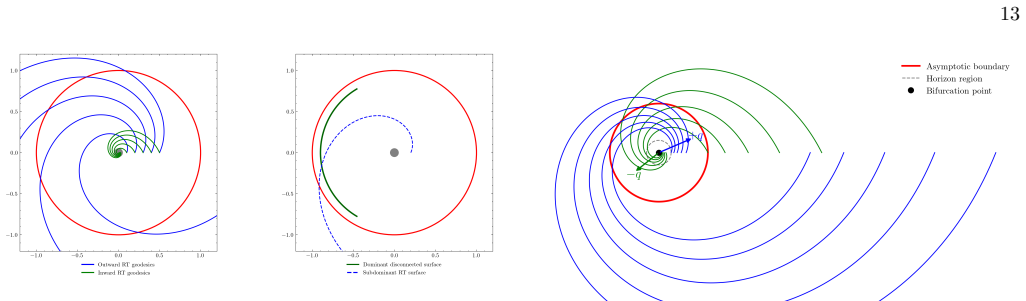
The load-bearing object is the near-horizon, near-extremal metric (13), a warped $\mathrm{AdS}_2\times S^1$ throat $$$ds^{2}$=-\frac{(2-\epsilon)\$rho^{2}$}{\$ell^{2}$}\,$dT^{2}$+\frac{\$ell^{2}$}{(2-\epsilon)\$rho^{2}$}\,d\$rho^{2}$+$r_e^{2}$\,d\$phi^{2}$$$ with effective AdS radius $R_{\mathrm{AdS}}^2=\ell^2/(2-\epsilon)$ and a constant electric field. This metric turns the charged Klein-Gordon equation into Whittaker's equation with parameters $a=\ell^2qQ\epsilon/(r_e(2-\epsilon))$ and $b=\sqrt{\ell^2(m^2+L^2/r_e^2)/(2-\epsilon)+1/4}$; the instability condition $b^2<0$ is a violation of the Breitenlohner-Freedman bound, which the paper reads as the onset of Schwinger pair production. The entropy half of the argument is carried by the modular flux $F_\xi=\int_{H^-}dU\,d\phi\,r_e\,U\,\delta^2T_{UU}$ on a Type II$_\infty$ horizon algebra, and the condition $\delta S_{\rm gen}=0$ turns into the null-null Einstein equation $R_{UU}=4G\beta\,\delta^2T_{UU}$. The final alignment uses the family of RT geodesics (holographic entanglement surfaces) $\rho(\phi)=\rho_0e^{\kappa\phi}$ on a constant-$T$ slice, whose inward and outward branches intersect at the quantum extremal surface.
What would settle it
Compute the surface gravity directly from the full charged BTZ lapse $f(r)=-M+r^2/\ell^2-(Q^2/2)\ln(r/r_0)$ in the scaling $r=r_e+\epsilon\rho$, $t=T/\epsilon$, and compare with Eq. (72); if the resulting temperature is not $T_H=(2-\epsilon)\epsilon\rho_+/(2\pi\ell^2)$, or if the next-order metric acquires a $\rho^2-\rho_+^2$ shift, the tunneling temperature and the claimed geometric alignment do not survive.
Extended reading notes
Core claim
The paper's central claim is that the near-horizon region of a near-extremal charged BTZ black hole is a warped $\mathrm{AdS}_2\times S^1$ throat with a constant electric field, and that all the quantum effects in this throat are organized by a single geometric locus. Solving the Klein-Gordon equation by separation into Whittaker functions gives a pair-production number $N=\sinh(2\pi b)/[\cosh(\pi a+\pi b)]\,e^{\pi b-\pi a}$ that reduces to the Schwinger rate $\exp(-\pi m_{\rm eff}^2/qE)$ when the electric force dominates; the WKB tunneling calculation gives $T_H=(2-\epsilon)\epsilon\rho_+/(2\pi\ell^2)$, which vanishes at extremality. The modular Hamiltonian flux across the past horizon, computed on a Type II$_\infty$ horizon algebra, balances the area variation when $\delta S_{\rm gen}=0$, producing the null-null semiclassical Einstein equation $R_{UU}=4G\beta\,\delta^2T_{UU}$. Finally, the paper claims that the intersection point of inward and outward RT geodesics is exactly where pair production peaks and $\delta S_{\rm gen}$ vanishes, so the throat geometry does not merely host quantum effects but encodes where they happen.
Load-bearing premise
The entire construction rests on using the throat metric $ds^2=-(2-\epsilon)\rho^2/\ell^2\,dT^2+\ell^2/((2-\epsilon)\rho^2)\,d\rho^2+r_e^2d\phi^2$ as the near-horizon, near-extremal limit, even though the tunneling calculation later introduces a horizon displacement $\rho_+$ to define the temperature; if the true throat is shifted so that $f\propto\rho^2-\rho_+^2$, the expansion, curvatures, and temperatures all change.
Editorial extensions
If this is right
- The pair-production number $N=\sinh(2\pi b)/[\cosh(\pi a+\pi b)]\,e^{\pi b-\pi a}$ becomes the semiclassical Schwinger rate $\exp(-\pi m_{\rm eff}^2/qE)$ in the strong-field regime, giving an exponential suppression controlled by the effective mass and electric field.
- The tunneling-derived Hawking temperature $T_H=(2-\epsilon)\epsilon\rho_+/(2\pi\ell^2)=\epsilon\rho_+/(2\pi R_{\mathrm{AdS}}^2)$ vanishes in the extremal limit, and the GUP-modified Hawking and Schwinger-like temperatures vanish at the minimal length, leaving a black hole remnant with critical electric field $E_{\rm crit}=m_{\rm eff}/(2q\sqrt{\alpha_0}l_{\rm Pl})$.
- Extremizing the generalized entropy with the modular flux yields $R_{UU}=4G\beta\,\delta^2T_{UU}$, the null-null component of the semiclassical Einstein equations, so the stationarity of entropy is equivalent to backreaction from produced pairs.
- Because the inward and outward RT geodesics intersect exactly where pair production peaks and $\delta S_{\rm gen}=0$, the quantum extremal surface is a saddle in the entanglement wedge rather than a boundary-anchored minimum.
- The near-extremal scaling $\delta E\sim T^2/G$ matches the known near-extremal behavior, supporting the paper's expectation of no mass gap in the charged BTZ case.
Reading between the lines
- A test the paper leaves implicit is to compute the actual near-extremal temperature from the full charged BTZ lapse and compare it with Eq. (72); if the $\rho_+$ introduced in Sec. IV is not the physical horizon displacement in metric (13), the alignment claim would need a corrected throat metric with $f\propto\rho^2-\rho_+^2$.
- The same triple coincidence should reappear for any near-extremal black hole with an $\mathrm{AdS}_2\times K$ throat, such as a four-dimensional charged black hole; checking it there would show whether the mechanism is special to BTZ or universal.
- The GUP remnant argument is logically independent of the modular-flow derivation; it could be turned into a quantitative prediction for the final specific heat or evaporation time, which analogue black hole experiments could probe.
- Since the modular-flux derivation fixes the background gauge field, repeating it with a dynamical electromagnetic field would test whether entropy extremization yields the full Einstein-Maxwell system rather than only its null-null gravitational component.
Editorial analysis
A structured set of objections, weighed in public.
Referee Report
Summary. The paper studies a charged scalar field in the near-horizon region of a near-extremal charged BTZ black hole. It derives an approximate metric (13) advertised as a warped AdS2 × S1 throat, solves the Klein-Gordon equation, and claims to compute Schwinger pair production, Hawking radiation via tunneling, GUP-modified temperatures, and modular-flow entropy. The central advertised result is that the intersection point of inward and outward Ryu-Takayanagi geodesics coincides with the peak of Schwinger pair production and with the vanishing of the variation of generalized entropy. The paper also claims to recover the null-null component of the semiclassical Einstein equations from entropy extremization.
Significance. If correct, the paper would connect Schwinger pair production, modular flow, holographic entanglement, and backreaction in a single near-extremal black-hole setup, which would be a notable synthesis. The authors use a standard toolkit—Whittaker functions, WKB tunneling, Tomita-Takesaki modular theory, and RT surfaces—and cite the relevant literature. However, the manuscript contains internal inconsistencies in the background geometry and curvature invariants, a circular derivation of the semiclassical Schwinger rate, and a central alignment claim that is asserted rather than derived. As it stands, the advertised results are not established.
major comments (5)
- [Sec. II, Eqs. (10)-(13)] The claimed near-horizon expansion does not follow from the stated coordinate and charge shifts. With Q^2 = Q_ext^2(1-ε) and r = r_e + ερ, the extremal conditions (7) hold only at ε = 0; at first order one obtains f(r_e + ερ) = f(r_e) + 2 ε^2 ρ r_e / ℓ^2 + O(ε^3), with f(r_e) generally of order ε (unless an additional mass shift is imposed), so the lapse cannot reduce to (2-ε) ε^2 ρ^2 / ℓ^2 as written in Eq. (12). The metric (13) is therefore the exactly extremal AdS2 × S1 throat with a double zero at ρ = 0 and no horizon radius. A finite-temperature near-extremal throat instead has f ≈ (2/ℓ^2) ε^2 (ρ^2 - ρ_+^2), with a horizon at ρ = ρ_+. This is the background actually used in Eqs. (68) and (72), but it is not the background used for the Klein-Gordon and Schwinger calculations. The mismatch invalidates the tunneling Hawking temperature, the GUP remnant analysis, the entropy variation δS_gen, and the claimed geometric alignment.
- [Sec. II, Eqs. (14) and (16)] Eq. (16) contradicts Eq. (14). For the metric (13), which is AdS2 × S1 with AdS2 radius squared ℓ^2/(2-ε), the Ricci scalar is R = -2(2-ε)/ℓ^2 and the Kretschmann scalar is K = 4(2-ε)^2/ℓ^4, not R = -6/ℓ^2 and K = 36/ℓ^4. The values in Eq. (16) are the AdS3 values and are not those of the metric the paper itself writes down. This is an elementary consistency check, and its failure undermines confidence in the subsequent curvature-related statements.
- [Sec. III, Eqs. (59)-(61), and Sec. IV, Eqs. (75)-(80)] The derivation of the semiclassical Schwinger rate is circular. The rate (61) is obtained by imposing the condition (59), ℓ^2/(2-ε) = (m_eff/(qE))^2. The promised derivation in Sec. IV defines the Schwinger temperature T_S = qE/(π m_eff) by matching a Boltzmann factor to the exponent of Eq. (61), and then derives qE/m_eff = 1/R_AdS from T_S ~ 2 T_H, which is exactly Eq. (59). Thus the condition is an input, not a prediction, and the claimed semiclassical rate (61) is not independently derived.
- [Sec. VII, Eqs. (104)-(118)] The derivation of the null-null Einstein equation is not supported by the presented equations. Eq. (104) defines F_Hξ as a symplectic pairing W(Φ, L_ξ Φ), while Eq. (112) defines Fξ as an integral of ξ^U δ^2 T_UU; no argument is given that these two quantities coincide. Similarly, Eq. (114) does not follow from the Raychaudhuri equation (113) without specifying the affine parametrization, performing an integration by parts, and controlling boundary terms. Consequently, Eq. (118) is a formal identification rather than a derivation of the semiclassical Einstein equation from entropy extremization.
- [Sec. VII.B, Eqs. (119)-(123) and Figs. 3-5] The central 'geometric alignment' claim is asserted rather than derived. The RT analysis introduces a length functional (120) and a family of geodesics ρ(φ) = ρ0 e^{κ φ}, but no calculation locates the intersection point of inward and outward geodesics, no calculation identifies the peak of the Schwinger pair-production rate as a function of ρ, and no equation connects either to the vanishing of δS_gen. The figures illustrate the claimed coincidence but do not establish it. The conclusion that the near-horizon geometry organizes quantum effects is therefore not supported by the mathematical content of the paper.
minor comments (4)
- [Sec. II, Eq. (43)] The relation R^2_AdS = (1 + Q^2/Q_ext^2) ℓ has incorrect dimensions; from Eqs. (39)-(42) and Q^2 = Q_ext^2(1-ε) one obtains R^2_AdS = ℓ^2/(1 + Q^2/Q_ext^2).
- [Sec. VI.B, Eq. (121)] The RT entropy S_RT = Δφ · r_e^2 / (4G L) uses L both as an angular momentum label and as a length parameter; the notation should be clarified so that the circular limit leading to S_BH = π r_e / (2G) is unambiguous.
- [Sec. VI.A, Eq. (101), and Sec. VII.B, Eq. (123)] The one-loop entropy in Eq. (101) contains A/(2π(2-ε)G), while Eq. (123) uses A/(4πG); the two expressions are inconsistent and should be reconciled.
- [Throughout] There are several typographical and grammatical errors, including 'Philosphenweg' in the affiliation, 'vaules' in the caption of Fig. 1, and 'we elaborate more one the quantum entropy' in the introduction.
Circularity Check
The semiclassical Schwinger rate is obtained by imposing condition (59), and the same condition is then 'recovered' from a temperature defined via that rate; the GUP remnant temperatures are forced by hand-fixed additive constants.
-
fitted input called prediction
[Sec. III.1, Eqs. (58)-(61); Sec. IV.A, Eqs. (74)-(79)]
"If we now use the following condition (which will be explained in more details next section) ℓ²/(2−ϵ) = (m_eff/(qE))², (59) ... we get a = m²_eff/(qE). Substituting into the exponent yields N ∼ exp(−πm²_eff/(qE)) ... From the condition T_S ∼ 2T_H, we get ... hence we get q/m_eff E = 1/R_AdS."
Equation (59) is the input: the Schwinger rate (61) exists only after imposing ℓ²/(2−ϵ) = (m_eff/(qE))². The paper then defines the thermal-like temperature T_S by matching a Boltzmann factor to this rate (75), and later imposes T_S ∼ 2T_H to 'derive' qE/m_eff = 1/R_AdS (79), which is the square root of the original condition. The critical Unruh temperature T_U = qE/(2πm_eff) = 1/(2πR_AdS) is therefore a restatement of the input (59), not an independent result.
-
fitted input called prediction
[Sec. V, Eqs. (85)-(94)]
"where, compared to [49], we have added a constant C which can be fixed from the condition of vanishing Hawking temperature, i.e., T_GUP_H = 0, in the limit Δx = Δx_min. ... Again, by construction, we can fix the constant C from the vanishing Schwinger-like temperature."
The paper's advertised result that quantum gravity drives the Hawking and Schwinger temperatures to zero is enforced by hand: the additive constant C is chosen precisely to make T_GUP_H vanish at Δx_min and T_GUP_S vanish at E=E_crit. The subsequent series expansions (89) and (95) then present the resulting −1/(2π√α0 l_Pl) offset as a 'backreaction effect', but this term is nothing more than the fitted constant, so the prediction reduces to the imposed condition.
full rationale
The manuscript contains two clear cases where a stated prediction reduces to its input by construction. First, the semiclassical Schwinger tunneling rate (61) is derived only after imposing condition (59), and that same condition is recycled in Sec. IV as the output of comparing T_S (defined from (61)) with T_H. Second, the vanishing of the GUP-corrected temperatures is obtained by explicitly fixing the additive constant C 'by construction' at the minimal length, after which the subtracted constant is relabeled as backreaction. These are genuine circular steps. The near-horizon metric (13) versus the later use of a finite horizon radius ρ+ in Eqs. (68)-(72) is a serious consistency flaw but is a correctness matter, not a circularity; similarly, the RT-intersection/Schwinger-peak coincidence is asserted rather than derived. The self-citation [50] (Jusufi) is used only to mention a known minimal-length metric and is not load-bearing for the central derivation. Overall score 6 reflects partial circularity: two 'predictions' reduce to inputs, although the modular-flow/entropy-extremization constraint (118) follows an independent Jacobson-type logic.
Assumptions & free parameters
free parameters (4)
- α0 (GUP parameter) =
not specified
- C (GUP constant) =
∆x_min/(4πα0 l_Pl²)
- Condition ℓ²/(2-ε) = (m_eff/(qE))² =
N/A
- Horizon radius ρ+ in the tunneling calculation =
unspecified
assumptions (4)
- ad hoc to paper The near-horizon, near-extremal expansion f(r) ≈ (2-ε)ε²ρ²/ℓ² (Eq 12) describes a black hole with a bifurcate Killing horizon at finite ρ+.
- domain assumption The horizon observables form a Type II_infinity von Neumann algebra with a semifinite trace (Sec. VII).
- domain assumption The generalized entropy variation takes the form δS_gen = δA/4G + βFξ, and quantum extremality δS_gen=0 governs the semiclassical backreaction (Eq 106).
- standard math The WKB approximation is justified by the infinite blueshift of outgoing modes near the horizon.
invented entities (2)
-
Black hole remnant at the minimal length
-
Alignment point where RT geodesics cross, pair production peaks, and entropy variation vanishes
Cite this review
Pith. "Pith review of Schwinger instability, modular flow, and holographic entropy for near-extremal charged BTZ black hole." pith.science (2026). https://pith.science/paper/A6BKFJNO
@misc{pith2026250517113,
  author       = {Pith},
  title        = {Pith review of: Schwinger instability, modular flow, and holographic entropy for near-extremal charged BTZ black hole},
  year         = {2026},
  howpublished = {\url{https://pith.science/paper/A6BKFJNO}},
  note         = {Machine review of arXiv:2505.17113}
}
abstract
We investigate the quantum dynamics of a charged scalar field in the near-horizon region of a near-extremal charged BTZ black hole. A controlled expansion of the Einstein-Maxwell equations reveals an emergent warped AdS$_2 \times S^1$ throat geometry threaded by a constant electric field--an ideal setting for studying Schwinger pair production, Hawking radiation, and entropy flow. By solving the Klein-Gordon equation using both tunneling and field-theoretic methods, we compute the pair production rate and identify an effective Unruh-like temperature. In particular, we apply the WKB approximation for Hawking tunneling, justified by the infinite blueshift experienced by outgoing modes near the horizon. Instability arises when local acceleration exceeds the AdS curvature scale, linking near-horizon dynamics to thermal emission. Through the generalized uncertainty principle, which implies the existence of a minimal length, we argue that quantum gravity effects can drive the Hawking and Schwinger-like temperatures to zero. To connect quantum radiation to geometry, we analyze the flux of the modular Hamiltonian across the horizon and show that its variation matches the entropic contribution of the produced pairs. Using Tomita-Takesaki theory and the type II\_\infty von Neumann algebra of horizon observables, we derive a semiclassical gravitational constraint involving the second variation of the stress tensor, recovering the null-null component of the Einstein equations from entropy extremization. The intersection point of inward and outward RT geodesics marks both the peak of pair production and the vanishing of entropy variation, revealing a geometric alignment between entanglement, quantum matter, and backreaction. The near-horizon geometry does not merely support quantum effects--it organizes them.
Figures


Figures from the paper (1 more)

Reference graph
Works this paper leans on
-
[1]
An emergent AdS2 throat parametrized by ( ρ, T), with effective curvature radius ℓ/√2 − ϵ, typical of near-horizon limits of extremal black holes [43, 44]
-
[2]
A compact angular dimension ϕ with radius re, which remains fixed as ϵ → 0 and sets the trans- verse size of the throat [8]
-
[3]
A gauge potential that simplifies in this limit. Us- ing the expansion: AT ≈ −Q ln re r0 + ϵρ re + O(ϵ2) (18) we see that the near-horizon electric field be- comes approximately constant. This supports a Schwinger effect in the AdS2 background, much like in higher-dimensional charged black holes [32, 45, 46]. This near-horizon limit provides a robust and ...
-
[4]
The radial solution given by (37) with parameters given by (31) andω2 0 given by (26)
and near the horizon ( z → ∞). The radial solution given by (37) with parameters given by (31) andω2 0 given by (26). The general solution (37) exhibit the following asymptotic behaviors: near the boundary ( z → 0), Mia,±b(z) ∼ z1/2±bez/2, (48) and near the horizon ( z → ∞), Mia,±b(z) ∼ e−z/2z1/2±ia. (49) At the boundary z → 0, the solution behaves as RB(...
-
[5]
Semiclassical Schwinger tunneling rate We will show that the expression for the mean number of produced pairs reduces to the semiclassical Schwinger tunneling rate in the appropriate limit. To see this, we need to consider the regime where a ≫ b is satisfied, i.e., corresponding to a sufficiently strong electric field. In this limit Eq. (55) becomes N ∼e−...
-
[6]
A thermal-like nature of Schwinger effect The spontaneous discharge of the black hole is a result of Hawking radiation and the Schwinger effect. Although the Schwinger effect is not thermal in nature, we would like to elaborate more a possible link and analogy be- tween Hawking radiation and the Schwinger effect in our spacetime geometry. Let us use the S...
-
[7]
S. W. Hawking, Commun. Math. Phys. 43, 199 (1975), [Erratum: Commun.Math.Phys. 46, 206 (1976)]
1975
-
[8]
W. G. Unruh, Phys. Rev. D 14, 870 (1976)
1976
Show all 63 references
-
[9]
D. N. Page, Phys. Rev. D 13, 198 (1976)
1976
-
[10]
J. D. Bekenstein, Phys. Rev. D 7, 2333 (1973)
1973
-
[11]
S. W. Hawking, Phys. Rev. D 13, 191 (1976)
1976
-
[12]
S. Das, P. Majumdar, and R. K. Bhaduri, Class. Quant. Grav. 19, 2355 (2002), arXiv:hep-th/0111001
2002 arXiv
-
[13]
M. K. Parikh and F. Wilczek, Phys. Rev. Lett. 85, 5042 (2000), arXiv:hep-th/9907001
2000 arXiv
-
[14]
Banados, C
M. Banados, C. Teitelboim, and J. Zanelli, Phys. Rev. Lett. 69, 1849 (1992), arXiv:hep-th/9204099
1992 arXiv
-
[15]
Banados, M
M. Banados, M. Henneaux, C. Teitelboim, and J. Zanelli, Phys. Rev. D 48, 1506 (1993), [Erratum: Phys.Rev.D 88, 069902 (2013)], arXiv:gr-qc/9302012
1993 arXiv
-
[16]
Carlip, Class
S. Carlip, Class. Quant. Grav. 12, 2853 (1995), arXiv:gr- qc/9506079
1995
-
[17]
R. R. Poojary, Phys. Rev. D 107, 066019 (2023), arXiv:2209.03065 [hep-th]
2023 arXiv
-
[18]
J. M. Maldacena, Adv. Theor. Math. Phys. 2, 231 (1998), hep-th/9711200
1998 arXiv
-
[19]
Cadoni and S
M. Cadoni and S. Mignemi, Nucl. Phys. B 557, 165 (1999), arXiv:hep-th/9902040
1999 arXiv
- [20]
- [21]
- [22]
-
[23]
Almheiri, N
A. Almheiri, N. Engelhardt, D. Marolf, and H. Maxfield, JHEP 12, 063, arXiv:1905.08762 [hep-th]
1905 arXiv
- [24]
- [27]
-
[28]
D. V. Fursaev, Phys. Rev. D 51, 5352 (1995), arXiv:hep- th/9412161
1995
-
[29]
V. P. Frolov, D. V. Fursaev, and A. I. Zelnikov, Nuclear Physics B 486, 339 (1997), arXiv:hep-th/9607104
1997 arXiv
-
[30]
Barrella, X
T. Barrella, X. Dong, S. A. Hartnoll, and V. Mar- tin, Journal of High Energy Physics 2013, 109 (2013), arXiv:1306.4682 [hep-th]
2013 arXiv
-
[31]
Banerjee, R
N. Banerjee, R. K. Gupta, I. Mandal, and A. Sen, Journal of High Energy Physics 2011, 143 (2011), arXiv:1005.3044 [hep-th]
2011 arXiv
-
[33]
Lewkowycz and J
A. Lewkowycz and J. Maldacena, Journal of High Energy Physics 2013, 90 (2013), arXiv:1304.4926 [hep-th]
2013 arXiv
-
[34]
Faulkner, A
T. Faulkner, A. Lewkowycz, and J. Maldacena, JHEP 11, 074, arXiv:1307.2892 [hep-th]
-
[35]
J. S. Schwinger, Phys. Rev. 82, 664 (1951)
1951
-
[36]
G. W. Gibbons, Commun. Math. Phys. 44, 245 (1975)
1975
-
[37]
C.-M. Chen, S. P. Kim, I.-C. Lin, J.-R. Sun, and M.-F. Wu, Phys. Rev. D 85, 124041 (2012), arXiv:1202.3224 [hep-th]
2012 arXiv
-
[38]
Chen, J.-R
C.-M. Chen, J.-R. Sun, F.-Y. Tang, and P.-Y. Tsai, Class. 16 Quant. Grav. 32, 195003 (2015), arXiv:1412.6876 [hep- th]
2015 arXiv
-
[39]
Cai, C.-M
R.-G. Cai, C.-M. Chen, S. P. Kim, and J.-R. Sun, Phys. Rev. D 101, 105015 (2020), arXiv:2004.00735 [hep-th]
2020 arXiv
-
[40]
Chen and S
C.-M. Chen and S. P. Kim, Phys. Rev. D 101, 085014 (2020), arXiv:2002.00394 [hep-th]
2020 arXiv
-
[41]
Jacobson, Phys
T. Jacobson, Phys. Rev. Lett. 75, 1260 (1995), arXiv:gr- qc/9504004
1995
-
[42]
Haag, Local quantum physics: Fields, particles, alge- bras (1992)
R. Haag, Local quantum physics: Fields, particles, alge- bras (1992)
1992
-
[43]
Witten, JHEP 10, 008, arXiv:2112.12828 [hep-th]
E. Witten, JHEP 10, 008, arXiv:2112.12828 [hep-th]
-
[44]
Chandrasekaran, R
V. Chandrasekaran, R. Longo, G. Penington, and E. Wit- ten, JHEP 02, 082, arXiv:2206.10780 [hep-th]
-
[45]
Chandrasekaran, G
V. Chandrasekaran, G. Penington, and E. Witten, JHEP 04, 009, arXiv:2209.10454 [hep-th]
-
[46]
Ryu and T
S. Ryu and T. Takayanagi, Phys. Rev. Lett. 96, 181602 (2006), arXiv:hep-th/0603001
2006 arXiv
-
[47]
Ryu and T
S. Ryu and T. Takayanagi, JHEP 08, 045, arXiv:hep- th/0605073
-
[48]
V. E. Hubeny, M. Rangamani, and T. Takayanagi, JHEP 07, 062, arXiv:0705.0016 [hep-th]
-
[49]
L. V. Iliesiu and G. J. Turiaci, JHEP 05, 145, arXiv:2003.02860 [hep-th]
2003 arXiv
- [50]
-
[51]
S. P. Kim and D. N. Page, Phys. Rev. D 78, 103517 (2008), arXiv:0803.2555 [hep-th]
2008 arXiv
-
[52]
S. P. Kim, H. K. Lee, and Y. Yoon, Int. J. Mod. Phys. D 28, 1950139 (2019), arXiv:1503.00218 [hep-th]
2019 arXiv
-
[53]
C.-M. Chen, S. P. Kim, and J.-R. Sun, in 15th Marcel Grossmann Meeting on Recent Developments in Theoret- ical and Experimental General Relativity, Astrophysics, and Relativistic Field Theories (2019) arXiv:1903.08881 [hep-th]
2019 arXiv
-
[54]
Veneziano, EPL 2, 199 (1986)
G. Veneziano, EPL 2, 199 (1986)
1986
-
[55]
Chen and R
P. Chen and R. J. Adler, Nucl. Phys. B Proc. Suppl. 124, 103 (2003), arXiv:gr-qc/0205106
2003 arXiv
-
[56]
Jusufi, Regular black holes in three dimensions and the zero point length (2022), arXiv:2209.04433 [gr-qc]
K. Jusufi, Regular black holes in three dimensions and the zero point length (2022), arXiv:2209.04433 [gr-qc]
2022 arXiv
-
[57]
Takesaki, Theory of Operator Algebras I (Springer, 1979)
M. Takesaki, Theory of Operator Algebras I (Springer, 1979)
1979
-
[58]
Bratteli and D
O. Bratteli and D. W. Robinson, Operator Algebras and Quantum Statistical Mechanics 1 (Springer, 1987)
1987
- [59]
-
[60]
Kudler-Flam, S
J. Kudler-Flam, S. Leutheusser, and G. Satishchandran, Phys. Rev. D 111, 025013 (2025), arXiv:2309.15897 [hep- th]
2025 arXiv
-
[61]
R. M. Wald, Quantum field theory in curved spacetime and black hole thermodynamics (University of Chicago press, 1994)
1994
-
[62]
Dimock, Communications in Mathematical Physics77, 219 (1980)
J. Dimock, Communications in Mathematical Physics77, 219 (1980)
1980
-
[63]
Prabhu, G
K. Prabhu, G. Satishchandran, and R. M. Wald, Phys. Rev. D 106, 066005 (2022), arXiv:2203.14334 [hep-th]
2022 arXiv
-
[64]
Faulkner, R
T. Faulkner, R. G. Leigh, O. Parrikar, and H. Wang, JHEP 09, 038, arXiv:1605.08072 [hep-th]
-
[65]
D. L. Jafferis, A. Lewkowycz, J. Maldacena, and S. J. Suh, Journal of High Energy Physics 2016, 1 (2016)
2016
-
[66]
Raychaudhuri, Physical Review 98, 1123 (1955)
A. Raychaudhuri, Physical Review 98, 1123 (1955)
1955
Reviewed August 7, 2026 · model on record in the stance chip above.
Discussion (0). Continue with ORCID to comment.