REVIEW 4 major objections 5 minor 73 references
Cut out and Replay: A Simple yet Versatile Strategy for Multi-Label Online Continual Learning
T0 review · 4 major / 5 minor · reviewed 2026-08-07 · deepseek-v4-flash
Pith's one-line read The paper claims that replaying single-object crops, cut from multi-label images by an unsupervised region-proposal step and filtered by a single-label confidence rule, beats established baselines in multi-label online continual learning.
desk verdict A genuinely simple and effective replay strategy for multi-label online continual learning, held back by an unmeasured auto-labeling step that carries the whole mechanism. read the letter →
The pith
A machine-rendered reading of the paper's core claim, the machinery that carries it, and where it could break.
The reading
What carries the argument
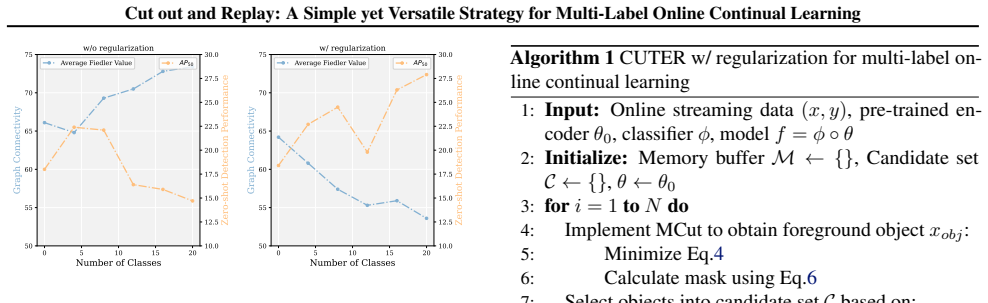
The load-bearing object is the single-label crop produced by the cut-out-and-replay cycle, which rests on three pieces. First, an annotation-free model-selection metric: the average Fiedler value (second-smallest eigenvalue of the Laplacian of the patch-feature similarity graph), which the paper shows correlates inversely with zero-shot localization accuracy — a lower Fiedler value means weaker graph connectivity and thus cleaner partitions for region-proposal methods. Second, Mask Cut (MCut), an iterative normalized-cut procedure that turns the feature graph into a list of candidate object masks and bounding boxes, with no ground-truth boxes or masks required. Third, a localization-preserving regularizer: the nuclear norm $R(A)=\lVert A\rVert_*$ applied to the patch adjacency matrix, which the paper proves upper-bounds the Fiedler value by $\lVert\varepsilon\rVert_2 + \lVert\varepsilon\rVert_\infty$ under a block-diagonal-plus-noise decomposition $A = A^* + \varepsilon$, thereby keeping the model's segmentation ability intact as training proceeds. The authors note the whole pipeline presumes a patch-structured transformer backbone, since the graph is built over patch features, and that the repeated MCut passes add computational overhead.
What would settle it
Using a dataset with ground-truth object boxes, such as PASCAL VOC or MS-COCO, match every crop admitted by the selection rule (top-1 confidence above threshold, second class below 0.5) against the ground-truth boxes of its source image and measure the fraction of stored crops whose predicted class truly fills the crop. If that precision is near chance, or if re-running the method with only ground-truth-verified crops changes performance insignificantly, then the clean single-label supervision story is not what drives the reported gains.
Extended reading notes
Core claim
CUTER claims that multi-label images should be replayed as single-label sub-images rather than as whole multi-label images, and that doing so removes the co-occurrence bias that sample-level replay inherits. For each incoming image, the method runs Mask Cut, an iterative normalized-cut segmentation over the patch-feature graph of a pre-trained ViT, to propose candidate object regions; each region is cropped, resized, and classified again. A crop enters the memory buffer only if its top predicted class clears a confidence threshold and its second prediction stays below 0.5, which the paper takes as evidence that crop and label correspond one-to-one, and a class-frequency-aware threshold pair with rebalanced reservoir sampling keeps the buffer's class distribution even. To prevent the backbone's localization skill from eroding during continual learning, the method adds a nuclear-norm penalty on the patch-similarity adjacency matrix, justified by a theorem bounding the graph's Fiedler value by the perturbation away from an ideal block-diagonal structure. The paper reports the strongest average performance on all three benchmarks (PASCAL VOC average mAP 82.07 versus 76.24 for the best baseline, MS-COCO 60.14 versus 56.45, NUS-WIDE 51.14 versus 49.16), with the largest margins on final-task performance, and shows the cut-and-replay module improves PRS, OCDM, KRT, and AGCN when grafted on.
Load-bearing premise
The method trusts the model's own top prediction on each resized crop as the single correct label for that crop; if the model is wrong about which object the crop actually contains, the memory buffer is silently poisoned with falsely labeled single-label samples and the clean-supervision advantage collapses.
Editorial extensions
If this is right
- Multi-label replay can be recast as single-label replay: the buffer holds sub-images with one label each, giving replay methods direct per-class control over what is stored and what is replayed.
- Pre-trained ViTs trained with multi-crop consistency can serve as annotation-free region proposers, and the average Fiedler value offers a way to choose among them before any downstream labels are seen.
- Localization ability is itself a learnable skill that can be consolidated during continual learning: a differentiable penalty on the patch adjacency matrix slows its decay.
- The cut-and-replay module is orthogonal to sampling and distillation components, so it composes with existing MOCL methods rather than replacing them.
- Because the largest margins appear on final-task performance, the benefit is concentrated in retaining older classes rather than in faster acquisition of new ones.
Reading between the lines
- The single-label selection rule effectively trains a detector without box annotations; if its precision is high, the buffer doubles as a weakly supervised object-detection signal, and the pipeline could be scored directly against VOC or COCO box predictions.
- The Fiedler-value criterion is a generic, annotation-free estimate of backbone localization quality and could be reused by any continual or transfer method that must pick a feature extractor before downstream labels arrive.
- A testable prediction of the paper's mechanism: the gain over whole-image replay should grow when head-tail class co-occurrence is strong, because crops sever the co-occurrence signal; a dataset constructed with adversarial co-occurrence should widen the gap.
- An ablation separating where the low-rank penalty is applied (stream features versus replayed crops) would clarify whether it preserves localization, reshapes the replay distribution, or both — a distinction the paper does not fully resolve.
Editorial analysis
A structured set of objections, weighed in public.
Referee Report
Summary. The paper proposes CUTER, a replay-based strategy for multi-label online continual learning (MOCL). The method first uses the average Fiedler value of patch-feature graphs to select a pre-trained ViT backbone with good zero-shot localization ability, then applies MaskCut to extract candidate object regions from each incoming image. Extracted crops are stored in a memory buffer only when the model's own prediction on the crop is confident and single-label (Eq. 2), with class-balanced reservoir sampling to control the buffer's class distribution. A nuclear-norm regularizer on the patch adjacency matrix is added to preserve localization ability during continual learning. Experiments on PASCAL VOC, MSCOCO, and NUS-WIDE report substantial gains over OCL, MLCIL, and MOCL baselines, and a plug-in study shows the cut-and-replay component can be combined with existing methods.
Significance. If the reported results hold, the paper makes a useful conceptual contribution: converting multi-label whole-image replay into single-label region replay can simultaneously mitigate catastrophic forgetting, missing labels, and class imbalance. The paper is unusually thorough in its experimental breadth, with three benchmarks, multiple backbones, ablations, sensitivity analyses, and a plug-in evaluation, and the code is released. However, the central mechanism of the paper, clean single-label supervision from automatically labeled crops, remains unverified against ground truth, and the low-rank regularizer is selected on the same benchmarks used for final evaluation. These issues affect the strength of the central claims, so I cannot recommend acceptance without additional validation.
major comments (4)
- [Section 2.2, Eq. (2), Algorithm 1 lines 7-9] The crop-label assignment relies entirely on the model's own predictions: a crop is stored only if argmax(p_obj) exceeds tau and the second-largest prediction is below 0.5, and the stored label is argmax(p_obj). There is no ground-truth verification that the predicted label is actually present in the crop. Since the memory buffer is the only mechanism for retaining past knowledge, confidently wrong auto-labels would poison the buffer and invalidate the claimed clean-supervision benefit. This risk is especially acute for objects from future classes, which the model cannot assign correctly because it has no output for those classes; such objects are likely to be stored with a wrong current-class label. I request a direct precision measurement of the crop-label assignments against ground-truth object labels (per class and per task), and an analysis of how often selected crops contain objects from future classes. The current AP50 localization numbers in Appendix E.2 are not a substitute, because localization quality does not imply label-crop correspondence.
- [Tables 3 and 6, Section 3.3] The claim that the low-rank regularizer Rl 'consistently boosts' performance is not supported by the reported tables. On NUS-WIDE, Table 6 shows CUTER w/Rl has last mAP 37.17+-1.46, while CUTER without Rl has last mAP 37.35+-0.42; Table 3 shows the smooth regularizer Rsm achieves last mAP 38.09 on NUS-WIDE, higher than Rl's 37.17. Moreover, Rl was selected among three regularizer candidates (Rl, Rsp, Rsm) based on final mAP on the very same three benchmarks used for evaluation. This is a selection-on-evaluation circularity. I ask the authors to either validate Rl on a separate development set or explicitly temper the claim and disclose the model-selection procedure.
- [Theorem 2.3 and Appendix C.2] Theorem 2.3 as stated is not correct for arbitrary block-diagonal A*. The proof uses the identity lambda_2(L*) = 0, which holds only when A* has at least two connected components. For a single block (for example, an image whose ideal graph is one connected object region), lambda_2(L*) is positive, and the stated bound can fail. Please state the necessary condition that A* has at least two blocks (e.g., foreground and background), or revise the theorem and proof accordingly. This is a formal correctness issue in a load-bearing theoretical justification for the regularization term.
- [Section 2.1, Figure 5, and Appendix E.2] The average Fiedler value is used both as the criterion for selecting the pre-trained backbone (Section 2.1, Table 7) and as the metric for showing that localization ability is preserved by regularization (Figure 5 and Appendix E.2). This creates a mild circularity: the same quantity is being used to justify design choices and to verify their success. The correlation with AP50 in Figure 2 is helpful, but I recommend reporting an independent localization metric for the regularization experiments, or at least clearly separating the model-selection phase from the evaluation phase.
minor comments (5)
- [Figures 1 and 2] There are typographical errors: 'Traning set' appears in Figure 1 and 'PACAL VOC' in Figure 2. These should be corrected.
- [Section 2.2, Eq. (2)] For multi-label classification, the output probabilities are per-class sigmoid outputs rather than a normalized distribution. The criterion p^(2)_obj < 0.5 therefore needs justification: why is 0.5 the correct threshold for the second-largest prediction, and how does the asymmetric loss (Eq. 1) affect the calibration of these probabilities?
- [Section 3.1 and Appendix E.2] The NUS-WIDE dataset was reconstructed by re-scraping from Flickr, but the paper does not specify how the original label sets or class names were obtained for the reconstructed version. This is important for reproducibility, since the benchmark is no longer the original NUS-WIDE.
- [Table 7 and Appendix E.2] Table 7 reports point estimates without standard deviations, although the main-text paragraph states that all experiments were repeated five times. Please report the standard deviations for these backbone comparisons.
- [Section 3.1 and Tables 1-4] The KRT baseline uses a TresnetM backbone while all other methods use ViT-S/16. This is stated in the implementation details, but it should be prominently noted in the main tables or their captions so readers do not misinterpret the comparison.
Circularity Check
No circular derivation: the central mAP results are external, and the Fiedler-value selection and nuclear-norm regularizer are empirically validated against ground-truth localization and held-out benchmarks; the only self-citations are minor or externally validated.
full rationale
I walked the claimed derivation chain and found no step in which a prediction reduces by construction to a fitted input or to the paper's own definitions. The backbone-selection metric (average Fiedler value, Section 2.1) is validated against ground-truth zero-shot AP50 in Figure 2, so selecting DINO by low Fiedler value is an empirical screening step, not a definition of the final mAP. The crop-selection rule in Eq. (2) uses the model's own predictions to assign pseudo-labels to replayed crops; this is self-training rather than a circular prediction, because the headline results (Tables 1, 2, 4) are measured against ground-truth labels on held-out test data, not against the model's own outputs. Theorem 2.3 is a standard eigenvalue perturbation bound, and the nuclear-norm regularizer R(A)=||A||* is chosen after comparing with sparse and smooth regularizers (Table 3) and its localization effect is checked against AP50 in Figure 5, so it is an empirically selected component rather than an assumed conclusion. The self-citations present are not load-bearing circularity: MCut (Wang et al., 2023a) is a published external algorithm whose outputs are here evaluated against ground truth, and Xinrui et al. (2024) is used only as a baseline and for a regularization definition. Appendix F honestly flags the ViT-backbone dependence and added computational cost; the more serious unaddressed risk, that auto-assigned crop labels in Eq. (2) are never precision-checked against ground-truth object labels, is a measurement/validity gap, not a circularity of the derivation.
Assumptions & free parameters
free parameters (4)
- alpha (low-rank regularization coefficient) =
not reported in main text; sensitivity range 0.0-0.5 in Fig. 6
- tau, tau1, tau2 (crop confidence thresholds) =
not reported in main text; sensitivity ranges roughly 0.50-0.70 and 0.70-0.90 in Fig. 6
- N (number of MCut iterations) =
not stated in main text
- learning rate, weight decay, batch sizes =
lr=1e-4, wd=1e-4, stream batch 12/20, memory batch 6/5
assumptions (5)
- standard math Cheeger's inequality and the Fiedler value bound the graph connectivity and hence localization quality (Lemma 2.2).
- standard math Courant-Fischer and Weyl eigenvalue perturbation bounds are valid for the graph Laplacian.
- domain assumption Pre-trained ViT patch features form clusters corresponding to objects, with multi-crop contrastive training strengthening intra-object similarity.
- ad hoc to paper Assumption C.1: the adjacency matrix A decomposes as A* + eps with A* an ideal block-diagonal matrix and eps a noise matrix.
- domain assumption The model's crop-level prediction p_obj is a reliable signal for single-label correspondence (Eq. 2).
Cite this review
Pith. "Pith review of Cut out and Replay: A Simple yet Versatile Strategy for Multi-Label Online Continual Learning." pith.science (2026). https://pith.science/paper/MOKMBRKF
@misc{pith2026250519680,
  author       = {Pith},
  title        = {Pith review of: Cut out and Replay: A Simple yet Versatile Strategy for Multi-Label Online Continual Learning},
  year         = {2026},
  howpublished = {\url{https://pith.science/paper/MOKMBRKF}},
  note         = {Machine review of arXiv:2505.19680}
}
read the original abstract
Multi-Label Online Continual Learning (MOCL) requires models to learn continuously from endless multi-label data streams, facing complex challenges including persistent catastrophic forgetting, potential missing labels, and uncontrollable imbalanced class distributions. While existing MOCL methods attempt to address these challenges through various techniques, \textit{they all overlook label-specific region identifying and feature learning} - a fundamental solution rooted in multi-label learning but challenging to achieve in the online setting with incremental and partial supervision. To this end, we first leverage the inherent structural information of input data to evaluate and verify the innate localization capability of different pre-trained models. Then, we propose CUTER (CUT-out-and-Experience-Replay), a simple yet versatile strategy that provides fine-grained supervision signals by further identifying, strengthening and cutting out label-specific regions for efficient experience replay. It not only enables models to simultaneously address catastrophic forgetting, missing labels, and class imbalance challenges, but also serves as an orthogonal solution that seamlessly integrates with existing approaches. Extensive experiments on multiple multi-label image benchmarks demonstrate the superiority of our proposed method. The code is available at \href{https://github.com/wxr99/Cut-Replay}{https://github.com/wxr99/Cut-Replay}
Figures


Figures from the paper (5 more)



Reference graph
Works this paper leans on
-
[1]
Online continual learning with maximal interfered retrieval
Aljundi, R., Belilovsky, E., Tuytelaars, T., Charlin, L., Caccia, M., Lin, M., and Page-Caccia, L. Online continual learning with maximal interfered retrieval. In Advances in Neural Information Processing Systems, volume 32, 2019 a
work page 2019
-
[2]
Gradient based sample selection for online continual learning
Aljundi, R., Lin, M., Goujaud, B., and Bengio, Y. Gradient based sample selection for online continual learning. Advances in neural information processing systems, 32, 2019 b
2019
-
[3]
New insights on reducing abrupt representation change in online continual learning
Caccia, L., Aljundi, R., Asadi, N., Tuytelaars, T., Pineau, J., and Belilovsky, E. New insights on reducing abrupt representation change in online continual learning. ICLR, 2022
work page 2022
-
[4]
Emerging properties in self-supervised vision transformers
Caron, M., Touvron, H., Misra, I., J\'egou, H., Mairal, J., Bojanowski, P., and Joulin, A. Emerging properties in self-supervised vision transformers. In Proceedings of the International Conference on Computer Vision (ICCV), 2021
2021
-
[5]
Co2l: Contrastive continual learning
Cha, H., Lee, J., and Shin, J. Co2l: Contrastive continual learning. In Proceedings of the IEEE/CVF International conference on computer vision, pp.\ 9516--9525, 2021
work page 2021
-
[6]
Efficient lifelong learning with a-gem
Chaudhry, A., Ranzato, M., Rohrbach, M., and Elhoseiny, M. Efficient lifelong learning with a-gem. ICLR, 2019 a
work page 2019
-
[7]
Chaudhry, A., Rohrbach, M., Elhoseiny, M., Ajanthan, T., Dokania, P. K., Torr, P. H., and Ranzato, M. On tiny episodic memories in continual learning. arXiv preprint arXiv:1902.10486, 2019 b
arXiv 1902
-
[8]
Continual learning in low-rank orthogonal subspaces
Chaudhry, A., Khan, N., Dokania, P., and Torr, P. Continual learning in low-rank orthogonal subspaces. Advances in Neural Information Processing Systems, 33: 0 9900--9911, 2020
work page 2020
Show all 73 references
-
[9]
Learning semantic-specific graph representation for multi-label image recognition
Chen, T., Xu, M., Hui, X., Wu, H., and Lin, L. Learning semantic-specific graph representation for multi-label image recognition. In Proceedings of the IEEE/CVF international conference on computer vision, pp.\ 522--531, 2019
2019
-
[10]
Improved baselines with momentum contrastive learning
Chen, X., Fan, H., Girshick, R., and He, K. Improved baselines with momentum contrastive learning. arXiv preprint arXiv:2003.04297, 2020
2003 arXiv
-
[11]
An empirical study of training self-supervised vision transformers
Chen*, X., Xie*, S., and He, K. An empirical study of training self-supervised vision transformers. arXiv preprint arXiv:2104.02057, 2021
2021 arXiv
-
[12]
Nus-wide: a real-world web image database from national university of singapore
Chua, T.-S., Tang, J., Hong, R., Li, H., Luo, Z., and Zheng, Y. Nus-wide: a real-world web image database from national university of singapore. In Proceedings of the ACM international conference on image and video retrieval, pp.\ 1--9, 2009
2009
-
[13]
Chung, F. R. Spectral graph theory, volume 92. American Mathematical Soc., 1997
1997
-
[14]
Vision transformers need registers
Darcet, T., Oquab, M., Mairal, J., and Bojanowski, P. Vision transformers need registers. arXiv preprint arXiv:2309.16588, 2023
2023 arXiv
-
[15]
Knowledge restore and transfer for multi-label class-incremental learning
Dong, S., Luo, H., He, Y., Wei, X., Cheng, J., and Gong, Y. Knowledge restore and transfer for multi-label class-incremental learning. In Proceedings of the IEEE/CVF International Conference on Computer Vision, pp.\ 18711--18720, 2023
2023
-
[16]
Agcn: augmented graph convolutional network for lifelong multi-label image recognition
Du, K., Lyu, F., Hu, F., Li, L., Feng, W., Xu, F., and Fu, Q. Agcn: augmented graph convolutional network for lifelong multi-label image recognition. In 2022 IEEE International Conference on Multimedia and Expo (ICME), pp.\ 01--06. IEEE, 2022
2022
-
[17]
Multi-label continual learning using augmented graph convolutional network
Du, K., Lyu, F., Li, L., Hu, F., Feng, W., Xu, F., Xi, X., and Cheng, H. Multi-label continual learning using augmented graph convolutional network. IEEE Transactions on Multimedia, 2023
2023
-
[18]
Rebalancing multi-label class-incremental learning
Du, K., Zhou, Y., Lyu, F., Li, Y., Xie, J., Shen, Y., Hu, F., and Liu, G. Rebalancing multi-label class-incremental learning. arXiv preprint arXiv:2408.12161, 2024
2024 arXiv
-
[19]
Confidence self-calibration for multi-label class-incremental learning
Du, K., Zhou, Y., Lyu, F., Li, Y., Lu, C., and Liu, G. Confidence self-calibration for multi-label class-incremental learning. In European Conference on Computer Vision, pp.\ 234--252. Springer, 2025
2025
-
[20]
A., Van Gool, L., Williams, C
Everingham, M., Eslami, S. A., Van Gool, L., Williams, C. K., Winn, J., and Zisserman, A. The pascal visual object classes challenge: A retrospective. International journal of computer vision, 111: 0 98--136, 2015
2015
-
[21]
and Zhou, H.-Y
Gao, B.-B. and Zhou, H.-Y. Learning to discover multi-class attentional regions for multi-label image recognition. IEEE Transactions on Image Processing, 30: 0 5920--5932, 2021
2021
-
[22]
A., Prabhu, A., Torr, P
Ghunaim, Y., Bibi, A., Alhamoud, K., Alfarra, M., Al Kader Hammoud, H. A., Prabhu, A., Torr, P. H., and Ghanem, B. Real-time evaluation in online continual learning: A new hope. In Proceedings of the IEEE/CVF Conference on Computer Vision and Pattern Recognition, pp.\ 11888--1...
2023
-
[23]
Not just selection, but exploration: Online class-incremental continual learning via dual view consistency
Gu, Y., Yang, X., Wei, K., and Deng, C. Not just selection, but exploration: Online class-incremental continual learning via dual view consistency. In Proceedings of the IEEE/CVF Conference on Computer Vision and Pattern Recognition, pp.\ 7442--7451, 2022
2022
-
[24]
M., and Bifet, A
Gunasekara, N., Pfahringer, B., Gomes, H. M., and Bifet, A. Survey on online streaming continual learning. In IJCAI, pp.\ 6628--6637, 2023
2023
-
[25]
Online continual learning through mutual information maximization
Guo, Y., Liu, B., and Zhao, D. Online continual learning through mutual information maximization. In International Conference on Machine Learning, pp.\ 8109--8126. PMLR, 2022
2022
-
[26]
and Zhang, M.-L
Hang, J.-Y. and Zhang, M.-L. Collaborative learning of label semantics and deep label-specific features for multi-label classification. IEEE Transactions on Pattern Analysis and Machine Intelligence, 44 0 (12): 0 9860--9871, 2021
2021
-
[27]
and Zhang, M.-L
Hang, J.-Y. and Zhang, M.-L. Dual perspective of label-specific feature learning for multi-label classification. In International Conference on Machine Learning, pp.\ 8375--8386. PMLR, 2022
2022
-
[28]
End-to-end probabilistic label-specific feature learning for multi-label classification
Hang, J.-Y., Zhang, M.-L., Feng, Y., and Song, X. End-to-end probabilistic label-specific feature learning for multi-label classification. In Proceedings of the AAAI Conference on Artificial Intelligence, volume 36, pp.\ 6847--6855, 2022
2022
-
[29]
Momentum contrast for unsupervised visual representation learning
He, K., Fan, H., Wu, Y., Xie, S., and Girshick, R. Momentum contrast for unsupervised visual representation learning. In Proceedings of the IEEE/CVF conference on computer vision and pattern recognition, pp.\ 9729--9738, 2020
2020
-
[30]
Masked autoencoders are scalable vision learners
He, K., Chen, X., Xie, S., Li, Y., Doll \'a r, P., and Girshick, R. Masked autoencoders are scalable vision learners. In Proceedings of the IEEE/CVF conference on computer vision and pattern recognition, pp.\ 16000--16009, 2022
2022
-
[31]
Learning label specific features for multi-label classification
Huang, J., Li, G., Huang, Q., and Wu, X. Learning label specific features for multi-label classification. In 2015 IEEE International conference on data mining, pp.\ 181--190. IEEE, 2015
2015
-
[32]
Learning label-specific features and class-dependent labels for multi-label classification
Huang, J., Li, G., Huang, Q., and Wu, X. Learning label-specific features and class-dependent labels for multi-label classification. IEEE transactions on knowledge and data engineering, 28 0 (12): 0 3309--3323, 2016
2016
-
[33]
D., Jeong, J., and Kim, G
Kim, C. D., Jeong, J., and Kim, G. Imbalanced continual learning with partitioning reservoir sampling. In Computer Vision--ECCV 2020: 16th European Conference, Glasgow, UK, August 23--28, 2020, Proceedings, Part XIII 16, pp.\ 411--428. Springer, 2020
2020
-
[34]
Learning common and label-specific features for multi-label classification with correlation information
Li, J., Li, P., Hu, X., and Yu, K. Learning common and label-specific features for multi-label classification with correlation information. Pattern recognition, 121: 0 108259, 2022
2022
-
[35]
Patchct: Aligning patch set and label set with conditional transport for multi-label image classification
Li, M., Wang, D., Liu, X., Zeng, Z., Lu, R., Chen, B., and Zhou, M. Patchct: Aligning patch set and label set with conditional transport for multi-label image classification. In Proceedings of the IEEE/CVF International Conference on Computer Vision, pp.\ 15348--15358, 2023
2023
-
[36]
A survey on incomplete multi-label learning: Recent advances and future trends
Li, X., Liu, J., Wang, X., and Chen, S. A survey on incomplete multi-label learning: Recent advances and future trends. arXiv preprint arXiv:2406.06119, 2024
2024 arXiv
-
[37]
Pushing one pair of labels apart each time in multi-label learning: from single positive to full labels
Li, X., Wang, X., and Chen, S. Pushing one pair of labels apart each time in multi-label learning: from single positive to full labels. Science China Information Sciences, 68 0 (6): 0 1--18, 2025
2025
-
[38]
and Li, W.-J
Liang, Y.-S. and Li, W.-J. Optimizing class distribution in memory for multi-label online continual learning. arXiv preprint arXiv:2209.11469, 2022
2022 arXiv
-
[39]
Lin, T.-Y., Maire, M., Belongie, S., Hays, J., Perona, P., Ramanan, D., Doll \'a r, P., and Zitnick, C. L. Microsoft coco: Common objects in context. In Computer Vision--ECCV 2014: 13th European Conference, Zurich, Switzerland, September 6-12, 2014, Proceedings, Part V 13, pp....
2014
-
[40]
Supervised contrastive replay: Revisiting the nearest class mean classifier in online class-incremental continual learning
Mai, Z., Li, R., Kim, H., and Sanner, S. Supervised contrastive replay: Revisiting the nearest class mean classifier in online class-incremental continual learning. In Proceedings of the IEEE/CVF Conference on Computer Vision and Pattern Recognition, pp.\ 3589--3599, 2021
2021
-
[41]
S., Shao, L., and Shah, M
Narayan, S., Gupta, A., Khan, S., Khan, F. S., Shao, L., and Shah, M. Discriminative region-based multi-label zero-shot learning. In Proceedings of the IEEE/CVF international conference on computer vision, pp.\ 8731--8740, 2021
2021
-
[42]
Dinov2: Learning robust visual features without supervision
Oquab, M., Darcet, T., Moutakanni, T., Vo, H., Szafraniec, M., Khalidov, V., Fernandez, P., Haziza, D., Massa, F., El-Nouby, A., et al. Dinov2: Learning robust visual features without supervision. arXiv preprint arXiv:2304.07193, 2023
2023 arXiv
-
[43]
Rebuffi, S.-A., Kolesnikov, A., Sperl, G., and Lampert, C. H. icarl: Incremental classifier and representation learning. In Proceedings of the IEEE conference on Computer Vision and Pattern Recognition, pp.\ 2001--2010, 2017
2001
-
[44]
Label distribution learning with label-specific features
Ren, T., Jia, X., Li, W., Chen, L., and Li, Z. Label distribution learning with label-specific features. In IJCAI, volume 1, pp.\ 3, 2019
2019
-
[45]
Asymmetric loss for multi-label classification
Ridnik, T., Ben-Baruch, E., Zamir, N., Noy, A., Friedman, I., Protter, M., and Zelnik-Manor, L. Asymmetric loss for multi-label classification. In Proceedings of the IEEE/CVF international conference on computer vision, pp.\ 82--91, 2021
2021
-
[46]
Royle, G. F. and Godsil, C. Algebraic graph theory, volume 207. New York: Springer, 2001
2001
-
[47]
R., Cogswell, M., Das, A., Vedantam, R., Parikh, D., and Batra, D
Selvaraju, R. R., Cogswell, M., Das, A., Vedantam, R., Parikh, D., and Batra, D. Grad-cam: Visual explanations from deep networks via gradient-based localization. In Proceedings of the IEEE international conference on computer vision, pp.\ 618--626, 2017
2017
-
[48]
and Malik, J
Shi, J. and Malik, J. Normalized cuts and image segmentation. IEEE Transactions on pattern analysis and machine intelligence, 22 0 (8): 0 888--905, 2000
2000
-
[49]
Online class-incremental continual learning with adversarial shapley value
Shim, D., Mai, Z., Jeong, J., Sanner, S., Kim, H., and Jang, J. Online class-incremental continual learning with adversarial shapley value. In Proceedings of the AAAI Conference on Artificial Intelligence, volume 35, pp.\ 9630--9638, 2021
2021
-
[50]
V., Roburin, S., Gidaris, S., Bursuc, A., P \'e rez, P., Marlet, R., and Ponce, J
Sim \'e oni, O., Puy, G., Vo, H. V., Roburin, S., Gidaris, S., Bursuc, A., P \'e rez, P., Marlet, R., and Ponce, J. Localizing objects with self-supervised transformers and no labels. arXiv preprint arXiv:2109.14279, 2021
2021 arXiv
-
[51]
Overcoming catastrophic forgetting for multi-label class-incremental learning
Song, X., Shu, K., Dong, S., Cheng, J., Wei, X., and Gong, Y. Overcoming catastrophic forgetting for multi-label class-incremental learning. In Proceedings of the IEEE/CVF Winter Conference on Applications of Computer Vision, pp.\ 2389--2398, 2024
2024
-
[52]
Memory replay with data compression for continual learning
Wang, L., Zhang, X., Yang, K., Yu, L., Li, C., Hong, L., Zhang, S., Li, Z., Zhong, Y., and Zhu, J. Memory replay with data compression for continual learning. ICLR, 2022
2022
-
[53]
X., and Misra, I
Wang, X., Girdhar, R., Yu, S. X., and Misra, I. Cut and learn for unsupervised object detection and instance segmentation. In Proceedings of the IEEE/CVF conference on computer vision and pattern recognition, pp.\ 3124--3134, 2023 a
2023
-
[54]
X., Crowley, J
Wang, Y., Shen, X., Yuan, Y., Du, Y., Li, M., Hu, S. X., Crowley, J. L., and Vaufreydaz, D. Tokencut: Segmenting objects in images and videos with self-supervised transformer and normalized cut. IEEE transactions on pattern analysis and machine intelligence, 2023 b
2023
-
[55]
Multi-label image recognition by recurrently discovering attentional regions
Wang, Z., Chen, T., Li, G., Xu, R., and Lin, L. Multi-label image recognition by recurrently discovering attentional regions. In Proceedings of the IEEE international conference on computer vision, pp.\ 464--472, 2017
2017
-
[56]
and Li, Y.-F
Wei, T. and Li, Y.-F. Does tail label help for large-scale multi-label learning? IEEE transactions on neural networks and learning systems, 31 0 (7): 0 2315--2324, 2019 a
2019
-
[57]
and Li, Y.-F
Wei, T. and Li, Y.-F. Learning compact model for large-scale multi-label data. In Proceedings of the AAAI Conference on Artificial Intelligence, volume 33, pp.\ 5385--5392, 2019 b
2019
-
[58]
Learning safe multi-label prediction for weakly labeled data
Wei, T., Guo, L.-Z., Li, Y.-F., and Gao, W. Learning safe multi-label prediction for weakly labeled data. Machine Learning, 107: 0 703--725, 2018
2018
-
[59]
Probabilistic label tree for streaming multi-label learning
Wei, T., Shi, J.-X., and Li, Y.-F. Probabilistic label tree for streaming multi-label learning. In Proceedings of the 27th ACM SIGKDD Conference on Knowledge Discovery & Data Mining, pp.\ 1801--1811, 2021
2021
-
[60]
Online prototype learning for online continual learning
Wei, Y., Ye, J., Huang, Z., Zhang, J., and Shan, H. Online prototype learning for online continual learning. In Proceedings of the IEEE/CVF International Conference on Computer Vision, pp.\ 18764--18774, 2023
2023
-
[61]
Forgetting, ignorance or myopia: Revisiting key challenges in online continual learning
Xinrui, W., Geng, C., Wan, W., Li, S.-Y., and Chen, S. Forgetting, ignorance or myopia: Revisiting key challenges in online continual learning. In The Thirty-eighth Annual Conference on Neural Information Processing Systems, 2024
2024
-
[62]
An em framework for online incremental learning of semantic segmentation
Yan, S., Zhou, J., Xie, J., Zhang, S., and He, X. An em framework for online incremental learning of semantic segmentation. In Proceedings of the 29th ACM international conference on multimedia, pp.\ 3052--3060, 2021
2021
-
[63]
and Zhang, M.-L
Yu, Z.-B. and Zhang, M.-L. Multi-label classification with label-specific feature generation: A wrapped approach. IEEE Transactions on Pattern Analysis and Machine Intelligence, 44 0 (9): 0 5199--5210, 2021
2021
-
[64]
Quaternions and matrices of quaternions
Zhang, F. Quaternions and matrices of quaternions. Linear algebra and its applications, 251: 0 21--57, 1997
1997
-
[65]
and Wu, L
Zhang, M.-L. and Wu, L. Lift: Multi-label learning with label-specific features. IEEE transactions on pattern analysis and machine intelligence, 37 0 (1): 0 107--120, 2014
2014
-
[66]
and Zhou, Z.-H
Zhang, M.-L. and Zhou, Z.-H. Ml-knn: A lazy learning approach to multi-label learning. Pattern recognition, 40 0 (7): 0 2038--2048, 2007
2007
-
[67]
and Zhou, Z.-H
Zhang, M.-L. and Zhou, Z.-H. A review on multi-label learning algorithms. IEEE transactions on knowledge and data engineering, 26 0 (8): 0 1819--1837, 2013
2013
-
[68]
Towards class-imbalance aware multi-label learning
Zhang, M.-L., Li, Y.-K., Yang, H., and Liu, X.-Y. Towards class-imbalance aware multi-label learning. IEEE Transactions on Cybernetics, 52 0 (6): 0 4459--4471, 2020
2020
-
[69]
Dynamic prompt adjustment for multi-label class-incremental learning
Zhao, H., Jin, Y., and Ma, L. Dynamic prompt adjustment for multi-label class-incremental learning. arXiv preprint arXiv:2501.00340, 2025
2025 arXiv
-
[70]
Deep region and multi-label learning for facial action unit detection
Zhao, K., Chu, W.-S., and Zhang, H. Deep region and multi-label learning for facial action unit detection. In Proceedings of the IEEE conference on computer vision and pattern recognition, pp.\ 3391--3399, 2016
2016
-
[71]
Image bert pre-training with online tokenizer
Zhou, J., Wei, C., Wang, H., Shen, W., Xie, C., Yuille, A., and Kong, T. Image bert pre-training with online tokenizer. In International Conference on Learning Representations, 2022
2022
-
[72]
Prototype augmentation and self-supervision for incremental learning
Zhu, F., Zhang, X.-Y., Wang, C., Yin, F., and Liu, C.-L. Prototype augmentation and self-supervision for incremental learning. In Proceedings of the IEEE/CVF Conference on Computer Vision and Pattern Recognition, pp.\ 5871--5880, 2021
2021
-
[73]
write newline
" write newline "" before.all 'output.state := FUNCTION n.dashify 't := "" t empty not t #1 #1 substring "-" = t #1 #2 substring "--" = not "--" * t #2 global.max substring 't := t #1 #1 substring "-" = "-" * t #2 global.max substring 't := while if t #1 #1 substring * t #2 gl...
Reviewed August 7, 2026 · model on record in the stance chip above.
Discussion (0). Sign in to comment.