REVIEW 3 major objections 6 minor 40 references
Precise Gradient Discontinuities in Neural Fields for Subspace Physics
T0 review · 3 major / 6 minor · reviewed 2026-08-07 · deepseek-v4-flash
Pith's one-line read Neural fields can represent gradient jumps as a closed-form distance lift, with the interface location supplied as input rather than learned.
desk verdict A useful lifting trick for gradient discontinuities that works well for heterogeneous materials, but the crease section is not backed by its stated energy and needs major revision. read the letter →
The pith
A machine-rendered reading of the paper's core claim, the machinery that carries it, and where it could break.
The reading
What carries the argument
The central object is the lifting map $L(x) = (x, H(x))$, where $H(x) = \lVert D_M(x)\rVert_{\mathrm{SC}}$ is the smoothly clamped unsigned distance to the interface mesh $M$. This $H$ is $C^0$, has a gradient discontinuity exactly on the interface, and is flat beyond a threshold $s$, which localizes computation and suits spatial hashing. The argument works because composition with the nonsmooth-but-$C^0$ height function transfers a controlled gradient jump to an otherwise smooth neural field; the network never needs to learn the jump location.
What would settle it
Run a conforming finite-element eigenanalysis of the Hessian energy on a finely meshed creased domain and compare the leading modes against the network's crease modes; if the network mode differs substantially in the interior or fails to track the analytic fold as the mesh refines, the crease claim collapses. A sharper check: force training samples to land exactly on the interface and see whether the learned basis changes discontinuously.
Extended reading notes
Core claim
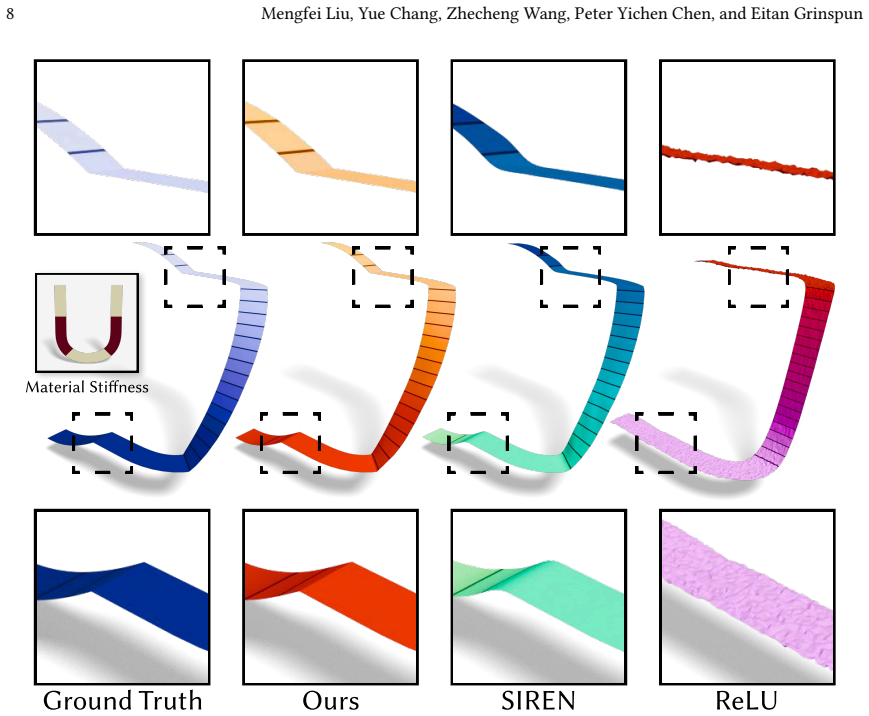
The central claim is that any smooth lifted field $\tilde f(x, H(x))$ restricted to the graph of a smoothly clamped unsigned distance field $H$ is $C^0$ with a controlled gradient jump across the interface $\Gamma$. The interface is an input, encoded by the closed-form distance field rather than by trained weights, so the network itself remains smooth everywhere in the lifted space. Training this basis on a weighted Dirichlet energy reproduces the elliptic jump condition $w_1 \partial u/\partial n = w_2 \partial u/\partial n$ across stiffness interfaces, and training on a Hessian energy produces crease modes whose sharp fold appears without any explicit boundary condition at the crease. The paper further shows that adding the generalized winding number field as a second lifting dimension yields bases with both value and gradient discontinuities, enabling simultaneous cutting and creasing in one model.
Load-bearing premise
The method assumes that training on random samples of the energy actually finds the true continuous vibration modes, even though the crease energy is infinite exactly on the crease and the training never evaluates that point.
Editorial extensions
If this is right
- One trained network yields basis functions across a parametric family of shapes and material layouts, so simulations can morph between shapes without remeshing or restarting.
- The same construction, with the generalized winding number as an extra dimension, gives basis functions that are discontinuous in value and in gradient, so cuts and creases can coexist and switch roles during one simulation.
- Because the interface is explicit and user-defined, crease geometry and boundary conditions can be edited interactively at runtime.
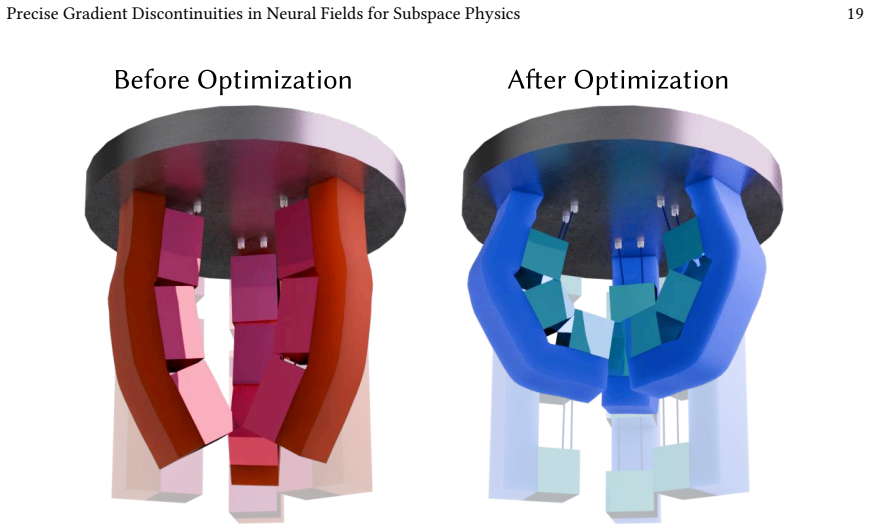
- The basis is differentiable with respect to the shape/material parameter $\alpha$, enabling reduced-space shape optimization such as maximizing a finger's bend by adjusting a design parameter.
- For heterogeneous materials, the learned basis obeys the transmission condition across stiffness jumps, matching FEM-like sharp transitions without a conforming mesh.
Reading between the lines
- The same lifting idea could be applied to other PDEs with interface transmission conditions, such as two-fluid Stokes flow or electromagnetic boundary-value problems, wherever the jump location is parameterized; this is an extension the paper does not test.
- The crease result implicitly depends on stochastic cubature never sampling the exact interface, where the Hessian energy has a Dirac layer; a natural test is to refine sampling near the crease and check whether the mode converges or degrades.
- Generalization quality is bounded by how well the training $\alpha$ samples cover the shape space, as the paper's own failure case shows; automating the interface description with a learned or physics-driven parameterization would be the next step.
- Because $H$ is local, the method is a candidate for real-time interactive design of crease patterns and heterogeneous layouts, where the user drags interfaces and immediately sees the reduced simulation respond.
Editorial analysis
A structured set of objections, weighed in public.
Referee Report
Summary. The paper introduces a neural field construction for representing continuous functions with discontinuous gradients (C^0 with gradient jumps) across user-specified interfaces. The key idea is to lift input coordinates by augmenting them with a smoothly clamped unsigned distance field to the interface, so that a smooth MLP defined in the lifted space restricts back to a function with a precise gradient jump at the interface, without storing the interface location in the network weights. The authors apply this representation to build reduced-order simulation bases for heterogeneous materials (weighted Dirichlet eigenproblem) and creasing (Hessian energy), and combine it with a prior winding-number lifting for simultaneous cuts and creases. The paper reports qualitative results on several 2D/3D benchmarks and claims the first reduced-order simulation method to support combined cuts and folds, evolving creases, and heterogeneous materials with parameterized interfaces.
Significance. If the construction holds, the lifting scheme is a simple and elegant mechanism for encoding gradient discontinuities in neural fields while keeping the network smooth, and the parameterized-interface aspect is a meaningful advance for reduced-order modeling across shape families. The method is discretization-agnostic and supports shape morphing and interactive editing, which are practically useful capabilities. However, the crease application relies on an energy that is not well-defined for the target function class, and the quantitative evaluation is thin; these issues currently limit the strength of the claims and require revision.
major comments (3)
- [Sec. 4.4, Eq. (8)] The crease-basis loss is not well-defined for the functions the method aims to produce. For a C^0 function with a gradient jump across Gamma, the distributional Hessian contains a Dirac layer n⊗n δ_Gamma, so the squared Frobenius norm in Eq. (8) is a squared delta, which is not integrable; the continuum energy is infinite or undefined on exactly the family of functions the architecture can represent. The implementation, which evaluates the loss by uniform stochastic cubature (Sec. 4.1), never samples the interface, so the objective actually minimized is the integral of ||∇^2φ||^2 over Ω\Gamma. That broken energy does not penalize the kink, and its minimizers subject to the L2 constraint are smooth eigenfunctions of the biharmonic operator, not creased modes. The sharp crease in Fig. 12 must therefore originate from the restricted parameterization (the fixed H-lift) and from optimization, not from solving Eq. (8). The claim in Sec. 4.4 that 'the gradient change arises naturally from the neural field' is unsupported. The paper should either reformulate the crease energy so it is well-defined for gradient-jump functions (e.g., through a regularized or weak form), or provide a rigorous argument for discarding the singular layer, together with a convergence study against a well-posed reference solution.
- [Sec. 5.1, Figs. 5, 7, 10; Sec. 5.2, Fig. 12] The validation is entirely qualitative. The text states in Sec. 5.1 that results are 'comparable to FEM,' but no error metrics, eigenvalue errors, or convergence data are reported for any experiment. For the heterogeneous-material case, a quantitative comparison to FEM eigenmodes on identical domains (e.g., L2 basis error or eigenvalue relative error) is needed to support the accuracy claim. For the crease case, a reference solution is required once the energy is made well-posed. Without such measures, the central claim of 'precise' gradient discontinuities (title and abstract) cannot be assessed.
- [Sec. 5.2, Fig. 13] The interactive crease-editing experiment raises a protocol question. In Sec. 4.2 the network is conditioned on a parameter alpha that encodes shape and material changes, including interface geometry. In the crease experiments (Sec. 5.2), the network is trained with the loss in Eq. (8) with no mention of alpha or of training over a family of crease shapes; the basis is then used for interactive editing of the crease polyline. If the basis is not conditioned on the current crease geometry, the interface location is effectively baked into the trained weights via the distance field used during training, contradicting the paper's premise that the interface is an input. The paper should clarify the training distribution for crease editing and show how the basis is updated (if at all) when the crease shape changes, with evidence of generalization error versus distance from the training crease.
minor comments (6)
- [Fig. 10 caption] 'Discretization: Agonistic' should be 'Discretization: Agnostic'.
- [Sec. 2.1] 'hapering maintainance' is a typo for 'hampering maintenance'.
- [Sec. 5.1] The sentence 'Figure 11 and the insect illustrates an example...' is incomplete and should be rephrased.
- [Sec. 6] The use of 'the paper' to refer to the simulated sheet in the crease example is ambiguous; use a consistent term such as 'the sheet'.
- [Sec. 4.3] The sentence 'This formulation overcomes this limitation' lacks a period and follows a colon-less list; please fix the punctuation.
- [Sec. 4.4, Eq. (8)] Equation (8) is displayed without an explicit '=' or 'min' operator; add the missing notation.
Circularity Check
Crease modes reduce to the clamped-distance lifting H by construction; otherwise the derivation chain is a self-contained representational construction with no fitted-parameter circularity.
-
self definitional
[Section 4.4 (Eq. 8), combined with Eqs. (2)-(4) and the definition of H in Section 3]
"Note that this formulation does not impose explicit boundary conditions at the crease, the gradient change arises naturally from the neural field, which allows for discontinuities at the crease."
By Eqs. (2)-(4), f(x) = f~_theta(x,H(x)), and H is defined in Section 3 as the clamped unsigned distance to the crease, explicitly designed to produce gradient discontinuities aligned with the interface normal. The kink therefore enters through the input lifting coordinate, not through Eq. (8). The uniform stochastic cubature never samples the measure-zero interface, so the singular Hessian layer is omitted and the energy does not select the kink. The crease in Fig. 12 is thus equivalent to the kink of H by construction; attributing it to the neural field 'without explicit boundary conditions' re-labels an architectural input as an emergent result. Only the jump magnitude is learned, not the discontinuity itself.
full rationale
The paper's central device is an explicit representational ansatz: f is the composition of a smooth neural field with a clamped unsigned distance field H that has a gradient kink at the user-specified interface. Because H is described in closed form and is not learned, the existence and location of gradient discontinuities are inputs to the construction, not outputs of a physical derivation. That is not circular in itself; a representation can legitimately be designed so that a desired feature is reproducible. The heterogeneous-material results (Eq. 6, Figs. 5, 7, 10) are independent demonstrations of this ansatz against FEM-style behavior, with no parameter fitted to a target and then reported as a prediction. The self-citation to Chang et al. 2025 for the lifting idea is a building block rather than load-bearing evidence, and no uniqueness theorem is invoked. The one genuinely circular step is in the crease discussion: the paper states that the gradient change 'arises naturally from the neural field' as if Eq. 8 alone produced the crease, but the crease is already present in H, and the sampling scheme discards the singular interface contribution that would make the continuum Hessian energy of a kinked function ill-defined. The stated limitation in Sec. 6 (out-of-distribution creases are 'less physically meaningful') is consistent with this being an architecture-driven effect rather than a robust solution of Eq. 8, though that is more a correctness concern than a further circularity. Overall, the derivation is mostly self-contained, with one crease-related reduction-by-construction claim.
Assumptions & free parameters
free parameters (3)
- Clamping threshold s =
1/8 (2D), 1/25 (hand), 1/16 (other 3D)
- Network width, depth, positional encoding =
5 layers, 128 channels, max frequency 2^5
- Number of reduced modes k =
4-21 depending on example (Table 1)
assumptions (4)
- standard math Weighted Laplace eigenfunctions have gradient discontinuities across interfaces where the weight jumps (Gilbarg and Trudinger 2001).
- domain assumption The skinning eigenmode subspace from the weighted Dirichlet energy (Eq. 6) is a suitable reduced basis for co-rotational heterogeneous elastodynamics.
- ad hoc to paper Minimizing the Hessian energy (Eq. 8) with the lifted neural field yields physically meaningful crease basis functions, with the singular Dirac contribution on the interface ignored.
- domain assumption Stochastic gradient descent on the non-convex loss converges to the low-order eigenmodes of the continuous problem.
invented entities (1)
-
Lifting dimension with clamped unsigned distance coordinate
Cite this review
Pith. "Pith review of Precise Gradient Discontinuities in Neural Fields for Subspace Physics." pith.science (2026). https://pith.science/paper/OU2MZIX7
@misc{pith2026250520421,
  author       = {Pith},
  title        = {Pith review of: Precise Gradient Discontinuities in Neural Fields for Subspace Physics},
  year         = {2026},
  howpublished = {\url{https://pith.science/paper/OU2MZIX7}},
  note         = {Machine review of arXiv:2505.20421}
}
read the original abstract
Discontinuities in spatial derivatives appear in a wide range of physical systems, from creased thin sheets to materials with sharp stiffness transitions. Accurately modeling these features is essential for simulation but remains challenging for traditional mesh-based methods, which require discontinuity-aligned remeshing -- entangling geometry with simulation and hindering generalization across shape families. Neural fields offer an appealing alternative by encoding basis functions as smooth, continuous functions over space, enabling simulation across varying shapes. However, their smoothness makes them poorly suited for representing gradient discontinuities. Prior work addresses discontinuities in function values, but capturing sharp changes in spatial derivatives while maintaining function continuity has received little attention. We introduce a neural field construction that captures gradient discontinuities without baking their location into the network weights. By augmenting input coordinates with a smoothly clamped distance function in a lifting framework, we enable encoding of gradient jumps at evolving interfaces. This design supports discretization-agnostic simulation of parametrized shape families with heterogeneous materials and evolving creases, enabling new reduced-order capabilities such as shape morphing, interactive crease editing, and simulation of soft-rigid hybrid structures. We further demonstrate that our method can be combined with previous lifting techniques to jointly capture both gradient and value discontinuities, supporting simultaneous cuts and creases within a unified model.
Figures


Figures from the paper (12 more)





Reference graph
Works this paper leans on
-
[3]
Hugo Bertiche, Meysam Madadi, and Sergio Escalera
Fast Complementary Dynamics via Skinning Eigenmodes.ACM Transactions on Graphics(2023). Hugo Bertiche, Meysam Madadi, and Sergio Escalera
work page 2023
-
[5]
InProceedings of Graphics Interface 2022(Montréal, Quebec)(GI 2022)
Active Learning Neural C-space Signed Distance Fields for Reduced Deformable Self-Collision. InProceedings of Graphics Interface 2022(Montréal, Quebec)(GI 2022). Canadian Information Processing Society, 92 –
work page 2022
-
[8]
InSIGGRAPH Asia 2023 Conference Papers(, Sydney, NSW, Australia,)(SA ’23)
LiCROM: Linear-Subspace Continuous Reduced Order Modeling with Neural Fields. InSIGGRAPH Asia 2023 Conference Papers(, Sydney, NSW, Australia,)(SA ’23). Association for Computing Machinery, New York, NY, USA, Article 111, 12 pages. https://doi.org/10.1145/3610548.3618158 Yue Chang, Mengfei Liu, Zhecheng Wang, Peter Yichen Chen, and Eitan Grinspun
arXiv 2023
-
[10]
Our model generalizes across heterogeneous domains, which is challenging for traditional methods based on eigenanalysis of discrete operators. We construct a robot shape space with varying material stiffness (first row) and apply constrained Delaunay trian- gulation [Shewchuk 2005], resulting in meshes with 209–560 vertices. This variation hinders mesh-ba...
work page 2005
-
[11]
We optimize the spacing between bars in the robot fingers
Our model is differentiable with respect to the shape parameter𝛼, enabling shape optimization in reduced space. We optimize the spacing between bars in the robot fingers. The optimized shape (right) exhibits greater deformation compared to the initial guess (left). Vanilla MLP [Modi et. al 2024, Chang et.al 2024] Our Method Fig
work page 2024
-
[12]
Comparison of basis functions learned by our method (top row) and a standard SIREN MLP [Chang et al . 2024; Modi et al. 2024] (bottom row) on a 2D domain with a crease. The scalar-valued basis functions are visualized by lifting along the𝑦-axis. Our method successfully captures the sharp gradient discontinuity introduced by the crease, while the vanilla M...
work page 2024
-
[14]
2025], enabling simulation of a paper-like material undergoing both progressive cutting and creasing
Our method can be combined with [Chang et al . 2025], enabling simulation of a paper-like material undergoing both progressive cutting and creasing. The sequence on the left shows the deformation evolving from smooth bending to sharp folds as creases and cuts develop. Region (1) highlights a transition from crease to cut, while region (2) shows the revers...
work page 2025
-
[15]
SIGGRAPH)41, 4 (aug 2022), 119:1–119:15
Physics Informed Neural Fields for Smoke Reconstruction with Sparse Data.ACM Transactions on Graphics, (Proc. SIGGRAPH)41, 4 (aug 2022), 119:1–119:15. Yitong Deng, Hong-Xing Yu, Diyang Zhang, Jiajun Wu, and Bo Zhu
work page 2022
Show all 40 references
-
[16]
Graph.42, 6 (2023)
Fluid Simulation on Neural Flow Maps.ACM Trans. Graph.42, 6 (2023). Lawson Fulton, Vismay Modi, David Duvenaud, David I. W. Levin, and Alec Jacobson
2023
-
[18]
In Proceedings of the 18th Annual ACM SIGGRAPH/Eurographics Symposium on Computer Animation(Los Angeles, California)(SCA ’19)
Subspace neural physics: fast data-driven interactive simulation. In Proceedings of the 18th Annual ACM SIGGRAPH/Eurographics Symposium on Computer Animation(Los Angeles, California)(SCA ’19). Association for Computing Machinery, New York, NY, USA, Article 6, 12 pages. https:/...
-
[21]
Graph.28, 3, Article 51 (July 2009), 8 pages
Numerical coarsening of inhomogeneous elastic materials.ACM Trans. Graph.28, 3, Article 51 (July 2009), 8 pages. https://doi.org/10.1145/1531326.1531357 Byungsoo Kim, Vinicius C Azevedo, Nils Thuerey, Theodore Kim, Markus Gross, and Barbara Solenthaler
2009
-
[22]
InACM SIGGRAPH 2022 Courses(Vancouver, British Columbia, Canada)(SIGGRAPH ’22)
Dynamic deformables: implementation and production practicalities (now with code!). InACM SIGGRAPH 2022 Courses(Vancouver, British Columbia, Canada)(SIGGRAPH ’22). Association for Computing Machinery, New York, NY, USA, Article 7, 259 pages. https://doi.org/10.1145/3532720.353...
2022
-
[23]
Abhishek Madan and David I.W
Accelerate Neural Subspace-Based Reduced-Order Solver of Deformable Simulation by Lipschitz Optimization.ACM Transactions on Graphics (TOG)43, 6 (2024), 1–10. Abhishek Madan and David I.W. Levin
2024
-
[24]
Graph.41, 4 (2022)
Fast Evaluation of Smooth Distance Constraints on Co-Dimensional Geometry.ACM Trans. Graph.41, 4 (2022). Vismay Modi, Nicholas Sharp, Or Perel, Shinjiro Sueda, and David I. W. Levin
2022
-
[25]
Graph.43, 4, Article 117 (jul 2024), 11 pages
Simplicits: Mesh-Free, Geometry-Agnostic Elastic Simulation.ACM Trans. Graph.43, 4, Article 117 (jul 2024), 11 pages. https://doi.org/10.1145/3658184 Nicolas Moës, John Dolbow, and Ted Belytschko
2024 doi
-
[31]
InACM SIGGRAPH 2023 Conference Proceedings(Los Angeles, CA, USA)(SIGGRAPH ’23)
Data-Free Learning of Reduced- Order Kinematics. InACM SIGGRAPH 2023 Conference Proceedings(Los Angeles, CA, USA)(SIGGRAPH ’23). Association for Computing Machinery, New York, NY, USA, Article 40, 9 pages. https://doi.org/10.1145/3588432.3591521 Siyuan Shen, Yang Yin, Tianjia ...
2023
-
[32]
Jonathan Richard Shewchuk
High-order differentiable autoencoder for nonlinear model reduction.arXiv preprint arXiv:2102.11026(2021). Jonathan Richard Shewchuk
2021 arXiv
-
[33]
Graph.37, 2, Article 23 (May 2018), 13 pages
Natural Boundary Conditions for Smoothing in Geometry Processing.ACM Trans. Graph.37, 2, Article 23 (May 2018), 13 pages. https://doi.org/10.1145/3186564 Yuanyuan Tao, Ivan Puhachov, Derek Nowrouzezahrai, and Paul Kry
2018 doi
-
[34]
InSIGGRAPH Asia 2024 Conference Papers
Neural Implicit Reduced Fluid Simulation. InSIGGRAPH Asia 2024 Conference Papers. 1–11. Precise Gradient Discontinuities in Neural Fields for Subspace Physics 15 Quoc-Minh Ton-That, Paul G. Kry, and Sheldon Andrews
2024
-
[35]
Ty Trusty, Otman Benchekroun, Eitan Grinspun, Danny M
Generalized eXtended Finite Element Method for Deformable Cutting via Boolean Operations.Computer Graphics Forum43, 8 (2024), 13 pages. Ty Trusty, Otman Benchekroun, Eitan Grinspun, Danny M. Kaufman, and David I.W. Levin
2024
-
[36]
InSIGGRAPH Asia 2023 Conference Papers(Sydney, NSW, Australia)(SA ’23)
Subspace Mixed Finite Elements for Real-Time Heterogeneous Elastodynamics. InSIGGRAPH Asia 2023 Conference Papers(Sydney, NSW, Australia)(SA ’23). Association for Computing Machinery, New York, NY, USA, Article 112, 10 pages. https://doi.org/10.1145/3610548.3618220 Ty Trusty, ...
2023
-
[37]
InSIGGRAPH Asia 2022 Conference Papers(Daegu, Republic of Korea)(SA ’22)
Mixed Variational Finite Elements for Implicit Simulation of Deformables. InSIGGRAPH Asia 2022 Conference Papers(Daegu, Republic of Korea)(SA ’22). Association for Computing Machinery, New York, NY, USA, Article 40, 8 pages. https://doi.org/10.1145/3550469.3555418 Yiming Wang,...
2022
-
[38]
InACM SIGGRAPH 2024 Conference Papers (SIGGRAPH ’24)
Physics-Informed Learning of Characteristic Trajectories for Smoke Reconstruction. InACM SIGGRAPH 2024 Conference Papers (SIGGRAPH ’24). Article 53, 11 pages. https://doi.org/10.1145/3641519.3657483 Shuqi Yang, Xingzhe He, and Bo Zhu
2024
-
[39]
InSIGGRAPH Asia 2024 Conference Papers (SA ‘24)
Neural Garment Dynamic Super-Resolution. InSIGGRAPH Asia 2024 Conference Papers (SA ‘24). Association for Computing Machinery, New York, NY, USA, Article 122, 11 pages. https://doi.org/10.1145/3680528.3687610 Yi Zhu and Evgueni T. Filipov
2024
-
[40]
Rapid multi-physics simulation for electro-thermal origami systems.International Journal of Mechanical Sciences 202-203 (2021), 106537. https://doi.org/10.1016/j.ijmecsci.2021.106537 16 Mengfei Liu, Yue Chang, Zhecheng Wang, Peter Yichen Chen, and Eitan Grinspun High Stiffness...
2021
-
[95]
https://doi.org/10.1145/1186223.1186342 Mengyu Chu, Lingjie Liu, Quan Zheng, Erik Franz, Hans-Peter Seidel, Christian Theobalt, and Rhaleb Zayer
-
[100]
Chiaramonte, Peter Yichen Chen, and Eitan Grinspun
https: //doi.org/10.20380/GI2022.11 Yue Chang, Otman Benchekroun, Maurizio M. Chiaramonte, Peter Yichen Chen, and Eitan Grinspun
-
[1989]
InProceedings of the 16th Annual Conference on Computer Graphics and Interactive Techniques (SIGGRAPH ’89)
Good vibrations: modal dynamics for graphics and animation. InProceedings of the 16th Annual Conference on Computer Graphics and Interactive Techniques (SIGGRAPH ’89). Association for Computing Machinery, New York, NY, USA, 215–222. https: //doi.org/10.1145/74333.74355 Cristia...
-
[1999]
A finite element method for crack growth without remeshing.Internat. J. Numer. Methods Engrg. 46, 1 (1999), 131–150. R. Mukherjee, X. Wu, and H. Wang
1999
-
[2004]
InACM SIGGRAPH 2004 Sketches(Los Angeles, California)(SIGGRAPH ’04)
Modeling and simulation of sharp creases. InACM SIGGRAPH 2004 Sketches(Los Angeles, California)(SIGGRAPH ’04). Association for Computing Machinery, New York, NY, USA,
2004
-
[2005]
Venant-Kirchhoff deformable models.ACM transactions on graphics (TOG) 24, 3 (2005), 982–990
Real-time subspace integration for St. Venant-Kirchhoff deformable models.ACM transactions on graphics (TOG) 24, 3 (2005), 982–990. Yash Belhe, Michaël Gharbi, Matthew Fisher, Iliyan Georgiev, Ravi Ramamoorthi, and Tzu-Mao Li
2005
-
[2013]
Graph.32, 4, Article 51 (July 2013), 8 pages
Folding and crumpling adaptive sheets.ACM Trans. Graph.32, 4, Article 51 (July 2013), 8 pages. https://doi.org/10.1145/2461912.2462010 A. Pentland and J. Williams
2013
-
[2016]
Incremental Deformation Subspace Reconstruction.Comput. Graph. Forum35, 7 (Oct. 2016), 169–178. Rahul Narain, Tobias Pfaff, and James F. O’Brien
2016
-
[2017]
Graph.36, 4, Article 84 (July 2017), 15 pages
Dynamics-aware numerical coarsening for fabrication design.ACM Trans. Graph.36, 4, Article 84 (July 2017), 15 pages. https://doi.org/10.1145/3072959.3073669 Desai Chen, David I. W. Levin, Shinjiro Sueda, and Wojciech Matusik
2017
-
[2018]
Graph.37, 4, Article 120 (July 2018), 12 pages
Numerical coarsening using discontinuous shape functions.ACM Trans. Graph.37, 4, Article 120 (July 2018), 12 pages. https://doi.org/10.1145/3197517.3201386 Peter Yichen Chen, Jinxu Xiang, Dong Heon Cho, Yue Chang, G A Pershing, Henrique Teles Maia, Maurizio M Chiaramonte, Kevi...
2018
-
[2019]
Computer Graphics Forum(2019)
Latent-space Dynamics for Reduced Deformable Simulation. Computer Graphics Forum(2019). David Gilbarg and Neil S. Trudinger. 2001.Elliptic Partial Differential Equations of Second Order(2nd ed.). Springer. https://doi.org/10.1007/978-3-642- 61798-0 Daniel Holden, Bang Chi Duon...
2019 doi
-
[2021]
https://doi.org/10.1145/3450626.3459875 Nicholas Sharp, Cristian Romero, Alec Jacobson, Etienne Vouga, Paul Kry, David I.W
Learning Contact Corrections for Handle-Based Subspace Dynamics.ACM Transactions on Graphics (TOG)40, 4, Article 131 (jul 2021), 12 pages. https://doi.org/10.1145/3450626.3459875 Nicholas Sharp, Cristian Romero, Alec Jacobson, Etienne Vouga, Paul Kry, David I.W. Levin, and Jus...
2021
-
[2022]
Graph.41, 6, Article 220 (nov 2022), 14 pages
Neural Cloth Simulation.ACM Trans. Graph.41, 6, Article 220 (nov 2022), 14 pages. https://doi.org/10.1145/3550454.3555491 Xinhao Cai, Eulalie Coevoet, Alec Jacobson, and Paul Kry
2022
-
[2024]
arXiv:2408.10099 [cs.GR] https://arxiv.org/abs/2408.10099 Yue Chang, Peter Yichen Chen, Zhecheng Wang, Maurizio M
Shape Space Spectra. arXiv:2408.10099 [cs.GR] https://arxiv.org/abs/2408.10099 Yue Chang, Peter Yichen Chen, Zhecheng Wang, Maurizio M. Chiaramonte, Kevin Carlberg, and Eitan Grinspun
-
[2025]
arXiv:2502.00626 [cs.GR] https://arxiv.org/abs/2502.00626 Desai Chen, David I
Lifting the Winding Number: Precise Representation of Complex Cuts in Subspace Physics Simulations. arXiv:2502.00626 [cs.GR] https://arxiv.org/abs/2502.00626 Desai Chen, David I. W. Levin, Wojciech Matusik, and Danny M. Kaufman
Reviewed August 7, 2026 · model on record in the stance chip above.
Discussion (0). Continue with ORCID to comment.