REVIEW 2 major objections 6 minor 67 references
Testing Extended Theories of Gravity via Black Hole Photon Rings
T0 review · 2 major / 6 minor · reviewed 2026-08-07 · deepseek-v4-flash
Pith's one-line read One parameter ε controls the photon sphere of a deformed Schwarzschild black hole: as ε rises, photon sphere radius, impact parameter, and ISCO radius all rise while the horizon stays fixed, so shadow data can bound ε.
desk verdict A workmanlike photon-ring study whose EHT constraints on epsilon are off by ~10% because fixing r0=2M unnormalizes the ADM mass. read the letter →
The pith
A machine-rendered reading of the paper's core claim, the machinery that carries it, and where it could break.
The reading
What carries the argument
The central object is the Konoplya-Zhidenko deformation of the Schwarzschild metric, a two-function parametrization [N²(r), B²(r)] with five parameters reduced to three independent ones by weak-field conditions. The paper fixes r0 = 2M, which pins the horizon at the Schwarzschild radius, leaving ε as the only parameter that shifts the photon sphere. The effective potential Veff(r) = u² N²(1/u) with u = 1/r carries the argument: its maximum yields the unstable photon sphere, whose radius and critical impact parameter then determine shadow size and photon-ring structure.
What would settle it
Calculate the photon-sphere radius from the horizon condition N²(r0) = 0 for each ε without imposing r0 = 2M; if rph does not increase monotonically with ε in that family, the paper's central claim is falsified.
Extended reading notes
Core claim
The paper's central discovery is that in the Konoplya-Zhidenko deformed Schwarzschild metric, with r0 fixed at 2M, the deformation parameter ε monotonically controls the strong-field geodesic structure: the photon sphere radius rph, critical impact parameter bph, and ISCO radius risco all increase with ε, while the event horizon radius remains exactly the Schwarzschild value. Counter-intuitively, the near-horizon parameters a2 and b2 produce nearly indistinguishable effects on the effective potential and photon trajectories, so they cannot be separated by imaging. The paper derives geodesic equations and the effective potential, classifies null geodesics by their number of disk crossings into direct, lensing, and photon-ring emission, and computes synthetic images for three toy emission models. It then inverts the shadow diameter formula against EHT measurements to constrain ε, obtaining -0.09 ≲ ε ≲ 0.19 from M87* and -0.280 ≲ ε ≲ 0.047 from Sgr A*.
Load-bearing premise
The paper's load-bearing premise is that setting r0 = 2M by hand—so the event horizon is Schwarzschild by construction—still captures the physically relevant part of the Konoplya-Zhidenko deformation; if r0 must co-vary with ε in the full theory, the reported monotonicity and the EHT bounds could change.
Editorial extensions
If this is right
- If ε controls the photon sphere monotonically, then measuring the shadow diameter of a black hole directly translates into a bound on ε, without needing to disentangle a2 and b2.
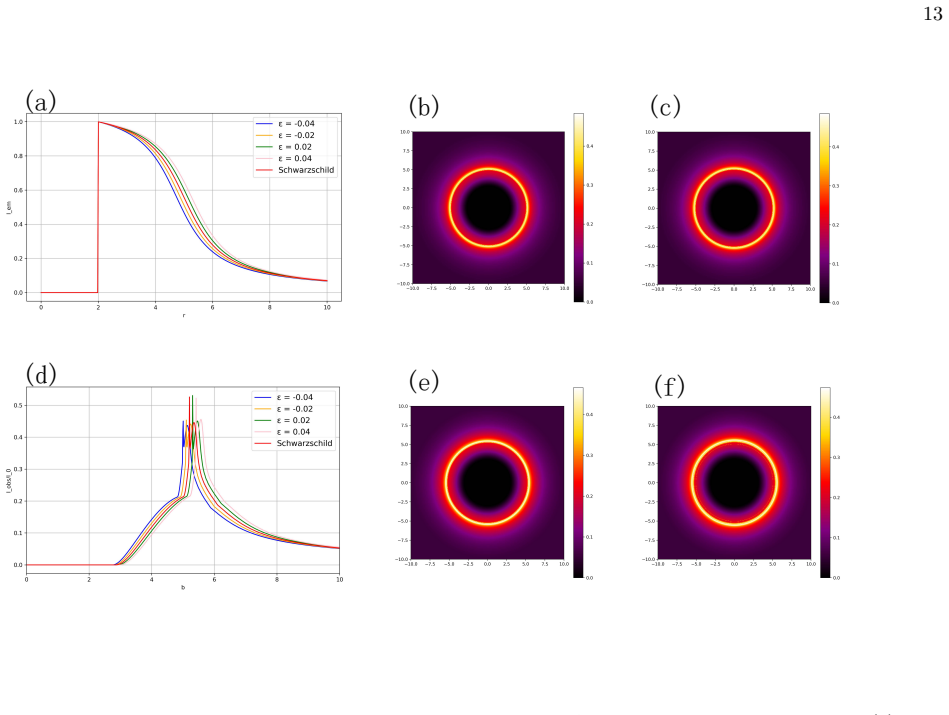
- Within the allowed ranges, ε ∈ [-0.04, 0.04] keeps KZ black holes observationally close to Schwarzschild in the three emission models, so current EHT images cannot yet rule out small deviations.
- The impact-parameter windows for lensing and photon rings shrink as ε rises, meaning future high-resolution photon-ring observations could detect the deformation earlier through the narrowing of ring separation than through the shadow alone.
- Because a2 and b2 are degenerate in imaging, extended-theory constraints from photon rings must fix or marginalize over these parameters, focusing on ε as the observable parameter.
Reading between the lines
- A natural step the paper does not take is to remove the r0 = 2M restriction and re-derive the EHT bounds; if r0 shifts with ε, the allowed intervals could widen or move, changing the comparison with General Relativity.
- The observed degeneracy of a2 and b2 suggests that any spherically symmetric metric whose near-horizon deformation is controlled by two similar functions will be hard to constrain by imaging alone; adding polarization or time-variability might break the degeneracy.
- The same technique could be applied to rotating Konoplya-Zhidenko metrics, where the photon ring becomes asymmetric; the monotonic ε dependence might then be testable with interferometric signatures.
Editorial analysis
A structured set of objections, weighed in public.
Referee Report
Summary. This paper studies null geodesics, shadow sizes, and photon-ring images of a static spherically symmetric black hole described by the Konoplya-Zhidenko (KZ) deformation of Schwarzschild. After fixing r0=2M and imposing the weak-field relations among the deformation parameters, the authors retain three parameters ε, a2, b2; they set a2=1 and b2=3 in most of the analysis. They derive the geodesic equation and effective potential, compute the horizon, photon-sphere, critical-impact-parameter, and ISCO radii for ε=-0.04, -0.02, 0, 0.02, 0.04, and classify geodesic-disk intersections into direct, lensing, and photon-ring emissions. Using three toy emission models and reverse ray tracing, they produce synthetic images and intensity profiles. They then compare the theoretical shadow diameter with EHT measurements for M87* and Sgr A*, obtaining ε intervals -0.09≲ε≲0.19 and -0.280≲ε≲0.047, respectively. The central claimed results are the monotonic increase of r_ph, b_ph, and r_isco with ε, the constancy of r_h, and the observational distinguishability of the KZ photon ring from that of Schwarzschild.
Significance. The manuscript applies a standard and well-understood ray-tracing framework to a popular phenomenological metric, and it checks the ε→0 limit correctly; Table I reducing to the Schwarzschild values (r_h=2, r_ph=3, b_ph=3√3, r_isco=6) is a useful validation. If the EHT constraint were robust, it would offer a simple one-parameter bound on KZ-type deviations, and the three toy-model images would be a useful reference catalog for future high-resolution observations. However, the observational claim presently rests on an unverified identification of the code mass unit with the spacetime's ADM mass, and the paper tests only the r0=2M slice of the KZ family, so the advertised test of extended theories of gravity is not yet demonstrated. The qualitative imaging trends are nonetheless valuable and likely correct modulo the normalization issue.
major comments (2)
- [Section IV.B, Eq. (27), Fig. 7] The comparison of the theoretical shadow diameter with EHT data is not normalized to the spacetime's ADM mass. The paper sets C=G=M=1 and r0=2M, evaluates d_sh=2b_ph from the code's M=1, and compares it with d_sh values expressed in units of the black hole mass. However, it is not shown that the coefficient of -1/r in the large-r expansion of -g_tt in Eq. (2), with Eq. (4) imposed, equals 1. On a natural reading of the KZ expansion with a2=1, the ADM mass is M_ADM=M(1-3ε); at ε=-0.04 and 0.04 this would shift the predicted d_sh from 9.99 to 8.92 and from 10.82 to 12.29, comparable to the 1σ EHT error bars. The constraints -0.09≲ε≲0.19 and -0.280≲ε≲0.047 in the abstract and Section IV.B are therefore not robust until the mass normalization is fixed. Please provide the explicit asymptotic expansion and recompute the constraints using d_sh=2b_ph/M_ADM.
- [Section II, after Eq. (5); Table I] The constancy of the event horizon is imposed rather than derived. The text states that r0 denotes the position of the event horizon and that ε measures the deviation of r0 from 2M, and then sets r0=2M 'to better simulate the Schwarzschild spacetime.' With r0 fixed, Eq. (8) gives r_h=2 for every ε, so the abstract's statement that the event horizon corresponds to Schwarzschild is a consequence of the parameter choice, not of the KZ dynamics. This also means the paper tests only a restricted one-parameter slice (ε with a2=1, b2=3) of the KZ family; the reader cannot infer from these computations what happens when r0 is allowed to vary with ε. The wording of the central claim should be revised, and the key shadow-diameter comparison should be repeated (or its insensitivity demonstrated) for the full KZ family.
minor comments (6)
- [Eq. (11)] The canonical momenta in Eq. (11) contain inconsistent signs and a typo: p_phi should be r^2 \dot{phi}, not -r^2 \dot{t}, and the signs of p_t, p_r, and p_theta need a single consistent convention.
- [Eq. (26)] The sentence 'Here, the dot denotes the derivative with respect to radial distance r' is misleading; the derivatives in Eq. (26) are with respect to r and should be denoted by primes, since dots are used for τ-derivatives elsewhere.
- [Abstract] The abstract contains a duplicated clause: 'the more the results approach the Schwarzschild case, the more the results approach the Schwarzschild case.'
- [Eqs. (2), (8), (27)] Several equations are typeset in a way that is hard to parse (e.g., the denominators in Eq. (2) and Eq. (8), and the misprint 'rphp' in Eq. (27)); please provide clean versions and check the signs in Eq. (8).
- [Abstract and Section V] The sentence 'the photon rings of this type of black hole do not exhibit degeneracy' appears to contradict the earlier statement that the effects of a2 and b2 on photon orbital dynamics exhibit observational degeneracy; please clarify which degeneracy is meant.
- [Throughout] The language needs editorial polish, including missing words and informal abbreviations such as 'natura', 'soln', and 'We'll maintain'.
Circularity Check
No meaningful circularity; the one constructional statement (r0=2M forces rh=2M) is not load-bearing for the photon-sphere constraint analysis.
-
self definitional
[Section II (metric definition, Eq. (2)) and Conclusion Section V; see also Table I]
"In this expression, N and B represent functions of the radial coordinate r, with r = r0 > 0 denoting the position of the EH. ... To better simulate the Schwarzschild spacetime, this paper sets r0 = 2 M. ... the event horizon rh remains unchanged (consistently equal to that of the Schwarzschild black hole)."
Since Eq. (2) contains an explicit factor (1 - r0/r), N^2(r0) = 0 identically; with r0 set to 2M the equality rh = 2M is imposed before any geodesic calculation. The paper's conclusion that 'the event horizon rh remains unchanged (consistently equal to that of the Schwarzschild black hole)' is therefore a restatement of the input r0 = 2M, not a derived result. This constructional step is minor because the main photon-sphere, critical-impact-parameter and ISCO trends are computed from the effective potential independently of the horizon claim, and the EHT constraint uses external shadow-diameter data rather than fitting the photon ring images.
full rationale
The derivation chain is otherwise self-contained: the metric is taken from the published Konoplya-Zhidenko parametrization, the null geodesic equation and effective potential are derived from the Lagrangian, the photon sphere and critical impact parameter follow from Veff'(rph)=0 and Veff(rph)=1/bph^2, and the shadow diameter is compared with external EHT measurements. No fitted parameter is renamed as a prediction, and the EHT constraints are not produced by tuning epsilon to make the photon ring images appear; they use quoted angular-diameter, distance, and mass measurements. The only constructional element is the setting r0 = 2M, which makes the event-horizon statement in the abstract and conclusion true by definition. Because this does not bear on the central photon-ring trends or the external-data comparison, and because no load-bearing self-citation was found, the circularity score is kept at 1.
Assumptions & free parameters
free parameters (4)
- epsilon =
scanned over [-0.04, 0.04]; EHT-allowed intervals -0.09 to 0.19 (M87*) and -0.28 to 0.047 (Sgr A*)
- a2 =
1
- b2 =
3
- r0 =
2M
assumptions (5)
- domain assumption The KZ metric (Eqs. 1-3) with the weak-field constraints (Eqs. 4-5) and positivity constraints (Eq. 6) represents the spacetime of extended gravity theories.
- standard math The null geodesic equations and effective potential from the Lagrangian (Eqs. 9-19) are the correct description of photon motion.
- domain assumption The ISCO formula (Eq. 26) gives the correct innermost stable circular orbit for this metric.
- domain assumption The shadow diameter d_sh = 2 r_ph / sqrt(N^2(r_ph)) can be compared with the EHT d_sh values from Ref [64], and the quoted errors are 1-sigma.
- domain assumption The three toy emission profiles (Eqs. 34-36) are representative of real accretion disk emission for the purposes of photon ring morphology.
Cite this review
Pith. "Pith review of Testing Extended Theories of Gravity via Black Hole Photon Rings." pith.science (2026). https://pith.science/paper/JOYVX25B
@misc{pith2026250521314,
  author       = {Pith},
  title        = {Pith review of: Testing Extended Theories of Gravity via Black Hole Photon Rings},
  year         = {2026},
  howpublished = {\url{https://pith.science/paper/JOYVX25B}},
  note         = {Machine review of arXiv:2505.21314}
}
abstract
This research delves into the optical characteristics of stationary, spherically symmetric black holes. These black holes follow the Konoplya-Zhidenko deformation rule in arbitrary gravity theories. This research finds that the effects of \(a_2\) and \(b_2\) on photon orbital dynamics exhibit observational degeneracy, while \(\varepsilon\) significantly governs photon capture characteristics. As \(\varepsilon\) increases, the radius of the photon sphere \(r_{\text{ph}}\) and the critical impact parameter \(b_{\text{ph}}\), and the innermost stable circular orbit radius \(r_{\text{isco}}\) all increase. The event horizon \( r_{\text{h}} \) corresponds to that of the Schwarzschild black hole, while the impact parameter range for the lens and photon rings is reduced. Black hole shadow and photon ring analyses across three emission models show that increasing \(\varepsilon\) shifts the peak rightward while enlarging the photon ring radius. The closer \(\varepsilon\) is to zero, the more the results approach the Schwarzschild case, the more the results approach the Schwarzschild case. Additionally, by combining EHT observational data on the shadow diameters of M87 and Sgr A*, we imposed constraints on the correlation parameter \(\varepsilon\) in the theoretical model(at the confidence level anchored by \(d_{\text{sh}}^{(M87^*)}\), the parameter \(\varepsilon\) is confined to the interval \(-0.09 \lesssim \varepsilon \lesssim 0.19\). For \(d_{\text{sh}}^{(Sgr A^*)}\), the constraint on \(\varepsilon\) is delineated as \(-0.280 \lesssim \varepsilon \lesssim 0.047\)). The results show that within the observationally allowed range of \(\varepsilon\) (such as \([-0.04, 0.04]\)), the characteristics of the black hole exhibit specific regularities with changes in \(\varepsilon\).
Figures


Figures from the paper (9 more)


Reference graph
Works this paper leans on
-
[1]
C. M. Will, Living Rev. Rel. 17, 4 (2014), arXiv:1403.7377 [gr-qc]
arXiv 2014
-
[2]
I. I. Shapiro, M. E. Ash, R. P. Ingalls, W. B. Smith, D. B. Campbell, R. B. Dyce, R. F. Jurgens, and G. H. Pettengill, Phys. Rev. Lett. 26, 1132 (1971)
work page 1971
-
[3]
C. W. Misner and K. S. Thorne, Gravitation (Princeton University Press, 2017)
work page 2017
-
[4]
R. M. Wald, General Relativity (University of Chicago Press, 1984)
work page 1984
-
[5]
E. Berti et al., Class. Quant. Grav. 32, 243001 (2015), arXiv:1501.07274 [gr-qc]
arXiv 2015
-
[6]
S. X. Tian and Z.-H. Zhu, Phys. Rev. D 100, 064011 (2019), arXiv:1908.11794 [gr-qc]
arXiv 2019
- [7]
-
[8]
M. ´Cuk, L. Dones, and D. Nesvorn` y, The Astrophysical Journal 820, 97 (2016)
work page 2016
Show all 67 references
-
[9]
Akiyama et al.(Event Horizon Telescope), Astrophys
K. Akiyama et al.(Event Horizon Telescope), Astrophys. J. Lett. 875, L1 (2019), arXiv:1906.11238 [astro-ph.GA]
2019 arXiv
-
[10]
Akiyama et al.(Event Horizon Telescope), Astrophys
K. Akiyama et al.(Event Horizon Telescope), Astrophys. J. Lett. 875, L2 (2019), arXiv:1906.11239 [astro-ph.IM]
2019 arXiv
-
[11]
Akiyama et al.(Event Horizon Telescope), Astrophys
K. Akiyama et al.(Event Horizon Telescope), Astrophys. J. Lett. 875, L3 (2019), arXiv:1906.11240 [astro-ph.GA]
2019 arXiv
-
[12]
Akiyama et al.(Event Horizon Telescope), Astrophys
K. Akiyama et al.(Event Horizon Telescope), Astrophys. J. Lett. 875, L4 (2019), arXiv:1906.11241 [astro-ph.GA]
2019 arXiv
-
[13]
Akiyama et al.(Event Horizon Telescope), Astrophys
K. Akiyama et al.(Event Horizon Telescope), Astrophys. J. Lett. 875, L5 (2019), arXiv:1906.11242 [astro-ph.GA]
2019 arXiv
-
[14]
Akiyama et al.(Event Horizon Telescope), Astrophys
K. Akiyama et al.(Event Horizon Telescope), Astrophys. J. Lett. 875, L6 (2019), arXiv:1906.11243 [astro-ph.GA]
2019 arXiv
-
[15]
Akiyama et al.(Event Horizon Telescope), Astrophys
K. Akiyama et al.(Event Horizon Telescope), Astrophys. J. Lett. 930, L12 (2022), arXiv:2311.08680 [astro-ph.HE]
2022 arXiv
-
[16]
(22) In polar coordinates, ϕ represents the total polar angle change along the null geodesic’s path
explains that for parallel null geodesics from the north pole direction, the impact parameter range de- pends on how many times these geodesics intersect the accretion disk, with the following relationship n = ϕ 2π . (22) In polar coordinates, ϕ represents the total polar angl...
2024
-
[17]
S. E. Gralla, D. E. Holz, and R. M. Wald, Phys. Rev. D 100, 024018 (2019), arXiv:1906.00873 [astro-ph.HE]
2019 arXiv
-
[18]
Wang, X.-M
X.-J. Wang, X.-M. Kuang, Y. Meng, B. Wang, and J.-P. Wu, Phys. Rev. D 107, 124052 (2023), arXiv:2304.10015 [gr-qc]
2023 arXiv
-
[19]
Wang, Z.-C
H.-M. Wang, Z.-C. Lin, and S.-W. Wei, Nucl. Phys. B 985, 116026 (2022), arXiv:2205.13174 [gr-qc]
2022 arXiv
-
[20]
Chael, M
A. Chael, M. D. Johnson, and A. Lupsasca, Astrophys. J. 918, 6 (2021), arXiv:2106.00683 [astro-ph.HE]
2021 arXiv
-
[21]
D. J. Gogoi and S. Ponglertsakul, Eur. Phys. J. C 84, 652 (2024), arXiv:2402.06186 [gr-qc]
2024 arXiv
-
[22]
M. D. Johnson et al., Sci. Adv. 6, eaaz1310 (2020), arXiv:1907.04329 [astro-ph.IM]
2020 arXiv
-
[23]
Himwich, M
E. Himwich, M. D. Johnson, A. Lupsasca, and A. Strominger, Phys. Rev. D 101, 084020 (2020), arXiv:2001.08750 [gr-qc]. 15
2020 arXiv
-
[24]
Beckwith and C
K. Beckwith and C. Done, Mon. Not. Roy. Astron. Soc. 359, 1217 (2005), arXiv:astro-ph/0411339
2005 arXiv
-
[25]
Gao, T.-T
X.-J. Gao, T.-T. Sui, X.-X. Zeng, Y.-S. An, and Y.-P. Hu, Eur. Phys. J. C 83, 1052 (2023), arXiv:2311.11780 [gr-qc]
2023 arXiv
-
[26]
J. P. Luminet, Astron. Astrophys. 75, 228 (1979)
1979
-
[27]
Q. Gan, P. Wang, H. Wu, and H. Yang, Phys. Rev. D 104, 044049 (2021), arXiv:2105.11770 [gr-qc]
2021 arXiv
- [28]
-
[29]
X. Yang, M. Tang, and Z. Xu, Eur. Phys. J. C 84, 977 (2024), arXiv:2408.12318 [gr-qc]
2024 arXiv
-
[30]
Zeng, C.-Y
X.-X. Zeng, C.-Y. Yang, M. I. Aslam, R. Saleem, and S. Aslam, (2025), arXiv:2505.07063 [gr-qc]
2025 arXiv
-
[31]
X. Wang, Z. Zhao, X.-X. Zeng, and X.-Y. Wang, Phys. Rev. D 111, 084054 (2025), arXiv:2501.08287 [gr-qc]
2025 arXiv
-
[32]
Zeng, L.-F
X.-X. Zeng, L.-F. Li, P. Li, B. Liang, and P. Xu, Sci. China Phys. Mech. Astron. 68, 220412 (2025), arXiv:2411.12528 [gr-qc]
2025 arXiv
-
[33]
Zeng, K.-J
X.-X. Zeng, K.-J. He, J. Pu, G.-p. Li, and Q.-Q. Jiang, Eur. Phys. J. C 83, 897 (2023), arXiv:2302.03692 [gr-qc]
2023 arXiv
-
[34]
Zeng, K.-J
X.-X. Zeng, K.-J. He, G.-P. Li, E.-W. Liang, and S. Guo, Eur. Phys. J. C 82, 764 (2022), arXiv:2209.05938 [gr-qc]
2022 arXiv
-
[35]
X.-X. Zeng, M. I. Aslam, and R. Saleem, Eur. Phys. J. C 83, 129 (2023), arXiv:2208.06246 [gr-qc]
2023 arXiv
-
[36]
Y. Wu, Z. Cai, Z. Ban, H. Feng, and W.-Q. Chen, (2025), arXiv:2504.10327 [gr-qc]
2025
-
[37]
Johannsen, Astrophys
T. Johannsen, Astrophys. J. 777, 170 (2013), arXiv:1501.02814 [astro-ph.HE]
2013 arXiv
- [38]
-
[39]
Zeng, G.-P
X.-X. Zeng, G.-P. Li, and K.-J. He, Nucl. Phys. B 974, 115639 (2022), arXiv:2106.14478 [hep-th]
2022 arXiv
-
[40]
S. Zare, L. M. Nieto, X.-H. Feng, S.-H. Dong, and H. Hassanabadi, JCAP 08, 041 (2024), arXiv:2406.07300 [astro-ph.HE]
2024 arXiv
-
[41]
Mizuno, Z
Y. Mizuno, Z. Younsi, C. M. Fromm, O. Porth, M. De Laurentis, H. Olivares, H. Falcke, M. Kramer, and L. Rezzolla, Nature Astron. 2, 585 (2018), arXiv:1804.05812 [astro-ph.GA]
2018 arXiv
-
[42]
Heydari-Fard, M
M. Heydari-Fard, M. Heydari-Fard, and N. Riazi, Int. J. Mod. Phys. D 32, 2350088 (2023), arXiv:2307.01529 [gr-qc]
2023 arXiv
-
[43]
Capozziello and M
S. Capozziello and M. De Laurentis, Phys. Rept. 509, 167 (2011), arXiv:1108.6266 [gr-qc]
2011 arXiv
-
[44]
Baghram, M
S. Baghram, M. Farhang, and S. Rahvar, Phys. Rev. D 75, 044024 (2007), arXiv:astro-ph/0701013
2007 arXiv
-
[45]
J. L. Anderson, Phys. Rev. D 3, 1689 (1971)
1971
-
[46]
B. A. Bassett, M. Kunz, D. Parkinson, and C. Ungarelli, Phys. Rev. D68, 043504 (2003), arXiv:astro-ph/0211303
2003 arXiv
- [47]
-
[48]
Brans and R
C. Brans and R. H. Dicke, Phys. Rev. 124, 925 (1961)
1961
-
[49]
De Felice and S
A. De Felice and S. Tsujikawa, Living Rev. Rel. 13, 3 (2010), arXiv:1002.4928 [gr-qc]
2010 arXiv
-
[50]
T. P. Sotiriou and V. Faraoni, Rev. Mod. Phys. 82, 451 (2010), arXiv:0805.1726 [gr-qc]
2010 arXiv
-
[51]
Kainulainen, J
K. Kainulainen, J. Piilonen, V. Reijonen, and D. Sun- hede, Phys. Rev. D 76, 024020 (2007), arXiv:0704.2729 [gr-qc]
2007 arXiv
-
[52]
Damour and G
T. Damour and G. Esposito-Farese, Class. Quant. Grav. 9, 2093 (1992)
1992
-
[53]
T. P. Sotiriou, Class. Quant. Grav. 23, 5117 (2006), arXiv:gr-qc/0604028
2006 arXiv
-
[54]
Futamase, T
T. Futamase, T. Rothman, and R. Matzner, Phys. Rev. D 39, 405 (1989)
1989
-
[55]
Capozziello and M
S. Capozziello and M. Francaviglia, Gen. Rel. Grav. 40, 357 (2008), arXiv:0706.1146 [astro-ph]
2008 arXiv
-
[56]
J. D. Barrow and S. Cotsakis, Phys. Lett. B 214, 515 (1988)
1988
-
[57]
G. A. Vilkovisky, Class. Quant. Grav. 9, 895 (1992)
1992
-
[58]
R. A. Konoplya and A. Zhidenko, JCAP 08, 008 (2023), arXiv:2303.03130 [gr-qc]
2023 arXiv
-
[59]
H. Xu, Y. Zhan, and S.-J. Zhang, Eur. Phys. J. C 84, 617 (2024), arXiv:2403.19392 [gr-qc]
2024 arXiv
-
[60]
Q. Gan, P. Wang, H. Wu, and H. Yang, Phys. Rev. D 104, 024003 (2021), arXiv:2104.08703 [gr-qc]
2021 arXiv
-
[61]
J. Peng, M. Guo, and X.-H. Feng, Chin. Phys. C 45, 085103 (2021), arXiv:2008.00657 [gr-qc]
2021 arXiv
-
[62]
J. Yang, C. Zhang, and Y. Ma, Eur. Phys. J. C 83, 619 (2023), arXiv:2211.04263 [gr-qc]
2023 arXiv
-
[63]
Rezzolla and A
L. Rezzolla and A. Zhidenko, Phys. Rev. D 90, 084009 (2014), arXiv:1407.3086 [gr-qc]
2014 arXiv
-
[64]
Akiyama et al.(Event Horizon Telescope), Astrophys
K. Akiyama et al.(Event Horizon Telescope), Astrophys. J. Lett. 930, L14 (2022), arXiv:2311.09479 [astro-ph.HE]
2022 arXiv
-
[65]
Z. Luo, J. Li, K.-J. He, and H. Yu, (2024), arXiv:2406.00265 [gr-qc]
2024 arXiv
-
[66]
Psaltis et al
D. Psaltis et al. (Event Horizon Telescope), Phys. Rev. Lett. 125, 141104 (2020), arXiv:2010.01055 [gr-qc]
2020 arXiv
- [67]
Reviewed August 7, 2026 · model on record in the stance chip above.
Discussion (0). Continue with ORCID to comment.