REVIEW 3 major objections 4 minor 2 cited by
Teleparallel dark energy in a nonflat universe
T0 review · 3 major / 4 minor · reviewed 2026-08-07 · deepseek-v4-flash
Pith's one-line read Teleparallel dark energy with a vanishing scalar potential is decisively preferred over the standard cosmological model in a combined fit of supernovae, chronometers, and growth data.
desk verdict A clean, honest extension of teleparallel dark energy to non-flat FLRW, whose headline preference over Lambda CDM rests on an asserted rather than derived curved-space Geff and on a growth sector the authors themselves flag as incomplete. read the letter →
The pith
A machine-rendered reading of the paper's core claim, the machinery that carries it, and where it could break.
The reading
What carries the argument
The load-bearing object is the nonminimal scalar-torsion coupling $\xi T\phi^2$ inside the action. For the diagonal tetrad on FLRW, the torsion scalar is $T = -6\left(H^2 - k/a^2\right)$, so the same coupling enters the background and the perturbation equations. The scalar field acts as an effective dark-energy fluid with density and pressure given by Eqs. (20)–(21), and its equation of state $w_{\mathrm{DE}}$ can cross the phantom divide. The growth sector is governed by Eq. (43) with the effective gravitational coupling $$\frac{G_{\mathrm{eff}}}{G} = \frac{1 - $3x_1^{2}$ + \xi $x_4^{2}$}{(1 + \xi $x_4^{2}$)^2},$$ where $x_1$ and $x_4$ are dynamical-system variables related to the scalar kinetic term and the field value. Because $\xi$ is constrained to negative values around $-0.34$, this $G_{\mathrm{eff}}$ differs from Newton's constant and suppresses the growth of matter fluctuations, which is what makes $S_8$ come out low. Curvature enters through the dynamical variable $x_5 = \sqrt{1 + k/(a^2H^2)}$, and the autonomous system of dimensionless variables converts the field equations into a form suitable for Markov chain Monte Carlo sampling.
What would settle it
Deriving the full linear scalar perturbations in covariant teleparallel gravity on a nonflat FLRW background would settle the matter: if the Poisson equation acquires a correction of order $k/(a^2H^2)$ relative to Eq. (26), the reported $S_8$ and $\Delta\mathrm{AIC}$ values would shift; alternatively, re-running the MCMC without the growth-rate data tests whether the decisive $\Delta\mathrm{AIC}=-10.4$ preference survives without the assumed $G_{\mathrm{eff}}$.
Extended reading notes
Core claim
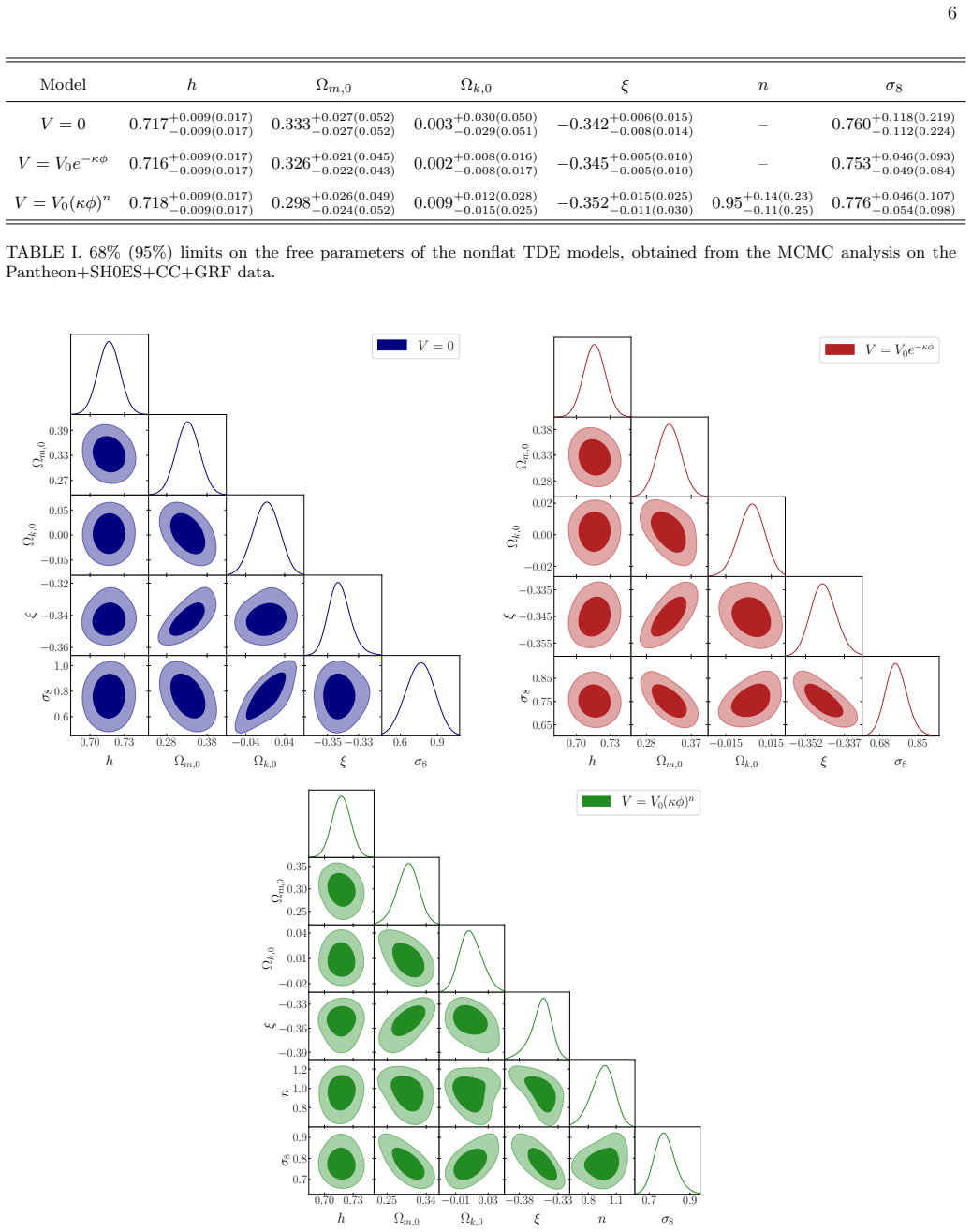
The central claim is that in a Friedmann-Lemaître-Robertson-Walker universe with arbitrary spatial curvature $k$, the teleparallel dark energy action $$S = \int $d^{4}$x\, e\left[\frac{T}{2\$kappa^{2}$} + \frac{1}{2}\partial_\mu\phi\,\partial^\mu\phi + \xi T\$phi^{2}$ - V(\phi) + \mathcal{L}_m\right]$$ produces an effective dark-energy fluid that fits the combined Pantheon+SH0ES+CC+GRF data better than $\Lambda$CDM, with the vanishing potential $V(\phi)=0$ as the standout case: $\Delta\mathrm{AIC}=-10.4$ and $\Delta\mathrm{DIC}=-14.1$ relative to $\Lambda$CDM, while exponential and power-law potentials remain statistically comparable. The fit for $V=0$ yields $h=0.717^{+0.009}_{-0.009}$, $\Omega_{m,0}=0.333$, $\Omega_{k,0}=0.003$, $\xi=-0.342$, $\sigma_8=0.760$, and $S_8=0.801\pm0.150$; the other models give similar $h$ and $S_8\approx0.785$ and $0.773$. The authors read these results as showing that the negative torsion-scalar coupling, rather than curvature alone, drives the improvement, and that nonflat teleparallel dark energy can ease both the Hubble and the $S_8$ tensions relative to Planck-$\Lambda$CDM.
Load-bearing premise
The growth-rate and $S_8$ results rest on assuming the flat-space quasi-static formula $G_{\mathrm{eff}}$ remains valid in a spatially curved FLRW background whenever the curvature scale is much larger than the perturbation scale; the paper asserts rather than derives this, and its own final remark concedes that strong-coupling issues may make linear perturbation analyses around symmetric teleparallel backgrounds incomplete.
Editorial extensions
If this is right
- If the vanishing-potential result holds, $\Lambda$CDM would be statistically outperformed by a torsion-based scalar field with nonzero spatial curvature, by a margin conventionally read as decisive.
- The Hubble constant in all three teleparallel dark energy scenarios sits near $h \approx 0.717$, in $1\sigma$ agreement with SH0ES and more than $4\sigma$ away from the Planck value, so the Hubble tension would be substantially eased without invoking early-universe physics.
- The inferred $S_8$ values fall below Planck's $0.832$ and overlap better with low-redshift large-scale-structure measurements, easing the growth-tension side as well.
- The mild preference for $\Omega_{k,0}>0$ means curvature is not required by the data; the negative torsion-scalar coupling $\xi$ is the parameter doing the main work.
- The exponential- and power-law-potential variants remain statistically comparable to $\Lambda$CDM, so the strong preference is specific to the zero-potential scenario rather than generic to the framework.
Reading between the lines
- The decisive $\Delta\mathrm{AIC}$ for the vanishing-potential scenario should be tested against an extended dataset that includes CMB distance priors or BAO, since those probes constrain curvature and expansion at redshifts where the torsion-scalar coupling may behave differently.
- If the full Hamiltonian analysis called for in the paper's final remark reveals additional strong-coupled degrees of freedom on FLRW backgrounds, those modes could back-react on the background and alter the posteriors, so the observational success is not guaranteed to survive the more complete theory.
- A direct extension would replace the flat-space quasi-static $G_{\mathrm{eff}}$ with a self-consistent curved-background derivation and run N-body or higher-order perturbation simulations; the predicted $f\sigma_8(z)$ at $z\lesssim1$ could then be compared directly with upcoming redshift-space distortion surveys.
Editorial analysis
A structured set of objections, weighed in public.
Referee Report
Summary. The paper extends teleparallel dark energy (TDE) with a nonminimally coupled scalar field to a spatially curved FLRW background. The authors build a dynamical-system formulation for three potentials (zero, exponential, power-law), then run an MCMC analysis on the joint Pantheon+SH0ES+CC+GRF likelihood. They report that the zero-potential nonflat TDE model is very strongly preferred over ΛCDM (ΔAIC=-10.4, ΔDIC=-14.1), that all TDE models yield h≈0.717 and S8≈0.77-0.80, and that these values are closer to local H0 and low-redshift growth measurements than Planck-ΛCDM predictions.
Significance. If the central claim holds, the paper demonstrates that a minimal torsion-scalar action with spatial curvature can simultaneously move H0 toward the local distance-ladder value, lower S8 relative to Planck, and statistically outperform ΛCDM on the chosen data combination. The dynamical-system construction is transparent, the MCMC pipeline is internally consistent, and the paper provides clear tables of best-fit values and information criteria. The significance is nonetheless conditional: the growth-rate sector relies on a flat-space quasi-static effective gravitational coupling that is asserted rather than derived for curved FLRW, and the reported H0 compatibility is partly circular because the SH0ES calibration is inside the fitted likelihood.
major comments (3)
- [Sec. II.B, Eq. (26); Sec. IV, Eq. (43)] The effective gravitational coupling Geff in Eq. (26) is imported from flat-space quasi-static linear perturbation theory and used in the nonflat growth equation (43) without a derivation. The manuscript asserts that the expression holds when the curvature scale is much larger than the perturbation scale, but it provides no quantitative criterion or check against the posterior values of Ωk,0. Because the GRF data enter the joint likelihood and thus the reported ΔAIC and ΔDIC in Table II, the headline preference for the V=0 model is conditional on this unverified extension. The final remark in Sec. V concedes that linear perturbation analyses around FLRW may be incomplete in teleparallel gravity, which further underscores the need to either derive Geff for nonflat backgrounds or demonstrate explicitly that curvature corrections are negligible at the scales probed by the growth data.
- [Sec. IV.A, Table I and prior on ξ] The prior on ξ is restricted to the interval [-1,0], so the posterior means ξ≈-0.34 lie in the middle of the allowed range and the statement that the coupling is "robustly constrained to negative values" is a restatement of the prior support. Because ξ=0 is excluded a priori, the data cannot discriminate between a minimal coupling and the negative values reported. To support the claim of a significant nonminimal coupling, the analysis should be repeated with a prior that includes ξ=0 (e.g., [-1,1]) or with a model-comparison statistic that properly accounts for the prior volume.
- [Sec. IV.B and Sec. V (H0 compatibility)] The agreement between the fitted h≈0.717 and the SH0ES local value is not an independent confirmation of the model: h is a free parameter and the SH0ES Cepheid host distances are part of the Pantheon+SH0ES likelihood used in Eq. (45). The reported value is therefore a fit to, not a prediction of, the local distance ladder. The interpretation that the model alleviates the H0 tension should be reframed as consistency with the SH0ES calibration included in the data, rather than as a resolution of the tension.
minor comments (4)
- [Abstract] The abstract refers to "Bayesian information criteria," but the paper computes the Akaike information criterion (AIC) and the deviance information criterion (DIC); the Bayesian information criterion (BIC) is not used. The wording should be changed to "information criteria" or the specific criteria should be named.
- [Sec. V] There is a typo "FRLW" in the concluding section; it should be "FLRW."
- [Sec. IV.A] The phrase "the the null potential" contains a duplicated article and should be corrected.
- [Table I and Sec. IV.B] For the V=0 model, σ8 has a 1σ uncertainty of ±0.118, yielding S8=0.801±0.150, which is consistent with the Planck value 0.832±0.013 at about 1σ. The statement that the model is in better agreement with low-redshift growth data should be tempered by this large uncertainty, since the difference is not statistically significant.
Circularity Check
Minor fitted-input overstatement: H0 and S8 compatibility claims partly restate the data used to fit h and σ8, while the central AIC/DIC model comparison remains an independent fit comparison.
-
fitted input called prediction
[Sec. IV (data description), Sec. IV B, and Sec. V (H0 and S8 compatibility claims)]
"we probe the background evolution through the most recent sample of type Ia supernova (SN) data, the Pantheon+ set [78, 79] ... in combination with the SH0ES Cepheid host distances [80] // Vice versa, our results are in agreement at the 1σ level with the model-independent estimate based on local Cepheids calibrations by the SH0ES team [80], h = 0.73 ± 0.01."
The Hubble constant h is a free parameter of the MCMC, and the SH0ES Cepheid host distances are part of the Pantheon+SH0ES likelihood used to constrain it. The reported posterior h ≈ 0.717 is therefore anchored to the SH0ES calibration, so the 1σ agreement with the SH0ES estimate is a restatement of an input rather than an out-of-sample prediction. Similarly, σ8 is a fitted parameter in the same likelihood that includes GRF data, so the 'better agreement with low-redshift structure formation data' is partly forced by the fit, although the growth-shape comparison retains non-trivial model dependence. This does not invalidate the central AIC/DIC model comparison, which is a separate statistical comparison of the same datasets under different models.
full rationale
The core derivations are self-contained: the action, background Friedmann equations, autonomous dynamical system, MCMC likelihood, and AIC/DIC comparison form a coherent chain in which the V = 0 preference is determined by the joint fit, not by a parameter defined to equal the target statistic. The effective gravitational coupling Geff in Eq. (26) is taken from prior flat-space perturbation theory [50,55]; it is a parameter-free derived quantity with stated approximations, so citing it is not circular. Its extension to nonflat FLRW is asserted in Sec. II B rather than derived, and the final remark concedes possible strong-coupling incompleteness of linear perturbation theory; these are physical-assumption risks, not circular reductions. The self-citations to [56] and [50] provide a numerical strategy and a derived formula, respectively, and are not used as uniqueness arguments or as substitutes for evidence. The only circularity-adjacent element is the presentation of H0 and, to a lesser extent, S8 compatibility as a success: because h and σ8 are fitted to data that include SH0ES and GRF, those agreements are statistically forced rather than independent confirmations. This is a partial, secondary circularity in the tension-relief narrative, but the central model-selection result does not reduce to its inputs, so the overall score is modest.
Assumptions & free parameters
free parameters (6)
- h =
0.717 (68% CI 0.708-0.726) for V=0
- Omega_m,0 =
0.333 (68% CI 0.306-0.360) for V=0
- Omega_k,0 =
0.003 (68% CI -0.026 to 0.033) for V=0
- xi =
-0.342 (68% CI -0.348 to -0.336) for V=0
- sigma_8 =
0.760 (68% CI 0.648-0.878) for V=0
- n =
0.95 (68% CI 0.84-1.09) for V=V0(kappa phi)^n
assumptions (5)
- domain assumption The diagonal tetrad in Weitzenbock gauge for the nonflat FLRW metric yields the same field equations as the covariant tetrad-spin-connection formulation.
- domain assumption The flat-space quasi-static subhorizon formula for Geff (Eq. 26) remains valid for nonflat FLRW backgrounds.
- ad hoc to paper The evolution starts from hand-chosen initial conditions at a_in=10^-2 with Omega_m,in=0.999, Omega_k,in=10^-6, x2,in=10^-6, x4,in=10^-6.
- ad hoc to paper The coupling xi is restricted to negative values by the flat prior xi in [-1,0].
- domain assumption The growth-rate data can be corrected for the fiducial Lambda CDM cosmology following [84].
Cite this review
Pith. "Pith review of Teleparallel dark energy in a nonflat universe." pith.science (2026). https://pith.science/paper/RJ4ZGXPD
@misc{pith2026250521359,
  author       = {Pith},
  title        = {Pith review of: Teleparallel dark energy in a nonflat universe},
  year         = {2026},
  howpublished = {\url{https://pith.science/paper/RJ4ZGXPD}},
  note         = {Machine review of arXiv:2505.21359}
}
abstract
In this paper, we investigate the cosmological dynamics of teleparallel dark energy in the presence of nonzero spatial geometry. Extending previous analyses of nonminimal scalar-tensor theories in the torsion-based framework, we consider different scalar field potentials and examine the resulting background evolution and linear perturbations. Adopting a dynamical systems approach, we reformulate the field equations and constrain the model parameters via a Markov chain Monte Carlo analysis combining updated datasets from Pantheon+SH0ES supernovae, cosmic chronometers, and growth rate measurements. Our results suggest a mild preference for an open geometry, although all models remain consistent with a flat universe at the $1\sigma$ level. Notably, Bayesian information criteria indicate that the nonflat teleparallel scenario with a vanishing potential is strongly favored over the standard $\Lambda$CDM model. Furthermore, all teleparallel scenarios are compatible with local determinations of the Hubble constant and exhibit better agreement with low-redshift structure formation data compared to $\Lambda$CDM. These findings highlight the potential of nonflat teleparallel gravity to address current observational tensions and motivate its further investigation as a viable alternative to standard cosmology.
Figures


Forward citations
Cited by 2 Pith papers
-
Quasinormal modes of nonlocal gravity black holes
Quasinormal frequencies of nonlocal gravity black holes deviate from Schwarzschild values by up to about 12%, and the derived bounds on the model parameters α and k depend on projected detector sensitivity.
-
Primordial Media: the shrouded realm of composite materials
For nonlocal layered metamaterials, the effective medium response depends on whether nonlocality or the layer thickness is taken to zero first, producing two new regimes.
Reference graph
Works this paper leans on
-
[56]
R. D’Agostino and O. Luongo, Phys. Rev. D 98, 124013 (2018), arXiv:1807.10167 [gr-qc]
arXiv 2018
-
[1]
E. Berti et al., Class. Quant. Grav. 32, 243001 (2015), arXiv:1501.07274 [gr-qc]
arXiv 2015
-
[2]
B. P. Abbott et al. (LIGO Scientific, Virgo), Phys. Rev. Lett. 116, 061102 (2016), arXiv:1602.03837 [gr-qc]
arXiv 2016
-
[3]
Akiyama et al.(Event Horizon Telescope), Astrophys
K. Akiyama et al.(Event Horizon Telescope), Astrophys. J. Lett. 875, L1 (2019), arXiv:1906.11238 [astro-ph.GA]
arXiv 2019
-
[4]
Weinberg, Rev
S. Weinberg, Rev. Mod. Phys. 61, 1 (1989)
1989
- [5]
- [6]
-
[7]
M. Ishak, Living Rev. Rel. 22, 1 (2019), arXiv:1806.10122 [astro-ph.CO]
arXiv 2019
Show all 97 references
-
[8]
D’Agostino, O
R. D’Agostino, O. Luongo, and M. Muccino, Class. Quant. Grav. 39, 195014 (2022), arXiv:2204.02190 [gr- qc]
2022 arXiv
-
[9]
Carlip, Rept
S. Carlip, Rept. Prog. Phys. 64, 885 (2001), arXiv:gr- qc/0108040
2001
-
[10]
Barack et al., Class
L. Barack et al., Class. Quant. Grav. 36, 143001 (2019), arXiv:1806.05195 [gr-qc]
2019 arXiv
-
[11]
Perlmutter et al.(Supernova Cosmology Project), As- trophys
S. Perlmutter et al.(Supernova Cosmology Project), As- trophys. J. 517, 565 (1999), arXiv:astro-ph/9812133
1999 arXiv
-
[12]
A. G. Riess et al. (Supernova Search Team), Astron. J. 116, 1009 (1998), arXiv:astro-ph/9805201
1998 arXiv
-
[13]
P. J. E. Peebles and B. Ratra, Rev. Mod. Phys. 75, 559 (2003), arXiv:astro-ph/0207347
2003 arXiv
-
[14]
E. J. Copeland, M. Sami, and S. Tsujikawa, Int. J. Mod. Phys. D 15, 1753 (2006), arXiv:hep-th/0603057
2006 arXiv
- [15]
-
[16]
A. G. Riess, Nature Rev. Phys. 2, 10 (2019), arXiv:2001.03624 [astro-ph.CO]
2019 arXiv
-
[17]
K. C. Wong et al. (H0LiCOW), Mon. Not. Roy. Astron. Soc. 498, 1420 (2020), arXiv:1907.04869 [astro-ph.CO]
2020 arXiv
-
[18]
D’Agostino and R
R. D’Agostino and R. C. Nunes, Phys. Rev. D 101, 103505 (2020), arXiv:2002.06381 [astro-ph.CO]
2020 arXiv
-
[19]
Perivolaropoulos and F
L. Perivolaropoulos and F. Skara, New Astron. Rev. 95, 101659 (2022), arXiv:2105.05208 [astro-ph.CO]
2022 arXiv
-
[20]
Li et al., Astron
S.-S. Li et al., Astron. Astrophys. 679, A133 (2023), arXiv:2306.11124 [astro-ph.CO]
2023 arXiv
-
[21]
D’Agostino and R
R. D’Agostino and R. C. Nunes, Phys. Rev. D 108, 023523 (2023), arXiv:2307.13464 [astro-ph.CO]
2023 arXiv
-
[22]
Di Valentino et al., (2025), arXiv:2504.01669 [astro- ph.CO]
E. Di Valentino et al., (2025), arXiv:2504.01669 [astro- ph.CO]
2025 arXiv
-
[23]
S. M. Carroll, V. Duvvuri, M. Trodden, and M. S. Turner, Phys. Rev. D 70, 043528 (2004), arXiv:astro- ph/0306438
2004
-
[24]
A. A. Starobinsky, JETP Lett. 86, 157 (2007), arXiv:0706.2041 [astro-ph]
2007 arXiv
-
[25]
T. P. Sotiriou and V. Faraoni, Rev. Mod. Phys. 82, 451 (2010), arXiv:0805.1726 [gr-qc]
2010 arXiv
-
[26]
Nojiri and S
S. Nojiri and S. D. Odintsov, Phys. Rept. 505, 59 (2011), arXiv:1011.0544 [gr-qc]
2011 arXiv
-
[27]
Bajardi and R
F. Bajardi and R. D’Agostino, Gen. Rel. Grav. 55, 49 (2023), arXiv:2208.02677 [gr-qc]
2023 arXiv
-
[28]
D’Agostino and G
R. D’Agostino and G. G. Luciano, Phys. Lett. B 857, 138987 (2024), arXiv:2408.13638 [gr-qc]
2024 arXiv
-
[29]
Bajardi, Eur
F. Bajardi, Eur. Phys. J. C 84, 1298 (2024)
2024
-
[30]
Clifton, P
T. Clifton, P. G. Ferreira, A. Padilla, and C. Sko- rdis, Phys. Rept. 513, 1 (2012), arXiv:1106.2476 [astro- ph.CO]
2012 arXiv
-
[31]
Koyama, Rept
K. Koyama, Rept. Prog. Phys. 79, 046902 (2016), arXiv:1504.04623 [astro-ph.CO]
2016 arXiv
-
[32]
Nojiri, S
S. Nojiri, S. D. Odintsov, and V. K. Oikonomou, Phys. Rept. 692, 1 (2017), arXiv:1705.11098 [gr-qc]
2017 arXiv
-
[33]
Capozziello, R
S. Capozziello, R. D’Agostino, and O. Luongo, Int. J. Mod. Phys. D 28, 1930016 (2019), arXiv:1904.01427 [gr- qc]
2019 arXiv
-
[34]
Capozziello and R
S. Capozziello and R. D’Agostino, Phys. Lett. B 832, 137229 (2022), arXiv:2204.01015 [gr-qc]
2022 arXiv
-
[35]
D’Agostino and R
R. D’Agostino and R. C. Nunes, Phys. Rev. D 106, 124053 (2022), arXiv:2210.11935 [gr-qc]
2022 arXiv
-
[36]
Brans and R
C. Brans and R. H. Dicke, Phys. Rev. 124, 925 (1961)
1961
-
[37]
G. W. Horndeski, Int. J. Theor. Phys. 10, 363 (1974)
1974
-
[38]
Deffayet, X
C. Deffayet, X. Gao, D. A. Steer, and G. Zahariade, Phys. Rev. D 84, 064039 (2011), arXiv:1103.3260 [hep- th]
2011 arXiv
-
[39]
Kobayashi, Rept
T. Kobayashi, Rept. Prog. Phys. 82, 086901 (2019), arXiv:1901.07183 [gr-qc]
2019 arXiv
-
[40]
D’Agostino and R
R. D’Agostino and R. C. Nunes, Phys. Rev. D 100, 044041 (2019), arXiv:1907.05516 [gr-qc]
2019 arXiv
-
[41]
Hayashi and T
K. Hayashi and T. Shirafuji, Phys. Rev. D 19, 3524 (1979), [Addendum: Phys.Rev.D 24, 3312–3314 (1982)]
1979
-
[42]
J. W. Maluf, J. Math. Phys. 35, 335 (1994)
1994
-
[43]
R. T. Hammond, Rept. Prog. Phys. 65, 599 (2002)
2002
-
[44]
Krssak, R
M. Krssak, R. J. van den Hoogen, J. G. Pereira, C. G. B¨ ohmer, and A. A. Coley, Class. Quant. Grav. 36, 183001 (2019), arXiv:1810.12932 [gr-qc]
2019 arXiv
-
[45]
Ferraro and F
R. Ferraro and F. Fiorini, Phys. Rev. D 75, 084031 (2007), arXiv:gr-qc/0610067
2007 arXiv
-
[46]
G. R. Bengochea and R. Ferraro, Phys. Rev. D 79, 124019 (2009), arXiv:0812.1205 [astro-ph]
2009 arXiv
-
[47]
E. V. Linder, Phys. Rev. D 81, 127301 (2010), [Erratum: Phys.Rev.D 82, 109902 (2010)], arXiv:1005.3039 [astro- ph.CO]
2010 arXiv
-
[48]
Y.-F. Cai, S. Capozziello, M. De Laurentis, and E. N. Saridakis, Rept. Prog. Phys. 79, 106901 (2016), arXiv:1511.07586 [gr-qc]
2016 arXiv
-
[49]
for modified f (T ) gravity. Specifically, it was shown that there exists a set of spin connection whose nonvan- ishing components are given by ω1 2θ = − p 1 − kr2 , ω 1 3φ = − p 1 − kr2 sin θ , ω2 3φ = − cos θ , (15) which provide the same field equations as in the pure tetra...
-
[50]
Abedi, S
H. Abedi, S. Capozziello, R. D’Agostino, and O. Luongo, Phys. Rev. D 97, 084008 (2018), arXiv:1803.07171 [gr- qc]
2018 arXiv
-
[51]
Krˇ sˇ s´ ak and E
M. Krˇ sˇ s´ ak and E. N. Saridakis, Class. Quant. Grav.33, 115009 (2016), arXiv:1510.08432 [gr-qc]
2016 arXiv
-
[52]
Bajardi, D
F. Bajardi, D. Blixt, and S. Capozziello, Phys. Rev. D 111, 084012 (2025), arXiv:2412.20592 [gr-qc]
2025 arXiv
-
[53]
Bahamonde, K
S. Bahamonde, K. F. Dialektopoulos, C. Escamilla- Rivera, G. Farrugia, V. Gakis, M. Hendry, M. Hohmann, J. Levi Said, J. Mifsud, and E. Di Valentino, Rept. Prog. 11 Phys. 86, 026901 (2023), arXiv:2106.13793 [gr-qc]
2023 arXiv
- [54]
-
[55]
Geng, C.-C
C.-Q. Geng, C.-C. Lee, E. N. Saridakis, and Y.-P. Wu, Phys. Lett. B 704, 384 (2011), arXiv:1109.1092 [hep-th]
2011 arXiv
-
[57]
Geng and Y.-P
C.-Q. Geng and Y.-P. Wu, JCAP 04, 033 (2013), arXiv:1212.6214 [astro-ph.CO]
2013 arXiv
-
[58]
H. Yu, B. Ratra, and F.-Y. Wang, Astrophys. J. 856, 3 (2018), arXiv:1711.03437 [astro-ph.CO]
2018 arXiv
-
[59]
Bajardi and S
F. Bajardi and S. Capozziello, Int. J. Geom. Meth. Mod. Phys. 18, 2140002 (2021), arXiv:2101.00432 [gr-qc]
2021 arXiv
-
[60]
Bahamonde, K
S. Bahamonde, K. F. Dialektopoulos, M. Hohmann, J. Levi Said, C. Pfeifer, and E. N. Saridakis, Eur. Phys. J. C 83, 193 (2023), arXiv:2203.00619 [gr-qc]
2023 arXiv
-
[61]
Capozziello, O
S. Capozziello, O. Luongo, R. Pincak, and A. Ravanpak, Gen. Rel. Grav. 50, 53 (2018), arXiv:1804.03649 [gr-qc]
2018 arXiv
-
[62]
D’Agostino, M
R. D’Agostino, M. Califano, N. Menadeo, and D. Vernieri, Phys. Rev. D 108, 043538 (2023), arXiv:2305.14238 [astro-ph.CO]
2023 arXiv
-
[63]
Lewis, A
A. Lewis, A. Challinor, and A. Lasenby, Astrophys. J. 538, 473 (2000), arXiv:astro-ph/9911177
2000 arXiv
-
[64]
Efstathiou, Mon
G. Efstathiou, Mon. Not. Roy. Astron. Soc. 343, L95 (2003), arXiv:astro-ph/0303127
2003 arXiv
-
[65]
Califano, R
M. Califano, R. D’Agostino, and D. Vernieri, Phys. Rev. D 109, 083520 (2024), arXiv:2403.15373 [astro-ph.CO]
2024 arXiv
-
[66]
Park and B
C.-G. Park and B. Ratra, Astrophys. J. 882, 158 (2019), arXiv:1801.00213 [astro-ph.CO]
2019 arXiv
-
[67]
Lasenby and C
A. Lasenby and C. Doran, Phys. Rev. D 71, 063502 (2005), arXiv:astro-ph/0307311
2005 arXiv
-
[68]
Handley, Phys
W. Handley, Phys. Rev. D 103, L041301 (2021), arXiv:1908.09139 [astro-ph.CO]
2021 arXiv
-
[69]
Di Valentino, A
E. Di Valentino, A. Melchiorri, and J. Silk, Nature As- tron. 4, 196 (2019), arXiv:1911.02087 [astro-ph.CO]
2019 arXiv
-
[70]
Golovnev, Class
A. Golovnev, Class. Quant. Grav. 38, 197001 (2021), arXiv:2105.08586 [gr-qc]
2021 arXiv
-
[71]
Hohmann, L
M. Hohmann, L. J¨ arv, and U. Ualikhanova, Phys. Rev. D 97, 104011 (2018), arXiv:1801.05786 [gr-qc]
2018 arXiv
-
[72]
Golovnev, PoS ICPPCRubakov2023, 031 (2024), arXiv:2312.13858 [gr-qc]
A. Golovnev, PoS ICPPCRubakov2023, 031 (2024), arXiv:2312.13858 [gr-qc]
2024 arXiv
-
[73]
Blixt, R
D. Blixt, R. Ferraro, A. Golovnev, and M.-J. Guzm´ an, Phys. Rev. D 105, 084029 (2022), arXiv:2201.11102 [gr- qc]
2022 arXiv
-
[74]
Hohmann, Int
M. Hohmann, Int. J. Geom. Meth. Mod. Phys. 18, 2140005 (2021), arXiv:2008.12186 [gr-qc]
2021 arXiv
-
[75]
Uzan, Phys
J.-P. Uzan, Phys. Rev. D 59, 123510 (1999), arXiv:gr- qc/9903004
1999
-
[76]
Padmanabhan, Structure Formation in the Universe (1993)
T. Padmanabhan, Structure Formation in the Universe (1993)
1993
-
[77]
P. J. Peebles, The Large-Scale Structure of the Universe (Princeton University Press, 1980)
1980
-
[78]
Scolnic et al
D. Scolnic et al. , Astrophys. J. 938, 113 (2022), arXiv:2112.03863 [astro-ph.CO]
2022 arXiv
-
[79]
Bahamonde, C
S. Bahamonde, C. G. B¨ ohmer, S. Carloni, E. J. Copeland, W. Fang, and N. Tamanini, Phys. Rept. 775-777, 1 (2018), arXiv:1712.03107 [gr-qc]
2018 arXiv
-
[80]
A. G. Riess et al., Astrophys. J. Lett. 934, L7 (2022), arXiv:2112.04510 [astro-ph.CO]
2022 arXiv
-
[81]
Brout et al
D. Brout et al. , Astrophys. J. 938, 110 (2022), arXiv:2202.04077 [astro-ph.CO]
2022 arXiv
-
[82]
Jimenez and A
R. Jimenez and A. Loeb, Astrophys. J. 573, 37 (2002), arXiv:astro-ph/0106145
2002 arXiv
-
[83]
Conley et al
A. Conley et al. (SNLS), Astrophys. J. Suppl. 192, 1 (2011), arXiv:1104.1443 [astro-ph.CO]
2011 arXiv
-
[84]
Nesseris, G
S. Nesseris, G. Pantazis, and L. Perivolaropoulos, Phys. Rev. D 96, 023542 (2017), arXiv:1703.10538 [astro- ph.CO]
2017 arXiv
-
[85]
Capozziello, R
S. Capozziello, R. D’Agostino, and O. Luongo, Phys. Dark Univ. 20, 1 (2018), arXiv:1712.04317 [gr-qc]
2018 arXiv
-
[86]
E. V. Linder, Phys. Rev. D 72, 043529 (2005), arXiv:astro-ph/0507263
2005 arXiv
-
[87]
to perform a Markov chain Monte Carlo (MCMC) analysis of the joint likelihood function Ljoint = LPantheon+SH0ES × LCC × LGRF , (45) which includes a total of 1750 data points. Following the strategy of [56], we numerically integrate the sys- tem (30) by setting the initial con...
-
[88]
Wang and P
L.-M. Wang and P. J. Steinhardt, Astrophys. J. 508, 483 (1998), arXiv:astro-ph/9804015
1998 arXiv
-
[89]
W. K. Hastings, Biometrika 57, 97 (1970)
1970
-
[90]
Aghanim et al
N. Aghanim et al. (Planck), Astron. Astrophys. 641, A6 (2020), [Erratum: Astron.Astrophys. 652, C4 (2021)], arXiv:1807.06209 [astro-ph.CO]
2020 arXiv
-
[91]
Akaike, IEEE Trans
H. Akaike, IEEE Trans. Automatic Control 19, 716 (1974)
1974
-
[92]
D. J. Spiegelhalter, N. G. Best, B. P. Carlin, and A. van der Linde, J. Roy. Statist. Soc. B 64, 583 (2002)
2002
- [93]
-
[94]
A. R. Liddle, Mon. Not. Roy. Astron. Soc. 377, L74 (2007), arXiv:astro-ph/0701113
2007 arXiv
-
[95]
R. E. Kass and A. E. Raftery, J. Am. Statist. Assoc. 90, 773 (1995)
1995
-
[96]
Golovnev and T
A. Golovnev and T. Koivisto, JCAP 11, 012 (2018), arXiv:1808.05565 [gr-qc]
2018 arXiv
-
[97]
A. V. Toporensky and P. V. Tretyakov, Int. J. Geom. Meth. Mod. Phys. 19, 2250147 (2022), arXiv:2110.12332 [gr-qc]. Appendix: Standard FLR W cosmology In standard FLR W cosmology, the Hubble expansion rate is given by H(a) = r Ωm,0 a3 + Ωk,0 a2 + 1 − Ωm,0 − Ωk,0 . (A.1) In part...
2022 arXiv
Reviewed August 7, 2026 · model on record in the stance chip above.
Discussion (0). Sign in to comment.