REVIEW 2 major objections 4 minor 8 cited by
Quantum gravity observables: observation, algebras, and mathematical structure
T0 review · 2 major / 4 minor · reviewed 2026-08-07 · deepseek-v4-flash
Pith's one-line read This paper argues that quantum-gravity observables, once made gauge-invariant by gravitational dressing, form a nonlocal algebra that goes beyond both quantum field theory and the type II von Neumann algebras of crossed products, and that…
desk verdict A clear, honest synthesis of the dressing program; the central conjecture is plausible but rests on an unconstructed all-orders dressing operator. read the letter →
The pith
A machine-rendered reading of the paper's core claim, the machinery that carries it, and where it could break.
The reading
What carries the argument
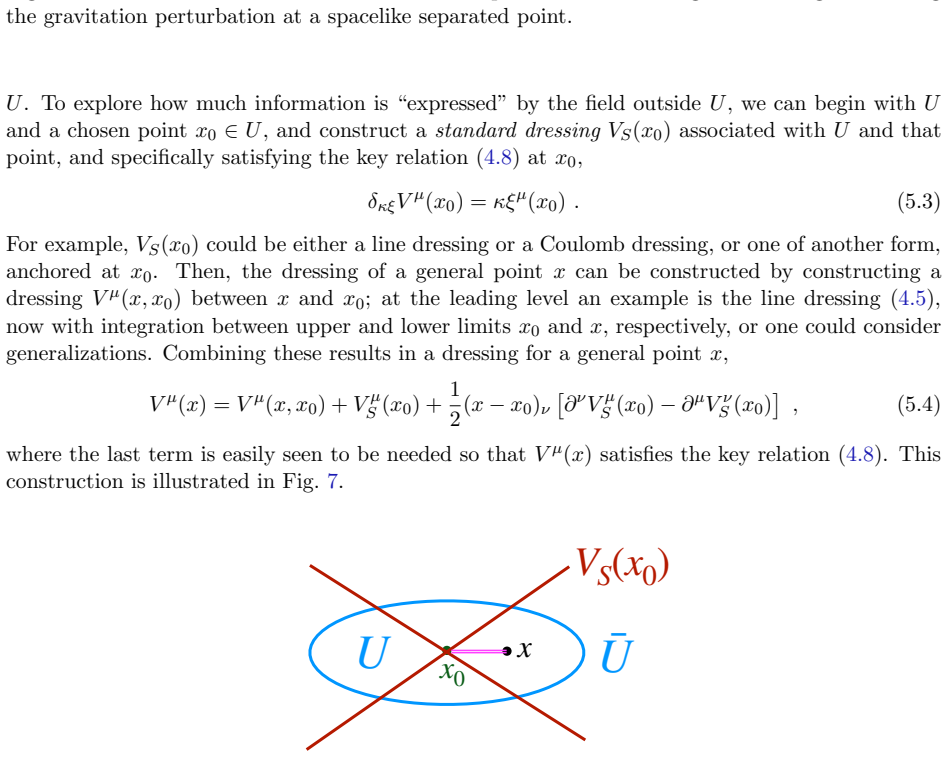
The load-bearing object is the gravitational dressing. In its simplest “line dressing” form, a scalar field $\phi(y)$ is replaced by $\Phi(y) = e^{i \int d^3x\, V^\mu(x) T_{0\mu}(x)} \phi(y) e^{-i \int d^3x\, V^\mu(x) T_{0\mu}(x)}$, where $V^\mu$ is a functional of the metric perturbation $h$ built so that its gauge variation satisfies $\delta_{\kappa\xi} V^\mu = \kappa \xi^\mu$; this key relation is what makes $\Phi$ diffeomorphism-invariant to leading order. The same dressing can be built for general backgrounds from Green functions, and the “standard dressing” $V^\mu(x) = V^\mu(x,x_0) + V_S^\mu(x_0) + \cdots$ decomposes an operator’s dressing into a part localized between $x$ and an anchor point $x_0$ plus a standard dressing extending to infinity. That decomposition yields the gravitational splitting formula, and it is also what makes the dressed observable take the form of a crossed product—a construction that adjoins the conjugating unitaries of a group and their conjugate momenta to an algebra—in the special cases where the group acts by automorphisms of the region algebra.
What would settle it
Compute the commutator $[C_\mu(x), O]$ for a dressed scalar at second order in $\kappa$ in linearized gravity around flat space or a simple anti-de Sitter background. If no choice of higher-order dressing forces this commutator to zero while preserving the leading-order long-distance field, or if every solution makes distant measurements of $h_{\mu\nu}$ encode more than the total momentum and angular momentum, then the gravitational-splitting and holography conclusions fail.
Extended reading notes
Core claim
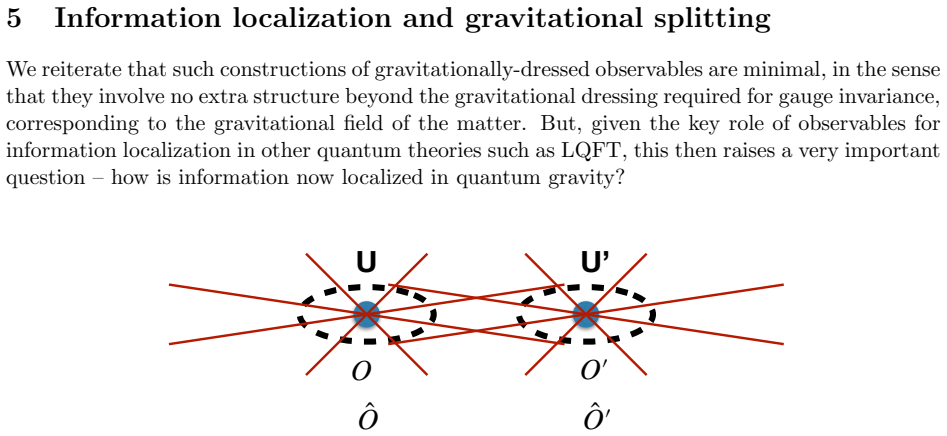
The paper’s central claim is that gravitationally dressed observables—operators made diffeomorphism-invariant by attaching a gravitational field, or dressing, that extends to infinity—have an algebra fundamentally different from local quantum field theory. Two such operators based on spacelike-separated regions generically do not commute because their dressings overlap, so the mutual independence of distant regions fails at the level of region subalgebras. Yet the nonuniqueness of dressings yields a compensating result, the gravitational splitting: choosing a “standard dressing” anchored at a point shows that, to leading order in Newton’s constant, the metric perturbation measured outside a region depends on the source state only through its total momentum and angular momentum, not its detailed structure. This same construction is a generalization of the crossed product of an algebra with a group of automorphisms; in special settings, such as the interior of an eternal black hole or a subregion of de Sitter space, it reduces to the crossed product and produces type II von Neumann algebras, which admit a trace and hence an entropy. For generic regions, though, the relevant automorphisms move the region, so the crossed-product description fails. If an all-orders dressing commuting with the constraints exists, asymptotic momentum charges could translate a dressed operator toward a spacetime boundary, giving a direct argument for holography; and in the limit where dressed operators create very large numbers of excitations, the nonlinearity of gravity is expected to “consume the spacetime,” which the paper takes as evidence that the final mathematical structure of quantum gravity may lie outside operator algebras altogether, possibly in networks of Hilbert space inclusions.
Load-bearing premise
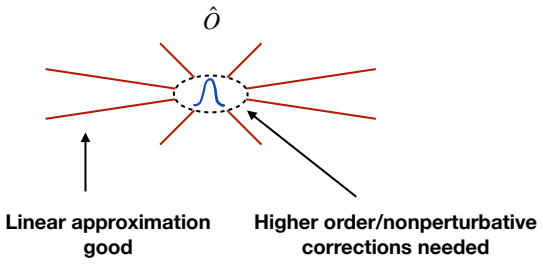
The argument depends on there being a fully dressed observable that is exactly invariant under all gravitational gauge transformations, obtained by pushing the leading-order dressing to all orders in Newton’s constant, with the same long-distance behavior. The paper explicitly notes that no such explicit dressing is provided (Sec. 6, footnote 13), and the holography argument in Sec. 7 is conditional on the expectation that it exists.
Editorial extensions
If this is right
- Distant gravitational measurements can in principle detect the presence of an excitation in a region through the field of its dressing, so the sharp shielding of spacelike-separated regions in quantum field theory is lost.
- At leading order in Newton’s constant, the gravitational splitting limits what a distant observer can learn: different states with the same total momentum and angular momentum produce identical metric perturbations outside the region.
- The dressing construction includes the crossed-product and type II von Neumann algebra constructions as special cases, so entropy defined through type II algebras rests on a particular choice of region and time translation rather than on the generic structure of quantum gravity.
- If an all-orders dressing exists, asymptotic momentum charges can move a localized dressed operator all the way to a spacetime boundary, yielding a simpler argument for gravitational holography.
- Dressed operators that create many excitations are expected to form large black holes whose nonlinear dressing expands, and in the limit of infinitely many excitations the resulting “algebraic spacetime disruption” suggests that no ordinary operator algebra describes the full Hilbert space.
Reading between the lines
- A concrete next step the paper leaves open is to construct, or rule out, an all-orders dressing in a tractable model such as linearized gravity around flat space or anti-de Sitter space; if no such operator exists, the generalized-crossed-product and holography conclusions would not follow.
- The gravitational splitting result suggests a testable consequence for gravitational-wave detectors: the leading-order response to a distant, compact source should depend only on the source’s total mass and angular momentum, and any observed dependence on internal structure would signal that higher-order dressing effects are relevant.
- If the Hilbert-space-inclusion proposal is correct, the notion of a “subsystem” in quantum gravity would be replaced by a hierarchy of approximate localizations, which could be probed by searching for inclusion nets in toy models of perturbative quantum gravity or low-dimensional dilaton gravity.
Editorial analysis
A structured set of objections, weighed in public.
Referee Report
Summary. The paper reviews and extends a relational approach to observables in quantum gravity, focusing on gravitationally dressed operators. It classifies relational observables, recalls leading-order constructions of dressed operators (Eqs. (4.5)-(4.13)), and discusses how dressings destroy the commutativity of spacelike-separated subalgebras (Sec. 5). It then argues that standard dressing gives a generalization of crossed product constructions and, in special cases such as black holes and de Sitter space, recovers type II von Neumann algebras (Sec. 6). The central speculative claim (Sec. 7) is that fully dressed observables satisfying [C_mu(x), O]=0 to all orders would imply translation by ADM momenta can shift operators to boundaries (holography) and that the resulting structure may not be described by algebras at all, suggesting non-algebraic structures such as networks of Hilbert space inclusions.
Significance. If correct, the proposal would be important: it would identify a concrete way in which gravitational dressing modifies the algebraic structure of QFT beyond the type II crossed-product framework, and it poses a sharp open problem whose resolution would clarify holography and subsystem definition. The paper is strongest as a synthesis: it collects a body of prior perturbative results, clearly marks which steps are leading order, and is honest about gaps. Its main weakness is that the non-algebraic conclusion is conditional on an all-orders dressing operator that is not constructed, so the significance is that of a well-motivated research program rather than an established result.
major comments (2)
- [Sec. 7, Eq. (7.1)] The central argument that fully dressed observables lead to holography and to non-algebraic structure assumes the existence of an operator solving [C_mu(x), O]=0 to all orders. The paper only gives leading-order dressings (Eqs. (4.11), (5.10), (6.4)) and explicitly states in footnote 13 that no such explicit dressing is given for black-hole backgrounds. Equation (7.2) therefore has no well-defined object on which to act if the all-orders dressing does not exist or has different commutation properties. Since this assumption is load-bearing for the paper's main novel claim, the manuscript should either provide a precise conjecture specifying the assumed properties, discuss known obstructions, or clearly restate the conclusion as conditional on an open problem rather than as a consequence of the perturbative results.
- [Sec. 6, Eqs. (6.1)-(6.4)] The claim that dressed observables 'generalize' the crossed product construction is not mathematically precise. A crossed product is defined by a group action of automorphisms of an algebra; the paper itself notes that Poincaré generators move the region U and hence are not automorphisms of A_U. The special black-hole case uses a truncated dressing (6.4) that commutes only with the leading-order constraint C_xi, not with the full set C_mu(x), and the paper acknowledges this. Thus the sense in which the full dressing generalizes the crossed product remains undefined. The paper should either define the generalized algebraic operation it has in mind or explicitly state that this is an open mathematical problem.
minor comments (4)
- [Sec. 4, text] The word 'perpindicular' should be 'perpendicular'.
- [References] References [21] and [40] refer to the same paper by Witten; one citation should be used for both instances.
- [Figs. 3 and 4] The labels such as 'Vτ LΔ' and 'Vτ CΔ' are difficult to read; the notation should be defined in the captions or in the text.
- [Eq. (5.7)] It would help to state explicitly that the expression shown is the leading-order expectation value in the dressed state and that higher-order terms are omitted.
Circularity Check
No significant circularity: the central non-algebraic conclusion is explicitly conditional on an unconstructed all-orders dressing, and the perturbative steps are derived from explicit gauge conditions rather than assumed as outputs.
full rationale
The paper's derivation chain is self-contained in the relevant sense. The leading-order dressed observables are constructed from the explicit gauge condition [C_mu(x), Ohat] = 0 (Eq. 4.17), with explicit expressions (4.4)-(4.6), (4.11), and (4.13). The noncommutativity of spacelike dressed observables and the gravitational splitting result (5.7) are algebraic consequences of those definitions, not assumptions equivalent to the paper's conclusions. The claimed connection to crossed products and type II algebras is explicitly attributed to prior external work [39] for the truncated case, and the paper notes that the truncated observable does not commute with the full set of constraints, so the generalization is honestly flagged as a construction-based suggestion rather than a forced result. The strongest structural claim, that quantum gravity may require non-algebraic structure, is explicitly conditional: Section 7 says 'Suppose, going beyond the construction of the leading dressing, we are able to solve [C_mu(x), Ohat] = 0 to all orders' and then 'we expect' Eq. (7.2) to hold, while footnote 13 states 'we do not give such an explicit dressing here.' No equation in the paper reduces to its own input by construction, and no fitted parameter is renamed as a prediction. The heavy self-citation cites prior published perturbative derivations with stated assumptions rather than importing the present paper's conclusions. The absence of an all-orders dressing is a completeness and correctness limitation, not circularity.
Assumptions & free parameters
assumptions (3)
- domain assumption Perturbative expansion in kappa around a fixed background (4.3) and treatment of long-distance behavior as weak-field
- domain assumption Diffeomorphisms at the platform or infinity are not gauge, so the dressing is invariant under them
- ad hoc to paper Existence of an all-orders dressing solving [C_mu(x), O] = 0 with the expected localization properties
Cite this review
Pith. "Pith review of Quantum gravity observables: observation, algebras, and mathematical structure." pith.science (2026). https://pith.science/paper/JDAGHQJW
@misc{pith2026250522708,
  author       = {Pith},
  title        = {Pith review of: Quantum gravity observables: observation, algebras, and mathematical structure},
  year         = {2026},
  howpublished = {\url{https://pith.science/paper/JDAGHQJW}},
  note         = {Machine review of arXiv:2505.22708}
}
read the original abstract
The questions of describing observables and observation in quantum gravity appear to be centrally important to its physics. A relational approach holds significant promise, and a classification of different types of relational observables (gravitationally dressed, field relational, and more general) is outlined. Plausibly gravitationally dressed observables are particularly closely tied to the fundamental structure of the theory. These may be constructed in the quantum theory to leading order in Newton's constant, and raise important questions about localization of information. Approximate localization is given by a "standard dressing" construction of a "gravitational splitting." It is also argued that such gravitational dressings give a generalization of the crossed product construction, reducing to this and yielding type II von Neumann algebras in special cases. Gravity therefore introduces a significantly more general alteration of the algebraic structure of local quantum field theory, also with apparent connections to holography, but whose implications have not been fully understood. In particular, properties of the algebra of gravitationally dressed observables suggest a possible role for other non-algebraic structure on the Hilbert space for quantum gravity.
Figures


Figures from the paper (8 more)




Forward citations
Cited by 8 Pith papers
-
Relational path integral, effective actions and quantum frame covariance in gravity
The gravitational path integral is reformulated with dynamical reference frames, producing gauge-invariant correlators, frame-dependent vacua, and effective actions, with sharpness of events becoming frame-relative.
-
Algebras for generalized entanglement wedges
Generalized (Bousso–Penington) entanglement wedges are conjectured to carry von Neumann algebras such that S_gen(W) = S(ω|A_W) − log Ind(E) + K_Ω (eq. 2.7), making BP's monotonicity and strong subadditivity consequenc...
-
Composite AdS geodesics for CFT correlators and timelike entanglement entropy
A bulk extremization prescription produces composite timelike-spacelike geodesics whose complex length exactly matches CFT two-point functions at timelike separation, including behind the BTZ horizon.
-
On the relation between perspective-neutral, algebraic, and effective quantum reference frames
For ideal quantum reference frames with a single constraint, the perspective-neutral, algebraic, and effective semiclassical approaches describe the same physics and the same frame-switching rules.
-
Algebras, Entanglement Islands, and Observers
Entanglement islands in the AdS/bath island model realize the quantum-gravity 'observer' as a Goldstone vector mode, making the island operator algebra an emergent Type II∞ von Neumann algebra.
-
Effective density matrix for vacua in asymptotically flat gravity
The vacuum of a large causal diamond in asymptotically flat gravity is claimed to be a Gaussian in the supertranslation Goldstone mode, giving modular Hamiltonian variance A/epsilon squared.
-
Observer Time from Causality in Perturbative Quantum Gravity
A lightbulb-and-mirror protocol defines diffeomorphism-invariant elapsed proper time, and its leading quantum gravity correction makes the time a noncommuting quantum operator.
-
Preface to Fields, Gravity, Strings and Beyond: In Memory of Stanley Deser
An editorial preface, not a research paper: it tributes Stanley Deser and catalogues the special issue's contributed articles in four thematic areas.
Reference graph
Works this paper leans on
-
[1]
Cosmological observables, IR growth of fluctuations, and scale-dependent anisotropies,
S. B. Giddings and M. S. Sloth, “Cosmological observables, IR growth of fluctuations, and scale-dependent anisotropies,” Phys. Rev. D 84 (2011) 063528, arXiv:1104.0002 [hep-th]
arXiv 2011
-
[2]
Haag, Local quantum physics: Fields, particles, algebras
R. Haag, Local quantum physics: Fields, particles, algebras . (Texts and monographs in physics). Springer, Berlin, Germany, 1992
1992
-
[3]
Quanten-Mechanik und Wirklichkeit,
A. Einstein, “Quanten-Mechanik und Wirklichkeit,” Dialectica 2 (1948) 320. 15
work page 1948
-
[4]
Einstein on locality and separability,
D. Howard, “Einstein on locality and separability,” Studies in History and Philosophy of Science Part A 16 no. 3, (1985) 171
work page 1985
-
[5]
Gravitational observables and local symmetries,
C. G. Torre, “Gravitational observables and local symmetries,” Phys. Rev. D 48 (1993) R2373–R2376, arXiv:gr-qc/9306030
arXiv 1993
-
[6]
Construction of a complete set of independent observables in the general theory of relativity,
A. Komar, “Construction of a complete set of independent observables in the general theory of relativity,” Physical Review 111 no. 4, (1958) 1182
work page 1958
-
[7]
B. S. DeWitt, “The Quantization of geometry,” in Gravitation: An Introduction to Current Research, L. Witten, ed., ch. 8, pp. 266–381. John Wiley and Sons, New York, 1962
work page 1962
-
[8]
What Is Observable in Classical and Quantum Gravity?,
C. Rovelli, “What Is Observable in Classical and Quantum Gravity?,” Class. Quant. Grav. 8 (1991) 297–316
1991
Show all 49 references
-
[9]
Almost ideal clocks in quantum cosmology: A Brief derivation of time,
D. Marolf, “Almost ideal clocks in quantum cosmology: A Brief derivation of time,” Class. Quant. Grav. 12 (1995) 2469–2486, arXiv:gr-qc/9412016
1995 arXiv
-
[10]
Partial and complete observables for canonical general relativity,
B. Dittrich, “Partial and complete observables for canonical general relativity,” Class. Quant. Grav. 23 (2006) 6155–6184, arXiv:gr-qc/0507106
2006 arXiv
-
[11]
Observables in effective gravity,
S. B. Giddings, D. Marolf, and J. B. Hartle, “Observables in effective gravity,” Phys. Rev. D 74 (2006) 064018, arXiv:hep-th/0512200
2006 arXiv
-
[12]
Relational Observables in Gravity: a Review,
J. Tambornino, “Relational Observables in Gravity: a Review,” SIGMA 8 (2012) 017, arXiv:1109.0740 [gr-qc]
2012 arXiv
-
[13]
Hilbert space structure in quantum gravity: an algebraic perspective,
S. B. Giddings, “Hilbert space structure in quantum gravity: an algebraic perspective,” JHEP 12 (2015) 099, arXiv:1503.08207 [hep-th]
2015 arXiv
-
[14]
Diffeomorphism-invariant observables and their nonlocal algebra,
W. Donnelly and S. B. Giddings, “Diffeomorphism-invariant observables and their nonlocal algebra,” Phys. Rev. D 93 no. 2, (2016) 024030, arXiv:1507.07921 [hep-th]. [Erratum: Phys.Rev.D 94, 029903 (2016)]
2016 arXiv
-
[15]
Propagators for gauge-invariant observables in cosmology,
M. B. Fr¨ ob and W. C. C. Lima, “Propagators for gauge-invariant observables in cosmology,” Class. Quant. Grav. 35 no. 9, (2018) 095010, arXiv:1711.08470 [gr-qc]
2018 arXiv
-
[16]
Diffeomorphism-invariant observables and dynamical frames in gravity: reconciling bulk locality with general covariance,
C. Goeller, P. A. Hoehn, and J. Kirklin, “Diffeomorphism-invariant observables and dynamical frames in gravity: reconciling bulk locality with general covariance,” arXiv:2206.01193 [hep-th]
-
[17]
An Algebra of Observables for de Sitter Space,
V. Chandrasekaran, R. Longo, G. Penington, and E. Witten, “An Algebra of Observables for de Sitter Space,” arXiv:2206.10780 [hep-th]
-
[18]
Proper Time Observables of General Gravitational Perturbations in Laser Interferometry-based Gravitational Wave Detectors,
V. S. H. Lee and K. M. Zurek, “Proper Time Observables of General Gravitational Perturbations in Laser Interferometry-based Gravitational Wave Detectors,” arXiv:2408.03363 [hep-ph]
-
[19]
Response of interferometers to the vacuum of quantum gravity,
D. Carney, M. Karydas, and A. Sivaramakrishnan, “Response of interferometers to the vacuum of quantum gravity,” arXiv:2409.03894 [hep-th]. 16
-
[20]
Relational observables in 2-D quantum gravity,
M. Gary and S. B. Giddings, “Relational observables in 2-D quantum gravity,” Phys. Rev. D 75 (2007) 104007, arXiv:hep-th/0612191
2007 arXiv
-
[22]
Gravitational entropy is observer-dependent,
J. De Vuyst, S. Eccles, P. A. Hoehn, and J. Kirklin, “Gravitational entropy is observer-dependent,” arXiv:2405.00114 [hep-th]
-
[23]
Construction of Bulk Fields with Gauge Redundancy,
I. Heemskerk, “Construction of Bulk Fields with Gauge Redundancy,” JHEP 09 (2012) 106, arXiv:1201.3666 [hep-th]
2012 arXiv
-
[24]
Decoding the hologram: Scalar fields interacting with gravity,
D. Kabat and G. Lifschytz, “Decoding the hologram: Scalar fields interacting with gravity,” Phys. Rev. D 89 no. 6, (2014) 066010, arXiv:1311.3020 [hep-th]
2014 arXiv
-
[25]
Gauge-invariant observables, gravitational dressings, and holography in AdS,
S. B. Giddings and A. Kinsella, “Gauge-invariant observables, gravitational dressings, and holography in AdS,” JHEP 11 (2018) 074, arXiv:1802.01602 [hep-th]
2018 arXiv
-
[26]
Algebra of diffeomorphism-invariant observables in Jackiw-Teitelboim gravity,
D. Harlow and J.-q. Wu, “Algebra of diffeomorphism-invariant observables in Jackiw-Teitelboim gravity,” JHEP 05 (2022) 097, arXiv:2108.04841 [hep-th]
2022 arXiv
-
[27]
Quantum gravity: a quantum-first approach,
S. B. Giddings, “Quantum gravity: a quantum-first approach,” LHEP 1 no. 3, (2018) 1–3, arXiv:1805.06900 [hep-th]
2018 arXiv
-
[28]
Gravitational splitting at first order: Quantum information localization in gravity,
W. Donnelly and S. B. Giddings, “Gravitational splitting at first order: Quantum information localization in gravity,” Phys. Rev. D 98 no. 8, (2018) 086006, arXiv:1805.11095 [hep-th]
2018 arXiv
-
[29]
Observables, gravitational dressing, and obstructions to locality and subsystems,
W. Donnelly and S. B. Giddings, “Observables, gravitational dressing, and obstructions to locality and subsystems,” Phys. Rev. D 94 no. 10, (2016) 104038, arXiv:1607.01025 [hep-th]
2016 arXiv
-
[30]
Perturbative quantum evolution of the gravitational state and dressing in general backgrounds,
S. B. Giddings and J. Perkins, “Perturbative quantum evolution of the gravitational state and dressing in general backgrounds,” Phys. Rev. D 110 no. 2, (2024) 026012, arXiv:2209.06836 [hep-th]
2024 arXiv
-
[31]
The Dynamics of general relativity,
R. L. Arnowitt, S. Deser, and C. W. Misner, “The Dynamics of general relativity,” Gen. Rel. Grav. 40 (2008) 1997–2027, arXiv:gr-qc/0405109
2008 arXiv
-
[32]
How is quantum information localized in gravity?,
W. Donnelly and S. B. Giddings, “How is quantum information localized in gravity?,” Phys. Rev. D 96 no. 8, (2017) 086013, arXiv:1706.03104 [hep-th]
2017 arXiv
-
[33]
Gravitational dressing, soft charges, and perturbative gravitational splitting,
S. B. Giddings, “Gravitational dressing, soft charges, and perturbative gravitational splitting,” Phys. Rev. D 100 no. 12, (2019) 126001, arXiv:1903.06160 [hep-th]
2019 arXiv
-
[34]
Localizing solutions of the Einstein constraint equations,
A. Carlotto and R. M. Schoen, “Localizing solutions of the Einstein constraint equations,” Invent. Math. 205 (2016) 559
2016
-
[35]
Anti-gravity ‘a la Carlotto-Schoen,
P. T. Chru´ sciel, “Anti-gravity ‘a la Carlotto-Schoen,”arXiv:1611.01808 [math.DG]. 17
-
[36]
On the asymptotics for the vacuum Einstein constraint equa- tions,
J. Corvino and R. M. Schoen, “On the asymptotics for the vacuum Einstein constraint equa- tions,” J. Diff. Geom. 73 no. 2, (2006) 185–217
2006
-
[37]
Duality for crossed products and the structure of von Neumann algebras of type III,
M. Takesaki, “Duality for crossed products and the structure of von Neumann algebras of type III,” Acta Mathematica 131 (1973) 249–310
1973
-
[38]
Gravity and the Crossed Product,
E. Witten, “Gravity and the Crossed Product,” arXiv:2112.12828 [hep-th]
-
[39]
Large N algebras and generalized entropy,
V. Chandrasekaran, G. Penington, and E. Witten, “Large N algebras and generalized entropy,” JHEP 04 (2023) 009, arXiv:2209.10454 [hep-th]
2023 arXiv
-
[40]
Algebras, regions, and observers.,
E. Witten, “Algebras, regions, and observers.,” Proc. Symp. Pure Math. 107 (2024) 247–276, arXiv:2303.02837 [hep-th]
2024 arXiv
-
[41]
Generalized black hole entropy is von Neumann entropy,
J. Kudler-Flam, S. Leutheusser, and G. Satishchandran, “Generalized black hole entropy is von Neumann entropy,” Phys. Rev. D 111 no. 2, (2025) 025013, arXiv:2309.15897 [hep-th]
2025 arXiv
-
[42]
Gauge-invariant observables in gravity and electromagnetism: black hole backgrounds and null dressings,
S. Giddings and S. Weinberg, “Gauge-invariant observables in gravity and electromagnetism: black hole backgrounds and null dressings,” Phys. Rev. D 102 no. 2, (2020) 026010, arXiv:1911.09115 [hep-th]
2020 arXiv
-
[43]
Generalized entropy for general subregions in quantum gravity,
K. Jensen, J. Sorce, and A. J. Speranza, “Generalized entropy for general subregions in quantum gravity,” JHEP 12 (2023) 020, arXiv:2306.01837 [hep-th]
2023 arXiv
-
[44]
A clock is just a way to tell the time: gravitational algebras in cosmological spacetimes,
C.-H. Chen and G. Penington, “A clock is just a way to tell the time: gravitational algebras in cosmological spacetimes,” arXiv:2406.02116 [hep-th]
-
[45]
Algebraic Observational Cosmology,
J. Kudler-Flam, S. Leutheusser, and G. Satishchandran, “Algebraic Observational Cosmology,” arXiv:2406.01669 [hep-th]
-
[46]
Linearization (in)stabilities and crossed products,
J. De Vuyst, S. Eccles, P. A. Hoehn, and J. Kirklin, “Linearization (in)stabilities and crossed products,” arXiv:2411.19931 [hep-th]
-
[47]
Unitarity and Holography in Gravitational Physics,
D. Marolf, “Unitarity and Holography in Gravitational Physics,” Phys. Rev. D 79 (2009) 044010, arXiv:0808.2842 [gr-qc]
2009 arXiv
-
[48]
Holography from the Wheeler-DeWitt equation,
C. Chowdhury, V. Godet, O. Papadoulaki, and S. Raju, “Holography from the Wheeler-DeWitt equation,” JHEP 03 (2022) 019, arXiv:2107.14802 [hep-th]
2022 arXiv
-
[49]
On the questions of asymptotic recoverability of information and subsystems in quantum gravity,
S. B. Giddings, “On the questions of asymptotic recoverability of information and subsystems in quantum gravity,” JHEP 08 (2022) 227, arXiv:2112.03207 [hep-th]
2022 arXiv
-
[50]
Quantum-first gravity,
S. B. Giddings, “Quantum-first gravity,” Found. Phys. 49 no. 3, (2019) 177–190, arXiv:1803.04973 [hep-th]. 18
2019 arXiv
Reviewed August 7, 2026 · model on record in the stance chip above.
Discussion (0). Sign in to comment.