REVIEW 3 major objections 5 minor 100 references
Thermal dilepton production within conformal viscous Gubser flow
T0 review · 3 major / 5 minor · reviewed 2026-08-07 · deepseek-v4-flash
Pith's one-line read A Gubser-flow calculation shows that thermal dilepton yields rise with fireball size, that smaller systems give hotter effective temperatures, and that Chapman-Enskog corrections are better behaved than Grad's.
desk verdict New combination of viscous Gubser flow and dilepton rates, but the central viscous formula (Eq. 18) is dimensionally inconsistent; ideal q-dependence likely survives. read the letter →
The pith
A machine-rendered reading of the paper's core claim, the machinery that carries it, and where it could break.
The reading
What carries the argument
The central machinery is Gubser flow, a Weyl-rescaled conformal hydrodynamics solution with $\mathrm{SO}(3)_q \otimes \mathrm{SO}(1,1)\otimes \mathbb{Z}_2$ symmetry that maps the expanding fireball to a static medium on de Sitter space through $d\hat{s}^2 = ds^2/\tau^2$ and the coordinates $(\rho,\theta)$. The Israel-Stewart equations in the Gubser coordinate $\rho$, Eqs. (8)--(9), supply the temperature and shear stress profiles, and the shear stress transformation, Eqs. (23)--(26), carries those profiles back to Milne coordinates through factors like $\cosh^2\rho$. The Chapman-Enskog non-equilibrium correction $\delta f = f_0\, \beta\, p_\mu p_\nu \pi^{\mu\nu}/(2\beta_\pi (u\cdot p))$, with $\beta_\pi = (\epsilon+P)/5$, converts the shear stress into a viscous modification of the Born dilepton rate, and the analogous Grad-method correction provides the comparison.
What would settle it
A direct check would be to derive Eqs. (23)--(26) from the Weyl rescaling and coordinate transformation given in Section II and verify the $\cosh^2\rho$ factor in Eq. (23); a mis-derived factor would change the viscous rate. Independently, one could solve the relativistic Boltzmann equation in Gubser flow in the relaxation-time approximation, compute the exact dilepton rate from the exact distribution function, and compare it with the Chapman-Enskog and Grad predictions: if the exact rate is closer to Grad than to Chapman-Enskog, the paper's preference for Chapman-Enskog corrections in the presence of transverse flow would be overturned.
Extended reading notes
Core claim
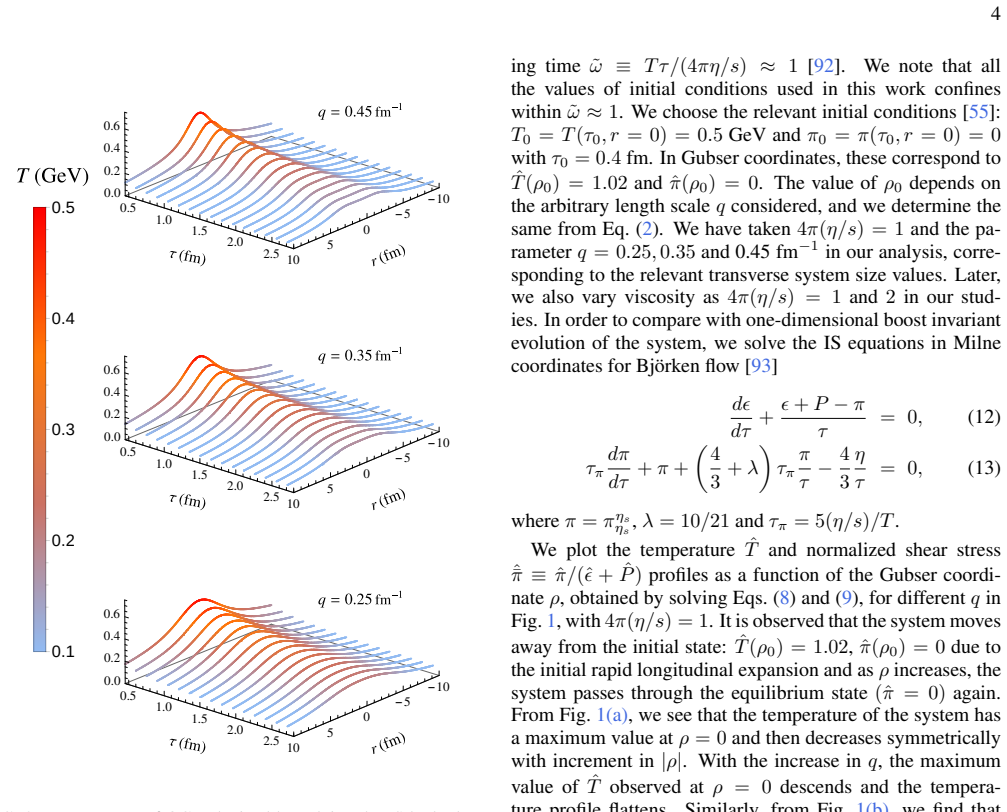
Within the Gubser solution of second-order Israel-Stewart hydrodynamics, the paper reports three connected results. First, at fixed initial central temperature $T_0=0.5\ \mathrm{GeV}$ and $\tau_0=0.4\ \mathrm{fm}$, the thermal dilepton yield is reduced relative to Bjorken flow for every finite $q$, and it approaches the Bjorken limit only as $q\to 0$; smaller $q$, corresponding to a larger transverse fireball, gives slower cooling and enhanced dilepton emission. Second, the effective temperature inferred by fitting the transverse-mass spectra is higher for larger $q$ (smaller systems), both when the initial central temperature is held fixed and when the total initial energy is held fixed, because the energy density becomes more localized at the center. Third, comparing the Chapman-Enskog-like and Grad 14-moment viscous corrections to the ideal rate, the Chapman-Enskog correction is smaller and grows less steeply with $p_T$, so the paper concludes it is the preferred prescription for dilepton production in the presence of transverse flow.
Load-bearing premise
The load-bearing premise is the correctness of the mapping from the Gubser-frame shear stress tensor to Milne coordinates, Eqs. (23)--(26), which are presented without derivation and contain an unexplained $\cosh^2\rho$ factor; if this transformation is wrong, the viscous contribution to the dilepton rate and the Chapman-Enskog versus Grad comparison would be quantitatively incorrect, though the ideal-yield dependence on $q$, which depends only on temperature, would survive.
Editorial extensions
If this is right
- Ideal and viscous dilepton yields within Gubser flow are always smaller than one-dimensional Bjorken yields at the same initial central temperature, and they approach the Bjorken limit only as $q\to 0$, so modeling transverse expansion matters quantitatively.
- Smaller systems return a larger effective temperature extracted from transverse-mass spectra, whether the initial condition fixes central temperature or total energy, so extracted temperatures are geometry-dependent rather than purely thermodynamic.
- Shear viscosity enhances the dilepton yield, with the enhancement growing at higher invariant mass and higher $p_T$, while the $\rho(770)$ peak remains visible in the invariant mass spectrum.
- Grad's viscous correction exceeds the Chapman-Enskog correction at all $p_T$ and $q$ considered, with the gap widening at high $p_T$, so using Grad's form would overestimate the viscous enhancement.
- The massless-pion approximation in the hadronic rate is accurate to within about 10% except at low invariant mass and low $p_T$, supporting the conformal treatment of pions used throughout.
Reading between the lines
- The ideal-yield dependence on $q$ comes only from the temperature profile, so that part of the result would survive even if the shear-stress transformation were later corrected; the Chapman-Enskog versus Grad comparison is the part most exposed to the assumed transformation.
- The same geometry-based effective-temperature enhancement should appear in thermal photon spectra computed under Gubser flow, extending the existing inviscid photon calculation to the viscous case.
- A direct test of the claimed preference for Chapman-Enskog corrections would be to compute the second-order Chapman-Enskog correction and check that it stays small relative to the first-order term across the $p_T$ range studied.
- An extension would be to tune the Gubser scale $q$ to measured charged-particle multiplicities and test whether the predicted ordering of effective temperatures with system size survives in data.
Editorial analysis
A structured set of objections, weighed in public.
Referee Report
Summary. The paper studies thermal dilepton production in heavy-ion collisions using conformal viscous Gubser flow. The authors solve Israel-Stewart hydrodynamics in the Gubser geometry, obtain temperature and shear-stress profiles for three values of the inverse transverse-length parameter q, and compute dilepton yields from quark-antiquark and pion annihilation with a first-order Chapman-Enskog viscous correction to the distribution function. They find that smaller q (larger transverse systems) produces enhanced dilepton spectra, that the effective temperature extracted from the transverse-mass slope is higher for smaller systems, and that Chapman-Enskog corrections are smaller and better behaved than Grad's 14-moment corrections. The ideal-yield part of the calculation relies on standard IS temperature profiles; the viscous part rests on Eq. (18) and the shear-tensor transformation in Eqs. (23)-(26).
Significance. The ideal-yield q-dependence is a useful, likely robust benchmark: it follows from the known Gubser temperature profiles and the paper correctly notes the approach to Bjorken flow as q tends to zero. The paper also makes an honest, explicit check of the massless pion approximation (Fig. 5), including its failure region. However, the viscous portion of the paper is not currently dependable: the central viscous rate formula is dimensionally inconsistent, and the transformation of the shear tensor to Milne coordinates is stated without a derivation that would allow the reader to test it. Until these are fixed, the viscous spectra, the viscous effective-temperature curves, and the CE-versus-Grad comparison should not be used as quantitative results. With corrections, the study would be a reasonable analytic-model contribution to electromagnetic probes in small systems.
major comments (3)
- [Section IV, Eq. (18)] The shear-viscous dilepton rate in Eq. (18) is dimensionally inconsistent as written. In natural units with E^2 = (u·p)^2 - M^2, the prefactor β/β_π scales as 1/[T^1 · T^4] = T^{-5}; p^μ p^ν π_{μν} scales as T^6, so after the explicit 1/E^5 the prefactor has dimensions T^{-4}. The bracket then contains E(E^2 - 3M^2/2)/(u·p), of dimension T^2, added to (3/4) M^4 ln[(u·p+E)/(u·p-E)], of dimension T^4. A correction factor multiplying the ideal rate must be dimensionless, but this expression is not. Because Eq. (18) is used to produce every viscous spectrum, the effective-temperature comparison in Fig. 8(b), and the CE-versus-Grad comparison in Fig. 9, all of these quantitative results are invalid until the formula is corrected and the numerics are regenerated.
- [Section IV, Eqs. (21)-(22)] The sign of the radial component of the four-velocity in Eq. (22) is inconsistent with the stated radial flow velocity. The authors define v_r(τ,r) = 2q^2 τ r / [1 + (qτ)^2 + (qr)^2], which is positive for r>0, and the Milne-frame contravariant radial component for an outward-flowing fluid should be u^r = +v_r/sqrt(1-v_r^2). The negative sign in Eq. (22) contradicts the standard relation u^r = u^τ v^r. The ideal yield may be insensitive to this sign because the φ_p integral produces I0(-z)=I0(z), but the viscous rate (18) depends on u·p in the bracket and in the logarithmic argument, so the viscous spectra and the CE/Grad comparison are affected.
- [Section IV, Eqs. (5), (23)-(26)] The transformation of the shear-stress tensor from Gubser coordinates to Milne coordinates is stated without derivation, and the given components do not follow self-evidently from the stated transformation rule. In particular, Eq. (23) contains a τ^{-2} factor and a cosh^2 ρ factor that are not explained. Treating the Gubser-frame tensor as covariant with the Weyl factor g_{μν} = τ^2 ghat_{μν} would yield a factor τ^2 rather than τ^{-2} for the corresponding component. The authors should provide the full derivation (or a direct reference to a calculation in Ref. [43]) and verify that the components satisfy the correct tensor transformation, because the viscous yield and the CE-versus-Grad comparison depend on these components through Eq. (20).
minor comments (5)
- [Section IV, Fig. 5] The massless pion approximation is shown to produce errors up to about 50% in the low-M, low-p_T region, which includes the ρ(770) invariant-mass region. The paper justifies the approximation by conformal consistency, but the abstract and conclusions should be more guarded when discussing the low-mass hadronic peak.
- [Section V, Fig. 8(b)] The caption of Fig. 8(b) does not identify the line styles for the viscous results. Please add a legend or state explicitly which curves are ideal and which are viscous for each q value.
- [Throughout] Some symbols are typeset inconsistently: 'pT' versus 'p_T' appear interchangeably, and the ratio in Eq. (33) is denoted R_{p_T} but the text later refers to 'RpT'. A uniform notation would improve readability.
- [Acknowledgments] The acknowledgment 'Authors would like to thank the anonymous referee' is unusual for a preprint and should be removed or recast, since the referee's identity and contribution are not established at submission.
- [Section IV, Eq. (27)] In Eq. (27), the integration over η_s is performed without specifying the upper and lower limits; the text later uses Θ(T > T_min) to truncate the evolution, but it would be clearer to show the explicit η_s integration range (e.g., symmetric in rapidity) in the equation.
Circularity Check
No significant circularity: the derivation chain is self-contained; the cited viscous rate is independent prior work, and the effective-temperature extraction is not a fitted input.
full rationale
The paper's central claims (q-dependent dilepton enhancement, effective-temperature ordering, CE-vs-Grad comparison) follow from numerically solving the Israel-Stewart equations (8)-(9) and then integrating the dilepton rate (17)-(18) over the resulting Gubser temperature and shear-stress profiles. The viscous rate (18) is attributed to the authors' earlier Refs. [96,97], but it is a closed-form analytic consequence of the CE correction (15) and the standard Born rate (14); it is parameter-free, uses stated assumptions (Maxwell-Boltzmann equilibrium, first-order Chapman-Enskog) and does not encode the target results of this paper. The Gubser Israel-Stewart evolution equations are taken from Ref. [43], which has no author overlap with the present paper. The quantity T_eff is obtained by fitting the computed spectra to exp(-m_T/T_eff); it is an extraction from the model output, not a parameter fitted to define the model, so reporting it as a result is not circular. The comparison between CE-like and Grad corrections uses two independent distribution-function ansatze and does not reduce to an input. The self-citations to Refs. [89,96,97] provide independent derivations of the viscous rate and prior comparisons of CE vs Grad; they do not assume the present conclusions. A possible dimensional inconsistency in Eq. (18) would be a correctness issue affecting the numerical viscous results, but it is not circularity: the formula is not defined in terms of the yields it is used to predict.
Assumptions & free parameters
free parameters (6)
- q (inverse length scale) =
0.25, 0.35, 0.45 fm^-1
- eta/s (shear viscosity to entropy ratio) =
1/(4*pi) and 1/(2*pi) (via 4*pi*eta/s = 1 and 2)
- Initial temperature T0 at (tau0, r=0) =
0.5 GeV
- Initial proper time tau0 =
0.4 fm
- Final temperature Tmin =
0.1 GeV
- Transverse momentum fit range for T_eff =
1.1 <= p_T <= 2.1 GeV
assumptions (6)
- domain assumption Gubser flow with conformal equation of state (epsilon = 3P) is a valid model for the QGP fireball expansion.
- domain assumption Israel-Stewart second-order hydrodynamics equations (Eqs. 8-9) from Ref. [43] are correct.
- domain assumption Born-level rates for q-qbar and pi-pi annihilation (Eq. 14) are sufficient for thermal dilepton production.
- domain assumption Maxwell-Boltzmann statistics for the equilibrium distribution in the rate calculation.
- ad hoc to paper The shear stress tensor transformation from Gubser to Milne coordinates (Eqs. 23-26) is correct.
- domain assumption Massless pion approximation in the hadronic dilepton rate.
Cite this review
Pith. "Pith review of Thermal dilepton production within conformal viscous Gubser flow." pith.science (2026). https://pith.science/paper/IIGYHL5L
@misc{pith2026250601500,
  author       = {Pith},
  title        = {Pith review of: Thermal dilepton production within conformal viscous Gubser flow},
  year         = {2026},
  howpublished = {\url{https://pith.science/paper/IIGYHL5L}},
  note         = {Machine review of arXiv:2506.01500}
}
abstract
By employing the Gubser solutions of causal relativistic second-order Israel-Stewart hydrodynamics, we study the thermal dilepton production from heavy-ion collisions, considering the transverse expansion of the viscous hot QCD medium along with longitudinal boost-invariance. We analyze the evolution of the temperature and shear stress profiles of the QCD matter under Gubser flow for different values of the associated parameter $q$ (inverse length scale). We study the dilepton production using leading order Born rates from QGP and hadronic sectors under Gubser geometry. Viscous modified dilepton rate is calculated using the first-order Chapman-Enskog (CE) like non-equilibrium correction of the particle distribution function. Our study indicates that lower values of $q$ result in the enhancement of the emitted dilepton spectra. We also determine the effective temperature of the hot QCD medium from the inverse slope of transverse mass spectra, for different $q$. We find that the effective temperature determined from the dilepton spectra for a smaller system to be higher. Further, we compare the strength of CE like and Grad's viscous correction to the ideal dilepton spectra and find that CE type viscous corrections are well behaved compared to that of Grad's in the presence of transverse flow.
Figures


Figures from the paper (6 more)


Reference graph
Works this paper leans on
-
[43]
Conformal hydrodynam- ics in Minkowski and de Sitter spacetimes,
Steven S. Gubser and Amos Yarom, “Conformal hydrodynam- ics in Minkowski and de Sitter spacetimes,” Nucl. Phys. B846, 469–511 (2011), arXiv:1012.1314 [hep-th]
arXiv 2011
-
[1]
We plot the ratio defined by RpT = dN dM pT dpT dy / dN 0 dM pT dpT dy ,(33) which gives the non-equilibrium corrections to the ideal dilep- ton yield (Eq
= 0.5GeV , as before. We plot the ratio defined by RpT = dN dM pT dpT dy / dN 0 dM pT dpT dy ,(33) which gives the non-equilibrium corrections to the ideal dilep- ton yield (Eq. (28)). It can be seen that the viscous corrections grow withp T for any value ofq. This can be understood from the termp µpνπµν (Eq. (20)) in theδf, which is proportional top 2 T ...
-
[2]
John Adamset al.(STAR), “Experimental and theoretical chal- lenges in the search for the quark gluon plasma: The STAR Collaboration’s critical assessment of the evidence from RHIC collisions,” Nucl. Phys. A757, 102–183 (2005), arXiv:nucl- ex/0501009
arXiv 2005
-
[3]
K. Adcoxet al.(PHENIX), “Formation of dense partonic matter in relativistic nucleus-nucleus collisions at RHIC: Experimental evaluation by the PHENIX collaboration,” Nucl. Phys. A757, 184–283 (2005), arXiv:nucl-ex/0410003
arXiv 2005
-
[4]
Quark gluon plasma and color glass condensate at RHIC? The Perspective from the BRAHMS experiment,
I. Arseneet al.(BRAHMS), “Quark gluon plasma and color glass condensate at RHIC? The Perspective from the BRAHMS experiment,” Nucl. Phys. A757, 1–27 (2005), arXiv:nucl- ex/0410020
arXiv 2005
-
[5]
The PHOBOS perspective on discoveries at RHIC,
B. B. Backet al.(PHOBOS), “The PHOBOS perspective on discoveries at RHIC,” Nucl. Phys. A757, 28–101 (2005), arXiv:nucl-ex/0410022
arXiv 2005
-
[6]
Viscos- ity in strongly interacting quantum field theories from black hole physics,
P. Kovtun, Dan T. Son, and Andrei O. Starinets, “Viscos- ity in strongly interacting quantum field theories from black hole physics,” Phys. Rev. Lett.94, 111601 (2005), arXiv:hep- th/0405231
arXiv 2005
-
[7]
Perfect fluidity of the quark gluon plasma core as seen through its dissipative hadronic corona,
Tetsufumi Hirano and Miklos Gyulassy, “Perfect fluidity of the quark gluon plasma core as seen through its dissipative hadronic corona,” Nucl. Phys. A769, 71–94 (2006), arXiv:nucl- th/0506049
Show all 100 references
-
[8]
Viscosity Informa- tion from Relativistic Nuclear Collisions: How Perfect is the Fluid Observed at RHIC?
Paul Romatschke and Ulrike Romatschke, “Viscosity Informa- tion from Relativistic Nuclear Collisions: How Perfect is the Fluid Observed at RHIC?” Phys. Rev. Lett.99, 172301 (2007), arXiv:0706.1522 [nucl-th]
2007 arXiv
-
[9]
Elliptic flow of charged particles in Pb-Pb collisions at 2.76 TeV,
K Aamodtet al.(ALICE), “Elliptic flow of charged particles in Pb-Pb collisions at 2.76 TeV,” Phys. Rev. Lett.105, 252302 (2010), arXiv:1011.3914 [nucl-ex]
2010 arXiv
-
[10]
Collective flow and vis- cosity in relativistic heavy-ion collisions,
Ulrich Heinz and Raimond Snellings, “Collective flow and vis- cosity in relativistic heavy-ion collisions,” Ann. Rev. Nucl. Part. Sci.63, 123–151 (2013), arXiv:1301.2826 [nucl-th]
2013 arXiv
-
[11]
Heavy Ion Collisions: The Big Picture, and the Big Ques- tions,
Wit Busza, Krishna Rajagopal, and Wilke van der Schee, “Heavy Ion Collisions: The Big Picture, and the Big Ques- tions,” Ann. Rev. Nucl. Part. Sci.68, 339–376 (2018), arXiv:1802.04801 [hep-ph]
2018 arXiv
-
[12]
Paul Romatschke and Ulrike Romatschke,Relativistic Fluid Dynamics In and Out of Equilibrium, Cambridge Monographs on Mathematical Physics (Cambridge University Press, 2019) arXiv:1712.05815 [nucl-th]
2019 arXiv
-
[13]
QCD thermalization: Ab initio approaches and interdisciplinary connections,
J ¨urgen Berges, Michal P. Heller, Aleksas Mazeliauskas, and Raju Venugopalan, “QCD thermalization: Ab initio approaches and interdisciplinary connections,” Rev. Mod. Phys.93, 035003 (2021), arXiv:2005.12299 [hep-th]
2021 arXiv
-
[14]
Conformal Relativis- tic Viscous Hydrodynamics: Applications to RHIC results at s(NN)**(1/2) = 200-GeV,
Matthew Luzum and Paul Romatschke, “Conformal Relativis- tic Viscous Hydrodynamics: Applications to RHIC results at s(NN)**(1/2) = 200-GeV,” Phys. Rev. C78, 034915 (2008), [Erratum: Phys.Rev.C 79, 039903 (2009)], arXiv:0804.4015 [nucl-th]
2008 arXiv
-
[15]
Relativistic hydrodynam- ics in heavy-ion collisions: general aspects and recent de- velopments,
Amaresh Jaiswal and Victor Roy, “Relativistic hydrodynam- ics in heavy-ion collisions: general aspects and recent de- velopments,” Adv. High Energy Phys.2016, 9623034 (2016), arXiv:1605.08694 [nucl-th]
2016 arXiv
-
[16]
Theories of Relativis- tic Dissipative Fluid Dynamics,
Gabriel S. Rocha, David Wagner, Gabriel S. Denicol, Jorge Noronha, and Dirk H. Rischke, “Theories of Relativis- tic Dissipative Fluid Dynamics,” Entropy26, 189 (2024), arXiv:2311.15063 [nucl-th]
2024 arXiv
-
[17]
L. D. Landau and E. M. Lifshitz,Fluid Mechanics(1987)
1987
-
[18]
The Thermodynamics of irreversible processes. 3.. Relativistic theory of the simple fluid,
Carl Eckart, “The Thermodynamics of irreversible processes. 3.. Relativistic theory of the simple fluid,” Phys. Rev.58, 919– 924 (1940)
1940
-
[19]
Stability and causality in dis- sipative relativistic fluids,
W. A. Hiscock and L. Lindblom, “Stability and causality in dis- sipative relativistic fluids,” Annals Phys.151, 466–496 (1983)
1983
-
[20]
Generic instabilities in first-order dissipative relativistic fluid theories,
William A. Hiscock and Lee Lindblom, “Generic instabilities in first-order dissipative relativistic fluid theories,” Phys. Rev. D31, 725–733 (1985)
1985
-
[21]
Second order dissipative fluid dynam- ics for ultrarelativistic nuclear collisions,
Azwinndini Muronga, “Second order dissipative fluid dynam- ics for ultrarelativistic nuclear collisions,” Phys. Rev. Lett.88, 062302 (2002), [Erratum: Phys.Rev.Lett. 89, 159901 (2002)], arXiv:nucl-th/0104064
2002 arXiv
-
[22]
Zum paradoxon der w ˜ACrmeleitungstheorie,
I. M ˜AŒller, “Zum paradoxon der w ˜ACrmeleitungstheorie,” Zeitschrift f ˜AŒr Physik198, 329–344 (1967)
1967
-
[23]
Nonstationary irreversible thermodynamics: A Causal relativistic theory,
W. Israel, “Nonstationary irreversible thermodynamics: A Causal relativistic theory,” Annals Phys.100, 310–331 (1976)
1976
-
[24]
Transient relativistic thermody- namics and kinetic theory,
W. Israel and J.M. Stewart, “Transient relativistic thermody- namics and kinetic theory,” Annals Phys.118, 341–372 (1979)
1979
-
[25]
Causal theories of dissipative relativis- tic fluid dynamics for nuclear collisions,
Azwinndini Muronga, “Causal theories of dissipative relativis- tic fluid dynamics for nuclear collisions,” Phys. Rev. C69, 034903 (2004), arXiv:nucl-th/0309055
2004 arXiv
-
[26]
Dissipative rel- ativistic fluid dynamics: a new way to derive the equations of motion from kinetic theory,
G. S. Denicol, T. Koide, and D. H. Rischke, “Dissipative rel- ativistic fluid dynamics: a new way to derive the equations of motion from kinetic theory,” Phys. Rev. Lett.105, 162501 (2010), arXiv:1004.5013 [nucl-th]
2010 arXiv
-
[27]
Derivation of transient relativistic fluid dynamics from the Boltzmann equation,
G. S. Denicol, H. Niemi, E. Molnar, and D. H. Rischke, “Derivation of transient relativistic fluid dynamics from the Boltzmann equation,” Phys. Rev. D85, 114047 (2012), [Erra- tum: Phys.Rev.D 91, 039902 (2015)], arXiv:1202.4551 [nucl- th]
2012 arXiv
-
[28]
Relativistic viscous hy- drodynamics, conformal invariance, and holography,
Rudolf Baier, Paul Romatschke, Dam Thanh Son, Andrei O. Starinets, and Mikhail A. Stephanov, “Relativistic viscous hy- drodynamics, conformal invariance, and holography,” JHEP04, 100 (2008), arXiv:0712.2451 [hep-th]
2008 arXiv
-
[29]
New relativistic dissipative fluid dynamics from kinetic theory,
Amaresh Jaiswal, Rajeev S. Bhalerao, and Subrata Pal, “New relativistic dissipative fluid dynamics from kinetic theory,” Phys. Lett. B720, 347–351 (2013), arXiv:1204.3779 [nucl-th]
2013 arXiv
-
[30]
Complete relativistic second-order dissipative hydrodynamics from the entropy principle,
Amaresh Jaiswal, Rajeev S. Bhalerao, and Subrata Pal, “Complete relativistic second-order dissipative hydrodynamics from the entropy principle,” Phys. Rev. C87, 021901 (2013), arXiv:1302.0666 [nucl-th]
2013 arXiv
-
[31]
Third-order relativistic dis- sipative hydrodynamics,
A. El, Z. Xu, and C. Greiner, “Third-order relativistic dis- sipative hydrodynamics,” Phys. Rev. C81, 041901 (2010), arXiv:0907.4500 [hep-ph]
2010 arXiv
-
[32]
Third order viscous hydrodynamics from the entropy four current,
Mohammed Younus and Azwinndini Muronga, “Third order viscous hydrodynamics from the entropy four current,” Phys. Rev. C102, 034902 (2020), arXiv:1910.11735 [nucl-th]
2020 arXiv
-
[33]
Third-order rel- ativistic dissipative fluid dynamics from the method of mo- ments,
Caio V . P. de Brito and Gabriel S. Denicol, “Third-order rel- ativistic dissipative fluid dynamics from the method of mo- ments,” Phys. Rev. D108, 096020 (2023), arXiv:2302.09097 12 [nucl-th]
2023 arXiv
-
[34]
Causal third-order viscous hydrodynamics within relaxation- time approximation,
Pushpa Panday, Amaresh Jaiswal, and Binoy Krishna Patra, “Causal third-order viscous hydrodynamics within relaxation- time approximation,” Phys. Rev. D109, 096039 (2024), arXiv:2404.06381 [hep-ph]
2024 arXiv
-
[35]
First order and stable relativistic dis- sipative hydrodynamics,
P. Van and T. S. Biro, “First order and stable relativistic dis- sipative hydrodynamics,” Phys. Lett. B709, 106–110 (2012), arXiv:1109.0985 [nucl-th]
2012 arXiv
-
[36]
Causality and existence of solutions of relativistic viscous fluid dynamics with gravity,
F ´abio S. Bemfica, Marcelo M. Disconzi, and Jorge Noronha, “Causality and existence of solutions of relativistic viscous fluid dynamics with gravity,” Phys. Rev. D98, 104064 (2018), arXiv:1708.06255 [gr-qc]
2018 arXiv
-
[37]
First-order relativistic hydrodynamics is stable,
Pavel Kovtun, “First-order relativistic hydrodynamics is stable,” JHEP10, 034 (2019), arXiv:1907.08191 [hep-th]
2019 arXiv
-
[38]
Is first-order relativistic hydrodynamics in a general frame stable and causal for arbitrary interactions?
Rajesh Biswas, Sukanya Mitra, and Victor Roy, “Is first-order relativistic hydrodynamics in a general frame stable and causal for arbitrary interactions?” Phys. Rev. D106, L011501 (2022), arXiv:2202.08685 [nucl-th]
2022 arXiv
-
[39]
Hydrodynamic theory of mul- tiple production of particles,
S. Z. Belenkij and L. D. Landau, “Hydrodynamic theory of mul- tiple production of particles,” Usp. Fiz. Nauk56, 309 (1955)
1955
-
[40]
On the multiparticle production in high-energy collisions,
L. D. Landau, “On the multiparticle production in high-energy collisions,” Izv. Akad. Nauk Ser. Fiz.17, 51–64 (1953)
1953
-
[41]
Highly Relativistic Nucleus-Nucleus Colli- sions: The Central Rapidity Region,
J. D. Bjorken, “Highly Relativistic Nucleus-Nucleus Colli- sions: The Central Rapidity Region,” Phys. Rev. D27, 140–151 (1983)
1983
-
[42]
Symmetry constraints on generaliza- tions of Bjorken flow,
Steven S. Gubser, “Symmetry constraints on generaliza- tions of Bjorken flow,” Phys. Rev. D82, 085027 (2010), arXiv:1006.0006 [hep-th]
2010 arXiv
-
[44]
Solutions of Con- formal Israel-Stewart Relativistic Viscous Fluid Dynamics,
Hugo Marrochio, Jorge Noronha, Gabriel S. Denicol, Matthew Luzum, Sangyong Jeon, and Charles Gale, “Solutions of Con- formal Israel-Stewart Relativistic Viscous Fluid Dynamics,” Phys. Rev. C91, 014903 (2015), arXiv:1307.6130 [nucl-th]
2015 arXiv
-
[45]
Studying the va- lidity of relativistic hydrodynamics with a new exact solution of the Boltzmann equation,
Gabriel S. Denicol, Ulrich W. Heinz, Mauricio Martinez, Jorge Noronha, and Michael Strickland, “Studying the va- lidity of relativistic hydrodynamics with a new exact solution of the Boltzmann equation,” Phys. Rev. D90, 125026 (2014), arXiv:1408.7048 [hep-ph]
2014 arXiv
-
[46]
New Exact Solution of the Relativistic Boltzmann Equation and its Hydrodynamic Limit,
Gabriel S. Denicol, Ulrich W. Heinz, Mauricio Martinez, Jorge Noronha, and Michael Strickland, “New Exact Solution of the Relativistic Boltzmann Equation and its Hydrodynamic Limit,” Phys. Rev. Lett.113, 202301 (2014), arXiv:1408.5646 [hep- ph]
2014 arXiv
-
[47]
Anisotropic hydrodynamics for conformal Gubser flow,
Mohammad Nopoush, Radoslaw Ryblewski, and Michael Strickland, “Anisotropic hydrodynamics for conformal Gubser flow,” Phys. Rev. D91, 045007 (2015), arXiv:1410.6790 [nucl- th]
2015 arXiv
-
[48]
Anisotropic fluid dynamics for Gubser flow,
M. Martinez, M. McNelis, and U. Heinz, “Anisotropic fluid dynamics for Gubser flow,” Phys. Rev. C95, 054907 (2017), arXiv:1703.10955 [nucl-th]
2017 arXiv
-
[49]
Higher order and anisotropic hydrodynam- ics for Bjorken and Gubser flows,
Chandrodoy Chattopadhyay, Ulrich Heinz, Subrata Pal, and Gojko Vujanovic, “Higher order and anisotropic hydrodynam- ics for Bjorken and Gubser flows,” Phys. Rev. C97, 064909 (2018), arXiv:1801.07755 [nucl-th]
2018 arXiv
-
[50]
An- alytic solutions of relativistic dissipative spin hydrodynam- ics with radial expansion in Gubser flow,
Dong-Lin Wang, Xin-Qing Xie, Shuo Fang, and Shi Pu, “An- alytic solutions of relativistic dissipative spin hydrodynam- ics with radial expansion in Gubser flow,” Phys. Rev. D105, 114050 (2022), arXiv:2112.15535 [hep-ph]
2022 arXiv
-
[51]
Building up the elliptic flow: analytical insights,
Yoshitaka Hatta and Bo-Wen Xiao, “Building up the elliptic flow: analytical insights,” Phys. Lett. B736, 180–185 (2014), arXiv:1405.1984 [nucl-th]
2014 arXiv
-
[52]
Magnetohydrodynamics, charged currents and directed flow in heavy ion collisions,
Umut Gursoy, Dmitri Kharzeev, and Krishna Rajagopal, “Magnetohydrodynamics, charged currents and directed flow in heavy ion collisions,” Phys. Rev. C89, 054905 (2014), arXiv:1401.3805 [hep-ph]
2014 arXiv
-
[53]
Flow harmonics within an analytically solvable vis- cous hydrodynamic model,
Yoshitaka Hatta, Jorge Noronha, Giorgio Torrieri, and Bo- Wen Xiao, “Flow harmonics within an analytically solvable vis- cous hydrodynamic model,” Phys. Rev. D90, 074026 (2014), arXiv:1407.5952 [hep-ph]
2014 arXiv
-
[54]
Flow harmonicsv n at finite density,
Yoshitaka Hatta, Akihiko Monnai, and Bo-Wen Xiao, “Flow harmonicsv n at finite density,” Phys. Rev. D92, 114010 (2015), arXiv:1505.04226 [hep-ph]
2015 arXiv
-
[55]
Does Quarkonia Suppression serve as a probe for the deconfine- ment in small systems?
Partha Bagchi, Arpan Das, and Ananta P. Mishra, “Does Quarkonia Suppression serve as a probe for the deconfine- ment in small systems?” Phys. Rev. D110, 014017 (2024), arXiv:2310.12267 [nucl-th]
2024 arXiv
-
[56]
Thermal photon production in Gubser inviscid relativistic fluid dynamics,
Jean-Franc ¸ois Paquet, “Thermal photon production in Gubser inviscid relativistic fluid dynamics,” Phys. Rev. C108, 064912 (2023), arXiv:2305.10669 [nucl-th]
2023 arXiv
-
[57]
Theory of Soft Electromagnetic Emission in Heavy-Ion Collisions,
Ralf Rapp, “Theory of Soft Electromagnetic Emission in Heavy-Ion Collisions,” Acta Phys. Polon. B42, 2823–2852 (2011), arXiv:1110.4345 [nucl-th]
2011 arXiv
-
[58]
Electro- magnetic radiation as a probe of the initial state and of viscous dynamics in relativistic nuclear collisions,
Gojko Vujanovic, Jean-Franc ¸ois Paquet, Gabriel S. Denicol, Matthew Luzum, Sangyong Jeon, and Charles Gale, “Electro- magnetic radiation as a probe of the initial state and of viscous dynamics in relativistic nuclear collisions,” Phys. Rev. C94, 014904 (2016), arXiv:1602.0145...
2016 arXiv
-
[59]
Direct real photons in relativistic heavy ion collisions,
Gabor David, “Direct real photons in relativistic heavy ion collisions,” Rept. Prog. Phys.83, 046301 (2020), arXiv:1907.08893 [nucl-ex]
2020 arXiv
-
[60]
Dilepton radiation from strongly interacting systems,
Piotr Salabura and Joachim Stroth, “Dilepton radiation from strongly interacting systems,” Prog. Part. Nucl. Phys.120, 103869 (2021), arXiv:2005.14589 [nucl-ex]
2021 arXiv
-
[61]
Multimessenger heavy-ion collision physics,
Charles Gale, Jean-Franc ¸ois Paquet, Bj¨orn Schenke, and Chun Shen, “Multimessenger heavy-ion collision physics,” Phys. Rev. C105, 014909 (2022), arXiv:2106.11216 [nucl-th]
2022 arXiv
-
[62]
Electromagnetic probes: Theory and experiment,
Frank Geurts and Ralf-Arno Tripolt, “Electromagnetic probes: Theory and experiment,” Prog. Part. Nucl. Phys.128, 104004 (2023), arXiv:2210.01622 [hep-ph]
2023 arXiv
-
[63]
Transverse mass scaling of dilepton radiation off a quark-gluon plasma,
Maurice Coquet, Xiaojian Du, Jean-Yves Ollitrault, Soeren Schlichting, and Michael Winn, “Transverse mass scaling of dilepton radiation off a quark-gluon plasma,” Nucl. Phys. A 1030, 122579 (2023), arXiv:2112.13876 [nucl-th]
2023 arXiv
-
[64]
Dilepton Polarization as a Signature of Plasma Anisotropy,
Maurice Coquet, Michael Winn, Xiaojian Du, Jean-Yves Ol- litrault, and Soeren Schlichting, “Dilepton Polarization as a Signature of Plasma Anisotropy,” Phys. Rev. Lett.132, 232301 (2024), arXiv:2309.00555 [nucl-th]
2024 arXiv
-
[65]
Dilepton production at finite temperature: Perturbative treatment at orderα s,
R. Baier, B. Pire, and D. Schiff, “Dilepton production at finite temperature: Perturbative treatment at orderα s,” Phys. Rev. D 38, 2814 (1988)
1988
-
[66]
Soft dilepton production in relativistic heavy ion collisions,
K. Haglin, Charles Gale, and V . Emel’yamnov, “Soft dilepton production in relativistic heavy ion collisions,” Phys. Rev. D47, 973–988 (1993), arXiv:hep-ph/9208211
1993 arXiv
-
[67]
Bremsstrahlung and photon production in thermal QCD,
P. Aurenche, F. Gelis, R. Kobes, and H. Zaraket, “Bremsstrahlung and photon production in thermal QCD,” Phys. Rev. D58, 085003 (1998), arXiv:hep-ph/9804224
1998 arXiv
-
[68]
Photon emission from quark gluon plasma: Com- plete leading order results,
Peter Brockway Arnold, Guy D. Moore, and Laurence G. Yaffe, “Photon emission from quark gluon plasma: Com- plete leading order results,” JHEP12, 009 (2001), arXiv:hep- ph/0111107
2001
-
[69]
Photon emission from ultrarelativistic plasmas,
Peter Brockway Arnold, Guy D. Moore, and Laurence G. Yaffe, “Photon emission from ultrarelativistic plasmas,” JHEP 11, 057 (2001), arXiv:hep-ph/0109064
2001 arXiv
-
[70]
Effective kinetic theory for high temperature gauge the- 13 ories,
Peter Brockway Arnold, Guy D. Moore, and Laurence G. Yaffe, “Effective kinetic theory for high temperature gauge the- 13 ories,” JHEP01, 030 (2003), arXiv:hep-ph/0209353
2003 arXiv
-
[71]
Low Mass Thermal Dilepton Production at NLO in a Weakly Coupled Quark-Gluon Plasma,
Jacopo Ghiglieri and Guy D. Moore, “Low Mass Thermal Dilepton Production at NLO in a Weakly Coupled Quark-Gluon Plasma,” JHEP12, 029 (2014), arXiv:1410.4203 [hep-ph]
2014 arXiv
-
[72]
Universal Parametrization of Thermal Photon Rates in Hadronic Matter,
Matthew Heffernan, Paul Hohler, and Ralf Rapp, “Universal Parametrization of Thermal Photon Rates in Hadronic Matter,” Phys. Rev. C91, 027902 (2015), arXiv:1411.7012 [hep-ph]
2015 arXiv
-
[73]
Out-of-equilibrium photon production in the late stages of relativistic heavy-ion collisions,
Niklas G ¨otz, Anna Sch ¨afer, Oscar Garcia-Montero, Jean- Franc ¸ois Paquet, Hannah Elfner, and Charles Gale (SMASH), “Out-of-equilibrium photon production in the late stages of relativistic heavy-ion collisions,” Phys. Rev. C105, 044910 (2022), [Erratum: Phys.Rev.C 109, 0499...
2022 arXiv
-
[74]
Dilepton production at next-to-leading or- der and intermediate invariant-mass observables,
Jessica Churchill, Lipei Du, Charles Gale, Greg Jackson, and Sangyong Jeon, “Dilepton production at next-to-leading or- der and intermediate invariant-mass observables,” Phys. Rev. C 109, 044915 (2024), arXiv:2311.06675 [nucl-th]
2024 arXiv
-
[75]
Photons from the Early Stages of Relativis- tic Heavy Ion Collisions,
L. Oliva, M. Ruggieri, S. Plumari, F. Scardina, G. X. Peng, and V . Greco, “Photons from the Early Stages of Relativis- tic Heavy Ion Collisions,” Phys. Rev. C96, 014914 (2017), arXiv:1703.00116 [nucl-th]
2017 arXiv
-
[76]
Intermediate mass dileptons as pre-equilibrium probes in heavy ion collisions,
Maurice Coquet, Xiaojian Du, Jean-Yves Ollitrault, Soeren Schlichting, and Michael Winn, “Intermediate mass dileptons as pre-equilibrium probes in heavy ion collisions,” Phys. Lett. B821, 136626 (2021), arXiv:2104.07622 [nucl-th]
2021 arXiv
-
[77]
Emission of electromagnetic radiation from the early stages of relativistic heavy-ion collisions,
Jessica Churchill, Li Yan, Sangyong Jeon, and Charles Gale, “Emission of electromagnetic radiation from the early stages of relativistic heavy-ion collisions,” Phys. Rev. C103, 024904 (2021), arXiv:2008.02902 [hep-ph]
2021 arXiv
-
[78]
Thermal dilepton polarization and dynamics of the QCD plasma in relativistic heavy-ion col- lisions,
Xiang-Yu Wu, Han Gao, Bailey Forster, Charles Gale, Greg Jackson, and Sangyong Jeon, “Thermal dilepton polarization and dynamics of the QCD plasma in relativistic heavy-ion col- lisions,” (2024), arXiv:2412.15052 [nucl-th]
2024 arXiv
-
[79]
Pre-equilibrium photons from the early stages of heavy-ion collisions,
Oscar Garcia-Montero, Aleksas Mazeliauskas, Philip Plaschke, and S ¨oren Schlichting, “Pre-equilibrium photons from the early stages of heavy-ion collisions,” JHEP03, 053 (2024), arXiv:2308.09747 [hep-ph]
2024 arXiv
-
[80]
Scaling of pre-equilibrium dilepton production in QCD kinetic theory,
Oscar Garcia-Montero, Philip Plaschke, and S ¨oren Schlichting, “Scaling of pre-equilibrium dilepton production in QCD kinetic theory,” Phys. Rev. D111, 034036 (2025), arXiv:2403.04846 [hep-ph]
2025 arXiv
-
[81]
Thermal Dileptons as Fire- ball Thermometer and Chronometer,
Ralf Rapp and Hendrik van Hees, “Thermal Dileptons as Fire- ball Thermometer and Chronometer,” Phys. Lett. B753, 586– 590 (2016), arXiv:1411.4612 [hep-ph]
2016 arXiv
-
[82]
Massive Lepton Pair Pro- duction in Hadron-Hadron Collisions at High-Energies,
S. D. Drell and Tung-Mow Yan, “Massive Lepton Pair Pro- duction in Hadron-Hadron Collisions at High-Energies,” Phys. Rev. Lett.25, 316–320 (1970), [Erratum: Phys.Rev.Lett. 25, 902 (1970)]
1970
-
[83]
Dilepton production from a viscous QGP,
Kevin Dusling and Shu Lin, “Dilepton production from a viscous QGP,” Nucl. Phys. A809, 246–258 (2008), arXiv:0803.1262 [nucl-th]
2008 arXiv
-
[84]
Photon emission from out of equilibrium dissipative parton plasma,
Jitesh R. Bhatt and V . Sreekanth, “Photon emission from out of equilibrium dissipative parton plasma,” Int. J. Mod. Phys. E19, 299–306 (2010), arXiv:0901.1363 [hep-ph]
2010 arXiv
-
[85]
Ther- mal photons in QGP and non-ideal effects,
Jitesh R. Bhatt, Hiranmaya Mishra, and V . Sreekanth, “Ther- mal photons in QGP and non-ideal effects,” JHEP11, 106 (2010), arXiv:1011.1969 [hep-ph]
2010 arXiv
-
[86]
Cavi- tation and thermal dilepton production in QGP,
Jitesh R. Bhatt, Hiranmaya Mishra, and V . Sreekanth, “Cavi- tation and thermal dilepton production in QGP,” Nucl. Phys. A 875, 181–196 (2012), arXiv:1101.5597 [hep-ph]
2012 arXiv
-
[87]
Particle production in relativistic heavy-ion col- lisions: A consistent hydrodynamic approach,
Rajeev S. Bhalerao, Amaresh Jaiswal, Subrata Pal, and V . Sreekanth, “Particle production in relativistic heavy-ion col- lisions: A consistent hydrodynamic approach,” Phys. Rev. C88, 044911 (2013), arXiv:1305.4146 [nucl-th]
2013 arXiv
-
[88]
Dilepton emission in high-energy heavy-ion collisions with viscous hydrodynamics,
Gojko Vujanovic, Clint Young, Bjoern Schenke, Ralf Rapp, Sangyong Jeon, and Charles Gale, “Dilepton emission in high-energy heavy-ion collisions with viscous hydrodynamics,” Phys. Rev. C89, 034904 (2014), arXiv:1312.0676 [nucl-th]
2014 arXiv
-
[89]
Quark and gluon distribution functions in a viscous quark-gluon plasma medium and dilep- ton production viaq¯qannihilation,
Vinod Chandra and V . Sreekanth, “Quark and gluon distribution functions in a viscous quark-gluon plasma medium and dilep- ton production viaq¯qannihilation,” Phys. Rev. D92, 094027 (2015), arXiv:1511.01208 [nucl-th]
2015 arXiv
-
[90]
Second order hydro- dynamics based on effective kinetic theory and electromag- netic signals from QGP,
Lakshmi J. Naik and V . Sreekanth, “Second order hydro- dynamics based on effective kinetic theory and electromag- netic signals from QGP,” J. Phys. G50, 025102 (2023), arXiv:2207.05310 [nucl-th]
2023 arXiv
-
[91]
Relativistic viscous hydrodynamics for heavy- ion collisions: A comparison between the Chapman-Enskog and Grad methods,
Rajeev S. Bhalerao, Amaresh Jaiswal, Subrata Pal, and V . Sreekanth, “Relativistic viscous hydrodynamics for heavy- ion collisions: A comparison between the Chapman-Enskog and Grad methods,” Phys. Rev. C89, 054903 (2014), arXiv:1312.1864 [nucl-th]
2014 arXiv
-
[92]
Isotropization and hydrody- namization in weakly coupled heavy-ion collisions,
Aleksi Kurkela and Yan Zhu, “Isotropization and hydrody- namization in weakly coupled heavy-ion collisions,” Phys. Rev. Lett.115, 182301 (2015), arXiv:1506.06647 [hep-ph]
2015 arXiv
-
[93]
Hydrodynamization in kinetic theory: Transient modes and the gradient expansion,
Michal P. Heller, Aleksi Kurkela, Michal Spali ´nski, and Vik- tor Svensson, “Hydrodynamization in kinetic theory: Transient modes and the gradient expansion,” Phys. Rev. D97, 091503 (2018), arXiv:1609.04803 [nucl-th]
2018 arXiv
-
[94]
Microscopic foundations of relativistic fluid dynamics,
Gabriel Denicol and Dirk Rischke, “Microscopic foundations of relativistic fluid dynamics,” Lecture Notes in Physics (2021), 10.1007/978-3-030-82077-0
2021 doi
-
[95]
Ramona V ogt,Ultrarelativistic heavy-ion collisions(Elsevier, Amsterdam, 2007)
2007
-
[96]
Dilep- ton production in a schematic causal viscous hydrodynamics,
Taesoo Song, Kyong Chol Han, and Che Ming Ko, “Dilep- ton production in a schematic causal viscous hydrodynamics,” Phys. Rev. C83, 024904 (2011), arXiv:1012.0798 [nucl-th]
2011 arXiv
-
[97]
Hydrodynamical attractor and thermal particle production in heavy-ion collision,
Lakshmi J. Naik, Sunil Jaiswal, K. Sreelakshmi, Amaresh Jaiswal, and V . Sreekanth, “Hydrodynamical attractor and thermal particle production in heavy-ion collision,” (2021), arXiv:2107.08791 [hep-ph]
2021 arXiv
-
[98]
Analytical attractors and thermal particle spectra from quark-gluon plasma,
Lakshmi J. Naik, Sunil Jaiswal, K. Sreelakshmi, Amaresh Jaiswal, and V . Sreekanth, “Analytical attractors and thermal particle spectra from quark-gluon plasma,” DAE Symp. Nucl. Phys.65, 660–661 (2021)
2021
-
[99]
Simulating elliptic flow with viscous hydrodynamics,
K. Dusling and D. Teaney, “Simulating elliptic flow with viscous hydrodynamics,” Phys. Rev. C77, 034905 (2008), arXiv:0710.5932 [nucl-th]
2008 arXiv
-
[100]
Dilepton pro- duction from the quark-gluon plasma using (3+1)-dimensional anisotropic dissipative hydrodynamics,
Radoslaw Ryblewski and Michael Strickland, “Dilepton pro- duction from the quark-gluon plasma using (3+1)-dimensional anisotropic dissipative hydrodynamics,” Phys. Rev. D92, 025026 (2015), arXiv:1501.03418 [nucl-th]
2015 arXiv
Reviewed August 7, 2026 · model on record in the stance chip above.
Discussion (0). Sign in to comment.