REVIEW 2 major objections 4 minor 2 cited by
Probing Terrestrial Relic Neutrino Charge with Mach-Zehnder Interferometer
T0 review · 2 major / 4 minor · reviewed 2026-08-07 · deepseek-v4-flash
Pith's one-line read The paper proposes a Mach-Zehnder interferometer with one arm on the Earth's surface and one underground, arguing that the photon phase shift from charged relic neutrinos could probe fractional charge down to 2.9 x 10^-22 (at m_ν = 0.05…
desk verdict Clever vertical-arm geometry, but the phase-shift derivation uses the wrong density and an unjustified n^{1/3}; the headline sensitivities do not follow. read the letter →
The pith
A machine-rendered reading of the paper's core claim, the machinery that carries it, and where it could break.
The reading
What carries the argument
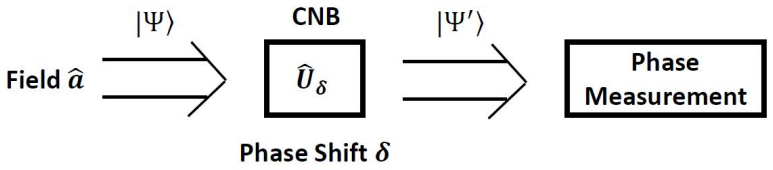
The load-bearing object is the differential phase shift induced by the $\sum_s (q_s^2/2m_s)\mathbf{A}^2(\mathbf{r}_s)$ term of the non-relativistic QED Hamiltonian, evaluated for a single-mode photon field to give $\hat H_{\rm int} = (\epsilon_\nu^2 e^2/m_\nu)(\hbar\omega^2/(16\pi^3\epsilon_0 c^3))(\hat a^\dagger\hat a+\tfrac12)N_\nu$. It carries the argument because it converts the number of charged relic neutrinos encountered along one interferometer arm into a unitary phase $e^{-i\hat N\delta}$ on the photon state. The second ingredient is the four-port Mach-Zehnder interferometer fed by a squeezed vacuum and a squeezed coherent state, with homodyne detection at the dark port, whose signal-to-noise formula lets the measurement run at standard-quantum, Heisenberg, or super-Heisenberg scaling in the phase-sensing photon number $N_{ps}$.
What would settle it
Recompute the phase shift using the difference in total charged-particle density $n_\nu+n_{\bar\nu}$ between the two arms rather than the asymmetry-based density in Eq. (5.2). If terrestrial accumulation creates only a neutrino--antineutrino swap with unchanged total density, the predicted SNR in Eq. (4.18) is zero and the quoted $\epsilon_\nu$ limits do not follow; a measurement of the local relic density at surface and underground depths would settle which quantity is non-zero.
Extended reading notes
Core claim
On the paper's own terms, the central claim is that the phase shift $$\delta = \frac{\epsilon_\$nu^{2}$ $e^{2}$}{m_\nu}\frac{\$omega^{2}$}{16\$pi^{3}$\epsilon_0 $c^{3}$}\,N_\nu t$$ produced by charged relic neutrinos in one arm of a Mach-Zehnder interferometer can be isolated by placing the other arm where the relic density is different, and that the resulting signal-to-noise ratio $$\mathrm{SNR} = \frac{\$alpha^{2}$(\mu+\nu)^2\$sin^{2}$\delta}{\$mu^{2}$+\$nu^{2}$-2\mu\nu\cos2\delta}$$ reaches the Heisenberg and super-Heisenberg scalings when the input is a squeezed vacuum plus a squeezed coherent state and the dark-port quadrature is read by homodyne detection. With the terrestrial asymmetry $|n_\nu-n_{\bar\nu}|/n_{\rm CNB}=10^{-8}$, arm length $L=1\,\mathrm{km}$, laser photon energy $1.17\,\mathrm{eV}$, and phase-sensing photon number $N_{ps}=10^{23}$, the minimum detectable fractional charge at $m_\nu=0.05\,\mathrm{eV}$ is $9.3\times10^{-11}$ in the standard quantum limit, $1.6\times10^{-16}$ at the Heisenberg limit, and $2.9\times10^{-22}$ at the super-Heisenberg limit. The paper argues that this is a laboratory route to the cosmic neutrino background that, in its best operating mode, surpasses the neutrality-of-matter bound and the existing stellar-cooling bounds.
Load-bearing premise
The projected sensitivities assume that the terrestrial neutrino--antineutrino asymmetry $|n_\nu-n_{\bar\nu}|/n_{\rm CNB}=10^{-8}$ directly sets the difference in charged relic-particle numbers seen by the two arms, even though the $q_s^2\mathbf{A}^2$ interaction counts neutrinos and antineutrinos with the same sign; without a total-density contrast the differential phase shift vanishes.
Editorial extensions
If this is right
- The same kilometre-scale interferometer technology used in gravitational-wave detectors could be redirected to a neutrino-charge search by giving one arm a vertical underground segment.
- If the super-Heisenberg operating mode is realized, the projected $\epsilon_\nu$ reach near $3\times10^{-22}$ would beat the strongest laboratory bound from neutrality of matter and the astrophysical bounds from magnetars and red giants.
- A detection would establish that relic neutrinos carry electric charge, which the paper notes would point to a Dirac mass origin and bear on electric-charge quantization.
- Because $\delta\propto\epsilon_\nu^2/m_\nu$, the reach in $\epsilon_\nu$ improves for lighter neutrinos; the paper's quoted $m_\nu=0.05\,\mathrm{eV}$ number is therefore the least favourable case across the $10^{-4}$ to $0.05\,\mathrm{eV}$ range it considers.
Reading between the lines
- The $q_s^2\mathbf{A}^2$ interaction is quadratic in charge and has the same sign for neutrinos and antineutrinos, so what must differ between the arms is the total charged-particle density $n_\nu+n_{\bar\nu}$, not just the $\nu$-$\bar\nu$ asymmetry; the paper adopts the asymmetry as the density contrast without deriving this step, and the quoted sensitivities stand or fall on it.
- If such a surface-to-underground density contrast exists, the same experiment could map the vertical profile of the terrestrial relic-neutrino overdensity, giving a direct measurement of how the Earth's weak potential bends neutrino trajectories.
- Because the phase grows linearly with particle number but only quadratically with charge, the layout is naturally suited to any abundant terrestrial millicharged population; extending it beyond the CNB would be a straightforward application.
Editorial analysis
A structured set of objections, weighed in public.
Referee Report
Summary. The manuscript proposes a Mach-Zehnder interferometer with one horizontal arm on the Earth's surface and one vertical arm underground to measure a phase shift induced by the terrestrial cosmic neutrino background interacting with photons, under the assumption that relic neutrinos carry a fractional electric charge. The terrestrial neutrino-antineutrino asymmetry of order 10^-8, taken from spherical-Earth analyses (Refs. [34–36]), is used in Eq. (5.2) to define the number N_nu entering the phase shift delta in Eq. (5.1). The authors derive SNR formulas for standard-quantum-limit, Heisenberg-limit, and super-Heisenberg-limit operation and quote projected sensitivities on the fractional neutrino charge as low as 9.3 x 10^-11, 1.6 x 10^-16, and 2.9 x 10^-22 for m_nu = 0.05 eV.
Significance. If the central calculation were correct, the proposal would constitute a genuinely new laboratory approach to constraining neutrino millicharge and could provide an indirect probe of the cosmic neutrino background. The paper usefully collects current astrophysical and laboratory bounds and provides a transparent quantum-optics treatment of the phase measurement. However, the key physical input—the use of the terrestrial neutrino-antineutrino asymmetry in a q^2 interaction—is not justified, and as written the differential phase between the two arms vanishes. The projected sensitivities therefore do not follow from the derivation.
major comments (2)
- [Sec. 5, Eq. (5.2); Sec. 3, Eq. (3.8)] The phase shift in Eq. (5.1) is derived from the interaction Hamiltonian in Eq. (3.8), which is proportional to sum_s q_s^2 A^2. For a Dirac millicharged neutrino, q_nubar = -q_nu, so q_nu^2 = q_nubar^2; neutrinos and antineutrinos contribute equally to the phase shift. The relevant density is therefore the total charged-particle density n_nu + n_nubar, not the asymmetry |n_nu - n_nubar|. Equation (5.2) nevertheless sets N_nu from n_nu* = |n_nu - n_nubar| = 10^-8 n_CNB, and the paper never shows that n_nu + n_nubar differs between the horizontal surface arm and the vertical underground arm. Absent such a difference, the differential phase between the two arms vanishes, and the projected sensitivities, including the headline 2.9 x 10^-22, do not follow from the derivation.
- [Sec. 5, Eq. (5.2)] The relation ntilde_nu = n_nu*^{1/3} is introduced without derivation. A three-dimensional number density cannot be converted into a number per unit length simply by taking a cube root; this implicitly assumes a particular transverse interaction volume or cross-section. Since N_nu enters delta linearly in Eq. (5.1), every sensitivity projection depends on this unstated assumption. If this step is imported from earlier work, it must be derived or explicitly referenced.
minor comments (4)
- [Throughout] The manuscript contains typographical errors such as "avaliable" (Sec. 1), "Moroeover" (Sec. 4), "sensititivy" (Sec. 5), "challange" (Sec. 6), and "Zender" (Sec. 4) that should be corrected before publication.
- [Sec. 5, Eq. (5.1)] The interaction time t in Eq. (5.1) is never explicitly defined; presumably t = L/c for a photon traversing an arm of length L, but this should be stated and used consistently.
- [Sec. 2, Eq. (2.2)] The notation -<m_nu U/k_nu^2> in Eq. (2.2) is not defined; the manuscript should clarify what the average is over and how this quantity is computed.
- [Sec. 4, Eqs. (4.1)–(4.3)] The squeezing parameter notation is inconsistent: the input states are written as |-r> and |-r,-i alpha> in the text, while Eq. (4.1) defines |r> in terms of S(r). The relation between these conventions should be clarified.
Circularity Check
No significant circularity: the predicted phase shift and sensitivity bounds follow algebraically from stated external inputs, and the authors' self-citations are contextual rather than load-bearing.
full rationale
Walking the derivation chain, the phase shift in Eq. (5.1) is obtained by comparing Eq. (3.8) with Eq. (3.9), and the SNR calculation in Eqs. (4.15)-(4.18) is carried out in the text; no parameter is fitted to the paper's own target observable. The projected limits are obtained by inverting the SNR condition for epsilon_nu using external inputs: n_CNB = 56 cm^-3, |n_nu - n_antinu|/n_CNB = 10^-8, N_ps = 10^23, L = 1 km, and the laser wavelength. These inputs are taken from Refs. [14,34-37,59-62] and from stated design choices, not from the paper's conclusion, so the projection is not statistically forced. Refs. [39] and [51] do share authors with the present paper, but they support a schematic figure and provide motivational context; the full derivation of the unitary phase shift and the quadrature variance is reproduced in Sections 3 and 4, so those self-citations are not load-bearing. I also flag, for the record, that Eq. (5.2) introduces N_nu = L n_nu*^{1/3} without derivation and that the q_s^2 structure of Eq. (3.8) means neutrinos and antineutrinos contribute with the same sign; however, these are physical-correctness or omitted-derivation concerns about the assumed signal, not cases where a claimed prediction reduces by construction to its input, so they do not raise the circularity score under the hard rules.
Assumptions & free parameters
free parameters (3)
- terrestrial neutrino asymmetry |n_nu - n_antinu|/n_CNB =
10^-8
- phase-sensing photon number N_ps =
10^23
- effective line-density exponent for N_nu =
1/3 (N_nu = L n_nu*^(1/3))
assumptions (4)
- domain assumption A terrestrial shell of relic neutrinos exists with |n_nu-n_antinu|/n_CNB ~ 10^-8 near Earth's surface and essentially zero a few meters away.
- ad hoc to paper The q_s^2 A^2 interaction phase shift can be evaluated using the asymmetry density n_nu* = |n_nu - n_antinu| rather than the total charged-particle density.
- domain assumption A Mach-Zehnder interferometer can operate at the Heisenberg or super-Heisenberg limit with N_ps = 10^23 photons.
- ad hoc to paper The vertical underground arm experiences no asymmetric CNB density while the horizontal surface arm experiences n_nu*, giving a non-zero differential phase.
Cite this review
Pith. "Pith review of Probing Terrestrial Relic Neutrino Charge with Mach-Zehnder Interferometer." pith.science (2026). https://pith.science/paper/SOSQTJH4
@misc{pith2026250604621,
  author       = {Pith},
  title        = {Pith review of: Probing Terrestrial Relic Neutrino Charge with Mach-Zehnder Interferometer},
  year         = {2026},
  howpublished = {\url{https://pith.science/paper/SOSQTJH4}},
  note         = {Machine review of arXiv:2506.04621}
}
abstract
We propose a novel method to probe the cosmic neutrino background (CNB) which has been shown to be accumulated on the surface of the earth. If such relic neutrino carries non-zero electric charge, Mach-Zehnder interferometer offers a suitable venue to unveil its interaction with photons. For neutrino mass equals to 0.05 eV, the sensitivity reach of our proposal could probe the fractional electric charge of the neutrino $\epsilon_{\nu}$ as low as $9.3 \times 10^{-11},\, 1.6 \times 10^{-16}$, and $2.9 \times 10^{-22}$ provided that the interferometer operates at standard quantum limit (SQL), the Heisenberg limit as well as super-Heisenberg limit, respectively.
Figures


Figures from the paper (1 more)

Forward citations
Cited by 2 Pith papers
-
Detection prospects for the Cosmic Neutrino Background using matter interferometers
The Cosmic Neutrino Background is predicted to induce phase shifts of ~1e-22 to 1e-14 rad in matter interferometers, far below current and near-future sensitivity.
-
Synchronization Induced by Ultralight Dark Matter
Ultralight dark matter is claimed to lock oscillator phases together once the coupling gω exceeds a mass-dependent threshold, with sensitivity projected for masses from 10^-14 eV to 1 eV.
Reference graph
Works this paper leans on
- [1]
-
[2]
R. Foot, G. C. Joshi, H. Lew and R. R. Volkas, Mod. Phys. Lett. A 5, 2721-2732 (1990) doi:10.1142/S0217732390003176
-
[3]
R. Foot, H. Lew and R. R. Volkas, J. Phys. G 19, 361-372 (1993) [erratum: J. Phys. G 19, 1067 (1993)] doi:10.1088/0954-3899/19/3/005 [arXiv:hep-ph/9209259 [hep-ph]]
arXiv 1993
-
[4]
K. S. Babu and R. N. Mohapatra, Phys. Rev. D 41, 271 (1990) doi:10.1103/PhysRevD.41.271
-
[5]
K. S. Babu and R. N. Mohapatra, Phys. Rev. Lett. 63, 228 (1989) doi:10.1103/PhysRevLett.63.228
-
[6]
V. Domcke and M. Spinrath, JCAP 06, 055 (2017) doi:10.1088/1475-7516/2017/06/055 [arXiv:1703.08629 [astro-ph.CO]]
arXiv 2017
-
[7]
J. D. Shergold, JCAP 11, no.11, 052 (2021) doi:10.1088/1475-7516/2021/11/052 [arXiv:2109.07482 [hep-ph]]
arXiv 2021
- [8]
Show all 71 references
-
[9]
Betts, W
S. Betts, W. R. Blanchard, R. H. Carnevale, C. Chang, C. Chen, S. Chidzik, L. Ciebiera, P. Cloessner, A. Cocco and A. Cohen, et al. [arXiv:1307.4738 [astro-ph.IM]]
-
[10]
I. K. Banerjee, U. K. Dey, N. Nath and S. S. Shariff, [arXiv:2304.02505 [hep-ph]]
-
[11]
Brdar, P
V. Brdar, P. S. B. Dev, R. Plestid and A. Soni, Phys. Lett. B 833, 137358 (2022) doi:10.1016/j.physletb.2022.137358 [arXiv:2207.02860 [hep-ph]]
2022
-
[12]
Mohammadi, J
R. Mohammadi, J. Khodagholizadeh, M. Sadegh, A. Vahedi and S. s. Xue, [arXiv:2109.00152 [hep-ph]]
- [13]
-
[14]
Arvanitaki and S
A. Arvanitaki and S. Dimopoulos, Phys. Rev. D 108, no.4, 043517 (2023) doi:10.1103/PhysRevD.108.043517 [arXiv:2212.00036 [hep-ph]]
2023 arXiv
-
[15]
Tsuchida, N
S. Tsuchida, N. Kanda, Y. Itoh and M. Mori, Phys. Rev. D 101 (2020) no.2, 023005 [arXiv:1909.00654 [astro-ph.HE]]
2020 arXiv
-
[16]
C. H. Lee, C. S. Nugroho and M. Spinrath, Eur. Phys. J. C 80, no.12, 1125 (2020) doi:10.1140/epjc/s10052-020-08692-3 [arXiv:2007.07908 [hep-ph]]
2020 arXiv
-
[17]
C. R. Chen and C. S. Nugroho, Phys. Rev. D 105, no.8, 083001 (2022) doi:10.1103/PhysRevD.105.083001 [arXiv:2111.11014 [hep-ph]]
2022 arXiv
-
[18]
M. A. Ismail, C. S. Nugroho and H. T. K. Wong, Phys. Rev. D 107, no.8, 082002 (2023) doi:10.1103/PhysRevD.107.082002 [arXiv:2211.13384 [hep-ph]]
2023 arXiv
-
[19]
C. H. Lee, R. Primulando and M. Spinrath, Phys. Rev. D 107, no.3, 035029 (2023) doi:10.1103/PhysRevD.107.035029 [arXiv:2208.06232 [hep-ph]]
2023 arXiv
-
[20]
Seto and A
N. Seto and A. Cooray, Phys. Rev. D 70 (2004), 063512 [arXiv:astro-ph/0405216 [astro- ph]]
2004 arXiv
-
[21]
A. W. Adams and J. S. Bloom, [arXiv:astro-ph/0405266 [astro-ph]]
-
[22]
C. S. Nugroho, Eur. Phys. J. C 85, no.3, 226 (2025) doi:10.1140/epjc/s10052-025-13985-6 [arXiv:2406.04788 [hep-ph]]
2025 arXiv
-
[23]
C. J. Riedel, Phys. Rev. D 88 (2013) no.11, 116005 [arXiv:1212.3061 [quant-ph]]
2013 arXiv
-
[24]
Y. V. Stadnik and V. V. Flambaum, Phys. Rev. Lett.114 (2015) 161301 [arXiv:1412.7801 [hep-ph]]
2015 arXiv
-
[25]
Arvanitaki, S
A. Arvanitaki, S. Dimopoulos and K. Van Tilburg, Phys. Rev. Lett. 116 (2016) no.3, 031102 [arXiv:1508.01798 [hep-ph]]
2016 arXiv
-
[26]
Y. V. Stadnik and V. V. Flambaum, Phys. Rev. A 93 (2016) no.6, 063630 [arXiv:1511.00447 [physics.atom-ph]]
2016 arXiv
-
[27]
Branca et al., Phys
A. Branca et al., Phys. Rev. Lett. 118 (2017) no.2, 021302 [arXiv:1607.07327 [hep-ex]]
2017 arXiv
-
[28]
C. J. Riedel and I. Yavin, Phys. Rev. D 96 (2017) no.2, 023007 [arXiv:1609.04145 [quant- ph]]. 11
2017 arXiv
-
[29]
E. D. Hall, R. X. Adhikari, V. V. Frolov, H. M¨ uller, and M. Pospelov, Phys. Rev. D 98 (2018) no.8, 083019 [arXiv:1605.01103 [gr-qc]]
2018 arXiv
-
[30]
Jung and C
S. Jung and C. S. Shin, Phys. Rev. Lett. 122 (2019) no.4, 041103 [arXiv:1712.01396 [astro-ph.CO]]
2019 arXiv
-
[31]
Pierce, K
A. Pierce, K. Riles and Y. Zhao, Phys. Rev. Lett. 121 (2018) no.6, 061102 [arXiv:1801.10161 [hep-ph]]
2018 arXiv
-
[32]
Morisaki and T
S. Morisaki and T. Suyama, Phys. Rev. D 100 (2019) no.12, 123512 [arXiv:1811.05003 [hep-ph]]
2019 arXiv
-
[33]
Grote and Y
H. Grote and Y. V. Stadnik, Phys. Rev. Research. 1 (2019) 033187 [arXiv:1906.06193 [astro-ph.IM]]
2019 arXiv
-
[34]
Kalia, Phys
S. Kalia, Phys. Rev. D 110, no.5, 053001 (2024) doi:10.1103/PhysRevD.110.053001 [arXiv:2404.11664 [hep-ph]]
2024 arXiv
-
[35]
G. y. Huang, JHEP 11, 153 (2024) doi:10.1007/JHEP11(2024)153 [arXiv:2401.07347 [hep-ph]]
2024 arXiv
- [36]
-
[37]
Ringwald and Y
A. Ringwald and Y. Y. Y. Wong, JCAP 12, 005 (2004) doi:10.1088/1475- 7516/2004/12/005 [arXiv:hep-ph/0408241 [hep-ph]]
2004 arXiv
-
[38]
C. C. Tannoudji, J. D. Roc, and G. Grynberg, Photons and Atoms In- troduction to Quantum Electrodynamics, John Wiley and Sons (1987), doi:https://doi.org/10.1002/9783527618422.ch3
1987 doi
-
[39]
C. S. Nugroho, Phys. Dark Univ. 46, 101557 (2024) doi:10.1016/j.dark.2024.101557 [arXiv:2302.08246 [hep-ph]]
2024
-
[40]
E. T. Jaynes and F. W. Cummings, IEEE Proc. 51, 89-109 (1963) doi:10.1109/PROC.1963.1664
1963
-
[41]
J. C. Garrison and R. Y. Chiao, Quantum Optics, Oxford University Press (2008), doi:https://doi.org/10.1093/acprof:oso/9780198508861.001.0001
2008
-
[42]
Fox, Quantum Optics: An Introduction, Oxford University Press (2006)
M. Fox, Quantum Optics: An Introduction, Oxford University Press (2006)
2006
-
[43]
F. X. Kartner and H. A. Haus, Phys. Rev. A 65, p. 4585 (1993)
1993
-
[44]
Z. Y. J. Ou, Quantum Optics for Experimentalists, World Scientific (2017)
2017
-
[45]
P. A. M. Dirac Proc. R. Soc. London Ser. A 114, p.243 (1927)
1927
-
[46]
Heitler, The Quantum Theory of Radiation, 3rd edn., Oxford University Press, Lon- don (1954)
W. Heitler, The Quantum Theory of Radiation, 3rd edn., Oxford University Press, Lon- don (1954)
1954
-
[47]
B. P. Abbott et al. [LIGO Scientific and Virgo], Phys. Rev. Lett. 116, no.6, 061102 (2016) doi:10.1103/PhysRevLett.116.061102 [arXiv:1602.03837 [gr-qc]]
2016 arXiv
-
[48]
R. S. Bondurant and J. H. Shapiro Phys. Rev. D 30, p. 2548 (1984). 12
1984
-
[49]
Grangier, R
P. Grangier, R. E. Slusher, B. Yurke, and A. Laporta, Phys. Rev. Lett.59, p.2153 (1987)
1987
-
[50]
M. Xiao, L. A. Wu, and H. J. Kimble Phys. Rev. Lett. 59, p.278 (1987)
1987
-
[51]
C. R. Chen, B. H. Nhung and C. S. Nugroho, Phys. Lett. B 839, 137764 (2023) doi:10.1016/j.physletb.2023.137764 [arXiv:2212.13017 [hep-ph]]
2023
-
[52]
and Lewis-Swan, Robert J
Szigeti, Stuart S. and Lewis-Swan, Robert J. and Haine, Simon A., Phys. Rev. Lett. 118, 150401 (2017). https://link.aps.org/doi/10.1103/PhysRevLett.118.150401
2017 doi
-
[53]
and Strobel, H
Linnemann, D. and Strobel, H. and Muessel, W. and Schulz, J. and Lewis-Swan, R. J. and Kheruntsyan, K. V. and Oberthaler, M. K., Phys. Rev. Lett. 117, 013001 (2016). https://link.aps.org/doi/10.1103/PhysRevLett.117.013001
2016 doi
-
[54]
Daryanoosh Shakib, Slussarenko Sergei, Berry Dominic W., Wiseman Howard M., Pryde Geoff J., Nat. Commun. 9, 4606 (2018). https://doi.org/10.1038/s41467-018-06601-7
2018 doi
-
[55]
and Schmittberger, Bonnie L
Anderson, Brian E. and Schmittberger, Bonnie L. and Gupta, Prasoon and Jones, Kevin M. and Lett, Paul D., Phys. Rev. A 95, 063843 (2017). https://doi.org/10.1103/PhysRevA.95.063843
2017 doi
-
[56]
J., Mitchell M
Napolitano M., Koschorreck M., Dubost B., Behbood N., Sewell R. J., Mitchell M. W., Nature 471, 486–489 (2011). https://doi.org/10.1038/nature09778
2011 doi
-
[57]
Napolitano and M
M. Napolitano and M. Koschorreck and B. Dubost and N. Behbood and R.J. Sewell and M.W. Mitchell, Opt. Photon. News. 22, pp. 40-40 (2011). https://doi.org/10.1364/OPN.22.12.000040
2011 doi
-
[58]
L. Qin, J. Li, Y. Niu and X. Q. Li, Phys. Lett. A 523, 129795 (2024) doi:10.1016/j.physleta.2024.129795 [arXiv:2308.08113 [quant-ph]]
2024
-
[59]
A. S. Chou et al. [GammeV (T-969)], Phys. Rev. Lett. 100, 080402 (2008) doi:10.1103/PhysRevLett.100.080402 [arXiv:0710.3783 [hep-ex]]
2008 arXiv
-
[60]
B¨ ahre, B
R. B¨ ahre, B. D¨ obrich, J. Dreyling-Eschweiler, S. Ghazaryan, R. Hodajerdi, D. Horns, F. Januschek, E. A. Knabbe, A. Lindner and D. Notz, et al. JINST 8, T09001 (2013) doi:10.1088/1748-0221/8/09/T09001 [arXiv:1302.5647 [physics.ins-det]]
2013 arXiv
-
[61]
Ehret et al
K. Ehret et al. [ALPS], Nucl. Instrum. Meth. A 612, 83-96 (2009) doi:10.1016/j.nima.2009.10.102 [arXiv:0905.4159 [physics.ins-det]]
2009 arXiv
-
[62]
Inada, T
T. Inada, T. Namba, S. Asai, T. Kobayashi, Y. Tanaka, K. Tamasaku, K. Sawada and T. Ishikawa, Phys. Lett. B 722, 301-304 (2013) doi:10.1016/j.physletb.2013.04.033 [arXiv:1301.6557 [physics.ins-det]]
2013 arXiv
-
[63]
A. Das, D. Ghosh, C. Giunti and A. Thalapillil, Phys. Rev. D 102, no.11, 115009 (2020) doi:10.1103/PhysRevD.102.115009 [arXiv:2005.12304 [hep-ph]]
2020 arXiv
-
[64]
A. Fung, S. Heeba, Q. Liu, V. Muralidharan, K. Schutz and A. C. Vincent, Phys. Rev. D 109, no.8, 083011 (2024) doi:10.1103/PhysRevD.109.083011 [arXiv:2309.06465 [hep-ph]]
2024 arXiv
-
[65]
Navas et al
S. Navas et al. [Particle Data Group], Phys. Rev. D 110, no.3, 030001 (2024) doi:10.1103/PhysRevD.110.030001 13
2024 doi
-
[66]
S. G. Karshenboim, Eur. Phys. J. D 79, no.4, 28 (2025) doi:10.1140/epjd/s10053-025- 00964-5 [arXiv:2406.19129 [hep-ph]]
2025 arXiv
-
[67]
Giunti, K
C. Giunti, K. Kouzakov, Y. F. Li and A. Studenikin, doi:10.1146/annurev-nucl-102122- 023242 [arXiv:2411.03122 [hep-ph]]
-
[68]
Caprini, S
C. Caprini, S. Biller and P. G. Ferreira, JCAP 02, 006 (2005) doi:10.1088/1475- 7516/2005/02/006 [arXiv:hep-ph/0310066 [hep-ph]]
2005 arXiv
-
[69]
Abe et al
K. Abe et al. [XMASS], Phys. Lett. B 809, 135741 (2020) doi:10.1016/j.physletb.2020.135741 [arXiv:2005.11891 [hep-ex]]
2020
-
[70]
Atzori Corona, W
M. Atzori Corona, W. M. Bonivento, M. Cadeddu, N. Cargioli and F. Dordei, Phys. Rev. D 107, no.5, 053001 (2023) doi:10.1103/PhysRevD.107.053001 [arXiv:2207.05036 [hep-ph]]
2023 arXiv
-
[71]
Bressi G, Carugno G, valle FD, Galeazzi G, Ruoso G, et al. Phys. Rev. A83(5):052101 (2011) 14
2011
Reviewed August 7, 2026 · model on record in the stance chip above.
Discussion (0). Sign in to comment.