REVIEW 5 major objections 5 minor 13 references
Predicting ICU In-Hospital Mortality Using Adaptive Transformer Layer Fusion
T0 review · 5 major / 5 minor · reviewed 2026-08-07 · deepseek-v4-flash
Pith's one-line read ALFIA's adaptive layer fusion beats strong tabular classifiers on ICU mortality AUPRC, and its embeddings add 2–3 more points when fed to gradient-boosted trees.
desk verdict A careful empirical study with a reproducible benchmark and a small, plausible AUPRC gain over tabular baselines, but the gain is over-attributed to adaptive layer fusion because no same-backbone text-only control is run. read the letter →
The pith
A machine-rendered reading of the paper's core claim, the machinery that carries it, and where it could break.
The reading
What carries the argument
The load-bearing component is the Adaptive Layer Fusion (ALF) module. For each of the top $N_f$ transformer layers it forms an attention-masked average-pooled summary, computes a cross-layer attention score against a global query, and optionally passes the result through a sigmoid gate to obtain layer weights $\lambda_j$; the full hidden-state sequences are then combined as $\mathbf{h}^{\mathrm{fused}}_t = \sum_{j=1}^{N_f} \lambda_j \mathbf{h}^{(L-N_f+j)}_t$. After a post-fusion block of LayerNorm, residual, and GELU layers, local token-level attention and global masked-mean pooling are concatenated and fused into $H^{\mathrm{ALF}}_{\mathrm{out}}$, which the Attentional Classifier Head (multi-head self-attention plus a feed-forward network) turns into logits. LoRA adapters keep the BERT backbone trainable at low rank. These learned weights are what the paper credits for separating survivor and non-survivor clusters in UMAP and for the AUPRC gains.
What would settle it
Retrain ALFIA on the cw-24 MIMIC-IV split with a single layer (no fusion) and with uniform layer weights, and separately score a TF-IDF/linear baseline on the same templated text. If AUPRC stays inside ALFIA's reported 0.585 (95% CI 0.552–0.617) under either change, the adaptive fusion is not the source of the claimed improvement.
Extended reading notes
Core claim
ALFIA's central claim is that adaptive fusion of hidden layers is what lets a pre-trained language model outperform tabular classifiers on imbalanced ICU mortality data. Operationally, the paper encodes each 24-hour patient record as a sentence, runs a BioLinkBERT-large backbone with LoRA adapters, and learns layer weights over the top four hidden states through cross-layer attention and a sigmoid gate; the weighted token sequence is pooled into local and global contexts and passed through an attention head that predicts hospital mortality. On the MIMIC-IV cw-24 test split this reaches AUPRC 0.585 (95% CI 0.552–0.617) versus 0.577 for the AutoGluon ensemble and 0.566 for FT-Transformer, at AUROC 0.894; on external eICU the MIMIC-trained model leads the GBDT and FT-Transformer baselines by about 1.5 AUPRC points. The same fused embedding, combined with original features and handed to CatBoost, LightGBM, XGBoost, or a neural net (ALFIA-boost and ALFIA-nn), raises AUPRC by another 2–3 points, which the authors read as evidence that the fusion module produces a task-optimized latent representation rather than a mere classifier improvement.
Load-bearing premise
The load-bearing premise is that turning the 133-field tabular record into the fixed sentence template neither hides nor adds information, so ALFIA's AUPRC edge comes from what the fusion module learns and not from wording, field order, or other surface regularities of the template.
Editorial extensions
If this is right
- On the MIMIC-IV cw-24 test split, ALFIA reports AUPRC 0.585, ahead of the AutoGluon ensemble (0.577) and FT-Transformer (0.566), which is the paper's headline comparison.
- The ALFIA-boost and ALFIA-nn variants, which feed ALF embeddings plus original features to CatBoost, LightGBM, XGBoost, or a neural net, claim an additional 2–3 AUPRC points over the tabular baselines.
- A model trained on MIMIC-IV and evaluated on eICU keeps an AUPRC lead of about 1.5 points over GBDTs and FT-Transformer, suggesting the learned fusion transfers across institutions.
- Inference on an RTX 4090 runs at 8–9 ms per sample with 1–3 GB memory, which the authors argue is practical for clinical early-warning systems.
- On 100-case cross-dataset samples, ALFIA's AUPRC and AUROC exceed both participating ICU specialists' scores, supporting the claim that the tool can aid expert risk stratification.
Reading between the lines
- A direct test the paper leaves open: run a linear or TF-IDF model on the same templated sentences and permute the template's field order. If AUPRC stays near 0.585, the edge is in the text encoding, not in layer fusion.
- The 24-hour window is the only one tested; the natural extension is shorter windows (6h, 12h). If fusion is most valuable when signal is sparse, the AUPRC gap over tabular baselines should widen as the window shrinks.
- Because cw-24's text is generated from structured fields, the claim of operating on 'routine clinical text' has not been tested on genuine free-text notes; feeding ALFIA real MIMIC-IV narratives would decide that.
- The learned per-layer weights $\lambda_j$ could be reported as patient-level explanations; if they track severity, they could double as an interpretability map or an alert-threshold modulator. The paper shows the weight heatmap but does not explore this use.
Editorial analysis
A structured set of objections, weighed in public.
Referee Report
Summary. The paper introduces ALFIA, an architecture that combines a LoRA-adapted BERT backbone with an adaptive layer-fusion (ALF) module and an attentional classifier head (ACH), and evaluates it on a new benchmark, cw-24, built from MIMIC-IV and eICU. The input to ALFIA is a templated text rendering of a 133-dimensional tabular feature matrix. The central claim is that ALFIA outperforms tabular classifiers such as AutoGluon's ensemble in AUPRC (0.585 vs 0.577 on MIMIC-IV) and that embedding-plus-GBDT variants (ALFIA-boost) yield further gains of 2 to 3 AUPRC points. External validation on eICU and a comparison with ICU specialists are also reported.
Significance. If the central claim is sustained, the adaptive layer-fusion module would be a reproducible architectural contribution for clinical mortality prediction from structured ICU data. The paper has genuine strengths: a public code and data repository, a fixed random seed for reproducibility, a genuinely held-out test split, external validation on eICU, and a broad set of baselines including an AutoGluon ensemble. The latent-space analysis (Section 3.4) is a valuable attempt to explain why the fused embeddings separate mortality from survival. However, as written, the paper does not establish that the adaptive layer-fusion module, rather than the transformer backbone or the text template, is responsible for the reported improvement, and several load-bearing claims are unsupported by the evidence presented.
major comments (5)
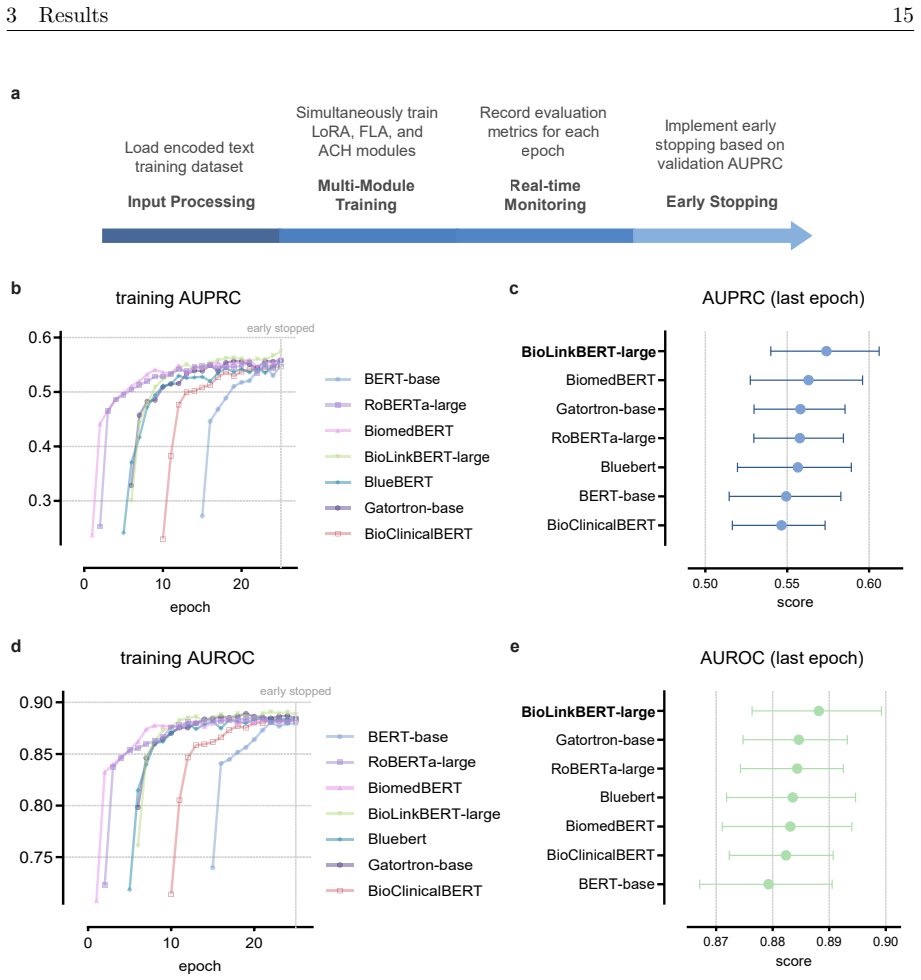
- [Section 3.2, Table 3] The experimental design cannot attribute the reported AUPRC advantage to the ALF module. ALFIA consists of BioLinkBERT + LoRA + ALF + ACH consuming templated text, while the strongest baselines (AutoGluon ensemble, LightGBM, FT-Transformer) consume tabular features. There is no row in Table 3 for the same BioLinkBERT + LoRA backbone with standard CLS/mean pooling and a plain classification head on the identical templated text. Figure 6b,c compares ALF embeddings against CLS/max/mean pooling only through nnFastAI, not in the end-to-end training setup of Table 3, and no numeric results are reported in the text. Without this control, the headline gain (0.585 vs 0.577) may reflect the text modality or the biomedical backbone rather than adaptive layer fusion. Please add this ablation and report numeric results.
- [Abstract and Section 2.2] The abstract's claim that ALFIA operates "directly on routine clinical text" is unsupported because the input is a generated template derived from 133 structured features (Section 2.2, Figure 1B), not actual clinical notes. This overstatement recurs in the Introduction and Discussion. Additionally, Section 2.4's statement that "All compared models use tabular data (encoded as text) as input" is contradicted by Section 3.4's description of the "original feature engineering matrix ... 133 dimensions" used by AutoGluon; please clarify exactly which baselines saw the text and which saw the raw tabular matrix, since this determines whether the comparison isolates the text encoder.
- [Section 3.2, Table 3, Discussion Section 4] The claimed consistent superiority of ALFIA is not statistically supported. The AUPRC advantage over the AutoGluon ensemble (0.585, CI 0.552-0.617, vs 0.577, CI 0.540-0.609) is within overlapping confidence intervals, and no significance test (e.g., bootstrap or a paired test for AUPRC) is reported. Moreover, ALFIA is numerically below AutoGluon on AUROC (0.894 vs 0.899), F1 (0.552 vs 0.554), and F2 (0.635 vs 0.653) in the same table. The Discussion's "significantly higher" regarding the AUPRC advantage is therefore not justified. Report paired tests and either demonstrate significance or soften the claim.
- [Section 3.3, Figure 5] The external eICU validation is presented through figures without a numeric table, and the two eICU analyses appear inconsistent: Figure 5a shows external eICU AUPRC values in the 0.28-0.36 range, while Figure 4's eICU panels show AUPRC values around 0.45-0.60 for the same method classes. The authors should clarify which protocol each figure reports (the mapping/imputation protocol described in Section 3.3 versus the direct eICU test set), and provide point estimates with confidence intervals for the external validation claim of "gains of about 1.5 percentage points."
- [Section 3.3, Figures 5e,f] The expert comparison is under-specified: it is not reported what information the two ICU specialists were shown (the generated template, the raw tabular features, or full clinical charts), how they were asked to produce a mortality probability, and how their confidence intervals were computed. As described, the claim that "our model surpassed clinical specialists in previously unencountered cases" is not verifiable and should either be fully specified or removed.
minor comments (5)
- [Table 3 caption] The Table 3 caption does not state that results are for the MIMIC-IV cw-24 test split; eICU results appear only in figures, so please add a numeric table for eICU or state explicitly which dataset Table 3 covers.
- [Figure 3a] Figure 3a refers to simultaneous optimization of "LoRA, FLA, and ACH modules," but the acronym FLA is never defined; presumably it means the Adaptive Layer Fusion (ALF) module, so please correct the label.
- [Figure 1a] The patient-selection flow diagram in Figure 1a contains internally inconsistent numbers (for example, the text reports 157,883 eICU admissions with 8.77% mortality, while the diagram shows different totals and percentages such as 156,466 and 91.2%); please redraw the diagram with consistent cohort counts.
- [Section 3.4] It is unclear whether the CLS/max/mean pooling embeddings used in Figure 6b,c are computed from the LoRA-finetuned BioLinkBERT or from the frozen pretrained model; the comparison is only meaningful if all embeddings come from the same fine-tuned backbone, so please state this explicitly.
- [Throughout] The paper uses "PRAUC" in the Table 3 caption and "AUPRC" elsewhere; please unify the terminology.
Circularity Check
ALFIA's main held-out result is independent, but the ALFIA-boost/nn 'confirmation' experiment is described as training on test-set embeddings, making its reported gains fitted rather than predicted.
-
fitted input called prediction
[Section 3.2, paragraph following Table 3]
"To confirm our technique, we ran additional experiments that combined the embeddings generated by the ALF module from training, validation, and test sets with original features and fed them into mainstream machine learning algorithms for further training. This effectively replaces the previous attention-based classification head. This practice resulted in significant performance increases, with gains of around 2-3 percentage points over baseline procedures."
The sentence states that embeddings 'from training, validation, and test sets' were fed into algorithms 'for further training'; therefore the derivative ALFIA-boost/nn models are fitted with evaluation-set data. The reported 2-3 percentage point improvement is then not a held-out prediction but a score computed on data that participated in fitting, so the gain is forced by construction. If the protocol was intended to be train/validation-only fitting, the published text does not say so, and as written it describes the opposite.
full rationale
The centrally advertised ALFIA result (Table 3: AUPRC 0.585 vs AutoGluon 0.577 on MIMIC-IV, with external eICU evaluation) rests on a held-out test split and an independently hosted external dataset, so that claim has independent content and is not circular. The ALF module is learned from the training data and is not defined in terms of the target outcome. The one step that reduces by construction is the ALFIA-boost/nn confirmation: its text places test-set embeddings into further training, so the reported gains are fitted evaluation-set scores rather than predictions. The absence of a same-backbone BERT/LoRA-without-ALF ablation weakens attribution of the headline AUPRC gain to the fusion module, but that is an experimental-control gap rather than circularity. No load-bearing self-citation or imported uniqueness theorem appears in the derivation chain.
Assumptions & free parameters
free parameters (8)
- Number of fused layers (N_fuse) =
4
- LoRA rank r =
16
- LoRA alpha =
16
- LoRA dropout =
0.05
- ACH attention heads =
4
- BCEWithLogitsLoss pos_weight =
not reported
- Learning rate, batch size, optimizer, warmup, max epochs =
not reported
- Early stopping patience =
5
assumptions (7)
- standard math Transformer hidden states H^(l) and attention operations behave as specified in Vaswani et al. (2017) and Devlin et al. (2019).
- domain assumption Templated text generated from tabular fields preserves all predictive information and adds no systematic artifact that baselines lack.
- domain assumption AUPRC is the appropriate primary metric for this imbalanced mortality task.
- domain assumption Severity scores (APACHE III/IV, SAPS II, SOFA, GCS, LODS, OASIS) recorded in the first 24 hours are valid predictors of hospital mortality.
- domain assumption Mode-imputed intersection features between eICU and MIMIC-IV remain clinically valid inputs for cross-dataset evaluation.
- domain assumption Pre-trained biomedical LMs (e.g., BioLinkBERT) transfer to templated clinical descriptions.
- domain assumption No future information beyond the 24-hour cutoff entered the predictive variables.
invented entities (2)
-
ALF (Adaptive Layer Fusion) module
-
CW-24 (CriticalWindow-24) benchmark
independent evidence
Cite this review
Pith. "Pith review of Predicting ICU In-Hospital Mortality Using Adaptive Transformer Layer Fusion." pith.science (2026). https://pith.science/paper/OWIGVM2F
@misc{pith2026250604924,
  author       = {Pith},
  title        = {Pith review of: Predicting ICU In-Hospital Mortality Using Adaptive Transformer Layer Fusion},
  year         = {2026},
  howpublished = {\url{https://pith.science/paper/OWIGVM2F}},
  note         = {Machine review of arXiv:2506.04924}
}
read the original abstract
Early identification of high-risk ICU patients is crucial for directing limited medical resources. We introduce ALFIA (Adaptive Layer Fusion with Intelligent Attention), a modular, attention-based architecture that jointly trains LoRA (Low-Rank Adaptation) adapters and an adaptive layer-weighting mechanism to fuse multi-layer semantic features from a BERT backbone. Trained on our rigorous cw-24 (CriticalWindow-24) benchmark, ALFIA surpasses state-of-the-art tabular classifiers in AUPRC while preserving a balanced precision-recall profile. The embeddings produced by ALFIA's fusion module, capturing both fine-grained clinical cues and high-level concepts, enable seamless pairing with GBDTs (CatBoost/LightGBM) as ALFIA-boost, and deep neuro networks as ALFIA-nn, yielding additional performance gains. Our experiments confirm ALFIA's superior early-warning performance, by operating directly on routine clinical text, it furnishes clinicians with a convenient yet robust tool for risk stratification and timely intervention in critical-care settings.
Figures


Figures from the paper (2 more)


Reference graph
Works this paper leans on
-
[1]
10, 2016]), https://doi.org/10.1007/978- 3-319-43742-2_21
Lee, J, Dubin, JA & Maslove, DM, in Secondary Analysis of Electronic Health Records [Internet] (Springer, [Sept. 10, 2016]), https://doi.org/10.1007/978- 3-319-43742-2_21
doi:10.1007/978- 2016
-
[2]
Wang, L, Guo, X, Shi, H, Ma, Y, Bao, H, Jiang, L, Zhao, L, Feng, Z, Zhu, T & Lu, L, CRISP: A causal relationships- guided deep learning framework for ad- vanced ICU mortality prediction, BMC Medical Informatics and Decision Making 25, 165, https : / / doi . org / 10 . 1186 / s12911-025-02981-1 ([Apr. 15, 2025])
work page 2025
-
[3]
Devlin, J, Chang, MW, Lee, K & Toutanova,K, BERT: Pre-training of Deep Bidirectional Transformers for Language Understanding, (May 24, 2019),https:// doi.org/10.48550/arXiv.1810.04805
-
[4]
16, 2021),https:// doi.org/10.48550/arXiv.2106.09685
Hu, EJ, Shen, Y, Wallis, P, Allen-Zhu, Z, Li, Y, Wang, S, Wang, L & Chen, W, LoRA: Low-Rank Adaptation of Large Lan- guage Models,(Oct. 16, 2021),https:// doi.org/10.48550/arXiv.2106.09685
-
[5]
Johnson, AEW, Bulgarelli, L, Shen, L, Gayles, A, Shammout, A, Horng, S, Pol- lard, TJ, Hao, S, Moody, B, Gow, B, Lehman, LwH, Celi, LA & Mark, RG, MIMIC-IV, a freely accessible electronic health record dataset, Scientific Data10, Publisher: Nature Publishing Group, 1, https : / / doi . org / 10 . 1038 / s41597 - 022-01899-x ([Jan. 3, 2023])
work page 2023
-
[6]
Pollard, TJ, Johnson, AEW, Raffa, JD, Celi, LA, Mark, RG & Badawi, O, The eICU Collaborative Research Database, a freely available multi-center database for critical care research, Scientific Data References 21 5, Publisher: Nature Publishing Group, 180178, https : / / doi . org / 10 . 1038 / sdata.2018.178 ([Sept. 11, 2018])
work page 2018
-
[7]
Vaswani, A, Shazeer, N, Parmar, N, Uszko- reit, J, Jones, L, Gomez, AN, Kaiser, L & Polosukhin, I,Attention Is All You Need, (Aug. 2, 2023), https : / / doi . org / 10 . 48550/arXiv.1706.03762
-
[8]
Liu, Y, Ott, M, Goyal, N, Du, J, Joshi, M, Chen, D, Levy, O, Lewis, M, Zettle- moyer, L & Stoyanov, V,RoBERTa: A Robustly Optimized BERT Pretraining Ap- proach, (July 26, 2019), https : / / doi . org/10.48550/arXiv.1907.11692
Show all 13 references
-
[9]
org / 10
Lee, J, Yoon, W, Kim, S, Kim, D, Kim, S, So, CH & Kang, J, BioBERT: a pre- trained biomedical language representa- tion model for biomedical text mining, Bioinformatics 36, 1234–1240, https:// doi . org / 10 . 1093 / bioinformatics / btz682 ([Feb. 15, 2020])
2020
- [10]
-
[11]
Ke, G, Meng, Q, Finley, T, Wang, T, Chen, W, Ma, W, Ye, Q & Liu, TY,LightGBM: A Highly Efficient Gradient Boosting Deci- sion Tree,in Advances in Neural Informa- tion Processing Systems30 (Curran Asso- ciates, Inc., [2017])
2017
-
[12]
org / 10
Hollmann, N, Müller, S, Purucker, L, Krishnakumar, A, Körfer, M, Hoo, SB, Schirrmeister, RT & Hutter, F, Accurate predictions on small data with a tabu- lar foundation model, Nature637, Pub- lisher: Nature Publishing Group, 319–326, https : / / doi . org / 10 . 1038 / s41586 -...
2025
- [13]
Reviewed August 7, 2026 · model on record in the stance chip above.
Discussion (0). Sign in to comment.