REVIEW 2 major objections 6 minor 2 cited by
Blocklet concatenation: Low-overhead fault-tolerant protocols for fusion-based quantum computation
T0 review · 2 major / 6 minor · reviewed 2026-08-15 · deepseek-v4-flash
Pith's one-line read Blocklet concatenation turns a code's syndrome-readout circuit into a transversal gate, yielding fault-tolerant fusion networks with constant-sized resource states and erasure thresholds up to 19.1%.
desk verdict Genuinely new blocklet concatenation construction with strong simulated thresholds, but the footprint scalings that beat surface codes rest on an unproven distance conjecture and the threshold numbers lack error bars. read the letter →
The pith
A machine-rendered reading of the paper's core claim, the machinery that carries it, and where it could break.
The reading
What carries the argument
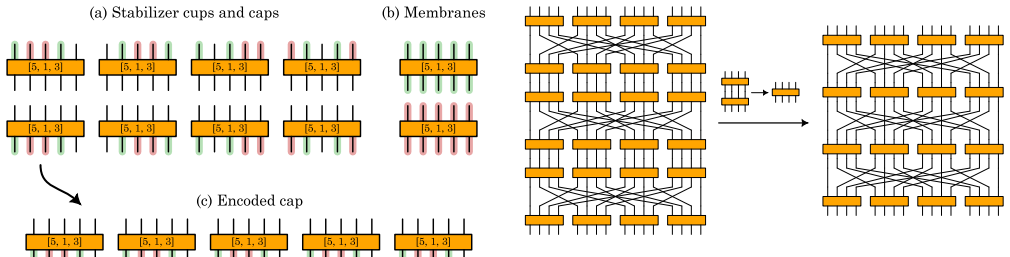
The blocklet is the central object: a $2n$-qubit resource state that is a Bell pair with both ends encoded in the same $[n,k,d]$ code, represented as a box in a ZX diagram whose Pauli webs split into cups, caps, and membranes. The concatenation prescription replaces each blocklet with two layers of $n$ blocklets connected transversally, so every check and logical operator gets re-encoded while the resource state itself is unchanged. The mechanism is carried by encoded Pauli webs: cups from one layer and membranes from the other reassemble into encoded cups, caps, and product checks, which is what makes the hierarchy of checks and the distance growth possible.
What would settle it
Exhaustively search small concatenated protocols, such as $[7,1,3]^3$ or $[5,1,3]^3$, for undetectable error strings of weight below $c\cdot d^L$; finding one, or observing subthreshold logical-error-rate exponents inconsistent with $c\cdot d^L$, would refute the distance conjecture and invalidate the $O(d)$, $O(d^{1.46})$, and $O(d^{0.58})$ footprint claims.
Extended reading notes
Core claim
The central discovery is that the syndrome-readout circuit of an $[n,k,d]$ stabilizer code is itself a transversal operation of that code (for CSS codes, and specially for the five-qubit code), so executing that readout transversally across $n$ code blocks implements one level of code concatenation using only the original low-weight measurements. The corresponding $2n$-qubit resource state, called a blocklet, is an encoded Bell pair; chaining blocklets and applying the same prescription repeatedly produces $[n,k,d]^L$ protocols whose resource state stays identical at every level while the code distance grows. Encoded cups, caps, and membranes—Pauli webs of the blocklet—combine to form hierarchical checks and logical operators. Simulated erasure thresholds for the $[4,2,2]$, $[5,1,3]$, and $[6,4,2]$ families are 13.8%, 19.1%, and 11.5%, and the paper conjectures distances $c\cdot d^L$ (Appendix A) that give footprint scalings $O(d)$, $O(d^{1.46})$, and $O(d^{0.58})$.
Load-bearing premise
The claimed footprint advantage over surface codes rests on the unproved conjecture that the code distance of an $[n,k,d]^L$ blocklet protocol is $c\cdot d^L$ with $c = d_{\mathrm{prod}}/d^2$, supported by subthreshold simulation data but not proven.
Editorial extensions
If this is right
- $[4,2,2]$ blocklet protocols use an 8-qubit resource state, have a 13.8% erasure threshold, and $O(d)$ footprint per logical qubit, exceeding the 12.0–12.7% thresholds and $d^2$ footprint of the surface-code baselines under the distance conjecture.
- $[5,1,3]$ blocklet protocols reach a 19.1% erasure threshold with 10-qubit resource states, and their footprint scales as about $0.47 d^{1.46}$.
- $[6,4,2]$ blocklet protocols use 12-qubit resource states, have an 11.5% threshold, and about $(1/6) d^{0.58}$ footprint, while encoding $k^L$ logical qubits per block.
- Blocklet protocols support universal computation: logical GHZ-state preparation, Hadamard and state injection for CSS codes, special logical operations for the $[5,1,3]$ code, and selective addressing of individual logical qubits for $k>1$.
- The hierarchical decoder decodes a distance-$d$ protocol in $O(\log d)$ parallel steps; for $[5,1,3]$ it gives a 16.7% erasure crossing versus 19.1% for the optimal decoder and a 1.7% Pauli-error crossing, and the protocols can be implemented with interleaving modules using $O(\log d)$ switchable delay lines.
Reading between the lines
- If the distance conjecture is proved, the $O(d)$ footprint of the $[4,2,2]$ family would make blocklet protocols competitive with or better than surface codes on total photonic overhead; if it fails, the threshold advantages alone may not justify the non-local connectivity.
- The author notes that any phaseless ZX diagram has cup, cap, and membrane Pauli webs, so the blocklet construction could in principle be searched systematically over stabilizer states to find better threshold–footprint trade-offs than the four families reported.
- Because XX and ZZ erasure thresholds can be made asymmetric (e.g., 21% versus 6.7% for $[4,1,2]$), orienting the fusion network to the dominant loss channel, or applying the paper's linking procedure, could extract further effective threshold gains in hardware where correlated erasures are controlled.
- The $O(\log d)$ delay-line count for photonic implementation suggests the practical overhead of the non-local fusion network grows slowly enough that blocklet protocols remain implementable at scales where surface-code fusion networks would need $d^2$ footprint.
Signed reviews
Editorial analysis
A structured set of objections, weighed in public.
Referee Report
Summary. The paper introduces 'blocklet concatenation,' a construction for fault-tolerant quantum protocols based on repeatedly concatenating a stabilizer code with itself via its own syndrome readout circuit, interpreted as an encoded Bell pair (blocklet). The construction yields families of fusion-based quantum computing (FBQC) networks with constant-sized resource states, and the paper presents specific families based on [4,2,2], [5,1,3], [6,4,2], and [7,1,3] codes, with Monte Carlo erasure-threshold simulations, logical-operation prescriptions, a hierarchical decoder, and a photonic interleaving implementation sketch. The headline results are erasure thresholds up to 19.1% and footprint-per-logical-qubit scalings O(d) to O(d^1.77) that would improve on surface-code fusion networks.
Significance. If the conjectured distance scaling holds, this is an important conceptual advance: it demonstrates a systematic way to obtain high erasure thresholds with constant-size resource states and sub-quadratic footprint scaling, breaking the surface-code paradigm. The work is carefully presented, the ZX/Pauli-web description is rigorous, and the Monte Carlo methodology with an optimal erasure decoder is standard and appropriate. The author is transparent about the main caveat (the unproven distance-scaling conjecture) and about the decoder being a proof of principle. However, because the advertised advantage over surface codes rests on that conjecture, the result is currently conditional.
major comments (2)
- [Appendix A, Table 1] The footprint-per-logical-qubit scalings in Table 1 and the abstract (O(d), O(d^1.46), O(d^0.58)) are derived from the unproven distance-scaling conjecture of Appendix A, namely that the code distance of an [n,k,d]^L protocol equals d_prod·d^(L-2). The manuscript explicitly acknowledges this in the Table 1 footnote and in the Conclusion ('proving (or disproving) the distance scaling conjecture also remains an open problem'), yet the central claim that blocklet protocols are 'promising candidates to replace surface codes' rests directly on these scalings. The numerical support in Fig. 25 (subthreshold fits) is consistent with the conjecture but does not establish it; if the true distance grows more slowly, all three footprint exponents would increase and the advantage over the d^2 surface-code footprint could disappear. The paper should either provide a proof or a rigorous lower bound, or clearly condition the overhead claims on the conjecture in the abstract and conclusion.
- [Sec. 2.2, Fig. 8] The erasure thresholds in Table 1 are reported as the physical error rate at which the logical error-rate curves of the two largest simulated protocols intersect, without statistical uncertainties or finite-size scaling analysis. Given that the headline comparison is a threshold of 13.8% versus 12.7% for the surface code, the absence of error bars makes it impossible to assess whether the difference is significant. I recommend reporting confidence intervals from the Monte Carlo sampling and, preferably, a scaling-collapse or fit-based threshold extraction to confirm convergence of the crossing point with system size.
minor comments (6)
- [Sec. 2.2] The notation 'dp' is used in the caption of Fig. 8 and in Sec. 2.2 (e.g., 'dp = 16') before being formally defined; please define dp = c·d^L at first use in Sec. 2.
- [Sec. 2.2] The statement 'we also observe that the logical error rates indeed scale no worse than O(p^{dp}) below threshold' is ambiguous; the intended meaning is presumably that the logical error rate decays at least as fast as p^{dp}.
- [Sec. 4] The hierarchical decoding section would benefit from a pseudo-code description or explicit equations for the conversion matrices C_i and for the conditioning/normalization step; the current text is sufficient for a proof of principle but hard to reproduce exactly.
- [Sec. 5] The discussion of interleaving modules would benefit from a figure showing the resource-state labels and delay lengths for a larger L; Fig. 23 is for L=3 with n=4 and is clear, but the generalization to arbitrary n and L is stated only in a formula.
- [Table 1] In Table 1, the references to surface code protocols as 'cubic [1]' and 'cuboctahedral [7]' are unclear; please specify the resource-state size and the exact fusion network variant.
- [Sec. 6] There are minor typos, e.g., 'more granular control control' in the Conclusion.
Circularity Check
No significant circularity: thresholds are obtained by direct simulation of the proposed fusion networks, and the footprint scalings in Table 1 are derived from an explicitly labeled open conjecture, which is a correctness caveat rather than a circular reduction.
full rationale
The central quantitative claims are not circular. The erasure thresholds in Table 1 are measured properties of the constructed protocols: they are read off from Monte Carlo simulations of the explicit [n,k,d]^L fusion networks under i.i.d. erasure noise, decoded with an optimal Gaussian-elimination decoder, at the crossing point of logical-error-rate curves for the two largest simulated concatenation levels (Sec. 2.2, Fig. 8). No parameter is fitted to reproduce a target threshold. The footprint-per-logical-qubit scalings in Table 1 are computed from the explicit formula O((d_p/c)^{log(n/k)/log d}), using the base code parameters n, k, d and the conjectured protocol distance d_p = c d^L (Sec. 2 and Appendix A); the prefactors c are fixed by each base code (e.g., c = 1 for [4,2,2] and [6,4,2], c = 5/9 for [5,1,3]). The distance-scaling conjecture is openly flagged: Appendix A states "a proof for this conjecture remains an open problem," Sec. 6 repeats "proving (or disproving) the distance scaling conjecture also remains an open problem," and Table 1's footnote says the footprint scaling is based on that conjecture. An open conjecture is a falsifiable assumption, not a circular definition. The paper's reliance on the author's prior ZX-calculus framework (Ref. [5]) and on interleaving/active-volume architectures (Refs. [25,26]) is for language and implementation, while the blocklet definitions, checks, logical membranes, and simulations are presented in the paper itself, and the surface-code comparisons use independent external benchmarks (Refs. [1,7]). Thus no fitted parameter is renamed as a prediction and no self-citation is load-bearing for the main quantitative results; the modest score reflects minor self-reliance on the author's prior framework, not circularity.
Assumptions & free parameters
assumptions (5)
- domain assumption ZX calculus and Pauli web framework correctly describe the fault-tolerant protocols (Ref. [5]).
- ad hoc to paper The distance scaling conjecture: an [n,k,d]^L blocklet protocol has code distance c times d^L with c = d_prod/d^2.
- domain assumption XX and ZZ fusion outcomes are erased independently and identically in the noise model.
- standard math The syndrome readout circuit of any CSS code is a transversal operation of that code.
- ad hoc to paper Product-code distances d_prod found by numerical search for [7,1,3] (d_prod=7) and [5,1,3] (d_prod=5) are correct.
invented entities (2)
-
Blocklet resource state
-
Product checks
Cite this review
Pith. "Pith review of Blocklet concatenation: Low-overhead fault-tolerant protocols for fusion-based quantum computation." pith.science (2026). https://pith.science/paper/2IBXV7ZE
@misc{pith2026250613619,
  author       = {Pith},
  title        = {Pith review of: Blocklet concatenation: Low-overhead fault-tolerant protocols for fusion-based quantum computation},
  year         = {2026},
  howpublished = {\url{https://pith.science/paper/2IBXV7ZE}},
  note         = {Machine review of arXiv:2506.13619}
}
abstract
We introduce a construction for protocols for fault-tolerant quantum computing based on code concatenation and transversal gates. These protocols can be interpreted as families of quantum circuits of low-weight stabilizer measurements without strict locality constraints, effectively implementing concatenated codes. However, we primarily study these protocols in the context of photonic fusion-based quantum computing (FBQC), where they yield families of fusion networks with constant-sized resource states. Their high erasure thresholds relative to their resource-state cost establish them as promising candidates to replace surface codes in the context of FBQC. Examples include protocol families using 8-, 10- and 12-qubit resource states, with erasure thresholds of 13.8%, 19.1% and 11.5%, and footprint-per-logical-qubit scaling as $\mathcal{O}(d)$, $\mathcal{O}(d^{1.46})$ and $\mathcal{O}(d^{0.58})$, respectively, where $d$ is the code distance. We also present techniques for performing logical operations, decoding, and implementing the protocols in photonic hardware. Although we focus on photonic FBQC, these ideas may also be of interest in other settings.
Figures


Figures from the paper (26 more)




Forward citations
Cited by 2 Pith papers
-
Duality constrains optimal thresholds in quantum error correction
Zero-rate em-symmetric CSS codes are self-dual under generalized Kramers-Wannier duality, pinning their optimal code-capacity threshold (at leading order in a replica limit) to the zero-rate hashing bound p≈0.110.
-
Growing Sparse Quantum Codes from a Seed
Conjoining only bit-flip and phase-flip repetition codes can generate any CSS code, and an iterative algorithm grows sparse subsystem codes with kd^2=O(n) worst-case scaling.
Reference graph
Works this paper leans on
-
[1]
S. Bartolucci, P. Birchall, H. Bombin, H. Ca- ble, C. Dawson, M. Gimeno-Segovia, E. Johnston, K. Kieling, N. Nickerson, M. Pant, F. Pastawski, T. Rudolph, and C. Sparrow, Fusion-based quan- tum computation, Nature Communications 14, 912 (2023)
work page 2023
-
[2]
B. Coecke and R. Duncan, Interacting quantum ob- servables: Categorical algebra and diagrammatics, New Journal of Physics 13, 043016 (2011)
work page 2011
-
[3]
M. Backens, The ZX-calculus is complete for stabi- lizer quantum mechanics, New Journal of Physics 16, 093021 (2014)
work page 2014
-
[4]
B. Coecke and A. Kissinger, Picturing Quantum Processes: A First Course in Quantum Theory and Diagrammatic Reasoning (Cambridge Univer- sity Press, 2017)
work page 2017
- [5]
-
[6]
A. Bolt, G. Duclos-Cianci, D. Poulin, and T. M. Stace, Foliated quantum error-correcting codes, Phys. Rev. Lett. 117, 070501 (2016)
2016
- [7]
-
[8]
A. Y. Kitaev, Fault-tolerant quantum computation by anyons, Ann. Phys. 303, 2 (2003)
2003
Show all 31 references
-
[9]
S. B. Bravyi and A. Y. Kitaev, Quantum codes on a lattice with boundary, arXiv:quant-ph/9811052 (1998)
1998 arXiv
-
[10]
Bombin and M
H. Bombin and M. A. Martin-Delgado, Topological quantum distillation, Phys. Rev. Lett. 97, 180501 (2006)
2006
-
[11]
Tillich and G
J.-P. Tillich and G. Zemor, Quantum ldpc codes with positive rate and minimum distance propor- tional to the square root of the blocklength, IEEE Transactions on Information Theory 60, 1193–1202 (2014)
2014
-
[12]
Panteleev and G
P. Panteleev and G. Kalachev, Asymptotically good quantum and locally testable classical ldpc codes, arXiv:2111.03654 (2022)
2022 arXiv
-
[13]
Bravyi, A
S. Bravyi, A. W. Cross, J. M. Gambetta, D. Maslov, P. Rall, and T. J. Yoder,High-threshold and low-overhead fault-tolerant quantum memory, Nature 627, 778–782 (2024)
2024
-
[14]
Knill and R
E. Knill and R. Laflamme, Concatenated quantum codes, arXiv:quant-ph/9608012 (1996)
1996 arXiv
-
[15]
Aharonov and M
D. Aharonov and M. Ben-Or, Fault-tolerant quantum computation with constant error rate, arXiv:quant-ph/9906129 (1999). 20
1999 arXiv
-
[16]
Aliferis, D
P. Aliferis, D. Gottesman, and J. Preskill, Quan- tum accuracy threshold for concatenated distance-3 codes, arXiv:quant-ph/0504218 (2005)
2005 arXiv
-
[17]
Yamasaki and M
H. Yamasaki and M. Koashi, Time-efficient constant-space-overhead fault-tolerant quantum computation, Nature Physics 20, 247–253 (2024)
2024
-
[18]
Yoshida, S
S. Yoshida, S. Tamiya, and H. Yamasaki, Concate- nate codes, save qubits, arXiv:2402.09606 (2024)
2024 arXiv
-
[19]
Gidney and T
C. Gidney and T. Bergamaschi, A constant rate quantum computer on a line, arXiv:2502.16132
-
[20]
A. J. Ferris and D. Poulin, Tensor networks and quantum error correction, Phys. Rev. Lett. 113 (2014)
2014
-
[21]
Cao and B
C. Cao and B. Lackey, Quantum lego: Building quantum error correction codes from tensor net- works, PRX Quantum 3, 020332 (2022)
2022
-
[22]
C. Cao, M. J. Gullans, B. Lackey, and Z. Wang, Quantum lego expansion pack: Enumerators from tensor networks, arXiv:2308.05152 (2024)
2024 arXiv
-
[23]
Steinberg, J
M. Steinberg, J. Fan, J. Eisert, S. Feld, A. Jahn, and C. Cao, Universal fault-tolerant logic with heterogeneous holographic codes, arXiv:2504.10386 (2025)
2025 arXiv
-
[24]
Bartolucci, T
S. Bartolucci, T. Bell, H. Bombin, P. Birchall, J. Bulmer, C. Dawson, T. Farrelly, S. Gartenstein, M. Gimeno-Segovia, D. Litinski, Y. Liu, R. Kneg- jens, N. Nickerson, A. Olivo, M. Pant, A. Patil, S. Roberts, T. Rudolph, C. Sparrow, D. Tuckett, and A. Veitia, Comparison of sch...
2025 arXiv
-
[25]
Litinski and N
D. Litinski and N. Nickerson, Active volume: An architecture for efficient fault-tolerant quan- tum computers with limited non-local connections, arXiv:2211.15465 (2022)
2022 arXiv
-
[26]
Bombin, I
H. Bombin, I. H. Kim, D. Litinski, N. Nicker- son, M. Pant, F. Pastawski, S. Roberts, and T. Rudolph, Interleaving: Modular architectures for fault-tolerant photonic quantum computing, arXiv:2103.08612 (2021)
2021 arXiv
-
[27]
C. H. Bennett, D. P. DiVincenzo, J. A. Smolin, and W. K. Wootters, Mixed-state entanglement and quantum error correction, Phys. Rev. A 54, 3824–3851 (1996)
1996
-
[28]
Laflamme, C
R. Laflamme, C. Miquel, J. P. Paz, and W. H. Zurek, Perfect quantum error correction code, arXiv:quant-ph/9602019 (1996)
1996 arXiv
-
[29]
Bomb´ ın, C
H. Bomb´ ın, C. Dawson, N. Nickerson, M. Pant, and J. Sullivan, Increasing error tolerance in quan- tum computers with dynamic bias arrangement, arXiv:2303.16122 (2023)
2023 arXiv
-
[30]
Gottesman, Theory of fault-tolerant quantum computation, Phys
D. Gottesman, Theory of fault-tolerant quantum computation, Phys. Rev. A 57, 127–137 (1998)
1998
-
[31]
T. J. Yoder, R. Takagi, and I. L. Chuang, Univer- sal fault-tolerant gates on concatenated stabilizer codes, Phys. Rev. X 6, 031039 (2016). A Conjecture about the code distance of concatenated blocklet protocols While the code distance of a repeatedly concatenated [n, k, d] co...
2016
Reviewed August 15, 2026 · model on record in the stance chip above.
Discussion (0). Continue with ORCID to comment.