REVIEW 5 major objections 4 minor 81 references
$\mathrm{^{117m}Sn}$ and $\mathrm{^{119m}Te}$ Production via Proton Bombardment on Natural Antimony and Implications for Modeling Charged Particle Reactions
T0 review · 5 major / 4 minor · reviewed 2026-08-07 · deepseek-v4-flash
Pith's one-line read Proton data on antimony sharpen predictions for two medical isotopes
desk verdict New cross sections for medically relevant Sn/Te isotopes up to 200 MeV, but the TALYS spin-cutoff and pre-equilibrium claims lean on BNL points that may carry unquantified secondary-particle contamination. read the letter →
The pith
A machine-rendered reading of the paper's core claim, the machinery that carries it, and where it could break.
The reading
What carries the argument
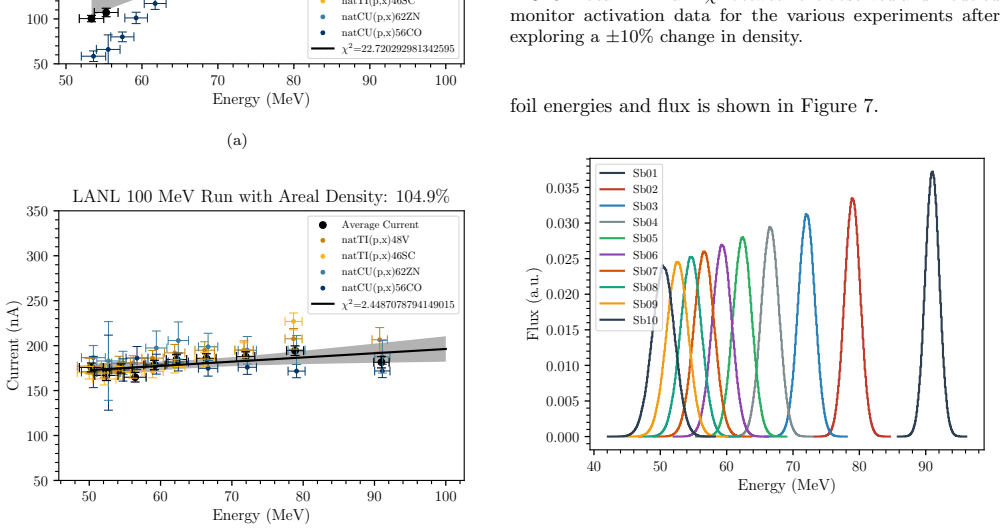
The central object is the spin cut-off parameter $\sigma^2$, the width of the angular-momentum distribution in TALYS's phenomenological level-density models, together with the weighted $\chi^2$ goodness-of-fit metric that lets the largest independent channels drive the optimization. The spin cut-off controls how much population flows to high-spin isomers, and reducing it to 0.4 is what repairs the measured $^{119g/m}$Te and $^{121g/m}$Te ground-state-to-isomer ratios. Supporting machinery includes the stacked-target activation method with monitor-foil current and energy characterization by variance minimization, and two channel-weighting schemes (cumulative cross-section and maximum cross-section) that balance the fit between the many low-energy points and the few high-energy points.
What would settle it
Measure the $\mathrm{^{nat}Sb}(p,x)^{119m}\mathrm{Te}$ and $\mathrm{^{nat}Sb}(p,x)^{121m}\mathrm{Te}$ excitation functions using a target arrangement that suppresses secondary neutrons (for example, thin degraders of low-Z material or an active neutron veto), and compare the results with the stacked-target data presented here. If the tellurium cross sections or isomer ratios shift significantly when the neutron fluence is reduced, the fitted TALYS parameters are biased by neutron-induced contributions and the claimed physical adjustments would need to be revisited.
Extended reading notes
Core claim
The paper establishes that default TALYS 1.95 systematically overpopulates high-spin isomeric states and underpopulates low-spin ground states in proton-induced reactions on antimony near A = 119-123. A parameter set with reduced spin cut-off ($\texttt{rspincut}=0.4$), a shell-effect-aware spin-cut-off model ($\texttt{spincutmodel}=2$), a deeper and narrower imaginary neutron volume potential ($\texttt{w1adjust}(n)=2.5$, $\texttt{w2adjust}(n)=0.6$), analytical pre-equilibrium transition rates ($\texttt{preeqmode}=1$), and adjusted exciton matrix-element parameters ($\texttt{m2constant}=2$, $\texttt{m2limit}=0.8$, $\texttt{m2shift}=1.8$, $\texttt{rpinu}=\texttt{rnupi}=\texttt{rnunu}=1.5$) reduces the reduced-$\chi^2$ for the tellurium channels by factors between 2.16 and 56.78 relative to defaults. The same parameters improve the overall fit to cumulative validation channels, while some antimony and indium channels fit worse, which the paper attributes to co-production of neutron-deficient products by secondary neutrons in the target stacks.
Load-bearing premise
The optimized model parameters are trustworthy only if the tellurium reaction channels that drive the fit are produced purely by protons and are not also fed by secondary neutrons created in the target stack.
Editorial extensions
If this is right
- The measured $\mathrm{^{nat}Sb}(p,x)$ cross sections provide new experimental benchmarks for $\mathrm{^{117m}Sn}$ and $\mathrm{^{119m}Te}$ production, including contaminant channels such as $\mathrm{^{113}Sn}$, $\mathrm{^{121g,m}Te}$, and $\mathrm{^{123m}Te}$ that affect radionuclidic purity for medical use.
- If the optimized TALYS parameters are adopted for proton-induced reactions near $A \approx 120$-$130$, predicted isomer-to-ground-state ratios for other tellurium and nearby isotopes should improve substantially.
- The persistent misfit of neutron-deficient antimony channels is evidence that secondary neutrons generated inside high-energy target stacks measurably contribute to isotope production, so future stacked-target experiments should account for or suppress this neutron field.
- The finding that stacked-target activation alone cannot unambiguously determine pre-equilibrium parameters implies that outgoing neutron spectral measurements are needed to fix the underlying physics of the model.
- The cross-section dataset, once submitted to the EXFOR database, will serve as a benchmark for future nuclear reaction model evaluations and for isotope-production simulation codes.
Reading between the lines
- A natural extension of the spin-cut-off result is to test whether $\texttt{rspincut}=0.4$ also improves isomer-ratio predictions for proton-induced reactions on neighboring target elements such as tin and iodine, which would indicate a generic deficiency in default spin distributions rather than a quirk of antimony.
- Because the optimized parameters were chosen to fit tellurium channels specifically, applying them to other targets may overcorrect for spin effects; a cross-validation against independent isomer-ratio data outside the fitted mass region would test the generality of the adjustment.
- The paper's secondary-neutron hypothesis could be tested directly by comparing measurements taken with and without high-Z degraders, or by placing neutron detectors around the stack and correlating neutron yield with the excess antimony production.
- If the decrease in spin cut-off reflects the prolate deformation neglected by the default model, then independent nuclear-structure calculations of level densities for deformed $^{119,121}$Te could corroborate or refute the physical interpretation of the fitted parameter.
Signed reviews
Editorial analysis
A structured set of objections, weighed in public.
Referee Report
Summary. This paper reports new stacked-target activation measurements of natSb(p,x)117mSn and natSb(p,x)119mTe, together with 22 co-produced residual-product cross sections and monitor-foil cross sections, for proton energies up to 200 MeV from LBNL, LANL, and BNL. The analysis uses a variance-minimization procedure to determine beam current and energy, and the data are compared with TALYS 1.95 calculations. A set of physics-motivated parameter adjustments (rspincut=0.4, spincutmodel=2, w1adjust(n)=2.5, w2adjust(n)=0.6, preeqmode=1, m2constant=2, m2limit=0.8, m2shift=1.8, rpinu=rnupi=rnunu=1.5) is reported to improve reduced chi2 for the dominant Te channels by factors between 2.16 and 56.78, with validation on cumulative and smaller independent channels.
Significance. The experimental dataset is the strongest part of the paper: the activation analysis is detailed, the decay-gamma assignments are documented, monitor foils and variance minimization are used carefully, and the data will be a useful EXFOR entry for medical-isotope production and for testing reaction models. If the modeling improvements were independently confirmed, the spin cut-off and optical-model adjustments would be a valuable step toward better proton-reaction modeling. The modeling conclusions are not yet established at the same level: the parameters are fit to the same data used for the improvement claim, the paper itself acknowledges that pre-equilibrium parameters cannot be uniquely assigned, and the high-energy Te data have not been shown to be free of secondary-particle contamination.
major comments (5)
- [Section IV; Table XV] The parameter optimization is driven by the seven Te channels, and the BNL data points at 102-188 MeV are the only high-energy constraints on the pre-equilibrium region. The paper excludes Sb residual data above 100 MeV because of secondary-neutron production (Section IV), but it does not apply an equivalent exclusion or correction to the Te channels. The BNL stack contains thick aluminum degraders (e.g., 4668.98 mg/cm2 in Table XV), which can generate secondary protons; unlike secondary neutrons, secondary protons can produce Te (Z=52) from Sb (Z=51) in downstream foils. No transport calculation, measured secondary fluence, or sensitivity estimate is provided to bound this contribution. If secondary-proton production of Te is not negligible, the fitted rspincut, optical-model, and pre-equilibrium parameters would be biased and the Table VII improvement ratios would not be transferable. Please quantify this contribution or explicitly restrict the high-energy modeling conclusions.
- [Section IV D, Eqs. (11)-(13)] There is an inconsistency in the goodness-of-fit definition. Equation (11) includes a factor 1/Nc multiplying the sum over channels, but the weights wc defined in Eqs. (12) and (13) are already normalized so that they sum to unity over channels. With the stated definitions, chi2_tot = (1/Nc) * sum_c chi2_c * wc is not the weighted average implied by the text, and the absolute values in Table V depend on this choice. Although the improvement ratios may be robust to an overall factor, this normalization must be corrected and the quoted values recalculated.
- [Section IV D-F; Table VII] The reported improvement factors in Table VII are in-sample: the same 12 independent channels were used both to select the TALYS parameters and to evaluate the fit. The validation channels (Table VIII) are a genuine out-of-sample check within the same dataset, but they were selected after the optimization and are not independent of the experimental conditions. Please present the Table VII ratios as fit diagnostics, add a sensitivity analysis that removes one channel or one energy region at a time, and state explicitly that the parameter set has not been tested on an independent dataset.
- [Section III C; Table II] The BNL points above 100 MeV carry the high-energy part of the modeling claim, but the BNL beam-energy and current determination relies on a single monitor reaction, natCu(p,x)58Co, and the paper notes this gives a relatively shallow reduced-chi2 minimum. The Table II energy uncertainties (e.g., +/-2.1 to +/-3.1 MeV) are propagated, but the normalization of these points is weakly constrained. A sensitivity study showing how the fitted parameters and improvement ratios change under alternative stopping-power adjustments, or with the natCu(p,x)56Co data included as a consistency check, would substantially strengthen the high-energy conclusions.
- [Section V] The paper's own conclusion that stacked-target measurements 'cannot unambiguously assign the correct pre-equilibrium parameters independently' and that outgoing neutron spectra are needed is an important caveat that is not reflected in the abstract or in the presentation of Table X as the optimized parameter set. The abstract and Section IV F should be revised to present the parameter adjustments as illustrative constraints on TALYS parameters, not as a uniquely determined or globally validated parameter recommendation.
minor comments (4)
- [Section V] The sentence 'The decay gamma spectroscopy used in this research is avalable for access' contains a typo; 'avalable' should be 'available'.
- [Figure 13] In Figure 13, panel (c) is captioned '123mTe' but the plotted curve and the surrounding text concern natSb(p,x)121(m)Te; relabel the panel.
- [Table II] Table II is very dense and some entries, such as the 117Te rows, have large relative uncertainties; a machine-readable supplement with pointwise cross sections and covariance information would improve usability and reproducibility.
- [Section III C] The sentence 'The existing experimental data for natCu(p,x)56Co was leveraged as a validation check for the BNL results, but these data were not incorporated into the final calculations' would benefit from a brief description of what the validation check showed, since it is the only consistency check for the BNL normalization.
Circularity Check
No significant circularity: the measured cross sections are independent data and the TALYS parameter optimization is transparently in-sample, with genuine held-out validation.
full rationale
The derivation chain is self-contained. The measured natSb(p,x) cross sections are obtained from activation data via Eqs. (1)-(5), with beam current and energy anchored to external IAEA monitor evaluations and a variance-minimization procedure taken from prior work; the data are not functions of the paper's conclusions. The TALYS modeling section is presented as an explicit optimization rather than as prediction: Section IV D states 'Twelve of the largest measured reaction channels were used to optimize TALYS 1.95 parameters,' and the Table VII improvement ratios (2.16-56.78) are in-sample chi-square values on those same channels, labeled as fit improvements. The abstract itself limits the modeling claim to a 'goodness-of-fit metric established by the largest independent cross section channels and cross-validated with remaining channels.' That cross-validation (Table VIII, improvement ratios 12.39 and 12.04 on nine cumulative channels and three independent channels not used in the fit) is genuine out-of-sample content, so the central modeling result does not reduce by construction to its inputs. The self-citations (Fox et al. [9,10], Morrell et al. [11,14,23], Voyles et al. [13,15]) supply methodology and prior context only; the reported chi-square values and the adopted parameter values (rspincut=0.4, spincutmodel=2, w1adjust=2.5, w2adjust=0.6, preeqmode=1, m2constant=2, m2limit=0.8, m2shift=1.8, rpinu=rnupi=rnunu=1.5) are computed in this paper from its own data, and the spin cut-off finding is independently supported by the external compilation of Rodrigo et al. [29]. Section V's admission that a stacked-target measurement 'cannot unambiguously assign the correct pre-equilibrium parameters independently' is an honest caveat about parameter degeneracy, not circular reasoning. The possible secondary-neutron contamination of the BNL Te points (Sb data excluded above 100 MeV while Te data are retained) is a systematic-uncertainty and correctness risk rather than an input-output circularity, so it does not raise this score.
Assumptions & free parameters
free parameters (10)
- rspincut =
0.4
- spincutmodel =
2
- w1adjust (n) =
2.5
- w2adjust (n) =
0.6
- preeqmode =
1
- m2constant =
2
- m2limit =
0.8
- m2shift =
1.8
- rpinu, rnupi, rpipi, rnunu =
1.5, 1.5, 1, 1.5
- Areal density adjustment factors per experiment =
102.6%, 101.4%, 104.9%, 98.2%, 103.0%
assumptions (5)
- domain assumption TALYS 1.95 provides an adequate framework for proton-induced reactions (optical model, Hauser-Feshbach, exciton model).
- domain assumption IAEA 2017 monitor reaction cross sections are accurate.
- domain assumption Anderson-Ziegler stopping powers with a global areal density multiplier within +/-10% describe energy loss in the stacks.
- domain assumption Natural antimony composition and decay data (half-lives, gamma intensities) from Nuclear Data Sheets are correct.
- domain assumption TALYS level density models assume a Gaussian spin distribution with adjustable spin cutoff.
Cite this review
Pith. "Pith review of $\mathrm{^{117m}Sn}$ and $\mathrm{^{119m}Te}$ Production via Proton Bombardment on Natural Antimony and Implications for Modeling Charged Particle Reactions." pith.science (2026). https://pith.science/paper/HRITU5AN
@misc{pith2026250613948,
  author       = {Pith},
  title        = {Pith review of: $\mathrm^117mSn$ and $\mathrm^119mTe$ Production via Proton Bombardment on Natural Antimony and Implications for Modeling Charged Particle Reactions},
  year         = {2026},
  howpublished = {\url{https://pith.science/paper/HRITU5AN}},
  note         = {Machine review of arXiv:2506.13948}
}
abstract
$\mathrm{^{117m}Sn}$ and $\mathrm{^{119}Sb}$, the latter of which is produced via a $\mathrm{^{119m}Te}$ generator, are promising radionuclides for the targeted treatment of both osteoarthritis and small mass tumors via Auger therapy. Experiments were conducted at Lawrence Berkeley National Laboratory, Los Alamos National Laboratory, and Brookhaven National Laboratory to measure the $\mathrm{^{nat}Sb}$(p,x)$\mathrm{^{117m}Sn}$ and $\mathrm{^{nat}Sb}$(p,x)$\mathrm{^{119m}Te}$ cross sections for incident proton energies up to 200 MeV. Additional measurements for co-produced isotopes are included as well. In addition to this dataset, this paper investigates improvements for proton-induced reaction modeling capabilities through comparison of these experimental dataset against theoretical models in TALYS 1.95. Parameter adjustments affecting level density, optical model potential, and pre-equilibrium emission were explored, with a goodness-of-fit metric established by the largest independent cross section channels and cross-validated with remaining channels.
Figures


Figures from the paper (10 more)




Reference graph
Works this paper leans on
-
[1]
Level Density Model TALYS includes both phenomenological and microscopic level density models. In comparison to these residual products, ldmodel 2 – the Back-Shifted Fermi Gas Model (BFG), shifts the baseline energy level for calculating excitation energy and provides the best global fit as seen in Table III
-
[2]
#-& (b) 121Te Decay 4C dz 5F & Z E *5 45
The Spin Cut-Off Parameter σ2 The observation of two adjacent odd-A Te isotopes (119Te and 121Te) and their long-lived isomeric states offered an opportunity to optimize reaction models for spin distribution values in unresolved multi-MeV nuclear states near shell closure. The simplified decay schema for these isotopes is shown in Figure 9. The neighborin...
-
[3]
J. W. Engle, A. V. Ignatyuk, R. Capote, B. V. Carlson, A. Hermanne, M. A. Kellett, T. Kib´ edi, G. Kim, F. G. Kondev, M. Hussain, O. Lebeda, A. Luca, Y. Nagai, H. Naik, A. L. Nichols, F. M. Nortier, S. V. Suryanarayana, S. Tak´ acs, F. T. T´ ark´ anyi, and M. Verpelli, Nuclear Data Sheets 155, 56 (2019)
work page 2019
-
[4]
J. Obaldo and B. Hertz, Asia Oceania Journal of Nuclear Medicine and Biology 9, 10.22038/aojnmb.2021.55514.1385 (2021)
-
[5]
S. S. Kelkar and T. M. Reineke, Bioconjugate Chemistry 22, 1879 (2011)
work page 2011
- [6]
-
[7]
Blachot, Nuclear Data Sheets 95, 679 (2002)
J. Blachot, Nuclear Data Sheets 95, 679 (2002)
work page 2002
-
[8]
M. Berger, Coursey, M. Zucker, and J. Chang, ESTAR, PSTAR, and ASTAR: Computer Programs for Calculating Stopping-Power and Range Tables for Electrons, Protons, and Helium Ions (version 1.2.3) (2005)
work page 2005
Show all 81 references
-
[9]
M. B. Fox, A. S. Voyles, J. T. Morrell, L. A. Bernstein, A. M. Lewis, A. J. Koning, J. C. Batchelder, E. R. Birnbaum, C. S. Cutler, D. G. Medvedev, F. M. Nortier, E. M. O’Brien, and C. Vermeulen, Physical Review C 103, 034601 (2021)
2021
-
[10]
G. T. Krishnamurthy, F. M. Swailem, S. C. Srivastava, H. L. Atkins, L. J. Simpson, T. K. Walsh, F. R. Ahmann, G. E. Meinken, and J. H. Shah, Journal of Nuclear Medicine: Official Publication, Society of Nuclear Medicine 38, 230 (1997)
1997
-
[11]
Symochko, E
D. Symochko, E. Browne, and J. Tuli, Nuclear Data Sheets 110, 2945 (2009)
2009
-
[12]
S. A. Graves, P. A. Ellison, T. E. Barnhart, H. F. Valdovinos, E. R. Birnbaum, F. M. Nortier, R. J. Nickles, and J. W. Engle, Nuclear Instruments and Methods in Physics Research Section B: Beam Interactions with Materials and Atoms 386, 44 (2016)
2016
-
[13]
M. B. Fox, A. S. Voyles, J. T. Morrell, L. A. Bernstein, J. C. Batchelder, E. R. Birnbaum, C. S. Cutler, A. J. Koning, A. M. Lewis, D. G. Medvedev, F. M. Nortier, E. M. O’Brien, and C. Vermeulen, Physical Review C 104, 064615 (2021)
2021
-
[14]
J. T. Morrell, E. M. O’Brien, M. Skulski, A. S. Voyles, D. G. Medvedev, V. Mocko, L. A. Bernstein, and C. E. Vermeulen, Measurement of Proton-Induced Reactions on Lanthanum from 55–200 MeV by Stacked-Foil Activation (2024), version Number: 1
2024
-
[15]
A. S. Voyles, A. M. Lewis, J. T. Morrell, M. S. Basunia, L. A. Bernstein, J. W. Engle, S. A. Graves, and E. F. Matthews, The European Physical Journal A 57, 94 (2021)
2021
-
[16]
A. S. Voyles, L. A. Bernstein, E. R. Birnbaum, J. W. Engle, S. A. Graves, T. Kawano, A. M. Lewis, and F. M. Nortier, Nuclear Instruments and Methods in Physics Research, Section B: Beam Interactions with Materials and Atoms 429, 53 (2018)
2018
-
[17]
J. T. Morrell, A. S. Voyles, M. S. Basunia, J. C. Batchelder, E. F. Matthews, and L. A. Bernstein, European Physical Journal A 56, 10.1140/epja/s10050-019-00010-0 (2020)
2020 doi
-
[18]
Kireeff Covo, R
M. Kireeff Covo, R. Albright, B. Ninemire, M. Johnson, A. Hodgkinson, T. Loew, J. Benitez, D. Todd, D. Xie, T. Perry, L. Phair, L. Bernstein, J. Bevins, J. Brown, B. Goldblum, M. Harasty, K. Harrig, T. Laplace, E. Matthews, A. Bushmaker, D. Walker, V. Oklejas, A. Hopkins, D. B...
2018
-
[19]
Hermanne, A
A. Hermanne, A. V. Ignatyuk, R. Capote, B. V. Carlson, J. W. Engle, M. A. Kellett, T. Kib´ edi, G. Kim, F. G. Kondev, M. Hussain, O. Lebeda, A. Luca, Y. Nagai, H. Naik, A. L. Nichols, F. M. Nortier, S. V. Suryanarayana, S. Tak´ acs, F. T. T´ ark´ anyi, and M. Verpelli, Nuclear...
2018
-
[20]
T´ ark´ anyi, A
F. T´ ark´ anyi, A. Hermanne, A. V. Ignatyuk, F. Ditr´ oi, S. Tak´ acs, and R. Capote-Noy, Journal of Radioanalytical and Nuclear Chemistry 333, 4243 (2024)
2024
-
[21]
Blachot, Nuclear Data Sheets 84, 277 (1998)
J. Blachot, Nuclear Data Sheets 84, 277 (1998)
1998
-
[22]
E. M. O’Brien, S. A. Baily, E. R. Birnbaum, C. Chapman, E. A. Espinoza, J. A. Faucett, J. O. Hill, K. D. John, P. S. Marroquin, R. C. McCrady, D. E. Norman, F. M. Nortier, J. F. O’Hara, E. R. Olivas, A. R. Patten, M. Pieck, L. J. Rybarcyk, J. F. Snyder, E. A. Swensen, R. A. Va...
2020
-
[23]
Blachot, Nuclear Data Sheets 111, 1471 (2010)
J. Blachot, Nuclear Data Sheets 111, 1471 (2010)
2010
-
[24]
J. F. Ziegler, M. Ziegler, and J. Biersack, Nuclear Instruments and Methods in Physics Research Section B: Beam Interactions with Materials and Atoms 268, 1818 (2010)
2010
-
[25]
Chen, Nuclear Data Sheets 174, 1 (2021)
J. Chen, Nuclear Data Sheets 174, 1 (2021)
2021
-
[26]
J. T. Morrell, Curie (2023), http://pypi.org/project/curie
2023
-
[27]
P. J. Huber (University of California Press, Berkeley, 1967) pp. 221–223
1967
-
[28]
(32) 118Te(i) 55.7 (27) 78.4 (18) 107.9 (21) 121.7 (32) 132.6 (16) 126.3 (40) 125.8 (16) 119gTe(i) 26.8 (25) 32.9 (28) 38.2 (41) 49.4 (53) 74.2 (73) 88.3 (84) 99
180. (32) 118Te(i) 55.7 (27) 78.4 (18) 107.9 (21) 121.7 (32) 132.6 (16) 126.3 (40) 125.8 (16) 119gTe(i) 26.8 (25) 32.9 (28) 38.2 (41) 49.4 (53) 74.2 (73) 88.3 (84) 99. (11) 119mTe(i) 36.74 (87) 45.41 (76) 59.94 (80) 80.1 (10) 114.6 (13) 140.1 (16) 161.1 (21) 121gTe(i) 12.53 (5...
-
[29]
Vidmar, M
T. Vidmar, M. Korun, A. Likar, and R. Martinˇ ciˇ c, Nuclear Instruments and Methods in Physics Research Section A: Accelerators, Spectrometers, Detectors and Associated Equipment 470, 533 (2001)
2001
-
[30]
Seltzer, XCOM-Photon Cross Sections Database, NIST Standard Reference Database 8 (1987)
S. Seltzer, XCOM-Photon Cross Sections Database, NIST Standard Reference Database 8 (1987)
1987
-
[31]
A. J. Koning, S. Hilaire, and S. Goriely, TALYS-1.95 - A Nuclear Reaction Program (2019)
2019
-
[32]
Rodrigo, N
A. Rodrigo, N. Otuka, S. Tak´ acs, and A. Koning, Atomic Data and Nuclear Data Tables 153, 101583 (2023)
2023
-
[33]
Cline and M
C. Cline and M. Blann, Nuclear Physics A 172, 225 (1971)
1971
-
[34]
Koning and J
A. Koning and J. Delaroche, Nuclear Physics A 713, 231 (2003)
2003
-
[35]
Singh, Nuclear Data Sheets 114, 1 (2013)
B. Singh, Nuclear Data Sheets 114, 1 (2013)
2013
-
[36]
C. M. Baglin, Nuclear Data Sheets 114, 1293 (2013)
2013
-
[37]
De Frenne and A
D. De Frenne and A. Negret, Nuclear Data Sheets 109, 943 (2008)
2008
-
[38]
G¨ urdal and F
G. G¨ urdal and F. Kondev, Nuclear Data Sheets113, 1315 (2012)
2012
-
[39]
Kumar, J
S. Kumar, J. Chen, and F. Kondev, Nuclear Data Sheets 137, 1 (2016)
2016
-
[40]
Blachot, Nuclear Data Sheets 110, 1239 (2009)
J. Blachot, Nuclear Data Sheets 110, 1239 (2009)
2009
-
[41]
Blachot, Nuclear Data Sheets 113, 515 (2012)
J. Blachot, Nuclear Data Sheets 113, 515 (2012)
2012
-
[42]
Blachot, Nuclear Data Sheets 111, 717 (2010)
J. Blachot, Nuclear Data Sheets 111, 717 (2010)
2010
-
[43]
Blachot, Nuclear Data Sheets 113, 2391 (2012)
J. Blachot, Nuclear Data Sheets 113, 2391 (2012)
2012
-
[44]
Kitao, Nuclear Data Sheets 75, 99 (1995)
K. Kitao, Nuclear Data Sheets 75, 99 (1995)
1995
-
[45]
Kitao, Y
K. Kitao, Y. Tendow, and A. Hashizume, Nuclear Data Sheets 96, 241 (2002)
2002
-
[46]
Tamura, Nuclear Data Sheets 108, 455 (2007)
T. Tamura, Nuclear Data Sheets 108, 455 (2007)
2007
-
[47]
Ohya, Nuclear Data Sheets 111, 1619 (2010)
S. Ohya, Nuclear Data Sheets 111, 1619 (2010)
2010
-
[48]
Wang and X
J. Wang and X. Huang, Nuclear Data Sheets 144, 1 (2017)
2017
-
[49]
Dong and H
Y. Dong and H. Junde, Nuclear Data Sheets 128, 185 (2015)
2015
-
[50]
Dong and H
Y. Dong and H. Junde, Nuclear Data Sheets 121, 1 (2014)
2014
-
[51]
Junde, H
H. Junde, H. Su, and Y. Dong, Nuclear Data Sheets 112, 1513 (2011)
2011
-
[52]
M. S. Basunia, Nuclear Data Sheets 151, 1 (2018)
2018
-
[53]
Junde, Nuclear Data Sheets 109, 787 (2008)
H. Junde, Nuclear Data Sheets 109, 787 (2008)
2008
-
[54]
Bhat, Nuclear Data Sheets 85, 415 (1998)
M. Bhat, Nuclear Data Sheets 85, 415 (1998)
1998
-
[55]
C. D. Nesaraja, S. D. Geraedts, and B. Singh, Nuclear Data Sheets 111, 897 (2010)
2010
-
[56]
Browne and J
E. Browne and J. Tuli, Nuclear Data Sheets 114, 1849 (2013)
2013
-
[57]
Zuber and B
K. Zuber and B. Singh, Nuclear Data Sheets125, 1 (2015)
2015
-
[58]
Singh and J
B. Singh and J. Chen, Nuclear Data Sheets 178, 41 (2021)
2021
-
[59]
A. L. Nichols, B. Singh, and J. K. Tuli, Nuclear Data Sheets 113, 973 (2012)
2012
-
[60]
Erjun and H
B. Erjun and H. Junde, Nuclear Data Sheets 92, 147 (2001)
2001
-
[61]
Browne and J
E. Browne and J. Tuli, Nuclear Data Sheets 111, 2425 (2010)
2010
-
[62]
Nesaraja, Nuclear Data Sheets 115, 1 (2014)
C. Nesaraja, Nuclear Data Sheets 115, 1 (2014)
2014
-
[63]
Abriola and A
D. Abriola and A. Sonzogni, Nuclear Data Sheets 111, 1 (2010)
2010
-
[64]
Singh, Nuclear Data Sheets 74, 63 (1995)
B. Singh, Nuclear Data Sheets 74, 63 (1995)
1995
-
[65]
Singh and N
B. Singh and N. Nica, Nuclear Data Sheets 113, 1115 (2012)
2012
-
[66]
Tuli and E
J. Tuli and E. Browne, Nuclear Data Sheets 157, 260 (2019)
2019
-
[67]
Singh, Nuclear Data Sheets 135, 193 (2016)
B. Singh, Nuclear Data Sheets 135, 193 (2016)
2016
-
[68]
McCutchan, Nuclear Data Sheets 125, 201 (2015)
E. McCutchan, Nuclear Data Sheets 125, 201 (2015)
2015
-
[69]
Abriola, M
D. Abriola, M. Bostan, S. Erturk, M. Fadil, M. Galan, S. Juutinen, T. Kib´ edi, F. Kondev, A. Luca, A. Negret, N. Nica, B. Pfeiffer, B. Singh, A. Sonzogni, J. Timar, J. Tuli, T. Venkova, and K. Zuber, Nuclear Data Sheets 110, 2815 (2009)
2009
-
[70]
Negret and B
A. Negret and B. Singh, Nuclear Data Sheets 124, 1 (2015)
2015
-
[71]
Singh and J
B. Singh and J. Chen, Nuclear Data Sheets 116, 1 (2014)
2014
-
[72]
Johnson and W
T. Johnson and W. Kulp, Nuclear Data Sheets 129, 1 (2015)
2015
-
[73]
McCutchan and A
E. McCutchan and A. Sonzogni, Nuclear Data Sheets 115, 135 (2014)
2014
-
[74]
Basu and E
S. Basu and E. Mccutchan, Nuclear Data Sheets 165, 1 (2020)
2020
-
[75]
C. M. Baglin, Nuclear Data Sheets 112, 1163 (2011)
2011
-
[76]
Chen and B
J. Chen and B. Singh, Nuclear Data Sheets 135, 1 (2016)
2016
-
[77]
Singh and J
B. Singh and J. Chen, Nuclear Data Sheets 126, 1 (2015)
2015
-
[78]
Burrows, Nuclear Data Sheets 108, 923 (2007)
T. Burrows, Nuclear Data Sheets 108, 923 (2007)
2007
-
[79]
Wu, Nuclear Data Sheets 91, 1 (2000)
S.-C. Wu, Nuclear Data Sheets 91, 1 (2000)
2000
-
[80]
Chen, Nuclear Data Sheets 179, 1 (2022)
J. Chen, Nuclear Data Sheets 179, 1 (2022)
2022
-
[81]
Chen and B
J. Chen and B. Singh, Nuclear Data Sheets 190, 1 (2023)
2023
Reviewed August 7, 2026 · model on record in the stance chip above.
Discussion (0). Continue with ORCID to comment.