REVIEW 3 major objections 5 minor 58 references
Replica RISM molecular solvation theory for electric double layer in nanoporous materials
T0 review · 3 major / 5 minor · reviewed 2026-08-15 · deepseek-v4-flash
Pith's one-line read Nanoporous supercapacitor voltage is governed by solvation chemistry and osmotic balance, not just pore surface area.
desk verdict A readable self-review of the author's replica RISM-KH-VM theory with new illustrative RDF/potential plots, but the central voltage equation as printed has a sign inconsistency and no experimental validation backs the predictive claims. read the letter →
The pith
A machine-rendered reading of the paper's core claim, the machinery that carries it, and where it could break.
The reading
What carries the argument
The central object is replica RISM-KH-VM theory, a statistical-mechanical formalism for an annealed electrolyte solution sorbed in a quenched disordered nanoporous matrix. It solves replica integral equations for the site-site correlation functions, using the KH closure for matrix-fluid and fluid-fluid correlations and a modified Verlet closure for the matrix-mediated blocking correlations between replicas; this yields averaged density distributions, solvation free energies, decomposed chemical potentials, and, via the electrostatic potential equation, the electric potential around each matrix nanoparticle. The fluid densities in each electrode are iterated until chemical equilibrium with the bulk solution and electroneutrality in each electrode are satisfied, with all connected conducting nanospheres held at the same potential.
What would settle it
Measure the open-circuit voltage and differential capacitance of nanoporous carbon electrodes with independently characterized pore-size distributions and surface chemistries over a range of bulk electrolyte concentrations. If the voltage's concentration dependence does not match the osmotic term's prediction, or the capacitance does not follow the compact-layer-plus-averaged-diffuse-layer mechanism, the central picture is falsified.
Extended reading notes
Core claim
The paper's central claim is that the behavior of electrolyte solutions sorbed inside nanoporous carbon electrodes is set by three coupled, spatially averaged factors: the electric double layer potential drop across the compact layer at the pore surface plus the diffuse layer averaged over the disordered nanoporous material; the osmotic term in the chemical potential arising from the difference in ion concentrations between the two electrodes and the bulk solution outside; and the solvation chemical potentials of the sorbed ions, which depend on ion size, solvent identity, surface functional groups, and steric confinement. These three terms enter a chemical equilibrium condition that fixes ion densities inside each electrode, and the device voltage is obtained by adding the potential changes across the intrinsic double layers in both electrodes to a boundary potential step that balances the interior chemical potentials against the bulk solution. The paper thereby replaces the common picture of a planar electric double layer mapped onto the pore surface with a molecular description in which confinement, solvation, and osmotic balance are the controlling physics.
Load-bearing premise
The load-bearing premise is that a disordered nanoporous carbon electrode can be represented as an equilibrium ensemble of connected carbon nanospheres with grafted functional groups, with equal electrostatic potential inside all conducting spheres and charge neutrality enforced separately in each electrode; if real pore shapes, connectivity, or surface chemistry diverge from this spherical idealization, the averaged voltage and mechanism predictions may not transfer to actual devices.
Editorial extensions
If this is right
- Specific capacitance of a nanoporous electrode is set by the interplay of the compact-layer potential drop, the averaged diffuse layer, the osmotic concentration term, and ion solvation chemical potentials, not by pore surface area alone.
- The supercapacitor voltage includes a boundary potential step at each electrode plus the intrinsic double-layer potential changes, so equivalent-circuit pictures based on a planar double layer are incomplete.
- Ion-specific solvation and steric effects, such as the enlarged effective size of solvated ions confined in pores, directly change adsorption and capacitance.
- The same chemical-potential balance accounts for solvent-specific wetting, water depletion in hydrophobic nanopores, desalination of ions, desalination reversal under external voltage, and specific adsorption in functionalized nanopores.
- Grafting functional groups on the pore surface changes ion distributions and electrostatic potentials in a way that depends on the ion species, showing that surface chemistry is a control knob.
Reading between the lines
- Editorial inference: because the osmotic term depends on the concentration ratio between electrode and bulk, measuring differential capacitance over a wide range of bulk electrolyte concentrations would directly probe this contribution.
- Editorial inference: the same replica formalism could be extended to other disordered porous hosts, such as battery electrodes or metal-organic frameworks, wherever ion-specific solvation in confinement matters.
- Editorial inference: the nanosphere morphology assumption could be stress-tested by comparing predictions against carbons with deliberately engineered, independently characterized pore-size distributions.
- Editorial inference: the theory implies that pore-size distributions that minimize the solvation penalty for partially desolvated ions, rather than merely maximize surface area, may be the better design target for supercapacitors.
Signed reviews
Editorial analysis
A structured set of objections, weighed in public.
Referee Report
Summary. The manuscript develops replica RISM-KH-VM molecular solvation theory for electrolyte solutions sorbed in disordered nanoporous electrodes. It combines DRISM-KH theory for the bulk electrolyte with replica Ornstein-Zernike equations for a quenched nanoporous matrix and an annealed solution, using the KH closure for connected correlations and a modified Verlet closure for blocking correlations. The paper derives analytical expressions for solvation chemical potentials, the chemical-equilibrium bias between two electrodes, and a formula for supercapacitor voltage (Eq. 37), then illustrates the theory with RDFs and electrostatic potential profiles for KOH, LiOH, and LiOH-KOH aqueous electrolytes in nanoporous carbon with and without MnO2 grafting. The central mechanistic claim is that the supercapacitor voltage and sorption behavior are controlled by Stern-layer and averaged Gouy-Chapman potential drops, an osmotic concentration term, and averaged solvation chemical potentials of sorbed ions.
Significance. If internally consistent and properly validated, this theory would be a significant contribution: it provides a closed-form, statistical-mechanical treatment of a quenched-annealed electrolyte system with molecular specificity, going beyond planar-EDL models, and it avoids the sampling cost of molecular dynamics for such systems. The closed analytical form of the chemical potential, the KH/VM closure combination, and the decomposition of the excess chemical potential into liquid-matrix, liquid-liquid, and blocking contributions are valuable formal elements. However, the central voltage equation is internally inconsistent as printed, and the claimed predictive power rests on qualitative plots without experimental or independent computational validation.
major comments (3)
- [Section 3, Eq. (37)] The printed voltage formula is inconsistent with Eq. (36). The text states that U is the sum (φI_av−φI_c) + (φII_av−φI_av) + (φII_c−φII_av), which equals φII_c−φI_c. Using Eq. (36) to replace φII_av−φI_av by (1/q_s)[kT ln(ρI_s/ρII_s)+ΔμI_s−ΔμII_s] and substituting into Eq. (37) as printed gives U = 2φI_av − 2φII_av + φII_c − φI_c, not φII_c−φI_c. The sign before the chemical-potential bracket must be changed from minus to plus (and the density ratio must read ρI_s/ρII_s) for the derivation to be consistent. As written, the central device-voltage result cannot be reproduced from the equations.
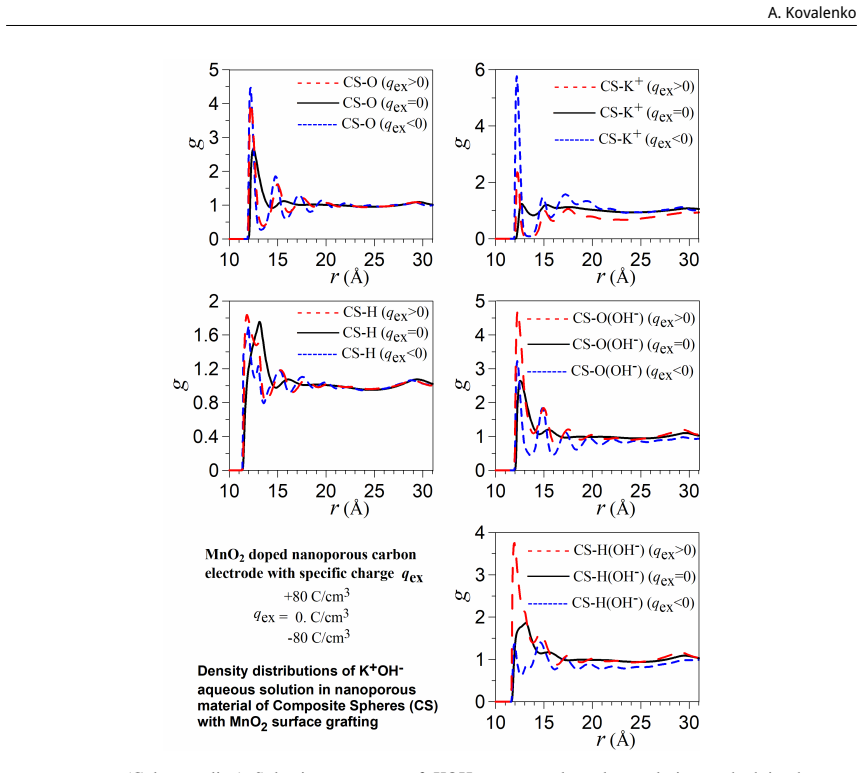
- [Section 4, Figs. 1–10] The central claim that the theory 'predicts and explains' supercapacitor electrochemistry is not substantiated quantitatively. The evidence consists of qualitative RDF and electrostatic-potential curves for a few charge states; no error bars, no convergence checks, no sensitivity analysis with respect to the DRISM length scale l, the Verlet parameter a, the universal-correction coefficients, the nanosphere radius, or functional-group coverage, and no comparison with experimental capacitance, voltage, or ion-loading data or with independent molecular simulation. Without such quantitative benchmarks, the mechanistic conclusions remain assertions of the model rather than validated predictions.
- [Section 3, Eqs. (32)–(34)] The representation of the disordered nanoporous carbon electrode as an equilibrium ensemble of conducting carbon nanospheres with equal internal electrostatic potential is load-bearing for the voltage calculation, but the manuscript provides no evidence that this morphology captures the pore size distribution, connectivity, and surface chemistry of real nanoporous carbons, and no sensitivity study is reported for these morphological parameters. The mechanisms extracted from the averaged model may therefore not transfer to actual devices.
minor comments (5)
- [Equation (37)] The density ratio in Eq. (37) is printed as 'ρI_s/ρI_s/' and should presumably read ρI_s/ρII_s; even after that correction, the sign inconsistency described in the major comments remains.
- [Section 3, text before Eq. (37)] The phrase 'With the relation (37) for the average electrostatic potentials' should refer to Eq. (36), and the phrase 'chemical equilibrium conditions (38)' should refer to Eq. (36) or the equations should be renumbered consistently.
- [Section 3, voltage-contribution list] In the sentence listing the summed potential changes, the first two items are both labeled '(i)'; the labels should be (i), (ii), and (iii).
- [Equation (23)] The second branch of the KH closure contains a stray slash: '1+d(r)/' should read '1+d(r)'.
- [Figure 10 caption] The caption of Figure 10 refers to 'LiKOH electrolyte', while the text describing Figure 10 discusses 'LiOH aqueous electrolyte solution'; the inconsistency should be corrected.
Circularity Check
No significant circularity: the replica RISM derivation is stated explicitly, and the self-citations and fitted UC correction are not construction-level inputs.
full rationale
The paper's derivation is self-contained at the equation level: the replica RISM equations (21)–(24), the chemical potential decomposition (25)–(27), the chemical equilibrium bias (36), and the voltage assembly described in the text before Eq. (37) are all written out explicitly. The voltage is intended to be the algebraic sum of the three stated potential drops, using Eq. (36) to express one of the drops through densities and excess chemical potentials; no target quantity is hidden inside a fitted input. The universal correction in Eq. (18) has regression-fitted coefficients, but that correction is not used in the nanoporous-electrode voltage derivation, and the paper discloses it as fitted rather than presenting it as a first-principles result. The self-citations, for example refs. [48–54] for the development and the statement that the theory was tested, provide provenance and appeal to prior work, but they do not enter the derivation as inputs, so they are not circularity under the hard rule requiring a specific reduction. I do note separately that the printed Eq. (37) appears algebraically inconsistent with the text's three-term sum and Eq. (36): substituting Eq. (36) into that sum would require a plus sign in front of the chemical-potential bracket and a density ratio consistent with Eq. (36), not the minus sign and reversed-looking ratio as printed. This is a correctness or typographical issue, not a circularity, because the claimed reduction is from explicit equations rather than from a definition or fit.
Assumptions & free parameters
free parameters (3)
- DRISM dielectric correction length scale l =
1 Å for water (Eq. 6)
- Verlet closure parameter a =
0.8 (Eq. 24b)
- Universal correction coefficients a and b =
not reported
assumptions (5)
- domain assumption Replica identity relating ln Z1 to the derivative of replicated free energy, with no replica symmetry breaking in the analytic continuation.
- domain assumption KH and VM closures give accurate correlation functions and chemical potentials for the systems considered.
- domain assumption Nanoporous carbon electrode can be modeled as an equilibrium ensemble of connected carbon nanospheres with grafted functional groups.
- domain assumption Electroneutrality and equal electrostatic potential inside all conducting carbon nanospheres.
- ad hoc to paper DRISM dielectric bridge correction with a single exponential envelope captures the dielectric response of the mixture.
Cite this review
Pith. "Pith review of Replica RISM molecular solvation theory for electric double layer in nanoporous materials." pith.science (2026). https://pith.science/paper/T7EO5NVU
@misc{pith2026250614616,
  author       = {Pith},
  title        = {Pith review of: Replica RISM molecular solvation theory for electric double layer in nanoporous materials},
  year         = {2026},
  howpublished = {\url{https://pith.science/paper/T7EO5NVU}},
  note         = {Machine review of arXiv:2506.14616}
}
read the original abstract
Applications of 3D-RISM-KH molecular solvation theory range from solvation energy of small molecules to phase behavior of polymers and biomolecules. It predicts the molecular mechanisms of chemical and biomolecular systems. Replica RISM-KH-VM molecular solvation theory predicts and explains the structure, thermodynamics, and electrochemistry of electrolyte solutions sorbed in a nanoporous material. It was tested on nanoporous carbon supercapacitors with aqueous electrolyte and nanoporous electrosorption cells. The mechanisms in these systems are steered by the electric double layer potential drop across the Stern layer at the nanopores surface and the Gouy-Chapman layer averaged over the nanoporous material, the osmotic term due to the ionic concentrations difference in the two nanoporous electrodes and in the electrolyte solution outside, and the solvation chemical potentials of sorbed ions averaged over the nanoporous material. The latter strongly depends on chemical specificity of ions, solvent, surface functional groups, and steric effects for solvated ions confined in nanopores.
Figures


Figures from the paper (8 more)




Reference graph
Works this paper leans on
-
[1]
Zhang J., Zhang H., Wu T., Wang Q., van der Spoel D., J. Chem. Theory Comput.,2017, 13, 1034–1043, doi:10.1021/acs.jctc.7b00169
-
[2]
GerezG.,DiRemigioEikåsR.,RuneJensenS.,BjøorgveM.,FredianiL.,J.Chem.TheoryComput.,2023, 19, 1034–1043, doi:10.1021/acs.jctc.2c01098
-
[3]
SkynerR.,McDonaghJ.,GroomC.,vanMourikT.,MitchellJ.,Phys.Chem.Chem.Phys.,2015, 17,6174–6191, doi:10.1039/C5CP00288E
-
[4]
VyboishchikovS.F.,VoityukA.A.,J.Chem.Inf.Model.,2021, 61,4544–4553,doi:10.1021/acs.jcim.1c00885
-
[5]
Klamt A., Diedenhofen M., J. Phys. Chem. A, 2015,119, 5439–5445, doi:10.1021/jp511158y
-
[6]
Chaudhari M. I., Vanegas J. M., Pratt L. R., Muralidharan A., Rempe S. B., Annu. Rev. Phys. Chem., 2020,71, 461–84, doi:10.1146/annurev-physchem-012320-015457
-
[7]
Pratt L. R., Rempe S. B., AIP Conf. Proc., 1999,492, 172–201, doi:10.1063/1.1301528
-
[8]
AsthagiriD.,DixitP.,MerchantS.,PaulaitisM.,PrattL.,RempeS.B.,VarmaS.,Chem.Phys.Lett.,2010, 485, 1–7, doi:10.1016/j.cplett.2009.12.013
Show all 58 references
-
[9]
M., Rempe S
Rogers D. M., Rempe S. B., J. Phys. Chem. B, 2011,115, 9116–9129, doi:10.1021/jp2012864
2011 doi
-
[10]
RogersD.M.,JiaoD.,PrattL.R.,RempeS.B.,Annu.Rep.Comput.Chem.,2012, 8,71–127,doi:10.1016/B978- 0-444-59440-2.00004-1
2012 doi
-
[11]
HirataF.(Ed.),MolecularTheoryofSolvation,UnderstandingChemicalReactivity,Vol.24,KluwerAcademic Publishers, Dordrecht, 2003, doi:10.1007/1-4020-2590-4
2003 doi
-
[12]
Roy D., Kovalenko A., Int. J. Mol. Sci., 2021,22, 5061, doi:10.3390/ijms22105061
2021
-
[13]
HansenJ.-P.,McDonaldI.R.,In:TheoryofSimpleLiquids,AcademicPress,Oxford,4thedn.,2013,455–510, doi:10.1016/B978-0-12-387032-2.00011-8
2013 doi
-
[14]
Kovalenko A., Hirata F., Chem. Phys. Lett., 1998,290, 237–244, doi:10.1016/S0009-2614(98)00471-0
1998 doi
-
[15]
Kovalenko A., Hirata F., J. Chem. Phys., 1999,110, 10095–10112, doi:10.1063/1.478883
1999 doi
-
[16]
Kovalenko A., Hirata F., J. Chem. Phys., 2000,112, 10391–10402, doi:10.1063/1.481676
2000 doi
-
[17]
Kovalenko A., Hirata F., J. Chem. Phys., 2000,112, 10403–10417, doi:10.1063/1.481677
2000 doi
-
[18]
24, Hirata F
Kovalenko A., In: Molecular Theory of Solvation, Understanding Chemical Reactivity, Vol. 24, Hirata F. (Ed.), Kluwer Academic Publishers, Dordrecht, 2004, 169–275, doi:10.1007/1-4020-2590-4_4. 23602-18 Replica RISM for nanoporous materials
2004 doi
-
[19]
Chandler D., Acc. Chem. Res., 1974,7, 246–251, doi:10.1021/ar50080a002
1974 doi
-
[20]
J., Chandler D., J
Lowden L. J., Chandler D., J. Chem. Phys., 1973,59, 6587–6595, doi:10.1063/1.1680038
1973 doi
-
[21]
Chandler D., J. Chem. Phys., 1973,59, 2742–2746, doi:10.1063/1.1680393
1973 doi
-
[22]
A., Yamazaki T., Gusarov S., Kovalenko A., Luchko T., J
Johnson J., Case D. A., Yamazaki T., Gusarov S., Kovalenko A., Luchko T., J. Phys.: Condens. Matter, 2016, 28, 344002, doi:10.1088/0953-8984/28/34/344002
2016 doi
-
[23]
R., Gusarov S., Kovalenko A., McCreery R
Kondratenko M., Stoyanov S. R., Gusarov S., Kovalenko A., McCreery R. L., J. Phys. Chem. C, 2015,119, 11286–11295, doi:10.1021/jp5128332
2015 doi
-
[24]
Genheden S., Luchko T., Gusarov S., Kovalenko A., Ryde U., J. Phys. Chem. B, 2010,114, 8505–8516, doi:10.1021/jp101461s
2010 doi
-
[25]
R., da Costa L
Stoyanov S. R., da Costa L. M., Gusarov S., Gray M. R., Stryker J. M., Tykwinski R. R., Tan X., Carneiro J. W. D. M., Seidl P. R., Kovalenko A., Spectroscopic characterization of the supramolecular ag- gregation interactions of petroleum asphaltenes in solution: A multiscale m...
2013
-
[26]
R., Gusarov S., Kuznicki S
Stoyanov S. R., Gusarov S., Kuznicki S. M., Kovalenko A., J. Phys. Chem. C, 2008,112, 6794–6810, doi:10.1021/jp075688h
2008 doi
-
[27]
Imai T., Hiraoka R., Kovalenko A., Hirata F., J. Am. Chem. Soc., 2005, 127, 15334–15335, doi:10.1021/ja054434b
2005 doi
-
[28]
S., Pettitt B
Perkyns J. S., Pettitt B. M., J. Chem. Phys., 1992,97, 7656–7666, doi:10.1063/1.463485
1992 doi
-
[29]
K., Yevick G
Percus J. K., Yevick G. J., Phys. Rev., 1958,110, 1–13, doi:10.1103/PhysRev.110.1
1958 doi
-
[30]
A., Sarkisov G
Martynov G. A., Sarkisov G. N., Mol. Phys., 1983,49, 1495–1504, doi:10.1080/00268978300102111
1983 doi
-
[31]
BalloneP.,PastoreG.,GalliG.,GazzilloD.,Mol.Phys.,1986, 59,275–290,doi:10.1080/00268978600102071
1986 doi
-
[32]
M., Kloss T., J
Kast S. M., Kloss T., J. Chem. Phys., 2008,129, 236101, doi:10.1063/1.3041709
2008 doi
-
[33]
PerkynsJ.S.,LynchG.C.,HowardJ.J.,PettittB.M.,J.Chem.Phys.,2010, 132,064106,doi:10.1063/1.3299277
2010 doi
-
[34]
C., Blinov N., Wishart D., Kovalenko A., Pande V
Stumpe M. C., Blinov N., Wishart D., Kovalenko A., Pande V. S., J. Phys. Chem. B, 2011,115, 319–328, doi:10.1021/jp102587q
2011 doi
-
[35]
G., Buff F
Kirkwood J. G., Buff F. P., J. Chem. Phys., 1951,19, 774–777, doi:10.1063/1.1748352
1951 doi
-
[36]
Harano Y., Imai T., Kovalenko A., Kinoshita M., Hirata F., J. Chem. Phys., 2001, 114, 9506–9511, doi:10.1063/1.1369138
2001 doi
-
[37]
Imai T., Harano Y., Kovalenko A., Hirata F., Biopolymers, 2001, 59, 512–519, doi:10.1002/1097- 0282(200112)59:7<512::AID-BIP1056>3.0.CO;2-C
2001 doi
-
[38]
S., Frolov A
Palmer D. S., Frolov A. I., Ratkova E. L., Fedorov M. V., J. Phys.: Condens. Matter, 2010,22, 492101, doi:10.1088/0953-8984/22/49/492101
2010 doi
-
[39]
C., Joyce K
Luchko T., Blinov N., Limon G. C., Joyce K. P., Kovalenko A., J. Comput.-Aided Mol. Des., 2016,30, 1115– 1127, doi:10.1007/s10822-016-9947-7
2016 doi
-
[40]
Roy D., Blinov N., Kovalenko A., J. Phys. Chem. B, 2017,121, 9268–9273, doi:10.1021/acs.jpcb.7b06375
2017 doi
-
[41]
Kovalenko A., Tenno S., Hirata F., J. Comput. Chem., 1999, 20, 928–936, doi:10.1002/(SICI)1096- 987X(19990715)20:9<928::AID-JCC4>3.0.CO;2-X
1999 doi
-
[42]
Pulay P., Chem. Phys. Lett., 1980,73, 393–398, doi:10.1016/0009-2614(80)80396-4
1980 doi
-
[43]
H., SIAM J
Saad Y., Schultz M. H., SIAM J. Sci. Stat. Comput., 1986, 7, No. 3, 856–869, doi:10.1137/0907058
1986 doi
-
[44]
J., Perkyns J
Howard J. J., Perkyns J. S., Choudhury N., Pettitt B. M., J. Chem. Theory Comput., 2008,4, 1928–1939, doi:10.1021/ct8002817
2008 doi
-
[45]
Minezawa N., Kato S., J. Chem. Phys., 2007,126, 054511, doi:10.1063/1.2431809
2007 doi
-
[46]
S., Shklovskii B
Skinner B., Chen T., Loth M. S., Shklovskii B. I., Phys. Rev. E, 2011, 83, 056102–56111, doi:10.1103/PhysRevE.83.056102
2011 doi
-
[47]
Feng G., Jiang D., Cummings P. T., J. Chem. Theory Comput., 2012,8, 1058–1063, doi:10.1021/ct200914j
2012 doi
-
[48]
Kovalenko A., Hirata F., J. Theor. Comput. Chem., 2002,1, 381–406, doi:10.1142/S0219633602000282
2002 doi
-
[49]
Kovalenko A., Hirata F., J. Chem. Phys., 2001,115, 8620–8633, doi:10.1063/1.1409954
2001 doi
-
[50]
Matter Phys., 2001,4, 643–678, doi:10.5488/CMP.4.4.643
Kovalenko A., Hirata F., Condens. Matter Phys., 2001,4, 643–678, doi:10.5488/CMP.4.4.643
2001 doi
-
[51]
Tanimura A., Kovalenko A., Hirata F., Chem. Phys. Lett., 2003, 378, 638–646, doi:10.1016/S0009- 2614(03)01336-8
2003 doi
-
[52]
Tanimura A., Kovalenko A., Hirata F., Langmuir, 2007,23, 1507–1517, doi:10.1021/la061617i
2007 doi
-
[53]
Kovalenko A., J. Comput. Theor. Nanosci., 2004,1, 398–411, doi:10.1166/jctn.2004.038
2004 doi
-
[54]
KovalenkoA.,In:SpringerHandbookofElectrochemicalEnergy,BreitkopfC.,Swider-LyonsK.(Eds.),Springer Berlin Heidelberg, Berlin, Heidelberg, 2017, 95–139, doi:10.1007/978-3-662-46657-5_5
2017 doi
- [55]
- [56]
-
[57]
A., Stell G
Given J. A., Stell G. R., Physica A, 1994,209, 495–510, doi:10.1016/0378-4371(94)90200-3
1994 doi
-
[58]
Chem., 2013,85, 159–199, doi:10.1351/PAC-CON-12-06-03
Kovalenko A., Pure Appl. Chem., 2013,85, 159–199, doi:10.1351/PAC-CON-12-06-03. 23602-19 A. Kovalenko Реплiчна теорiя молекулярної сольватацiї RISM для подвiйного електричного шару в нанопористих матерiалах А. Коваленко Центр програмного забезпечення для багатомасштабного моде...
2013 doi
Reviewed August 15, 2026 · model on record in the stance chip above.
Discussion (0). Continue with ORCID to comment.