REVIEW 4 major objections 4 minor 36 references
Thermal corrections to Regge trajectories
T0 review · 4 major / 4 minor · reviewed 2026-08-15 · deepseek-v4-flash
Pith's one-line read Finite temperature makes Regge slopes fall and meson masses rise in a scalar field theory.
desk verdict A novel finite-temperature Regge formula, but the printed B(t,β) is internally inconsistent with its own expansion, and the claimed thermal mass rise is not reproducible from the equations. read the letter →
The pith
A machine-rendered reading of the paper's core claim, the machinery that carries it, and where it could break.
The reading
What carries the argument
The load-bearing machinery is the resummation of ladder ("staircase") diagrams in the Regge limit $s\to\infty$ with $t$ fixed. Each box diagram contributes a leading logarithm $K(t)\ln(s)/s$; exponentiating the infinite ladder gives the amplitude $\lambda^2 s^{K(t)-1}$, so the trajectory is $K(t)-1$. At finite temperature the same box is evaluated with Matsubara frequencies in the imaginary-time formalism, and the Bose–Einstein part generates a new kernel $B(t,\beta)$ with the same $\ln(s)/s$ structure, so the ladder still exponentiates with $K(t)+B(t,\beta)$. Collins' technique isolates the leading log by exploiting the $yws$ term in the Feynman-parameter denominator, and a small-$t$ expansion renders the integral over the Feynman parameter $z$ analytic.
What would settle it
Evaluate the next ($t^2$) term in the small-$t$ expansion of Eq. (32), or solve $\alpha(t,\beta)=1$ using the unexpanded $K(t)+B(t,\beta)$ continued through $t=4m^2$. If the $\rho$ mass shift between $T=0$ and $T=50\,\text{MeV}$ changes by more than a few tens of MeV compared with the quoted $0.744\rightarrow 0.839\,\text{GeV}$, or if the exact trajectory acquires an imaginary part at the mass point, the thermal mass evolution is an artifact of extrapolation rather than a prediction.
Extended reading notes
Core claim
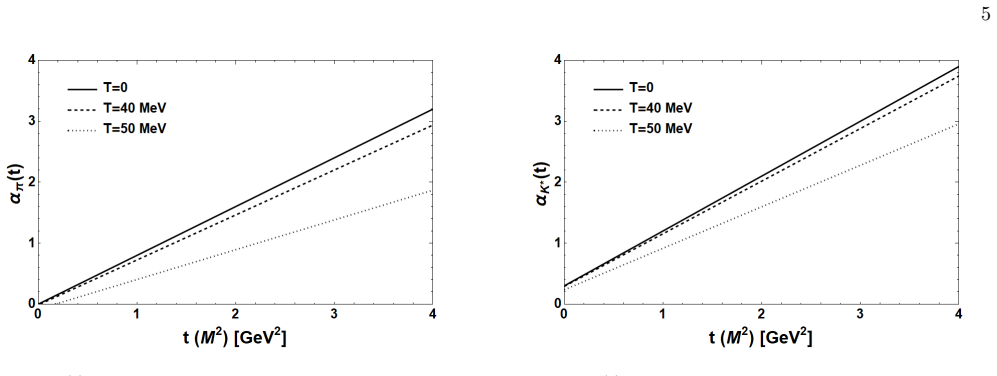
The central claim is that the leading high-energy behavior of the scattering amplitude remains a power law once the ladder diagrams are evaluated at finite temperature, with the exponent becoming $\alpha(t,\beta)=K(t)-1+B(t,\beta)$, where $B(t,\beta)=-\lambda^2\int_0^1 dz\,\beta^2 e^{-\beta\sqrt{tz(1-z)+m}}/(32\pi)$. In the small-$t$ expansion this reduces to $\alpha(t,\beta)=\lambda^2/(96\pi^2 m^2)-\lambda^2\beta^2 e^{-m\beta}/(32\pi)+t[\lambda^2/(576\pi^2 m^4)-\lambda^2\beta^3 e^{-m\beta}/(384\pi m)]$, so the thermal contribution lowers the intercept and, through the $\beta^3$ term, reduces the slope. Reading the $\rho$ mass from $\alpha(m_\rho^2,\beta)=1$ on the fitted trajectory gives $0.744\,\text{GeV}$ at $T=0$, $0.756\,\text{GeV}$ at $T=40\,\text{MeV}$, and $0.839\,\text{GeV}$ at $T=50\,\text{MeV}$. The authors present this as evidence that the excitation spectrum of hadrons is modified by a thermal bath, with the temperature dependence entering through the Bose–Einstein distribution in the imaginary-time formalism.
Load-bearing premise
The argument's load-bearing assumption is that the small-$t$ expansion of $\alpha(t,\beta)$ remains numerically faithful when evaluated at the rho squared mass $t\approx 0.55\,\text{GeV}^2$, even though the scalar mass fitted from the trajectory gives $4m^2\approx 0.37\,\text{GeV}^2$, where the exact $K(t)$ is no longer real and the expansion has already broken down.
Editorial extensions
If this is right
- The Regge slope $\alpha'$ decreases with temperature, so at a fixed spin the squared mass of the excited state moves upward.
- Meson masses extracted from $\alpha(t,\beta)=1$ grow with $T$; for the $\rho$ the paper quotes $0.744\rightarrow 0.756\rightarrow 0.839\,\text{GeV}$ as $T$ goes $0\rightarrow 40\rightarrow 50\,\text{MeV}$.
- The same slope reduction applies to the $\pi$, $\phi$ and $K^*$ trajectories, since they share the same zero-temperature slope $0.8$–$0.9\,\text{GeV}^{-2}$ in the fit.
- The thermal corrections are exponentially suppressed at low temperature, $e^{-m\beta}$, so the effect becomes numerically visible only as $T$ approaches the scalar mass scale $m\approx 0.30\,\text{GeV}$.
- The analytic form of $B$ gives a concrete prediction for the temperature dependence of the $\rho$ pole that can be compared with thermal-QCD determinations.
Reading between the lines
- If the small-$t$ truncation is relaxed, the full kernel $B(t,\beta)$ gives the trajectory curvature in $t$, so hot-medium data on trajectory curvature would discriminate between this ladder mechanism and a purely linear thermal shift.
- The derivation suggests that any ladder-resummed theory with a Bose–Einstein distribution will produce a negative exponential thermal kernel, so slope reduction with temperature may be a generic feature rather than a peculiarity of this scalar model.
- A decisive internal check would be to solve $\alpha(t,\beta)=1$ using the unexpanded $K(t)+B(t,\beta)$ (with an analytic continuation through $t=4m^2$) and compare the root to the value obtained from the linear expansion; this separates the physical claim from the extrapolation.
- One could test the same formalism at nonzero chemical potential by replacing $\beta$ with the corresponding thermal distribution, yielding a density-dependent trajectory that is absent from the paper.
Signed reviews
Editorial analysis
A structured set of objections, weighed in public.
Referee Report
Summary. The manuscript studies Regge trajectories in λφ^3 theory at zero and finite temperature. At T=0 it evaluates the ladder box diagram in the high-energy limit, identifies the Regge trajectory α(t)=K(t)−1, and then fits the parameters λ and m to reproduce the empirical ρ, π, φ, and K* trajectories. At finite temperature the authors use the imaginary-time formalism, resum thermal ladder diagrams, and obtain α(t,β)=K(t)−1+B(t,β). Expanding this at small t leads to a temperature-dependent intercept and slope. The paper reports that the Regge slope decreases with temperature and that the ρ meson mass increases, for example from about 0.744 GeV at T=0 to 0.839 GeV at T=50 MeV.
Significance. If the derivation were correct, the paper would provide a simple analytic toy model for thermal Regge trajectories and a concrete, falsifiable prediction for the temperature dependence of meson masses. The strategy of resumming ladder diagrams is sensible, the formulas are explicit, and the comparison with the known rising ρ mass is a useful target. These are genuine strengths. However, the thermal derivation contains several internal inconsistencies and sign errors, and the reported mass evolution cannot be obtained from the printed formulas. The central claim is therefore not supported as written.
major comments (4)
- [III, Eq. (15)] The Matsubara denominator is written as (ω_n+q^2+Δ)^4, but in the imaginary-time formalism the scalar propagator denominator is ω_n^2+q^2+Δ. With the stated definition ω_n=2πn/β, the sum performed in Eq. (18) is not the standard thermal sum for the box diagram. This is a technical error at the starting point of the thermal calculation; as written, Eqs. (15)–(18) do not follow from Eq. (14).
- [III, Eqs. (21)–(24)] The sign of the thermal amplitude changes without justification. After the q integration, Eq. (22) is positive, while Eq. (24) acquires an overall minus sign after the Feynman-parameter integration. The zero-temperature analogue in Eq. (8) is positive, so the Collins procedure itself does not introduce this sign flip. Since B(t,β) in Eq. (26) inherits the sign of Eq. (24), the sign of the thermal correction to the trajectory is not under control.
- [III, Eq. (26) and Eq. (32)] Equations (26) and (32) are mutually inconsistent. From Eq. (26), B(t,β) is negative and its t-derivative is positive for all t in the integration range, so the thermal contribution to the Regge slope must be positive. Equation (32), however, contains the negative t-coefficient −λ²β³e^{−βm}/(384πm). The advertised reduction of the slope follows only from Eq. (32), not from Eq. (26). This is not a cosmetic issue: the sign controls whether α(t)=1 moves to larger or smaller t, and with the fitted parameters the printed formula can even produce a negative slope in the plotted temperature range. The mass increase reported in Figs. 7–8 therefore cannot be obtained from the printed formulas.
- [III, after Eq. (32)] The small-t expansion is used to extract masses at t=m_ρ²≈0.55 GeV², but the fitted m≈0.304 GeV gives 4m²≈0.37 GeV². For t>4m², K(t) in Eq. (10) has a square-root branch cut and becomes complex, so the linear approximation has broken down before reaching the ρ pole. The mass values quoted in Figs. 7–8 are read from a formula outside its domain of validity, and this extrapolation is never justified in the text.
minor comments (4)
- [III, Eq. (22)] The exponent contains an unexplained factor π, e^{−βπ√Δ}, while Eq. (23) drops it. This changes the numerical result and needs to be explained or corrected.
- [III, Eqs. (24) and (26)] The exponential e^{−β√{tz(1−z)}+m} is ambiguous; it should be written as e^{−β(√{tz(1−z)}+m)} with parentheses.
- [III, Eq. (18)] The thermal distribution is written as e^{−βE} rather than the Bose-Einstein factor 1/(e^{βE}−1). If a low-temperature approximation is intended, it should be stated explicitly and its accuracy at T=40–50 MeV should be checked.
- [References] References [11] and [14] appear to be the same work and should be consolidated or replaced with distinct citations.
Circularity Check
Zero-temperature rho mass is fixed by the fit to empirical trajectories, but the thermal correction itself is an independent calculation.
-
fitted input called prediction
[Section III, after Eq. (33); Figs. 7 and 8 and surrounding text]
"In order to analyze how the Regge trajectories change with temperature, we plot the trajectories given by Eq. (33) at different temperatures. To do so, we fit the values of λ and m in such a way that, at T = 0, the trajectory reproduces the correct one. ... From Fig. 7, we can extract the mass of the ρ meson in the zero temperature case as approximately 0.744 GeV"
The T=0 mass is not a derivation: λ and m are fixed by requiring α(t,0)=λ²/(96π²m²)-1+λ²t/(576π²m⁴) to reproduce the empirical ρ line α=0.5+0.9t (Eq. (33)). Solving α(t)=1 then gives t≈0.55 GeV², i.e., m_ρ≈0.74 GeV, by construction. Reporting this as 'extracted' from Fig. 7 and using it as the T=0 anchor in Fig. 8 restates the fitted input. The thermal shift B(t,β) in Eq. (26), however, is computed from the ladder resummation and is not fitted, so the T>0 evolution retains independent content.
full rationale
The central thermal result, α(t,β)=K(t)-1+B(t,β) with B given by Eq. (26), is obtained from a genuine Matsubara/ladder-diagram calculation and is not fitted to thermal data. The only clear reduction-by-construction is the zero-temperature ρ mass read from Fig. 7: it is determined by the same λ and m that were fitted so that α(t,0) reproduces the empirical trajectory of Eq. (33). This is an ancillary baseline rather than the main claim, so it does not make the whole derivation circular. The self-citations (Refs. [25], [36], [37]) are used as comparisons or supporting context, not as load-bearing uniqueness or derivation steps. I also note the apparent sign inconsistency between Eq. (26) (which implies B'(t)>0) and Eq. (32) (negative t-coefficient); this is a correctness issue, not circularity, and was not scored as such.
Assumptions & free parameters
free parameters (2)
- λ (scalar coupling) =
not quoted in paper
- m (scalar mass) =
not quoted in paper
assumptions (4)
- domain assumption Leading-log resummation of the scalar ladder diagrams yields A(s,t)=λ² s^{K(t)-1}.
- domain assumption Imaginary-time formalism, with the loop integral replaced by a Matsubara sum, correctly captures the finite-temperature box diagram.
- domain assumption The finite-temperature ladder diagrams exponentiate in the same way as at T=0, with K+B replacing K in the geometric series.
- ad hoc to paper The λφ^3 model, after fitting λ and m, describes the empirical meson Regge trajectories and their thermal evolution.
Cite this review
Pith. "Pith review of Thermal corrections to Regge trajectories." pith.science (2026). https://pith.science/paper/RLZAQ6O5
@misc{pith2026250614979,
  author       = {Pith},
  title        = {Pith review of: Thermal corrections to Regge trajectories},
  year         = {2026},
  howpublished = {\url{https://pith.science/paper/RLZAQ6O5}},
  note         = {Machine review of arXiv:2506.14979}
}
abstract
In this work, we investigate the behavior of Regge trajectories in the context of quantum field theory at finite temperature. For this purpose, we employ the $\lambda \phi^3$ model. We first compute the Regge trajectories at zero temperature, establishing a baseline for comparison. As a key novelty, we extended our analysis to finite temperature and derive an analytical expression for the Regge trajectories in this regime. We explore how temperature modifies the structure of the Regge trajectories and analyze the physical implications of these modifications, which arise from the resummation of thermal ladder diagrams. As an interesting consequence, we find the thermal evolution of masses belonging to different Regge trajectories.
Figures


Figures from the paper (3 more)


Reference graph
Works this paper leans on
-
[1]
Regge, Nuovo Cim
T. Regge, Nuovo Cim. 14, 951 (1959)
1959
-
[2]
G. F. Chew and S. C. Frautschi, Phys. Rev. Lett. 7, 394 (1961)
work page 1961
-
[3]
G. F. Chew and S. C. Frautschi, Phys. Rev. Lett. 8, 41 (1962)
work page 1962
-
[4]
P. D. B. Collins, Phys. Rept. 1, 103 (1971)
work page 1971
- [5]
-
[6]
A. C. Irving and R. P. Worden, Phys. Rept. 34, 117 (1977)
work page 1977
- [7]
-
[8]
G. Colangelo, F. Hagelstein, M. Hoferichter, L. Laub, and P. Stoffer, JHEP 03, 101 (2020), arXiv:1910.13432 [hep-ph]
arXiv 2020
Show all 36 references
-
[9]
Caron-Huot, JHEP 05, 093 (2015), arXiv:1309.6521 [hep-th]
S. Caron-Huot, JHEP 05, 093 (2015), arXiv:1309.6521 [hep-th]
2015 arXiv
-
[10]
L. J. Dixon, C. Duhr, and J. Pennington, JHEP 10, 074 (2012), arXiv:1207.0186 [hep-th]
2012 arXiv
-
[12]
Del Duca, C
V. Del Duca, C. Duhr, E. Gardi, L. Magnea, and C. D. White, Phys. Rev. D 85, 071104 (2012), arXiv:1108.5947 [hep-ph]
2012 arXiv
-
[13]
Ruiz de Elvira, J
J. Ruiz de Elvira, J. R. Pelaez, M. R. Pennington, and D. J. Wilson, Phys. Rev. D 84, 096006 (2011), arXiv:1009.6204 [hep-ph]
2011 arXiv
-
[14]
Z. Shah, K. Thakkar, A. K. Rai, and P. C. Vinodkumar, Chin. Phys. C 40, 123102 (2016), arXiv:1609.08464 [nucl- th]
2016 arXiv
-
[15]
S. D. Bass, M. Skurzok, and P. Moskal, Phys. Rev. C 98, 025209 (2018), arXiv:1808.03202 [hep-ph]
2018 arXiv
-
[16]
Mistry, M
R. Mistry, M. Shah, and A. Majethiya, Rev. Mex. Fis. 70, 010801 (2024)
2024
-
[17]
Ebert, R
D. Ebert, R. N. Faustov, and V. O. Galkin, Phys. Rev. D 79, 114029 (2009), arXiv:0903.5183 [hep-ph]
2009 arXiv
-
[18]
W.-j. Fu, J. M. Pawlowski, and F. Rennecke, Phys. Rev. D 101, 054032 (2020), arXiv:1909.02991 [hep-ph]
2020 arXiv
-
[19]
L. A. Hern´ andez, J. D. Mart´ ınez-S´ anchez, and R. Zamora, Phys. Rev. D 111, 096019 (2025), arXiv:2502.08051 [hep-ph]
2025 arXiv
-
[20]
Fayazbakhsh and N
S. Fayazbakhsh and N. Sadooghi, Phys. Rev. D 88, 065030 (2013)
2013
-
[21]
Ghiglieri, A
J. Ghiglieri, A. Kurkela, M. Strickland, and A. Vuorinen, Phys. Rept. 880, 1 (2020), arXiv:2002.10188 [hep-ph]
2020 arXiv
-
[22]
L. A. Hern´ andez and R. Zamora, Phys. Rev. D 111, 036003 (2025), arXiv:2410.17874 [hep-ph]
2025 arXiv
-
[23]
Y. A. Simonov, Phys. Atom. Nucl. 79, 455 (2016), arXiv:1503.06616 [hep-ph]
2016 arXiv
-
[24]
Berges, K
J. Berges, K. Boguslavski, S. Schlichting, and R. Venugopalan, Phys. Rev. D 89, 074011 (2014), arXiv:1303.5650 [hep-ph]
2014 arXiv
-
[25]
Cadiz, M
R. Cadiz, M. Loewe, and R. Zamora, Phys. Rev. D 109, 116004 (2024), arXiv:2404.01927 [hep-ph]
2024 arXiv
-
[26]
Laine and A
M. Laine and A. Vuorinen, Basics of Thermal Field The- ory, Vol. 925 (Springer, 2016) arXiv:1701.01554 [hep-ph]
2016 arXiv
-
[27]
I. I. Gaspar, L. A. Hern´ andez, and R. Zamora, Phys. Rev. D 108, 094020 (2023), arXiv:2305.00101 [hep-ph]
2023 arXiv
-
[28]
Berges, M
J. Berges, M. P. Heller, A. Mazeliauskas, and R. Venugopalan, Rev. Mod. Phys. 93, 035003 (2021), arXiv:2005.12299 [hep-th]
2021 arXiv
-
[29]
Scardina, S
F. Scardina, S. K. Das, V. Minissale, S. Plumari, and V. Greco, Phys. Rev. C 96, 044905 (2017), arXiv:1707.05452 [nucl-th]
2017 arXiv
-
[30]
Curtin, P
D. Curtin, P. Meade, and H. Ramani, Eur. Phys. J. C 78, 787 (2018), arXiv:1612.00466 [hep-ph]
2018 arXiv
-
[31]
C. A. Dominguez, M. Loewe, C. Villavicencio, and R. Zamora, Phys. Rev. D 108, 074024 (2023), arXiv:2308.05663 [hep-ph]
2023 arXiv
-
[32]
J. O. Andersen, L. E. Leganger, M. Strickland, and N. Su, Phys. Lett. B 696, 468 (2011), arXiv:1009.4644 [hep-ph]
2011 arXiv
-
[33]
Fern´ andez, L
G. Fern´ andez, L. A. Hern´ andez, and R. Zamora, Phys. Rev. D 110, 014016 (2024), arXiv:2403.14478 [hep-ph]
2024 arXiv
-
[34]
P. D. B. Collins, An Introduction to Regge Theory and High Energy Physics , Cambridge Monographs on Math- ematical Physics (Cambridge University Press, 1977)
1977
-
[35]
M. L. Bellac, Thermal Field Theory , Cambridge Mono- graphs on Mathematical Physics (Cambridge University Press, 2011)
2011
-
[36]
C. A. Dominguez, M. Loewe, and J. C. Rojas, Z. Phys. C 59, 63 (1993)
1993
-
[37]
Loewe, D
M. Loewe, D. Valenzuela, and R. Zamora, Eur. Phys. J. A 59, 184 (2023), arXiv:2207.12387 [hep-ph]
2023 arXiv
Reviewed August 15, 2026 · model on record in the stance chip above.
Discussion (0). Continue with ORCID to comment.