REVIEW 1 major objections 5 minor 71 references
Photon Emission from Nucleon-Nucleon Bremsstrahlung in Fermi-energy Heavy-Ion Collisions
T0 review · 1 major / 5 minor · reviewed 2026-08-15 · deepseek-v4-flash
Pith's one-line read Hard photons in Fermi-energy heavy-ion collisions are emitted mostly in the first ~100 fm/c by primordial nucleon-nucleon collisions carrying the initial collective beam motion, not by the thermalized fireball.
desk verdict Solid first application of QFT-based bremsstrahlung rates to Fermi-energy hard photons; the primordial-dominance claim holds, but the magnitude of the early-time enhancement is not tightly pinned down. read the letter →
The pith
A machine-rendered reading of the paper's core claim, the machinery that carries it, and where it could break.
The reading
What carries the argument
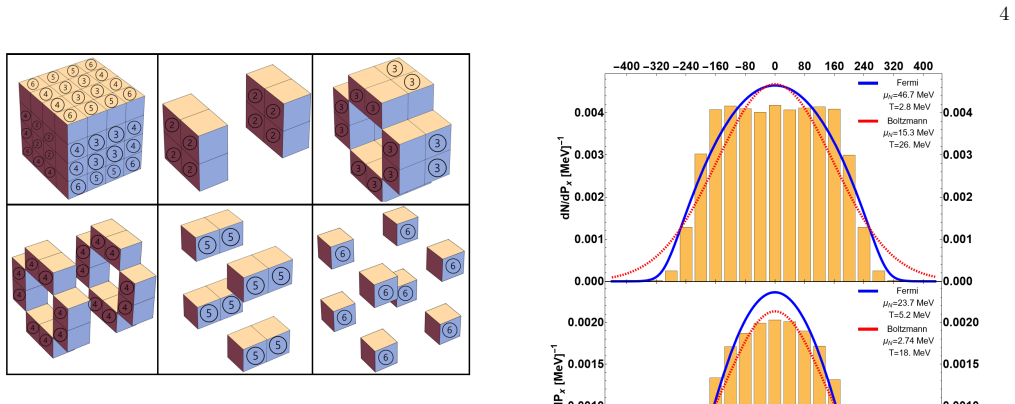
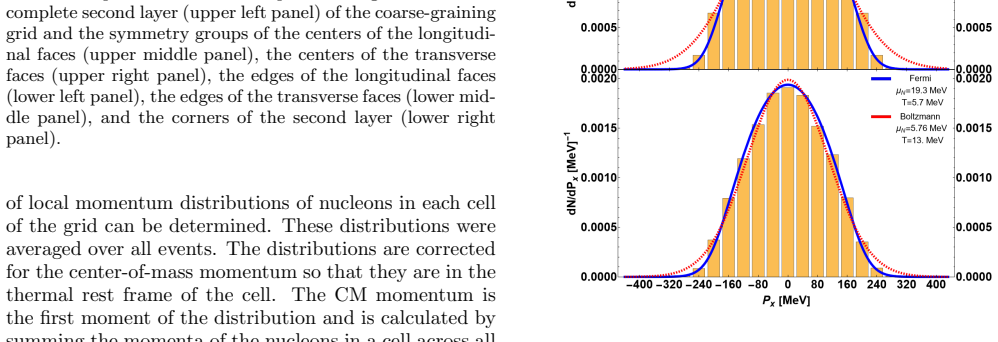
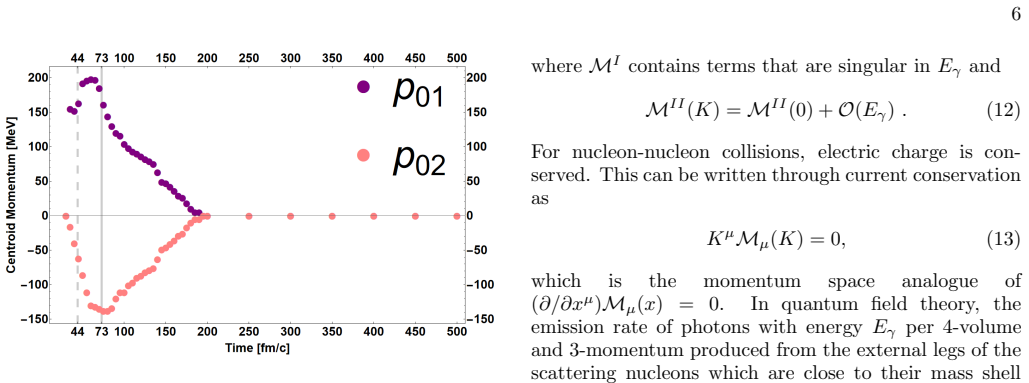
The load-bearing object is a two-centroid Fermi-Dirac distribution function for the longitudinal nucleon momentum: a weighted sum of two thermal Fermi functions centered at momenta $\pm p_0$, with effective longitudinal temperatures set by thermal stretch parameters $\xi_1,\xi_2$. It captures the two incoming nuclei as partially overlapping momentum blobs and, through its central dip, relieves Pauli blocking at low momentum. The photon rate is the field-theoretic Bremsstrahlung rate coupling elastic nucleon-nucleon scattering to photon emission through electric-dipole (proton-neutron) and quadrupole (proton-proton) currents, with final-state Pauli blocking included and the photon energy kept in energy conservation rather than invoking the soft-photon approximation. The paper convolves this rate over the coarse-grained space-time evolution and applies laboratory boosts and detector acceptance cuts before comparing to data.
What would settle it
Run the same photon-emission rate directly on the full nucleon momentum distributions from the transport code, without fitting the two-centroid ansatz, at 35A MeV for central Ca+Ca, and compare the E_gamma > 40 MeV yield; alternatively, measure hard-photon spectra from a symmetric 40Ca+40Ca collision at 35A MeV with full 4pi acceptance. If the un-fitted yield does not reproduce the enhancement, or if the measured symmetric-system yield does not show the predicted early, hard component, the primordial-dominance claim is falsified.
Extended reading notes
Core claim
The paper establishes that the initial collective nuclear motion, not the thermalized medium, is the dominant source of hard photons in Fermi-energy heavy-ion collisions. During the early compressed phase, the longitudinal nucleon momentum distribution develops a two-hump structure with a dip near zero momentum; the paper models this with a two-centroid Fermi-Dirac distribution and shows that this dip opens phase space for colliding nucleons to be stopped, converting nearly all of their kinetic energy into photons. This mechanism enhances high-energy photon emission by two to four orders of magnitude relative to a purely thermal calculation. A layer-by-layer and time-window decomposition shows the enhancement comes almost entirely from the first two spatial layers and the earliest time windows, before the centroid motion dissipates. In the most realistic implementation, including the narrower longitudinal momentum tails, the calculated spectrum reproduces the measured slope but underestimates the data by a factor of roughly three to four at photon energies above about 40 MeV, a gap the paper attributes to mechanisms not yet included, such as internal meson-exchange radiation.
Load-bearing premise
The calculation assumes the two-centroid Fermi ansatz fitted to transport output faithfully represents the true early-time nucleon momentum distribution, especially the low-momentum dip that lets nucleons stop and radiate; if the real distribution fills that dip, the hard-photon enhancement from primordial collisions is biased upward.
Editorial extensions
If this is right
- Above roughly 30-40 MeV, measured photon spectra primarily encode the first ~100 fm/c of the collision, when nucleons still move with the initial collective beam direction.
- Inferring fireball temperatures from hard-photon slopes in this energy regime is indirect at best, since the high-energy part of the spectrum is dominated by primordial, off-equilibrium collisions rather than by thermal emission.
- Pauli blocking and the exact photon energy in energy conservation are quantitatively essential at Fermi energies: using the soft-photon approximation would overestimate the emissivity by up to a factor of several at the temperatures and densities considered, because the final-state phase space is heavily degenerate.
- Hard-photon production is almost entirely from neutron-proton collisions (proton-proton Bremsstrahlung contributes less than 4%), so the mechanism is a selective probe of isospin-dependent nucleon-nucleon dynamics.
- The enhancement from centroid motion predicts a strong early-time, high-energy component; comparisons that omit the initial collective motion underestimate the measured spectrum by a large factor, while including it brings the calculation close to the data in slope and magnitude.
Reading between the lines
- If primordial-dominance holds, hard-photon yields become a tunable probe of nuclear stopping and of the early momentum-space structure at first contact, quantities that are hard to access through hadronic observables.
- The residual factor 3-4 deficit at the highest photon energies is a plausible smoking-gun for internal (meson-exchange) Bremsstrahlung, whose leading-order monopole contribution is not included here and would grow near the kinematic endpoint.
- A direct testable extension is an isospin scan: switching to neutron-rich projectiles or targets should raise the hard-photon yield per participant, because the pn channel dominates and its dipole coupling is much stronger than pp or nn quadrupole emission.
- Recomputing the rate without the analytic two-centroid fit, using the raw event-averaged momentum distribution from the transport code, would show whether the low-momentum dip is a genuine feature of the early phase space or an artifact of the fit; this is a falsifiable check of the paper's enhancement mechanism.
Signed reviews
Editorial analysis
A structured set of objections, weighed in public.
Referee Report
Summary. The manuscript computes photon emission from nucleon-nucleon bremsstrahlung in Fermi-energy heavy-ion collisions by combining a quantum-field-theoretical emission rate with nucleon distribution functions extracted from a coarse-grained Constrained Molecular Dynamics simulation of central 40Ca+40Ca collisions at 35 A MeV. The transverse momentum distributions are described by thermal Fermi-Dirac functions, while the longitudinal distributions use a two-centroid anisotropic ansatz with thermal stretch parameters, allowing the authors to treat the early off-equilibrium collective motion and its gradual thermalization. The emission rates include final-state Pauli blocking, retain the photon energy in energy conservation rather than using the soft-photon approximation, and are benchmarked against the Rrapaj-Reddy emissivity. Three versions of the calculation are presented: purely thermal, including centroid motion, and including both centroid motion and longitudinal temperature anisotropy. The central finding is that hard photons are produced predominantly in the first two coarse-graining layers during the earliest time windows, i.e., from primordial collisions carrying the initial collective nuclear motion, with later quasi-thermal emission sub-dominant.
Significance. If correct, the paper's central claim redirects the interpretation of hard photons at Fermi energies: rather than reflecting the hottest thermal fireball stage, the hard-photon tail would be a direct probe of the early, non-equilibrium collective motion of the projectile and target nucleons. This is a significant conceptual point for the field. The study is also careful in several respects: the emissivity is benchmarked against an established calculation, the soft-photon approximation is deliberately avoided because Pauli blocking makes it inaccurate, and the authors present three model variants so that the role of each effect is visible rather than hidden in a single tuned curve. The honest comparison with data, including its acknowledged underprediction, strengthens the credibility of the framework. The main risk is not internal circularity but the unphysical behavior of the fitted distribution function in the early stage, which directly enters the primordial-emission mechanism that underlies the central claim.
major comments (1)
- [Sec. V, Eq. (6) and Eq. (19)] The authors state in the paragraph following Fig. 19 that the two-centroid fit of Eq. (6) can exceed unity during the initial high-density, strongly anisotropic stages, and they handle the problem only by inserting theta functions on the final-state blocking factors in Eq. (19). This corrects negative values of (1-f3) and (1-f4), but it does not cap f1 or f2, so the production factor f1f2 in Eq. (19) can still exceed unity. Because the claimed enhancement of primordial emission is produced precisely by the configurations with large centroid momentum and large stretch parameter that make Eq. (6) exceed unity (the same low-momentum dip that reduces final-state blocking), the early-time yields in Figs. 28, 29, and 33, and hence the central conclusion that primordial collisions dominate hard photons, may be overestimated by an uncontrolled amount. Please either normalize the two-centroid function so that the fitted occupancy never exceeds unity, or cap f1 and f2 in the rate and show how the layer/time decompositions change. In either case, a direct comparison of the fit to the CoMD histograms in the low-pz and low-p_perp region of Fig. 4 should be shown, since that is the phase-space region that drives the reported hard-photon enhancement.
minor comments (5)
- [Sec. III C, after Fig. 12] The sentence "dominated by radiation from thermal sources." following Fig. 12 is an incomplete orphan fragment and should be removed or integrated into a surrounding sentence.
- [References [16] and [58]] References [16] and [58] are cited as "letter (1988?)" and "email (2023)", respectively; these are not archival citations and should be replaced by complete published references.
- [Fig. 34] The experimental data in Fig. 34 are shown as dots without visible statistical error bars; please include the error bars or state explicitly that they are smaller than the symbol size.
- [Sec. VI A, Eqs. (27)-(28)] The participant rescaling factor (123/77)^(4/3) is a strong assumption, and the exponent 4/3 is motivated by a geometric early-time argument; a sensitivity test, for example comparing A_participant scaling with A_participant^(4/3) scaling, would make the quantitative comparison in Fig. 34 more robust.
- [App. A, Eq. (A14)] The isotropic S-wave assumption for the elastic NN differential cross section is a simplification that may affect the hard-photon slope; since internal bremsstrahlung is already identified in Sec. IX as a likely missing mechanism, a brief estimate of the sensitivity to the angular form of dσ/dΩ would strengthen the quantitative conclusions.
Circularity Check
No significant circularity: the photon spectra are genuine forward predictions from transport-derived phase-space distributions plus an externally benchmarked rate.
full rationale
The paper's derivation chain is self-contained and does not reduce to its own inputs. The photon emission rate in Eq. (19) is derived from the standard Low soft-photon theorem and external-leg electromagnetic currents, and the underlying cross sections in Eqs. (20) and (22) are parameterizations of external NN scattering data, not of photon spectra. The rate is benchmarked against the independent emissivity calculation of Rrapaj and Reddy (Table I, Figs. 13--14), and the observed disagreement at Fermi-energy conditions is presented as a physical consequence of Pauli blocking and going beyond the soft-photon approximation, not as a fitted adjustment. The nucleon distribution functions entering the rate are extracted from CoMD transport via coarse-graining (Eqs. (3)--(6)); the parameters T, mu_N, p_01, p_02, xi_1, xi_2, and w are fitted to transport output, not to the Ar+Mo photon data. The comparison to the measured 36Ar+98Mo spectrum (Fig. 34) is therefore a genuine forward prediction, with no parameter adjusted to the photon yields. The central conclusion that primordial collisions dominate hard-photon emission follows from convolving the rate with the transport-derived early-time distributions; although it is sensitive to the two-centroid ansatz of Eq. (6), that ansatz is not defined in terms of, or fitted to, the photon observable. The only author self-citation is Ref. [33] for the coarse-graining framework, which supplies independent transport-model input rather than a fitted target or an unverified uniqueness claim. The concern that Eq. (6) can exceed unity during the initial stages and is not capped in the production term is a physical-consistency and correctness risk for the model input, not a circularity in the prediction, since it does not amount to re-inserting the predicted spectrum into the model. On this basis, no circular step meeting the quoted-evidence standard was identified.
Assumptions & free parameters
free parameters (5)
- r_np(T_CM) piecewise parameterization =
5-piece form in Eq. (20), e.g., 9.04065*T^-0.354978 for 0<T<8 MeV
- r_pp(T_CM) piecewise parameterization =
7.1873*T^-0.5267 for T<52 MeV and 0.999341*T^-0.0286 above, Eq. (22)
- Local temperature T and nucleon chemical potential mu_N =
Time and cell dependent, extracted from Fermi-Dirac fits to transverse momentum distributions
- Centroid momenta p01, p02 and thermal stretch parameters xi1, xi2, weight w =
Time and cell dependent, extracted from two-centroid Fermi fits to longitudinal momentum distributions, Eq. (6)
- Participant-number rescaling factor for Ar-Mo comparison =
(123/77)^(4/3) ≈ 1.87 applied to the Ca-Ca spectrum
assumptions (6)
- domain assumption Photon emission from the external nucleon lines can be related to elastic NN scattering via the soft-photon expansion (Low theorem), and internal meson-exchange bremsstrahlung is neglected.
- domain assumption The NN elastic cross sections are angularly symmetric (S-wave only), so dsigma/dOmega = r^2/(4 pi).
- domain assumption Nucleon momentum distributions are well described by a thermal Fermi-Dirac form in the transverse direction and a two-centroid Fermi form in the longitudinal direction, with negative Pauli blocking factors clipped by theta functions.
- domain assumption Coarse-grained local cells are approximately in thermal rest frames, and photon emission is isotropic in each cell rest frame; cell collective velocities are combined with the lab boost.
- ad hoc to paper Central 40Ca+40Ca results can be rescaled to the 36Ar+98Mo data by a participant-number factor (123/77)^(4/3).
- standard math Nonrelativistic nucleon kinematics, E_nucleon approx M, and neglect of the photon 3-momentum in the energy-conserving delta function while retaining E_gamma.
Cite this review
Pith. "Pith review of Photon Emission from Nucleon-Nucleon Bremsstrahlung in Fermi-energy Heavy-Ion Collisions." pith.science (2026). https://pith.science/paper/RHYK6EEC
@misc{pith2026250616865,
  author       = {Pith},
  title        = {Pith review of: Photon Emission from Nucleon-Nucleon Bremsstrahlung in Fermi-energy Heavy-Ion Collisions},
  year         = {2026},
  howpublished = {\url{https://pith.science/paper/RHYK6EEC}},
  note         = {Machine review of arXiv:2506.16865}
}
abstract
The emission of direct (hard and thermal) photons from nucleon-nucleon Bremsstrahlung in heavy-ion collisions at Fermi energies is analyzed. We utilize a photon emission rate based on a quantum-field-theoretical model together with nucleon distribution functions extracted from a coarse-graining method of transport model simulations. The latter accounts for off-equilibrium effects during the early stages of nuclear collisions primarily occurring in the beam direction while the transverse-momentum distributions are amenable to a thermal description. With this setup, we quantify the contributions from first-chance nucleon-nucleon collisions and the subsequent transition to a thermal source to the photon energy spectrum measured from Ca-Ca collisions at 35 A$\cdot$MeV bombarding energy. We find that most of the hard photons are produced in the initial stages of heavy-ion collisions from primordial collisions where nucleons move with the initial collective nuclear motion while the emission from the later stages plays a sub-dominant role. We compare our calculations to experimental measurements of a differential photon-energy spectrum from a collision system of similar size and beam energy, thereby including acceptance cuts as applied in the detectors.
Figures

Figures from the paper (29 more)




Reference graph
Works this paper leans on
- [1]
- [2]
-
[3]
Photon Production in Hot and Dense Strongly Interacting Matter
C. Gale, Landolt-Bornstein 23, 445 (2010), 0904.2184
work page Pith review arXiv 2010
-
[4]
A. Bonasera, R. Coniglione, and P. Sapienza, Eur. Phys. J. A 30, 47 (2006)
work page 2006
- [5]
- [6]
-
[7]
J. D. Jackson, Classical Electrodynamics (Wiley, 1998), ISBN 978-0-471-30932-1
1998
-
[8]
W. Cassing, T. Biro, U. Mosel, M. Tohyama, and W. Bauer, Phys. Lett. B 181, 217 (1986)
work page 1986
Show all 71 references
-
[9]
P. F. M. Koehler, K. W. Rothe, and E. H. Thorndike, Phys. Rev. Lett. 18, 933 (1967), URL https://link. aps.org/doi/10.1103/PhysRevLett.18.933
1967 doi
-
[10]
Neuhauser and S
D. Neuhauser and S. E. Koonin, Nucl. Phys. A 462, 163 (1987)
1987
-
[11]
Edgington and B
J. Edgington and B. Rose, Nuclear Physics 89, 523 (1966), ISSN 0029-5582, URL https: //www.sciencedirect.com/science/article/pii/ 002955826690928X
1966
-
[12]
Nakayama, Phys
K. Nakayama, Phys. Rev. C 39, 1475 (1989)
1989
-
[13]
Nakayama and G
K. Nakayama and G. F. Bertsch, Phys. Rev. C 40, 685 (1989)
1989
-
[14]
Grosse, P
E. Grosse, P. Grimm, H. Heckwolf, W. F. J. M¨ uller, H. Noll, A. Oskarsson, H. Stelzer, and W. R¨ osch, Eu- rophys. Lett. 2, 9 (1986)
1986
-
[15]
Stevenson et al., Phys
J. Stevenson et al., Phys. Rev. Lett. 57, 555 (1986)
1986
-
[16]
Gossett, letter (1988?)
C. Gossett, letter (1988?)
1988
-
[17]
Sch¨ afer, T
M. Sch¨ afer, T. S. Biro, W. Cassing, U. Mosel, H. Nife- necker, and J. A. Pinston, Z. Phys. A 339, 391 (1991)
1991
-
[18]
C. J. Horowitz, Phys. Rev. C 31, 1340 (1985)
1985
-
[19]
D. P. Murdock and C. J. Horowitz, Phys. Rev. C 35, 21 1442 (1987)
1987
-
[20]
S. S. Wang, Y. G. Ma, X. G. Cao, D. Q. Fang, and C. W. Ma, Eur. Phys. J. A 56, 254 (2020), 2010.05261
2020 arXiv
- [21]
-
[22]
X. Deng, Y. Ma, and M. Veselsky, Phys. Rev. C 94, 044622 (2016), 1610.04736
2016 arXiv
-
[23]
S. S. Wang, Y. G. Ma, X. G. Cao, D. Q. Fang, and C. W. Ma, Phys. Rev. C 102, 024620 (2020)
2020
-
[24]
C. Shi, Y. Ma, X. Cao, D. Fang, W. He, and C. Zhong, Phys. Rev. C 102, 014601 (2020), 2008.03514
2020 arXiv
-
[25]
N. Gan, K. T. Brinkmann, A. L. Caraley, B. J. Fineman, W. J. Kernan, R. L. McGrath, and P. Danielewicz, Phys. Rev. C 49, 298 (1994)
1994
- [26]
-
[27]
Guo, B.-A
W.-M. Guo, B.-A. Li, and G.-C. Yong, Phys. Rev. C108, 034617 (2023), 2307.05135
2023 arXiv
-
[28]
Huovinen, M
P. Huovinen, M. Belkacem, P. Ellis, and J. I. Kapusta, Phys. Rev. C 66, 014903 (2002), nucl-th/0203023
2002 arXiv
-
[29]
Santini, J
E. Santini, J. Steinheimer, M. Bleicher, and S. Schramm, Phys. Rev. C 84, 014901 (2011), 1102.4574
2011 arXiv
-
[30]
H. L. Liu, Y. G. Ma, A. Bonasera, X. G. Deng, O. Lopez, and M. Veselsk´ y, Phys. Rev. C 96, 064604 (2017), 1803.07945
2017 arXiv
-
[31]
Galatyuk, P
T. Galatyuk, P. M. Hohler, R. Rapp, F. Seck, and J. Stroth, Eur. Phys. J. A 52, 131 (2016), 1512.08688
2016 arXiv
-
[32]
Endres, H
S. Endres, H. van Hees, J. Weil, and M. Bleicher, Phys. Rev. C 92, 014911 (2015), 1505.06131
2015 arXiv
-
[33]
Onyango, A
T. Onyango, A. Bonasera, and R. Rapp, Nucl. Phys. A 1022, 122426 (2022), 2112.14653
2022 arXiv
-
[34]
C. Zhou, Y. Ma, D. Fang, and G. Zhang, Phys. Rev. C 88, 024604 (2013), 1212.4907
2013 arXiv
-
[35]
Zheng, G
H. Zheng, G. Bonasera, J. Mabiala, P. Marini, and A. Bonasera, Eur. Phys. J. A 50, 167 (2014), 1404.2518
2014 arXiv
-
[36]
M. Papa, T. Maruyama, and A. Bonasera, Phys. Rev. C 64, 024612 (2001), nucl-th/0012083
2001 arXiv
-
[37]
M. Papa, G. Giuliani, and A. Bonasera, J. Comput. Phys. 208, 403 (2005), nucl-th/0502067
2005 arXiv
-
[38]
F. E. Low, Phys. Rev. 110, 974 (1958)
1958
-
[39]
E. M. Nyman, Phys. Rev. 170, 1628 (1968)
1968
-
[40]
T. H. Burnett and N. M. Kroll, Phys. Rev. Lett. 20, 86 (1968)
1968
- [41]
-
[42]
J. H. Chang, R. Essig, and S. D. McDermott, JHEP 01, 107 (2017), 1611.03864
2017 arXiv
-
[43]
Heller, Phys
L. Heller, Phys. Rev. 174, 1580 (1968)
1968
-
[44]
R. P. Brinkmann and M. S. Turner, Phys. Rev. D 38, 2338 (1988)
1988
-
[45]
Hartnack, Z
C. Hartnack, Z. X. Li, L. Neise, G. Peilert, A. Rosen- hauer, H. Sorge, H. Stoecker, W. Greiner, and J. Aiche- lin, Nucl. Phys. A 495, 303C (1989)
1989
-
[46]
Hartnack, R
C. Hartnack, R. K. Puri, J. Aichelin, J. Konopka, S. A. Bass, H. Stoecker, and W. Greiner, Eur. Phys. J. A 1, 151 (1998), nucl-th/9811015
1998 arXiv
-
[47]
S. A. Bass, C. Hartnack, H. Stoecker, and W. Greiner, Phys. Rev. C 51, R12 (1995)
1995
-
[48]
V. G. J. Stoks, R. A. M. Klomp, M. C. M. Rentmeester, and J. J. de Swart, Phys. Rev. C 48, 792 (1993)
1993
-
[49]
Lechanoine-LeLuc and F
C. Lechanoine-LeLuc and F. Lehar, Rev. Mod. Phys. 65, 47 (1993), URL https://link.aps.org/doi/10.1103/ RevModPhys.65.47
1993
-
[50]
S. K. Charagi and S. K. Gupta, Phys. Rev. C 41, 1610 (1990)
1990
-
[51]
Herrmann, J
V. Herrmann, J. Speth, and K. Nakayama, Phys. Rev. C 43, 394 (1991)
1991
-
[52]
Santonocito et al., Phys
D. Santonocito et al., Phys. Rev. C 66, 044619 (2002)
2002
-
[53]
Piattelli et al., Nucl
P. Piattelli et al., Nucl. Phys. A 599, 63 (1996)
1996
-
[54]
Nifenecker, J
H. Nifenecker, J. Blachot, J. Crancon, A. Gizon, and A. Lleres, Nucl. Phys. A 447, 533 (1986)
1986
-
[55]
Suomijarvi et al., Phys
T. Suomijarvi et al., Phys. Rev. C 53, 2258 (1996)
1996
-
[56]
Piattelli et al., Nucl
P. Piattelli et al., Nucl. Phys. A 649, 181 (1999)
1999
-
[57]
Migneco, C
E. Migneco, C. Agodi, R. Alba, G. Bellia, R. Coniglione, A. Del Zoppo, P. Finocchiaro, C. Maiolino, P. Piattelli, G. Raia, et al., Nuclear Instruments and Methods in Physics Research Section A: Accelerators, Spectrometers, Detectors and Associated Equipment 314, 31 (1992), ISS...
1992
-
[58]
Santonocito, M
D. Santonocito, M. Colonna, and P. Piattelli, email (2023)
2023
-
[59]
J. I. Kapusta, Phys. Rev. C 15, 1580 (1977)
1977
-
[60]
Guo, B.-A
W.-M. Guo, B.-A. Li, and G.-C. Yong, Phys. Rev. C104, 034603 (2021), 2106.08242
2021 arXiv
-
[61]
G. H. Liu, Y. G. Ma, X. Z. Cai, D. Q. Fang, W. Q. Shen, W. D. Tian, and K. Wang, Phys. Lett. B663, 312 (2008)
2008
-
[62]
Y. G. Ma, G. H. Liu, X. Z. Cai, D. Q. Fang, W. Guo, W. Q. Shen, W. D. Tian, and H. W. Wang, Phys. Rev. C 85, 024618 (2012), 1203.0164
2012 arXiv
-
[63]
Cassing, V
W. Cassing, V. Metag, U. Mosel, and K. Niita, Phys. Rept. 188, 363 (1990)
1990
-
[64]
Mahoney, A
C. Mahoney, A. K. Leibovich, and A. R. Zentner, Phys. Rev. D 96, 043018 (2017), 1706.08871
2017 arXiv
-
[65]
C. S. Shin and S. Yun, JHEP 02, 133 (2022), 2110.03362
2022 arXiv
-
[66]
Giannotti and F
M. Giannotti and F. Nesti, Phys. Rev. D 72, 063005 (2005), hep-ph/0505090
2005 arXiv
-
[67]
H. A. Weldon, Phys. Rev. D 28, 2007 (1983)
1983
-
[68]
J. D. Bjorken and S. D. Drell, Relativistic Quantum Me- chanics, International Series In Pure and Applied Physics (McGraw-Hill, New York, 1965), ISBN 978-0-07-005493- 6
1965
-
[69]
M. E. Peskin and D. V. Schroeder, An Introduction to quantum field theory (Addison-Wesley, Reading, USA, 1995), ISBN 978-0-201-50397-5
1995
-
[70]
Haglin, C
K. Haglin, C. Gale, and V. Emel’yamnov, Phys. Rev. D 47, 973 (1993), hep-ph/9208211
1993 arXiv
-
[71]
R. P. Feynman, Phys. Rev. 76, 769 (1949). Appendices Appendix A: Derivation of Nucleon-Nucleon Bremsstrahlung Rate The photon production rate can be derived from ki- netic theory starting with the photon emissivity ˙ϵ, which is the emission rate of energy Eγ by photons per uni...
1949
Reviewed August 15, 2026 · model on record in the stance chip above.
Discussion (0). Continue with ORCID to comment.