REVIEW 3 major objections 4 minor 86 references
Crosstalk-Robust Dynamical Decoupling for Bipartite-Topology Quantum Processors
T0 review · 3 major / 4 minor · reviewed 2026-08-15 · deepseek-v4-flash
Pith's one-line read Staggering the timing of equidistant π-pulse DD sequences cancels first-order ZZ crosstalk on any two-colorable qubit layout, with no extra pulses and twice the cycle time.
desk verdict Legitimate generalization of pulse-staggered DD from XY4 to equidistant pi-pulse sequences, with strong hardware evidence but an unproven 'any sequence' claim and an overstated abstract. read the letter →
The pith
A machine-rendered reading of the paper's core claim, the machinery that carries it, and where it could break.
The reading
What carries the argument
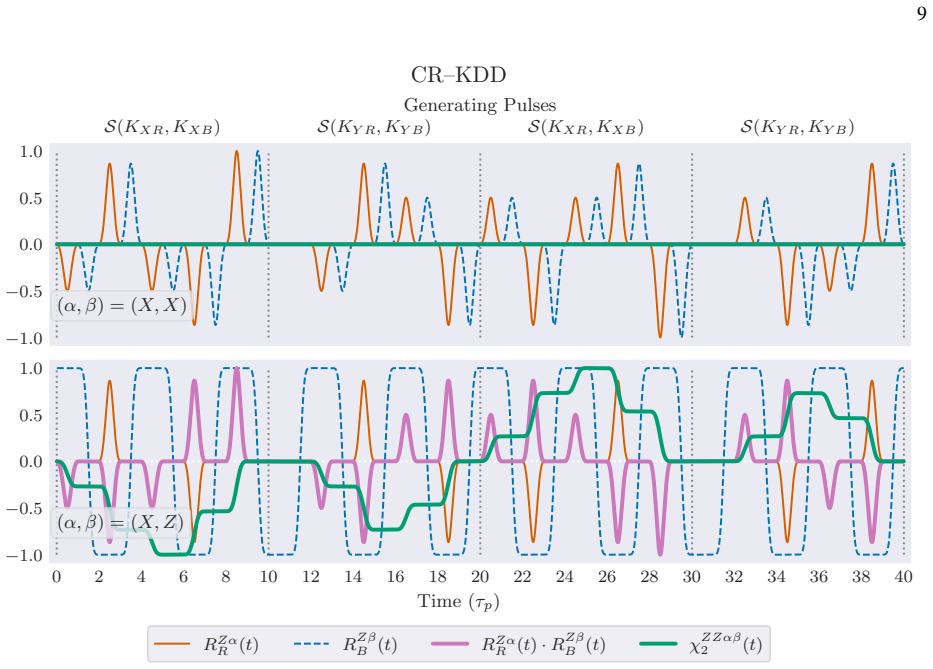
The machinery is the staggered two-color pulse schedule of Eq. (32), in which one color applies each π-pulse before the free-evolution delay $f_p$ and the other color places the delay before the pulse. This schedule makes the products of single-qubit control-matrix elements $R^{Z\alpha}_R(t)R^{Z\beta}_B(t)$ either mutually orthogonal or displacement-antisymmetric over the cycle, so their time integral—the first-order two-local error matrix $\chi^{ZZ\alpha\beta}_{2,e}(\tau_c)$—vanishes. The equal-delay, equal-duration π-pulse structure preserves each base sequence's own first-order single-qubit suppression, because the staggering only permutes pulse and delay order without changing the local sequence.
What would settle it
Set up two qubits on a fixed-coupler device with known ZZ coupling, run CR-DD versus SIM-DD with an engineered non-ZZ crosstalk term or a time-modulated ZZ coupling, and measure survival probability or the first-order Magnus term; if CR-DD does not outperform SIM-DD or $\chi^{ZZ\alpha\beta}_{2,e}(\tau_c)$ fails to vanish, the claimed universality of Eq. (32) is refuted. A simpler laboratory check is to violate one premise—unequal inter-pulse delays or unequal pulse durations—and observe whether the staggered pair still cancels the ZZ error matrix to first order.
Extended reading notes
Core claim
Eq. (32) is the paper's central claim: for any single-qubit DD sequence composed of π-pulses with equal delays, the two-color implementation $D_R = \prod_{\phi\in\Phi_R}(\pi)_\phi f_p$ and $D_B = \prod_{\phi\in\Phi_B} f_p(\pi)_\phi$ suppresses all effective first-order ZZ error terms on a two-colorable graph, while preserving the sequence's original single-qubit robustness. The suppression is shown through the control-matrix condition $\chi^{ZZ\alpha\beta}_{2,e}(\tau_c)=\int_0^{\tau_c} R^{Z\alpha}_R(t)R^{Z\beta}_B(t)\,dt=0$, which the staggered timing produces through orthogonality and displacement (anti)symmetry between the two colors' control-matrix elements. The result holds for homogeneous pairs of sequences (XY4, KDD, UR10, RGA64c) and for heterogeneous pairs (such as XY4 with UR12), and it survives symmetric or asymmetric idle padding around each pulse. The paper identifies the π-pulse-driven toggling of $R^{ZZ}(t)$ between $\pm 1$ as the feature that makes the cancellation robust for this whole family.
Load-bearing premise
The derivation assumes the error Hamiltonian contains only single-qubit terms and static ZZ couplings between adjacent qubits, with equal-duration pulses and equal inter-pulse delays; any significant non-ZZ correlated noise, time-dependent ZZ coupling, or unequal pulse timing can break the first-order suppression condition.
Editorial extensions
If this is right
- Every equidistant-π-pulse DD sequence can be converted into a crosstalk-robust variant at the cost of a factor-2 increase in cycle time and no increase in pulse count.
- The two colors need not run the same sequence, so DD schedules can be composed from different base sequences while retaining ZZ suppression.
- Equal padding added symmetrically or asymmetrically around pulses preserves the suppression, letting practitioners trade pulse count against wall time when protecting idling qubits.
- Comparing SIM and CR variants of the same sequence serves as an indirect ZZ-crosstalk diagnostic: a large performance gap indicates significant static ZZ crosstalk, and near-equal performance indicates hardware-level suppression.
- On the tested fixed-coupler devices, CR-DD raised the median characteristic time of survival-probability decay by factors of roughly 3 to 10 relative to SIM-DD, across system sizes from 5 to 20 qubits.
Reading between the lines
- If Eq. (32) is as general as claimed, the same timing recipe should transfer to other platforms with bipartite nearest-neighbor coupling and equal-duration pulses, such as trapped-ion chains or neutral-atom arrays, provided their crosstalk is static ZZ.
- A testable extension would be to run the SIM-versus-CR comparison on hardware where the dominant correlated noise is not ZZ (e.g., XX or YY crosstalk); the first-order suppression condition is specific to ZZ terms, so the CR advantage should disappear or shrink.
- The protocol's diagnostic use is a cheap reverse-engineering tool: a pulse-count-matched pair of SIM and CR experiments gives a direct estimate of whether ZZ crosstalk limits memory fidelity on an unfamiliar device, without a full noise-spectroscopy analysis.
- Because the method allows arbitrary equal padding and heterogeneous sequence pairs, DD-aware compilers could insert idle gaps or choose per-color sequences to fit algorithmic scheduling constraints while keeping crosstalk suppression; this scheduling flexibility is implicit in the paper's Eqs. (33)–(34) but is not developed into an algorithm there.
Signed reviews
Editorial analysis
A structured set of objections, weighed in public.
Referee Report
Summary. The manuscript introduces a pulse-timing protocol, CR-DD, that targets static ZZ crosstalk on two-colorable qubit topologies. Given a single-qubit DD sequence composed of equally spaced π-pulses, the proposal is to implement the sequence on the two color classes with a relative time shift: one color uses pulses followed by a delay of one pulse duration, while the other uses the same phase list with the delay preceding each pulse (Eq. (32)). The authors claim that, for any such sequence, this staggered implementation satisfies the first-order ZZ suppression condition Eq. (16) while preserving the sequence's single-qubit robustness, with no increase in pulse number and only a factor-2 cycle-time overhead. The theoretical framework is based on first-order Magnus/control-matrix conditions (Eqs. (15)-(16)), and the claim is supported by numerical studies of the control matrices for XY4, KDD, and a heterogeneous XY4/UR12 composition, as well as by hardware demonstrations on IBM fixed-coupler (Eagle r3) and tunable-coupler (Heron r2) devices with up to 20 qubits. The fixed-coupler experiments show consistently higher survival probabilities for the staggered variants than for simultaneous DD, and the tunable-coupler experiments show little SIM/CR gap, which the authors interpret as evidence that ZZ crosstalk is suppressed at the hardware level.
Significance. If the central universality claim were established, this would be a broadly useful low-overhead method for making a large family of practical DD sequences robust to static ZZ crosstalk. The first-order perturbative framework and the explicit suppression conditions are clean, and the multi-device, multi-embedding, multi-sequence hardware study is a substantial experimental contribution. The padding study and the fixed-versus-tunable-coupler comparison are also valuable and, for the tested sequences, the reported improvements in characteristic fidelity-decay time are striking. However, the paper's headline theoretical assertion — that Eq. (32) works for every equidistant π-pulse sequence — is not proven; the text offers examples and symmetry arguments but no general derivation, and the paper itself concedes the analytical understanding is limited. The experimental conclusions for the tested sequences are credible, but the universality claim, as written, goes beyond what the manuscript establishes.
major comments (3)
- [Sec. V B, Eq. (32)] The central claim that Eq. (32) satisfies the first-order ZZ suppression condition Eq. (16) for every single-qubit DD sequence of equally spaced π-pulses is asserted without proof. A direct first-order calculation using the control-matrix convention of Eq. (6) shows that cancellation is not automatic: the pulse-induced cross terms such as χ^{ZX}_2 and χ^{XZ}_2 reduce to discrete sums of single-pulse integrals, and the condition for their vanishing is not implied by the 1-local suppression condition Eq. (15). The two conditions involve different sign weightings of the pulse integrals; an additional discrete orthogonality or alternating-phase condition on the phase list is required, and this condition is neither stated nor verified in the manuscript. The paper's own statements in Sec. I ('Analytical understanding of pulse staggering ... extremely limited') and Sec. VI B ('The examples above substantiate our claim') confirm that the general claim is supported by induction from examples rather than by a proof. Please either supply a general proof, state and verify the missing condition, or narrow the claim to the class of sequences for which the condition provably holds.
- [Abstract and Table II] The abstract states that on fixed-coupler devices the authors 'observe at least a 3× improvement in the fidelity decay rate' from CR-DD, and the introduction repeats an 'approximately 3× to 10× improvement' claim. This is contradicted by Table II: on ibm kyiv, the CR/SIM characteristic-time ratios for UR10 are 2.32 for n=10 and 2.58 for n=20. The quantitative summary should be revised to reflect the device- and sequence-dependent range actually reported in the tables, for example by saying that most tested sequences show improvements of roughly 3× to 10×, with smaller gains for UR10 on ibm kyiv.
- [Sec. VII F] The diagnostic conclusion that tunable-coupler devices have substantially suppressed ZZ crosstalk is inferred from the absence of a large SIM/CR gap on ibm marrakesh. This inference presupposes that, for the specific sequences used, CR-DD removes all first-order ZZ-induced errors while leaving 1-local errors unchanged. Because the general cancellation in Eq. (16) is not proven (see the first major comment), the diagnostic is only as reliable as the unproven cancellation. Please quantify the predicted residual first-order error for the actual sequences and DRAG pulses used on ibm marrakesh — for example, by reporting the numerical value of the left-hand side of Eq. (16) at the end of the CR cycle — and include that alongside the hardware comparison.
minor comments (4)
- [Sec. IV B, Eqs. (18)-(19)] The XY4 phase list in Eq. (19) is Φ=(0,π/2,0,π/2), which corresponds to X,Y,X,Y, while Eq. (18) writes the sequence as Y-f-X-f-Y-f-X-f. Please clarify the time-ordering convention used in the product notation so that the two expressions are unambiguously consistent.
- [Table III caption] The caption says the padded sequences have cycle duration 'τc = 80τ γ'; this should read 'τc = 80τp', consistent with the main text.
- [Sec. VII A 2, Eq. (38)] The characteristic times in Tables I-III are obtained from three-parameter exponential fits (A, γ, c) to survival-probability traces, but no fit uncertainties or goodness-of-fit statistics are reported. Please provide uncertainties on τγ or a goodness-of-fit measure so that the ratios in the tables can be assessed.
- [Fig. 3] The caption describes the heterogeneous composition with 'red-orange' and 'blue' sequences, but the figure itself does not show a legend or a key matching these colors to the two qubit colors; please add an explicit legend and also state the full UR12 phase list in the caption.
Circularity Check
No significant circularity: the CR-DD protocol is derived from first-order Magnus/control-matrix conditions and validated against independent hardware traces; the cited prior work supplies the original XY4 example but is not the sole justification.
full rationale
The central result, Eq. (32), is a control-timing construction, not a quantity fitted to the data it is said to predict. First-order suppression conditions (15)-(16) are derived from the standard Magnus/control-matrix expansion of Sec. II, and the paper then checks by direct numerical evaluation of the control-matrix products (Figs. 1-3) that the staggered sequences make chi^{ZZ alpha beta}_2 vanish. No parameter appearing in the suppression condition is adjusted to the survival-probability measurements; the exponential fit of Eq. (38) is a post-hoc summary of decay rates and does not feed back into the derivation. The citation to Ref. [9] (which shares an author) supplies the original XY4 staggering example and suppression-condition language, but the present paper re-derives the relevant control-matrix framework and provides independent numerical and device-based evidence; the self-citation is not the sole or load-bearing justification for the new claim. The statement that the approach extends to a wide variety of DD sequences is supported by examples (XY4, KDD, UR10/UR12, RGA64c) rather than a general proof, and the paper itself notes the analytical understanding of staggering is limited; that is a proof-strength/induction limitation, not circularity. No fitted input is renamed as a prediction, and no definition reduces Eq. (32) to Eq. (16).
Assumptions & free parameters
free parameters (1)
- Exponential decay fit parameters A, gamma, c (Eq. 38) =
per-trace fits; values in Tables I-III are medians of tau_gamma = 1/gamma
assumptions (7)
- standard math Magnus expansion and the strong-control condition ||H_C|| >> ||H_err|| justify truncating error dynamics at first order.
- domain assumption The error Hamiltonian contains only 1-local terms and ZZ 2-local terms (Eq. 9).
- domain assumption ZZ crosstalk is static, with B_ZZ,e = J_e I for fixed-coupler devices.
- domain assumption All single-qubit pulses have the same duration on the device.
- domain assumption The qubit topology is two-colorable and every edge connects opposite colors.
- domain assumption First-order Magnus suppression is sufficient for the observed error reduction.
- ad hoc to paper For any list of pi-pulse phases with equal delays, the staggered pair in Eq. (32) satisfies the ZZ suppression condition Eq. (16).
Cite this review
Pith. "Pith review of Crosstalk-Robust Dynamical Decoupling for Bipartite-Topology Quantum Processors." pith.science (2026). https://pith.science/paper/EEH2EVG4
@misc{pith2026250618010,
  author       = {Pith},
  title        = {Pith review of: Crosstalk-Robust Dynamical Decoupling for Bipartite-Topology Quantum Processors},
  year         = {2026},
  howpublished = {\url{https://pith.science/paper/EEH2EVG4}},
  note         = {Machine review of arXiv:2506.18010}
}
abstract
We introduce a protocol that modifies dynamical decoupling (DD) sequences to be robust to static $ZZ$ crosstalk when implemented with bounded control on two-colorable qubit topologies. The protocol, which relies on modifications to the pulse timing, can be applied to any sequence with equidistant $\pi$-pulses. We motivate the method theoretically via suppression conditions identified through time-dependent perturbation theory. Theoretical findings are supported by demonstrations of widely studied sequences on several superconducting qubit devices offered by the IBM Quantum Platform. Using up to 20 qubits on fixed-coupler devices, we observe at least a $3\times$ improvement in the fidelity decay rate via our approach when compared to non-robust DD variants. In addition, we leverage our approach to assess the impact of $ZZ$ errors on tunable-coupler devices. We find that $ZZ$-robust sequences perform nearly equivalent to non-robust DD, affirming the reduced impact of such errors in a tunable-coupler architecture. Nevertheless, our demonstrations indicate that fixed-coupler devices, when subject to DD-protection, can outperform tunable-coupler devices. Our method broadens the scope of practical DD protocols: with modest overhead and a reasonable constraint on the qubit topology, the method attains significant performance improvements on modern quantum computing devices.
Figures


Figures from the paper (12 more)


Reference graph
Works this paper leans on
-
[9]
Pokharel, N
B. Pokharel, N. Anand, B. Fortman, and D. A. Lidar, Physical Review Letters121, 220502 (2018)
2018
-
[1]
The qubits are ini- tialized in the ground state∣0⟩ ⊗n
State Preparation Specifications Each circuit consists of three subcircuits: state en- code, suppression, and state decode. The qubits are ini- tialized in the ground state∣0⟩ ⊗n. State encoding in- volves applying a unitary operationU enc = ⊗ v∈VU∣ψv⟩, which simultaneously prepares thenqubits in the state ∣ψenc⟩= ⊗ v∈V ∣ψv⟩, where the∣ψ v⟩need not be the...
-
[2]
To this end, we repeat the demonstration over a range of protection durations
Survival Probability We are interested in the probability of faithfully re- covering the initial state with no error after some protec- tion duration. To this end, we repeat the demonstration over a range of protection durations. In IDLE demonstra- tions, this corresponds to allowing the qubits to evolve freely for increasing periods of time. In the case ...
-
[3]
We avoid placing a path over an edge with a 2-qubit gate with reported error rate equal to 100 percent at compile time
Device Properties For the large-scale demonstrations onibm kyivand ibm sherbrooke, qubit embeddings were selected by taking continuous paths of qubits (length 5, 10, 15, 20) in the devices’ topology graphs. We avoid placing a path over an edge with a 2-qubit gate with reported error rate equal to 100 percent at compile time. This is done in case such an e...
2024
-
[4]
E. L. Hahn, Physical Review80, 580 (1950)
1950
-
[5]
H. Y . Carr and E. M. Purcell, Physical Review94, 630 (1954)
1954
-
[6]
Meiboom and D
S. Meiboom and D. Gill, Review of Scientific Instruments 29, 688 (1958)
1958
-
[7]
A. A. Maudsley, Journal of Magnetic Resonance (1969) 69, 488 (1986)
work page 1969
Show all 86 references
-
[8]
Haeberlen,High Resolution NMR in solids selective averaging: supplement 1 advances in magnetic reso- nance, V ol
U. Haeberlen,High Resolution NMR in solids selective averaging: supplement 1 advances in magnetic reso- nance, V ol. 1 (Elsevier, 2012)
2012
-
[10]
Tripathi, H
V . Tripathi, H. Chen, M. Khezri, K.-W. Yip, E. Levenson- Falk, and D. A. Lidar, Physical Review Applied18, 024068 (2022)
2022
-
[11]
Ezzell, B
N. Ezzell, B. Pokharel, L. Tewala, G. Quiroz, and D. A. Lidar, Phys. Rev. Appl.20, 064027 (2023)
2023
-
[12]
Z. Zhou, R. Sitler, Y . Oda, K. Schultz, and G. Quiroz, Phys. Rev. Lett.131, 210802 (2023)
2023
-
[13]
Rahman, D
A. Rahman, D. J. Egger, and C. Arenz, Physical Review Applied22, 054074 (2024)
2024
-
[14]
C. Tong, H. Zhang, and B. Pokharel, Empirical learning of dynamical decoupling on quantum processors (2025), arXiv:2403.02294 [quant-ph]
2025 arXiv
-
[15]
G. S. Ravi, K. N. Smith, P. Gokhale, A. Mari, N. Earnest, A. Javadi-Abhari, and F. T. Chong, in2022 IEEE Interna- tional Symposium on High-Performance Computer Archi- tecture (HPCA)(IEEE, 2022) pp. 288–303
2022
-
[16]
Niu and A
S. Niu and A. Todri-Sanial, IEEE Transactions on Quan- tum Engineering3, 1 (2022), arXiv:2204.01471 [quant- ph]
2022 arXiv
-
[17]
Y . Kim, C. J. Wood, T. J. Yoder, S. T. Merkel, J. M. Gam- betta, K. Temme, and A. Kandala, Nat. Phys.19, 752 (2023)
2023
-
[18]
Pokharel and D
B. Pokharel and D. A. Lidar, Physical Review Letters130, 210602 (2023)
2023
-
[19]
Pokharel and D
B. Pokharel and D. A. Lidar, npj Quantum Information 10, 1 (2024)
2024
- [20]
-
[21]
Singkanipa, V
P. Singkanipa, V . Kasatkin, Z. Zhou, G. Quiroz, and D. A. Lidar, Demonstration of Algorithmic Quantum Speedup for an Abelian Hidden Subgroup Problem (2024), arXiv:2401.07934 [quant-ph]
2024 arXiv
-
[22]
Quiroz, B
G. Quiroz, B. Pokharel, J. Boen, L. Tewala, V . Tripathi, D. Williams, L.-A. Wu, P. Titum, K. Schultz, and D. Lidar, Reports on Progress in Physics87, 097601 (2024)
2024
- [23]
-
[24]
J.-X. Han, J. Zhang, G.-M. Xue, H. Yu, and G. Long, Pro- tecting logical qubits with dynamical decoupling (2024), arXiv:2402.05604 [quant-ph]
2024 arXiv
-
[25]
Z. Chen, K. J. Satzinger, J. Atalaya, A. N. Korotkov, A. Dunsworth, D. Sank, C. Quintana, M. McEwen, R. Barends, P. V . Klimov,et al., Nature595, 383 (2021)
2021
-
[26]
Krinner, N
S. Krinner, N. Lacroix, A. Remm, A. Di Paolo, E. Genois, C. Leroux, C. Hellings, S. Lazar, F. Swiadek, J. Her- rmann,et al., Nature605, 669 (2022)
2022
-
[27]
Google Quantum AI, Nature614, 676 (2023)
2023
-
[28]
Postler, F
L. Postler, F. Butt, I. Pogorelov, C. D. Marciniak, S. Heußen, R. Blatt, P. Schindler, M. Rispler, M. M ¨uller, and T. Monz, PRX Quantum5, 030326 (2024)
2024
-
[29]
Bluvstein, S
D. Bluvstein, S. J. Evered, A. A. Geim, S. H. Li, H. Zhou, T. Manovitz, S. Ebadi, M. Cain, M. Kalinowski, D. Hangleiter,et al., Nature626, 58 (2024)
2024
-
[30]
H. K. Ng, D. A. Lidar, and J. Preskill, Phys. Rev. A84, 012305 (2011)
2011
-
[31]
Z. Cai, R. Babbush, S. C. Benjamin, S. Endo, W. J. Hug- gins, Y . Li, J. R. McClean, and T. E. O’Brien, Rev. Mod. Phys.95, 045005 (2023)
2023
-
[32]
Takagi, S
R. Takagi, S. Endo, S. Minagawa, and M. Gu, npj Quan- tum Information8, 114 (2022)
2022
-
[33]
Takagi, H
R. Takagi, H. Tajima, and M. Gu, Phys. Rev. Lett.131, 210602 (2023)
2023
-
[34]
P. W. Shor, Physical Review A52, R2493 (1995)
1995
-
[35]
A. M. Steane, Physical Review Letters77, 793 (1996)
1996
-
[36]
Gottesman, Stabilizer codes and quantum error correc- tion (1997), arXiv:quant-ph/9705052 [quant-ph]
D. Gottesman, Stabilizer codes and quantum error correc- tion (1997), arXiv:quant-ph/9705052 [quant-ph]
1997 arXiv
-
[37]
S. B. Bravyi and A. Y . Kitaev, Quantum codes on a lattice with boundary (1998), arXiv:quant-ph/9811052 [quant- ph]
1998 arXiv
-
[38]
B. M. Terhal, Reviews of Modern Physics87, 307 (2015)
2015
-
[39]
Gottesman, Quantum fault tolerance in small experi- ments (2016), arXiv:1610.03507 [quant-ph]
D. Gottesman, Quantum fault tolerance in small experi- ments (2016), arXiv:1610.03507 [quant-ph]
2016 arXiv
-
[40]
P. W. Shor, inProceedings of 37th conference on founda- tions of computer science(IEEE, 1996) pp. 56–65
1996
-
[41]
Viola and S
L. Viola and S. Lloyd, Physical Review A58, 2733 (1998)
1998
-
[42]
Zanardi, Physics Letters A258, 77 (1999)
P. Zanardi, Physics Letters A258, 77 (1999)
1999
-
[43]
Viola, E
L. Viola, E. Knill, and S. Lloyd, Physical Review Letters 82, 2417 (1999)
1999
-
[44]
Khodjasteh and D
K. Khodjasteh and D. A. Lidar, Physical Review Letters 95, 180501 (2005)
2005
-
[45]
G. S. Uhrig, Physical Review Letters98, 100504 (2007)
2007
-
[46]
Z.-H. Wang, G. de Lange, D. Rist `e, R. Hanson, and V . V . Dobrovitski, Phys. Rev. B85, 155204 (2012)
2012
-
[47]
G. T. Genov, D. Schraft, N. V . Vitanov, and T. Halfmann, Physical Review Letters118, 133202 (2017)
2017
-
[48]
A. M. Souza, G. A. ´Alvarez, and D. Suter, Philosophical Transactions of the Royal Society A: Mathematical, Phys- ical and Engineering Sciences370, 4748 (2012)
2012
-
[49]
Viola and E
L. Viola and E. Knill, Physical Review Letters90, 037901 (2003)
2003
-
[50]
L. P. Pryadko and G. Quiroz, Phys. Rev. A77, 012330 (2008)
2008
-
[51]
Khodjasteh and L
K. Khodjasteh and L. Viola, Phys. Rev. Lett.102, 080501 (2009)
2009
-
[52]
Gregory Quiroz and D. A. Lidar, Physical Review A88, 052306 (2013)
2013
-
[53]
J. A. Jones and E. Knill, Journal of Magnetic Resonance 141, 322 (1999)
1999
-
[54]
Stollsteimer and G
M. Stollsteimer and G. Mahler, Phys. Rev. A64, 052301 (2001)
2001
-
[55]
Leung, Journal of Modern Optics49, 1199 (2002)
D. Leung, Journal of Modern Optics49, 1199 (2002)
2002
-
[56]
Rotteler and P
M. Rotteler and P. Wocjan, IEEE transactions on informa- tion theory52, 4171 (2006)
2006
-
[57]
Wocjan, Physical Review A73, 062317 (2006)
P. Wocjan, Physical Review A73, 062317 (2006)
2006
-
[58]
A. D. Bookatz, M. Roetteler, and P. Wocjan, IEEE Trans- 24 actions on Information Theory62, 2881 (2016)
2016
-
[59]
Krantz, M
P. Krantz, M. Kjaergaard, F. Yan, T. P. Orlando, S. Gus- tavsson, and W. D. Oliver, Applied Physics Reviews6, 021318 (2019)
2019
-
[60]
S. P. Fors, J. Fern´andez-Pend´as, and A. F. Kockum, Com- prehensive explanation of ZZ coupling in superconduct- ing qubits (2024), arXiv:2408.15402 [quant-ph]
2024 arXiv
-
[61]
A. F. Brown and D. A. Lidar, Efficient chromatic-number- based multi-qubit decoherence and crosstalk suppression (2025), arXiv:2406.13901 [quant-ph]
2025 arXiv
-
[62]
Evert, Z
B. Evert, Z. G. Izquierdo, J. Sud, H.-Y . Hu, S. Grabbe, E. G. Rieffel, M. J. Reagor, and Z. Wang, Syncopated Dy- namical Decoupling for Suppressing Crosstalk in Quan- tum Circuits (2024), arXiv:2403.07836 [quant-ph]
2024
-
[63]
Stehlik, D
J. Stehlik, D. M. Zajac, D. L. Underwood, T. Phung, J. Blair, S. Carnevale, D. Klaus, G. A. Keefe, A. Carniol, M. Kumph, M. Steffen, and O. E. Dial, Phys. Rev. Lett. 127, 080505 (2021)
2021
-
[64]
Khodjasteh and D
K. Khodjasteh and D. A. Lidar, Physical Review A75, 062310 (2007)
2007
-
[65]
P. Moan, J. Oteo, and J. Ros, Journal of Physics A: Math- ematical and General32, 5133 (1999)
1999
-
[66]
A. G. Kofman and G. Kurizki, Phys. Rev. Lett.87, 270405 (2001)
2001
-
[67]
Cywi ´nski, R
L. Cywi ´nski, R. M. Lutchyn, C. P. Nave, and S. Das Sarma, Phys. Rev. B77, 174509 (2008)
2008
-
[68]
Green, H
T. Green, H. Uys, and M. J. Biercuk, Phys. Rev. Lett.109, 020501 (2012)
2012
-
[69]
T. J. Green, J. Sastrawan, H. Uys, and M. J. Biercuk, New Journal of Physics15, 095004 (2013)
2013
-
[70]
G. A. Paz-Silva, L. M. Norris, F. Beaudoin, and L. Viola, Phys. Rev. A100, 042334 (2019)
2019
-
[71]
D. A. Lidar, Quantum information and computation for chemistry , 295 (2014)
2014
-
[72]
A. M. Souza, G. A. ´Alvarez, and D. Suter, Physical Re- view Letters106, 240501 (2011)
2011
-
[73]
G. A. ´Alvarez, A. M. Souza, and D. Suter, Physical Re- view A85, 052324 (2012)
2012
-
[74]
Khodjasteh and L
K. Khodjasteh and L. Viola, Physical Review Letters102, 080501 (2009)
2009
-
[75]
Murali, N
P. Murali, N. M. Linke, M. Martonosi, A. J. Abhari, N. H. Nguyen, and C. H. Alderete, inProceedings of the 46th International Symposium on Computer Architecture (2019) pp. 527–540
2019
-
[76]
Chamberland, G
C. Chamberland, G. Zhu, T. J. Yoder, J. B. Hertzberg, and A. W. Cross, Phys. Rev. X10, 011022 (2020)
2020
-
[77]
G. A. Paz-Silva, S.-W. Lee, T. J. Green, and L. Viola, New Journal of Physics18, 073020 (2016)
2016
-
[78]
Motzoi, J
F. Motzoi, J. M. Gambetta, P. Rebentrost, and F. K. Wil- helm, Phys. Rev. Lett.103, 110501 (2009)
2009
-
[79]
J. M. Chow, A. D. C ´orcoles, J. M. Gambetta, C. Rigetti, B. R. Johnson, J. A. Smolin, J. R. Rozen, G. A. Keefe, M. B. Rothwell, M. B. Ketchen, and M. Steffen, Phys. Rev. Lett.107, 080502 (2011)
2011
-
[80]
J. M. Chow, J. M. Gambetta, A. D. C´orcoles, S. T. Merkel, J. A. Smolin, C. Rigetti, S. Poletto, G. A. Keefe, M. B. Rothwell, J. R. Rozen, M. B. Ketchen, and M. Steffen, Phys. Rev. Lett.109, 060501 (2012)
2012
-
[81]
A. Seif, H. Liao, V . Tripathi, K. Krsulich, M. Malekakhlagh, M. Amico, P. Jurcevic, and A. Javadi- Abhari, Suppressing Correlated Noise in Quantum Computers via Context-Aware Compiling (2024), arXiv:2403.06852 [quant-ph]
2024 arXiv
-
[82]
Coote, R
P. Coote, R. Dimov, S. Maity, G. S. Hartnett, M. J. Bier- cuk, and Y . Baum, Resource-efficient context-aware dy- namical decoupling embedding for arbitrary large-scale quantum algorithms (2024), arXiv:2409.05962 [quant- ph]
2024 arXiv
-
[83]
Bylander, S
J. Bylander, S. Gustavsson, F. Yan, F. Yoshihara, K. Harrabi, G. Fitch, D. G. Cory, Y . Nakamura, J.-S. Tsai, and W. D. Oliver, Nature Physics7, 565 (2011)
2011
-
[84]
G. A. ´Alvarez and D. Suter, Physical Review Letters107, 230501 (2011)
2011
-
[85]
G. A. Paz-Silva, L. M. Norris, and L. Viola, Phys. Rev. A 95, 022121 (2017)
2017
-
[86]
Blais, A
A. Blais, A. M. Van Den Brink, and A. M. Zagoskin, Physical Review Letters90, 127901 (2003)
2003
Reviewed August 15, 2026 · model on record in the stance chip above.
Discussion (0). Continue with ORCID to comment.