REVIEW 4 major objections 5 minor 41 references
A Geometry-Aware AI Emulator for the Coupled Whole Atmosphere from Earth Surface to the Ionosphere and Thermosphere
T0 review · 4 major / 5 minor · reviewed 2026-08-06 · deepseek-v4-flash
Pith's one-line read CAM-NET, a spherical Fourier neural operator trained on WACCM-X, reproduces whole-atmosphere variability from the surface to the ionosphere with comparable accuracy and more than 1000x faster inference.
desk verdict A plausible SFNO emulator for WACCM-X that overclaims accuracy without quantitative evaluation. read the letter →
The pith
A machine-rendered reading of the paper's core claim, the machinery that carries it, and where it could break.
The reading
What carries the argument
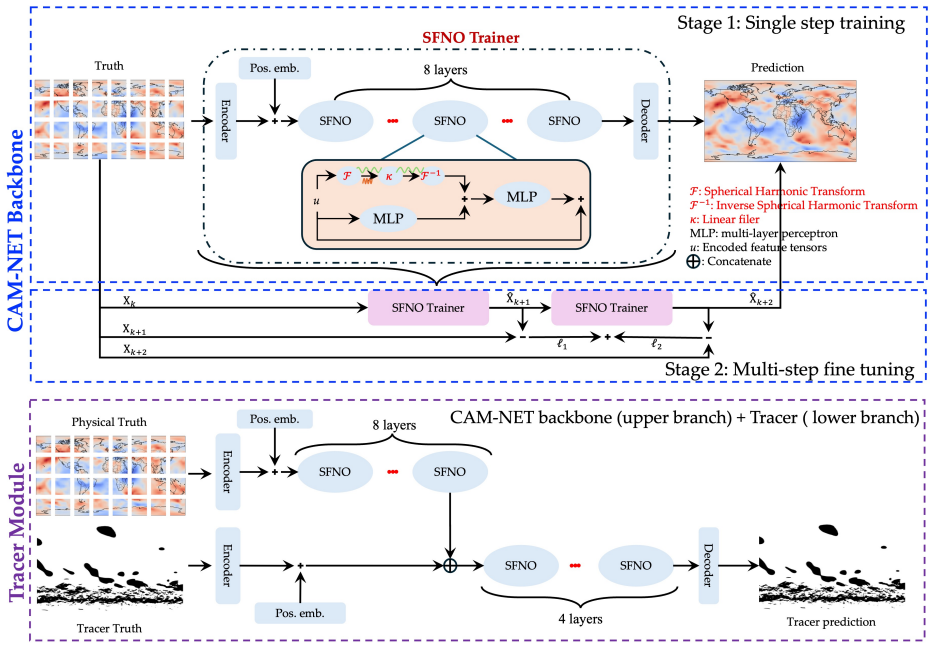
The load-bearing component is the Spherical Fourier Neural Operator (SFNO), which replaces the flat-geometry discrete Fourier transform with the Spherical Harmonic Transform $\mathcal{F}_s$ onto the basis $Y_\ell^m$; the field is filtered in spectral space by a learned complex-valued kernel $K_{\ell,m}$ and transformed back by $\mathcal{F}_s^{-1}$. Because the transform lives on the sphere, the learned global convolutions respect Earth's geometry and avoid the spectral artifacts of Euclidean Fourier mixing. The backbone stacks an encoder with positional embeddings, eight SFNO blocks with up/down-scaling and MLPs, and a decoder, and a separate lightweight tracer branch (spherical resolution $\ell_{\max}/m_{\max}=24/19$) attaches to the frozen physical backbone ($\ell_{\max}/m_{\max}=64/49$) to predict fields such as O$_2$ without retraining the full model.
What would settle it
Take a held-out WACCM-X year, run CAM-NET autoregressively for 30 days, and compare the normalized spectral energy at 90 km for spherical harmonic degrees near and above the truncation limit; a systematic and growing high-wavenumber deficit, or visible drift of the large-scale state away from the target, would falsify the comparable-accuracy and stability claims. A complementary observational test is to compare CAM-NET's mesopause winds and temperatures and ionospheric densities with lidar, radar, and satellite measurements: if its errors mirror WACCM-X's known observation biases, the emulator is faithful to the model but not independently to the atmosphere.
Extended reading notes
Core claim
The paper's central claim is that CAM-NET, a Spherical Fourier Neural Operator surrogate trained on WACCM-X, reproduces WACCM-X variability from the surface to the ionosphere-thermosphere region with comparable accuracy and a more than 1000x speedup at inference. The intended outputs are neutral winds, temperature, pressure-coordinate vertical velocity, and, as the abstract states, electron density and zonal ion drift; the model preserves dominant large-scale morphology, including the IT pattern, and stays stable through multi-day autoregressive rollouts. Spherical-harmonic diagnostics show close spectral agreement at low degrees at 20 km and 250 km, while high-wavenumber mesospheric structures near 90 km are under-represented, an effect the authors attribute to the spectral bias of neural operators. The tracer module predicts O2 at 90 km with large-scale latitudinal gradients and day-night asymmetries retained, showing downstream tracer tasks can be attached without retraining the backbone. CAM-NET is positioned as a computationally efficient emulator for rapid, large-scale experiments, not as an operational forecasting system.
Load-bearing premise
The load-bearing premise is that WACCM-X output can stand in for the real atmosphere in training and evaluation; if WACCM-X's representation of mesospheric or ionospheric coupling is biased, CAM-NET will faithfully reproduce that bias, and the paper offers no direct comparison with observations.
Editorial extensions
If this is right
- A trained CAM-NET can produce a one-year whole-atmosphere simulation in minutes rather than about a week, enabling large ensembles and sensitivity studies that would be impractical with WACCM-X.
- Spherical geometry-awareness means the model captures large-scale, low-degree variability from the lower stratosphere through the thermosphere, preserving dominant ionosphere-thermosphere morphology on multi-day rollouts.
- The separate tracer module lets researchers add new species, such as sodium, polar mesospheric clouds, or airglow, by fine-tuning a small branch while leaving the backbone frozen.
- The documented spectral bias near 90 km means CAM-NET underestimates high-wavenumber energy in the gravity-wave-breaking region, so emulator-based studies of fine-scale vertical coupling should be interpreted with that damping in mind.
Reading between the lines
- Because the reported fidelity is to WACCM-X rather than to observations, the emulator's scientific value inherits WACCM-X's validity; a natural test is to validate CAM-NET rollouts against lidar, radar, and satellite measurements of mesopause winds, temperatures, and ionospheric densities.
- The spectral damping near 90 km sits in the gravity-wave-breaking region that drives vertical coupling, so CAM-NET is best used for large-scale morphology, tides, and planetary waves; capturing wave-resolving coupling would require higher spherical resolution or generative upscaling, as the authors suggest.
- The lightweight tracer module could double as a cheap observation-assimilation tool: fine-tune it on airglow or sodium lidar data while keeping the backbone frozen, turning the emulator into a physics-informed interpolator between sparse observations.
- A wall-clock benchmark of one year of CAM-NET rollout versus a WACCM-X year on comparable hardware would make the 1000x speedup figure directly auditable, since the paper states the factor without detailing the full hardware baseline.
Editorial analysis
A structured set of objections, weighed in public.
Referee Report
Summary. The manuscript introduces CAM-NET, a Spherical Fourier Neural Operator (SFNO) surrogate trained on WACCM-X simulation output, with a lightweight fine-tuning module for tracer variables (demonstrated on O2). The authors claim accuracy comparable to WACCM-X at more than 1000x inference speedup, and stable multi-day autoregressive rollouts. The evaluation consists of qualitative map comparisons at 9, 30, and 60 forecast hours and normalized spectral energy at three altitudes; no quantitative error metrics or baselines are presented.
Significance. If substantiated, CAM-NET would be a valuable emulator for rapid ensemble and sensitivity studies of coupled whole-atmosphere variability, and the modular tracer design is a sensible architectural idea. The paper is honest about the spectral-bias limitation at 90 km, which is a strength in transparency but also undercuts the 'comparable accuracy' claim in the mesopause region. However, the current evidence is insufficient: the central accuracy claim rests on selected snapshots and spectra, the promised ionosphere-thermosphere variables (electron density, zonal ion drift) are never evaluated, and the speedup claim lacks a benchmark. No code or data availability statement is provided, which limits reproducibility.
major comments (4)
- [Section 3.1, Figures 2–6] The central claim of accuracy 'comparable to WACCM-X' is not supported by quantitative evidence. The evaluation is entirely visual: Figures 2–5 show selected snapshots at 9, 30, and 60 forecast hours, and Figure 6 shows normalized spectra. No RMSE, MAE, bias, anomaly correlation, or skill score is reported, and no baseline (persistence, climatology, or a competing emulator) is compared. Because the abstract and Section 4 assert WACCM-X-comparable accuracy, the authors must provide error metrics aggregated over the two-year test set (2012–2013) and at least a persistence/climatology baseline. Without these, the snapshots cannot distinguish a model that genuinely matches WACCM-X from one that captures only the largest-scale patterns.
- [Abstract vs. Sections 2.1 and 3] The abstract promises prediction of 'electron density and zonal ion drift' in the ionosphere-thermosphere system, but these variables are never defined as targets, trained, or evaluated. Section 2.1 lists zonal wind, meridional wind, temperature, and pressure time rate as the neutral parameters to be trained, and Section 3.1 evaluates only those variables. The IT-extension portion of the central claim is therefore unverified. Either add electron density and zonal ion drift results to the evaluation, or revise the abstract and title-level claims to match the actual scope.
- [Abstract and Section 4] The claimed 'over 1000x speedup' and 'one year simulation within a few minutes' are stated without any runtime benchmark. No hardware configuration, wall-clock measurements for WACCM-X or CAM-NET, or inference-time table are provided. Since computational efficiency is a core motivation for the work, this claim must be supported by a concrete benchmark with the hardware and measurement conditions specified.
- [Section 3.1, Figure 6] The manuscript acknowledges that CAM-NET damps high-wavenumber energy near 90 km and attributes this to spectral bias, but it does not quantify the degradation. In particular, no spectral error metric or scale-decomposed skill score is given, so the reader cannot assess how much of the gravity-wave-driven coupling—the stated motivation for a whole-atmosphere emulator—is lost. This is not merely a presentation issue: it directly qualifies the 'comparable accuracy' claim in the mesopause region.
minor comments (5)
- [Section 2.1] The phrase 'The neutral parameters eo be trained' should read 'to be trained'.
- [Section 2.2, after Eq. (4)] The sentence 'allowing the model to minimize accumulated across rollouts' is incomplete; it should read 'accumulated error over rollouts'.
- [Section 3.1 and Figure 6] The altitude in the Figure 6 caption (10 km) differs from the text (20 km), and the text itself first says '10 km (lower stratosphere)' then '20 km' in the same section. Please reconcile.
- [Figure 7 caption] The word 'targe' should be 'target'.
- [Section 2.2] The paper does not state how input fields are normalized, what loss function is used in the single-step phase beyond the L2 form in Eq. (4), or the optimizer hyperparameters; this information is needed for reproducibility.
Circularity Check
No significant circularity: CAM-NET is a supervised regression emulator trained on WACCM-X and evaluated on held-out WACCM-X years, so its core claim is a generalization claim within the target dataset, not a derivation from its own inputs.
full rationale
The paper does not derive WACCM-X behavior from first principles, nor does it fit a parameter to a subset of data and then rename that fit as a prediction. CAM-NET is trained on 10 years of WACCM-X output (2001-2011), tested on 2012-2013, and used for inference on 2014, so agreement with WACCM-X on unseen years is a genuine held-out generalization test rather than a construction. The SFNO equations (Eqs. 1-3) and the multi-step loss (Eq. 4) define a standard operator-learning regression; no fitted constant is later reported as an independent prediction. The self-citations (Dong et al. 2023, Dong et al. 2021) are architectural or motivational and are not load-bearing for the accuracy claim. The acknowledged spectral bias near 90 km is a limitation, not a circular step. The abstract's mention of electron density and zonal ion drift is not quantitatively evaluated in the body, and the absence of RMSE or baseline comparisons weakens the 'comparable accuracy' claim, but these are missing-evidence and correctness-risk issues, not circularity. Overall, the central emulation claim is self-contained with respect to its training target, so the circularity score is 0.
Assumptions & free parameters
free parameters (4)
- SFNO spectral filter coefficients K_lm =
learned during training, values not reported
- Architecture dimensions =
embedding 384, physical channels 232, tracer channels 29, lmax/mmax 64/49 and 24/19, 8 physical + 4 tracer SFNO blocks
- Multi-step rollout horizon T =
not specified
- Training hyperparameters =
not reported
assumptions (4)
- domain assumption The SFNO spherical-harmonic architecture preserves spherical geometry and can represent the coupled surface-to-ionosphere dynamics.
- domain assumption WACCM-X, nudged by MERRA-2, is an adequate reference for the real whole-atmosphere system.
- domain assumption The 3-hourly time step and 0.9x1.25 degree grid resolve the coupling processes of interest.
- domain assumption Spectral bias is a fixed property of neural operators that explains the mesospheric error.
Cite this review
Pith. "Pith review of A Geometry-Aware AI Emulator for the Coupled Whole Atmosphere from Earth Surface to the Ionosphere and Thermosphere." pith.science (2026). https://pith.science/paper/DOF6XD52
@misc{pith2026250619340,
  author       = {Pith},
  title        = {Pith review of: A Geometry-Aware AI Emulator for the Coupled Whole Atmosphere from Earth Surface to the Ionosphere and Thermosphere},
  year         = {2026},
  howpublished = {\url{https://pith.science/paper/DOF6XD52}},
  note         = {Machine review of arXiv:2506.19340}
}
read the original abstract
Whole-atmosphere models such as WACCM-X resolve coupling from the Earth surface to the Mesosphere-Lower-Thermosphere (MLT), and Ionosphere-Thermosphere (IT) systems with expensive computational costs. Here we introduce CAM-NET, a geometry-aware Spherical Fourier Neural Operator (SFNO) surrogate for emulating WACCM-X variability from Earth surface to IT region. CAM-NET is trained on 3-hourly WACCM-X simulations and predicts neutral winds, temperature, pressure-coordinate vertical velocity, electron density, and zonal ion drift. The framework combines a Spherical Fourier Neural Operator (SFNO) backbone with a newly developed lightweight module that extends the frozen atmospheric representation to plasma variables. For the held-out simulation, CAM-NET preserves the dominant IT morphology and remains stable during multi-day autoregressive rollouts. Spherical-harmonic diagnostics show that the model retains low-degree variability while damping high-wavenumber mesospheric structures, especially near 90 km where gravity wave breaks. CAM-NET is intended as a computationally efficient emulator of WACCM-X, rather than an operational forecasting system. These results demonstrate its potential for rapid ensemble experiments, uncertainty quantification, and sensitivity studies of large-scale coupled whole atmospheric variability.
Figures


Figures from the paper (4 more)


Reference graph
Works this paper leans on
-
[1]
azeem2015multisensor APACrefauthors Azeem, I. , Yue, J. , Hoffmann, L. , Miller, S D. , Straka III, W C. \ Crowley, G. APACrefauthors \ 2015 . Multisensor profiling of a concentric gravity wave event propagating from the troposphere to the ionosphere Multisensor profiling of a concentric gravity wave event propagating from the troposphere to the ionospher...
work page 2015
-
[2]
bi2023accurate APACrefauthors Bi, K. , Xie, L. , Zhang, H. , Chen, X. , Gu, X. \ Tian, Q. APACrefauthors \ 2023 . Accurate medium-range global weather forecasting with 3D neural networks Accurate medium-range global weather forecasting with 3d neural networks . Nature 619 7970 533--538
work page 2023
-
[3]
bonev2023modelling APACrefauthors Bonev, B. , Kurth, T. , Hundt, C. , Pathak, J. , Baust, M. , Kashinath, K. \ Anandkumar, A. APACrefauthors \ 2023 1 . Modelling atmospheric dynamics with spherical fourier neural operators Modelling atmospheric dynamics with spherical fourier neural operators . ICLR 2023 Workshop on Tackling Climate Change with Machine Le...
work page 2023
-
[4]
bonev2023spherical APACrefauthors Bonev, B. , Kurth, T. , Hundt, C. , Pathak, J. , Baust, M. , Kashinath, K. \ Anandkumar, A. APACrefauthors \ 2023 2 . Spherical fourier neural operators: Learning stable dynamics on the sphere Spherical fourier neural operators: Learning stable dynamics on the sphere . International conference on machine learning Internat...
work page 2023
-
[5]
bulte2025uncertainty APACrefauthors B \"u lte, C. , Horat, N. , Quinting, J. \ Lerch, S. APACrefauthors \ 2025 . Uncertainty quantification for data-driven weather models Uncertainty quantification for data-driven weather models . Artificial Intelligence for the Earth Systems
work page 2025
-
[6]
chakraborty2025 APACrefauthors Chakraborty, D. , Mohan, A T. \ Maulik, R. APACrefauthors \ 2025 feb 1 . Binned Spectral Power Loss for Improved Prediction of Chaotic Systems Binned spectral power loss for improved prediction of chaotic systems . arXiv preprint arXiv:2502.00472 . APACrefDOI doi:10.48550/arXiv.2502.00472 APACrefDOI
-
[7]
chen2023fengwu APACrefauthors Chen, K. , Han, T. , Gong, J. , Bai, L. , Ling, F. , Luo, J J. others APACrefauthors \ 2023 . Fengwu: Pushing the skillful global medium-range weather forecast beyond 10 days lead Fengwu: Pushing the skillful global medium-range weather forecast beyond 10 days lead . arXiv preprint arXiv:2304.02948
arXiv 2023
-
[8]
chen2023fuxi APACrefauthors Chen, L. , Zhong, X. , Zhang, F. , Cheng, Y. , Xu, Y. , Qi, Y. \ Li, H. APACrefauthors \ 2023 . FuXi: A cascade machine learning forecasting system for 15-day global weather forecast Fuxi: A cascade machine learning forecasting system for 15-day global weather forecast . npj climate and atmospheric science 6 1 190
work page 2023
Show all 41 references
-
[9]
, Fritts, D C
dong2023accelerating APACrefauthors Dong, W. , Fritts, D C. , Liu, A Z. , Lund, T S. , Liu, H L. \ Snively, J. APACrefauthors \ 2023 . Accelerating atmospheric gravity wave simulations using machine learning: Kelvin-Helmholtz instability and mountain wave sources driving gravi...
2023
-
[10]
, Fritts, D C
dong2020SA APACrefauthors Dong, W. , Fritts, D C. , Lund, T S. , Wieland, S A. \ Zhang, S. APACrefauthors \ 2020 . Self-Acceleration and Instability of Gravity Wave Packets: 2. Two-Dimensional Packet Propagation, Instability Dynamics, and Transient Flow Responses Self-accelera...
2020
-
[11]
, Fritts, D C
Dong2021pmc APACrefauthors Dong, W. , Fritts, D C. , Thomas, G E. \ Lund, T S. APACrefauthors \ 2021 . Modeling responses of polar mesospheric clouds to gravity wave and instability dynamics and induced large-scale motions Modeling responses of polar mesospheric clouds to grav...
2021 doi
-
[12]
, Bruinsma, S L
forbes2016gravity APACrefauthors Forbes, J M. , Bruinsma, S L. , Doornbos, E. \ Zhang, X. APACrefauthors \ 2016 . Gravity wave-induced variability of the middle thermosphere Gravity wave-induced variability of the middle thermosphere . Journal of Geophysical Research: Space Ph...
2016
-
[13]
\ Alexander, M J
fritts2003gravity APACrefauthors Fritts, D C. \ Alexander, M J. APACrefauthors \ 2003 . Gravity wave dynamics and effects in the middle atmosphere Gravity wave dynamics and effects in the middle atmosphere . Reviews of geophysics 41 1
2003
-
[14]
, Dong, W
Fritts2020SA APACrefauthors Fritts, D C. , Dong, W. , Lund, T S. , Wieland, S. \ Laughman, B. APACrefauthors \ 2020 . Self-Acceleration and Instability of Gravity Wave Packets: 3. Three-Dimensional Packet Propagation, Secondary Gravity Waves, Momentum Transport, and Transient ...
2020
-
[15]
\ Lund, T S
fritts2011gravity APACrefauthors Fritts, D C. \ Lund, T S. APACrefauthors \ 2011 . Gravity wave influences in the thermosphere and ionosphere: Observations and recent modeling Gravity wave influences in the thermosphere and ionosphere: Observations and recent modeling . Aerono...
2011
-
[16]
\ Liu, A Z
Gardner2010 APACrefauthors Gardner, C S. \ Liu, A Z. APACrefauthors \ 2010 . Wave-induced transport of atmospheric constituents and its effect on the mesospheric Na layer Wave-induced transport of atmospheric constituents and its effect on the mesospheric Na layer . J. Geophys...
2010 doi
-
[17]
\ Liu, A Z
Gardner2016 APACrefauthors Gardner, C S. \ Liu, A Z. APACrefauthors \ 2016 . Chemical transport of neutral atmospheric constituents by waves and turbulence: Theory and observations Chemical transport of neutral atmospheric constituents by waves and turbulence: Theory and obser...
2016 doi
-
[18]
, Mardani, M
guibas2021adaptive APACrefauthors Guibas, J. , Mardani, M. , Li, Z. , Tao, A. , Anandkumar, A. \ Catanzaro, B. APACrefauthors \ 2021 . Adaptive fourier neural operators: Efficient token mixers for transformers Adaptive fourier neural operators: Efficient token mixers for trans...
2021 arXiv
-
[19]
, Fritts, D C
Hecht2018 APACrefauthors Hecht, J H. , Fritts, D C. , Wang, L. , Gelinas, L J. , Rudy, R J. , Walterscheid, R L. Franke, S J. APACrefauthors \ 2018 . Observations of the Breakdown of Mountain Waves Over the Andes Lidar Observatory at Cerro Pachon on 8/9 July 2012 Observations ...
2018 doi
-
[20]
, Walterscheid, R L
Hecht2010 APACrefauthors Hecht, J H. , Walterscheid, R L. , Gelinas, L J. , Vincent, R A. , Reid, I M. \ Woithe, J M. APACrefauthors \ 2010 . Observations of the phase-locked 2 day wave over the Australian sector using medium-frequency radar and airglow data Observations of th...
2010 doi
-
[21]
, Bell, B
hersbach2020era5 APACrefauthors Hersbach, H. , Bell, B. , Berrisford, P. , Hirahara, S. , Hor \'a nyi, A. , Mu \ n oz-Sabater, J. Schepers, D. APACrefauthors \ 2020 . The ERA5 global reanalysis, quarterly journal of the royal meteorological society The era5 global reanalysis, ...
2020
-
[22]
, Zimmerman, S
keneshea1979dynamic APACrefauthors Keneshea, T. , Zimmerman, S. \ Philbrick, C. APACrefauthors \ 1979 . A dynamic model of the mesosphere and lower thermosphere A dynamic model of the mesosphere and lower thermosphere . Planetary and Space Science 27 4 385--401
1979
-
[23]
, Oommen, V
khodakarami2025mitigating APACrefauthors Khodakarami, S. , Oommen, V. , Bora, A. \ Karniadakis, G E. APACrefauthors \ 2025 . Mitigating Spectral Bias in Neural Operators via High-Frequency Scaling for Physical Systems Mitigating spectral bias in neural operators via high-frequ...
2025 arXiv
-
[24]
, Sanchez-Gonzalez, A
lam2023learning APACrefauthors Lam, R. , Sanchez-Gonzalez, A. , Willson, M. , Wirnsberger, P. , Fortunato, M. , Alet, F. others APACrefauthors \ 2023 . Learning skillful medium-range global weather forecasting Learning skillful medium-range global weather forecasting . Science...
2023
-
[25]
, Kovachki, N
li2020fourier APACrefauthors Li, Z. , Kovachki, N. , Azizzadenesheli, K. , Liu, B. , Bhattacharya, K. , Stuart, A. \ Anandkumar, A. APACrefauthors \ 2020 . Fourier neural operator for parametric partial differential equations Fourier neural operator for parametric partial diff...
2020 arXiv
-
[26]
\ Swenson, G R
liu2003modeling APACrefauthors Liu, A Z. \ Swenson, G R. APACrefauthors \ 2003 . A modeling study of O2 and OH airglow perturbations induced by atmospheric gravity waves A modeling study of o2 and oh airglow perturbations induced by atmospheric gravity waves . Journal of Geoph...
2003
-
[27]
, Pedatella, N
liu2017medium APACrefauthors Liu, H. , Pedatella, N. \ Hocke, K. APACrefauthors \ 2017 . Medium-scale gravity wave activity in the bottomside F region in tropical regions Medium-scale gravity wave activity in the bottomside f region in tropical regions . Geophysical Research L...
2017
-
[28]
, Bardeen, C G
liu2018development APACrefauthors Liu, H L. , Bardeen, C G. , Foster, B T. , Lauritzen, P. , Liu, J. , Lu, G. others APACrefauthors \ 2018 . Development and validation of the whole atmosphere community climate model with thermosphere and ionosphere extension (WACCM-X 2.0) Deve...
2018
-
[29]
, Lauritzen, P
liu2024assessment APACrefauthors Liu, H L. , Lauritzen, P. , Vitt, F. \ Goldhaber, S. APACrefauthors \ 2024 1 . Assessment of gravity waves from tropopause to thermosphere and ionosphere in high-resolution WACCM-X simulations Assessment of gravity waves from tropopause to ther...
2024
-
[30]
, Lauritzen, P H
Liu2024 APACrefauthors Liu, H L. , Lauritzen, P H. , Vitt, F. \ Goldhaber, S. APACrefauthors \ 2024 2 . Assessment of gravity waves from tropopause to thermosphere and ionosphere in high-resolution waccm-x simulations Assessment of gravity waves from tropopause to thermosphere...
2024 doi
-
[31]
, McInerney, J M
Liu2014 APACrefauthors Liu, H L. , McInerney, J M. , Santos, S. , Lauritzen, P H. , Taylor, M A. \ Pedatella, N M. APACrefauthors \ 2014 . Gravity waves simulated by high-resolution whole atmosphere community climate model Gravity waves simulated by high-resolution whole atmos...
2014 doi
-
[32]
APACrefauthors \ 1995
murtagh1995state APACrefauthors Murtagh, D P. APACrefauthors \ 1995 . The state of O2 in the mesopause region The state of o2 in the mesopause region . The Upper Mesosphere and Lower Thermosphere: A Review of Experiment and Theory 87 243--249
1995
-
[33]
, Brandstetter, J
nguyen2023climax APACrefauthors Nguyen, T. , Brandstetter, J. , Kapoor, A. , Gupta, J K. \ Grover, A. APACrefauthors \ 2023 . Climax: A foundation model for weather and climate Climax: A foundation model for weather and climate . arXiv preprint arXiv:2301.10343
2023 arXiv
-
[34]
, Bora, A
oommen2024 APACrefauthors Oommen, V. , Bora, A. , Zhang, Z. \ Karniadakis, G E. APACrefauthors \ 2025 . Integrating neural operators with diffusion models improves spectral representation in turbulence modelling Integrating neural operators with diffusion models improves spect...
2025
-
[35]
, Subramanian, S
pathak2022fourcastnet APACrefauthors Pathak, J. , Subramanian, S. , Harrington, P. , Raja, S. , Chattopadhyay, A. , Mardani, M. others APACrefauthors \ 2022 . Fourcastnet: A global data-driven high-resolution weather model using adaptive fourier neural operators Fourcastnet: A...
2022 arXiv
-
[36]
, Sanchez-Gonzalez, A
price2023gencast APACrefauthors Price, I. , Sanchez-Gonzalez, A. , Alet, F. , Andersson, T R. , El-Kadi, A. , Masters, D. others APACrefauthors \ 2023 . Gencast: Diffusion-based ensemble forecasting for medium-range weather Gencast: Diffusion-based ensemble forecasting for med...
2023 arXiv
-
[37]
, Baratin, A
rahaman2019spectral APACrefauthors Rahaman, N. , Baratin, A. , Arpit, D. , Draxler, F. , Lin, M. , Hamprecht, F. Courville, A. APACrefauthors \ 2019 . On the spectral bias of neural networks On the spectral bias of neural networks . International conference on machine learning...
2019
-
[38]
ren2021deep APACrefauthors Ren, X. , Li, X. , Ren, K. , Song, J. , Xu, Z. , Deng, K. \ Wang, X. APACrefauthors \ 2021 . Deep learning-based weather prediction: a survey Deep learning-based weather prediction: a survey . Big Data Research 23 100178
2021
-
[39]
, Senan, R
roberts2018climate APACrefauthors Roberts, C D. , Senan, R. , Molteni, F. , Boussetta, S. , Mayer, M. \ Keeley, S P. APACrefauthors \ 2018 . Climate model configurations of the ECMWF Integrated Forecasting System (ECMWF-IFS cycle 43r1) for HighResMIP Climate model configuratio...
2018
-
[40]
\ Liu, H l
vadas2009generation APACrefauthors Vadas, S L. \ Liu, H l. APACrefauthors \ 2009 . Generation of large-scale gravity waves and neutral winds in the thermosphere from the dissipation of convectively generated gravity waves Generation of large-scale gravity waves and neutral win...
2009
-
[41]
, Chen, L
zhong2024fuxi APACrefauthors Zhong, X. , Chen, L. , Fan, X. , Qian, W. , Liu, J. \ Li, H. APACrefauthors \ 2024 . FuXi-2.0: Advancing machine learning weather forecasting model for practical applications Fuxi-2.0: Advancing machine learning weather forecasting model for practi...
2024 arXiv
Reviewed August 6, 2026 · model on record in the stance chip above.
Discussion (0). Continue with ORCID to comment.