REVIEW 4 major objections 6 minor 32 references
Neural Collapse based Deep Supervised Federated Learning for Signal Detection in OFDM Systems
T0 review · 4 major / 6 minor · reviewed 2026-08-15 · deepseek-v4-flash
Pith's one-line read For the regularized multi-binary logistic-loss problem, the paper proves that every global minimizer of its layer-peeled model is a neural-collapse solution, and exploits that fixed orthogonal structure to speed up federated OFDM signal…
desk verdict The paper's core theorem about neural collapse in multi-binary classification appears correct and is genuinely new, but the connection to the federated learning algorithm is not established; the reader's dimension objection does not hold up. read the letter →
The pith
A machine-rendered reading of the paper's core claim, the machinery that carries it, and where it could break.
The reading
What carries the argument
The load-bearing object is the layer-peeled problem (5) together with the block matrix $A$ built recursively in (7)--(8). The matrix satisfies $AA^{\top}=K2^I I_{dI}$, so the bilinear form $P=w^{\top}Ah$ for the $K2^I$ samples of $I$ binary labels is bounded below by $-\sqrt{K2^{I-1}}(\|W\|^2+\|H\|^2)$, with equality only under four explicit conditions. Jensen's inequality on the logistic loss then makes every global minimizer attain equality and constant per-sample arguments, and Lemma A.3 turns these conditions into feature collapse, classifier orthogonality and duality (NC1--NC3). The algorithm's practical mechanism is the direct consequence NC2: because an orthogonal classifier set with $w_{i,1}=-w_{i,0}$ and equal norms is optimal, those weights can be fixed in advance at the output layer and at an auxiliary deep-supervision layer, reducing trainable parameters and giving all federated clients a shared geometric anchor for their features.
What would settle it
Train the same three-hidden-layer OFDM detector used in Section IV with trainable output and auxiliary layers, then check whether the converged classifiers satisfy $w_{i,1}+w_{i,0}=0$ and $\langle w_{i,1}, w_{j,1}\rangle=0$ for all $i\neq j$, and whether the training loss reaches the predicted value $L(\rho_{\mathrm{opt}})$; if either check fails, the minimizers of the real constrained problem are not captured by Theorem II.1.
Extended reading notes
Core claim
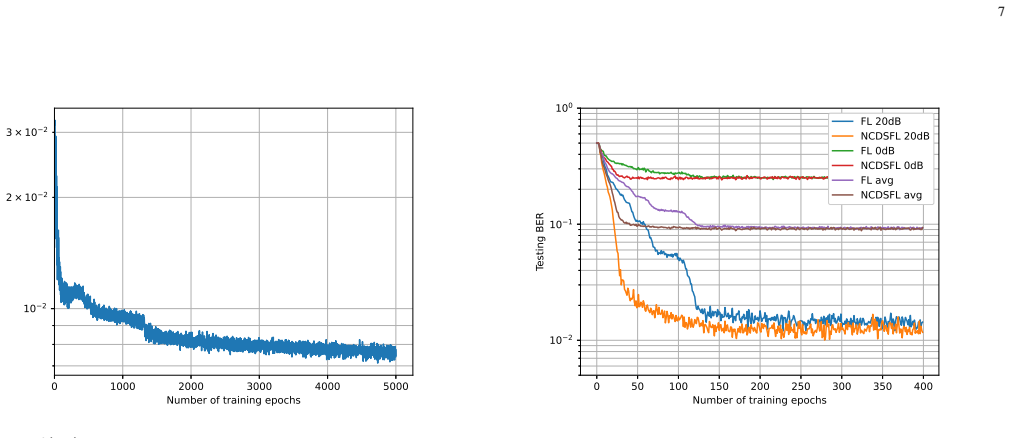
The central discovery is Theorem II.1: if $0<\lambda<1/(2I\sqrt{2K2^I})$, then any global minimizer of problem (5), the layer-peeled multi-binary classification model with cross-entropy loss and $\ell^2$ regularization on weights and features, is an NC solution satisfying Definition 1. The proof bounds the sum of the logistic arguments $P=w^{\top}Ah$ from below using the row-orthogonality of the block matrix $A$, showing equality forces the four conditions of Lemma A.2 together with constant argument values; Lemma A.3 then converts those conditions into the three neural-collapse properties. The paper leverages NC2 to generate an orthogonal classifier set, fixes it at the output layer, adds a second fixed NC classifier as a deep-supervision auxiliary layer, and embeds the resulting model in federated learning. In OFDM simulations the monitored quantities $\theta$ and $\vartheta$ decrease monotonically, and the NCDSFL algorithm reaches a testing BER at about 60 epochs while the FedAvg baseline needs about 150 epochs.
Load-bearing premise
The proof relies on the layer-peeled model, which treats hidden features as free optimization variables; the actual three-hidden-layer networks used in the OFDM simulations are not shown to be over-parameterized enough for that model to apply exactly.
Editorial extensions
If this is right
- Fixing the output and auxiliary classifiers to an orthogonal NC weight set does not sacrifice the global optimum of the layer-peeled loss, so the reduced-parameter network is in principle as expressive at the final layer as a fully trained one.
- Because all clients share fixed classifiers, their hidden features are pushed toward a common low-dimensional subspace, which should reduce model divergence under heterogeneous power delay profiles.
- The design removes the output layer and auxiliary layer weights from local updates and communication, lowering both computation and transmission cost per round.
- In the reported OFDM experiments, NCDSFL converges in about 60 training epochs versus about 150 for FedAvg at SNR 10 dB, and it matches or improves the testing BER especially when client SNRs or Rician factors are heterogeneous.
- The monotone decay of $\theta$ and $\vartheta$ observed during training supports the claim that the multi-binary OFDM detector actually exhibits neural collapse.
Reading between the lines
- The theorem is proved for the layer-peeled model, not for the finite three-hidden-layer networks actually simulated; extending the argument would require showing that the optimization over features constrained by a finite backbone has the same minimizers, or testing the NC metrics on much wider networks.
- Since the paper notes the multi-binary formulation is equivalent to multi-label classification, the fixed-NC-weight recipe should transfer to other multi-label tasks; a direct experiment would apply NCDSFL to a standard multi-label image benchmark.
- The shared orthogonal classifiers provide an anchor for aggregation, so NCDSFL may remain stable under partial client participation or asynchronous updates, regimes the paper does not simulate.
- The convergence-speed gain suggests a quantitative test: vary the degree of power-delay-profile heterogeneity across clients and record the rounds needed to reach a target BER; the mechanism predicts the gap between NCDSFL and FedAvg should widen as heterogeneity increases.
Signed reviews
Editorial analysis
A structured set of objections, weighed in public.
Referee Report
Summary. The manuscript proposes NCDSFL, a federated learning algorithm for signal detection in OFDM systems. It defines a neural collapse (NC) solution for multi-binary classification, proves in a layer-peeled model that all global minimizers of a regularized logistic-type loss are NC solutions, and then fixes the output layer and an auxiliary deep-supervision layer to orthogonal equal-norm classifiers derived from the NC definition. The remaining backbone weights are trained in a federated setup. Experiments on WINNER II and Rician channel models report that NCDSFL converges faster than FedAvg and independent learning and achieves comparable or better BER than these baselines and than MMSE.
Significance. If the theoretical and empirical claims hold, the paper offers a concrete way to reduce trainable parameters and communication payload in federated receivers while mitigating client drift: freezing NC-derived classifiers in both the output and an auxiliary layer. The explicit global-optimality characterization of neural collapse for multi-binary classification with balanced labels is of independent interest, and the authors provide a self-contained proof with consistent matrix definitions. The OFDM experiments cover realistic heterogeneity in power delay profiles and include a conventional MMSE baseline. The main caveat is the gap between the layer-peeled theorem and the actual constrained DNN/FL objective, which is examined below.
major comments (4)
- [§II.C, §III.B, §IV.B] Theorem II.1 is proved for the layer-peeled problem (5), where the hidden features H are free optimization variables and the data are balanced with exactly K samples for each of the 2^I label sequences. The actual training objective (14) uses a fixed 500-250-128 ReLU backbone, softmax cross-entropy, and I=16 bits with randomly drawn bit streams; the theorem is not shown to transfer. Universal approximation of functions does not imply that intermediate features are unconstrained optimization variables, and the balanced-label condition of problem (5) is not satisfied exactly in the experiments. Therefore the claim in §IV.B that faster convergence follows 'as stated in Theorem II.1' is not supported. Please either prove a transfer or approximation result showing that the constrained minimizer inherits NC structure (for example, as width grows), or rephrase the algorithmic benefit as heuristic motivation and add a control experiment with a random fixed orthogonal head.
- [Appendix A, proof of Theorem II.1] The chain of inequalities (45)-(49) shows that every feasible point has loss at least Lbar(ρopt), but the sentence 'which indicates that problem (5) also admits non-trivial global minimizers' does not follow without exhibiting a point that attains the lower bound. The proof should explicitly construct equality-attaining points: choose orthogonal equal-norm class differences Δw_i, set w_i0 = -w_i1, choose h in the row space of A satisfying h = -1/(c K 2^I) A^T w, and scale c so that ||W||^2 + ||H||^2 = ρopt. For the record, the dimension concern about A does not land: A in (7) is dI × dK2^I, and Lemma A.1 is consistent with this dimension.
- [§IV.A, Figs. 3-4] The validation of Theorem II.1 reports two quantities θ and ϑ for a single training run with no error bars or repeated seeds. Both figures show values that decrease but remain visibly above zero at 5000 epochs, yet the text says they 'confirm the presence of the NC phenomenon' and that hidden features 'gradually converge toward the subspace'. To support this claim, report final metric values, multiple seeds with error bars, a threshold or statistical test, and ideally a comparison against a random fixed orthogonal head to show that the observed alignment is caused by the NC weights rather than by generic training dynamics.
- [§IV.B] The FL motivation is data heterogeneity, and the paper explicitly contrasts NCDSFL with FedProx [14], MOON [16], and matched averaging [17]. However, the experiments compare only against FedAvg and independent learning, so the reader cannot judge whether the proposed fixed-NC deep supervision adds value over existing feature-alignment FL methods. Please add FedProx and MOON (and ideally matched averaging) with matched hyperparameters, and report communication cost or transmitted parameter counts if the reduced-overhead claim is retained.
minor comments (6)
- [§IV figures] Several figure axis labels contain typos, for example 'T e ting BER' and 'Number of t aining epochs'; please correct them.
- [§III.D, Eq. (27)] 'imagery part' should be 'imaginary part'.
- [References] Reference [11] contains the typo 'IIEEE J. Sel. Top. Signal Process.' and should be corrected.
- [§II.A] The notation in 'K samples for each label s∈S I' is malformed; please define the label indexing and the relationship between s^{(j)} and the binary value of the sequence more carefully.
- [Algorithm 1] The update rule in line 5 sets v_{i,0}=v_k inside the epoch loop, but the reset of local parameters and the relation between v_k and the aggregated global model are not explicit; please clarify the notation.
- [Appendix A, Eq. (48)] The formula for ρopt is valid only in the regime 0<λ<t/2; the manuscript should state this restriction explicitly when presenting the formula.
Circularity Check
No significant circularity: Theorem II.1 is derived from the regularized loss, and the fixed NC weights are a design consequence rather than a fitted input.
full rationale
The paper's central theoretical claim, Theorem II.1, is not circular. The proof in Appendix A derives the NC conditions from the regularized loss via Jensen's inequality and the lower bound in Lemma A.2; the equality conditions of that bound are then shown to imply Definition 1's NC1-NC3. The NC solution is therefore characterized, not assumed. The layer-peeled model is a standard modeling reduction cited from external work ([22], [30]); whether it applies to the three-hidden-layer networks used in the OFDM experiments is a transfer/justification gap, not a circular reduction. The algorithm's fixed WNC and eWNC are generated once from Definition 1 and are not fitted to the BER data, so there is no 'fitted input called prediction' pattern. The empirical validation in Section IV.A tracks θ and ϑ on a single-client training trajectory; because Fig. 3 reports nonzero, decreasing θ, it is not evaluating the fixed orthogonal WNC of Algorithm 1 (where θ would be identically zero by construction), so the observed NC trends are empirical rather than definitional. The claimed FL benefit from Theorem II.1 involves an unproven step from the layer-peeled problem to the constrained multi-client DNN objective in (14)-(15), but this is an inference gap concerning applicability, not a case where the conclusion is equivalent to the input by definition. Self-citations [11]-[13] appear only as contextual related work and are not load-bearing for the derivation. Overall, no specific circular step can be exhibited, so the appropriate finding is no significant circularity with score 0.
Assumptions & free parameters
free parameters (3)
- λ (regularization weight) =
not specified in simulations
- µ (auxiliary loss weight) =
0.5
- NC classifier norm =
unspecified
assumptions (5)
- domain assumption Balanced label distribution: K samples for each label sequence
- domain assumption Layer-peeled model: features H are free variables, ignoring the backbone network
- standard math Universal approximation property of DNNs
- domain assumption WINNER II channel model (B1 NLoS, 24 paths) as the data generator
- domain assumption A global model is learnable from partial PDP observations
Cite this review
Pith. "Pith review of Neural Collapse based Deep Supervised Federated Learning for Signal Detection in OFDM Systems." pith.science (2026). https://pith.science/paper/YEN5PLOR
@misc{pith2026250619476,
  author       = {Pith},
  title        = {Pith review of: Neural Collapse based Deep Supervised Federated Learning for Signal Detection in OFDM Systems},
  year         = {2026},
  howpublished = {\url{https://pith.science/paper/YEN5PLOR}},
  note         = {Machine review of arXiv:2506.19476}
}
read the original abstract
Future wireless networks are expected to be AI-empowered, making their performance highly dependent on the quality of training datasets. However, physical-layer entities often observe only partial wireless environments characterized by different power delay profiles. Federated learning is capable of addressing this limited observability, but often struggles with data heterogeneity. To tackle this challenge, we propose a neural collapse (NC) inspired deep supervised federated learning (NCDSFL) algorithm.
Figures


Figures from the paper (4 more)


Reference graph
Works this paper leans on
-
[14]
Federated optimization in heterogeneous networks,
T. Li, A. K. Sahu, M. Zaheer, M. Sanjabi, A. Talwalkar, and V . Smith, “Federated optimization in heterogeneous networks,”Proc. Mach. Learn. Syst., vol. 2, pp. 429–450, 2020
2020
-
[16]
Model-contrastive federated learning,
Q. Li, B. He, and D. Song, “Model-contrastive federated learning,” in Proc. IEEE/CVF Conf. Comput. Vis. Pattern Recognit. (CVPR) , 2021, pp. 10 713–10 722
work page 2021
-
[17]
Federated learning with matched averaging,
H. Wang, M. Yurochkin, Y . Sun, D. Papailiopoulos, and Y . Khazaeni, “Federated learning with matched averaging,” in Intl. Conf. Learn. Repre., 2020
work page 2020
-
[1]
Application of machine learning in wireless networks: Key techniques and open issues,
Y . Sun, M. Peng, Y . Zhou, Y . Huang, and S. Mao, “Application of machine learning in wireless networks: Key techniques and open issues,” IEEE Commun. Surv. Tutor., vol. 21, no. 4, pp. 3072–3108, 2019
work page 2019
-
[2]
Intelligent radio signal processing: A survey,
Q.-V . Pham, N. T. Nguyen, T. Huynh-The, L. B. Le, K. Lee, and W.-J. Hwang, “Intelligent radio signal processing: A survey,” IEEE Access , vol. 9, pp. 83 818–83 850, 2021
work page 2021
-
[3]
Power of deep learning for channel estimation and signal detection in ofdm systems,
H. Ye, G. Y . Li, and B.-H. Juang, “Power of deep learning for channel estimation and signal detection in ofdm systems,” IEEE Wirel. Commun. Letters, vol. 7, no. 1, pp. 114–117, 2017
work page 2017
-
[4]
Deep learning for joint channel estimation and signal detection in ofdm systems,
X. Yi and C. Zhong, “Deep learning for joint channel estimation and signal detection in ofdm systems,” IEEE Commun. Lett., vol. 24, no. 12, pp. 2780–2784, 2020
work page 2020
-
[5]
H. Ye, L. Liang, G. Y . Li, and B.-H. Juang, “Deep learning-based end-to- end wireless communication systems with conditional gans as unknown channels,” IEEE Trans. Wireless Commun. , vol. 19, no. 5, pp. 3133– 3143, 2020
work page 2020
Show all 32 references
-
[6]
Deep learning based end-to-end wireless communication systems without pilots,
H. Ye, G. Y . Li, and B.-H. Juang, “Deep learning based end-to-end wireless communication systems without pilots,” IEEE Trans. Cogn. Commun. Netw., vol. 7, no. 3, pp. 702–714, 2021
2021
-
[7]
Deeprx: Fully convolutional deep learning receiver,
M. Honkala, D. Korpi, and J. M. Huttunen, “Deeprx: Fully convolutional deep learning receiver,” IEEE Trans. Wireless Commun., vol. 20, no. 6, pp. 3925–3940, 2021
2021
-
[8]
Beam predic- tion based on large language models,
Y . Sheng, K. Huang, L. Liang, P. Liu, S. Jin, and G. Y . Li, “Beam predic- tion based on large language models,” arXiv preprint arXiv:2408.08707, 2024
2024 arXiv
-
[9]
Communication-efficient learning of deep networks from decentralized data,
B. McMahan, E. Moore, D. Ramage, S. Hampson, and B. A. y Arcas, “Communication-efficient learning of deep networks from decentralized data,” in Artif. Intell. Stat. PMLR, 2017, pp. 1273–1282
2017
-
[10]
Federated learning and wireless commu- nications,
Z. Qin, G. Y . Li, and H. Ye, “Federated learning and wireless commu- nications,” IEEE Wirel. Commun., vol. 28, no. 5, pp. 134–140, 2021
2021
-
[11]
Federated reinforcement learning for resource allocation in v2x networks,
K. Xu, S. Zhou, and G. Y . Li, “Federated reinforcement learning for resource allocation in v2x networks,” IIEEE J. Sel. Top. Signal Process., vol. 18, no. 7, pp. 1210–1221, 2024
2024
-
[12]
Rescale-invariant federated reinforce- ment learning for resource allocation in v2x networks,
K. Xu, S. Zhou, and G. Ye Li, “Rescale-invariant federated reinforce- ment learning for resource allocation in v2x networks,” IEEE Commun. Lett., vol. 28, no. 12, pp. 2799–2803, 2024
2024
-
[13]
New environment adaptation with few shots for ofdm receiver and mmwave beamforming,
O. Wang, S. Zhou, and G. Y . Li, “New environment adaptation with few shots for ofdm receiver and mmwave beamforming,” arXiv preprint arXiv:2310.12343, 2023
2023 arXiv
-
[15]
Fedalign: Federated do- main generalization with cross-client feature alignment,
S. Gupta, V . Sutar, V . Singh, and A. Sethi, “Fedalign: Federated do- main generalization with cross-client feature alignment,” arXiv preprint arXiv:2501.15486, 2025
2025 arXiv
-
[18]
Prevalence of neural collapse during the terminal phase of deep learning training,
V . Papyan, X. Han, and D. L. Donoho, “Prevalence of neural collapse during the terminal phase of deep learning training,” Proc. Natl. Acad. Sci. U.S.A., vol. 117, no. 40, pp. 24 652–24 663, 2020
2020
-
[19]
Neural collapse: A review on modelling principles and generalization,
V . Kothapalli, “Neural collapse: A review on modelling principles and generalization,” Trans. Mach. Learn. Res. , 2023
2023
-
[20]
A geometric analysis of neural collapse with unconstrained features,
Z. Zhu, T. Ding, J. Zhou, X. Li, C. You, J. Sulam, and Q. Qu, “A geometric analysis of neural collapse with unconstrained features,” Adv. Neural Inf. Process. Syst. , vol. 34, pp. 29 820–29 834, 2021
2021
-
[21]
Memorization-dilation: Modeling neural collapse under noise,
D. A. Nguyen, R. Levie, J. Lienen, E. H ¨ullermeier, and G. Kutyniok, “Memorization-dilation: Modeling neural collapse under noise,” in Intl. Conf. Learn. Repre. , 2023
2023
-
[22]
Inducing neural collapse in imbalanced learning: Do we really need a learnable classifier at the end of deep neural network?
Y . Yang, S. Chen, X. Li, L. Xie, Z. Lin, and D. Tao, “Inducing neural collapse in imbalanced learning: Do we really need a learnable classifier at the end of deep neural network?” Adv. Neural Inf. Process. Syst. , vol. 35, pp. 37 991–38 002, 2022
2022
-
[23]
Neural collapse in multi-label learning with pick-all-label loss,
P. Li, X. Li, Y . Wang, and Q. Qu, “Neural collapse in multi-label learning with pick-all-label loss,” arXiv preprint arXiv:2310.15903 , 2023
2023 arXiv
-
[24]
The prevalence of neural collapse in neural multivariate regression,
G. Andriopoulos, Z. Dong, L. Guo, Z. Zhao, and K. W. Ross, “The prevalence of neural collapse in neural multivariate regression,” in Conf. Neural Inform. Process. Syst. , 2024
2024
-
[25]
Deeply-supervised nets,
C.-Y . Lee, S. Xie, P. Gallagher, Z. Zhang, and Z. Tu, “Deeply-supervised nets,” in Artif. Intell. Stat. Pmlr, 2015, pp. 562–570
2015
-
[26]
A comprehensive review on deep su- pervision: Theories and applications,
R. Li, X. Wang, G. Huang, W. Yang, K. Zhang, X. Gu, S. N. Tran, S. Garg, J. Alty, and Q. Bai, “A comprehensive review on deep su- pervision: Theories and applications,” arXiv preprint arXiv:2207.02376, 2022
2022 arXiv
-
[27]
3d deeply supervised network for automatic liver segmentation from ct volumes,
Q. Dou, H. Chen, Y . Jin, L. Yu, J. Qin, and P.-A. Heng, “3d deeply supervised network for automatic liver segmentation from ct volumes,” in Med. Image Comput. Comput.-Assist. Interv. Springer, 2016, pp. 149–157
2016
-
[28]
Sne-roadseg+: Rethinking depth- normal translation and deep supervision for freespace detection,
H. Wang, R. Fan, P. Cai, and M. Liu, “Sne-roadseg+: Rethinking depth- normal translation and deep supervision for freespace detection,” in Proc. IEEE/RSJ Int. Conf. Intell. Robots Syst. (IROS) . IEEE, 2021, pp. 1140–1145
2021
-
[29]
Deeply-recursive convolutional network for image super-resolution,
J. Kim, J. K. Lee, and K. M. Lee, “Deeply-recursive convolutional network for image super-resolution,” in Proc. IEEE Conf. Comput. Vis. Pattern Recognit. (CVPR), 2016, pp. 1637–1645
2016
-
[30]
Exploring deep neural networks via layer-peeled model: Minority collapse in imbalanced training,
C. Fang, H. He, Q. Long, and W. J. Su, “Exploring deep neural networks via layer-peeled model: Minority collapse in imbalanced training,” Proc. Natl. Acad. Sci. U.S.A. , vol. 118, no. 43, p. e2103091118, 2021
2021
-
[31]
Adam: A method for stochastic optimization,
D. P. Kingma and J. Ba, “Adam: A method for stochastic optimization,” arXiv preprint arXiv:1412.6980 , 2014
2014 arXiv
-
[32]
Winner ii channel models,
P. Kyosti, “Winner ii channel models,” IST, Tech. Rep. IST-4-027756 WINNER II D1. 1.2 V1. 2 , 2007
2007
Reviewed August 15, 2026 · model on record in the stance chip above.
Discussion (0). Continue with ORCID to comment.