REVIEW 2 major objections 5 minor 34 references
Analytic formulation of Leptogenesis with neutrino oscillation data employing the general parametrization for neutrino mass matrix
T0 review · 2 major / 5 minor · reviewed 2026-08-06 · deepseek-v4-flash
Pith's one-line read The paper derives analytic CP-asymmetry formulas showing that non-thermal leptogenesis in a Type-I seesaw with a neutrinophilic Higgs doublet can succeed with the lightest right-handed neutrino mass as low as the sphaleron decoupling…
desk verdict The analytic CP-asymmetry formulas are a solid, useful contribution, but the headline 132 GeV non-thermal bound rests on an unjustified κ=1 assumption that the benchmark parameters themselves contradict. read the letter →
The pith
A machine-rendered reading of the paper's core claim, the machinery that carries it, and where it could break.
The reading
What carries the argument
The central object is the complex orthogonal matrix O (with O^T O = 1) in the general parametrization m_D = \sqrt{M_N}\, O\, \sqrt{D_\nu}\, U^\dagger, where \sqrt{M_N} contains the right-handed neutrino masses, \sqrt{D_\nu} the light-neutrino masses, and U the observed neutrino mixing matrix. The paper's analytic formulas express the CP asymmetry \epsilon_1 and the decay width \Gamma_1 of the lightest right-handed neutrino directly in terms of O and the light masses; the key structural fact is that \epsilon_1 \propto m_{N_1}/$v_h^{2}$ while the washout parameter K = \Gamma_1/H is independent of m_{N_1}. This separation makes the minimum m_{N_1} computable by scanning only the parameters of O, and in the neutrinophilic Higgs model v_h is replaced by the small VEV v_2, which is what lowers the required mass.
What would settle it
A fully flavor-resolved Boltzmann calculation for m_{N_1} near 132 GeV in the neutrinophilic Higgs model would settle the claim: if the baryon asymmetry computed with flavor-dependent CP asymmetries and washout differs from the single-flavor result by an order-unity factor, the minimal mass must be revised accordingly. A second direct check would be a collider search for a right-handed neutrino near 132 GeV in same-sign dilepton final states, which the model's parameters put within reach if the bound is real.
Extended reading notes
Core claim
The paper establishes that, in the general parametrization of the Dirac mass matrix, the CP asymmetry parameter for the lightest right-handed neutrino can be written analytically in terms of the light-neutrino masses and the parameters of a complex orthogonal matrix, with no dependence on the measured neutrino mixing matrix. Explicit formulas are provided for both the minimal two-right-handed-neutrino case and the three-generation case, for normal and inverted light-neutrino hierarchies. The formulas separate cleanly: the washout parameter is independent of the right-handed neutrino mass, while the CP asymmetry scales linearly with that mass, so the observed baryon asymmetry directly fixes a minimum mass. In the neutrinophilic Higgs doublet model, replacing the Standard Model Higgs VEV by the smaller VEV v_2 lowers the non-thermal bound as $v_2^{2}$, pushing the minimum right-handed neutrino mass down to about 132 GeV, the temperature at which sphaleron processes switch off.
Load-bearing premise
The calculation assumes a single-flavor Boltzmann treatment of washout remains accurate down to right-handed neutrino masses near 132 GeV; at those temperatures all charged-lepton Yukawa interactions are in equilibrium, and flavor effects could change the effective efficiency enough to move the quoted bound.
Editorial extensions
If this is right
- In the standard Type-I seesaw, thermal leptogenesis with three right-handed neutrinos requires the lightest mass to be at least about 6.7 × 10^8 GeV for normal hierarchy and 6.5 × 10^8 GeV for inverted hierarchy, while two generations require 6.24 × 10^10 GeV (normal) and 1.62 × 10^13 GeV (inverted).
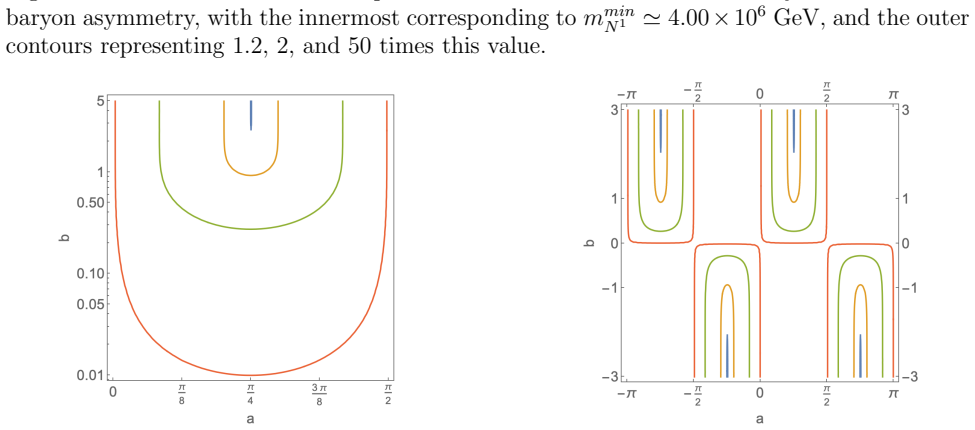
- Non-thermal production loosens these bounds: with three generations the minimum drops to about 3.3 × 10^6 GeV, and with two generations to 4.0 × 10^6 GeV (normal) or 2.2 × 10^8 GeV (inverted).
- In the neutrinophilic Higgs doublet model, non-thermal leptogenesis works with the lightest right-handed neutrino at about 132 GeV for two or three generations and either mass ordering, because the mass bound scales as v_2^2.
- Thermal leptogenesis in the neutrinophilic model also benefits, but less dramatically: the minimum is about 1.7 × 10^6 GeV (normal) and 5.1 × 10^5 GeV (inverted) for three generations at v_2 of a few GeV, and equals the standard-model values at v_2 = 246 GeV.
- Because the analytic asymmetry formulas are independent of the neutrino mixing matrix, the resulting minimum masses depend only on the light-neutrino masses and the right-handed sector parameters, not on the measured angles and phases.
Reading between the lines
- In the editor's reading, the scaling m_{N_1}^{min} \propto v_2^2 means the ultimate floor is set by how small the neutrinophilic VEV can be; updating the lepton-flavor-violation constraints that force v_2 ≳ 10 MeV would directly sharpen or shift the 132 GeV result.
- The paper restricts to hierarchical right-handed masses; restoring the self-energy enhancement S_j would let the same parametrization assess the resonant regime, where lower masses are generally possible for the same CP asymmetry.
- If the 132 GeV scale is correct, the model suggests a searchable signature: right-handed neutrinos produced through the neutrinophilic Higgs could appear in same-sign dilepton events at colliders, a calculation the paper does not perform.
Editorial analysis
A structured set of objections, weighed in public.
Referee Report
Summary. The paper derives closed-form expressions for the leptogenesis CP-asymmetry parameter epsilon_1 in the Casas-Ibarra orthogonal parametrization, for both two and three right-handed neutrinos, and uses them to scan for the minimum mass of the lightest right-handed neutrino that reproduces neutrino oscillation data and the observed baryon asymmetry. Thermal and non-thermal leptogenesis are treated, in the standard Type-I seesaw with the SM Higgs and in a neutrinophilic two-Higgs-doublet variant. The headline claim is that in the neutrinophilic non-thermal case the lightest right-handed neutrino mass can be as low as the sphaleron decoupling temperature, about 132 GeV.
Significance. If correct, the low-mass result would connect leptogenesis to right-handed neutrino masses that may be accessible to laboratory searches, which is of genuine phenomenological interest. The analytic formulas for epsilon_1 and the explicit parameter scans are useful and transparent; the paper also correctly notes that epsilon_1 is independent of the MNS matrix and of some orthogonal-matrix parameters. The thermal large-mass results reproduce the expected order of magnitude of the Davidson-Ibarra-type bound. However, the headline low-mass claim rests on an unjustified no-washout assumption and on a single-flavor Boltzmann treatment at a scale where flavor effects are important; until those issues are addressed, the quoted lower bounds are not established.
major comments (2)
- [Section 4.2, Eq. (4.14)] The condition mN1<TR stated after Eq. (4.14) does not justify setting kappa=1. Inverse-decay washout is controlled by K=Gamma_1/H(mN1) in Eq. (4.8), not by the production temperature; at T~mN1 the inverse decay rate is unsuppressed. For the NH benchmark that realizes |epsilon_1|=3.27e-10 at mN1=132 GeV, Eq. (4.23) with vh replaced by v2 implies v2~1.4 GeV, and Eq. (4.8) gives K at least of order 10^6 because (O Dnu O-dagger)_11 = (m2+m3)/2 cosh(2b) for the a=pi/4, b>>1 configuration that maximizes epsilon_1. In this regime the efficiency factor in Eq. (4.7) is kappa ~ 2/(z_B K) << 1, so the asymmetry is suppressed by orders of magnitude. The 132 GeV values in Table 2 are therefore not supported by the analysis as presented.
- [Sections 4.1-4.2, Eqs. (4.1)-(4.7)] The Boltzmann treatment is single-flavor throughout, with one lepton yield YL and one washout rate gamma_W. For the non-thermal neutrinophilic benchmarks with mN1 ~ 132 GeV, the asymmetry is generated at T ~ mN1, where the tau, mu, and electron Yukawa interactions are all in equilibrium; in this regime flavored leptogenesis is required. The unflavored CP asymmetry and the single-flavor efficiency factor kappa in Eq. (4.7) can differ appreciably from the properly flavored quantities, so the lower bounds in Table 2 and the requirement |epsilon_1|=3.27e-10 in Eq. (4.15) need to be re-derived with flavor-dependent Boltzmann equations before the low-mass claim can be accepted.
minor comments (5)
- [Eq. (2.11) vs. Eqs. (3.5)-(3.6)] The orthogonal matrix in Eq. (2.11) is written with cosh(a+ib) and sinh(a+ib), but the resulting formulas for Gamma_1 and epsilon_1 contain sin(2a) sinh(2b) and cos(2a) cosh(2b). These expressions follow from O = [[cos(a+ib), sin(a+ib)],[-sin(a+ib), cos(a+ib)]], not from the cosh/sinh parameterization. Please correct the definition of O or the analytic formulas.
- [Eq. (2.16)] The matrix O2 has a stray '1' in the (3,2) entry and is not orthogonal as written; the (3,2) entry should be 0 for the standard rotation form.
- [Figures 4 and 5 captions] The text describing the right panels repeats mlightest/eV = 10^{-2} three times before 10^{-8}; this appears to be a typo and should be corrected to match the intended scan values.
- [Section 5.0.2] The text says the three-RHN neutrinophilic non-thermal case has six free parameters, but the sentence lists mN1, mlightest, a12, a13, b12, b13, and v2, which is seven; please clarify the counting.
- [Abstract and Section 5] The spelling 'neutrinophillic' should be 'neutrinophilic', and 'heirarchy' should be 'hierarchy'.
Circularity Check
No significant circularity: the CP-asymmetry formula is derived from standard one-loop amplitudes, and the quoted lower bounds are obtained by extremizing free parameters against externally fixed inputs (neutrino oscillation data, observed baryon asymmetry, and the sphaleron decoupling temperature).
full rationale
The paper's derivation chain is self-contained and not circular. The CP asymmetry formula (Sec. 3, Eqs. 3.1, 3.4, 3.5-3.8) is obtained by inserting the Casas-Ibarra parametrization mD = sqrt(MN) O sqrt(Dnu) U† into the standard one-loop expression for epsilon_i, with no parameter fitted to the target quantities. The observed neutrino masses and mixing angles are external inputs (Eq. 2.7), and the baryon asymmetry nB/s = 8.7 × 10^-11 is used only as the constraint that fixes the required epsilon. The free parameters a, b, and mlightest are scanned and extremized, not fitted and then repackaged as predictions; the minimum mN1 is the result of a well-defined minimization. The non-thermal analysis does set kappa = 1 and fixes |epsilon1| = 3.27 × 10^-10 via Eq. (4.14) under the stated conditions TR ~ mN1 ~ mphi/2 and BR = 1; this is a model assumption, and whether it is physically self-consistent (e.g., washout at these masses) is a correctness or physics concern, not a circularity. In the neutrinophilic Higgs case, the 132 GeV value is obtained by using the scaling mmin_N1 ∝ v2^2 and imposing the independent sphaleron decoupling bound from Ref. [31]; the bound is an external input, not an output of the leptogenesis calculation. No load-bearing self-citation or imported uniqueness claim appears: the efficiency factor is taken from Ref. [19] (external), and self-citations are not used to justify the central result. Therefore, no circular step can be exhibited, and the paper's claims are not equivalent to their inputs by construction.
Assumptions & free parameters
free parameters (5)
- a, b: real parameters of the 2x2 orthogonal matrix O in the two right-handed neutrino case
- a12, a13, b12, b13: real parameters of the 3x3 orthogonal matrix O in the three right-handed neutrino case
- mlightest
- v2
- BR(phi -> N1 N1) =
1 (maximal)
assumptions (6)
- domain assumption Type-I seesaw formula m_nu approximately mD^T M_N^{-1} mD with hierarchical heavy neutrinos
- standard math Casas-Ibarra parametrization mD = sqrt(MN) O sqrt(Dnu) U^dagger with complex orthogonal O
- domain assumption Hierarchical right-handed neutrino masses with vertex and self-energy corrections Vj and Sj approximately 1
- domain assumption Single-flavor Boltzmann equations with the analytic efficiency factor kappa from Ref. [19]
- domain assumption Sphaleron decoupling at 132 GeV
- domain assumption Non-thermal production where only N1 is produced by scalar decay, kappa = 1, and mN1 < TR
Cite this review
Pith. "Pith review of Analytic formulation of Leptogenesis with neutrino oscillation data employing the general parametrization for neutrino mass matrix." pith.science (2026). https://pith.science/paper/6PEIVWDB
@misc{pith2026250620580,
  author       = {Pith},
  title        = {Pith review of: Analytic formulation of Leptogenesis with neutrino oscillation data employing the general parametrization for neutrino mass matrix},
  year         = {2026},
  howpublished = {\url{https://pith.science/paper/6PEIVWDB}},
  note         = {Machine review of arXiv:2506.20580}
}
read the original abstract
The observed neutrino oscillations and baryon asymmetry, unexplained by the Standard Model (SM), can both be accounted for by extending the SM to include Majorana right-handed neutrinos (RHNs). Tiny neutrino masses naturally arise through the Type-I seesaw mechanism, which involves lepton number violation. Meanwhile, the baryon asymmetry can be generated via leptogenesis, where the out-of-equilibrium decay of RHNs produces a lepton asymmetry that is partially converted into a baryon asymmetry through sphaleron processes. The Dirac Yukawa couplings play the crucial role for both Type-I seesaw and leptogenesis. In this work, we derive an analytic expression for the CP asymmetry parameter in a general parametrization. Focusing on a hierarchical RHN mass spectrum, we evaluate the lowest mass of the lightest RHN that reproduce both neutrino oscillation data and the observed baryon asymmetry. We study the case with two and three generations of RHNs for both thermal and non-thermal leptogenesis scenarios. Besides the standard Type-I seesaw involving SM Higgs doublet, we also examine the Type-I seesaw with a new neutrinophillic Higgs doublet. In this case for non-thermal leptogenesis, the minimum value for the lightest RHN mass can be as low as sphaleron decoupling temperature.
Figures


Figures from the paper (7 more)




Reference graph
Works this paper leans on
-
[32]
Insights on the Scale of Leptogenesis from Neutrino Masses and Neutrinoless Double-Beta Decay
Alessandro Granelli et al. “Insights on the Scale of Leptogenesis from Neutrino Masses and Neutrinoless Double-Beta Decay”. In: (Feb. 2025). arXiv: 2502.10093 [hep-ph]. 22
arXiv 2025
-
[1]
S. Navas et al. “Review of particle physics”. In: Phys. Rev. D 110.3 (2024), p. 030001. doi: 10.1103/PhysRevD.110.030001
-
[2]
µ → eγ at a Rate of One Out of 10 9 Muon Decays?
Peter Minkowski. “ µ → eγ at a Rate of One Out of 10 9 Muon Decays?” In: Phys. Lett. B 67 (1977), pp. 421–428. doi: 10.1016/0370-2693(77)90435-X
- [3]
- [4]
-
[5]
The future of elementary particle physics
S. L. Glashow. “The future of elementary particle physics”. In: Proceedings of the 1979 Carg` ese Summer Institute on Quarks and Leptons (M. L´ evy et al. eds.) Plenum Press, New York (1980), p. 687
work page 1980
-
[6]
Neutrino Mass and Spontaneous Parity Nonconservation
Rabindra N. Mohapatra and Goran Senjanovic. “Neutrino Mass and Spontaneous Parity Nonconservation”. In: Phys. Rev. Lett. 44 (1980), p. 912. doi: 10.1103/PhysRevLett. 44.912
-
[7]
Neutrino Masses in SU(2) x U(1) Theories
J. Schechter and J. W. F. Valle. “Neutrino Masses in SU(2) x U(1) Theories”. In: Phys. Rev. D 22 (1980), p. 2227. doi: 10.1103/PhysRevD.22.2227
Show all 34 references
-
[8]
Baryogenesis Without Grand Unification
M. Fukugita and T. Yanagida. “Baryogenesis Without Grand Unification”. In: Phys. Lett. B 174 (1986), pp. 45–47. doi: 10.1016/0370-2693(86)91126-3
1986 doi
-
[9]
Symmetry Breaking Through Bell-Jackiw Anomalies
Gerard ’t Hooft. “Symmetry Breaking Through Bell-Jackiw Anomalies”. In: Phys. Rev. Lett. 37 (1976). Ed. by Mikhail A. Shifman, pp. 8–11. doi: 10.1103/PhysRevLett.37.8
1976 doi
-
[10]
Topology in the Weinberg-Salam Theory
N. S. Manton. “Topology in the Weinberg-Salam Theory”. In: Phys. Rev. D 28 (1983), p. 2019. doi: 10.1103/PhysRevD.28.2019
1983 doi
-
[11]
A Saddle Point Solution in the Weinberg-Salam Theory
Frans R. Klinkhamer and N. S. Manton. “A Saddle Point Solution in the Weinberg-Salam Theory”. In: Phys. Rev. D 30 (1984), p. 2212. doi: 10.1103/PhysRevD.30.2212. 20
1984 doi
-
[12]
On the Anomalous Electroweak Baryon Number Nonconservation in the Early Universe
V. A. Kuzmin, V. A. Rubakov, and M. E. Shaposhnikov. “On the Anomalous Electroweak Baryon Number Nonconservation in the Early Universe”. In: Phys. Lett. B 155 (1985), p. 36. doi: 10.1016/0370-2693(85)91028-7
1985 doi
-
[13]
Sphalerons, Small Fluctuations and Baryon Number Violation in Electroweak Theory
Peter Brockway Arnold and Larry D. McLerran. “Sphalerons, Small Fluctuations and Baryon Number Violation in Electroweak Theory”. In: Phys. Rev. D 36 (1987), p. 581. doi: 10.1103/PhysRevD.36.581
1987 doi
-
[14]
The Statistical Theory of Anomalous Fermion Number Nonconservation
S. Yu. Khlebnikov and M. E. Shaposhnikov. “The Statistical Theory of Anomalous Fermion Number Nonconservation”. In: Nucl. Phys. B 308 (1988), pp. 885–912. doi: 10.1016/0550-3213(88)90133-2
1988 doi
-
[15]
Cosmological baryon and lepton number in the presence of electroweak fermion number violation
Jeffrey A. Harvey and Michael S. Turner. “Cosmological baryon and lepton number in the presence of electroweak fermion number violation”. In: Phys. Rev. D 42 (1990), pp. 3344–
1990
-
[16]
CP violating decays in leptogenesis scenarios
Laura Covi, Esteban Roulet, and Francesco Vissani. “CP violating decays in leptogenesis scenarios”. In: Phys. Lett. B 384 (1996), pp. 169–174. doi: 10.1016/0370- 2693(96) 00817-9. arXiv: hep-ph/9605319
1996 arXiv
-
[17]
CP asymmetry in Majorana neutrino decays
W. Buchmuller and M. Plumacher. “CP asymmetry in Majorana neutrino decays”. In: Phys. Lett. B 431 (1998), pp. 354–362. doi: 10.1016/S0370-2693(97)01548-7 . arXiv: hep-ph/9710460
1998 arXiv
-
[18]
A Lower bound on the right-handed neutrino mass from leptogenesis
Sacha Davidson and Alejandro Ibarra. “A Lower bound on the right-handed neutrino mass from leptogenesis”. In: Phys. Lett. B 535 (2002), pp. 25–32. doi: 10.1016/S0370- 2693(02)01735-5. arXiv: hep-ph/0202239
2002 arXiv
-
[19]
Leptogenesis for pedestrians
W. Buchmuller, P. Di Bari, and M. Plumacher. “Leptogenesis for pedestrians”. In: Annals Phys. 315 (2005), pp. 305–351. doi: 10.1016/j.aop.2004.02.003 . arXiv: hep- ph/ 0401240
2005 doi
-
[20]
Squeezing out predictions with leptogenesis from SO(10)
Franco Buccella et al. “Squeezing out predictions with leptogenesis from SO(10)”. In: Phys. Rev. D 86 (2012), p. 035012. doi: 10.1103/PhysRevD.86.035012 . arXiv: 1203. 0829 [hep-ph]
2012 doi
-
[21]
Oscillating neutrinos and µ → e, γ
J. A. Casas and A. Ibarra. “Oscillating neutrinos and µ → e, γ”. In: Nucl. Phys. B 618 (2001), pp. 171–204. doi: 10.1016/S0550-3213(01)00475-8 . arXiv: hep-ph/0103065
2001 arXiv
-
[22]
Neutrino phenomenology: The Case of two right-handed neutrinos
A. Ibarra and Graham G. Ross. “Neutrino phenomenology: The Case of two right-handed neutrinos”. In: Phys. Lett. B 591 (2004), pp. 285–296. doi: 10.1016/j.physletb.2004. 04.037. arXiv: hep-ph/0312138
2004 arXiv
-
[23]
Naturally small seesaw neutrino mass with no new physics beyond the TeV scale
Ernest Ma. “Naturally small seesaw neutrino mass with no new physics beyond the TeV scale”. In: Phys. Rev. Lett. 86 (2001), pp. 2502–2504. doi: 10.1103/PhysRevLett.86
2001 doi
-
[24]
Hunting for Heavy Majorana Neutrinos with Lepton Number Violating Signatures at LHC
Chao Guo et al. “Hunting for Heavy Majorana Neutrinos with Lepton Number Violating Signatures at LHC”. In: JHEP 04 (2017), p. 065. doi: 10.1007/JHEP04(2017)065. arXiv: 1701.02463 [hep-ph]. 21
2017 arXiv
-
[25]
Remarks on the unified model of elementary particles
Ziro Maki, Masami Nakagawa, and Shoichi Sakata. “Remarks on the unified model of elementary particles”. In: Prog. Theor. Phys. 28 (1962), pp. 870–880. doi: 10.1143/PTP. 28.870
1962 doi
-
[26]
NuFit-6.0: updated global analysis of three-flavor neutrino oscilla- tions
Ivan Esteban et al. “NuFit-6.0: updated global analysis of three-flavor neutrino oscilla- tions”. In: JHEP 12 (2024), p. 216. doi: 10.1007/JHEP12(2024)216. arXiv: 2410.05380 [hep-ph]
2024 arXiv
-
[27]
Baryogenesis through mixing of heavy Majorana neutrinos
Marion Flanz et al. “Baryogenesis through mixing of heavy Majorana neutrinos”. In: Phys. Lett. B 389 (1996), pp. 693–699. doi: 10.1016/S0370-2693(96)01337-8 . arXiv: hep-ph/9607310
1996 arXiv
-
[28]
CP violation and baryogenesis due to heavy Majorana neutrinos
Apostolos Pilaftsis. “CP violation and baryogenesis due to heavy Majorana neutrinos”. In: Phys. Rev. D 56 (1997), pp. 5431–5451. doi: 10.1103/PhysRevD.56.5431 . arXiv: hep-ph/9707235
1997 arXiv
-
[29]
Baryogenesis and lepton number violation
Michael Plumacher. “Baryogenesis and lepton number violation”. In: Z. Phys. C 74 (1997), pp. 549–559. doi: 10.1007/s002880050418. arXiv: hep-ph/9604229
1997 arXiv
-
[30]
Natural Z’ -portal Majorana dark matter in alternative U(1) extended standard model
Nobuchika Okada, Satomi Okada, and Digesh Raut. “Natural Z’ -portal Majorana dark matter in alternative U(1) extended standard model”. In: Phys. Rev. D 100.3 (2019), p. 035022. doi: 10.1103/PhysRevD.100.035022. arXiv: 1811.11927 [hep-ph]
2019 arXiv
-
[31]
Sphaleron Rate in the Minimal Standard Model
Michela D’Onofrio, Kari Rummukainen, and Anders Tranberg. “Sphaleron Rate in the Minimal Standard Model”. In: Phys. Rev. Lett. 113.14 (2014), p. 141602. doi: 10.1103/ PhysRevLett.113.141602. arXiv: 1404.3565 [hep-ph]
2014 arXiv
-
[2502]
arXiv: hep-ph/0011121
-
[3349]
doi: 10.1103/PhysRevD.42.3344
Reviewed August 6, 2026 · model on record in the stance chip above.
Discussion (0). Sign in to comment.