REVIEW 4 major objections 4 minor 48 references
Adsorbate-induced formation of a surface-polarity-driven nonperiodic superstructure
T0 review · 4 major / 4 minor · reviewed 2026-08-06 · deepseek-v4-flash
Pith's one-line read On a polar crystal surface, hydrogen atoms self-assemble into a two-dimensional tiling with no long-range periodicity, forming isolated (1×1)-H clusters whose local electronic structure is governed by quantum confinement.
desk verdict Novel STM observation of a nonperiodic surface tiling, but the hydrogen identification rests on a questionable IETS/DFT match that needs an isotope or CO control before the central claim is fully trusted. read the letter →
The pith
A machine-rendered reading of the paper's core claim, the machinery that carries it, and where it could break.
The reading
What carries the argument
The central object is the (1×1)-H cluster: a hexagonally packed patch in which every surface Pd atom carries one hydrogen atom bonded on top, with hydrogen atoms at the cluster periphery displaced outward relative to the ideal Pd lattice. The surface polarity (formally +0.5 electrons per surface Pd atom) is the driving force: dissociative H adsorption transfers electron density from the Pd layer to H, raising the local work function (about 5 eV at cluster boundaries to about 7 eV at cluster centres) and relieving the polar catastrophe, while Coulomb repulsion between adsorbed H atoms sets the cluster-size distribution and the $\sqrt{3}a$ edge-to-edge separation between clusters.
What would settle it
Expose the cleaved Pd-terminated surface to deuterium (D2) instead of residual H2 and repeat the IETS and STM measurements: if the 42 meV and 272 meV inelastic features shift by a factor close to 1/√2 and the same nonperiodic tiling appears, hydrogen is confirmed; if the mode shifts differently or the tiling does not form, the assignment fails.
Extended reading notes
Core claim
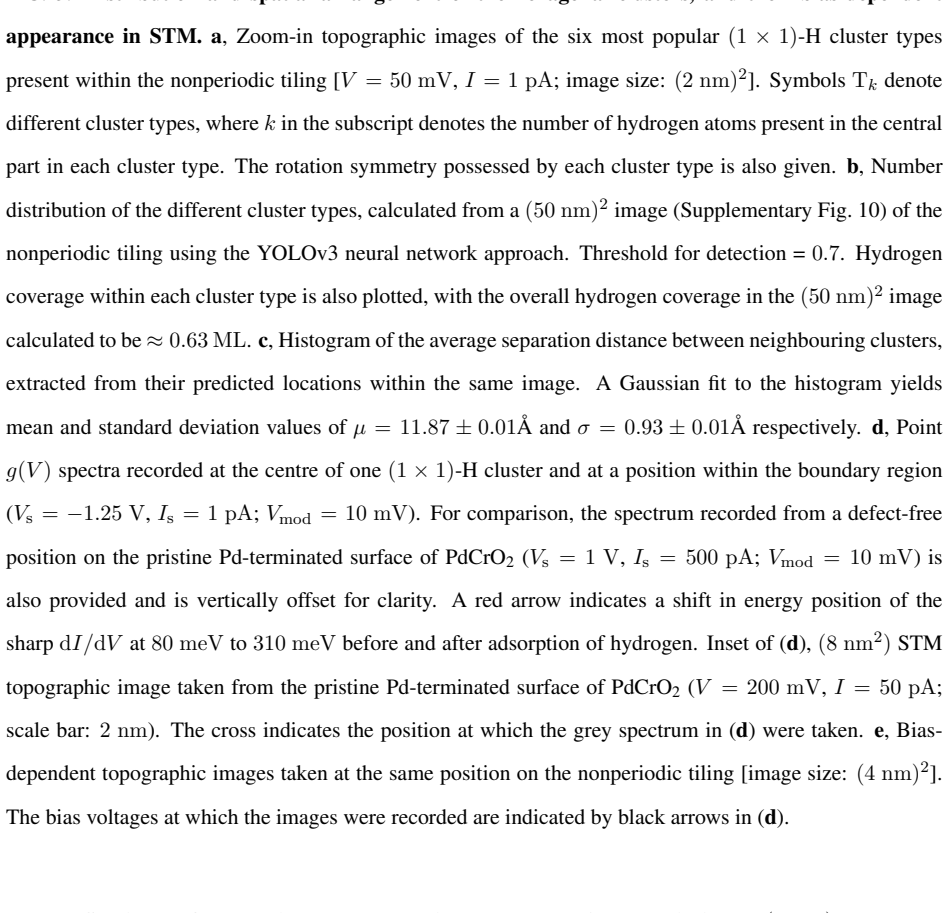
On the Pd-terminated surface of PdCrO2, hydrogen dissociatively adsorbs in a (1×1) arrangement within each cluster, with H atoms bonded directly on top of Pd atoms, producing clusters of different sizes and shapes tiled across terraces with one-atom-wide bare-Pd boundaries. The tiling has no periodic repeat (Fourier transform shows broad features), with an average cluster separation of about 11.9 Å and an overall H coverage of about 0.63 ML, slightly overcompensating the surface polarity. Hydrogen adsorption shifts the sharp surface conductance peak from about 80 meV to about 310 meV and creates cluster-size-dependent bound states at negative bias, attributed to hole-like confinement. The authors rule out alternative explanations such as Pd vacancy networks.
Load-bearing premise
The identification of the adsorbed species as hydrogen, and the claim that each hydrogen sits directly atop a Pd atom, lean on density-functional calculations of a small slab model whose bottom surface is artificially hydrogen-saturated and fixed; the measured in-plane vibrational peak (42 meV) is about 45% below the computed one (61 meV), so the species assignment rests more on scenario elimination than on a perfect spectroscopic match.
Editorial extensions
If this is right
- If the identification is right, the PdCrO2 surface provides the first example of an adsorbate-driven nonperiodic tiling whose building blocks are single atoms rather than molecules or thin-film grains.
- The coverage of about 0.63 ML slightly overcompensates the nominal surface polarity, so the balance between charge transfer and H–H repulsion determines cluster sizes; varying the hydrogen partial pressure during cleavage should tune the tiling.
- The cluster-type-dependent bound states imply that each cluster acts as a quantum box, so the nonperiodic pattern is a natural template for spatially localised electronic states with energies set by cluster geometry.
- Because the pristine Pd-terminated surface shows no such tiling when cleaved at 12 K, the formation requires hydrogen exposure, and the tiling can be removed by scanning at high bias, which desorbs hydrogen and recovers the pristine surface.
Reading between the lines
- The mechanism may be general for polar metallic surfaces: any +1 metallic layer with a high hydrogen affinity could form similar hydrogen tilings, turning a chemical reactivity hazard into a design tool for catalytic site arrays.
- The one-atom-wide bare Pd boundaries between clusters act as an aperiodic network of bare metal sites; these could be the active sites for hydrogen evolution, which would connect the observed structure directly to the reported electrocatalytic activity of delafossites.
- The discrepancy between the computed in-plane H vibration (61 meV) and the measured IETS peak (42 meV) leaves room for an alternative adsorbate or for a modified DFT treatment; an isotope-exchange experiment (H vs D) would settle the species without relying on the calculation.
- The hole-like confined states at negative bias suggest the H-covered clusters locally hole-dope the Pd layer; spectroscopy across the tiling could be used to map the spatial variation of the doping and test whether the confinement energies scale with cluster size as a particle-in-a-box predicts.
Editorial analysis
A structured set of objections, weighed in public.
Referee Report
Summary. The paper reports the observation, by low-temperature STM, of a nonperiodic tiling structure on the Pd-terminated surface of the delafossite PdCrO2 after cleavage at ~20 K, and attributes it to dissociative adsorption of hydrogen from residual vacuum. The proposed structure consists of (1x1)-H clusters of a few atoms, separated by one-atom-wide Pd rows without hydrogen, arranged without long-range periodicity. The evidence includes topographic images and Fourier transforms, inelastic tunneling spectra with peaks at 42, 84, and 272 meV, local barrier-height maps, a neural-network-based cluster census giving an overall H coverage of ~0.63 ML, and DFT calculations of adsorption geometry, vibrational modes, and local electronic structure. The paper also shows spatially resolved dI/dV maps revealing cluster-dependent bound states attributed to quantum confinement.
Significance. If the hydrogen assignment and the nonperiodic tiling claim hold, this is a novel adsorbate-driven nonperiodic surface superstructure on a crystalline oxide surface, with potential implications for surface polarity compensation, catalysis, and electronic localization. The experimental documentation is substantial: multiple STM images, Fourier analysis, vibrational spectroscopy, local barrier-height imaging, atomic displacement analysis, and DFT scenario testing are combined. The paper also ships a data availability link. The central weakness is the identification of the adsorbate: the spectroscopic match to hydrogen is incomplete, and the alternative CO interpretation raised by the vibrational mode energies is not explicitly refuted in the text.
major comments (4)
- [Fig. 2a; Methods: DFT calculations] The species assignment rests on the IETS peaks at 42 and 272 meV, but the DFT in-plane H mode is 61 meV (a 45% discrepancy), while the out-of-plane mode matches better (257 vs 272 meV). The text calls 61 meV vs 42 meV 'good agreement' without justification. Because the CO scenario (tested but not shown) would give a frustrated translation near 40-50 meV and a C-O stretch near 250 meV, the observed pair is also compatible with CO. Please show the CO scenario results referenced in Methods, or provide additional evidence (e.g., isotope substitution, anharmonic corrections, or a systematic error analysis of the DFT modes) that rules out CO and supports H.
- [Methods: DFT calculations] The DFT calculations use a two-layer slab with the bottom Pd surface fixed and saturated with the same number of H atoms as the top surface. No convergence tests with respect to slab thickness, k-point sampling, or the fixed-bottom constraint are reported. The computed in-plane mode at 61 meV, which is already a poor match to the measured 42 meV, could be significantly affected by these choices. Please provide convergence checks or discuss the expected error bars on the vibrational frequencies.
- [Fig. 3b; Methods: Neural network analysis] The neural network was trained with only eight images per cluster class (before 60-degree rotations) and tested on five images per class. No precision, recall, or confusion matrix is reported. Since the overall hydrogen coverage of ~0.63 ML and the cluster-type distribution are central to the polarity-compensation narrative, please report classification accuracy and validate the counts against a manual or independent analysis.
- [Discussion] The absence of tiling on the 12-K-cleaved sample is attributed to cold trapping of hydrogen in the vacuum chamber. While plausible, this is not directly supported by pressure measurements or control experiments, and alternative explanations (e.g., temperature-dependent sticking or different surface condition) are not discussed. Please present corroborating evidence or soften the claim to a suggestion.
minor comments (4)
- [Electronic confinement section] In the sentence 'the drastic differences in the differential conductance spectra g(V ) acquired in the centre of a cluster and at a boundary position between the clusters (Fig. 3d)', the word 'acrossing' appears to be a typo for 'across'.
- [Methods: DFT calculations] The code name 'V ASP' should be 'VASP'.
- [Fig. 3 caption and text] The notation Tk is introduced in Fig. 3a, but the text uses 'T6' in the sentence 'the non-observation of any T6 cluster' before T6 is defined in the figure. Please clarify the definition of T6 (presumably a cluster with six central atoms) when it is first mentioned.
- [Discussion and Methods] The text refers to 'the 12 K-cleaved sample' in the Discussion and to 'cleaved at 12 K' in Methods; please make the sample temperature terminology consistent.
Circularity Check
No significant circularity: the nonperiodic tiling is an experimental observation, and the hydrogen assignment rests on independent DFT, IETS, desorption, and temperature-control evidence; self-citations are background only.
full rationale
The paper's central claim is an observed STM topography (the nonperiodic tiling of hexagonally packed domains), not a quantity derived from an input model. The identification of the adsorbate as hydrogen is supported by several independent strands: IETS peaks at 42/84/272 meV, DFT vibrational calculations (61 and 257 meV), local barrier-height maps, hydrogen desorption under high bias, and the absence of the tiling on a 12 K-cleaved sample. The DFT is not fitted to the IETS data; the in-plane mode disagreement (42 vs 61 meV) is a quantitative weakness in the species assignment, but it is a correctness risk rather than a circular reduction. The self-citations (e.g., refs. 28, 29, 37, 38) provide background on PdCoO2/PdCrO2 surface states and prior evidence of hydrogen adsorption, but the tiling claim does not reduce to those papers. No equation or fitted parameter is renamed as a prediction: the coverage (~0.63 ML) is measured from images, the cluster separation is measured, and the DFT is used for scenario identification rather than to generate the tiling pattern. There is no self-definitional step, no uniqueness theorem imported from the authors, and no ansatz smuggled in via citation. The overall circularity burden is therefore low; the score of 2 reflects only minor overlapping-author citations that are not load-bearing.
Assumptions & free parameters
free parameters (3)
- U (LDA+U on Cr d-orbitals) =
Not stated; taken from previous studies (Ref. 21)
- Neural network detection threshold =
0.7
- z-rescaling exclusion limit =
3 sigma
assumptions (4)
- domain assumption The Pd-terminated surface of PdCrO2 is polar, with a formal charge of +0.5 per Pd atom after cleavage (Fig. 1a).
- domain assumption A two-layer slab with the bottom Pd surface saturated with the same number of H atoms as the top, and with bottom layers fixed, accurately models the surface in DFT.
- domain assumption The inelastic tunneling peaks at 42, 84, and 272 meV are vibrational modes of H on Pd, and the 84 meV peak is the second harmonic of 42 meV.
- ad hoc to paper The absence of the tiling on the 12 K-cleaved sample is due to cold trapping of hydrogen in the vacuum chamber, reducing the H2 partial pressure.
Cite this review
Pith. "Pith review of Adsorbate-induced formation of a surface-polarity-driven nonperiodic superstructure." pith.science (2026). https://pith.science/paper/WATN7EPM
@misc{pith2026250700809,
  author       = {Pith},
  title        = {Pith review of: Adsorbate-induced formation of a surface-polarity-driven nonperiodic superstructure},
  year         = {2026},
  howpublished = {\url{https://pith.science/paper/WATN7EPM}},
  note         = {Machine review of arXiv:2507.00809}
}
read the original abstract
The chemical and electronic properties of surfaces and interfaces are important for many technologically relevant processes, be it in information processing, where interfacial electronic properties are crucial for device performance, or in catalytic processes, which depend on the types and densities of active nucleation sites for chemical reactions. Quasi-periodic and nonperiodic crystalline surfaces offer new opportunities because of their inherent inhomogeneity, resulting in localisation and properties vastly different from those of surfaces described by conventional Bravais lattices. Here, we demonstrate the formation of a nonperiodic tiling structure on the surface of the frustrated antiferromagnet PdCrO2 due to hydrogen adsorption. The tiling structure exhibits no long-range periodicity but comprises few-atom hexagonally packed domains covering large terraces. Measurement of the local density of states by tunnelling spectroscopy reveals adsorption-driven modifications to the quasi-2D electronic structure of the surface layer, showing exciting opportunities arising from electron localisation.
Figures


Figures from the paper (1 more)
Reference graph
Works this paper leans on
-
[1]
J. V . Barth, G. Costantini, and K. Kern, Engineering atomic and molecular nanostructures at surfaces, Nature 437, 671-679 (2005), URL http://www.nature.com/doifinder/10. 1038/nature04166
work page 2005
-
[2]
K. J. Franke, H. R. Sharma, W. Theis, P. Gille, Ph. Ebert, and K. H. Rieder, Quasicrystalline 11 Epitaxial Single Element Monolayers on Icosahedral Al-Pd-Mn and Decagonal Al-Ni-Co Quasicrystal Surfaces, Phys. Rev. Lett. 89, 156104 (2002), URL https://link.aps.org/ doi/10.1103/PhysRevLett.89.156104
-
[3]
S. F ¨orster, K. Meinel, R. Hammer, M. Trautmann, and W. Widdra, Quasicrystalline structure formation in a classical crystalline thin-film system, Nature 502, 215-218 (2013), URL http: //www.nature.com/articles/nature12514
work page 2013
-
[4]
S. F ¨orster, M. Trautmann, S. Roy, W. A. Adeagbo, E. M. Zollner, R. Hammer, F. O. Schumann, K. Meinel, S. K. Nayak, K. Mohseni, et al., Observation and Structure Determination of an Oxide Quasicrystal Approximant, Phys. Rev. Lett. 117, 095501 (2016), URL https://link.aps. org/doi/10.1103/PhysRevLett.117.095501
-
[5]
A. L. Lewandowski, S. Tosoni, L. Gura, P. Schlexer, P. Marschalik, W. Schneider, M. Heyde, G. Pacchioni, and H. Freund, From Crystalline to Amorphous Germania Bilayer Films at the Atomic Scale: Preparation and Characterization, Angew. Chem. 131, 11019-11024 (2019), URL https://onlinelibrary.wiley.com/doi/10.1002/ange.201903922
-
[6]
A. L. Lewandowski, P. Schlexer, S. Tosoni, L. Gura, P. Marschalik, C. B ¨uchner, H. Burrall, K. M. Burson, W.-D. Schneider, G. Pacchioni, et al., Determination of Silica and Germania Film Network Structures on Ru(0001) at the Atomic Scale, J. Phys. Chem. C 123, 7889-7897 (2019), URL https://pubs.acs.org/doi/10.1021/acs.jpcc.8b07110
-
[7]
C. B ¨uchner, L. Liu, S. Stuckenholz, K. M. Burson, L. Lichtenstein, M. Heyde, H.-J. Gao, and H.-J. Freund, Building block analysis of 2D amorphous networks reveals medium range correlation, J. Non-Cryst. Solids 435, 40-47 (2016), URL https://linkinghub.elsevier. com/retrieve/pii/S0022309315302982
work page 2016
-
[8]
P. Alexa, C. Oligschleger, P. Gr ¨oger, C. Morchutt, V . Vyas, B. V . Lotsch, J. C. Sch¨on, R. Gutzler, and K. Kern, Short-Range Structural Correlations in Amorphous 2D Polymers, ChemPhysChem 20, 2340-2347 (2019), URL https://onlinelibrary.wiley.com/doi/abs/10.1002/ cphc.201900326
work page 2019
Show all 48 references
-
[9]
Lackinger and W
M. Lackinger and W. M. Heckl, A STM perspective on covalent intermolecular coupling reactions on surfaces, J. Phys. D: Appl. Phys. 44, 464011 (2011), URL https://iopscience.iop. org/article/10.1088/0022-3727/44/46/464011
2011 doi
-
[10]
Widmer, O
R. Widmer, O. Gr ¨oning, P. Ruffieux, and P. Gr ¨oning, Low-temperature scanning tunneling 12 spectroscopy on the 5-fold surface of the icosahedral AlPdMn quasicrystal, Philos. Mag 86, 781-787 (2006), URL http://www.tandfonline.com/doi/abs/10.1080/ 14786430500253919
2006
-
[11]
V . A. Rogalev, O. Gr¨oning, R. Widmer, J. H. Dil, F. Bisti, L. L. Lev, T. Schmitt, and V . N. Strocov, Fermi states and anisotropy of Brillouin zone scattering in the decagonal Al–Ni–Co quasicrystal, Nat. Commun 6, 8607 (2015), URL http://www.nature.com/articles/ncomms9607
2015
-
[12]
P. A. Thiel, Quasicrystal Surfaces Annu. Rev. Phys. Chem. 59, 129-152 (2008), URL http:// www.annualreviews.org/doi/10.1146/annurev.physchem.59.032607.093736
2008 arXiv
-
[13]
Zhang, C
Y. Zhang, C. Felser, and L. Fu, Moir ´e metal for catalysis, arXiv:2111.03058 [cond-mat] (2021), URL http://arxiv.org/abs/2111.03058
2021 arXiv
-
[14]
Rivier, Non-stick quasicrystalline coatings, J
N. Rivier, Non-stick quasicrystalline coatings, J. Non-Cryst. Solids 153-154, 458 (1993), ISSN 00223093, URL https://linkinghub.elsevier.com/retrieve/pii/ 002230939390395E
1993
-
[15]
Takatsu, H
H. Takatsu, H. Yoshizawa, S. Yonezawa, and Y. Maeno, Critical behavior of the metallic triangular-lattice Heisenberg antiferromagnet PdCrO 2, Phys. Rev. B 79, 104424 (2009), URL https://link.aps.org/doi/10.1103/PhysRevB.79.104424
2009 doi
-
[17]
C. W. Hicks, A. S. Gibbs, L. Zhao, P. Kushwaha, H. Borrmann, A. P. Mackenzie, H. Takatsu, S. Yonezawa, Y. Maeno, and E. A. Yelland, Quantum oscillations and magnetic reconstruction in the delafossite PdCrO2, Phys. Rev. B 92, 014425 (2015), URL https://link.aps.org/doi/ 10.1103...
2015 doi
-
[18]
J. A. Sobota, K. Kim, H. Takatsu, M. Hashimoto, S.-K. Mo, Z. Hussain, T. Oguchi, T. Shishidou, Y. Maeno, B. I. Min, et al., Electronic structure of the metallic antiferromagnet PdCrO2 measured by angle-resolved photoemission spectroscopy, Phys. Rev. B 88, 125109 (2013), URL ht...
2013 doi
-
[19]
H.-J. Noh, J. Jeong, B. Chang, D. Jeong, H. S. Moon, E.-J. Cho, J. M. Ok, J. S. Kim, K. Kim, B. I. Min, et al., Direct Observation of Localized Spin Antiferromagnetic Transition in PdCrO 2 13 by Angle-Resolved Photoemission Spectroscopy, Sci Rep 4, 3680 (2014), URL http://www....
2014
-
[20]
Sunko, F
V . Sunko, F. Mazzola, S. Kitamura, S. Khim, P. Kushwaha, O. J. Clark, M. D. Watson, I. Markovi ´c, D. Biswas, L. Pourovskii, et al., Probing spin correlations using angle-resolved photoemission in a coupled metallic/Mott insulator system, Sci. Adv 6, eaaz0611 (2020), URL http...
2020 doi
-
[21]
C. M. Yim, G.-R. Siemann, S. Stavri ´c, S. Khim, I. Benedi ˇciˇc, P. A. E. Murgatroyd, T. Antonelli, M. D. Watson, A. P. Mackenzie, S. Picozzi, et al., Avoided metallicity in a hole-doped Mott insulator on a triangular lattice, Nat. Commun 15, 8098 (2024), URL https://www.natu...
2024
-
[22]
Arsenijevi ´c, J
S. Arsenijevi ´c, J. M. Ok, P. Robinson, S. Ghannadzadeh, M. I. Katsnelson, J. S. Kim, and N. E. Hussey, Anomalous Magnetothermopower in a Metallic Frustrated Antiferromagnet, Phys. Rev. Lett. 116, 087202 (2016), URL https://link.aps.org/doi/10.1103/PhysRevLett. 116.087202
2016 doi
-
[23]
R. Daou, R. Fr ´esard, V . Eyert, S. H´ebert, and A. Maignan, Unconventional aspects of electronic transport in delafossite oxides, Sci Technol Adv Mate 18, 919-938 (2017), URL https://www. tandfonline.com/doi/full/10.1080/14686996.2017.1393633
2017
-
[24]
Harada, Thin-film growth and application prospects of metallic delafossites, Mater
T. Harada, Thin-film growth and application prospects of metallic delafossites, Mater. Today Adv. 11, 100146 (2021), URL https://linkinghub.elsevier.com/retrieve/pii/ S2590049821000163
2021
-
[25]
A. P. Mackenzie, The properties of ultrapure delafossite metals, Rep. Prog. Phys. 80, 032501 (2017), URL http://stacks.iop.org/0034-4885/80/i=3/a=032501
2017
-
[26]
P. W. Tasker, The stability of ionic crystal surfaces, J. Phys. C: Solid State Phys. 12, 4977 (1979), URL https://iopscience.iop.org/article/10.1088/0022-3719/12/22/036
1979 doi
-
[27]
Sunko, H
V . Sunko, H. Rosner, P. Kushwaha, S. Khim, F. Mazzola, L. Bawden, O. J. Clark, J. M. Riley, D. Kasinathan, M. W. Haverkort, et al., Maximal Rashba-like spin splitting via kinetic- energy-coupled inversion-symmetry breaking, Nature 549, 492-496 (2017), URLhttps://www. nature.c...
2017
-
[28]
Mazzola, V
F. Mazzola, V . Sunko, S. Khim, H. Rosner, P. Kushwaha, O. J. Clark, L. Bawden, I. Markovi ´c, T. K. Kim, M. Hoesch, et al., Itinerant ferromagnetism of the Pd-terminated polar surface of 14 PdCoO2, Proc. Natl. Acad. Sci. U.S.A. 115, 12956-12960 (2018), URLhttp://www.pnas.org/...
2018 doi
-
[29]
C. M. Yim, D. Chakraborti, L. C. Rhodes, S. Khim, A. P. Mackenzie, and P. Wahl, Quasiparticle interference and quantum confinement in a correlated Rashba spin-split 2D electron liquid, Sci. Adv 7, eabd7361 (2021), URL https://advances.sciencemag.org/lookup/doi/10. 1126/sciadv.abd7361
2021
-
[30]
P. Kong, G. Li, Z. Yang, C. Wen, Y. Qi, C. Felser, and S. Yan, Fully Two-Dimensional Incommensurate Charge Modulation on the Pd-Terminated Polar Surface of PdCoO 2, Nano Lett 22, 5635-5640 (2022), URL https://pubs.acs.org/doi/10.1021/acs.nanolett. 1c03857
2022 doi
-
[31]
Noguera, Polar oxide surfaces, J
C. Noguera, Polar oxide surfaces, J. Phys.: Condens. Matter 12, R367 (2000), URL https: //iopscience.iop.org/article/10.1088/0953-8984/12/31/201
2000 doi
-
[32]
G. Li, S. Khim, C. S. Chang, C. Fu, N. Nandi, F. Li, Q. Yang, G. R. Blake, S. Parkin, G. Auffermann, et al., In Situ Modification of a Delafossite-Type PdCoO 2 Bulk Single Crystal for Reversible Hydrogen Sorption and Fast Hydrogen Evolution, ACS Energy Lett. 4, 2185-2191 (2019...
2019 doi
-
[33]
Podjaski, D
F. Podjaski, D. Weber, S. Zhang, L. Diehl, R. Eger, V . Duppel, E. Alarc ´on-Llad´o, G. Richter, F. Haase, A. Fontcuberta i Morral, et al., Rational strain engineering in delafossite oxides for highly efficient hydrogen evolution catalysis in acidic media, Nat. Catal 3, 55-63 ...
2020
-
[34]
Moumaneix, A
L. Moumaneix, A. Rautakorpi, and T. Kallio, Interactions between Hydrogen and Palladium Nanoparticles: Resolving Adsorption and Absorption Contributions, ChemElectroChem 10, e202201109 (2023), URL https://onlinelibrary.wiley.com/doi/abs/10.1002/ celc.202201109
2023
-
[35]
L. J. T. Metzroth, E. M. Miller, A. G. Norman, S. Yazdi, and G. M. Carroll, Accelerating Hydrogen Absorption and Desorption Rates in Palladium Nanocubes with an Ultrathin Surface Modification, Nano Lett 21, 9131-9137 (2021), URL https://doi.org/10.1021/acs. nanolett.1c02903
2021 doi
-
[36]
Darmadi, F
I. Darmadi, F. A. A. Nugroho, and C. Langhammer, High-Performance Nanostructured Palladium-Based Hydrogen Sensors—Current Limitations and Strategies for Their Mitigation, 15 ACS Sens. 5, 3306-3327 (2020), URLhttps://doi.org/10.1021/acssensors.0c02019
2020 doi
-
[37]
Siemann, P
G.-R. Siemann, P. A. E. Murgatroyd, T. Antonelli, E. A. Morales, S. Khim, H. Rosner, M. D. Watson, A. P. Mackenzie, and P. D. C. King, Dichotomy of electron-phonon interactions in the delafossite PdCoO2: From weak bulk to polaronic surface coupling, arXiv:2501.03730 [cond-mat]...
2025
-
[38]
Mazzola, C
F. Mazzola, C. M. Yim, V . Sunko, S. Khim, P. Kushwaha, O. J. Clark, L. Bawden, I. Markovi ´c, D. Chakraborti, T. K. Kim, et al., Tuneable electron–magnon coupling of ferromagnetic surface states in PdCoO 2, npj Quantum Mater. 7, 20 (2022), URL https://www.nature.com/ articles...
2022
-
[39]
L. C. Fern ´andez-Torres, E. C. H. Sykes, S. U. Nanayakkara, and P. S. Weiss, Dynamics and Spectroscopy of Hydrogen Atoms on Pd {111}, J. Phys. Chem. B 110, 7380-7384 (2006), URL https://pubs.acs.org/doi/10.1021/jp055815e
2006 doi
-
[40]
S. Hong, T. S. Rahman, R. Heid, and K. P. Bohnen, First-principles calculations of the phonon dispersion curves of H on Pt(111), Phys. Rev. B 71, 245409 (2005), URL https://link.aps. org/doi/10.1103/PhysRevB.71.245409
2005 doi
-
[41]
S. C. White, U. R. Singh, and P. Wahl, A stiff scanning tunneling microscopy head for measurement at low temperatures and in high magnetic fields, Rev. Sci. Instrum. 82, 113708 (2011), URL http://aip.scitation.org/doi/10.1063/1.3663611
2011 doi
-
[42]
Takatsu and Y
H. Takatsu and Y. Maeno, Single crystal growth of the metallic triangular-lattice antiferromagnet PdCrO2, J. Cryst. Growth 312, 3461-3465 (2010), URL https://linkinghub.elsevier. com/retrieve/pii/S0022024810005853
2010
-
[43]
Redmon and A
J. Redmon and A. Farhadi, YOLOv3: An Incremental Improvement, arXiv:1804.02767 (2018), URL https://arxiv.org/abs/1804.02767
2018 arXiv
-
[44]
Kresse and J
G. Kresse and J. Hafner, Ab initio molecular dynamics for liquid metals, Phys. Rev. B 47, 558(R) (1993), URL https://journals.aps.org/prb/abstract/10.1103/PhysRevB.47. 558
1993 doi
-
[45]
Kresse and J
G. Kresse and J. Hafner, Ab initio molecular-dynamics simulation of the liquid-metal–amorphous- semiconductor transition in germanium, Phys. Rev. B 49, 14251 (1994), URL https:// journals.aps.org/prb/abstract/10.1103/PhysRevB.49.14251
1994 doi
-
[46]
Kresse and J
G. Kresse and J. Hafner, Norm-conserving and ultrasoft pseudopotentials for first-row and 16 transition elements, J. Phys.: Condens. Matter 6, 8245 (1994), URL https://iopscience. iop.org/article/10.1088/0953-8984/6/40/015
1994 doi
-
[47]
Kresse and J
G. Kresse and J. Furthm ¨uller, Efficiency of Ab-Initio Total Energy Calculations for Metals and Semiconductors Using a Plane-Wave Basis Set, Comput. Mater. Sci 6, 15-50 (1996), URL www. sciencedirect.com/science/article/pii/0927025696000080
1996
-
[48]
Kresse and J
G. Kresse and J. Furthm ¨uller, Efficient iterative schemes for ab initio total-energy calculations using a plane-wave basis set, Phys. Rev. B 54, 11169 (1996), URL https://journals.aps. org/prb/abstract/10.1103/PhysRevB.54.11169
1996 doi
-
[49]
Kresse and D
G. Kresse and D. Joubert, From ultrasoft pseudopotentials to the projector augmented-wave method, Phys. Rev. B 59, 1758 (1999), URLhttps://journals.aps.org/prb/abstract/ 10.1103/PhysRevB.59.1758. 17 Acknowledgements: We gratefully acknowledge discussions of hydrogen adsorption...
1999 doi
Reviewed August 6, 2026 · model on record in the stance chip above.
Discussion (0). Continue with ORCID to comment.