REVIEW 4 major objections 4 minor 34 references
Structure studies of 257Db through combined {\alpha}, {\gamma} and internal-conversion-electron spectroscopy
T0 review · 4 major / 4 minor · reviewed 2026-08-06 · deepseek-v4-flash
Pith's one-line read This paper argues that the ground state of $^{257}$Db is the $9/2^-[505]$ Nilsson state, not the previously assigned $9/2^+[624]$ state, based on the first observation of a high-$K$ isomer in $^{257}$Db, a new $\alpha$-decay branch in…
desk verdict Genuinely new data on 257Db and its decay chain, but the parity-change claim is a plausible interpretation built on a few soft assumptions, not a settled result. read the letter →
The pith
A machine-rendered reading of the paper's core claim, the machinery that carries it, and where it could break.
The reading
What carries the argument
The load-bearing object is the Nilsson single-proton orbital $9/2^-[505]$, which the paper places at the Fermi surface of $^{257}$Db. The mechanism that carries the argument is the hindrance factor of $\alpha$ decay: a transition between states of opposite parity and different spin projection would be strongly hindered, so the observation of favoured decays (hindrance factor near $1$) forces the initial and final states to share the same Nilsson configuration. This is combined with Monte Carlo simulations of the detector response that reproduce the energy summing of $\alpha$ particles with internal-conversion electrons and atomic radiations; the double-humped shape of the measured $\alpha$ spectrum is the fingerprint that selects among candidate decay schemes. The newly observed high-$K$ isomer, whose decay is seen only in correlation with the high-spin ground state, provides the additional constraint that the ground state must itself be high-spin.
What would settle it
Measure the multipolarity of the $145$ keV transition in $^{253}$Lr by collecting enough $K$-shell versus $L$-shell conversion-electron ratios to distinguish E1 from M1/E2; an E1 result would contradict the proposed decay from the $9/2^-[505]$ band head to the $11/2^-$ member. A second, independent check is direct atomic spectroscopy of $^{257}$Db: if the ground-state spin and parity turn out to be $9/2^+$, the paper's central revision is refuted.
Extended reading notes
Core claim
The central claim is that the accepted $9/2^+[624]$ ground-state assignment for $^{257}$Db cannot accommodate the sum of the measured decays, and that the data instead support a $9/2^-[505]$ ground state, a proton Nilsson orbital from the same $h_{9/2}$ shell that gives the $7/2^-[514]$ ground state of $^{253}$Lr. The evidence assembled is that the $145$ keV highly converted transition in $^{253}$Lr appears only after the high-spin $\alpha$ decay of $^{257}$Db; that no scenario built on a $9/2^+$ state can reproduce the double-humped $\alpha$-energy spectrum in Monte Carlo simulations unless an inter-band transition of about $145$ keV is introduced; and that the newly measured chains place the $1/2^-[521]$ state $48$-$78$ keV above the ground state in $^{249}$Md, nearly degenerate ($-24$ to $6$ keV) in $^{253}$Lr, and $59$-$89$ keV above the ground state in $^{257}$Db. With the $9/2^-$ assignment, the favoured $\alpha$ decay to the $9/2^-[505]$ band head has hindrance factor about $1.2$, the weaker branches to the $11/2^-$ and $9/2^-$ members are consistent with the observed spectrum, and the conversion coefficient of the $145$ keV transition, although imprecise, does not exclude M1 or E2 multipolarity.
Load-bearing premise
The argument assumes that the previously assigned $7/2^-[514]$ ground states of $^{253}$Lr and $^{249}$Md are correct and that all $80$-$150$ keV electron events in $^{253}$Lr come from conversion of a single $145$ keV transition; if either of these gives way, the deduced band structure and the $9/2^-[505]$ assignment lose their foundation.
Editorial extensions
If this is right
- The ground state of $^{257}$Db should be reassigned as $9/2^-[505]$, and future work on the $A=257$ decay chain should adopt the revised level scheme of Fig. 17.
- The $1/2^-[521]$ isomer is now placed at $48$-$78$ keV in $^{249}$Md, $-24$ to $6$ keV in $^{253}$Lr, and $59$-$89$ keV in $^{257}$Db; these values become fixed points that nuclear-structure calculations of the $Z>100$ region must reproduce.
- If the reassignment holds, the $9/2^+[624]$ orbital is no longer a low-lying proton state in $^{257}$Db, which affects the microscopic configurations proposed for high-$K$ isomers in neighbouring nuclei such as $^{257}$Rf and $^{254}$No.
- Confirmation of the $9/2^-[505]$ assignment would imply that non-self-consistent mean-field calculations misorder proton orbitals above $Z=100$, pointing to higher-multipolarity deformation or charge-density effects as the missing ingredient.
Reading between the lines
- A direct test would be to search for the $9/2^-[505]$ band head in neighbouring odd-proton nuclei such as $^{255}$Lr or $^{251}$Md; finding it close to the $7/2^-[514]$ ground state, as this scheme predicts, would strengthen the assignment, while a high placement would weaken it.
- The technique of using the summed $\alpha$-plus-conversion-electron spectral shape as a fingerprint, rather than relying only on peak energies, could be applied to other odd-$Z$ superheavy $\alpha$ emitters that show unexplained double-humped structures.
- A model-independent parity measurement of the $^{257}$Db ground state, for example from laser spectroscopy of the hyperfine structure or from angular correlations of oriented nuclei, would settle the $9/2^-$ versus $9/2^+$ question without invoking hindrance-factor systematics.
- The conversion coefficient of the $145$ keV transition in $^{253}$Lr is measured with very wide uncertainties; a dedicated run collecting more electron events would discriminate M1/E2 from the much less converted E1 alternative, and with it the proposed decay path.
Signed reviews
Editorial analysis
A structured set of objections, weighed in public.
Referee Report
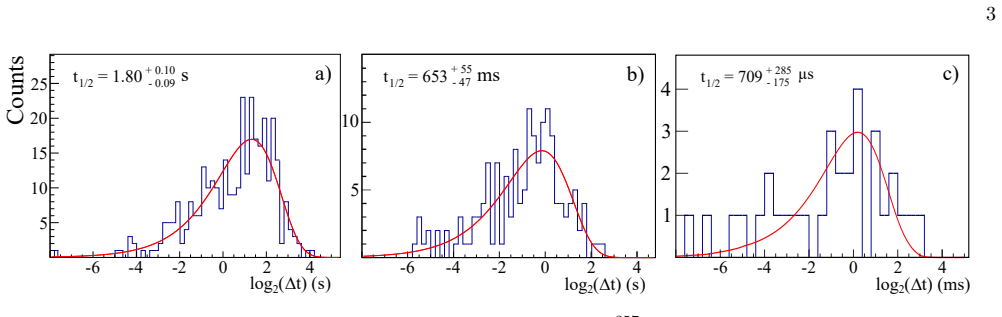
Summary. This manuscript reports a combined alpha-gamma-electron spectroscopy study of 257Db produced in the 50Ti + 209Bi fusion-evaporation reaction, using the GABRIELA setup coupled to SHELS. It presents three main experimental findings: (i) the first observation of a high-K isomer in 257Db with t1/2 = 0.71(+0.29,-0.18) ms and an excitation energy of at least 1.1 MeV; (ii) a previously unreported alpha-decay branch from the 1/2- state in 249Md at about 8350 keV with t1/2 ~ 1.1 s, constraining its excitation energy to 48-78 keV; and (iii) the first observation of internal conversion electrons in 253Lr following the high-spin alpha decay of 257Db, with a highly converted 145 keV transition and 48 electron events in the 80-150 keV range. On the basis of these data and Geant4 simulations, the authors propose that the high-spin ground state of 257Db has negative parity, 9/2-[505], rather than the previously suggested 9/2+[624], with the 1/2-[521] state at 59-89 keV; this revision affects Nilsson-level systematics above Z = 100.
Significance. The experimental material is valuable. The correlation plots in Figs. 2, 5, 7, and 12 support the claimed new isomer, the new alpha branch, and the coincidence pattern, and the measured half-lives and energies are broadly consistent with previous work. If the parity change is correct, the paper provides a rare experimental constraint on single-proton Nilsson states near Z = 105, with implications for the ordering of h9/2 and i13/2 intruder orbitals and for hexadecapole deformation trends. The paper also gives new quantitative constraints on the relative energies of the 1/2- and 7/2- states in 249Md, 253Lr, and 257Db. However, the central parity assignment is not yet established at the level claimed: it rests on the single-transition interpretation of a broad electron group and on Geant4 simulations whose feeding intensities are adjusted to reproduce the same data. The manuscript itself acknowledges the assumption that the 7/2- assignments of 253Lr and 249Md are correct, and the present data do not provide an independent, statistically quantified test of the 9/2- scenario.
major comments (4)
- [Section III.A and Section IV.B (Figs. 7 and 17)] The parity-change conclusion depends on identifying all 48 electron events in the 80-150 keV range as LMN conversion electrons of a single 145 keV transition in 253Lr. The text itself says "If one assumes..." and the resulting conversion coefficient 21(+28,-11) overlaps M1/E2 predictions at less than 2 sigma, but the electron energy distribution is broad and the decay scheme in Fig. 17 contains other low-energy transitions (66, 85, 60 keV) that could contribute to the same detector group. The authors should demonstrate, for example by simulating the response to a mixture of transitions or by fitting the electron-energy distribution, that the single-transition assumption is justified; otherwise the 145 keV placement and the derived 9/2- parity lose their quantitative foundation.
- [Section IV.B, Figs. 16(a) and 18] The Geant4 simulations are used to rule out the previous 9/2+[624] interpretation (Fig. 16) and to support the new 9/2- scenario (Fig. 18), but the feeding intensities fed into the simulation are extracted from the same measured alpha spectrum (Table I, Section III.A) and no uncertainties are attached to the simulated spectra. The agreement in Fig. 18 is therefore a fit, not an independent validation, and the statement that the 9/2+ scenario "cannot account for the double-humped structure" is not quantified. The authors should provide a statistical comparison (for example chi-square or likelihood with bin-by-bin errors, including systematic uncertainties from implantation depth and detection efficiencies) and show the sensitivity of the conclusion to the fitted feeding intensities.
- [Section IV.B] The proposed assignment explicitly assumes the previous 7/2-[514] ground-state assignments for 253Lr and 249Md: "The scenario proposed here ... assumes that the previous 7/2- assignments ... is correct." This is a load-bearing external input: if either assignment were incorrect, the relative-parity argument and the preferred 9/2-[505] assignment would not follow. The paper does not assess how the conclusion would change if, for example, the ground state of 253Lr or 249Md had spin 9/2- or 5/2-. A sensitivity discussion, or at least an explicit statement that the conclusion is conditional on these assignments, is needed in the interpretation section rather than only as an embedded caveat.
- [Section IV.A (Fig. 14)] The deduced 48-78 keV excitation energy of the 1/2- state in 249Md depends on the assumption that the 7/2+[633] band head in 245Es lies below the 5/2- member at about 30 keV (deduced from systematics) and on excluding the possible 5/2- feeding branch from the simulation because of low statistics. These choices affect the band structure and the subsequent energy constraints in 253Lr and 257Db. The authors should at least indicate the range of excitation energies allowed if the 5/2- branch were present at the few-percent level, or justify the exclusion more quantitatively.
minor comments (4)
- [Abstract] The phrase "the first observation the internal decay in 253Lr" is grammatically incomplete; it should read "the first observation of the internal decay in 253Lr."
- [Section II] There is a typo in "to ensure the highest detection efficiency possile [14]"; it should be "possible."
- [Figure 17] The half-life for the 253Lr low-spin state is labeled "2.0(14) s", whereas the text and Table I give 2.0(1) s; this should be corrected.
- [Section III.A, Table I] The alpha-decay energies for 257Db are listed as "extracted from the Monte Carlo simulation"; the directly measured peak centroids should also be reported, since those are the primary observable quantities and would allow independent checks of the simulation-based corrections.
Circularity Check
The α-spectrum agreement in Figs. 16/18 is produced with feeding intensities extracted from the same measured spectrum; the parity-change scenario is therefore a consistency fit, not an independent prediction.
-
fitted input called prediction
[Section IV.B / Fig. 18; Section IV.A / Fig. 13]
"To replicate the observed “double-hump” α spectrum in Fig.4, a ∼145 keV M1 or E2 transition connecting states from different rotational bands is necessary. ... Figure 18 highlights the reproduction of the data through Geant4 simulation with this scenario; ... The extracted intensities yield a HF of the order of 1.2 and 34 for the decays to the 9/2−[505] band head and to the 9/2− member of the ground-state band."
The feeding intensities that drive the Geant4 simulation (the 18.8% and 5% branches in Table I, and the 'extracted intensities' quoted in Fig. 18) are obtained from the very measured high-spin 257Db α spectrum that the simulation is then said to reproduce. The double-hump shape is first used to require a ∼145 keV inter-band M1/E2 transition; the simulation is then run with that transition and with branch intensities tuned to the same spectrum. The agreement in Fig. 18 is therefore a fit-quality check, not an independent confirmation of the 9/2−[505] assignment. The same fitted-input pattern applies to the 249Md simulation in Fig. 13, where the new 8350 keV decay energy and the 20% branch are placed into the model and compared with the same measured spectrum from which they were inferred.
full rationale
The paper's genuinely new measurements (the high-K isomer half-life, the 8350 keV 249Md α branch, the 145 keV γ rays and 80–150 keV electron group in coincidence with 257Db α decays, and the half-lives and energies of the two 257Db and two 253Lr states) are independent data. The circularity is confined to the simulation-based validation: in Figs. 13 and 18, the Geant4 calculations are initialized with energies, transition multipolarities, and feeding intensities that were derived from the same spectra being compared, so the 'reproduction' is a consistency statement rather than a prediction. I found no load-bearing self-citation chain: references [9], [14], and [15] are methodological/prior-work citations from the same group, but the central interpretation rests on the new data and on external nuclear-structure systematics. The explicit assumption that the 7/2− assignments for 253Lr and 249Md are correct is stated openly and is not circular. The conversion-coefficient argument for the 145 keV transition is statistically weak (ICC = 21 +28/−11 compared with M1/E2 values of 4.95/6.4) and depends on assuming all 80–150 keV electrons belong to a single transition, but that is a fragility/robustness concern, not a circularity. Overall, the circularity is partial: the central spectral agreement is fitted, but the underlying observables are independently measured and the proposed 9/2−[505] assignment is not solely a renaming of those inputs.
Assumptions & free parameters
free parameters (3)
- 257Db high-spin state alpha feeding intensities =
5.0 +/- 1.5%, 76.2 +/- 4.5%, 18.8 +/- 4.5%
- 249Md simulation feeding of 9/2- rotational band member in 245Es =
20%
- Implantation depth profile parameters =
Gaussian mean and standard deviation adjusted to reproduce escaping 257Db alpha energy depositions
assumptions (5)
- domain assumption Ground states of 253Lr and 249Md have spin-parity 7/2-[514]
- domain assumption The 145 keV transition observed in 253Lr is a single transition and all electrons above 100 keV are its LMN+ conversion electrons
- domain assumption Rotational band parameters and gyromagnetic factor g_K=0.69 for 7/2-[514] in 253Lr are the same as measured in 251Md
- domain assumption Nilsson model classification with asymptotic quantum numbers is applicable to these deformed superheavy nuclei
- domain assumption No unobserved low-energy transitions below detector thresholds contribute significantly to the alpha spectra
Cite this review
Pith. "Pith review of Structure studies of 257Db through combined {\alpha}, {\gamma} and internal-conversion-electron spectroscopy." pith.science (2026). https://pith.science/paper/NJX7S2U2
@misc{pith2026250701262,
  author       = {Pith},
  title        = {Pith review of: Structure studies of 257Db through combined \alpha, \gamma and internal-conversion-electron spectroscopy},
  year         = {2026},
  howpublished = {\url{https://pith.science/paper/NJX7S2U2}},
  note         = {Machine review of arXiv:2507.01262}
}
abstract
This work reports on the study of the decay properties along the $^{257}$Db decay chain using the GABRIELA setup. The first observation of a high-K isomer in $^{257}$Db is presented. In addition, an unreported $\alpha$-decay branch in $^{249}$Md has been evidenced, allowing to constrain the differences in energy of the $\alpha$-decaying levels in $^{249}$Md, $^{253}$Lr and $^{257}$Db. Finally, the combination of the observed fine structure $\alpha$-decay from the high-spin state in $^{257}$Db with the first observation the internal decay in $^{253}$Lr requires a revision of level and decay scheme. In particular, a change of parity for the high-spin state from 9/2$^{+}$ to 9/2$^{-}$ in the $^{257}$Db is suggested, and the implications of such a change are also discussed.
Figures


Figures from the paper (11 more)


Reference graph
Works this paper leans on
- [1]
-
[2]
S. Dmitriev, M. Itkis, Y. Oganessian, Status and per- spectives of the Dubna superheavy element factory 131 (2016) 08001
work page 2016
-
[3]
S. Xu, Z. Zhang, Z. Gan, M. Huang, L. Ma, J. Wang, M. Zhang, H. Yang, C. Yang, Z. Zhao, et al., A gas- filled recoil separator, SHANS2, at the China accelera- tor facility for superheavy elements, Nuclear Instruments and Methods in Physics Research Section A: Acceler- ators, Spectrometers, Detectors and Associated Equip- ment 1050 (2023) 168113
work page 2023
-
[4]
J. M. Gates, R. Orford, D. Rudolph, C. Appleton, B. M. Barrios, J. Y. Benitez, M. Bordeau, W. Botha, C. M. Campbell, J. Chadderton, et al., Toward the discovery of new elements: Production of Livermorium (Z = 116) with 50Ti, Physical Review Letter 133 (2024) 172502
work page 2024
-
[5]
K. Hauschild, A. Yeremin, O. Dorvaux, A. Lopez- Martens, A. Belozerov, C. Brian¸ con, M. Chelnokov, V. Chepigin, S. Garcia-Santamaria, V. Gorshkov, et al., GABRIELA: A new detector array for γ-ray and con- version electron spectroscopy of transfermium elements, Nuclear Instruments and Methods in Physics Research Section A: Accelerators, Spectrometers, Det...
work page 2006
-
[6]
A. Popeko, A. Yeremin, O. Malyshev, V. Chepigin, A. Isaev, Y. Popov, A. Svirikhin, K. Haushild, A. Lopez- Martens, K. Rezynkina, O. Dorvaux, Separator for Heavy ELement Spectroscopy - velocity filter SHELS, Nuclear Instruments and Methods in Physics Research Section B: Beam Interactions with Materials and Atoms 376 (2016) 140–143, proceedings of the XVIIt...
work page 2016
-
[7]
F. Heßberger, S. Hofmann, D. Ackermann, V. Ni- nov, M. Leino, G. M¨ unzenberg, S. Saro, A. Lavrentev, A. Popeko, A. Yeremin, et al., Decay properties of neutron-deficient isotopes 256,257Db, 255Rf, 252,253Lr, The European Physical Journal A-Hadrons and Nuclei 12 (2001) 57–67
work page 2001
-
[8]
J. M. Gates, S. L. Nelson, K. E. Gregorich, I. Dragojevi´ c, C. E. D¨ ullmann, P. A. Ellison, C. M. Folden III, M. A. Garcia, L. Stavsetra, R. Sudowe, et al., Comparison of reactions for the production of Db258,257: 208Pb (51V, xn) and 209Bi ( 50Ti, xn), Physical Review C 78 (3) (2008) 034604
work page 2008
Show all 34 references
-
[9]
Brionnet, Etude des ´ etats isom` eres des noyaux su- perlourds : cas des noyaux 257Db et 243Lr, Ph.D
P. Brionnet, Etude des ´ etats isom` eres des noyaux su- perlourds : cas des noyaux 257Db et 243Lr, Ph.D. thesis (2017)
2017
-
[10]
Streicher, Synthesis and spectroscopic properties of transfermium isotopes with Z= 105, 106 and 107, Ph.D
B. Streicher, Synthesis and spectroscopic properties of transfermium isotopes with Z= 105, 106 and 107, Ph.D. thesis (2006)
2006
-
[11]
Bogomolov, V
S. Bogomolov, V. Bekhterev, A. Efremov, B. Gikal, G. Gulbekian, Y. Kostukhov, A. Lebedev, V. Loginov, N. Yazvitsky, Recent development in ECR ion sources at FLNR JINR, in: Proc. Russian Particle Accelerator Conf. RUPAC, 2012, pp. 203–207
2012
-
[12]
Rubert, J
J. Rubert, J. Piot, Z. Asfari, B. Gall, J. ¨Arje, O. Dorvaux, P. Greenlees, H. Koivisto, A. Ouadi, R. Sepp¨ al¨ a, First intense isotopic titanium-50 beam using MIVOC method, Nuclear Instruments and Methods in Physics Research Section B: Beam Interactions with Materials and At...
2012
-
[13]
V. B. Kutner, S. L. Bogomolov, A. A. Efremov, A. N. Lebedev, V. Y. Lebedev, V. N. Loginov, A. B. Yakushev, N. Y. Yazvitsky, Production of intense 48Ca ion beam at the U-400 cyclotron, Review of Scientific Instruments 71 (2) (2000) 860–862
2000
-
[14]
Chakma, K
R. Chakma, K. Hauschild, A. Lopez-Martens, A. Yeremin, O. Malyshev, A. Popeko, Y. A. Popov, A. Svirikhin, V. Chepigin, O. Dorvaux, et al., Gamma and conversion electron spectroscopy using GABRIELA, The European Physical Journal A-Hadrons and Nuclei 56 (2020) 1–10
2020
-
[15]
Lopez-Martens, A
A. Lopez-Martens, A. Yeremin, M. Tezekbayeva, Z. As- fari, P. Brionnet, O. Dorvaux, B. Gall, K. Hauschild, D. Ackermann, L. Caceres, et al., Measurement of proton-evaporation rates in fusion reactions leading to transfermium nuclei, Physics Letters B 795 (2019) 271– 276
2019
-
[16]
Heßberger, S
F. Heßberger, S. Antalic, B. Streicher, S. Hofmann, D. Ackermann, B. Kindler, I. Kojouharov, P. Kuusiniemi, M. Leino, B. Lommel, et al., Energy systematics of low- lying Nilsson levels in odd-mass einsteinium isotopes, The European Physical Journal A-Hadrons and Nuclei 26 (200...
2005
-
[17]
Briselet, C
R. Briselet, C. Theisen, B. Sulignano, M. Airiau, K. Au- ranen, D. M. Cox, F. D´ echery, A. Drouart, Z. Favier, B. Gall, et al., In-beam γ-ray and electron spectroscopy of 249,251Md, Physical Review C 102 (2020) 014307
2020
-
[18]
Briselet, C
R. Briselet, C. Theisen, M. Vandebrouck, A. Marchix, M. Airiau, K. Auranen, H. Badran, D. Boilley, T. Calver- ley, D. Cox, et al., Production cross section and decay study of 243Es and 249Md, Physical Review C 99 (2019) 024614
2019
-
[19]
Heßberger, S
F. Heßberger, S. Antalic, F. Giacoppo, B. Andel, D. Ack- ermann, M. Block, S. Heinz, J. Khuyagbaatar, I. Ko- jouharov, M. Venhart, Alpha-gamma decay studies of 247Md, The European Physical Journal A-Hadrons and Nuclei 58 (1) (2022) 11
2022
-
[20]
Huang, D
T. Huang, D. Seweryniak, B. B. Back, P. C. Bender, M. P. Carpenter, P. Chowdhury, R. M. Clark, P. A. Copp, X.-T. He, R. D. Herzberg, D. E. M. Hoff, H. Jayatissa, T. L. Khoo, F. G. Kondev, G. Morgan, C. Morse, A. Ko- richi, T. Lauritsen, C. M¨ uller-Gatermann, et al., Discov- e...
2022
-
[21]
Ahmad, R
I. Ahmad, R. Sjoblom, A. Friedman, S. Yates, Proton states in the Z= 99 nucleus 251Es excited by 251Fm elec- tron capture decay and 250Cf ( α, t) reaction, Physical Review C 17 (6) (1978) 2163
1978
-
[22]
Ahmad, F
I. Ahmad, F. G. Kondev, E. F. Moore, M. P. Carpen- ter, R. R. Chasman, J. P. Greene, R. V. F. Janssens, T. Lauritsen, C. J. Lister, D. Seweryniak, R. W. Hoff, J. E. Evans, R. W. Lougheed, C. E. Porter, L. K. Felker, Energy levels of 249Bk populated in the α decay of 253 99 Es ...
2005
-
[23]
Jeppesen, R
H. Jeppesen, R. Clark, K. Gregorich, A. Afanasjev, M. Ali, J. Allmond, C. Beausang, M. Cromaz, M. Dele- planque, I. Dragojevi´ c, et al., High-K multi-quasiparticle states and rotational bands in 253 103Lr, Physical Review C 80 (3) (2009) 034324
2009
-
[24]
Rissanen, R
J. Rissanen, R. Clark, K. Gregorich, J. Gates, C. Camp- bell, H. Crawford, M. Cromaz, N. Esker, P. Fallon, U. Forsberg, et al., Decay of the high-K isomeric state to a rotational band in 257Rf, Physical Review C 88 (4) (2013) 044313
2013
-
[25]
Tandel, T
S. Tandel, T. Khoo, D. Seweryniak, G. Mukherjee, I. Ah- mad, B. Back, R. Blinstrup, M. Carpenter, J. Chapman, P. Chowdhury, et al., K isomers in No254: Probing single- particle energies and pairing strengths in the heaviest nu- clei, Physical Review Letters 97 (8) (2006) 082502
2006
-
[26]
Herzberg, N
R.-D. Herzberg, N. Amzal, F. Becker, P. Butler, A. Chewter, J. Cocks, O. Dorvaux, K. Eskola, J. Gerl, P. Greenlees, et al., Spectroscopy of transfermium nuclei: 252 102No, Physical Review C 65 (1) (2001) 014303
2001
-
[27]
Clark, K
R. Clark, K. Gregorich, J. Berryman, M. Ali, J. Allmond, C. Beausang, M. Cromaz, M. Deleplanque, I. Dragojevi´ c, J. Dvorak, et al., High-K multi-quasiparticle states in 254No, Physics Letters B 690 (1) (2010) 19–24
2010
-
[28]
Y. Shi, J. Dobaczewski, P. Greenlees, Rotational prop- erties of nuclei around No 254 investigated using a spectroscopic-quality skyrme energy density functional, Physical Review C 89 (3) (2014) 034309
2014
-
[29]
Sobiczewski, K
A. Sobiczewski, K. Pomorski, Description of structure and properties of superheavy nuclei, Progress in Particle and Nuclear Physics 58 (1) (2007) 292–349. 12
2007
-
[30]
Parkhomenko, A
A. Parkhomenko, A. Sobiczewski, Single-particle effects in decay chains of odd-a superheavy nuclei, International Journal of Modern Physics E 15 (02) (2006) 457–463
2006
-
[31]
´Cwiok, S
S. ´Cwiok, S. Hofmann, W. Nazarewicz, Shell structure of the heaviest elements, Nuclear Physics A 573 (3) (1994) 356–394
1994
-
[32]
R. R. Chasman, I. Ahmad, A. Friedman, J. Erskine, Sur- vey of single-particle states in the mass region A > 228, Reviews of Modern Physics 49 (4) (1977) 833
1977
-
[33]
Kessaci, B
K. Kessaci, B. J. P. Gall, O. Dorvaux, M. Forge, A. Lopez-Martens, R. Chakma, K. Hauschild, M. L. Chelnokov, V. I. Chepigin, A. V. Isaev, et al., Cascade of high-K isomers in 255 102No153, Physical Review C 110 (2024) 054310
2024
-
[34]
Parkhomenko, A
A. Parkhomenko, A. Sobiczewski, Neutron one- quasiparticle states of heaviest nuclei, Acta Physica Polonica B 36 (10) (2005) 3115
2005
Reviewed August 6, 2026 · model on record in the stance chip above.
Discussion (0). Continue with ORCID to comment.