REVIEW 3 major objections 4 minor 4 cited by
Nuclear Physics Confronts Relativistic Collisions Of Isobars
T0 review · 3 major / 4 minor · reviewed 2026-08-06 · deepseek-v4-flash
Pith's one-line read Isobar collision ratios are explained by nuclear shapes, not magnetic fields.
desk verdict A comprehensive and mostly honest task-force report that makes the nuclear-structure interpretation of the isobar data credible, but rests its sharpest quantitative claim on a flagged and unresolved assumption about octupole deformation in 96Zr. read the letter →
The pith
A machine-rendered reading of the paper's core claim, the machinery that carries it, and where it could break.
The reading
What carries the argument
The load-bearing object is the deformed Woods-Saxon density of each colliding nucleus, $\rho(r,\theta,\phi) = \rho_0/(1+\exp[(r-R(\theta,\phi))/a])$ with $R(\theta,\phi) = R_0(1+\beta_2 Y^0_2 + \beta_3 Y^0_3 + \cdots)$, whose parameters $R_0$ (radius), $a$ (diffuseness or skin), $\beta_2$ (quadrupole), $\beta_3$ (octupole), and $\gamma$ (triaxiality) are sampled event-by-event to build initial conditions. The argument works through the near-linear mapping from initial eccentricities ($\varepsilon_2$, $\varepsilon_3$) computed from these densities to final harmonic flow coefficients ($v_2$, $v_3$), combined with a Taylor-expansion relation for isobar ratios, $\mathcal{O}_{\mathrm{Ru}}/\mathcal{O}_{\mathrm{Zr}} \approx 1 + c_1\Delta\beta_2^2 + c_2\Delta\beta_3^2 + c_3\Delta a + c_4\Delta R_0$, which isolates how each nuclear parameter shows up in each observable. Octupole deformation mainly feeds triangular flow in central collisions, while the diffuseness difference drives the non-monotonic multiplicity and flow-ratio trends.
What would settle it
A decisive test would be a model-independent measurement of zirconium-96's ground-state shape, for instance a precision Coulomb-excitation or laser-spectroscopy experiment that determines whether the ground state carries a static octupole deformation $\beta_3 \approx 0.2$ without assuming equality of the $0^+$ and $3^-$ wave functions. Alternatively, an ab initio calculation that yields a spherical or vibration-only octupole picture for the ground state, or a hydrodynamic simulation that reproduces the measured $v_3$ ratio without any static $\beta_3$, would falsify the report's central explanation.
Extended reading notes
Core claim
The paper's central claim is that the measured isobar ratios of multiplicity, elliptic flow, and triangular flow are reproduced by initial-state and hydrodynamic calculations once the two nuclei are given different intrinsic shapes: ruthenium-96 more quadrupole-deformed, zirconium-96 with a larger neutron skin and a significant octupole deformation. This picture is consistent with low-energy nuclear structure information, in particular a strong E3 transition in zirconium-96 that can be read as a static octupole deformation $\beta_3 \approx 0.2$–$0.27$. Consequently, the report concludes that the isobar run does not provide evidence for the chiral magnetic effect; the nuclear-structure background dominates the ratios and must be quantified before magnetic-field effects can be isolated. It also concludes that the same measurements, once understood, turn isobar collisions into a precision probe of nuclear shapes and skins.
Load-bearing premise
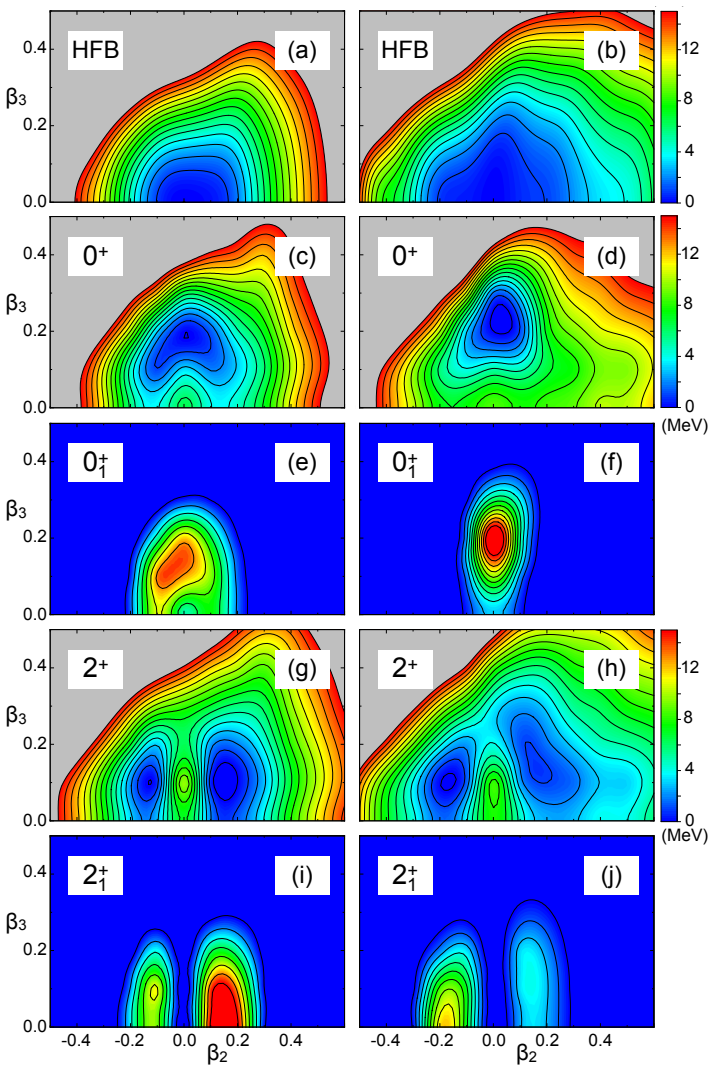
The load-bearing assumption is that zirconium-96's ground state really is octupole-deformed in the static sense, inferred by assuming that the ground state and the $3^{{-}}$ excited state are formed from the same intrinsically deformed shape; if that conversion is wrong, the triangular-flow excess needs another source.
Editorial extensions
If this is right
- If the central claim is correct, the ratio of triangular flow between the isobars serves as a quantitative measure of octupole deformation in zirconium-96.
- The measured elliptic-flow and multiplicity ratios can be used to extract the quadrupole deformation of ruthenium-96 and the difference in skin thickness between the two nuclei.
- A sound conclusion about the chiral magnetic effect requires nuclear-structure uncertainty quantification; without it, isobar ratios cannot be read as magnetic-field signals.
- Future isobar runs intended to probe magnetic-field effects should use a pair in which at least one nucleus is near-spherical, since the A=96 pair is particularly geometry-sensitive.
- Isobar ratio data can also constrain the short-range nucleon-nucleon repulsion parameter in initial-state models, which is poorly determined by existing global analyses.
Reading between the lines
- Editorial: if the report's method is sound, isobar ratios become a new high-energy handle on ground-state properties of isotopes that are hard to study at low energy, including nuclei relevant to neutrinoless double beta decay.
- Editorial: the octupole-deformation interpretation predicts specific centrality and multiplicity dependence of higher-order cumulant ratios, such as $v_3\{4\}/v_3\{2\}$, which future isobar data could test.
- Editorial: the Taylor-expansion identity suggests a general experimental strategy: measuring ratios of observables across isobar pairs cancels much of the unknown bulk dynamics, isolating geometry parameters; this could be applied to other isobar pairs beyond A=96.
- Editorial: the report leaves open whether the large correlation energy that beyond-mean-field methods attribute to octupole shapes is physical; if it is not, the value of $\beta_3$ extracted from flow will need reinterpretation.
Editorial analysis
A structured set of objections, weighed in public.
Referee Report
Summary. This paper is the report of the EMMI Rapid Reaction Task Force on isobar collisions at RHIC. It combines low-energy nuclear structure calculations (mean-field, beyond-mean-field, shell model, ab initio PGCM, lattice EFT prospects) with high-energy initial-state and full dynamical simulations (T RENTo, SMASH, AMPT, iEBE-VISHNU, Trajectum) to understand the STAR measurements of 96Ru+96Ru and 96Zr+96Zr collisions. The central claim is that the measured isobar ratios are naturally explained if the two nuclei have different intrinsic shapes, in particular a large octupole deformation in 96Zr, and that the corresponding differences qualitatively agree with low-energy nuclear information. A corollary is that nuclear-structure effects mask relative magnetic-field-driven variations, so a sound conclusion about the chiral magnetic effect requires proper uncertainty quantification of nuclear ground-state properties. The report also recommends using the 136Xe-136Ce pair for future CME searches and argues that isobar collisions can serve as a precision probe of nuclear shapes and skins.
Significance. If the central claim holds, this report establishes a genuinely cross-disciplinary result: high-energy isobar collision ratios become a quantitative imaging tool for nuclear ground-state shapes and surface properties, and CME conclusions become contingent on nuclear-structure uncertainties. The report is strengthened by the diversity of independent model comparisons, by its explicit engagement with low-energy experimental data, and by the unusually candid self-assessment of limitations, including the unresolved static-vs-vibrational octupole interpretation and the absence of uncertainty quantification. The Taylor-expansion approach and the correlated-sampling method of Sec. 4.6 are practically valuable methodological contributions. The significance is high for both the heavy-ion and nuclear-structure communities, provided the load-bearing octupole assumption is settled or explicitly downgraded.
major comments (3)
- [Sec. 3.5.2 and Sec. 3.2] The quantitative explanation of the v3 excess rests on converting B(E3; 3- -> 0+) = 42-53 W.u. into a static ground-state octupole deformation beta3 ~ 0.2-0.27, but the report itself states in Sec. 3.5.2 that this assumes the ground state and the 3-1 state share the same intrinsic state with static octupole deformation, and Sec. 3.1.2 notes that no alternating-parity band built on the ground state is observed. The independent many-body results in Tables 1-2 and in Secs. 3.4 and 3.6 give ground-state beta3 values of 0, 0.05-0.125, or at most 0.175, all below the 0.2-0.27 used in Table 3 and in the hydrodynamic/AMPT comparisons. Because the central v3 excess in Secs. 4 and 5 is generated by the large beta3(96Zr) input, the conclusion that the STAR observations are naturally explained by low-energy structure is contingent on an assumption that the report itself identifies as unresolved.
- [Sec. 5.5 (Table 9), Sec. 4.2 (Cases 3-6), Sec. 5.3] There is partial circularity in the validation chain: beta3(96Zr) = 0.2 is taken from Ref. [99], a value inferred from STAR isobar data, and is then used as input to simulations that reproduce those same STAR data. This applies to the Trajectum case-5 setup, the T RENTo default/cases 3-6, and the AMPT default. As a validation of the nuclear-structure explanation, the agreement with STAR data in these sections is therefore not independent. The paper should either repeat the comparisons with beta3 values derived solely from low-energy data (including the smaller values predicted by the calculations in Sec. 3), or explicitly demonstrate that the reproduced ratios are insensitive to the provenance of beta3; without this, the 'naturally explained' claim is weakened.
- [Secs. 4-6] No uncertainty bands are attached to the theoretical isobar ratios, despite the experimental precision of about 0.4% and the report's own recommendation in Sec. 6 that quantitative conclusions about the magnetic-field effects require uncertainty quantification. Propagated uncertainties on beta2, beta3, a, R0, dmin, and the transport parameters would be needed to assess whether the agreement with STAR data is statistically supported or merely a visual match. The final conclusions should either include such uncertainty quantification or explicitly downgrade the 'naturally explained' statement to a plausibility argument.
minor comments (4)
- [Sec. 4.3.3] In the sentence 'the largest effect is observed when we move from case 4 to vase 5', 'vase' should read 'case'.
- [Sec. 3.3.1 and Tables 3, 5, 9] The distinction between the Woods-Saxon deformation parameter beta_WS used in the simulation tables and the multipole moment beta_l0 of Eq. (20) should be applied consistently; for the values used here the difference is about 0.02 and should be accounted for when comparing high-energy extractions with low-energy results.
- [Sec. 5.3.2, Table 7] The row 'Case 1 and 5 difference' lists Delta_beta2^2 and Delta_beta3^2 alongside Delta R0 and Delta a, but Eq. (81) uses Delta beta_n^2 notation; the table would be clearer if it explicitly stated that the tabulated deformation differences are already squared.
- [Sec. 5.5.2 and Fig. 37] The quantity N^off_trk,raw and the meaning of the 'off' superscript are not defined in the text; a brief definition would help readers interpret the inverse-correction procedure.
Circularity Check
The v3-excess explanation recycles the fitted input: beta3(96Zr) ~ 0.2 enters every simulation from a STAR-data-based work (Ref. [99]) and is then found to 'reproduce' the same STAR v3 ratio; the low-energy B(E3) anchor is real but yields static beta3 only under an assumption the paper itself flags as unverified.
-
fitted input called prediction
[Sec. 1.2.1; Sec. 4.2 Table 3 (Case 6); Sec. 5.5.1 Table 9 (Case 5)]
"The v3 of 96Zr+96Zr collisions is indeed higher by about 10% in the central limit. This was not predicted by any kind of calculations, and points to an effect that is akin to the presence of a large octupole deformation in the ground state of 96Zr. … Case 5 mirrors case 4 but incorporates β2 and β3 values in 96Zr in accordance to Ref. [99]."
The ~10% central v3 excess is the paper's headline observation ('This was not predicted by any kind of calculations'), yet the explanation is generated by simulations initialized with β3 = 0.20–0.202 for 96Zr (TRENTo Table 3 Case 6; AMPT Table 7; Trajectum Table 9 Case 5), a value the report says is 'in accordance to Ref. [99]', and Sec. 3.5.2 itself describes Refs. [99, 123] as 'based on STAR data'. The STAR v3 ratio motivated the large-β3 hypothesis; the same STAR ratio is then 'reproduced' by simulations whose key input is that hypothesis. The reproduction is a consistency check of the fit rather than an independent prediction, so for the v3 channel the claim that isobar observations are 'naturally explained' by nuclear shape reduces, by construction, to the fitted input.
-
self citation load bearing
[Sec. 3.5.2 (MCSM results)]
"This is consistent with the large values of octupole deformation indicated in theoretical works [99, 123] based on STAR data [14]."
The MCSM result (B(E3) = 52 W.u., β3 = 0.27) is offered as low-energy support for the large octupole deformation used in the collision simulations, but the text explicitly locates the comparison value in 'theoretical works [99, 123] based on STAR data' — i.e., in analyses of the very isobar ratios the report aims to explain. The 'consistency' between β3 ≈ 0.27 and β3 ≈ 0.2 is therefore partly a comparison of STAR-derived quantities with STAR-derived quantities, and the simulation input (β3 ≈ 0.2, from Ref. [99]) is not independently verified outside this self-referential chain. Genuinely external evidence — the measured B(E3) = 42–53 W.u.
1 more flagged steps
-
self definitional
[Sec. 3.5.2; see also Sec. 3.2]
"The present value, 0.27, is obtained based on the assumption that the ground state and the 3−1 state are formed from the same intrinsic state with static octupole deformation. This assumption has to be further studied, as it is in contrast with the traditional picture of the octupole vibration assuming a spherical ground state."
To reach the 'qualitative agreement with low-energy data' claimed in the conclusions, the measured B(E3; 3−→0+) = 42–53 W.u. must be converted into a ground-state β3 ≈ 0.2–0.27. The paper admits this conversion is valid only 'based on the assumption that the ground state and the 3−1 state are formed from the same intrinsic state with static octupole deformation' — the very property the high-energy analysis invokes to explain the v3 excess. Sec. 3.2 records that no alternating-parity band is observed in 96Zr and that there is no simple experimental procedure to test equal deformations of the 0+ and 3− states; Sec. 3.5.1 notes the traditional picture is octupole vibration around a spherical ground state.
full rationale
The derivation chain largely decomposes into independent channels and one self-referential channel. The multiplicity and v2 ratios are driven by differences in surface diffuseness a and quadrupole deformation β2, anchored to low-energy measurements (B(E2; 2+→0+) = 2.3 vs 18.2 W.u.) and to EDF/mean-field predictions, and these explanations were in the literature before the 2021 data release (Shou et al., Xu et al.). The report also contains genuine forward predictions (longitudinal decorrelation r3, cumulant ratios, ac2{3}, [pT] ratios) and is internally honest: it flags the B(E3)→β3 conversion assumption in Sec. 3.5.2, reports that most mean-field functionals give β3 = 0 for 96Zr, and notes the absence of an alternating-parity band. The circularity is confined to the v3 channel, which is nevertheless the report's most emphasized novelty: the 'completely nontrivial' 10% central v3 excess was 'not predicted by any kind of calculations', yet every simulation that 'explains' it is initialized with β3(96Zr) = 0.20–0.202 taken 'in accordance to Ref. [99]', a work the text explicitly describes as 'based on STAR data'. Reproducing the data with an input derived from that same data is a fitted-input-called-prediction loop; the independent low-energy B(E3) strength is real evidence of octupole collectivity, but it fixes a static ground-state β3 only through the contested same-intrinsic-state assumption the paper itself says 'has to be further studied'. The overall conclusion — that isobar data are sensitive to nuclear shapes — survives, but the specific quantitative explanation of the v3 excess, and the claim of qualitative agreement with low-energy data for this channel, are partially circular.
Assumptions & free parameters
free parameters (7)
- beta2 (quadrupole deformation) of 96Ru =
0.12 to 0.16 in different cases
- beta3 (octupole deformation) of 96Zr =
0.2 (Ref [99]) or 0.27 (MCSM)
- a (surface diffuseness) for 96Ru and 96Zr =
0.46 fm and 0.52 fm
- R0 (half-density radius) for 96Ru and 96Zr =
5.09 fm and 5.02 fm
- gamma (triaxiality) =
0 to 30 degrees
- dmin (minimum inter-nucleon distance) =
0 to 1.0 fm
- hydrodynamic transport parameters (eta/s, tau_FS) =
e.g., eta/s=0.05, tau_FS=1 fm/c
assumptions (5)
- domain assumption Instantaneous snapshot of nucleon positions from ground-state wavefunction (position-space factorization)
- domain assumption Woods-Saxon form with spherical-harmonic expansion describes the nuclear density for collision simulations
- domain assumption Linear (or near-linear) mapping between initial eccentricities and final flow harmonics
- domain assumption EDF ground-state shapes are reliable inputs for these transitional nuclei
- domain assumption B(E3) strength can be interpreted as static octupole deformation assuming identical intrinsic states for 0+ and 3-
Cite this review
Pith. "Pith review of Nuclear Physics Confronts Relativistic Collisions Of Isobars." pith.science (2026). https://pith.science/paper/KBBOVWOW
@misc{pith2026250701454,
  author       = {Pith},
  title        = {Pith review of: Nuclear Physics Confronts Relativistic Collisions Of Isobars},
  year         = {2026},
  howpublished = {\url{https://pith.science/paper/KBBOVWOW}},
  note         = {Machine review of arXiv:2507.01454}
}
abstract
High-energy collisions involving the $A=96$ isobars $^{96}$Zr and $^{96}$Ru have been performed in 2018 at Brookhaven National Laboratory's Relativistic Heavy Ion Collider (RHIC) as a means to search for the chiral magnetic effect in QCD. This would manifest itself as specific deviations from unity in the ratio of observables taken between $^{96}$Zr+$^{96}$Zr and $^{96}$Ru+$^{96}$Ru collisions. Measurements of such ratios (released at the end of 2021) indeed reveal deviations from unity, but these are primarily caused by the two collided isobars having different radial profiles and intrinsic deformations. To make progress in understanding RHIC data, nuclear physicists across the energy spectrum gathered in Heidelberg in 2022 as part of an EMMI Rapid Reaction Task Force (RRTF) to address the following question. Does the combined effort of low-energy nuclear structure physics and high-energy heavy-ion physics enable us to understand the observations made in isobar collisions at RHIC?
Figures


Figures from the paper (36 more)




Forward citations
Cited by 4 Pith papers
-
Evidence of nuclear geometry-driven anisotropic flow in OO and Ne$-$Ne collisions at $\mathbf{\sqrt{{\textit s}_{\rm\mathbf {NN}}}}$ = 5.36 TeV
First measurements of elliptic and triangular flow in OO and Ne-Ne collisions show geometry-driven collectivity consistent with hydrodynamic predictions.
-
Impacts of isolated nucleon-nucleon correlations in relativistic $^{16}$O+$^{16}$O collisions
Applying rejection sampling to 16O configurations constrained by a Fermi density and a two-nucleon distance distribution reproduces the initial-state eccentricities and energy fluctuations of NLEFT and VMC ab-initio m...
-
A Resummed Hydrodynamic Description of Relativistic Heavy-ion Collisions
A resummed hydrodynamic scheme with tunable caps on shear and bulk viscous stress is introduced; it reduces to standard second-order hydrodynamics for small stresses and is used to quantify flow-observable uncertainti...
-
Scaling approach to rigid and soft nuclear deformation through flow fluctuations in high-energy nuclear collisions
Triangular flow four-particle cumulants scale linearly with the fourth moment of octupole deformation, allowing the mean and variance of 238U octupole deformation to be extracted separately.
Reference graph
Works this paper leans on
-
[99]
C. Zhang and J. Jia, “Evidence of Quadrupole and Octupole Deformations in 96Zr+96Zr and 96Ru+96Ru Collisions at Ultrarelativistic Energies”, Phys. Rev. Lett. 128 (2022), 022301, doi: 10.1103/PhysRevLett.128.022301, arXiv: 2109.01631 [nucl-th]
arXiv 2022
-
[1]
Possibility of spontaneous parity violation in hot QCD
D. Kharzeev, R. D. Pisarski, and Michel H. G. Tytgat, “Possibility of spontaneous parity violation in hot QCD”, Phys. Rev. Lett. 81 (1998), 512–515, doi: 10.1103/ PhysRevLett.81.512, arXiv: hep-ph/9804221
arXiv 1998
-
[2]
Pionic measures of parity and CP violation in high- energy nuclear collisions
D. Kharzeev and R. D. Pisarski, “Pionic measures of parity and CP violation in high- energy nuclear collisions”, Phys. Rev. D 61 (2000), 111901, doi: 10.1103/PhysRevD. 61.111901, arXiv: hep-ph/9906401
arXiv 2000
-
[3]
Parity violation in hot QCD: Why it can happen, and how to look for it
D. Kharzeev, “Parity violation in hot QCD: Why it can happen, and how to look for it”, Phys. Lett. B 633 (2006), 260–264, doi: 10.1016/j.physletb.2005.11.075 , arXiv: hep-ph/0406125
arXiv 2006
-
[4]
D. E. Kharzeev, L. D. McLerran, and H. J. Warringa, “The Effects of topological charge change in heavy ion collisions: ’Event by event P and CP violation’”, Nucl. Phys. A 803 (2008), 227–253, doi: 10.1016/j.nuclphysa.2008.02.298 , arXiv: 0711.0950 [hep-ph]
arXiv 2008
-
[5]
K. Fukushima, D. E. Kharzeev, and H. J. Warringa, “The Chiral Magnetic Effect”, Phys. Rev. D 78 (2008), 074033, doi: 10.1103/PhysRevD.78.074033, arXiv: 0808. 3382 [hep-ph]
-
[6]
Chiral magnetic and vortical effects in high-energy nuclear collisions—A status report
D. E. Kharzeev et al. , “Chiral magnetic and vortical effects in high-energy nuclear collisions—A status report”, Prog. Part. Nucl. Phys. 88 (2016), 1–28, doi: 10.1016/ j.ppnp.2016.01.001, arXiv: 1511.04050 [hep-ph]
arXiv 2016
-
[7]
Chiral magnetic effect reveals the topology of gauge fields in heavy-ion collisions
D. E. Kharzeev and J. Liao, “Chiral magnetic effect reveals the topology of gauge fields in heavy-ion collisions”, Nature Rev. Phys. 3 (2021), 55–63, doi: 10.1038/s42254- 020-00254-6, arXiv: 2102.06623 [hep-ph]
arXiv 2021
Show all 300 references
-
[8]
Electromagnetic fields and anomalous transports in heavy-ion collisions — A pedagogical review
X.G. Huang, “Electromagnetic fields and anomalous transports in heavy-ion collisions — A pedagogical review”, Rept. Prog. Phys. 79 (2016), 076302, doi: 10.1088/0034- 4885/79/7/076302, arXiv: 1509.04073 [nucl-th]
2016 arXiv
-
[9]
Chiral Magnetic Effects in Nuclear Collisions
W. Li and G. Wang, “Chiral Magnetic Effects in Nuclear Collisions”, Ann. Rev. Nucl. Part. Sci. 70 (2020), 293–321, doi: 10.1146/annurev-nucl-030220-065203 , arXiv: 2002.10397 [nucl-ex]
2020 arXiv
-
[10]
Collective flow and viscosity in relativistic heavy-ion collisions
U. Heinz and R. Snellings, “Collective flow and viscosity in relativistic heavy-ion collisions”, Ann. Rev. Nucl. Part. Sci. 63 (2013), 123–151, doi: 10.1146/annurev- nucl-102212-170540, arXiv: 1301.2826 [nucl-th]
2013 arXiv
-
[11]
Measures of azimuthal anisotropy in high-energy collisions
J.Y. Ollitrault, “Measures of azimuthal anisotropy in high-energy collisions”, Eur. Phys. J. A 59 (2023), 236, doi: 10 . 1140 / epja / s10050 - 023 - 01157 - 7, arXiv: 2308.11674 [nucl-ex]
2023 arXiv
-
[12]
Parity violation in hot QCD: How to detect it
S. A. Voloshin, “Parity violation in hot QCD: How to detect it”, Phys. Rev. C 70 (2004), 057901, doi: 10.1103/PhysRevC.70.057901, arXiv: hep-ph/0406311. 90
2004 arXiv
-
[13]
Effects of Momentum Conservation and Flow on Angular Correlations at RHIC
S. Pratt, S. Schlichting, and S. Gavin, “Effects of Momentum Conservation and Flow on Angular Correlations at RHIC”, Phys. Rev. C 84 (2011), 024909, doi: 10.1103/ PhysRevC.84.024909, arXiv: 1011.6053 [nucl-th]
2011 arXiv
-
[14]
Search for the chiral magnetic effect with isobar collisions at√sN N=200 GeV by the STAR Collaboration at the BNL Relativistic Heavy Ion Collider
M. Abdallah et al. , “Search for the chiral magnetic effect with isobar collisions at√sN N=200 GeV by the STAR Collaboration at the BNL Relativistic Heavy Ion Collider”, Phys. Rev. C 105 (2022), 014901, doi: 10.1103/PhysRevC.105.014901 , arXiv: 2109.00131 [nucl-ex]
2022
-
[15]
Toward the discovery of matter creation with neutrinoless ββ decay
M. Agostini et al. , “Toward the discovery of matter creation with neutrinoless ββ decay”, Rev. Mod. Phys. 95 (2023), 025002, doi: 10.1103/RevModPhys.95.025002 , arXiv: 2202.01787 [hep-ex]
2023 arXiv
-
[16]
Beyond-mean-field approaches for nuclear neutrinoless double beta decay in the standard mechanism
J. M. Yao et al., “Beyond-mean-field approaches for nuclear neutrinoless double beta decay in the standard mechanism”, Prog. Part. Nucl. Phys. 126 (2022), 103965, doi: 10.1016/j.ppnp.2022.103965, arXiv: 2111.15543 [nucl-th]
2022
-
[17]
Testing the Chiral Magnetic Effect with Central U+U collisions
S. A. Voloshin, “Testing the Chiral Magnetic Effect with Central U+U collisions”, Phys. Rev. Lett. 105 (2010), 172301, doi: 10.1103/PhysRevLett.105.172301, arXiv: 1006.1020 [nucl-th]
2010 arXiv
-
[18]
Initial State in RHIC and Ground-State Properties of Nuclei
P. Filip, “Initial State in RHIC and Ground-State Properties of Nuclei”, J. Phys. Conf. Ser. 446 (2013), 012033, doi: 10.1088/1742-6596/446/1/012033
2013 doi
-
[19]
Tables of E2 Transition Probabilities from the first 2+ States in Even-Even Nuclei
B. Pritychenko et al., “Tables of E2 Transition Probabilities from the first 2+ States in Even-Even Nuclei”, Atom. Data Nucl. Data Tabl. 107 (2016), [Erratum: Atom.Data Nucl.Data Tabl. 114, 371–374 (2017)], 1–139, doi: 10.1016/j.adt.2015.10.001 , arXiv: 1312.5975 [nucl-th]
2016 arXiv
-
[20]
Nuclear ground-state masses and deformations: FRDM(2012)
P. M¨ oller et al. , “Nuclear ground-state masses and deformations: FRDM(2012)”, Atom. Data Nucl. Data Tabl. 109-110 (2016), 1–204, doi: 10.1016/j.adt.2015. 10.002, arXiv: 1508.06294 [nucl-th]
2012 arXiv
-
[21]
Parameterization of Deformed Nuclei for Glauber Modeling in Relativistic Heavy Ion Collisions
Q. Y. Shou et al. , “Parameterization of Deformed Nuclei for Glauber Modeling in Relativistic Heavy Ion Collisions”, Phys. Lett. B 749 (2015), 215–220, doi: 10.1016/ j.physletb.2015.07.078, arXiv: 1409.8375 [nucl-th]
2015 arXiv
-
[22]
Azimuthal anisotropy in U+U and Au+Au collisions at RHIC
L. Adamczyk et al., “Azimuthal anisotropy in U+U and Au+Au collisions at RHIC”, Phys. Rev. Lett. 115 (2015), 222301, doi: 10.1103/PhysRevLett.115.222301, arXiv: 1505.07812 [nucl-ex]
2015 arXiv
-
[23]
A Multi-phase transport model for relativistic heavy ion collisions
Z.W. Lin et al., “A Multi-phase transport model for relativistic heavy ion collisions”, Phys. Rev. C 72 (2005), 064901, doi: 10.1103/PhysRevC.72.064901, arXiv: nucl- th/0411110
2005
-
[24]
Test the chiral magnetic effect with isobaric collisions
W.T. Deng et al. , “Test the chiral magnetic effect with isobaric collisions”, Phys. Rev. C 94 (2016), 041901, doi: 10.1103/PhysRevC.94.041901, arXiv: 1607.04697 [nucl-th]
2016 arXiv
-
[25]
Importance of isobar density distributions on the chiral magnetic effect search
H.J. Xu et al. , “Importance of isobar density distributions on the chiral magnetic effect search”, Phys. Rev. Lett. 121 (2018), 022301, doi: 10 . 1103 / PhysRevLett . 121.022301, arXiv: 1710.03086 [nucl-th]. 91
2018 arXiv
-
[26]
Multiphase transport model predictions of isobaric collisions with nuclear structure from density functional theory
H. Li et al., “Multiphase transport model predictions of isobaric collisions with nuclear structure from density functional theory”, Phys. Rev. C 98 (2018), 054907, doi: 10.1103/PhysRevC.98.054907, arXiv: 1808.06711 [nucl-th]
2018 arXiv
-
[27]
Manipulating strong electromagnetic fields with the aver- age transverse momentum of relativistic nuclear collisions
G. Giacalone and C. Shen, “Manipulating strong electromagnetic fields with the aver- age transverse momentum of relativistic nuclear collisions”,Eur. Phys. J. A 57 (2021), 230, doi: 10.1140/epja/s10050-021-00545-1 , arXiv: 2104.01890 [nucl-th]
2021 arXiv
-
[28]
Influence of the neutron-skin effect on nuclear isobar colli- sions at energies available at the BNL Relativistic Heavy Ion Collider
J. Hammelmann et al. , “Influence of the neutron-skin effect on nuclear isobar colli- sions at energies available at the BNL Relativistic Heavy Ion Collider”, Phys. Rev. C 101 (2020), 061901, doi: 10.1103/PhysRevC.101.061901 , arXiv: 1908.10231 [nucl-th]
2020 arXiv
-
[29]
Probing the neutron skin with ultrarelativistic isobaric collisions
H. Li et al., “Probing the neutron skin with ultrarelativistic isobaric collisions”, Phys. Rev. Lett. 125 (2020), 222301, doi: 10 . 1103 / PhysRevLett . 125 . 222301, arXiv: 1910.06170 [nucl-th]
2020 arXiv
-
[30]
Revised B(E3) transition rate and structure of the 3 − level in 96Zr
L.W. Iskra et al. , “Revised B(E3) transition rate and structure of the 3 − level in 96Zr”, Physics Letters B 788 (2019), 396–400, doi: https://doi.org/10.1016/j. physletb.2018.10.069
2019 doi
-
[31]
Status of the chiral magnetic effect and collisions of isobars
V. Koch et al. , “Status of the chiral magnetic effect and collisions of isobars”, Chin. Phys. C 41 (2017), 072001, doi: 10.1088/1674-1137/41/7/072001 , arXiv: 1608. 00982 [nucl-th]
2017 doi
-
[32]
First meeting of the EMMI RRTF, https: // indico. gsi. de/ event/ 14430/
-
[33]
Second meeting of the EMMI RRTF, https: // indico. gsi. de/ event/ 15627/
-
[34]
System size, energy, pseudorapidity, and centrality dependence of elliptic flow
B. Alver et al. , “System size, energy, pseudorapidity, and centrality dependence of elliptic flow”, Phys. Rev. Lett. 98 (2007), 242302, doi: 10.1103/PhysRevLett.98. 242302, arXiv: nucl-ex/0610037
2007 arXiv
-
[35]
Glauber modeling in high energy nuclear collisions
M. L. Miller et al. , “Glauber modeling in high energy nuclear collisions”, Ann. Rev. Nucl. Part. Sci. 57 (2007), 205–243, doi: 10 . 1146 / annurev . nucl . 57 . 090506 . 123020, arXiv: nucl-ex/0701025
2007 arXiv
-
[36]
Improved version of the PHOBOS Glauber Monte Carlo
C. Loizides, J. Nagle, and P. Steinberg, “Improved version of the PHOBOS Glauber Monte Carlo”, SoftwareX 1-2 (2015), 13–18, doi: 10.1016/j.softx.2015.05.001 , arXiv: 1408.2549 [nucl-ex]
2015 arXiv
-
[37]
Progress in the Glauber Model at Collider Energies
D. d’Enterria and C. Loizides, “Progress in the Glauber Model at Collider Energies”, Ann. Rev. Nucl. Part. Sci. 71 (2021), 315–344, doi: 10 . 1146 / annurev - nucl - 102419-060007, arXiv: 2011.14909 [hep-ph]
2021 arXiv
-
[38]
Collision geometry fluctuations and triangular flow in heavy- ion collisions
B. Alver and G. Roland, “Collision geometry fluctuations and triangular flow in heavy- ion collisions”, Phys. Rev. C 81 (2010), [Erratum: Phys.Rev.C 82, 039903 (2010)], 054905, doi: 10.1103/PhysRevC.82.039903, arXiv: 1003.0194 [nucl-th]
2010 arXiv
-
[39]
Initial state and thermalization in the Color Glass Condensate framework
F. Gelis, “Initial state and thermalization in the Color Glass Condensate framework”, Int. J. Mod. Phys. E 24 (2015), 1530008, doi: 10.1142/S0218301315300088, arXiv: 1508.07974 [hep-ph]. 92
2015 arXiv
-
[40]
Time-dependent density-functional description of nuclear dy- namics
T. Nakatsukasa et al., “Time-dependent density-functional description of nuclear dy- namics”, Rev. Mod. Phys. 88 (2016), 045004, doi: 10.1103/RevModPhys.88.045004
2016 doi
-
[41]
Many-body correlations for nuclear physics across scales: from nuclei to quark-gluon plasmas to hadron distributions
G. Giacalone, “Many-body correlations for nuclear physics across scales: from nuclei to quark-gluon plasmas to hadron distributions”, Eur. Phys. J. A 59 (2023), 297, doi: 10.1140/epja/s10050-023-01200-7 , arXiv: 2305.19843 [nucl-th]
2023 arXiv
-
[42]
Quantum gas microscopy for single atom and spin detec- tion
C. Gross and W. S. Bakr, “Quantum gas microscopy for single atom and spin detec- tion”, Nature Physics 12 (Dec. 2021), 1316–1323, doi: 10.1038/s41567-021-01370- 5, arXiv: 2010.15407 [cond-mat.quant-gas]
2021 arXiv
-
[43]
A Glimpse at the Quantum Behavior of a Uniform Gas
M. Parish, “A Glimpse at the Quantum Behavior of a Uniform Gas” . url: https: //physics.aps.org/articles/v18/89
-
[44]
Emergent interaction-driven elliptic flow of few fermionic atoms
S. Brandstetter et al. , “Emergent interaction-driven elliptic flow of few fermionic atoms”, Nature Phys. 21 (2025), 52–56, doi: 10.1038/s41567-024-02705-8 , arXiv: 2308.09699 [cond-mat.quant-gas]
2025 arXiv
-
[45]
In Situ Imaging of the Thermal de Broglie Wavelength in an Ultracold Bose Gas
J. Xiang et al., “In Situ Imaging of the Thermal de Broglie Wavelength in an Ultracold Bose Gas”, Phys. Rev. Lett. 134 (2025), 183401, doi: 10.1103/PhysRevLett.134. 183401, arXiv: 2411.08779 [cond-mat.quant-gas]
2025 arXiv
-
[46]
Measuring Pair Correlations in Bose and Fermi Gases via Atom- Resolved Microscopy
R. Yao et al. , “Measuring Pair Correlations in Bose and Fermi Gases via Atom- Resolved Microscopy”, Phys. Rev. Lett. 134 (2025), 183402, doi: 10.1103/PhysRevLett. 134.183402, arXiv: 2411.08780 [cond-mat.quant-gas]
2025
-
[47]
Quantum Gas Microscopy of Fermions in the Continuum
T. de Jongh et al., “Quantum Gas Microscopy of Fermions in the Continuum”, Phys. Rev. Lett. 134 (2025), 183403, doi: 10 . 1103 / PhysRevLett . 134 . 183403, arXiv: 2411.08776 [cond-mat.quant-gas]
2025
-
[48]
Triangularity and Dipole Asymmetry in Heavy Ion Colli- sions
D. Teaney and L. Yan, “Triangularity and Dipole Asymmetry in Heavy Ion Colli- sions”, Phys. Rev. C 83 (2011), 064904, doi: 10.1103/PhysRevC.83.064904, arXiv: 1010.1876 [nucl-th]
2011 arXiv
-
[49]
Initial energy-momentum to final flow: A general framework for heavy-ion collisions
J. Sousa, J. Noronha, and M. Luzum, “Initial energy-momentum to final flow: A general framework for heavy-ion collisions”, Phys. Rev. C 110 (2024), 044909, doi: 10.1103/PhysRevC.110.044909, arXiv: 2405.13600 [nucl-th]
2024 arXiv
-
[50]
Continuous description of fluctu- ating eccentricities
J.P. Blaizot, W. Broniowski, and J.Y. Ollitrault, “Continuous description of fluctu- ating eccentricities”, Phys. Lett. B 738 (2014), 166–171, doi: 10.1016/j.physletb. 2014.09.028, arXiv: 1405.3572 [nucl-th]
2014 arXiv
-
[51]
Non-Gaussian eccentricity fluctua- tions
H. Gr¨ onqvist, J.P. Blaizot, and J.Y. Ollitrault, “Non-Gaussian eccentricity fluctua- tions”, Phys. Rev. C 94 (2016), 034905, doi: 10.1103/PhysRevC.94.034905, arXiv: 1604.07230 [nucl-th]
2016 arXiv
-
[52]
Revealing the harmonic structure of nuclear two-body correlations in high-energy heavy-ion collisions
T. Duguet et al., “Revealing the harmonic structure of nuclear two-body correlations in high-energy heavy-ion collisions” (2025), arXiv: 2504.02481 [nucl-th]
2025 arXiv
-
[53]
History of the concept of nuclear shape
D. Verney, “History of the concept of nuclear shape”, Eur. Phys. J. A 61 (2025), 82, doi: 10.1140/epja/s10050-025-01545-1 . 93
2025 doi
-
[54]
Self-consistent mean-field models for nuclear structure
M. Bender, P.H. Heenen, and P.G. Reinhard, “Self-consistent mean-field models for nuclear structure”, Rev. Mod. Phys. 75 (2003), 121–180, doi: 10.1103/RevModPhys. 75.121
2003 doi
-
[55]
Constraining the quadrupole deformation of atomic nuclei with rela- tivistic nuclear collisions
G. Giacalone, “Constraining the quadrupole deformation of atomic nuclei with rela- tivistic nuclear collisions”,Phys. Rev. C 102 (2020), 024901, doi: 10.1103/PhysRevC. 102.024901, arXiv: 2004.14463 [nucl-th]
2020 arXiv
-
[56]
Angular structure of many-body correlations in atomic nuclei: From nuclear deformations to diffractive vector meson production in γA collisions
J-P. Blaizot and G. Giacalone, “Angular structure of many-body correlations in atomic nuclei: From nuclear deformations to diffractive vector meson production in γA collisions” (2025), arXiv: 2504.15421 [nucl-th]
2025 arXiv
-
[57]
Shape of atomic nuclei in heavy ion collisions
J. Jia, “Shape of atomic nuclei in heavy ion collisions”, Phys. Rev. C 105 (2022), 014905, doi: 10.1103/PhysRevC.105.014905, arXiv: 2106.08768 [nucl-th]
2022 arXiv
-
[58]
High-energy collisions of strongly deformed nuclei: An Old idea with a new twist
E. V. Shuryak, “High-energy collisions of strongly deformed nuclei: An Old idea with a new twist”, Phys. Rev. C 61 (2000), 034905, doi: 10.1103/PhysRevC.61.034905, arXiv: nucl-th/9906062
2000 arXiv
-
[59]
Anisotropic transverse flow and the quark hadron phase transition
P. F. Kolb, J. Sollfrank, and U. W. Heinz, “Anisotropic transverse flow and the quark hadron phase transition”, Phys. Rev. C 62 (2000), 054909, doi: 10.1103/PhysRevC. 62.054909, arXiv: hep-ph/0006129
2000 arXiv
-
[60]
Evidence of Hexadecapole Deformation in Uranium-238 at the Relativistic Heavy Ion Collider
W. Ryssens et al. , “Evidence of Hexadecapole Deformation in Uranium-238 at the Relativistic Heavy Ion Collider”, Phys. Rev. Lett. 130 (2023), 212302, doi: 10.1103/ PhysRevLett.130.212302, arXiv: 2302.13617 [nucl-th]
2023 arXiv
-
[61]
Impact of the radial profile of atomic nuclei on observ- ables in high-energy collisions
Z. Yan, J. Xu, and J. Jia, “Impact of the radial profile of atomic nuclei on observ- ables in high-energy collisions”, Phys. Rev. C 110 (2024), L041901, doi: 10.1103/ PhysRevC.110.L041901, arXiv: 2405.18318 [nucl-th]
2024 arXiv
-
[62]
Bohr and B
A. Bohr and B. R. Mottelson, Nuclear Structure. Vol. 2. Benjamin, Reading, Mas- sachusetts, 1975
1975
-
[63]
Intrinsic Quadrupole Moments and Shapes of Nuclear Ground States and Excited States
K. Kumar, “Intrinsic Quadrupole Moments and Shapes of Nuclear Ground States and Excited States”, Phys. Rev. Lett. 28 (1972), 249, doi: 10.1103/PhysRevLett. 28.249
1972 doi
-
[64]
Nuclear Shapes Studied by Coulomb excitation
D. Cline, “Nuclear Shapes Studied by Coulomb excitation”, Ann. Rev. Nucl. Part. Sci. 36 (1986), 683, doi: 10.1146/annurev.ns.36.120186.003343
1986
-
[65]
url: https://www.nndc.bnl.gov/ensdf/
Evaluated Nuclear Structure Data File . url: https://www.nndc.bnl.gov/ensdf/
-
[66]
Competition between proton and neutron excitations in 96Zr
G. Kumbartzki et al., “Competition between proton and neutron excitations in 96Zr”, Phys. Lett. B 562 (2003), 193, doi: https://doi.org/10.1016/S0370-2693(03) 00608-7
2003 doi
-
[67]
Level lifetimes in the stable Zr nuclei: Effects of chemical proper- ties in Doppler-shift measurements
E. E. Peters et al., “Level lifetimes in the stable Zr nuclei: Effects of chemical proper- ties in Doppler-shift measurements”, Phys. Rev. C 88 (2013), 024317, doi: 10.1103/ PhysRevC.88.024317
2013
-
[68]
Coulomb Excitation of the First 2 + Levels of Zr90 and Zr96
Y. P. Gangrskii and I. K. Lemberg, “Coulomb Excitation of the First 2 + Levels of Zr90 and Zr96”, Yadern. Fiz. (1965), 1025. 94
1965
-
[69]
Lifetime of the 3 − 1 state and octupole collectivity in 96Zr
D. J. Horen et al., “Lifetime of the 3 − 1 state and octupole collectivity in 96Zr”, Phys. Rev. C 48 (1993), R2131, doi: 10.1103/PhysRevC.48.R2131
1993 doi
-
[70]
First Measurement of Collectivity of Coexisting Shapes Based on Type II Shell Evolution: The Case of 96Zr
C. Kremer et al. , “First Measurement of Collectivity of Coexisting Shapes Based on Type II Shell Evolution: The Case of 96Zr”, Phys. Rev. Lett. 117 (2016), 172503, doi: 10.1103/PhysRevLett.117.172503
2016 doi
-
[71]
Lifetime of the first excited state in 96Zr
D. Burch et al., “Lifetime of the first excited state in 96Zr”, Phys. Lett. B 40 (1972), 357, doi: https://doi.org/10.1016/0370-2693(72)90819-2
1972 doi
-
[72]
Studies of 95Ru and 94Ru with the 96Ru (p, d) and ( p, t) reactions
J.B. Ball, “Studies of 95Ru and 94Ru with the 96Ru (p, d) and ( p, t) reactions”, Nucl. Phys. A 160 (1971), 225, doi: https://doi.org/10.1016/0375-9474(71)90127-8
1971 doi
-
[73]
States in 97,101Ru observed in the reactions 96,100Ru (d, p)
C.L. Hollas et al., “States in 97,101Ru observed in the reactions 96,100Ru (d, p)”, Nucl. Phys. A 276 (1977), 1, doi: https://doi.org/10.1016/0375-9474(77)90155-5
1977 doi
-
[74]
Quadrupole moments of the first excited states of 96Ru, 98Ru, 100Ru, 102Ru, and 104Ru
S. Landsberger et al., “Quadrupole moments of the first excited states of 96Ru, 98Ru, 100Ru, 102Ru, and 104Ru”, Phys. Rev. C 21 (1980), 588, doi: 10.1103/PhysRevC. 21.588
1980 doi
-
[75]
Octupole deformation in the ground states of even-even nuclei: a global analysis within the covariant density functional theory
S. E. Agbemava, A. V. Afanasjev, and P. Ring, “Octupole deformation in the ground states of even-even nuclei: a global analysis within the covariant density functional theory”, Phys. Rev. C 93 (2016), 044304, doi: 10 . 1103 / PhysRevC . 93 . 044304, arXiv: 1603.03414 [nucl-th]
2016 arXiv
-
[76]
Landscape of pear-shaped even-even nuclei
Y. Cao et al., “Landscape of pear-shaped even-even nuclei”, Phys. Rev. C 102 (2020), 024311, doi: 10.1103/PhysRevC.102.024311, arXiv: 2004.01319 [nucl-th]
2020 arXiv
-
[77]
Octupole deformation in the nuclear chart based on the 3D Skyrme Hartree-Fock plus BCS model
S. Ebata and T. Nakatsukasa, “Octupole deformation in the nuclear chart based on the 3D Skyrme Hartree-Fock plus BCS model”, Phys. Scr. 92 (2017), 064005, doi: 10.1088/1402-4896/aa6c4c, arXiv: 1707.07416 [nucl-th]
2017 arXiv
-
[78]
Global systematics of octupole excitations in even- even nuclei
L. M. Robledo and G. F. Bertsch, “Global systematics of octupole excitations in even- even nuclei”, Phys. Rev. C 84 (2011), 054302, doi: 10.1103/PhysRevC.84.054302
2011 doi
-
[79]
Intrinsic reflection asymmetry in atomic nuclei
P. A. Butler and W. Nazarewicz, “Intrinsic reflection asymmetry in atomic nuclei”, Rev. Mod. Phys. 68 (1996), 349, doi: 10.1103/RevModPhys.68.349
1996 doi
-
[80]
Properties of nuclei in the nobelium region studied within the covariant, Skyrme, and Gogny energy density functionals
J. Dobaczewski et al., “Properties of nuclei in the nobelium region studied within the covariant, Skyrme, and Gogny energy density functionals”,Nucl. Phys. A 944 (2015), 388, doi: 10.1016/j.nuclphysa.2015.07.015, arXiv: 1504.03245 [nucl-th]
2015 arXiv
-
[81]
Deformed one-quasiparticle states in covari- ant density functional theory
A. V. Afanasjev and S. Shawaqfeh, “Deformed one-quasiparticle states in covari- ant density functional theory”, Phys. Lett. B 706 (2011), 177, doi: 10 . 1016 / j . physletb.2011.11.007, arXiv: 1205.2135 [nucl-th]
2011 arXiv
-
[82]
Abriola and A
D. Abriola and A. A. Sonzogni, Nucl. Data Sheets 109 (2008), 2501
2008
-
[83]
Octupole vibrations in nuclei
S. G. Rohozinski, “Octupole vibrations in nuclei”, Reports on Progress in Physics 51 (1988), 541, doi: 10.1088/0034-4885/51/4/002. 95
1988 doi
-
[84]
Anatomy of octupole correlations in96Zr with a symmetry-restored multidimensionally-constrained covariant density functional theory
Y.-T. Rong et al., “Anatomy of octupole correlations in96Zr with a symmetry-restored multidimensionally-constrained covariant density functional theory”, Phys. Lett. B 840 (2023), 137896, doi: 10.1016/j.physletb.2023.137896 , arXiv: 2201.02114 [nucl-th]
2023
-
[85]
Charge radii in covariant density func- tional theory: A global view
U. C. Perera, A. V. Afanasjev, and P. Ring, “Charge radii in covariant density func- tional theory: A global view”, Phys. Rev. C 104 (2021), 064313, doi: 10 . 1103 / PhysRevC.104.064313
2021
-
[86]
Laser spectroscopy for nuclear structure physics
P. Campbell, I. Moore, and M. Pearson, “Laser spectroscopy for nuclear structure physics”, Prog. Part. Nucl. Phys. 86 (2016), 127, doi: https://doi.org/10.1016/ j.ppnp.2015.09.003
2016
-
[87]
Laser spectroscopy of cooled Zirconium fission fragments
P. Campbell et al., “Laser spectroscopy of cooled Zirconium fission fragments”, Phys. Rev. Lett. 89 (2002), 082501, doi: 10.1103/PhysRevLett.89.082501
2002 doi
-
[88]
A Skyrme Parametrization from Subnuclear to Neutron Star Densities
E. Chabanat et al. , “A Skyrme Parametrization from Subnuclear to Neutron Star Densities”, Nuclear Physics A 627 (1997), 710–746, doi: 10.1016/S0375-9474(97) 00596-4
1997 doi
-
[89]
A Skyrme Parametrization from Subnuclear to Neutron Star Densities Part II. Nuclei Far from Stabilities
E. Chabanat et al. , “A Skyrme Parametrization from Subnuclear to Neutron Star Densities Part II. Nuclei Far from Stabilities”, Nuclear Physics A 635 (1998), 231– 256, doi: 10.1016/S0375-9474(98)00180-8
1998 doi
-
[90]
Erratum to Ref. [88]
E. Chabanat et al., “Erratum to Ref. [88]”, Nuclear Physics A 643 (1998), 441, doi: 10.1016/S0375-9474(98)00570-3
1998 doi
-
[91]
Variations on a Theme by Skyrme: A Systematic Study of Ad- justments of Model Parameters
P. Kl¨ upfel et al. , “Variations on a Theme by Skyrme: A Systematic Study of Ad- justments of Model Parameters”, Phys. Rev. C 79 (2009), 034310, doi: 10.1103/ PhysRevC.79.034310, arXiv: 0804.3385 [nucl-th]
2009 arXiv
-
[92]
Constraining the Surface Properties of Effective Skyrme Interac- tions
R. Jodon et al. , “Constraining the Surface Properties of Effective Skyrme Interac- tions”, Phys. Rev. C 94 (2016), 024335, doi: 10.1103/PhysRevC.94.024335, arXiv: 1606.01410 [nucl-th]
2016 arXiv
-
[93]
Skyrme-Hartree-Fock-Bogoliubov Mass Models on a 3D Mesh: Effect of Triaxial Shape
G. Scamps et al. , “Skyrme-Hartree-Fock-Bogoliubov Mass Models on a 3D Mesh: Effect of Triaxial Shape”, Eur. Phys. J. A 57 (2021), 333, doi: 10 . 1140 / epja / s10050-021-00642-1 , arXiv: 2011.07904 [nucl-th]
2021 arXiv
-
[94]
Skyrme–Hartree–Fock–Bogoliubov Mass Models on a 3D Mesh: II. Time-reversal Symmetry Breaking
W. Ryssens et al. , “Skyrme–Hartree–Fock–Bogoliubov Mass Models on a 3D Mesh: II. Time-reversal Symmetry Breaking”, Eur. Phys. J. A 58 (2022), 246, doi: 10 . 1140/epja/s10050-022-00894-5 , arXiv: 2208.06455 [nucl-th]
2022 arXiv
-
[95]
Skyrme-Hartree-Fock-Bogoliubov mass models on a 3D mesh: III. From atomic nuclei to neutron stars
G. Grams et al. , “Skyrme-Hartree-Fock-Bogoliubov mass models on a 3D mesh: III. From atomic nuclei to neutron stars”, Eur. Phys. J. A 59 (2023), 270, doi: 10.1140/ epja/s10050-023-01158-6 , arXiv: 2307.14276 [nucl-th]
2023 arXiv
-
[96]
Ryssens, Symmetry breaking in nuclear mean-field models
W. Ryssens, Symmetry breaking in nuclear mean-field models. PhD Thesis, Universit´ e Libre de Bruxelles, 2016
2016
-
[97]
Nuclear Energy Density Optimization
M. Kortelainen et al. , “Nuclear Energy Density Optimization”, Phys. Rev. C 82 (2010), 024313, doi: 10.1103/PhysRevC.82.024313, arXiv: 1005.5145 [nucl-th]. 96
2010 arXiv
-
[98]
Impact of the Surface Energy Coefficient on the Deformation Properties of Atomic Nuclei as Predicted by Skyrme Energy Density Functionals
W. Ryssens et al. , “Impact of the Surface Energy Coefficient on the Deformation Properties of Atomic Nuclei as Predicted by Skyrme Energy Density Functionals”, Phys. Rev. C 99 (Apr. 2019), 044315, doi: 10.1103/PhysRevC.99.044315
2019 doi
-
[100]
Microscopic Origin of Reflection-Asymmetric Nuclear Shapes
M. Chen et al., “Microscopic Origin of Reflection-Asymmetric Nuclear Shapes”, Phys. Rev. C 103 (2021), 034303, doi: 10 . 1103 / PhysRevC . 103 . 034303, arXiv: 2012 . 06500 [nucl-th]
2021
-
[101]
Impact of choices for center-of-mass correction energy on the surface energy of Skyrme energy density functionals
P. Da Costa et al. , “Impact of choices for center-of-mass correction energy on the surface energy of Skyrme energy density functionals”, Phys. Rev. C 109 (2024), 034316, doi: 10.1103/PhysRevC.109.034316, arXiv: 2310.05090 [nucl-th]
2024 arXiv
-
[102]
Configuration Mixing of Angular-Momentum and Particle-Number Projected Triaxial Hartree-Fock-Bogoliubov States Using the Skyrme Energy Density Functional
M. Bender and P.H. Heenen, “Configuration Mixing of Angular-Momentum and Particle-Number Projected Triaxial Hartree-Fock-Bogoliubov States Using the Skyrme Energy Density Functional”,Phys. Rev. C 78 (2008), 024309, doi: 10.1103/PhysRevC. 78.024309, arXiv: 0805.4383 [nucl-th]
2008 arXiv
-
[103]
Relativistic nuclear energy density functionals: Mean-field and beyond
T. Nikˇ si´ c, D. Vretenar, and P. Ring, “Relativistic nuclear energy density functionals: Mean-field and beyond”, Progress in Particle and Nuclear Physics 66 (2011), 519– 548, doi: https://doi.org/10.1016/j.ppnp.2011.01.055 , arXiv: 1102.4193 [nucl-th]
2011 arXiv
-
[104]
State-of-the-art of beyond mean field theories with nuclear density functionals
J. L. Egido, “State-of-the-art of beyond mean field theories with nuclear density functionals”, Physica Scripta 91 (2016), 073003, doi: 10.1088/0031- 8949/91/7/ 073003, arXiv: 1606.00407 [nucl-th]
2016 arXiv
-
[105]
Mean field and beyond description of nuclear structure with the Gogny force: a review
L.M. Robledo, T.R. Rodrı´ guez, and R.R. Rodrı´ guez-Guzm´ an, “Mean field and beyond description of nuclear structure with the Gogny force: a review”,Journal of Physics G: Nuclear and Particle Physics 46 (2018), 013001, doi: 10.1088/1361-6471/aadebd , arXiv: 1807.02518 [nucl-th]
2018 arXiv
-
[106]
Ring and P
P. Ring and P. Schuck, The Nuclear Many-Body Problem. New York: Springer-Verlag, 1980
1980
-
[107]
Particle number projection with effec- tive forces
M. Anguiano, J.L. Egido, and L.M. Robledo, “Particle number projection with effec- tive forces”, Nuclear Physics A 696 (2001), 467–493, doi: https://doi.org/10. 1016/S0375-9474(01)01219-2, arXiv: nucl-th/0105003
2001 arXiv
-
[108]
Octupole correlations in the 144Ba nucleus described with symmetry-conserving configuration-mixing calcu- lations
R. N. Bernard, L. M. Robledo, and T. R. Rodrı´ guez, “Octupole correlations in the 144Ba nucleus described with symmetry-conserving configuration-mixing calcu- lations”, Phys. Rev. C 93 (2016), 061302, doi: 10.1103/PhysRevC.93.061302
2016 doi
-
[109]
Symmetry conserving configuration mixing method with cranked states
Marta B., Tom´ as R. R., and J. L. Egido, “Symmetry conserving configuration mixing method with cranked states”, Physics Letters B 746 (2015), 341–346, doi: https: //doi.org/10.1016/j.physletb.2015.05.030, arXiv: 1505.03497 [nucl-th]. 97
2015 arXiv
-
[110]
Triaxial shape fluctuations and quasiparticle excitations in heavy nuclei
F.Q. Chen and J. L. Egido, “Triaxial shape fluctuations and quasiparticle excitations in heavy nuclei”, Phys. Rev. C 95 (2017), 024307, doi: 10 . 1103 / PhysRevC . 95 . 024307, arXiv: 1701.03650 [nucl-th]
2017 arXiv
-
[111]
Global study of quadrupole correlation effects
M. Bender, G. F. Bertsch, and P.H. Heenen, “Global study of quadrupole correlation effects”, Phys. Rev. C 73 (2006), 034322, doi: 10.1103/PhysRevC.73.034322
2006 doi
-
[112]
Toward global beyond- mean-field calculations of nuclear masses and low-energy spectra
T. R. Rodrı´ guez, A. Arzhanov, and G. Martı´ nez-Pinedo, “Toward global beyond- mean-field calculations of nuclear masses and low-energy spectra”, Phys. Rev. C 91 (2015), 044315, doi: 10.1103/PhysRevC.91.044315, arXiv: 1407.7699 [nucl-th]
2015 arXiv
-
[113]
Rodrı´ guez, T. R. and Robledo, L. M., in preparation
-
[114]
https://www.nndc.bnl.gov/nudat3/
National Nuclear Data Center, NuDat 3.0 . https://www.nndc.bnl.gov/nudat3/
-
[115]
Reduced electric-octupole transition probabilities, B(E3;0 + 1 → 3− 1 )—an update
T. Kibedi and R.H. Spear, “Reduced electric-octupole transition probabilities, B(E3;0 + 1 → 3− 1 )—an update”, Atomic Data and Nuclear Data Tables 80 (2002), 35, doi: https://doi.org/10.1006/adnd.2001.0871
2002
-
[116]
Quantum Phase Transition in the Shape of Zr isotopes
T. Togashi et al., “Quantum Phase Transition in the Shape of Zr isotopes”, Physical Review Letters 117 (2016), 172502, doi: 10.1103/PhysRevLett.117.172502, arXiv: 1606.09056 [nucl-th]
2016 arXiv
-
[117]
Diagonalization of Hamiltonians for Many- Body Systems by Auxiliary Field Quantum Monte Carlo Technique
M. Honma, T. Mizusaki, and T. Otsuka, “Diagonalization of Hamiltonians for Many- Body Systems by Auxiliary Field Quantum Monte Carlo Technique”,Physical Review Letters 75 (1995), 1284, doi: 10.1103/PhysRevLett.75.1284
1995 doi
-
[118]
Structure of the N=Z=28 Closed Shell Studied by Monte Carlo Shell Model Calculation
T. Otsuka, T. Mizusaki, and M. Honma, “Structure of the N=Z=28 Closed Shell Studied by Monte Carlo Shell Model Calculation”, Physical Review Letters 81 (1998), 1588, doi: 10.1103/PhysRevLett.81.1588
1998 doi
-
[119]
Monte Carlo Shell Model for Atomic Nuclei
T. Otsuka et al., “Monte Carlo Shell Model for Atomic Nuclei”, Progress in Particle and Nuclear Physics 47 (2001), 319–400, doi: https://doi.org/10.1016/S0146- 6410(01)00157-0
2001 doi
-
[120]
New-generation Monte Carlo shell model for the K computer era
N. Shimizu et al. , “New-generation Monte Carlo shell model for the K computer era”, Progress of Theoretical and Experimental Physics 2012 (2012), 01A205, doi: 10.1093/ptep/pts012, arXiv: 1207.4554 [nucl-th]
2012 arXiv
-
[121]
Monte Carlo shell model studies with massively parallel super- computers
N. Shimizu et al. , “Monte Carlo shell model studies with massively parallel super- computers”, Physica Scripta 92 (2017), 063001, doi: 10.1088/1402-4896/aa65e4
2017 doi
-
[122]
Yanase, K. et al. , papers in preparation
-
[123]
Inferring nuclear structure from heavy isobar collisions using Trajectum
G. Nijs and W. van der Schee, “Inferring nuclear structure from heavy isobar collisions using Trajectum”, SciPost Phys. 15 (2023), 041, doi: 10.21468/SciPostPhys.15. 2.041, arXiv: 2112.13771 [nucl-th]
2023 arXiv
-
[124]
Variational approach with the superposition of the symmetry- restored quasiparticle vacua for nuclear shell-model calculations
N. Shimizu et al. , “Variational approach with the superposition of the symmetry- restored quasiparticle vacua for nuclear shell-model calculations”, Physical Review C 103 (2021), 014312, doi: 10.1103/PhysRevC.103.014312
2021 doi
-
[125]
Nuclear Constitution and the Interpretation of Fission Phenomena
D. L. Hill and J. A. Wheeler, “Nuclear Constitution and the Interpretation of Fission Phenomena”, Phys. Rev. 89 (1953), 1102–1145, doi: 10.1103/PhysRev.89.1102. 98
1953 doi
-
[126]
Collective Motions in Nuclei by the Method of Generator Coordinates
J. J. Griffin and J. A. Wheeler, “Collective Motions in Nuclei by the Method of Generator Coordinates”, Phys. Rev. 108 (1957), 311–327, doi: 10.1103/PhysRev. 108.311
1957 doi
-
[127]
Projection on particle number and angular momentum: Ex- ample of triaxial Bogoliubov quasiparticle states
B. Bally and M. Bender, “Projection on particle number and angular momentum: Ex- ample of triaxial Bogoliubov quasiparticle states”, Phys. Rev. C 103 (2021), 024315, doi: 10.1103/PhysRevC.103.024315, arXiv: 2010.15224 [nucl-th]
2021 arXiv
-
[128]
Evidence of the triaxial structure of 129Xe at the Large Hadron Collider
B. Bally et al. , “Evidence of the triaxial structure of 129Xe at the Large Hadron Collider”, Phys. Rev. Lett. 128 (2022), 082301, doi: 10.1103/PhysRevLett.128. 082301, arXiv: 2108.09578 [nucl-th]
2022 arXiv
-
[129]
The shape of gold
Bally, B., Giacalone, G., and Bender, M., “The shape of gold”, Eur. Phys. J. A 59 (2023), 58, doi: 10 . 1140 / epja / s10050 - 023 - 00955 - 3, arXiv: 2301 . 02420 [nucl-th]
2023
-
[130]
Modern theory of nuclear forces
E. Epelbaum, H.-W. Hammer, and Ulf-G. Meißner, “Modern theory of nuclear forces”, Rev. Mod. Phys. 81 (2009), 1773–1825, doi: 10.1103/RevModPhys.81.1773 , arXiv: 0811.1338 [nucl-th]
2009 arXiv
-
[131]
Chiral effective field theory and nuclear forces
R. Machleidt and D.R. Entem, “Chiral effective field theory and nuclear forces”, Physics Reports 503 (2011), 1–75, doi: https://doi.org/10.1016/j.physrep. 2011.02.001, arXiv: 1105.2919 [nucl-th]
2011 arXiv
-
[132]
Improved nuclear matter calculations from chiral low-momentum interactions
K. Hebeler et al. , “Improved nuclear matter calculations from chiral low-momentum interactions”, Phys. Rev. C 83 (2011), 031301, doi: 10.1103/PhysRevC.83.031301, arXiv: 1012.3381 [nucl-th]
2011 arXiv
-
[133]
Symmetry-projected vari- ational calculations with the numerical suite TAURUS - I. Variation after particle- number projection
Bally, B., S´ anchez-Fern´ andez, A., and Rodrı´ guez, T. R., “Symmetry-projected vari- ational calculations with the numerical suite TAURUS - I. Variation after particle- number projection”, Eur. Phys. J. A 57 (2021), 69, doi: 10.1140/epja/s10050- 021-00369-z, arXiv: 2010.141...
2021 arXiv
-
[134]
Lattice simulations for few- and many-body systems
D. Lee, “Lattice simulations for few- and many-body systems”, Prog. Part. Nucl. Phys. 63 (2009), 117–154, doi: 10.1016/j.ppnp.2008.12.001 , arXiv: 0804.3501 [nucl-th]
2009 arXiv
-
[135]
T. A. L¨ ahde and U.G. Meißner, Nuclear Lattice Effective Field Theory: An introduc- tion. Vol. 957. Springer, 2019. isbn: 978-3-030-14187-5. doi: 10.1007/978-3-030- 14189-9
2019 doi
-
[136]
Ab initio Calculations of the Isotopic Dependence of Nuclear Clustering
S. Elhatisari et al. , “Ab initio Calculations of the Isotopic Dependence of Nuclear Clustering”, Phys. Rev. Lett. 119.22 (2017), 222505, doi: 10.1103/PhysRevLett. 119.222505, arXiv: 1702.05177 [nucl-th]
2017 arXiv
-
[137]
Emergent geometry and duality in the carbon nucleus
S. Shen et al., “Emergent geometry and duality in the carbon nucleus”, Nature Com- mun. 14.1 (2023), 2777, doi: 10.1038/s41467- 023- 38391- y, arXiv: 2202.13596 [nucl-th]. 99
2023 arXiv
-
[138]
16O 16O collisions at energies available at the BNL Relativistic Heavy Ion Collider and at the CERN Large Hadron Collider comparing α clustering versus substructure
N. Summerfield et al., “16O 16O collisions at energies available at the BNL Relativistic Heavy Ion Collider and at the CERN Large Hadron Collider comparing α clustering versus substructure”, Phys. Rev. C 104.4 (2021), L041901, doi: 10.1103/PhysRevC. 104.L041901, arXiv: 2103.03...
2021 arXiv
-
[139]
The unexpected uses of a bowling pin: exploiting 20Ne isotopes for precision characterizations of collectivity in small systems
G. Giacalone et al. , “The unexpected uses of a bowling pin: exploiting 20Ne isotopes for precision characterizations of collectivity in small systems” (Feb. 2024), arXiv: 2402.05995 [nucl-th]
2024 arXiv
-
[140]
Anisotropic Flow in Fixed-Target 208Pb+20Ne Collisions as a Probe of Quark-Gluon Plasma
G. Giacalone et al. , “Anisotropic Flow in Fixed-Target 208Pb+20Ne Collisions as a Probe of Quark-Gluon Plasma”, Phys. Rev. Lett. 134.8 (2025), 082301, doi: 10 . 1103/PhysRevLett.134.082301, arXiv: 2405.20210 [nucl-th]
2025 arXiv
-
[141]
Wavefunction matching for solving quantum many-body prob- lems
S. Elhatisari et al. , “Wavefunction matching for solving quantum many-body prob- lems”, Nature 630.8015 (2024), 59–63, doi: 10.1038/s41586-024-07422-z , arXiv: 2210.17488 [nucl-th]
2024 arXiv
-
[142]
A matter of shape: seeing the deformation of atomic nuclei at high- energy colliders
G. Giacalone, “A matter of shape: seeing the deformation of atomic nuclei at high- energy colliders”. PhD thesis. U. Paris-Saclay, 2020. arXiv: 2101.00168 [nucl-th]
2020 arXiv
-
[143]
Accessing the shape of atomic nuclei with rel- ativistic collisions of isobars
G. Giacalone, J. Jia, and V. Som` a, “Accessing the shape of atomic nuclei with rel- ativistic collisions of isobars”, Phys. Rev. C 104 (2021), L041903, doi: 10 . 1103 / PhysRevC.104.L041903, arXiv: 2102.08158 [nucl-th]
2021 arXiv
-
[144]
Scaling approach to nuclear structure in high-energy heavy- ion collisions
J. Jia and C. Zhang, “Scaling approach to nuclear structure in high-energy heavy- ion collisions”, Phys. Rev. C 107 (2023), L021901, doi: 10.1103/PhysRevC.107. L021901, arXiv: 2111.15559 [nucl-th]
2023 arXiv
-
[145]
Impact of Nuclear Deformation on Relativistic Heavy-Ion Collisions: Assessing Consistency in Nuclear Physics across Energy Scales
G. Giacalone, J. Jia, and C. Zhang, “Impact of Nuclear Deformation on Relativistic Heavy-Ion Collisions: Assessing Consistency in Nuclear Physics across Energy Scales”, Phys. Rev. Lett. 127 (2021), 242301, doi: 10.1103/PhysRevLett.127.242301, arXiv: 2105.01638 [nucl-th]
2021 arXiv
-
[146]
Separating the Impact of Nuclear Skin and Nuclear Deformation in High-Energy Isobar Collisions
J. Jia, G. Giacalone, and C. Zhang, “Separating the Impact of Nuclear Skin and Nuclear Deformation in High-Energy Isobar Collisions”, Phys. Rev. Lett. 131 (2023), 022301, doi: 10.1103/PhysRevLett.131.022301, arXiv: 2206.10449 [nucl-th]
2023 arXiv
-
[147]
Alternative ansatz to wounded nu- cleon and binary collision scaling in high-energy nuclear collisions
J. S. Moreland, J. E. Bernhard, and S. A. Bass, “Alternative ansatz to wounded nu- cleon and binary collision scaling in high-energy nuclear collisions”, Phys. Rev. C 92 (2015), 011901, doi: 10.1103/PhysRevC.92.011901, arXiv: 1412.4708 [nucl-th]
2015 arXiv
-
[148]
Bayesian calibration of a hybrid nuclear collision model using p-Pb and Pb-Pb data at energies available at the CERN Large Hadron Collider
J. S. Moreland, J. E. Bernhard, and S. A. Bass, “Bayesian calibration of a hybrid nuclear collision model using p-Pb and Pb-Pb data at energies available at the CERN Large Hadron Collider”, Phys. Rev. C 101 (2020), 024911, doi: 10.1103/PhysRevC. 101.024911, arXiv: 1808.02106 [nucl-th]
2020 arXiv
-
[149]
Probing triaxial deformation of atomic nuclei in high-energy heavy ion col- lisions
J. Jia, “Probing triaxial deformation of atomic nuclei in high-energy heavy ion col- lisions”, Phys. Rev. C 105 (2022), 044905, doi: 10.1103/PhysRevC.105.044905 , arXiv: 2109.00604 [nucl-th]. 100
2022 arXiv
-
[150]
Predictions and postdictions for relativistic lead and oxygen collisions with the computational simulation code Trajectum
G. Nijs and W. van der Schee, “Predictions and postdictions for relativistic lead and oxygen collisions with the computational simulation code Trajectum”, Phys. Rev. C 106 (2022), 044903, doi: 10.1103/PhysRevC.106.044903 , arXiv: 2110.13153 [nucl-th]
2022 arXiv
-
[151]
Bayesian estimation of the specific shear and bulk viscosity of quark–gluon plasma
J. E. Bernhard, J. S. Moreland, and S. A. Bass, “Bayesian estimation of the specific shear and bulk viscosity of quark–gluon plasma”, Nature Phys. 15 (2019), 1113–1117, doi: 10.1038/s41567-019-0611-8
2019 doi
-
[152]
Multisystem Bayesian constraints on the transport coefficients of QCD matter
D. Everett et al. , “Multisystem Bayesian constraints on the transport coefficients of QCD matter”, Phys. Rev. C 103 (2021), 054904, doi: 10 . 1103 / PhysRevC . 103 . 054904, arXiv: 2011.01430 [hep-ph]
2021 arXiv
-
[153]
Transverse Momentum Differential Global Analysis of Heavy-Ion Col- lisions
G. Nijs et al., “Transverse Momentum Differential Global Analysis of Heavy-Ion Col- lisions”, Phys. Rev. Lett. 126 (2021), 202301, doi: 10 . 1103 / PhysRevLett . 126 . 202301, arXiv: 2010.15130 [nucl-th]
2021 arXiv
-
[154]
Bayesian estimation of the specific shear and bulk viscosity of the quark-gluon plasma with additional flow harmonic observables
J. E. Parkkila, A. Onnerstad, and D. J. Kim, “Bayesian estimation of the specific shear and bulk viscosity of the quark-gluon plasma with additional flow harmonic observables”, Phys. Rev. C 104 (2021), 054904, doi: 10 . 1103 / PhysRevC . 104 . 054904, arXiv: 2106.05019 [hep-ph]
2021 arXiv
-
[155]
New constraints for QCD matter from improved Bayesian parameter estimation in heavy-ion collisions at LHC
J. E. Parkkila et al. , “New constraints for QCD matter from improved Bayesian parameter estimation in heavy-ion collisions at LHC”, Phys. Lett. B 835 (2022), 137485, doi: 10.1016/j.physletb.2022.137485, arXiv: 2111.08145 [hep-ph]
2022
-
[156]
Phenomenological constraints on the transport properties of QCD matter with data-driven model averaging
D. Everett et al., “Phenomenological constraints on the transport properties of QCD matter with data-driven model averaging”, Phys. Rev. Lett. 126 (2021), 242301, doi: 10.1103/PhysRevLett.126.242301, arXiv: 2010.03928 [hep-ph]
2021 arXiv
-
[157]
Bayesian analysis of heavy ion collisions with the heavy ion compu- tational framework Trajectum
G. Nijs et al. , “Bayesian analysis of heavy ion collisions with the heavy ion compu- tational framework Trajectum”, Phys. Rev. C 103 (2021), 054909, doi: 10.1103/ PhysRevC.103.054909, arXiv: 2010.15134 [nucl-th]
2021 arXiv
-
[158]
Bayesian calibration of viscous anisotropic hydrodynamic sim- ulations of heavy-ion collisions
D. Liyanage et al. , “Bayesian calibration of viscous anisotropic hydrodynamic sim- ulations of heavy-ion collisions”, Phys. Rev. C 108 (2023), 054905, doi: 10.1103/ PhysRevC.108.054905, arXiv: 2302.14184 [nucl-th]
2023 arXiv
-
[159]
Pre-equilibrium evolution effects on heavy-ion collision observables
J. Liu, C. Shen, and U. Heinz, “Pre-equilibrium evolution effects on heavy-ion collision observables”, Phys. Rev. C 91 (2015), [Erratum: Phys.Rev.C 92, 049904 (2015)], 064906, doi: 10.1103/PhysRevC.91.064906, arXiv: 1504.02160 [nucl-th]
2015 arXiv
-
[160]
Free-streaming approximation in early dynamics of relativistic heavy-ion collisions
W. Broniowski et al., “Free-streaming approximation in early dynamics of relativistic heavy-ion collisions”, Phys. Rev. C 80 (2009), 034902, doi: 10.1103/PhysRevC.80. 034902, arXiv: 0812.3393 [nucl-th]
2009 arXiv
-
[161]
Impact of the pre-equilibrium stage for the determination of nuclear geometry in high-energy isobar collisions
F. G. Gardim et al. , “Impact of the pre-equilibrium stage for the determination of nuclear geometry in high-energy isobar collisions”, Phys. Rev. C 110 (2024), 064907, doi: 10.1103/PhysRevC.110.064907, arXiv: 2305.03703 [nucl-th]. 101
2024 arXiv
-
[162]
Ratios of collective flow observables in high-energy isobar collisions are insensitive to final-state interactions
C. Zhang, S. Bhatta, and J. Jia, “Ratios of collective flow observables in high-energy isobar collisions are insensitive to final-state interactions”, Phys. Rev. C 106 (2022), L031901, doi: 10.1103/PhysRevC.106.L031901, arXiv: 2206.01943 [nucl-th]
2022 arXiv
-
[163]
Transverse-momentum–flow correlations in relativistic heavy-ion colli- sions
P. Bozek, “Transverse-momentum–flow correlations in relativistic heavy-ion colli- sions”, Phys. Rev. C 93 (2016), 044908, doi: 10.1103/PhysRevC.93.044908, arXiv: 1601.04513 [nucl-th]
2016 arXiv
-
[164]
Observing the deformation of nuclei with relativistic nuclear colli- sions
G. Giacalone, “Observing the deformation of nuclei with relativistic nuclear colli- sions”, Phys. Rev. Lett. 124 (2020), 202301, doi: 10 . 1103 / PhysRevLett . 124 . 202301, arXiv: 1910.04673 [nucl-th]
2020 arXiv
-
[165]
Systematic investigation of the nuclear multipole deformations in U+U collisions with a multi-phase transport model
Z. Wang et al. , “Systematic investigation of the nuclear multipole deformations in U+U collisions with a multi-phase transport model”, Phys. Rev. C 110 (2024), 034907, doi: 10.1103/PhysRevC.110.034907, arXiv: 2405.09329 [nucl-th]
2024 arXiv
-
[166]
Probing nuclear quadrupole deformation from cor- relation of elliptic flow and transverse momentum in heavy ion collisions
J. Jia, S. Huang, and C. Zhang, “Probing nuclear quadrupole deformation from cor- relation of elliptic flow and transverse momentum in heavy ion collisions”, Phys. Rev. C 105 (2022), 014906, doi: 10.1103/PhysRevC.105.014906 , arXiv: 2105.05713 [nucl-th]
2022 arXiv
-
[167]
Characterizing the initial conditions of heavy-ion collisions at the LHC with mean transverse momentum and anisotropic flow correlations
S. Acharya et al., “Characterizing the initial conditions of heavy-ion collisions at the LHC with mean transverse momentum and anisotropic flow correlations”, Phys. Lett. B 834 (2022), 137393, doi: 10.1016/j.physletb.2022.137393, arXiv: 2111.06106 [nucl-ex]
2022
-
[168]
Correlations between flow and transverse momentum in Xe+Xe and Pb+Pb collisions at the LHC with the ATLAS detector: A probe of the heavy-ion initial state and nuclear deformation
G. Aad et al. , “Correlations between flow and transverse momentum in Xe+Xe and Pb+Pb collisions at the LHC with the ATLAS detector: A probe of the heavy-ion initial state and nuclear deformation”, Phys. Rev. C 107 (2023), 054910, doi: 10. 1103/PhysRevC.107.054910, arXiv: 2205...
2023 arXiv
-
[169]
Momentum-dependent flow correlations in deformed nuclei at collision energies available at the BNL Relativistic Heavy Ion Collider
R. Samanta and P. Bo˙ zek, “Momentum-dependent flow correlations in deformed nuclei at collision energies available at the BNL Relativistic Heavy Ion Collider”, Phys. Rev. C 107 (2023), 054916, doi: 10 . 1103 / PhysRevC . 107 . 054916, arXiv: 2301.10659 [nucl-th]
2023 arXiv
-
[170]
Comparisons and predictions for collisions of deformed 238U nuclei at √sNN = 193 GeV
N. M. Fortier, S. Jeon, and C. Gale, “Comparisons and predictions for collisions of deformed 238U nuclei at √sNN = 193 GeV”, Phys. Rev. C 111 (2025), 014901, doi: 10.1103/PhysRevC.111.014901, arXiv: 2308.09816 [nucl-th]
2025 arXiv
-
[171]
Heavy-ion collisions as probes of nuclear struc- ture
N. M. Fortier, S. Jeon, and C. Gale, “Heavy-ion collisions as probes of nuclear struc- ture”, Phys. Rev. C 111.1 (2025), L011901, doi: 10.1103/PhysRevC.111.L011901 , arXiv: 2405.17526 [nucl-th]
2025 arXiv
-
[172]
Correlation between mean transverse momentum and anisotropic flow in heavy-ion collisions
G. Giacalone et al., “Correlation between mean transverse momentum and anisotropic flow in heavy-ion collisions”, Phys. Rev. C 103 (2021), 024909, doi: 10 . 1103 / PhysRevC.103.024909, arXiv: 2004.01765 [nucl-th]
2021 arXiv
-
[173]
Particle production and equilibrium properties within a new hadron transport approach for heavy-ion collisions
J. Weil et al. , “Particle production and equilibrium properties within a new hadron transport approach for heavy-ion collisions”, Phys. Rev. C 94 (2016), 054905, doi: 10.1103/PhysRevC.94.054905, arXiv: 1606.06642 [nucl-th]. 102
2016 arXiv
-
[174]
Oliinychenko et al
D. Oliinychenko et al. , smash-transport/smash: SMASH-2.0 . Version SMASH-2.0. Dec. 2020. doi: 10 . 5281 / zenodo . 4336358. url: https : / / doi . org / 10 . 5281 / zenodo.4336358
2020
-
[175]
Particle production in a hybrid approach for a beam energy scan of Au+Au/Pb+Pb collisions between √sNN = 4.3 GeV and √sNN = 200.0 GeV
A. Sch¨ afer et al. , “Particle production in a hybrid approach for a beam energy scan of Au+Au/Pb+Pb collisions between √sNN = 4.3 GeV and √sNN = 200.0 GeV”, Eur. Phys. J. A 58 (2022), 230, doi: 10.1140/epja/s10050-022-00872-x , arXiv: 2112.08724 [hep-ph]
2022 arXiv
-
[176]
Review of Particle Physics
M. Tanabashi et al. , “Review of Particle Physics”, Phys. Rev. D 98 (2018), 030001, doi: 10.1103/PhysRevD.98.030001
2018 doi
-
[177]
PYTHIA 6.4 Physics and Manual
T. Sjostrand, S. Mrenna, and P. Z. Skands, “PYTHIA 6.4 Physics and Manual”, JHEP 05 (2006), 026, doi: 10.1088/1126-6708/2006/05/026, arXiv: hep-ph/0603175
2006 arXiv
-
[178]
A Brief Introduction to PYTHIA 8.1
T. Sjostrand, S. Mrenna, and P. Z. Skands, “A Brief Introduction to PYTHIA 8.1”, Comput. Phys. Commun. 178 (2008), 852–867, doi: 10.1016/j.cpc.2008.01.036 , arXiv: 0710.3820 [hep-ph]
2008 arXiv
-
[179]
Dynamical modeling of high energy heavy ion collisions
T. Hirano and Y. Nara, “Dynamical modeling of high energy heavy ion collisions”, PTEP 2012 (2012), 01A203, doi: 10.1093/ptep/pts007, arXiv: 1203.4418 [nucl-th]
2012 arXiv
-
[180]
Probing Cold Dense Nuclear Matter
R. Subedi et al. , “Probing Cold Dense Nuclear Matter”, Science 320 (2008), 1476– 1478, doi: 10.1126/science.1156675, arXiv: 0908.1514 [nucl-ex]
2008 arXiv
-
[181]
Direct Observation of Proton-Neutron Short-Range Correlation Dominance in Heavy Nuclei
M. Duer et al. , “Direct Observation of Proton-Neutron Short-Range Correlation Dominance in Heavy Nuclei”, Phys. Rev. Lett. 122 (2019), 172502, doi: 10.1103/ PhysRevLett.122.172502, arXiv: 1810.05343 [nucl-ex]
2019 arXiv
-
[182]
Universality of nucleon-nucleon short-range correlations and nucleon momentum distributions
M. Alvioli et al., “Universality of nucleon-nucleon short-range correlations and nucleon momentum distributions”, Int. J. Mod. Phys. E 22 (2013), 1330021, doi: 10.1142/ S021830131330021X, arXiv: 1306.6235 [nucl-th]
2013 arXiv
-
[183]
Spin-isospin correlated configurations in complex nuclei and neutron skin effect in W± production in high-energy proton-lead collisions
M. Alvioli and M. Strikman, “Spin-isospin correlated configurations in complex nuclei and neutron skin effect in W± production in high-energy proton-lead collisions”, Phys. Rev. C 100 (2019), 024912, doi: 10 . 1103 / PhysRevC . 100 . 024912, arXiv: 1811 . 10078 [hep-ph]
2019
-
[184]
A Monte Carlo generator of nucleon configurations in complex nuclei including Nucleon-Nucleon correlations
M. Alvioli, H.J. Drescher, and M. Strikman, “A Monte Carlo generator of nucleon configurations in complex nuclei including Nucleon-Nucleon correlations”, Phys. Lett. B 680 (2009), 225–230, doi: 10.1016/j.physletb.2009.08.067, arXiv: 0905.2670 [nucl-th]
2009 arXiv
-
[185]
Proton-Neutron and Proton-Proton Correlations in Medium-Weight Nuclei and the Role of the Tensor Force
M. Alvioli, C. Ciofi degli Atti, and H. Morita, “Proton-Neutron and Proton-Proton Correlations in Medium-Weight Nuclei and the Role of the Tensor Force”, Phys. Rev. Lett. 100 (2008), 162503, doi: 10.1103/PhysRevLett.100.162503
2008 doi
-
[186]
Deviations of the Energy-Momentum Tensor from Equilibrium in the Initial State for Hydrodynamics from Transport Approaches
D. Oliinychenko and H. Petersen, “Deviations of the Energy-Momentum Tensor from Equilibrium in the Initial State for Hydrodynamics from Transport Approaches”, Phys. Rev. C 93 (2016), 034905, doi: 10.1103/PhysRevC.93.034905, arXiv: 1508. 04378 [nucl-th]. 103
2016 doi
-
[187]
Particle Production via Strings and Baryon Stopping within a Hadronic Transport Approach
J. Mohs, S. Ryu, and H. Elfner, “Particle Production via Strings and Baryon Stopping within a Hadronic Transport Approach”, J. Phys. G 47 (2020), 065101, doi: 10 . 1088/1361-6471/ab7bd1, arXiv: 1909.05586 [nucl-th]
2020 arXiv
-
[188]
The BFKL equation from the Wilson renormalization group
J. Jalilian-Marian et al. , “The BFKL equation from the Wilson renormalization group”, Nucl. Phys. B 504 (1997), 415–431, doi: 10.1016/S0550-3213(97)00440-9 , arXiv: hep-ph/9701284
1997 arXiv
-
[189]
The Wilson renormalization group for low x physics: To- wards the high density regime
J. Jalilian-Marian et al. , “The Wilson renormalization group for low x physics: To- wards the high density regime”, Phys. Rev. D 59 (1998), 014014, doi: 10 . 1103 / PhysRevD.59.014014, arXiv: hep-ph/9706377
1998 arXiv
-
[190]
Nonlinear gluon evolution in the color glass condensate. 1
E. Iancu, A. Leonidov, and L. D. McLerran, “Nonlinear gluon evolution in the color glass condensate. 1.”, Nucl. Phys. A 692 (2001), 583–645, doi: 10 . 1016 / S0375 - 9474(01)00642-X, arXiv: hep-ph/0011241
2001 arXiv
-
[191]
The Renormalization group equation for the color glass condensate
E. Iancu, A. Leonidov, and L. D. McLerran, “The Renormalization group equation for the color glass condensate”, Phys. Lett. B 510 (2001), 133–144, doi: 10.1016/S0370- 2693(01)00524-X, arXiv: hep-ph/0102009
2001 arXiv
-
[192]
Unitarity at small Bjorken x
H. Weigert, “Unitarity at small Bjorken x”, Nucl. Phys. A 703 (2002), 823–860, doi: 10.1016/S0375-9474(01)01668-2 , arXiv: hep-ph/0004044
2002 arXiv
-
[193]
Nonlinear gluon evolution in path integral form
J.P. Blaizot, E. Iancu, and H. Weigert, “Nonlinear gluon evolution in path integral form”, Nucl. Phys. A 713 (2003), 441–469, doi: 10.1016/S0375-9474(02)01299-X , arXiv: hep-ph/0206279
2003 arXiv
-
[194]
On the running coupling in the JIMWLK equation
T. Lappi and H. M¨ antysaari, “On the running coupling in the JIMWLK equation”, Eur. Phys. J. C 73 (2013), 2307, doi: 10.1140/epjc/s10052-013-2307-z , arXiv: 1212.4825 [hep-ph]
2013 arXiv
-
[195]
The shape of the proton at high energies
S. Schlichting and B. Schenke, “The shape of the proton at high energies”, Phys. Lett. B 739 (2014), 313–319, doi: 10.1016/j.physletb.2014.10.068, arXiv: 1407.8458 [hep-ph]
2014 arXiv
-
[196]
Fluctuating Glasma initial conditions and flow in heavy ion collisions
B. Schenke, P. Tribedy, and R. Venugopalan, “Fluctuating Glasma initial conditions and flow in heavy ion collisions”, Phys. Rev. Lett. 108 (2012), 252301, doi: 10.1103/ PhysRevLett.108.252301, arXiv: 1202.6646 [nucl-th]
2012 arXiv
-
[197]
Event-by-event gluon multiplicity, en- ergy density, and eccentricities in ultrarelativistic heavy-ion collisions
B. Schenke, P. Tribedy, and R. Venugopalan, “Event-by-event gluon multiplicity, en- ergy density, and eccentricities in ultrarelativistic heavy-ion collisions”, Phys. Rev. C 86 (2012), 034908, doi: 10.1103/PhysRevC.86.034908, arXiv: 1206.6805 [hep-ph]
2012 arXiv
-
[198]
A modification of the satura- tion model: DGLAP evolution
J. Bartels, K. J. Golec-Biernat, and H. Kowalski, “A modification of the satura- tion model: DGLAP evolution”, Phys. Rev. D 66 (2002), 014001, doi: 10 . 1103 / PhysRevD.66.014001, arXiv: hep-ph/0203258
2002 arXiv
-
[199]
An Impact parameter dipole saturation model
H. Kowalski and D. Teaney, “An Impact parameter dipole saturation model”, Phys. Rev. D 68 (2003), 114005, doi: 10.1103/PhysRevD.68.114005 , arXiv: hep- ph/ 0304189. 104
2003 doi
-
[200]
Wilson line correlator in the MV model: Relating the glasma to deep inelastic scattering
T. Lappi, “Wilson line correlator in the MV model: Relating the glasma to deep inelastic scattering”, Eur. Phys. J. C 55 (2008), 285–292, doi: 10 . 1140 / epjc / s10052-008-0588-4 , arXiv: 0711.3039 [hep-ph]
2008 arXiv
-
[201]
Rapidity dependence of initial state ge- ometry and momentum correlations in p+Pb collisions
B. Schenke, S. Schlichting, and P. Singh, “Rapidity dependence of initial state ge- ometry and momentum correlations in p+Pb collisions”, Phys. Rev. D 105 (2022), 094023, doi: 10.1103/PhysRevD.105.094023, arXiv: 2201.08864 [nucl-th]
2022 arXiv
-
[202]
Energy dependence of the deformed nuclear structure at small-x
H. M¨ antysaari and P. Singh, “Energy dependence of the deformed nuclear structure at small-x” (2024), arXiv: 2411.14934 [nucl-th]
2024 arXiv
-
[203]
Methods for systematic study of nuclear structure in high-energy collisions
M. Luzum, M. Hippert, and J.Y. Ollitrault, “Methods for systematic study of nuclear structure in high-energy collisions”, Eur. Phys. J. A 59 (2023), 110, doi: 10.1140/ epja/s10050-023-01021-8 , arXiv: 2302.14026 [nucl-th]
2023 arXiv
-
[204]
The PHOBOS Glauber Monte Carlo
B. Alver et al. , “The PHOBOS Glauber Monte Carlo” (2008), arXiv: 0805 . 4411 [nucl-ex]
2008
-
[205]
Mapping the hydrodynamic response to the initial geometry in heavy-ion collisions
F. G. Gardim et al., “Mapping the hydrodynamic response to the initial geometry in heavy-ion collisions”, Phys. Rev. C 85 (2012), 024908, doi: 10.1103/PhysRevC.85. 024908, arXiv: 1111.6538 [nucl-th]
2012 arXiv
-
[206]
Effects of viscosity on the mapping of initial to final state in heavy ion collisions
F. G. Gardim et al. , “Effects of viscosity on the mapping of initial to final state in heavy ion collisions”, Phys. Rev. C 91 (2015), 034902, doi: 10.1103/PhysRevC.91. 034902, arXiv: 1411.2574 [nucl-th]
2015 arXiv
-
[207]
Linear and cubic response to the initial eccentricity in heavy-ion collisions
J. Noronha-Hostler et al. , “Linear and cubic response to the initial eccentricity in heavy-ion collisions”, Phys. Rev. C 93 (2016), 014909, doi: 10.1103/PhysRevC.93. 014909, arXiv: 1511.03896 [nucl-th]
2016 arXiv
-
[208]
CERN Large Hadron Collider system size scan predictions for PbPb, XeXe, ArAr, and OO with relativistic hydrodynamics
M. D. Sievert and J. Noronha-Hostler, “CERN Large Hadron Collider system size scan predictions for PbPb, XeXe, ArAr, and OO with relativistic hydrodynamics”, Phys. Rev. C 100 (2019), 024904, doi: 10 . 1103 / PhysRevC . 100 . 024904, arXiv: 1901.01319 [nucl-th]
2019 arXiv
-
[209]
Non linearities in the harmonic spectrum of heavy ion colli- sions with ideal and viscous hydrodynamics
D. Teaney and L. Yan, “Non linearities in the harmonic spectrum of heavy ion colli- sions with ideal and viscous hydrodynamics”, Phys. Rev. C 86 (2012), 044908, doi: 10.1103/PhysRevC.86.044908, arXiv: 1206.1905 [nucl-th]
2012 arXiv
-
[210]
ν4, ν5, ν6, ν7: nonlinear hydrodynamic response versus LHC data
L. Yan and J.Y. Ollitrault, “ ν4, ν5, ν6, ν7: nonlinear hydrodynamic response versus LHC data”, Phys. Lett. B 744 (2015), 82–87, doi: 10.1016/j.physletb.2015.03. 040, arXiv: 1502.02502 [nucl-th]
2015 arXiv
-
[211]
Ultracentral Collisions of Small and Deformed Systems at RHIC
D. Wertepny et al., “Ultracentral Collisions of Small and Deformed Systems at RHIC”, Nucl. Phys. A 1005 (2021), 121839, doi: 10.1016/j.nuclphysa., arXiv: 1905.13323 [hep-ph]
2021 arXiv
-
[212]
Possible octupole deformation of 208Pb and the ultracentral v2 to v3 puzzle
P. Carzon et al. , “Possible octupole deformation of 208Pb and the ultracentral v2 to v3 puzzle”, Phys. Rev. C 102 (2020), 054905, doi: 10.1103/PhysRevC.102.054905, arXiv: 2007.00780 [nucl-th]. 105
2020 arXiv
-
[213]
Effect of the QCD equation of state and strange hadronic resonances on multiparticle correlations in heavy ion collisions
P. Alba et al., “Effect of the QCD equation of state and strange hadronic resonances on multiparticle correlations in heavy ion collisions”, Phys. Rev. C 98 (2018), 034909, doi: 10.1103/PhysRevC.98.034909, arXiv: 1711.05207 [nucl-th]
2018 arXiv
-
[214]
Baseline predictions of elliptic flow and fluctuations for the RHIC Beam Energy Scan using response coefficients
S. Rao, M. Sievert, and J. Noronha-Hostler, “Baseline predictions of elliptic flow and fluctuations for the RHIC Beam Energy Scan using response coefficients”, Phys. Rev. C 103 (2021), 034910, doi: 10.1103/PhysRevC.103.034910 , arXiv: 1910.03677 [nucl-th]
2021 arXiv
-
[215]
Applying Bayesian parameter estimation to relativistic heavy- ion collisions: simultaneous characterization of the initial state and quark-gluon plasma medium
J. E. Bernhard et al., “Applying Bayesian parameter estimation to relativistic heavy- ion collisions: simultaneous characterization of the initial state and quark-gluon plasma medium”, Phys. Rev. C 94 (2016), 024907, doi: 10.1103/PhysRevC.94.024907 , arXiv: 1605.03954 [nucl-th]
2016 arXiv
-
[216]
Bulk Viscosity Effects in Event-by-Event Relativistic Hy- drodynamics
J. Noronha-Hostler et al., “Bulk Viscosity Effects in Event-by-Event Relativistic Hy- drodynamics”, Phys. Rev. C 88 (2013), 044916, doi: 10.1103/PhysRevC.88.044916, arXiv: 1305.1981 [nucl-th]
2013 arXiv
-
[217]
Bulk viscosity-driven suppression of shear viscosity effects on the flow harmonics at energies available at the BNL Relativistic Heavy Ion Collider
J. Noronha-Hostler, J. Noronha, and F. Grassi, “Bulk viscosity-driven suppression of shear viscosity effects on the flow harmonics at energies available at the BNL Relativistic Heavy Ion Collider”, Phys. Rev. C 90 (2014), 034907, doi: 10.1103/ PhysRevC.90.034907, arXiv: 1406.3...
2014 arXiv
-
[218]
Sensitivity of flow harmonics to subnucleon scale fluctuations in heavy ion collisions
J. Noronha-Hostler, J. Noronha, and M. Gyulassy, “Sensitivity of flow harmonics to subnucleon scale fluctuations in heavy ion collisions”, Phys. Rev. C 93 (2016), 024909, doi: 10.1103/PhysRevC.93.024909, arXiv: 1508.02455 [nucl-th]
2016 arXiv
-
[219]
Constraining the hadronic spectrum through QCD thermodynamics on the lattice
P. Alba et al. , “Constraining the hadronic spectrum through QCD thermodynamics on the lattice”, Phys. Rev. D 96 (2017), 034517, doi: 10.1103/PhysRevD.96.034517, arXiv: 1702.01113 [hep-lat]
2017 arXiv
-
[220]
Universal fluctuation-driven eccentricities in proton- proton, proton-nucleus and nucleus-nucleus collisions
L. Yan and J.Y. Ollitrault, “Universal fluctuation-driven eccentricities in proton- proton, proton-nucleus and nucleus-nucleus collisions”, Phys. Rev. Lett. 112 (2014), 082301, doi: 10.1103/PhysRevLett.112.082301, arXiv: 1312.6555 [nucl-th]
2014 arXiv
-
[221]
Relative flow fluctuations as a probe of initial state fluctuations
G. Giacalone, J. Noronha-Hostler, and J.Y. Ollitrault, “Relative flow fluctuations as a probe of initial state fluctuations”, Phys. Rev. C 95 (2017), 054910, doi: 10.1103/ PhysRevC.95.054910, arXiv: 1702.01730 [nucl-th]
2017 arXiv
-
[222]
Impact parameter dependence of anisotropic flow: Bayesian reconstruction in ultracentral nucleus-nucleus collisions
M. Alqahtani et al. , “Impact parameter dependence of anisotropic flow: Bayesian reconstruction in ultracentral nucleus-nucleus collisions”, Phys. Rev. C 110 (2024), 064906, doi: 10.1103/PhysRevC.110.064906, arXiv: 2407.17308 [nucl-th]
2024 arXiv
-
[223]
Elliptic flow fluctuations in central collisions of spherical and deformed nuclei
G. Giacalone, “Elliptic flow fluctuations in central collisions of spherical and deformed nuclei”, Phys. Rev. C 99 (2019), 024910, doi: 10.1103/PhysRevC.99.024910, arXiv: 1811.03959 [nucl-th]
2019 arXiv
-
[224]
Flow distribution analysis as a probe of nuclear deformation
H. Mehrabpour and S. M. A. Tabatabaee, “Flow distribution analysis as a probe of nuclear deformation”, Phys. Rev. C 108 (2023), 034902, doi: 10.1103/PhysRevC. 108.034902, arXiv: 2301.07770 [nucl-th]. 106
2023 arXiv
-
[225]
A ”breathing
Hao-jie Xu et al. , “A ”breathing” octupole 208Pb nucleus: resolving the elliptical-to- triangular azimuthal anisotropy puzzle in ultracentral relativistic heavy ion collisions” (2025), arXiv: 2504.19644 [nucl-th]
2025 arXiv
-
[226]
Longitudinal dynamics and particle production in relativis- tic nuclear collisions
C. Shen and B. Schenke, “Longitudinal dynamics and particle production in relativis- tic nuclear collisions”, Phys. Rev. C 105 (2022), 064905, doi: 10.1103/PhysRevC. 105.064905, arXiv: 2203.04685 [nucl-th]
2022 arXiv
-
[227]
Viscosities of the Baryon-Rich Quark-Gluon Plasma from Beam Energy Scan Data
C. Shen, B. Schenke, and W. Zhao, “Viscosities of the Baryon-Rich Quark-Gluon Plasma from Beam Energy Scan Data”, Phys. Rev. Lett. 132 (2024), 072301, doi: 10.1103/PhysRevLett.132.072301, arXiv: 2310.10787 [nucl-th]
2024 arXiv
-
[228]
Energy dependence of longitudinal flow decorrelation from STAR
M. Nie, “Energy dependence of longitudinal flow decorrelation from STAR”, Nucl. Phys. A 1005 (2021), 121783, doi: 10 . 1016 / j . nuclphysa . 2020 . 121783, arXiv: 2005.03252 [nucl-ex]
2021 arXiv
-
[229]
Impact of nuclear structure on longitudinal flow decorrelations in high-energy isobar collisions
M. Nie et al. , “Impact of nuclear structure on longitudinal flow decorrelations in high-energy isobar collisions”, Phys. Lett. B 845 (2023), 138177, doi: 10.1016/j. physletb.2023.138177, arXiv: 2208.05416 [nucl-th]
2023
-
[230]
Longitudinal flow decorrelations in small col- lision systems
Hadi Mehrabpour and Abhisek Saha, “Longitudinal flow decorrelations in small col- lision systems” (2025), arXiv: 2501.14243 [nucl-th]
2025
-
[231]
Imaging the initial condition of heavy-ion collisions and nuclear structure across the nuclide chart
J. Jia et al., “Imaging the initial condition of heavy-ion collisions and nuclear structure across the nuclide chart”, Nucl. Sci. Tech. 35 (2024), 220, doi: 10.1007/s41365- 024-01589-w, arXiv: 2209.11042 [nucl-ex]
2024 arXiv
-
[232]
Imaging shapes of atomic nuclei in high-energy nuclear collisions
M. I. Abdulhamid et al. , “Imaging shapes of atomic nuclei in high-energy nuclear collisions”, Nature 635 (2024), 67–72, doi: 10.1038/s41586-024-08097-2 , arXiv: 2401.06625 [nucl-ex]
2024 arXiv
-
[233]
Longitudinal Structure of Quark-Gluon Plasma Unveiled Through Nuclear Deformations
C. Zhang, S. Huang, and J. Jia, “Longitudinal Structure of Quark-Gluon Plasma Unveiled Through Nuclear Deformations” (2024), arXiv: 2405.08749 [nucl-th]
2024 arXiv
-
[234]
Probing the octupole deformation of 238U in high-energy nuclear collisions
Chunjian Zhang et al. , “Probing the octupole deformation of 238U in high-energy nuclear collisions” (2025), arXiv: 2504.15245 [nucl-th]
2025 arXiv
-
[235]
Imaging nuclear shape through anisotropic and radial flow in high-energy heavy-ion collisions
“Imaging nuclear shape through anisotropic and radial flow in high-energy heavy-ion collisions” (2025), arXiv: 2506.17785 [nucl-ex]
2025
-
[236]
Determination of the Neutron Skin of 208Pb from Ultrarelativistic Nuclear Collisions
G. Giacalone, G. Nijs, and W. van der Schee, “Determination of the Neutron Skin of 208Pb from Ultrarelativistic Nuclear Collisions”, Phys. Rev. Lett. 131 (2023), 202302, doi: 10.1103/PhysRevLett.131.202302, arXiv: 2305.00015 [nucl-th]
2023 arXiv
-
[237]
Elliptic flow of charged particles at midrapidity relative to the spectator plane in Pb–Pb and Xe–Xe collisions
S. Acharya et al. , “Elliptic flow of charged particles at midrapidity relative to the spectator plane in Pb–Pb and Xe–Xe collisions”, Phys. Lett. B 846 (2023), 137453, doi: 10.1016/j.physletb.2022.137453, arXiv: 2204.10240 [nucl-ex]
2023
-
[238]
Probing neutron-skin thickness with free spectator neutrons in ul- tracentral high-energy isobaric collisions
L.M. Liu et al. , “Probing neutron-skin thickness with free spectator neutrons in ul- tracentral high-energy isobaric collisions”, Phys. Lett. B 834 (2022), 137441, doi: 10.1016/j.physletb.2022.137441, arXiv: 2203.09924 [nucl-th]. 107
2022
-
[239]
Free spectator nucleons in ultracentral relativistic heavy-ion collisions as a probe of neutron skin
L.M. Liu et al., “Free spectator nucleons in ultracentral relativistic heavy-ion collisions as a probe of neutron skin”, Phys. Rev. C 106 (2022), 034913, doi: 10 . 1103 / PhysRevC.106.034913, arXiv: 2209.03106 [nucl-th]
2022 arXiv
-
[240]
Precision Tests of the Nonlinear Mode Cou- pling of Anisotropic Flow via High-Energy Collisions of Isobars
J. Jia, G. Giacalone, and C. Zhang, “Precision Tests of the Nonlinear Mode Cou- pling of Anisotropic Flow via High-Energy Collisions of Isobars”, Chin. Phys. Lett. 40 (2023), 042501, doi: 10 . 1088 / 0256 - 307X / 40 / 4 / 042501, arXiv: 2206 . 07184 [nucl-th]
2023
-
[241]
Multiparticle azimuthal correlations in isobaric 96Ru+96Ru and 96Zr+96Zr collisions at √sN N= 200 GeV
Z. Wang et al. , “Multiparticle azimuthal correlations in isobaric 96Ru+96Ru and 96Zr+96Zr collisions at √sN N= 200 GeV” (2024), arXiv: 2409.15040 [nucl-th]
2024
-
[242]
Hydrodynamic Modeling of Heavy-Ion Collisions
C. Gale, S. Jeon, and B. Schenke, “Hydrodynamic Modeling of Heavy-Ion Collisions”, Int. J. Mod. Phys. A 28 (2013), 1340011, doi: 10.1142/S0217751X13400113, arXiv: 1301.5893 [nucl-th]
2013 arXiv
-
[243]
Strongly coupled quark-gluon plasma in heavy ion collisions
E. Shuryak, “Strongly coupled quark-gluon plasma in heavy ion collisions”, Rev. Mod. Phys. 89 (2017), 035001, doi: 10.1103/RevModPhys.89.035001 , arXiv: 1412.8393 [hep-ph]
2017 arXiv
-
[244]
Hydrodynamic modelling for relativistic heavy-ion collisions at RHIC and LHC
H. Song, “Hydrodynamic modelling for relativistic heavy-ion collisions at RHIC and LHC”, Pramana 84 (2015), 703–715, doi: 10.1007/s12043- 015- 0971- 2, arXiv: 1401.0079 [nucl-th]
2015 arXiv
-
[245]
Collective flow and hydrodynamics in large and small systems at the LHC
H. Song, Y. Zhou, and K. Gajdosova, “Collective flow and hydrodynamics in large and small systems at the LHC”, Nucl. Sci. Tech. 28 (2017), 99, doi: 10.1007/s41365- 017-0245-4, arXiv: 1703.00670 [nucl-th]
2017 arXiv
-
[246]
The iEBE-VISHNU code package for relativistic heavy-ion collisions
C. Shen et al., “The iEBE-VISHNU code package for relativistic heavy-ion collisions”, Comput. Phys. Commun. 199 (2016), 61–85, doi: 10.1016/j.cpc.2015.08.039 , arXiv: 1409.8164 [nucl-th]
2016 arXiv
-
[247]
Viscous QCD matter in a hybrid hydrody- namic+Boltzmann approach
H. Song, S. A. Bass, and U. Heinz, “Viscous QCD matter in a hybrid hydrody- namic+Boltzmann approach”, Phys. Rev. C 83 (2011), 024912, doi: 10 . 1103 / PhysRevC.83.024912, arXiv: 1012.0555 [nucl-th]
2011 arXiv
-
[248]
Probing the nuclear deformation with three-particle asymmetric cu- mulant in RHIC isobar runs
S. Zhao et al. , “Probing the nuclear deformation with three-particle asymmetric cu- mulant in RHIC isobar runs”, Phys. Lett. B 839 (2023), 137838, doi: 10.1016/j. physletb.2023.137838, arXiv: 2204.02387 [nucl-th]
2023
-
[249]
Dissipative hydrodynamics for viscous relativistic fluids
U. W. Heinz, H. Song, and A. K. Chaudhuri, “Dissipative hydrodynamics for viscous relativistic fluids”, Phys. Rev. C 73 (2006), 034904, doi: 10.1103/PhysRevC.73. 034904, arXiv: nucl-th/0510014
2006 arXiv
-
[250]
Causal viscous hydrodynamics in 2+1 dimensions for relativistic heavy-ion collisions
H. Song and U. W. Heinz, “Causal viscous hydrodynamics in 2+1 dimensions for relativistic heavy-ion collisions”, Phys. Rev. C 77 (2008), 064901, doi: 10 . 1103 / PhysRevC.77.064901, arXiv: 0712.3715 [nucl-th]
2008 arXiv
-
[251]
Suppression of elliptic flow in a minimally viscous quark- gluon plasma
H. Song and U. W. Heinz, “Suppression of elliptic flow in a minimally viscous quark- gluon plasma”, Phys. Lett. B 658 (2008), 279–283, doi: 10.1016/j.physletb.2007. 11.019, arXiv: 0709.0742 [nucl-th]. 108
2008 arXiv
-
[252]
QCD Equation of State and Hadron Resonance Gas
P. Huovinen and P. Petreczky, “QCD Equation of State and Hadron Resonance Gas”, Nucl. Phys. A 837 (2010), 26–53, doi: 10.1016/j.nuclphysa.2010.02.015, arXiv: 0912.2541 [hep-ph]
2010 arXiv
-
[253]
Systematic parameter study of hadron spectra and elliptic flow from viscous hydrodynamic simulations of Au+Au collisions at √sN N= 200 GeV
C. Shen et al., “Systematic parameter study of hadron spectra and elliptic flow from viscous hydrodynamic simulations of Au+Au collisions at √sN N= 200 GeV”, Phys. Rev. C 82 (2010), 054904, doi: 10.1103/PhysRevC.82.054904 , arXiv: 1010.1856 [nucl-th]
2010 arXiv
-
[254]
Microscopic models for ultrarelativistic heavy ion collisions
S. A. Bass et al., “Microscopic models for ultrarelativistic heavy ion collisions”, Prog. Part. Nucl. Phys. 41 (1998), 255–369, doi: 10 . 1016 / S0146 - 6410(98 ) 00058 - 1, arXiv: nucl-th/9803035
1998 arXiv
-
[255]
Relativistic hadron hadron collisions in the ultrarelativistic quan- tum molecular dynamics model
M. Bleicher et al., “Relativistic hadron hadron collisions in the ultrarelativistic quan- tum molecular dynamics model”, J. Phys. G 25 (1999), 1859–1896, doi: 10.1088/ 0954-3899/25/9/308, arXiv: hep-ph/9909407
1999 arXiv
-
[256]
Collective flow in 2.76 A TeV and 5.02 A TeV Pb+Pb collisions
W. Zhao, H.J. Xu, and H. Song, “Collective flow in 2.76 A TeV and 5.02 A TeV Pb+Pb collisions”, Eur. Phys. J. C 77 (2017), 645, doi: 10.1140/epjc/s10052- 017-5186-x, arXiv: 1703.10792 [nucl-th]
2017 arXiv
-
[257]
High-order flow harmonics of identified hadrons in 2.76A TeV Pb + Pb collisions
H.J. Xu, Z. Li, and H. Song, “High-order flow harmonics of identified hadrons in 2.76A TeV Pb + Pb collisions”, Phys. Rev. C 93 (2016), 064905, doi: 10 . 1103 / PhysRevC.93.064905, arXiv: 1602.02029 [nucl-th]
2016 arXiv
-
[258]
Probing nuclear structure with mean transverse momentum in rel- ativistic isobar collisions
H.J. Xu et al. , “Probing nuclear structure with mean transverse momentum in rel- ativistic isobar collisions”, Phys. Rev. C 108.1 (2023), L011902, doi: 10 . 1103 / PhysRevC.108.L011902, arXiv: 2111.14812 [nucl-th]
2023 arXiv
-
[259]
Determine the neutron skin type by relativistic isobaric collisions
H.J. Xu et al. , “Determine the neutron skin type by relativistic isobaric collisions”, Phys. Lett. B 819 (2021), 136453, doi: 10.1016/j.physletb.2021.136453 , arXiv: 2103.05595 [nucl-th]
2021
-
[260]
Fluctuations of anisotropic flow in Pb+Pb collisions at √sNN = 5.02 TeV with the ATLAS detector
M. Aaboud et al. , “Fluctuations of anisotropic flow in Pb+Pb collisions at √sNN = 5.02 TeV with the ATLAS detector”, JHEP 01 (2020), 051, doi: 10 . 1007 / JHEP01(2020)051, arXiv: 1904.04808 [nucl-ex]
2020 arXiv
-
[261]
B(E2) ↑ (0+ 1 → 2+ 1 ) predictions for even–even nuclei in the differential equation model
R. C. Nayak and S. Pattnaik, “B(E2) ↑ (0+ 1 → 2+ 1 ) predictions for even–even nuclei in the differential equation model”, Int. J. Mod. Phys. E 24 (2015), 1550011, doi: 10.1142/S0218301315500111, arXiv: 1405.3191 [nucl-th]
2015 arXiv
-
[262]
Nuclear ground state masses and deformations
P. Moller et al., “Nuclear ground state masses and deformations”, Atom. Data Nucl. Data Tabl. 59 (1995), 185–381, doi: 10.1006/adnd.1995.1002 , arXiv: nucl- th/ 9308022
1995
-
[263]
Systematic Measurements of Identified Particle Spectra in pp, d+ Au and Au+Au Collisions from STAR
B. I. Abelev et al., “Systematic Measurements of Identified Particle Spectra in pp, d+ Au and Au+Au Collisions from STAR”, Phys. Rev. C 79 (2009), 034909, doi: 10. 1103/PhysRevC.79.034909, arXiv: 0808.2041 [nucl-ex]
2009 arXiv
-
[264]
https : / / indico . gsi . de / event / 14430 / contributions / 64193 / attachments / 40149/54971/discussion.pdf. 109
-
[265]
Ab initio calculations of neutrinoless ββ decay refine neutrino mass limits
A. Belley et al., “Ab initio calculations of neutrinoless ββ decay refine neutrino mass limits” (2023), arXiv: 2307.15156 [nucl-th]
2023 arXiv
-
[266]
High-density gas target at the LHCb experiment
O. Boente Garcia et al. , “High-density gas target at the LHCb experiment”, Phys. Rev. Accel. Beams 27 (2024), 111001, doi: 10 . 1103 / PhysRevAccelBeams . 27 . 111001, arXiv: 2407.14200 [physics.ins-det]
2024 arXiv
-
[267]
A Decade of Collectivity in Small Systems
J. F. Grosse-Oetringhaus and U. A. Wiedemann, “A Decade of Collectivity in Small Systems” (2024), arXiv: 2407.07484 [hep-ex]
2024 arXiv
-
[268]
Observation of Long-Range Near-Side Angular Correlations in Proton-Proton Collisions at the LHC
V. Khachatryan et al. , “Observation of Long-Range Near-Side Angular Correlations in Proton-Proton Collisions at the LHC”, JHEP 09 (2010), 091, doi: 10 . 1007 / JHEP09(2010)091, arXiv: 1009.4122 [hep-ex]
2010 arXiv
-
[269]
Long-range angular correlations on the near and away side in p-Pb collisions at √sN N= 5.02 TeV
B. Abelev et al., “Long-range angular correlations on the near and away side in p-Pb collisions at √sN N= 5.02 TeV”, Phys. Lett. B 719 (2013), 29–41, doi: 10.1016/j. physletb.2013.01.012, arXiv: 1212.2001 [nucl-ex]
2013 arXiv
-
[270]
Observation of Associated Near-Side and Away-Side Long-Range Correlations in √sN N=5.02 TeV Proton-Lead Collisions with the ATLAS Detector
G. Aad et al. , “Observation of Associated Near-Side and Away-Side Long-Range Correlations in √sN N=5.02 TeV Proton-Lead Collisions with the ATLAS Detector”, Phys. Rev. Lett. 110 (2013), 182302, doi: 10.1103/PhysRevLett.110.182302, arXiv: 1212.5198 [hep-ex]
2013 arXiv
-
[271]
Creation of quark–gluon plasma droplets with three distinct geome- tries
C. Aidala et al., “Creation of quark–gluon plasma droplets with three distinct geome- tries”, Nature Phys. 15 (2019), 214–220, doi: 10.1038/s41567-018-0360-0 , arXiv: 1805.02973 [nucl-ex]
2019
-
[272]
Measurements of the Elliptic and Triangular Azimuthal Anisotropies in Central 3He+Au, d+Au and p+Au Collisions at √sNN = 200 GeV
M. I. Abdulhamid et al. , “Measurements of the Elliptic and Triangular Azimuthal Anisotropies in Central 3He+Au, d+Au and p+Au Collisions at √sNN = 200 GeV”, Phys. Rev. Lett. 130 (2023), 242301, doi: 10.1103/PhysRevLett.130.242301, arXiv: 2210.11352 [nucl-ex]
2023
-
[273]
The smallest fluid on Earth
B. Schenke, “The smallest fluid on Earth”, Rept. Prog. Phys. 84 (2021), 082301, doi: 10.1088/1361-6633/ac14c9, arXiv: 2102.11189 [nucl-th]
2021 arXiv
-
[274]
Opportunities of OO and pO collisions at the LHC
J. Brewer, A. Mazeliauskas, and W. van der Schee, “Opportunities of OO and pO collisions at the LHC”. 2021. arXiv: 2103.01939 [hep-ph]
2021 arXiv
-
[275]
ALICE physics projections for a short oxygen-beam run at the LHC
S. Acharya et al., “ALICE physics projections for a short oxygen-beam run at the LHC”, ALICE-PUBLIC-2021-004 (2021)
2021
-
[276]
cern / news / news / accelerators / first - ever - collisions - oxygen-lhc
https : / / home . cern / news / news / accelerators / first - ever - collisions - oxygen-lhc
-
[277]
Density dependence of the symmetry energy from neutron skin thickness in finite nuclei
X. Vi˜ nas et al. , “Density dependence of the symmetry energy from neutron skin thickness in finite nuclei”, Eur. Phys. J. A 50 (2014), 27, doi: 10.1140/epja/i2014- 14027-8, arXiv: 1308.1008 [nucl-th]
2014 arXiv
-
[278]
Neutron skins of atomic nuclei: per aspera ad astra
M. Thiel et al., “Neutron skins of atomic nuclei: per aspera ad astra”, J. Phys. G 46 (2019), 093003, doi: 10.1088/1361-6471/ab2c6d, arXiv: 1904.12269 [nucl-ex]
2019 arXiv
-
[279]
Ab initio predictions link the neutron skin of 208Pb to nuclear forces
B. Hu et al., “Ab initio predictions link the neutron skin of 208Pb to nuclear forces”, Nature Phys. 18 (2022), 1196–1200, doi: 10.1038/s41567- 023- 02324- 9, arXiv: 2112.01125 [nucl-th]. 110
2022 arXiv
-
[280]
Constraints on Nuclear Symmetry Energy Parameters
J. M. Lattimer, “Constraints on Nuclear Symmetry Energy Parameters”, Particles 6 (2023), 30–56, doi: 10.3390/particles6010003, arXiv: 2301.03666 [nucl-th]
2023 arXiv
-
[281]
Precision Determination of the Neutral Weak Form Factor of Ca48
D. Adhikari et al. , “Precision Determination of the Neutral Weak Form Factor of Ca48”, Phys. Rev. Lett. 129 (2022), 042501, doi: 10 . 1103 / PhysRevLett . 129 . 042501, arXiv: 2205.11593 [nucl-ex]
2022 arXiv
-
[282]
Accurate Determination of the Neutron Skin Thickness of 208Pb through Parity-Violation in Electron Scattering
D. Adhikari et al. , “Accurate Determination of the Neutron Skin Thickness of 208Pb through Parity-Violation in Electron Scattering”,Phys. Rev. Lett. 126 (2021), 172502, doi: 10.1103/PhysRevLett.126.172502, arXiv: 2102.10767 [nucl-ex]
2021 arXiv
-
[283]
Density dependence of the symmetry energy in the post–PREX- CREX era
B. T. Reed et al. , “Density dependence of the symmetry energy in the post–PREX- CREX era”, Phys. Rev. C 109 (2024), 035803, doi: 10.1103/PhysRevC.109.035803, arXiv: 2305.19376 [nucl-th]
2024 arXiv
-
[284]
Connecting Heaven and Earth: PREX and CREX Tell us About Neutron Stars
J. Mammei and F. J. Fattoyev, “Connecting Heaven and Earth: PREX and CREX Tell us About Neutron Stars”, Nucl. Phys. News 34 (2024), 11–15, doi: 10.1080/ 10619127.2024.2336428
2024
-
[285]
The Neutron Skin of 48Ca and 208Pb: A Critical Analysis
F. Sammarruca, “The Neutron Skin of 48Ca and 208Pb: A Critical Analysis”, Sym- metry 16 (2024), 34, doi: 10.3390/sym16010034, arXiv: 2311.02539 [nucl-th]
2024 arXiv
-
[286]
Constraints on Neutron Skin Thickness and Nuclear Deformations Using Relativistic Heavy-ion Collisions from STAR
H.J. Xu, “Constraints on Neutron Skin Thickness and Nuclear Deformations Using Relativistic Heavy-ion Collisions from STAR”, Acta Phys. Polon. Supp. 16 (2023), 1–A30, doi: 10.5506/APhysPolBSupp.16.1-A30, arXiv: 2208.06149 [nucl-ex]
2023 arXiv
-
[287]
Exploring nuclear structure with multiparticle azimuthal correla- tions at the LHC
S. Acharya et al. , “Exploring nuclear structure with multiparticle azimuthal correla- tions at the LHC” (2024), arXiv: 2409.04343 [nucl-ex]
2024
-
[288]
Probe nuclear structure using the anisotropic flow at the Large Hadron Collider
Z. Lu et al., “Probe nuclear structure using the anisotropic flow at the Large Hadron Collider”, Eur. Phys. J. A 59 (2023), 279, doi: 10.1140/epja/s10050-023-01194-2 , arXiv: 2309.09663 [nucl-th]
2023 arXiv
-
[289]
Generic multi-particle transverse momentum correlations as a new tool for studying nuclear structure at the energy frontier
E. G. D. Nielsen et al. , “Generic multi-particle transverse momentum correlations as a new tool for studying nuclear structure at the energy frontier”, Eur. Phys. J. A 60 (2024), 38, doi: 10.1140/epja/s10050- 024- 01266- x, arXiv: 2312.00492 [nucl-th]
2024 arXiv
-
[290]
Exploring the Nuclear Shape Phase Transition in Ultra-Relativistic 129Xe+129Xe Collisions at the LHC
S. Zhao et al. , “Exploring the Nuclear Shape Phase Transition in Ultra-Relativistic 129Xe+129Xe Collisions at the LHC”, Phys. Rev. Lett. 133 (2024), 192301, doi: 10. 1103/PhysRevLett.133.192301, arXiv: 2403.07441 [nucl-th]
2024 arXiv
-
[291]
A unified algorithm for multi-particle correlations between azimuthal angle and transverse momentum in ultra-relativistic nuclear collisions
E. G. D. Nielsen et al. , “A unified algorithm for multi-particle correlations between azimuthal angle and transverse momentum in ultra-relativistic nuclear collisions” (2025), arXiv: 2504.03044 [nucl-th]
2025 arXiv
-
[292]
Prevailing triaxial shapes in atomic nuclei and a quantum theory of rotation of composite objects
T. Otsuka et al. , “Prevailing triaxial shapes in atomic nuclei and a quantum theory of rotation of composite objects”, Eur. Phys. J. A 61 (2025), 126, doi: 10.1140/ epja/s10050-025-01553-1 , arXiv: 2303.11299 [nucl-th]
2025 arXiv
-
[293]
https://indico.bnl
STAR Collaboration, STAR Beam Use Request for Run 25 . https://indico.bnl. gov/event/25236/attachments/58307/100146/STAR_BUR_Run25_2024.pdf. 111
-
[294]
Statistical analysis for the neutrinoless double- β-decay matrix element of Ca48
M. Horoi, A. Neacsu, and S. Stoica, “Statistical analysis for the neutrinoless double- β-decay matrix element of Ca48”, Phys. Rev. C 106 (2022), 054302, doi: 10.1103/ PhysRevC.106.054302, arXiv: 2203.10577 [nucl-th]
2022 arXiv
-
[295]
Global sensitivity analysis and uncertainty quantification of nuclear low-lying states and double-beta decay with a covariant energy density functional
X. Zhang et al., “Global sensitivity analysis and uncertainty quantification of nuclear low-lying states and double-beta decay with a covariant energy density functional” (2024), arXiv: 2408.13209 [nucl-th]
2024 arXiv
-
[296]
Subspace-projected multireference covariant density functional the- ory
X. Zhang et al., “Subspace-projected multireference covariant density functional the- ory” (2024), arXiv: 2408.00691 [nucl-th]
2024 arXiv
-
[297]
Correlation of neutrinoless double-beta decay nuclear matrix ele- ments with nucleon-nucleon phase shifts
A. Belley et al. , “Correlation of neutrinoless double-beta decay nuclear matrix ele- ments with nucleon-nucleon phase shifts” (2024), arXiv: 2408.02169 [nucl-th]
2024 arXiv
-
[298]
Benchmarking nuclear matrix elements of 0νββ decay with high-energy nuclear collisions
Y. Li et al., “Benchmarking nuclear matrix elements of 0νββ decay with high-energy nuclear collisions” (2025), arXiv: 2502.08027 [nucl-th]
2025 arXiv
-
[299]
Neutrinoless double beta decay search with LEGEND
R. Brugnera, “Neutrinoless double beta decay search with LEGEND”, PoS NOW2022 (2023), 075, doi: 10.22323/1.421.0075, arXiv: 2501.10046 [nucl-ex]
2023 arXiv
-
[300]
Prospects for light-ion operation at the HL-LHC: machine developments and physics opportunities
R. Alemany Fernandez, “Prospects for light-ion operation at the HL-LHC: machine developments and physics opportunities”, PoS LHCP2024 (2025), 335, doi: 10 . 22323/1.478.0335. 112
2025
Reviewed August 6, 2026 · model on record in the stance chip above.
Discussion (0). Sign in to comment.