REVIEW 6 minor 1 cited by
Beyond morphophoricity: $s$-tight IC measurements in geometric generalised probabilistic theories
T0 review · 0 major / 6 minor · reviewed 2026-08-06 · deepseek-v4-flash
Pith's one-line read The paper proves that, in any supra-dual geometric generalised probabilistic theory, a measurement with a canonical instrument is tight IC if and only if its generalized Urgleichung takes the form of the classical total probability law…
desk verdict Clean, correct, and well-scoped: the new s-tight IC class genuinely unifies morphophoric and tight IC measurements, and the generalized Urgleichung equivalences are real theorems worth publishing. read the letter →
The pith
A machine-rendered reading of the paper's core claim, the machinery that carries it, and where it could break.
The reading
What carries the argument
The argument is carried by scalable frames: finite sequences of vectors that can be scaled elementwise to a tight frame. For a measurement, the traceless parts of its effects (their projections onto the hyperplane orthogonal to the unit effect) form a frame for the traceless subspace; s-tight IC means exactly that this frame is scalable. The canonical instrument, which maps a pre-measurement state $x$ to the fixed post-measurement state $w_j$ with probability $\pi_j(x)$, makes the conditional probabilities $p^{\xi|\pi}_{k|j}(x)$ independent of $x$, which is what lets the generalised primal equation collapse to the simple total-probability form. The supra-duality assumption (the positive dual cone is contained in the cone) is used to identify effects with positive states via the Riesz isomorphism, so that frame-theoretic tools apply directly to states.
What would settle it
Construct a concrete geometric GPT (a finite-dimensional cone and state space) for which no choice of $\mu$ makes the cone supra-dual; if such a theory exists, Theorems 6, 8 and 10 would not apply to it. Alternatively, exhibit an IC measurement that is not tight IC but still satisfies equation (11) for every further measurement $\xi$, which would refute the 'only if' direction of Theorem 10.
Extended reading notes
Core claim
The central claim is Theorem 10: in a supra-dual GGPT, for a measurement $\pi$ with its canonical instrument, $\pi$ is tight IC if and only if for every further measurement $\xi$ and every state $x$, $p^{\xi}_k(x) - p^{\xi}_k(m)$ equals $A$ times the sum over outcomes $j$ of $p^{\xi|\pi}_{k|j}(x)$ times $(p^{\pi}_j(x) - p^{\pi}_j(m))$, with $A = 1/(\alpha\mu)$. In words, tight IC measurements are exactly the measurements for which the generalized Urgleichung takes the form of the classical law of total probability plus a correction term. The paper argues that this simplicity is not a special feature of unbiasedness or morphophoricity, but is precisely the signature of tight IC measurements, thereby extending the QBist story beyond quantum theory.
Load-bearing premise
The results assume that the theory's inner product can be tuned, by choosing the size parameter $\mu$ small enough, so that the cone is supra-dual; the paper does not prove that this tuning is always possible, citing earlier work.
Editorial extensions
If this is right
- Tight IC measurements become the natural reference devices for QBist reconstructions in any supra-dual GGPT, since their generalized Urgleichung has the simplest possible form.
- The class of s-tight IC measurements unifies morphophoric and tight IC measurements under one condition—scalability of the traceless frame—so theorems about state recovery can be proved once for both.
- For self-dual GGPTs, $\chi$-ray tight IC measurements satisfy $\alpha\mu = \chi/(\mu\dim V_0)$, a relation linking the measurement constant, the state-space geometry, and the Hilbert-space dimension, with no dependence on the number of outcomes.
- The probabilistic form of the Urgleichung for tight IC measurements is expressed entirely in probabilities and conditional probabilities, with no arbitrary scale factors, making it a purely operational formula.
Reading between the lines
- One could test whether the same characterization holds for instruments that are balanced at $m$ but not canonical; the paper's Theorem 8 suggests the equation gains an $x$-dependence, and comparing the two forms might quantify how non-classical a given instrument is.
- If the supra-duality scaling fact fails for some cones, then the class of GGPTs for which the result holds would shrink; finding a concrete counterexample would sharpen the boundary of the theorem.
- The result suggests that the 'quantumness' visible in the Urgleichung's correction term is tied to frame tightness rather than to the specific Hilbert-space structure, which could inform attempts to reconstruct quantum theory from information-theoretic postulates.
- The frame-scalability perspective might offer a way to look for SIC-POVM analogues in arbitrary self-dual GPTs: tight IC measurements that are also $\chi$-ray are the closest candidates.
Editorial analysis
A structured set of objections, weighed in public.
Referee Report
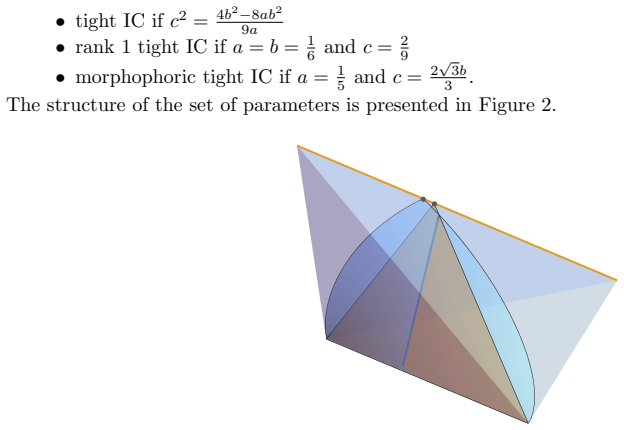
Summary. The paper introduces a new class of measurements in geometric generalised probabilistic theories (GGPTs), called s-tight informationally complete (IC) measurements, defined by the requirement that the projected effects form a scalable frame for the traceless subspace. This class contains both morphophoric measurements and Scott's tight IC measurements as special cases. The main results are: (i) a frame-theoretic characterisation of s-tight IC and tight IC measurements, including a decomposition identity for the frame operator (Proposition 4); (ii) generalised primal equations for s-tight IC and tight IC measurements with instruments balanced at a distinguished state m (Theorems 6 and 8); and (iii) a characterisation of tight IC measurements as exactly those for which the generalised Urgleichung with the canonical instrument takes the form of the classical law of total probability plus a correction term (Theorem 10). The paper also gives an explicit qubit example illustrating the hierarchy of these classes and discusses the relation to the QBist Urgleichung.
Significance. If the results are correct, the paper provides a clean unification of morphophoric and tight IC measurements under a single scalable-frame condition, and it extends the QBist Urgleichung formalism beyond both quantum theory and the previously treated morphophoric case. The central equivalence, Theorem 10, is a genuine and checkable characterisation: it is derived from the definitions rather than fitted to data, and the operator identities in Propositions 4 and Theorem 8 are explicit and verifiable. The qubit example in Section 4 usefully delineates the parameter regions for the different classes. The paper is transparent about its main imported ingredient, the supra-duality assumption on the GGPT, which is inherited from the author's prior framework [27]. The proof style is mostly self-contained, and the claimed results are falsifiable in the sense that they give concrete criteria that can be checked for any proposed GGPT and measurement.
minor comments (6)
- [Section 2] The sentence after the definition of a GGPT asserts that by taking the size parameter μ sufficiently small one can always make the cone supra-dual, but no proof or precise reference is given; since the supra-duality assumption is used in Theorems 6, 8 and 10, please add a proof or a specific citation to [27] for this scaling fact.
- [Theorem 10] The proof of Theorem 10 is too compressed: it invokes the probabilistic version of Theorem 8, but Corollary 9 is stated in the forward direction only, and the proof does not explicitly justify that equality on the state space B extends to an operator equality on V0 (both sides vanish at m and are linear on the affine span of B). Please expand this step so that condition (iii) is seen to imply tightness.
- [Abstract] The first sentence contains a grammatical error: 'The analysed in this paper new class' should read 'The new class analysed in this paper'.
- [Section 5] There is a typo in the introductory paragraph of Section 5: 'Urgleihung' should be 'Urgleichung'.
- [Corollary 7] The index range in the last line of Corollary 7 reads 'k = 1, ..., k′', but the second measurement has n′ outcomes; this should be 'k = 1, ..., n′'.
- [Definition 9] In Definition 9, the codomain of the maps Λ_j is described as C, but the post-measurement subnormalised states Λ_j(x) need not be normalised states; the maps should be described as affine maps into the cone C (or into V) with e(Λ_j(x)) = π_j(x), and this is presumably the intended meaning.
Circularity Check
No significant circularity: Theorem 10 is a genuine equivalence proven in-paper; self-citations to [27] and the supra-duality assumption are background, not load-bearing.
full rationale
The paper's main result, Theorem 10, is a genuine equivalence and does not reduce to its inputs by construction. Tight IC is defined (Definition 7) in purely frame-theoretic terms: pi is tight IC iff (1/sqrt(pi_j(m)))P_0(v_j) is a tight frame for V_0, i.e. iff its frame operator S_0 equals alpha P_0. The claimed target, equation (11) (the canonical-instrument Urgleichung with LTP-plus-correction form), is a probabilistic identity involving a second, arbitrary measurement xi. The two conditions meet only through the operator algebra in Theorems 6 and 8, which is proven in the paper: the identity C delta_pi = K delta_pi follows from Proposition 4 (S = S_0 + (1/mu)P_m), itself derived from the defining scales and the relation T^{-1}(e) = (1/mu)m, and the converse direction recovers the tight-frame condition from equation (11) by injectivity of an informationally complete xi. Both directions are established, so the identification of tight IC as the only class with this Urgleichung form is derived, not assumed. The genuinely imported items are: (i) the GGPT-with-inner-product framework and the balanced-at-m instrument notion from the author's prior [27], cited as background, and (ii) the Section 2 assertion that mu can be chosen so that C is supra-dual. That assertion is not cited, is true (for any proper cone with base point m, taking mu sufficiently small forces the polar of B-m into any neighborhood of 0, giving C^+ subset C), and restricts the class of theories considered rather than encoding the target statement. Citations to [27] for the IC characterization (Theorem 2, also in [25]), the classical LTP for balanced instruments (equation (7), immediately verifiable from sum_j v_j = (1/mu)m), and morphophoric comparison results are background or auxiliary; none forces the conclusion, and no uniqueness theorem is invoked. No data are fitted and no fitted quantity is renamed as a prediction. The mild definitional effect, selecting scales 1/sqrt(pi_j(m)) so the algebra simplifies, is Scott's external definition (properly attributed to [24]) and a narrative framing, not a logical circle.
Assumptions & free parameters
assumptions (5)
- domain assumption Finite-dimensional GPT state space (V,C,e) with proper generating closed cone, no restriction hypothesis (all effects 0<=g<=e are allowed).
- domain assumption The theory is geometric: V0 carries inner product and scalar mu is chosen so that the cone is supra-dual (or self-dual when possible).
- domain assumption Measurements are implemented by instruments Lambda balanced at m (Lambda_j(m)=mu v_j), and the canonical instrument is the special case Lambda_j(x)=pi_j(x)w_j.
- standard math Finite frame theory: analysis/synthesis operators, dual frames, tight frames and scalable frames behave as stated.
- standard math Informationally complete measurements are frames: lin{P0(pi_j)}=V0* (Theorem 2), so reconstruction uses a dual frame.
Cite this review
Pith. "Pith review of Beyond morphophoricity: $s$-tight IC measurements in geometric generalised probabilistic theories." pith.science (2026). https://pith.science/paper/47EWXA3D
@misc{pith2026250701745,
  author       = {Pith},
  title        = {Pith review of: Beyond morphophoricity: $s$-tight IC measurements in geometric generalised probabilistic theories},
  year         = {2026},
  howpublished = {\url{https://pith.science/paper/47EWXA3D}},
  note         = {Machine review of arXiv:2507.01745}
}
abstract
The analysed in this paper new class of $s$-tight IC measurements contains both morphophoric measurements, preserving the geometry of the states space, and tight IC measurements, introduced nearly 20 years ago by Scott in the quantum case as optimal for the task of linear quantum tomography. By looking at the mathematical side of these classes we discover their common feature, which is also preserved in the broader class of $s$-tight IC measurements: a particularly elegant form of the formula that can be seen as the generalised form of the Urgleichung known from the QBist approach to quantum theory. In particular, the tight IC measurements are identified as the ones for which this generalised Urgleichung takes an exceptionally simple form.
Figures

Forward citations
Cited by 1 Pith paper
-
From minimal informationally complete measurements to orthocentric simplices and back again
A minimal informationally complete measurement is s-tight if and only if its suitably rescaled vectors form an acute orthocentric simplex centered at the origin, equivalent to homothetic self-duality.
Reference graph
Works this paper leans on
-
[27]
Szymusiak, A, S lomczy´ nski, W, Can QBism exist without Q? Morphophoric measurements in generalised probabilistic theories, Quantum 9, 1598 (2025)
work page 2025
-
[24]
Scott, AJ, Tight informationally complete quantum measurements, J. Phys. A, 39 (2006), 13507
work page 2006
-
[1]
Appleby, DM, Ericsson, A, Fuchs, CA, Properties of QBist state spaces, Found. Phys. 41 (2011), 564–579
work page 2011
-
[2]
Appleby, M, Fuchs, CA, Stacey, BC, Zhu, H, Introducing the Qplex: a novel arena for quantum theory, Eur. Phys. J. D 71 (2017), 197
work page 2017
-
[3]
Barnum, H, M¨ uller, MP, Ududec, C, Higher-order interference and single-system postulates characterizing quantum theory, New J. Phys. 16 (2014), 123029
work page 2014
-
[4]
Barnum, H, Wilce, A, Information processing in convex operational theories, Electron. Notes Theor. Comput. Sci. 270 (2011), 3–15
work page 2011
-
[5]
Fundamental Theories of Physics, vol 181, Springer, Dordrecht, 2016, 367–420
Barnum, H, Wilce, A, Post-classical probability theory, in: Chiribella, G, Spekkens, R (eds), Quantum Theory: Informational Foundations and Foils. Fundamental Theories of Physics, vol 181, Springer, Dordrecht, 2016, 367–420
work page 2016
-
[6]
Barrett, J, Information processing in generalised probabilistic theories, Phys. Rev. A 75 (2007), 032304. 10
work page 2007
Show all 33 references
-
[7]
Daubechies, I, Grossmann, A, Meyer, Y, Painless Nonorthogonal Expansions, in: Heil, C, Walnut, DF (eds), Funda- mental Papers in Wavelet Theory, Princeton UP, Princeton, 2006, 372–384
2006
-
[8]
Davies, EB, Quantum Theory of Open Systems, Academic Press, London, 1976
1976
-
[9]
Davies, EB, Lewis, JT, An operational approach to quantum probability, Comm. Math. Phys. 17 (1970), 239–260
1970
-
[10]
DeBrota, JB, Fuchs, CA, Pienaar, JL, Stacey, BC, Born’s rule as a quantum extension of Bayesian coherence, Phys. Rev. A 104 (2021), 022207
2021
-
[11]
Fuchs, CA, QBism, where next?, 2023, arxiv:2303.01446 [quant-ph]
2023 arXiv
-
[12]
Fuchs, CA, Olshanii, M, Weiss, MB, Quantum mechanics? It’s all fun and games until someone loses an i, 2022, arXiv:2206.15343v2 [quant-ph]
2022 arXiv
-
[13]
Fuchs, CA, Schack, R, Quantum-Bayesian coherence, 2009, arXiv:0906.2187 [quant-ph]
2009 arXiv
-
[14]
Fuchs, CA, Schack, R, A Quantum-Bayesian route to quantum-state space, Found. Phys. 41 (2011), 345–356
2011
-
[15]
Fuchs, CA, Schack, R, Quantum-Bayesian coherence, Rev. Mod. Phys. 85 (2013), 1693–1715
2013
-
[16]
Janotta, P, Lal, R, Generalized probabilistic theories without the no-restriction hypothesis, Phys. Rev. A 87 (2013), 052131
2013
-
[17]
438 (2013), 2225–2238
Kutyniok, G, Okoudjou KA, Philipp, F, Tuley, EK, Scalable frames, Linear Algebra Appl. 438 (2013), 2225–2238
2013
-
[18]
Lami, L, Non-classical correlations in quantum mechanics and beyond, PhD Thesis, Universitat Aut` onoma de Barcelona, 2017, arXiv:1803.02902 [quant-ph]
2017 arXiv
-
[19]
Ludwig, G, Deutung des Begriffs physikalische Theorie und axiomatische Grundlegung der Hilbertraumstruktur der Quantenmechanik durch Haupts¨ atze des Messens, Springer, Berlin, 1970
1970
-
[20]
Volume 1 Derivation of Hilbert Space Structure, Springer, Berlin, 1985
Ludwig, G, An Axiomatic Basis for Quantum Mechanics. Volume 1 Derivation of Hilbert Space Structure, Springer, Berlin, 1985
1985
-
[21]
Fundamental Theories of Physics, vol 181, Springer, Dordrecht, 2016, 139–170
M¨ uller, MP, Masanes, L, Information-Theoretic Postulates for Quantum Theory, in: Chiribella, G, Spekkens, R (eds) Quantum Theory: Informational Foundations and Foils. Fundamental Theories of Physics, vol 181, Springer, Dordrecht, 2016, 139–170
2016
-
[22]
Pl´ avala, M, General probabilistic theories: An introduction, Phys. Rep. 1033 (2023), 1–64
2023
-
[23]
Rosado, JI, Representation of quantum states as points in a probability simplex associated to a SIC-POVM, Found. Phys. 41 (2011), 1200–1213
2011
-
[25]
Singer, M, Stulpe, W, Phase-space representations of general statistical physical theories, J. Math. Phys. 33 (1992), 131–142
1992
-
[26]
S lomczy´ nski, W, Szymusiak, A, Morphophoric POVMs, generalised qplexes, and 2-designs, Quantum 4 (2020), 338
2020
-
[28]
Takakura, R, Convexity and uncertainty in operational quantum foundations, PhD Thesis, Kyoto University, 2022, arXiv:2202.13834v1 [quant-ph]
2022 arXiv
-
[29]
Ududec, C, Perspectives on the Formalism of Quantum Theory, PhD Thesis, University of Waterloo, 2012
2012
-
[30]
Waldron, SFD, An introduction to finite tight frames, Birkh¨ auser, New York, 2018
2018
-
[31]
van de Wetering, J, Quantum Theory from Principles, Quantum Software from Diagrams, PhD Thesis, Radboud University Nijmegen, 2021, arXiv:2101.03608 [quant-ph]
2021 arXiv
-
[32]
Wilce, A, A royal road to Quantum Theory (or thereabouts), Entropy 20 (2018), 227
2018
-
[33]
F aculty of Mathematics and Computer Science, Jagiellonian University, Lojasiewicza 6, 30-348 Krak ´ow, Poland Email address: anna.szymusiak@uj.edu.pl 11
Wilce, A, Conjugates, filters and quantum mechanics, Quantum 3 (2019), 158. F aculty of Mathematics and Computer Science, Jagiellonian University, Lojasiewicza 6, 30-348 Krak ´ow, Poland Email address: anna.szymusiak@uj.edu.pl 11
2019
Reviewed August 6, 2026 · model on record in the stance chip above.
Discussion (0). Continue with ORCID to comment.