REVIEW 3 major objections 6 minor 26 references
Image Marker
T0 review · 3 major / 6 minor · reviewed 2026-08-06 · deepseek-v4-flash
Pith's one-line read Image Marker turns image review into a nine-key tagging loop that records pixel and sky coordinates to a CSV.
desk verdict A clear, honest software note whose central efficiency claim and even the tool's existence are unverifiable from the manuscript as submitted. read the letter →
The pith
A machine-rendered reading of the paper's core claim, the machinery that carries it, and where it could break.
The reading
What carries the argument
The central mechanism is the Qt GUI main window, which maps the number keys 1 through 9 to nine distinct, user-renamable mark groups. Pressing a key drops a mark at the cursor and immediately appends a row to a per-user CSV file containing pixel coordinates, WCS coordinates (if the FITS header or TIFF metadata provides them), the group name, an editable label, the image file name, and the date. Around this core sit supporting tools: multi-frame FITS and TIFF handling, brightness stretch and interval controls with Gaussian blur, and import of external mark files defined by label plus either x/y or RA/Dec columns.
What would settle it
Time a complete pass of loading, displaying, and marking 1,000 thumbnail FITS cutouts with one key press each on a standard laptop; if the process takes dramatically longer than the paper's stated rate of 'hundreds ... in a matter of minutes' (for example, more than a few seconds per image), the central efficiency claim is not supported.
Extended reading notes
Core claim
The paper's contribution is a working, publicly released software tool whose core workflow is a fast keyboard loop: navigate to an image, press a number key to tag a feature, and move on, with all metadata recorded without breaking flow. The central claim is that this Qt-based application is light enough to handle 'thousands of images' on 'personal-scale computers' while still providing the format flexibility (FITS, TIFF, PNG, JPEG), WCS awareness, and shareable mark files that scientific inspection tasks need. Concretely, the paper argues that Image Marker fills the gap between citizen-science platforms and heavyweight viewers, enabling a small collaboration to validate automated selections such as brightest cluster galaxies with human inspection.
Load-bearing premise
The claim that the Qt-based loop can mark thousands of images efficiently on an ordinary computer rests on an unstated performance assumption; the paper gives no benchmarks, so if the tool is slow or unstable in practice the primary reason to adopt it disappears.
Editorial extensions
If this is right
- A single investigator can label a survey-sized set of cutouts on a laptop, with no internet connection or crowdsourcing platform, if the claimed throughput is genuine.
- The CSV output with both pixel and WCS coordinates plugs directly into catalog-based analyses, letting human labels be cross-matched against algorithmic selections like redMaPPer or MCMF.
- Because mark files are importable and shareable, several users can contribute to one dataset and their coordinate lists can be compared for consistency.
- The customizable groups and image categories transfer the tool beyond astronomy to general image-quality inspection and algorithm validation tasks.
Reading between the lines
- The paper makes no timing or resource measurements, so a prospective user should benchmark the mark-and-advance loop on their own hardware before trusting the 'hundreds of thumbnails in minutes' claim.
- A natural extension the authors do not explore is exporting marks in a format directly usable by the very algorithms being validated, which would turn the tool into a ground-truth generator for centering or classification methods.
- The point-mark-only design may limit applicability to tasks needing regions or contours, such as contamination masks or morphological annotation, but adding such shapes appears consistent with the same CSV-logging architecture.
Editorial analysis
A structured set of objections, weighed in public.
Referee Report
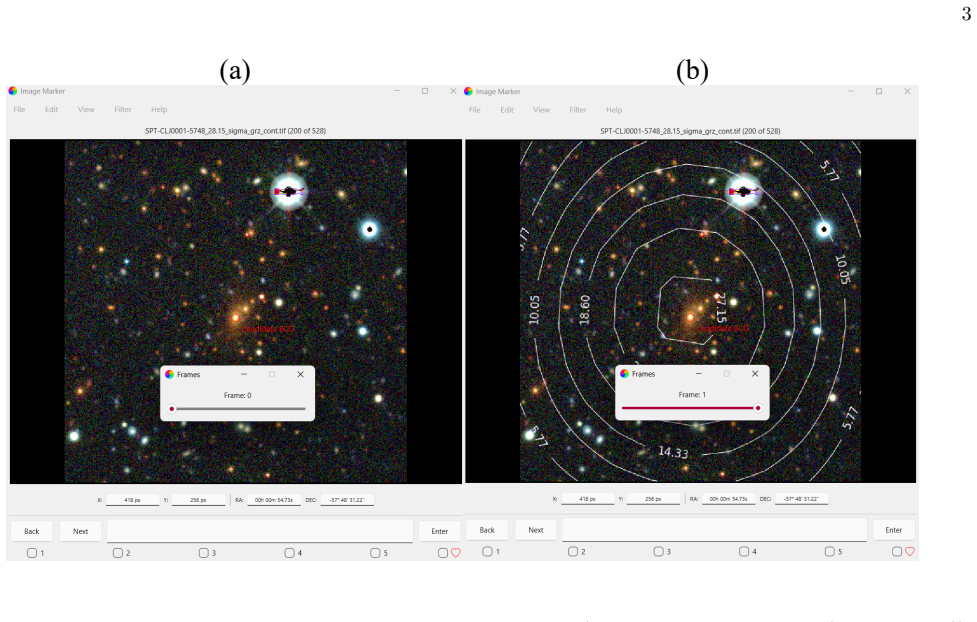
Summary. The paper presents Image Marker, a Python/Qt desktop application for visually inspecting and annotating images in FITS, TIFF, PNG, and JPEG formats. Users can place marks in up to nine groups via numeric keys, edit labels, read pixel and WCS coordinates, save marks to a CSV file, and import external mark files. The application is motivated by two astronomical use cases: identifying brightest cluster galaxies in SPT-3G data and cleaning thumbnail cutouts in Euclid Deep Field South analyses. The central stated value is that Image Marker is a lightweight tool that enables efficient marking of thousands of images on personal-scale computers; the manuscript describes the features and includes screenshots, but it provides no quantitative measurement of performance, no repository URL or version identifier, and no reproducible installation verification.
Significance. If its performance and availability claims were substantiated, Image Marker would fill a useful niche between web-based crowdsourcing platforms and large-image viewers such as DS9 and FitsMap. The feature set is sensible and clearly motivated: multiple mark classes, CSV export, WCS-aware coordinate logging, multi-frame FITS/TIFF support, and import of external mark files are all valuable capabilities. The paper also gives appropriate credit by citing the astronomy software ecosystem on which it builds. However, the contribution rests on an unverified efficiency assertion, and the manuscript as submitted does not allow a reviewer or user to test the tool. The absence of a benchmark, a machine-checked artifact link, or a minimal installation check means the core utility claim is not currently evidence-backed. This is not an internal inconsistency, but it is a load-bearing gap in an otherwise clearly written software description.
major comments (3)
- [Abstract and §1.1.1] The central claim that Image Marker enables 'efficient marking of thousands of images' and that 'hundreds of small thumbnail cutouts' can be scanned 'in a matter of minutes' is unsupported by any measurement. There is no benchmark, timing test, memory usage report, or description of the test environment, and no comparison against DS9 or FitsMap. Because this efficiency is the primary differentiator, the paper should include a minimal benchmark (e.g., load time, render time, mark-saving time, and memory footprint for 100, 1,000, and 10,000 representative images) and should define what is meant by 'personal-scale computers.' Without such evidence, the central utility claim is an assertion rather than a demonstrated result.
- [§3] The paper states that Image Marker is 'available on GitHub' and installable via 'pip install imgmarker', but it does not provide a repository URL, version number, commit identifier, or DOI. A reviewer or potential user cannot verify that the artifact exists, install it, or reproduce the described behavior. Add a persistent link and a minimal installation/test section, including the supported Python versions and operating system specifics.
- [§2.1] The paper concedes that images exceeding PyQt bit-depth limits 'will have their bit depth lowered,' but it does not state whether the user is warned, whether the scaling is performed per-image or globally, or what range mapping is applied. For 32-bit FITS images, silent downsampling can affect the visibility of faint sources and therefore the marking task. This should be documented explicitly and, if possible, made user-controllable, since it directly affects the scientific use case described in §1.1.
minor comments (6)
- [§2.2] There is a typo: '9groups' and '1 of 9groups' should read '9 groups' and '1 of 9 groups.'
- [Abstract and §3] The abstract limits executables to 'Mac and Windows 11,' while §3 says installation is supported on 'Mac, Linux, and Windows.' Please reconcile these statements.
- [§2.2] The description of the CSV output says 'pixel coordinates, WCS coordinates (if applicable), group, label, the name of the image where the mark was placed, and the current date' are saved, but it does not specify column names or the WCS coordinate units. Including an example CSV row would remove ambiguity.
- [§2.4] The settings section does not state whether the marks' colors, sizes, and symbol styles are configurable per group; if they are, this should be stated, and if not, it is a limitation worth noting for users who need to distinguish many classes.
- [§2.3] The Gaussian blur tool is described only as a 'slider'; specifying the sigma range or showing a sample blurred image would help readers understand its utility for the stated inspection tasks.
- [Author block] The author name 'Ryan W alker' appears with an unintended space; please correct it to 'Ryan Walker.'
Circularity Check
No significant circularity: Image Marker is a software description with no fitted parameters, equations, or self-citation chain, so no claim reduces to its own input.
full rationale
This paper presents a GUI software tool and contains no derivation, fitting procedure, or quantitative result that could be compared with its inputs. The central claims are functional, such as allowing quick seeking through images and enabling flexible marking and logging of up to 9 classes of features, and they are supported by screenshots and feature descriptions rather than by any measured benchmark. A missing performance benchmark or missing repository URL is a completeness and verifiability concern, not a circularity defect: no step in the paper defines an output in terms of an input, imports a load-bearing result from the authors' prior work, or renames a known result in new coordinates. The self-references to SPT-3G survey papers and to the planned BCG analysis are contextual and do not supply the paper's main claim. Therefore no circular step can be quoted or exhibited, and the appropriate finding is no significant circularity.
Assumptions & free parameters
assumptions (2)
- domain assumption FITS and TIFF WCS headers, when present, are interpreted correctly by the software
- domain assumption The Python/PyQt dependency stack runs on the user's machine within the stated bit-depth limits
Cite this review
Pith. "Pith review of Image Marker." pith.science (2026). https://pith.science/paper/M2SWWJ4I
@misc{pith2026250702153,
  author       = {Pith},
  title        = {Pith review of: Image Marker},
  year         = {2026},
  howpublished = {\url{https://pith.science/paper/M2SWWJ4I}},
  note         = {Machine review of arXiv:2507.02153}
}
read the original abstract
A wide range of scientific imaging datasets benefit from human inspection for purposes ranging from prosaic-such as fault identification and quality inspection-to profound, enabling the discovery of new phenomena. As such, these datasets come in a wide variety of forms, with diverse inspection needs. In this paper we present a software package, Image Marker, designed to help facilitate human categorization of images. The software allows for quick seeking through images and enables flexible marking and logging of up to 9 different classes of features and their locations in files of FITS, TIFF, PNG, and JPEG format. Additional tools are provided to add text-based comments to the marking logs and for displaying external mark datasets on images during the classification process. As our primary use case will be the identification of features in astronomical survey data, Image Marker will also utilize standard world coordinate system (WCS) headers embedded in FITS headers and TIFF metadata when available. The lightweight software, based on the Qt Framework to build the GUI application, enables efficient marking of thousands of images on personal-scale computers. We provide Image Marker as a Python package, and as Mac and Windows 11 executables. It is available on GitHub or via pip installation.
Figures

Reference graph
Works this paper leans on
-
[1]
Allen, S. W., Evrard, A. E., & Mantz, A. B. 2011, ARA&A, 49, 409, doi: 10.1146/annurev-astro-081710-102514
-
[2]
Archipley, M., Hryciuk, A., Bleem, L. E., et al. 2025, arXiv e-prints, arXiv:2506.00298, doi: 10.48550/arXiv.2506.00298 Astropy Collaboration, Robitaille, T. P., Tollerud, E. J., et al. 2013, A&A, 558, A33, doi: 10.1051/0004-6361/201322068 Astropy Collaboration, Price-Whelan, A. M., Sip˝ ocz, B. M., et al. 2018, AJ, 156, 123, doi: 10.3847/1538-3881/aabc4f...
-
[3]
2012, in Astronomical Society of the Pacific Conference Series, Vol
Bertin, E. 2012, in Astronomical Society of the Pacific Conference Series, Vol. 461, Astronomical Data Analysis Software and Systems XXI, ed. P. Ballester, D. Egret, & N. P. F. Lorente, 263 1 http://www.astropy.org
work page 2012
-
[4]
Chaubal, P. S., Reichardt, C. L., Gupta, N., et al. 2022, ApJ, 931, 139, doi: 10.3847/1538-4357/ac6a55
-
[5]
2015, Pillow (PIL Fork) Documentation, readthedocs
Clark, A. 2015, Pillow (PIL Fork) Documentation, readthedocs. https://buildmedia.readthedocs.org/ media/pdf/pillow/latest/pillow.pdf
2015
-
[6]
Dey, A., Schlegel, D. J., Lang, D., et al. 2019, AJ, 157, 168, doi: 10.3847/1538-3881/ab089d
-
[7]
2025, MNRAS, 536, 572, doi: 10.1093/mnras/stae2601
Ding, J., Dalal, R., Sunayama, T., et al. 2025, MNRAS, 536, 572, doi: 10.1093/mnras/stae2601
-
[8]
Galaxy Zoo: Morphological Classification and Citizen Science
Fortson, L., Masters, K., Nichol, R., et al. 2012, in Advances in Machine Learning and Data Mining for Astronomy, ed. M. J. Way, J. D. Scargle, K. M. Ali, & A. N. Srivastava, 213–236, doi: 10.48550/arXiv.1104.5513
work page Pith review arXiv doi:10.48550/arxiv.1104.5513 2012
Show all 26 references
-
[9]
R., Millman, K
Harris, C. R., Millman, K. J., van der Walt, S. J., et al. 2020, Nature, 585, 357, doi: 10.1038/s41586-020-2649-2
2020 doi
-
[10]
2022, Astronomy and Computing, 39, 100586, doi: https://doi.org/10.1016/j.ascom.2022.100586 5
Hausen, R., & Robertson, B. 2022, Astronomy and Computing, 39, 100586, doi: https://doi.org/10.1016/j.ascom.2022.100586 5
2022
-
[11]
2017, SAOImageDS9/SAOImageDS9, v7.6b8, Zenodo, doi: 10.5281/zenodo.1041781
Joye, W. 2017, SAOImageDS9/SAOImageDS9, v7.6b8, Zenodo, doi: 10.5281/zenodo.1041781
2017 doi
-
[12]
M., Jobel, J., Eiger, O., et al
Kelly, P. M., Jobel, J., Eiger, O., et al. 2024, Monthly Notices of the Royal Astronomical Society, 533, 572, doi: 10.1093/mnras/stae1786
2024 doi
-
[13]
J., et al
Klein, M., Grandis, S., Mohr, J. J., et al. 2019, MNRAS, 488, 739, doi: 10.1093/mnras/stz1463
2019 doi
-
[14]
Limited, R. C. 2025, PyQt Documentation. https: //www.riverbankcomputing.com/static/Docs/PyQt6/
2025
-
[15]
J., Verma, A., More, A., et al
Marshall, P. J., Verma, A., More, A., et al. 2016, MNRAS, 455, 1171, doi: 10.1093/mnras/stv2009
2016 doi
-
[16]
2016, Astronomy and Computing, 16, 99, doi: 10.1016/j.ascom.2016.04.003
Melchior, P., Sheldon, E., Drlica-Wagner, A., et al. 2016, Astronomy and Computing, 16, 99, doi: 10.1016/j.ascom.2016.04.003
2016 doi
-
[17]
2024, ApJ, 973, 4, doi: 10.3847/1538-4357/ad5ff1
Prabhu, K., Raghunathan, S., Millea, M., et al. 2024, ApJ, 973, 4, doi: 10.3847/1538-4357/ad5ff1
2024 doi
-
[18]
2022, ApJ, 928, 16, doi: 10.3847/1538-4357/ac510f
Raghunathan, S. 2022, ApJ, 928, 16, doi: 10.3847/1538-4357/ac510f
2022 doi
-
[19]
Rozo, E., & Rykoff, E. S. 2014, ApJ, 783, 80, doi: 10.1088/0004-637X/783/2/80
2014 doi
-
[20]
S., Rozo, E., Busha, M
Rykoff, E. S., Rozo, E., Busha, M. T., et al. 2014, ApJ, 785, 104, doi: 10.1088/0004-637X/785/2/104
2014 doi
-
[21]
R., & De Roure, D
Simpson, R., Page, K. R., & De Roure, D. 2014, in Proceedings of the 23rd International Conference on World Wide Web, WWW ’14 Companion (New York,
2014
-
[22]
NY, USA: Association for Computing Machinery), 1049–1054, doi: 10.1145/2567948.2579215
-
[23]
A., Anderson, A
Sobrin, J. A., Anderson, A. J., Bender, A. N., et al. 2022, ApJS, 258, 42, doi: 10.3847/1538-4365/ac374f
2022 doi
-
[24]
A., & Zeldovich, Y
Sunyaev, R. A., & Zeldovich, Y. B. 1972, Comments on Astrophysics and Space Physics, 4, 173
1972
-
[25]
2020, A&A Rv, 28, 7, doi: 10.1007/s00159-020-00129-w
Umetsu, K. 2020, A&A Rv, 28, 7, doi: 10.1007/s00159-020-00129-w
2020 doi
-
[26]
E., et al
Virtanen, P., Gommers, R., Oliphant, T. E., et al. 2020, Nature Methods, 17, 261, doi: 10.1038/s41592-019-0686-2
2020 doi
Reviewed August 6, 2026 · model on record in the stance chip above.
Discussion (0). Continue with ORCID to comment.