REVIEW 2 major objections 4 minor 43 references
Mitigating Goal Misgeneralization via Minimax Regret
T0 review · 2 major / 4 minor · reviewed 2026-08-06 · deepseek-v4-flash
Pith's one-line read Training to minimize worst-case regret prevents goal misgeneralization, while maximizing expected value does not.
desk verdict A solid, well-scoped theory-plus-experiments paper on minimax regret and goal misgeneralization, held back only by an abstract that overstates the full-observability caveat the authors themselves document. read the letter →
The pith
A machine-rendered reading of the paper's core claim, the machinery that carries it, and where it could break.
The reading
What carries the argument
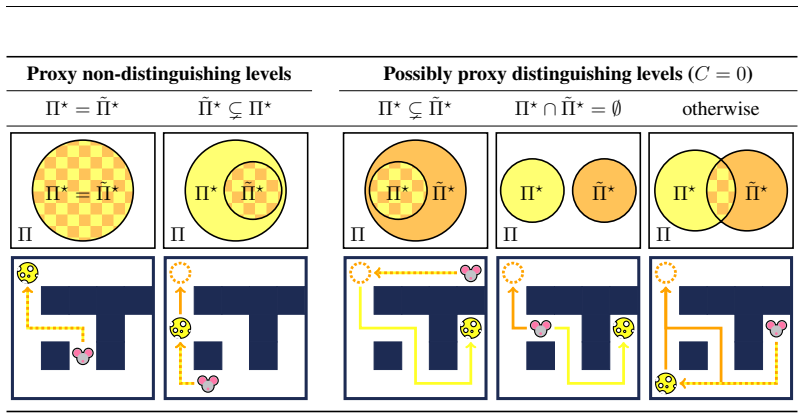
The central object is the expected regret identity G_R(π; Λ) = max_{π'} V_R(π'; Λ) − V_R(π; Λ), which holds only because policies are conditioned on the level θ in a fully observable underspecified MDP. This identity lets the minimax expected regret objective be analyzed as a distribution-free robustness property: the adversary can always concentrate on the levels where a proxy-pursuing policy loses the most. The paper also introduces the proxy-distinguishing distribution shift (a pair of training and deployment distributions over levels, with different fractions α and β of distinguishing levels), and uses it to state the possibility theorem for MEV and the impossibility theorem for MMER in a single formal setting.
What would settle it
Run a partially observable variant of CHEESE IN THE CORNER where the cheese position is hidden until the mouse is adjacent, train with ACCEL plus the oracle-latest regret estimator, and measure deployment return on distinguishing levels; a return below the optimal level minus the optimization threshold would disprove the claim that MMER-based training is robust to goal misgeneralization.
Extended reading notes
Core claim
The central claim is Theorem 2: for any proxy-distinguishing distribution shift in a fully observable underspecified MDP, every policy that is approximately optimal under the minimax expected regret objective is also approximately optimal under the true goal on the deployment distribution, and hence does not goal misgeneralize. Theorem 1 shows the contrast: if the training distribution contains distinguishing levels with probability at most the optimization threshold ε, then some approximately MEV-optimal policy is proxy-optimal on deployment but βC-suboptimal under the true goal. The paper also demonstrates empirically that regret-based UED methods amplify rare distinguishing levels in the training buffer, which is the mechanism that steers the policy back to the true goal, and that domain randomization fails exactly where the theory predicts. The guarantee degrades gracefully under partial observability: an irreducible regret gap enters the bound, and the paper flags this as a limitation of standard MMER.
Load-bearing premise
The core guarantee assumes the policy can observe which level it is in; once levels are only partially observable, an irreducible regret gap can let goal misgeneralization slip through.
Editorial extensions
If this is right
- Any approximately MMER policy is approximately optimal under any deployment distribution over levels in the specified space, so regret-based training is provably robust to goal misgeneralization in fully observable settings.
- Domain randomization will misgeneralize whenever the training fraction of distinguishing levels α is at most the optimization tolerance ε; experiments show failure at α as high as 1e-2 to 1e-1.
- Regret-based UED adversaries amplify rare distinguishing levels in the training buffer, which is the mechanism that corrects goal pursuit; more flexible adversaries and more accurate regret estimators strengthen this effect.
- An adversary with unrestricted edit operations can prevent goal misgeneralization even when α=0, showing that the limitation is access to distinguishing levels rather than the MMER objective itself.
- In partially observable environments, an irreducible regret gap can enter the MMER bound and break the guarantee; the paper proposes a lexicographic refinement to address this.
Reading between the lines
- If the theory holds, MMER offers a training objective that does not require manually tuning the proportion of rare, goal-revealing situations, since the adversary discovers them automatically; this could replace the practice of hand-crafting α for safety-critical tasks.
- The KEYS AND CHESTS failure with the max-latest regret estimator suggests that the practical bottleneck is regret estimation rather than the MMER objective, so advances in value-network-based or sample-based maximum-return estimators could close most of the remaining gap.
- The paper's broader-impact argument extends naturally: as RL agents become more capable, regret-maximizing adversaries also become more capable of finding distinguishing situations, so MMER-style training should become more, not less, effective at keeping advanced systems aligned with the intended goal.
- A testable extension would be to run the same grid-world tasks with the level identity only partially observable, comparing ACCEL with the oracle-latest estimator against domain randomization; the paper's Section E predicts that the UED advantage shrinks or reverses as irreducible regret grows.
Editorial analysis
A structured set of objections, weighed in public.
Referee Report
Summary. The paper formalizes goal misgeneralization as a proxy-distinguishing distribution shift over underspecified MDPs. It proves that under approximate maximum expected value (MEV) optimization, a proxy-pursuing policy can be near-optimal on the training distribution when the fraction of distinguishing levels is at most the optimization threshold (Theorem 1), while under approximate minimax expected regret (MMER) optimization every near-optimal policy is near-optimal on the deployment distribution (Theorem 2), under the paper's stated assumption that policies are conditioned on the level and the environment is fully observable. The paper then compares domain randomization with two regret-based unsupervised environment design (UED) methods, PLR⊥ and ACCEL, using both a sample-based and an oracle regret estimator, in three procedurally generated grid-world environments. The empirical results show that domain randomization often misgeneralizes when distinguishing levels are rare, while UED methods frequently prevent this, with notable exceptions reported in Section 7.4.
Significance. If the claims are read within their stated assumptions, the paper makes a valuable theoretical contribution: it gives the first formal treatment of goal misgeneralization as a distribution-shift phenomenon and cleanly proves that MMER has a robustness guarantee that MEV lacks. The proofs in Section A are straightforward and correct, and the paper is unusually transparent: it reports the failure of ACCEL with the max-latest estimator in KEYS AND CHESTS, includes extensive ablations in Appendices J through N, and explicitly derives a partial-observability weakening in Section E.2. The formal setting of proxy-distinguishing distribution shifts is likely to be reused by later work. The main weakness is that the advertised claims in the abstract and conclusion are stated more broadly than the theorems support, because Theorem 2 relies on full observability and level-conditioned policies and the experiments are all in fully observable environments.
major comments (2)
- [Section 5.2, Eq. (2); Section E.2; Abstract; Section 8] Theorem 2's robustness guarantee is carried by Eq. (2), which holds only when policies are conditioned on the level and the environment is fully observable (Propositions 1 and 2). The paper's own Section E.2 shows that under partial observability the conclusion degrades to the bound epsilon + g(Lambda_Deploy), and the aliasing example in Section E.1 exhibits a gap g equal to the full value range. The abstract's claim that goal misgeneralization is possible under MEV 'but not the MMER objective' and the conclusion's 'provably robust' are therefore unqualified overstatements. Please carry the level-conditioned/full-observability qualification into the abstract and the statement of Theorem 2, and move the POMDP caveat from Section E.2 into at least a main-text remark.
- [Section 6.1 and Section F] All three experimental environments are fully observable: Section F states that all goal-relevant information, including cheese, dish, key, and chest positions, is encoded in the observation channels. Consequently the empirical study does not test the regime in which Theorem 3's irreducible-regret gap can make the MMER guarantee vacuous. The abstract's claim that regret-based UED methods 'are more robust to goal misgeneralization' is presented without this scope restriction. Please state explicitly in the main text and abstract that the empirical results concern fully observable environments only, and note that the partial-observability case remains open.
minor comments (4)
- [Section 5.2, Remarks] The remark that 'a slightly modified bound holds for partially observable environments' understates the severity of the degradation: in the aliasing example of Section E.1, Theorem 3's additive gap can equal the full value range. Please refer explicitly to Eq. (12) and Theorem 3 when making this remark.
- [Section 7.4 and Figure 4] In KEYS AND CHESTS, ACCEL with the max-latest regret estimator performs worse than domain randomization (Figure 4, Section 7.4). The paper reports this honestly, but the abstract's summary that 'current regret-based UED methods are more robust to goal misgeneralization' should name this exception or be softened to 'in most environments and configurations tested'.
- [Section K, Theorem 4 proof] The proof asserts without derivation that c(theta, alpha) >= V^R(pi*; theta-prime) for theta not in the adversary's support and theta-prime in the support. Please add a sentence explaining that alpha equals the per-level value of pi* on the MMEV adversary's support and that c(theta, alpha) >= alpha by Definition 12.
- [Section 3, Eq. (2)] Equation (2) is introduced as an identity before it is proved in Section B; adding a forward reference to Proposition 1 would help the reader understand why this nontrivial identity is available.
Circularity Check
No significant circularity: Theorem 2 is derived from definitions and an explicitly proved identity, with scope limitations disclosed in Section E.
full rationale
The central theoretical claim (Theorem 2) is proved in Appendix A using only the definitions of expected return, expected regret, approximate MMER, and the identity in Eq. (2). That identity is not imported from prior work; it is proved in Appendix B via Propositions 1 and 2, which rely on the explicit assumption that policies are conditioned on the level theta. The proof of Theorem 2 then converts a regret bound into an expected-return bound by substitution into Eq. (2), and the final step that minimum regret vanishes is also derived from Eq. (2). No fitted parameter is renamed as a prediction, and no self-cited uniqueness theorem or ansatz is used as the load-bearing premise. Self-citations such as Dennis et al. (2020) and Langosco et al. (2022) supply context, baselines, and environment provenance, but the theoretical results do not depend on them. The partial-observability restriction is explicitly disclosed in Section E.2, where the authors state that the irreducible regret gap g(Lambda_Deploy) weakens the guarantee and that this 'is a limitation of standard MMER.' Even if the abstract's unqualified phrasing overstates the scope of the fully-observable theorem, that is a scope/accuracy concern rather than circular reasoning. The empirical study is also self-contained: DR, PLR, and ACCEL are compared on procedurally generated environments, and the regret estimators are either sample-based or based on exact environment solutions, not fitted to the deployment results. Overall, the derivation chain is independent of its conclusions, so no circular step is present.
Assumptions & free parameters
free parameters (3)
- PPO hyperparameters =
learning rate 5e-5, clip 0.1, GAE lambda 0.95, entropy 1e-3 (1e-2 for KEYS AND CHESTS)
- UED configuration =
buffer size 4096, rank prioritization, temperature 0.1, staleness 0.1, replay rate 0.33 (PLR) or 0.5 (ACCEL)
- ACCEL edit distribution =
12 elementary edits, classification-preserving in main text
assumptions (4)
- domain assumption UMDP is finite: Theta, S, A finite; discount gamma in (0,1); goals normalized to [0,1].
- domain assumption Policies are level-conditioned, pi: Theta x S -> Delta(A), and the environment is fully observable, so max and expectation commute (Proposition 2).
- domain assumption Distinguishing levels are present in Theta and accessible during training; true-goal reward is reliable in them.
- standard math Approximate optimization is modeled as arg-eps-max and arg-eps-min over policy sets.
Cite this review
Pith. "Pith review of Mitigating Goal Misgeneralization via Minimax Regret." pith.science (2026). https://pith.science/paper/2L7AMY4M
@misc{pith2026250703068,
  author       = {Pith},
  title        = {Pith review of: Mitigating Goal Misgeneralization via Minimax Regret},
  year         = {2026},
  howpublished = {\url{https://pith.science/paper/2L7AMY4M}},
  note         = {Machine review of arXiv:2507.03068}
}
read the original abstract
Safe generalization in reinforcement learning requires not only that a learned policy acts capably in new situations, but also that it uses its capabilities towards the pursuit of the designer's intended goal. The latter requirement may fail when a proxy goal incentivizes similar behavior to the intended goal within the training environment, but not in novel deployment environments. This creates the risk that policies will behave as if in pursuit of the proxy goal, rather than the intended goal, in deployment -- a phenomenon known as goal misgeneralization. In this paper, we formalize this problem setting in order to theoretically study the possibility of goal misgeneralization under different training objectives. We show that goal misgeneralization is possible under approximate optimization of the maximum expected value (MEV) objective, but not the minimax expected regret (MMER) objective. We then empirically show that the standard MEV-based training method of domain randomization exhibits goal misgeneralization in procedurally-generated grid-world environments, whereas current regret-based unsupervised environment design (UED) methods are more robust to goal misgeneralization (though they don't find MMER policies in all cases). Our findings suggest that minimax expected regret is a promising approach to mitigating goal misgeneralization.
Figures


Figures from the paper (3 more)


Reference graph
Works this paper leans on
-
[1]
A simple environment for showing mesa misalignment
Matthew Barnett. A simple environment for showing mesa misalignment. Alignment Forum, September 2019. URL https://www.alignmentforum.org/posts/AFdRGfYDWQqmkdhFq
work page 2019
-
[2]
Michael Beukman, Samuel Coward, Michael Matthews, Mattie Fellows, Minqi Jiang, Michael Dennis, and Jakob N. Foerster. Refining minimax regret for unsupervised environment design. In Proceedings of the 41st International Conference on Machine Learning, volume 235 of Proceedings of Machine Learning Research, pp.\ 3637--3657. PMLR, 2024
work page 2024
-
[3]
JAX: composable transformations of Python + NumPy programs, 2018
James Bradbury, Roy Frostig, Peter Hawkins, Matthew James Johnson, Chris Leary, Dougal Maclaurin, George Necula, Adam Paszke, Jake VanderPlas , Skye Wanderman-Milne , and Qiao Zhang. JAX: composable transformations of Python + NumPy programs, 2018. URL http://github.com/jax-ml/jax
work page 2018
-
[4]
Jake Bruce, Michael Dennis, Ashley Edwards, Jack Parker-Holder, Yuge Shi, Edward Hughes, Matthew Lai, Aditi Mavalankar, Richie Steigerwald, Chris Apps, Yusuf Aytar, Sarah Maria Elisabeth Bechtle, Feryal Behbahani, Stephanie C. Y. Chan, Nicolas Heess, Lucy Gonzalez, Simon Osindero, Sherjil Ozair, Scott Reed, Jingwei Zhang, Konrad Zolna, Jeff Clune, Nando D...
work page 2024
-
[5]
Techniques for optimizing worst-case performance
Paul Christiano. Techniques for optimizing worst-case performance. AI Alignment (Blog), February 2018. URL https://ai-alignment.com/techniques-for-optimizing-worst-case-performance-39eafec74b99
work page 2018
-
[6]
Quantifying generalization in reinforcement learning
Karl Cobbe, Oleg Klimov, Chris Hesse, Taehoon Kim, and John Schulman. Quantifying generalization in reinforcement learning. In Proceedings of the 36th International Conference on Machine Learning, volume 97 of Proceedings of Machine Learning Research, pp.\ 1282--1289. PMLR, 2019
work page 2019
-
[7]
Leveraging procedural generation to benchmark reinforcement learning
Karl Cobbe, Chris Hesse, Jacob Hilton, and John Schulman. Leveraging procedural generation to benchmark reinforcement learning. In Proceedings of the 37th International Conference on Machine Learning, volume 119 of Proceedings of Machine Learning Research, pp.\ 2048--2056. PMLR, 2020
work page 2020
-
[8]
Russell, Andrew Critch, and Sergey Levine
Michael Dennis, Natasha Jaques, Eugene Vinitsky, Alexandre Bayen, Stuart J. Russell, Andrew Critch, and Sergey Levine. Emergent complexity and zero-shot transfer via unsupervised environment design. In Advances in Neural Information Processing Systems 33, pp.\ 13049--13061. Curran Associates, Inc., 2020
work page 2020
Show all 43 references
-
[9]
IMPALA : Scalable distributed deep- RL with importance weighted actor-learner architectures
Lasse Espeholt, Hubert Soyer, Remi Munos, Karen Simonyan, Vlad Mnih, Tom Ward, Yotam Doron, Vlad Firoiu, Tim Harley, Iain Dunning, Shane Legg, and Koray Kavukcuoglu. IMPALA : Scalable distributed deep- RL with importance weighted actor-learner architectures. In Proceedings of ...
2018
-
[10]
Wichmann
Robert Geirhos, J \"o rn-Henrik Jacobsen, Claudio Michaelis, Richard Zemel, Wieland Brendel, Matthias Bethge, and Felix A. Wichmann. Shortcut learning in deep neural networks. Nature Machine Intelligence, 2: 0 665--673, 2020
2020
-
[11]
Recurrent world models facilitate policy evolution
David Ha and J\" u rgen Schmidhuber. Recurrent world models facilitate policy evolution. In Advances in Neural Information Processing Systems 31, pp.\ 2450--2462. Curran Associates, Inc., 2018
2018
-
[12]
Russell, and Anca Dragan
Dylan Hadfield-Menell, Smitha Milli, Pieter Abbeel, Stuart J. Russell, and Anca Dragan. Inverse reward design. In Advances in Neural Information Processing Systems 30, pp.\ 6765--6774. Curran Associates, Inc., 2017
2017
-
[13]
Dream to control: Learning behaviors by latent imagination
Danijar Hafner, Timothy Lillicrap, Jimmy Ba, and Mohammad Norouzi. Dream to control: Learning behaviors by latent imagination. In 8th International Conference on Learning Representations. OpenReview, 2020
2020
-
[14]
Mastering diverse control tasks through world models
Danijar Hafner, Jurgis Pasukonis, Jimmy Ba, and Timothy Lillicrap. Mastering diverse control tasks through world models. Nature, 640 0 (8059): 0 647--653, 2025
2025
-
[15]
Towards an empirical investigation of inner alignment
Evan Hubinger. Towards an empirical investigation of inner alignment. Alignment Forum, September 2019. URL https://www.alignmentforum.org/posts/2GycxikGnepJbxfHT
2019
-
[16]
Foerster, Edward Grefenstette, and Tim Rockt\" a schel
Minqi Jiang, Michael Dennis, Jack Parker-Holder, Jakob N. Foerster, Edward Grefenstette, and Tim Rockt\" a schel. Replay-guided adversarial environment design. In Advances in Neural Information Processing Systems 34, pp.\ 1884--1897. Curran Associates, Inc., 2021 a
2021
-
[17]
Prioritized level replay
Minqi Jiang, Edward Grefenstette, and Tim Rockt \"a schel. Prioritized level replay. In Proceedings of the 38th International Conference on Machine Learning, volume 139 of Proceedings of Machine Learning Research, pp.\ 4940--4950. PMLR, 2021 b
2021
-
[18]
A survey of zero-shot generalisation in deep reinforcement learning
Robert Kirk, Amy Zhang, Edward Grefenstette, and Tim Rockt \"a schel. A survey of zero-shot generalisation in deep reinforcement learning. Journal of Artificial Intelligence Research, 76: 0 201--264, 2023
2023
-
[19]
RMA : Rapid motor adaptation for legged robots
Ashish Kumar, Zipeng Fu, Deepak Pathak, and Jitendra Malik. RMA : Rapid motor adaptation for legged robots. In Proceedings of Robotics: Science and Systems XVII, 2021
2021
-
[20]
Sharkey, Jacob Pfau, and David Krueger
Lauro Langosco, Jack Koch, Lee D. Sharkey, Jacob Pfau, and David Krueger. Goal misgeneralization in deep reinforcement learning. In Proceedings of the 39th International Conference on Machine Learning, volume 162 of Proceedings of Machine Learning Research, pp.\ 12004--12019. ...
2022
-
[21]
Liu, Behzad Haghgoo, Annie S
Evan Z. Liu, Behzad Haghgoo, Annie S. Chen, Aditi Raghunathan, Pang Wei Koh, Shiori Sagawa, Percy Liang, and Chelsea Finn. Just train twice: Improving group robustness without training group information. In Proceedings of the 38th International Conference on Machine Learning, ...
2021
-
[22]
DrEureka: language model guided sim-to-real transfer
Yecheng Jason Ma, William Liang, Hung-Ju Wang, Sam Wang, Yuke Zhu, Linxi Fan, Osbert Bastani, and Dinesh Jayaraman. DrEureka: language model guided sim-to-real transfer. In Proceedings of Robotics: Science and Systems XX, 2024
2024
-
[23]
Isaac gym: High performance GPU based physics simulation for robot learning
Viktor Makoviychuk, Lukasz Wawrzyniak, Yunrong Guo, Michelle Lu, Kier Storey, Miles Macklin, David Hoeller, Nikita Rudin, Arthur Allshire, Ankur Handa, and Gavriel State. Isaac gym: High performance GPU based physics simulation for robot learning. In Proceedings of the Neural ...
2021
-
[24]
Foerster
Nathan Monette, Alistair Letcher, Michael Beukman, Matthew Thomas Jackson, Alexander Rutherford, Alexander David Goldie, and Jakob N. Foerster. An optimisation framework for unsupervised environment design. Reinforcement Learning Journal, 2025. To appear
2025
-
[25]
Robot learning from randomized simulations: A review
Fabio Muratore, Fabio Ramos, Greg Turk, Wenhao Yu, Michael Gienger, and Jan Peters. Robot learning from randomized simulations: A review. Frontiers in Robotics and AI, 9: 0 799893, 2022
2022
-
[26]
The alignment problem from a deep learning perspective
Richard Ngo, Lawrence Chan, and S\"oren Mindermann. The alignment problem from a deep learning perspective. In 12th International Conference on Learning Representations. OpenReview, 2024
2024
-
[27]
Solving Rubik's Cube with a robot hand
OpenAI, Ilge Akkaya, Marcin Andrychowicz, Maciek Chociej, Mateusz Litwin, Bob McGrew, Arthur Petron, Alex Paino, Matthias Plappert, Glenn Powell, Raphael Ribas, Jonas Schneider, Nikolas Tezak, Jerry Tworek, Peter Welinder, Lilian Weng, Qiming Yuan, Wojciech Zaremba, and Lei Zh...
1910 arXiv
-
[28]
Foerster, Edward Grefenstette, and Tim Rockt \"a schel
Jack Parker-Holder, Minqi Jiang, Michael Dennis, Mikayel Samvelyan, Jakob N. Foerster, Edward Grefenstette, and Tim Rockt \"a schel. Evolving curricula with regret-based environment design. Preprint arXiv:2203.01302 [cs.LG], 2022
2022 arXiv
-
[29]
Sim-to-real transfer of robotic control with dynamics randomization
Xue Bin Peng, Marcin Andrychowicz, Wojciech Zaremba, and Pieter Abbeel. Sim-to-real transfer of robotic control with dynamics randomization. In 2018 IEEE International Conference on Robotics and Automation, pp.\ 3803--3810. IEEE, 2018
2018
-
[30]
No regrets: Investigating and improving regret approximations for curriculum discovery
Alexander Rutherford, Michael Beukman, Timon Willi, Bruno Lacerda, Nick Hawes, and Jakob Foerster. No regrets: Investigating and improving regret approximations for curriculum discovery. In Advances in Neural Information Processing Systems 37, pp.\ 16071--16101. Curran Associa...
2024
-
[31]
Leonard J. Savage. The theory of statistical decision. Journal of the American Statistical Association, 46 0 (253): 0 55--67, 1951
1951
-
[32]
Mastering Atari, Go, chess and shogi by planning with a learned model
Julian Schrittwieser, Ioannis Antonoglou, Thomas Hubert, Karen Simonyan, Laurent Sifre, Simon Schmitt, Arthur Guez, Edward Lockhart, Demis Hassabis, Thore Graepel, Timothy Lillicrap, and David Silver. Mastering Atari, Go, chess and shogi by planning with a learned model. Natur...
2020
-
[33]
High-dimensional continuous control using generalized advantage estimation
John Schulman, Philipp Moritz, Sergey Levine, Michael Jordan, and Pieter Abbeel. High-dimensional continuous control using generalized advantage estimation. Preprint arXiv:1506.02438 [cs.LG], 2015
2015 arXiv
-
[34]
Proximal policy optimization algorithms
John Schulman, Filip Wolski, Prafulla Dhariwal, Alec Radford, and Oleg Klimov. Proximal policy optimization algorithms. Preprint arXiv:1707.06347 [cs.LG], 2017
2017 arXiv
-
[35]
Goal misgeneralization: Why correct specifications aren't enough for correct goals
Rohin Shah, Vikrant Varma, Ramana Kumar, Mary Phuong, Victoria Krakovna, Jonathan Uesato, and Zac Kenton. Goal misgeneralization: Why correct specifications aren't enough for correct goals. Preprint arXiv:2210.01790 [cs.LG], 2022
-
[36]
Addressing goal misgeneralization with natural language interfaces
Giulio Starace. Addressing goal misgeneralization with natural language interfaces. Master's thesis, University of Amsterdam, 2023
2023
-
[37]
Miguel Suau, Matthijs T. J. Spaan, and Frans A. Oliehoek. Bad habits: Policy confounding and out-of-trajectory generalization in reinforcement learning. Reinforcement Learning Journal, 4: 0 1711--1732, 2024
2024
-
[38]
Domain randomization for transferring deep neural networks from simulation to the real world
Josh Tobin, Rachel Fong, Alex Ray, Jonas Schneider, Wojciech Zaremba, and Pieter Abbeel. Domain randomization for transferring deep neural networks from simulation to the real world. In 2017 IEEE/RSJ International Conference on Intelligent Robots and Systems, 2017
2017
-
[39]
Danesh, Nguyen X
Tu Trinh, Mohamad H. Danesh, Nguyen X. Khanh, and Benjamin Plaut. Getting by goal misgeneralization with a little help from a mentor. In The First Workshop on Safe & Trustworthy Agents, 2024. Workshop at NeurIPS 2024. Preprint arXiv:2410.21052 [cs.LG]
2024 arXiv
-
[40]
Diffusion models are real-time game engines
Dani Valevski, Yaniv Leviathan, Moab Arar, and Shlomi Fruchter. Diffusion models are real-time game engines. In 13th International Conference on Learning Representations. OpenReview, 2025
2025
-
[41]
On the foundation of distributionally robust reinforcement learning
Shengbo Wang, Nian Si, Jose Blanchet, and Zhengyuan Zhou. On the foundation of distributionally robust reinforcement learning. Preprint arxiv:2311.09018 [cs.LG], 2023
2023 arXiv
-
[42]
Sohoni, Hongyang R
Michael Zhang, Nimit S. Sohoni, Hongyang R. Zhang, Chelsea Finn, and Christopher R \'e . Correct-N-Contrast: a contrastive approach for improving robustness to spurious correlations. In Proceedings of the 39th International Conference on Machine Learning, volume 162 of Proceed...
2022
-
[43]
Consequences of misaligned AI
Simon Zhuang and Dylan Hadfield-Menell. Consequences of misaligned AI . In Advances in Neural Information Processing Systems 33, pp.\ 15763--15773. Curran Associates, Inc., 2020
2020
Reviewed August 6, 2026 · model on record in the stance chip above.
Discussion (0). Continue with ORCID to comment.