REVIEW 2 major objections 5 minor 4 cited by
High-power readout of a transmon qubit using a nonlinear coupling
T0 review · 2 major / 5 minor · reviewed 2026-08-06 · deepseek-v4-flash
Pith's one-line read A purely nonlinear coupling keeps transmon readout faithful and QND at hundreds of photons.
desk verdict Solid experimental demonstration of high-power QND readout with nonlinear cosφ coupling; the 300-photon plateau is credible qualitatively, but the photon-number axis is calibrated only to 200 photons, so the highest-power numbers should be taken with a grain of salt. read the letter →
The pith
A machine-rendered reading of the paper's core claim, the machinery that carries it, and where it could break.
The reading
What carries the argument
The load-bearing element is the purely nonlinear coupling term $-2E_J[\cos(\hat{\varphi}_q)-1][\cos(\hat{\varphi}_a)-1]$, which comes from galvanic coupling between two transmon modes and contains no linear term. After the low phase-drop approximation and rotating-wave approximation it yields the nonperturbative cross-Kerr coupling, and every transition it induces conserves parity in both transmon excitations and readout photons. A third resonator, transversely coupled to the ancilla and decoupled from the qubit by symmetry, hybridizes into polariton readout modes; choosing the more linear polariton gives the reduced dispersive Hamiltonian and protects the qubit from Purcell decay. The paper's new high-power scale is the critical photon number $\bar{n}_r^{\mathrm{crit}} = \frac{1}{2\sin^2\theta}\sqrt{\frac{E_J(1+2L_J/L_a)}{E_{Ca}}} = 377$ photons, marking where the fourth-order Taylor expansion of $\cos(\hat{\varphi}_a)$ stops being valid.
What would settle it
Compare an independent photon-number calibration, such as transmitted-power measurement or sideband thermometry, against the Stark-shift scale between 200 and 400 photons; a disagreement would rescale $\bar{n}_r^{\mathrm{crit}}$ and the QNDness-versus-power map, while a match would confirm the 377-photon limit.
Extended reading notes
Core claim
The central claim is that the transmon molecule's $\cos\varphi$-coupling produces a nonperturbative cross-Kerr interaction of the form $2\chi_{qr}\,\hat{q}^\dagger\hat{q}\hat{c}_r^\dagger\hat{c}_r$, so the readout Hamiltonian looks like dispersive readout but without any large-detuning approximation. Consequently, the standard critical photon number $\bar{n}_\mathrm{std}^\mathrm{crit} = \Delta^2/(2g)^2$ does not limit this scheme; the limiting assumptions are instead the rotating-wave approximation, linearization of the readout mode, and the low phase-drop Taylor expansion. For this sample the last gives $\bar{n}_r^{\mathrm{crit}} = 377$ photons, which coincides with the abrupt rise in QNDness errors visible in the measured power map. The device achieves $T_1 = 124.5\,\mu\mathrm{s}$ without any Purcell filter, whereas the equivalent transverse-coupling readout would have $T_1 \approx 800\,\mathrm{ns}$ and a critical photon number of only 26.
Load-bearing premise
The photon-number scale assumes the AC-Stark shift remains linear in readout power above the 200-photon range where it was experimentally verified, so the 300-photon and 377-photon numbers rest on an extrapolation.
Editorial extensions
If this is right
- Readout power can be pushed to roughly 100 photons while keeping fidelity above 99% and QNDness near 97%, so signal-to-noise ratio is no longer limited by dispersive-shift collapse.
- A transmon molecule can deliver high-fidelity readout without a Purcell filter, with $T_1 = 124.5\,\mu\mathrm{s}$ compared with about $800\,\mathrm{ns}$ for an equivalent transverse-coupling readout.
- QNDness errors stay below 4% up to about 300 photons, supporting repeated-measurement protocols, pre-selection, and active feedback at much higher power than standard readout allows.
- The derived 377-photon limit gives a concrete design target: increasing it by tuning the hybridization angle $\theta$, the ancilla charging energy, or the Josephson energy would push the scheme further into the high-power regime.
Reading between the lines
- If the AC-Stark photon-number calibration is independently verified above 200 photons, the 377-photon critical number becomes a quantitative design rule; if that calibration drifts, the quoted power scale shifts but the qualitative robustness of the readout likely remains.
- The parity-conservation property of the $\cos\varphi$ coupling suggests that measurement-induced state transitions are strongly suppressed compared with transverse readout; a systematic census of transitions above 300 photons would test this directly.
- Because the qubit is Purcell-protected by symmetry, the scheme could plausibly be extended to multiplexed multi-qubit readout where several high-power measurements coexist on one chip, though this would require a dedicated architecture study.
Editorial analysis
A structured set of objections, weighed in public.
Referee Report
Summary. The paper reports an experimental study of a transmon-molecule readout scheme in which the qubit is coupled to a readout mode through a purely nonlinear cos(φ) coupling rather than through the usual transverse linear coupling. The authors report a post-selected readout fidelity of 99.21 ± 0.01% at an average readout photon number of 89, a two-pulse QNDness of 96.7 ± 0.2% at the same power, and QNDness errors below 4% for powers corresponding to up to 300 photons. They also derive a critical photon number associated with the low phase-drop approximation, obtaining nbar_r^crit = 377 photons for their sample parameters, and they argue that this value explains the observed onset of non-QND errors at high power. The manuscript includes detailed appendices on the circuit Hamiltonian, hybridization, fabrication, setup, and calibration, as well as a comparison with an equivalent standard dispersive readout scheme.
Significance. If the results hold, this is a significant experimental advance for superconducting qubit readout: it demonstrates that a purely nonlinear coupling can provide high-fidelity, high-QND readout at photon numbers where standard dispersive readout degrades, and it does so without Purcell filtering. The measurement protocols are standard and the headline numbers come with error bars. A notable strength is that the theoretical critical photon number is not fitted to the QNDness curve but is evaluated from independently characterized circuit parameters, and the manuscript provides extensive supporting details on fabrication, setup, and calibration. The work should be of interest to the circuit-QED and quantum-computing communities, both for the specific transmon-molecule platform and for the general lesson that nonlinear couplings can extend the high-power readout regime.
major comments (2)
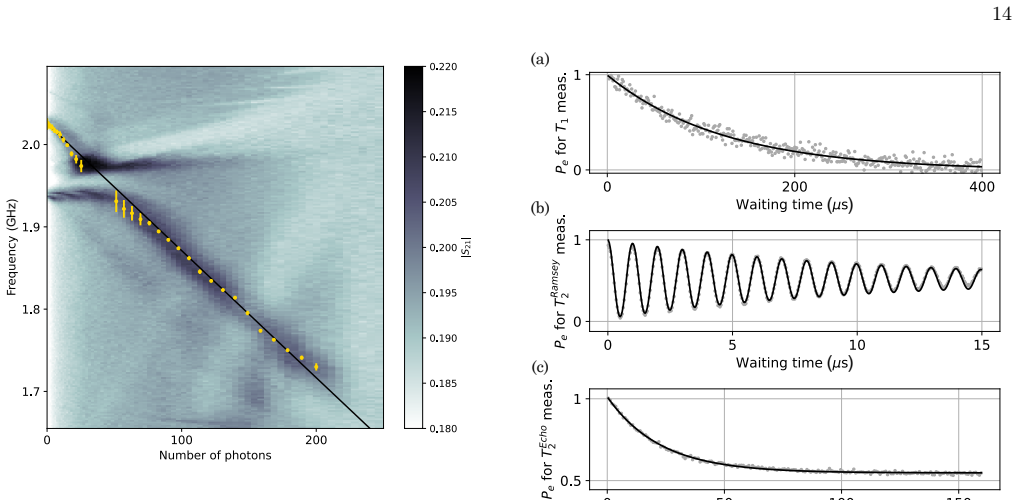
- [Appendix F and Fig. 3(b)] The photon-number axis used for the high-power QNDness map in Fig. 3(b) is calibrated via the AC-Stark shift using nbar_r(P) = Delta-omega_q(P)/(2 chi_qr). The last sentence of Appendix F states that this linear calibration was experimentally verified only up to 200 photons and then extrapolated to higher powers. Because the quantitative claims 'errors below 4% up to 300 photons' and 'the onset near 400 photons coincides with nbar_r^crit = 377' are read off this extrapolated axis, the linearity assumption is load-bearing. If the AC-Stark shift saturates or deviates from linearity above 200 photons, the photon-number scale is overestimated and the apparent coincidence with the theoretical ncrit would shift. I recommend extending the calibration into the 300-400 photon range, or, if that is not possible, explicitly marking the extrapolated region in Fig. 3 and softening the quantitative wording of the plateau and onset claims.
- [Section VI, Eq. (A14)] The theoretical critical photon number nbar_r^crit = nbar_r^lowphi = 377 is presented as a quantitative prediction that coincides with the measured onset of QNDness errors. Equation (A14) is evaluated using EJ, La, ECa, and sin^2(theta), but Table II does not specify whether these are measured values, design targets, or extracted fit parameters, nor does it give their uncertainties. To make the claimed agreement convincing, the manuscript should state the provenance of each input and propagate its uncertainty to nbar_r^crit, or at least give a sensitivity estimate. As written, the good agreement between 377 and the observed onset could be fortuitous, especially given the calibration caveat in Appendix F.
minor comments (5)
- [Section IV.A] When the readout power is first quoted as '89 photons', the text refers the reader to Appendix F for the calibration; it would be helpful to state already at that point that the calibration is linear only up to 200 photons and that higher-power data are extrapolated.
- [Fig. 7 caption] The caption says 'ovelayed black line' and the main text says 'shifts quite linearly as a function of power until it reaches about 1.7 GHz'; this wording is ambiguous because it is not clear whether 1.7 GHz refers to the shifted qubit frequency or to the total shift. Please clarify the sentence and correct the typo.
- [Section VI, Eq. (A10)] The derivation of nbar_r^RWA states that the perturbative term 'reaches the same probability amplitude as the non-perturbative term,' but the threshold criterion is not precisely defined. Please state the exact condition used to obtain Eq. (A10).
- [Appendix A.4] The equivalent standard readout scheme uses a transverse coupling g_eq/(2pi) = 515 MHz, which is a very large coupling that would also produce strong dressing beyond the dispersive approximation; the comparison is illustrative, but it should be labelled as such so that the derived nbar_std^crit = 26 is not overinterpreted.
- [Appendix G] The sentence introducing Eq. (G2) says 'the dephasing induced by both of the readout mode and the unused lower polariton, which is noted with the index l'; this is grammatically awkward and should be rephrased for clarity.
Circularity Check
No significant circularity: the headline fidelities and QNDness values are direct measurements, and the 377-photon critical number is derived from independently determined circuit parameters, not fitted to the QNDness data; the acknowledged AC-Stark extrapolation is a calibration risk, not a circular step.
full rationale
The paper's central quantitative claims (99.21% post-selected fidelity at 89 photons, 96.7% QNDness, QNDness errors below 4% up to 300 photons) are direct experimental measurements of a fabricated device. They are not derived from the theory, so they cannot reduce by construction to the theory's inputs. The only theoretical prediction is the critical photon number nbar_r^crit = 377, derived in Appendix A.3c from the low-phase-drop condition via Eq. (A14) using EJ, LJ/La, ECa, and sin^2(theta); these are spectroscopically and geometrically determined circuit parameters, not values fitted to the QNDness error map. The paper explicitly frames the comparison as qualitative ('qualitatively explained', 'coincides with an abrupt increase'), which is a post-hoc consistency check rather than a fitted prediction. The genuine weakness is the Appendix F photon-number calibration nbar(P) = Delta_omega_q(P)/(2 chi_qr), which the manuscript itself states was experimentally verified only up to 200 photons and then extrapolated to higher power; this could shift the quantitative location of the 300-photon plateau and the 377-photon onset if the AC-Stark shift becomes nonlinear above 200 photons, but it is a calibration extrapolation risk, not a logical circularity. The self-citations to [11,12,16] supply the circuit Hamiltonian, the prior low-power transmon-molecule demonstration, and the QNDness protocol; these are published, parameter-free derivations and are not invoked as a uniqueness theorem to forbid alternative explanations. No load-bearing step in the derivation chain is equivalent to its own input by definition, so no specific circular step is identified under the quote-and-reduction standard.
Assumptions & free parameters
assumptions (6)
- domain assumption The transmon molecule circuit Hamiltonian (Eq. A1), including the cosφ coupling term, is taken from Refs [11,12] as the starting point.
- domain assumption Low phase-drop approximation ⟨φ_q,a²⟩≪1, used to Taylor expand the cosφ coupling to fourth order.
- domain assumption Rotating-wave approximation is applied to the cosφ coupling and the ancilla-cavity coupling.
- domain assumption The ancilla mode is approximated as linear when forming polaritons, and the unused lower polariton is assumed to remain in vacuum.
- domain assumption The qubit mode is decoupled from the resonator by dipole-moment orthogonality (symmetry), so no direct transverse coupling or Purcell decay is present in the ideal model.
- domain assumption Photon number is extracted from the AC-Stark shift as nbar = Δωq/(2χqr), assuming χqr remains constant with power.
Cite this review
Pith. "Pith review of High-power readout of a transmon qubit using a nonlinear coupling." pith.science (2026). https://pith.science/paper/HQOMONOJ
@misc{pith2026250703642,
  author       = {Pith},
  title        = {Pith review of: High-power readout of a transmon qubit using a nonlinear coupling},
  year         = {2026},
  howpublished = {\url{https://pith.science/paper/HQOMONOJ}},
  note         = {Machine review of arXiv:2507.03642}
}
abstract
The field of superconducting qubits is constantly evolving with new circuit designs. However, when it comes to qubit readout, the use of simple transverse linear coupling remains overwhelmingly prevalent. This standard readout scheme has significant drawbacks: in addition to the Purcell effect, it suffers from a limitation on the maximal number of photons in the readout mode, which restricts the signal-to-noise ratio (SNR) and the Quantum Non-Demolition (QND) nature of the readout. Here, we explore the high-power regime by engineering a nonlinear coupling between a transmon qubit and its readout mode. Our approach builds upon previous work by Dassonneville et al. [Physical Review X 10, 011045 (2020)], on qubit readout with a non-perturbative cross-Kerr coupling in a transmon molecule. We demonstrate a readout fidelity of 99.21% with 89 photons utilizing a parametric amplifier. At this elevated photon number, the QND nature remains high at 96.7%. Even with up to 300 photons, the QNDness is only reduced by a few percent. This is qualitatively explained by deriving a critical number of photons associated with the nonlinear coupling, yielding a theoretical value of $\bar{n}_r^\text{crit} = 377$ photons for our sample's parameters. These results highlight the promising performance of the transmon molecule in the high-power regime, establishing it as a compelling platform for high-fidelity qubit readout.
Figures


Figures from the paper (4 more)


Forward citations
Cited by 4 Pith papers
-
Collapse and Inversion of the Josephson Potential in a Strongly Driven Superconducting Circuit
The Josephson potential of a transmon collapses and inverts under a strong fast flux drive, dynamically stabilizing the qubit at φ=π, as shown by spectroscopy and readout.
-
Analytic gradients for low-rank quantum optimal control
A new gradient-based quantum control algorithm propagates only a low-rank factorization of the density matrix, giving analytic gradients and quadratic speedups over full master-equation simulations for high-purity protocols.
-
Readout-Induced Leakage in Superconducting Circuits with Nonlinear Couplings
Native nonlinear qubit-readout couplings alone neither eliminate nor reliably suppress readout-induced leakage; auxiliary modes reintroduce multiphoton channels whose rates vary by orders of magnitude over <7% frequen...
-
Suppression of measurement-induced state transitions in cos{\phi}-coupling transmon readout
A cos-phi-coupled transmon readout is experimentally free of measurement-induced state transitions up to roughly 300 photons, with flux-controlled activation of specific transitions.
Reference graph
Works this paper leans on
-
[12]
All the modes are simulated for1 Joule of stored energy so that the re- sults are comparable
as well as the current circular design. All the modes are simulated for1 Joule of stored energy so that the re- sults are comparable. Both simulated designs also have the same resonant frequencies: here, the qubit mode is around 2 GHz and the ancilla mode is around3.5 GHz. From the simulations, we can compute the field distribu- tion and the total average...
-
[1]
Transmon molecule Hamiltonian The Hamiltonian for the transmon molecule circuit [green circuit in Fig. 1(c)] is derived in [11, 12]. It is flux-dependent due to the superconducting loop formed by the two Josephson junctions and the inductance and takes the following form: ˆHtm(Φext) = 4ECq ˆn2 q − EJq cos ( ˆφq) + 4ECa ˆn2 a −2EJ " cos ( ˆφa) − LJ La(Φext...
-
[2]
Hybridization of the readout mode The previous subsection showed that the transmon molecule implements a transmon which can be measured through another circuit mode, called ancilla. The ancilla mode has promising characteristics for a readout mode but it cannot be used as such because it is uncoupled to the exterior in our present description. In order to...
-
[3]
There are thus other approximations which become limiting in the high-power regime
Critical number of photons for the transmon molecule Since the transmon molecule readout scheme does not rely on any high-detuning approximation, the standard critical number of photons becomes meaningless. There are thus other approximations which become limiting in the high-power regime. The three main assumptions made for attaining the ideal cross-Kerr...
-
[4]
Equivalent transverse-coupling readout scheme To highlight the benefits of the cos φ-coupling, the sample can be compared to an equivalent transversely- coupled-transmon. The standard readout scheme uses the Hamiltonian ˆH eq std/ℏ = ωeq q ˆq† ˆq + αeq q 2 ˆq† ˆq† ˆq ˆq + ωeq c ˆc†ˆc + geq x ˆqˆc† + ˆq†ˆc , (A15) where ωeq q is the transmon’s resonant fre...
-
[5]
Full microwave setup The full microwave setup is shown in Fig. 4. The cav- ity control and qubit control pulses are generated by a Quantum Machines OPX+ and up-converted by a Quan- tum Machines Octave. The two control signals are then combined and sent to the cavity through a common mi- crowave line. The cavity’s output signal is amplified at base tempera...
-
[6]
We use its TE101 mode for the transmon molecule read- out scheme
Cavity characteristics The 3D resonator used is a rectangular cavity made of OFHC copper, with dimensions 5 × 24.5 × 35 mm. We use its TE101 mode for the transmon molecule read- out scheme. The cavity can be probed in transmission 4 K 300 K 30 mK -20 dB-20 dB-20 dBEcco. Ecco. -20 dB -6 dB -10 dB HEMT TWPA -20 dBEcco. Ecco. -10 dB -3 dB Oct. Oct. ~ ~ Oct. ...
-
[7]
Sample design As explained in the Section III, misaligning the trans- mon molecule and the 3D resonator can lead to remnants of transverse coupling and Purcell effect. In order to be less sensitive to misalignment, the design of the new gen- eration of samples was changed to a circular shape, in- spired by the concentric transmons [47, 48]. Since the tran...
Show all 60 references
-
[8]
Connolly, P
T. Connolly, P. D. Kurilovich, V. D. Kurilovich, C. G. L. Bøttcher, S. Hazra, W. Dai, A. Z. Ding, V. R. Joshi, H. Nho, S. Diamond, D. K. Weiss, V. Fatemi, L. Frunzio, L. I. Glazman, and M. H. Devoret, Full characterization of measurement-induced transitions of a superconductin...
2025 arXiv
-
[9]
Circuit parameters The circuit’s electrical parameters must be tuned to increase ∆qc and reduce αa. However, there are many constraints to be considered simultaneously, so we start from the previous set of parameters from [12], shown in Table II, and vary them to improve the s...
-
[10]
P. W. Shor, Scheme for reducing decoherence in quantum computer memory, Physical Review A52, R2493 (1995)
1995
-
[11]
D. E. Gottesman, Stabilizer Codes and Quantum Error 15 Correction, Ph.D. thesis, California Institute of Technol- ogy (1997)
1997
-
[13]
J. E. Johnson, C. Macklin, D. H. Slichter, R. Vijay, E. B. Weingarten, J. Clarke, and I. Siddiqi, Heralded State Preparation in a Superconducting Qubit, Physical Re- view Letters109, 050506 (2012)
2012
-
[14]
Ristè, C
D. Ristè, C. C. Bultink, K. W. Lehnert, and L. DiCarlo, Feedback Control of a Solid-State Qubit Using High- Fidelity Projective Measurement, Physical Review Let- ters 109, 240502 (2012)
2012
-
[15]
J. Koch, T. M. Yu, J. Gambetta, A. A. Houck, D. I. Schuster, J. Majer, A. Blais, M. H. Devoret, S. M. Girvin, and R. J. Schoelkopf, Charge-insensitive qubit design de- rived from the Cooper pair box, Physical Review A76, 042319 (2007)
2007
-
[16]
Swiadek, R
F. Swiadek, R. Shillito, P. Magnard, A. Remm, C. Hellings, N. Lacroix, Q. Ficheux, D. C. Zanuz, G. J. Norris, A. Blais, S. Krinner, and A. Wallraff, Enhancing Dispersive Readout of Superconducting Qubits through Dynamic Control of the Dispersive Shift: Experiment and Theory, P...
2024
-
[17]
P. D. Kurilovich, T. Connolly, C. G. L. Bøttcher, D. K. Weiss, S. Hazra, V. R. Joshi, A. Z. Ding, H. Nho, S. Di- amond, V. D. Kurilovich, W. Dai, V. Fatemi, L. Frun- zio, L. I. Glazman, and M. H. Devoret, High-frequency readout free from transmon multi-excitation resonances (2...
2025 arXiv
-
[18]
Gusenkova, M
D. Gusenkova, M. Spiecker, R. Gebauer, M. Willsch, D. Willsch, F. Valenti, N. Karcher, L. Grünhaupt, I. Tak- makov, P. Winkel, D. Rieger, A. V. Ustinov, N. Roch, W.Wernsdorfer, K.Michielsen, O.Sander,andI.M.Pop, Quantum Nondemolition Dispersive Readout of a Super- conducting A...
2021
-
[19]
Takmakov, P
I. Takmakov, P. Winkel, F. Foroughi, L. Planat, D. Gusenkova, M. Spiecker, D. Rieger, L. Grünhaupt, A. Ustinov, W. Wernsdorfer, I. Pop, and N. Roch, Min- imizing the Discrimination Time for Quantum States of an Artificial Atom, Physical Review Applied15, 064029 (2021)
2021
-
[20]
Diniz, E
I. Diniz, E. Dumur, O. Buisson, and A. Auffèves, Ultra- fast quantum nondemolition measurements based on a diamond-shaped artificial atom, Physical Review A87, 033837 (2013)
2013
-
[21]
Dassonneville, T
R. Dassonneville, T. Ramos, V. Milchakov, L. Planat, E. Dumur, F. Foroughi, J. Puertas, S. Leger, K. Bharad- waj, J. Delaforce, C. Naud, W. Hasch-Guichard, J. García-Ripoll, N. Roch, and O. Buisson, Fast High- Fidelity Quantum Nondemolition Qubit Readout via a Nonperturbative ...
2020
-
[22]
Y. Ye, J. B. Kline, S. Chen, A. Yen, and K. P. O’Brien, Ultrafast superconducting qubit readout with the quarton coupler, Science Advances10, 10.1126/sci- adv.ado9094 (2024)
2024 doi
-
[23]
Pfeiffer, M
F. Pfeiffer, M. Werninghaus, C. Schweizer, N. Bruck- moser, L. Koch, N. Glaser, G. Huber, D. Bunch, F. Haslbeck, M. Knudsen, G. Krylov, K. Liegener, A. Marx, L. Richard, J. Romeiro, F. Roy, J. Schirk, C. Schneider, M. Singh, L. Södergren, I. Tsitsilin, F. Wallner, C. Riofrío, ...
2024
-
[24]
K. V. Salunkhe, S. Kundu, S. Das, J. Deshmukh, M. P. Patankar, and R. Vijay, The quantromon: A qubit- resonator system with orthogonal qubit and readout modes, arXiv:2501.17439 [quant-ph] (2025)
2025 arXiv
-
[25]
Dassonneville, T
R. Dassonneville, T. Ramos, V. Milchakov, C. Mori, L. Planat, F. Foroughi, C. Naud, W. Hasch-Guichard, J. García-Ripoll, N. Roch, and O. Buisson, Transmon- qubit readout using an in situ bifurcation amplification in the mesoscopic regime, Physical Review Applied20, 044050 (2023)
2023
-
[26]
Didier, J
N. Didier, J. Bourassa, and A. Blais, Fast Quantum Non- demolition Readout by Parametric Modulation of Lon- gitudinal Qubit-Oscillator Interaction, Physical Review Letters 115, 203601 (2015)
2015
-
[27]
A. A. Chapple, A. McDonald, M. H. Muñoz-Arias, and A. Blais, Robustness of longitudinal transmon readout to ionization (2024), arXiv:2412.07734 [quant-ph]
2024
-
[28]
Blais, R.-S
A. Blais, R.-S. Huang, A. Wallraff, S. M. Girvin, and R. J. Schoelkopf, Cavity quantum electrodynamics for superconducting electrical circuits: An architecture for quantum computation, Physical Review A 69, 062320 (2004)
2004
-
[29]
Gambetta, A
J. Gambetta, A. Blais, D. I. Schuster, A. Wallraff, L. Frunzio, J. Majer, M. H. Devoret, S. M. Girvin, and R. J. Schoelkopf, Qubit-photon interactions in a cavity: Measurement-induced dephasing and number splitting, Physical Review A74, 042318 (2006)
2006
-
[30]
Dumur, B
E. Dumur, B. Küng, A. Feofanov, T. Weißl, Y. Krupko, N. Roch, C. Naud, W. Guichard, and O. Buisson, Unex- pectedly Allowed Transition in Two Inductively Coupled Transmons, IEEE Transactions on Applied Superconduc- tivity 26, 1 (2016)
2016
-
[31]
Wallraff, D
A. Wallraff, D. I. Schuster, A. Blais, L. Frunzio, J. Ma- jer, M. H. Devoret, S. M. Girvin, and R. J. Schoelkopf, Approaching Unit Visibility for Control of a Supercon- ducting Qubit with Dispersive Readout, Physical Review Letters 95, 060501 (2005)
2005
-
[32]
Niemeyer and V
J. Niemeyer and V. Kose, Observation of large dc super- currents at nonzero voltages in josephson tunnel junc- tions, Applied Physics Letters29, 380 (1976)
1976
-
[33]
G.J.Dolan,Offsetmasksforlift-offphotoprocessing,Ap- plied Physics Letters31, 337 (1977)
1977
-
[34]
Lecocq, I
F. Lecocq, I. M. Pop, Z. Peng, I. Matei, T. Crozes, T. Fournier, C. Naud, W. Guichard, and O. Buisson, Junction fabrication by shadow evaporation without a suspended bridge, Nanotechnology22, 315302 (2011)
2011
-
[35]
Ranadive, M
A. Ranadive, M. Esposito, L. Planat, E. Bonet, C. Naud, O. Buisson, W. Guichard, and N. Roch, Kerr reversal in Josephson meta-material and traveling wave parametric amplification, Nature Communications13, 1737 (2022)
2022
-
[36]
Walter, P
T. Walter, P. Kurpiers, S. Gasparinetti, P. Mag- nard, A. Potočnik, Y. Salathé, M. Pechal, M. Mon- dal, M. Oppliger, C. Eichler, and A. Wallraff, Rapid High-Fidelity Single-Shot Dispersive Readout of Super- conducting Qubits, Physical Review Applied7, 054020 (2017)
2017
-
[37]
Spring, L
P. Spring, L. Milanovic, Y. Sunada, S. Wang, A. Loo, S. Tamate, and Y. Nakamura, Fast multiplexed super- conducting qubit readout with intrinsic Purcell filtering 16 (2024), arXiv:2409.04967 [quant-ph]
2024 arXiv
-
[38]
Leroux, C
S.Krinner, N.Lacroix, A.Remm, A.DiPaolo, E.Genois, C. Leroux, C. Hellings, S. Lazar, F. Swiadek, J. Her- rmann, G.J.Norris, C.K.Andersen, M.Müller, A.Blais, C. Eichler, and A. Wallraff, Realizing repeated quantum error correction in a distance-three surface code, Nature 605, 6...
2022
-
[39]
K. C. Miao, M. McEwen, J. Atalaya, D. Kafri, L. P. Pryadko, A. Bengtsson, A. Opremcak, K. J. Satzinger, Z. Chen, P. V. Klimov, C. Quintana, R. Acharya, K. An- derson, M. Ansmann, F. Arute, K. Arya, A. Asfaw, J. C. Bardin, A. Bourassa, J. Bovaird, L. Brill, B. B. Buckley, D. A....
2023
-
[40]
Pereira, J
L. Pereira, J. García-Ripoll, and T. Ramos, Complete Physical Characterization of Quantum Nondemolition Measurements via Tomography, Physical Review Letters 129, 010402 (2022)
2022
-
[41]
Pereira, J
L. Pereira, J. J. García-Ripoll, and T. Ramos, Parallel tomography of quantum non-demolition measurements in multi-qubit devices, npj Quantum Information9, 22 (2023)
2023
-
[42]
Hazra, W
S. Hazra, W. Dai, T. Connolly, P. Kurilovich, Z. Wang, L. Frunzio, and M. Devoret, Benchmarking the readout of a superconducting qubit for repeated measurements (2024), arXiv:2407.10934 [quant-ph]
2024 arXiv
-
[43]
Touzard, A
S. Touzard, A. Kou, N. Frattini, V. Sivak, S. Puri, A. Grimm, L. Frunzio, S. Shankar, and M. Devoret, Gated Conditional Displacement Readout of Supercon- ducting Qubits, Physical Review Letters 122, 080502 (2019)
2019
-
[44]
Gambetta, A
J. Gambetta, A. Blais, M. Boissonneault, A. A. Houck, D. I. Schuster, and S. M. Girvin, Quantum trajectory approach to circuit QED: Quantum jumps and the Zeno effect, Physical Review A77, 012112 (2008)
2008
-
[45]
Blais, A
A. Blais, A. L. Grimsmo, S. Girvin, and A. Wallraff, Circuit quantum electrodynamics, Reviews of Modern Physics 93, 025005 (2021)
2021
-
[46]
D. Sank, Z. Chen, M. Khezri, J. Kelly, R. Barends, B. Campbell, Y. Chen, B. Chiaro, A. Dunsworth, A. Fowler, E. Jeffrey, E. Lucero, A. Megrant, J. Mu- tus, M. Neeley, C. Neill, P. O’Malley, C. Quintana, P. Roushan, A. Vainsencher, T. White, J. Wenner, A. N. Korotkov, and J. M....
2016
-
[47]
F. R. Ong, M. Boissonneault, F. Mallet, A. Palacios- Laloy, A. Dewes, A. C. Doherty, A. Blais, P. Bertet, D. Vion, and D. Esteve, Circuit QED with a Nonlin- ear Resonator: ac-Stark Shift and Dephasing, Physical Review Letters106, 167002 (2011)
2011
-
[48]
C.EichlerandA.Wallraff,Controllingthedynamicrange ofaJosephsonparametricamplifier,EPJQuantumTech- nology 1, 1 (2014)
2014
-
[49]
Eichler, Y
C. Eichler, Y. Salathe, J. Mlynek, S. Schmidt, and A. Wallraff, Quantum-Limited Amplification and Entan- glement in Coupled Nonlinear Resonators, Physical Re- view Letters113, 110502 (2014)
2014
-
[50]
N. E. Frattini, V. V. Sivak, A. Lingenfelter, S. Shankar, and M. H. Devoret, Optimizing the Nonlinearity and Dis- sipation of a SNAIL Parametric Amplifier for Dynamic Range, Physical Review Applied10, 054020 (2018)
2018
-
[51]
Planat, R
L. Planat, R. Dassonneville, J. P. Martínez, F. Foroughi, O. Buisson, W. Hasch-Guichard, C. Naud, R. Vijay, K. Murch, and N. Roch, Understanding the Saturation Power of Josephson Parametric Amplifiers Made from SQUID Arrays, Physical Review Applied 11, 034014 (2019)
2019
-
[52]
Planat, A
L. Planat, A. Ranadive, R. Dassonneville, J. Puer- tas Martínez, S. Léger, C. Naud, O. Buisson, W. Hasch- Guichard, D. M. Basko, and N. Roch, Photonic-Crystal Josephson Traveling-Wave Parametric Amplifier, Physi- cal Review X10, 021021 (2020)
2020
-
[53]
W. Hu, K. Sarveswaran, M. Lieberman, and G. H. Bernstein, Sub-10 nm electron beam lithography us- ing cold development of poly(methylmethacrylate), Jour- nal of Vacuum Science & Technology B: Microelectron- ics and Nanometer Structures Processing, Measurement, and Phenomena22,...
2004
-
[54]
B. Cord, J. Lutkenhaus, and K. K. Berggren, Optimal temperature for development of poly(methylmethacrylate), Journal of Vacuum Sci- ence & Technology B: Microelectronics and Nanometer Structures Processing, Measurement, and Phenomena 25, 2013 (2007)
2007
-
[55]
L. E. Ocola and A. Stein, Effect of cold development on improvement in electron-beam nanopatterning reso- lution and line roughness, Journal of Vacuum Science & Technology B: Microelectronics and Nanometer Struc- tures Processing, Measurement, and Phenomena 24, 3061 (2006)
2006
-
[56]
Braumüller, M
J. Braumüller, M. Sandberg, M. R. Vissers, A. Schneider, S. Schlör, L. Grünhaupt, H. Rotzinger, M. Marthaler, A. Lukashenko, A. Dieter, A. V. Ustinov, M. Weides, and D. P. Pappas, Concentric transmon qubit featuring fast tunability and an anisotropic magnetic dipole moment, Ap...
2016 doi
-
[57]
Spring, T
J.Rahamim, T.Behrle, M.J.Peterer, A.Patterson, P.A. Spring, T. Tsunoda, R. Manenti, G. Tancredi, and P. J. Leek, Double-sided coaxial circuit qed with out-of-plane wiring, Applied Physics Letters110, 10.1063/1.4984299 (2017)
2017 doi
-
[58]
D. I. Schuster, A. Wallraff, A. Blais, L. Frunzio, R.-S. Huang, J. Majer, S. M. Girvin, and R. J. Schoelkopf, ac Stark Shift and Dephasing of a Superconducting Qubit 17 Strongly Coupled to a Cavity Field, Physical Review Let- ters 94, 123602 (2005)
2005
-
[59]
L. B. Nguyen, G. Koolstra, Y. Kim, A. Morvan, T. Chis- tolini, S. Singh, K. N. Nesterov, C. Jünger, L. Chen, Z. Pedramrazi, B. K. Mitchell, J. M. Kreikebaum, S. Puri, D. I. Santiago, and I. Siddiqi, Blueprint for a High-Performance Fluxonium Quantum Processor, PRX Quantum 3, 0...
2022
-
[60]
Bertet, I
P. Bertet, I. Chiorescu, G. Burkard, K. Semba, C. J. P. M. Harmans, D. P. DiVincenzo, and J. E. Mooij, De- phasing of a Superconducting Qubit Induced by Photon Noise, Physical Review Letters95, 257002 (2005)
2005
Reviewed August 6, 2026 · model on record in the stance chip above.
Discussion (0). Continue with ORCID to comment.