REVIEW 3 major objections 5 minor 2 cited by
Rotational susceptibility of a hot and dense hadronic matter
T0 review · 3 major / 5 minor · reviewed 2026-08-06 · deepseek-v4-flash
Pith's one-line read A rotating hadron gas shows a non-monotonic response near the QCD phase transition.
desk verdict Clean higher-order rotational susceptibility calculation in a rotating VDW HRG, but the 'QCD phase transition' bump is the model's liquid-gas transition—the claim overreaches. read the letter →
The pith
A machine-rendered reading of the paper's core claim, the machinery that carries it, and where it could break.
The reading
What carries the argument
The central object is the rotational susceptibility $\chi^n_\omega$, defined through the pressure expansion in $\omega/T$. The calculation starts from a phase-space distribution for a rigidly rotating relativistic gas that contains the spin factor $\sinh\left(\left(s+\frac12\right)\omega/T\right)/\sinh(\omega/2T)$, then feeds it into the van der Waals equation of state, whose attractive parameter $a$ and repulsive excluded-volume parameter $b$ modify the chemical potentials. The bump arises from the interplay of these interactions with finite baryon chemical potential and is the main carrier of the paper's phase-transition argument.
What would settle it
Recompute the rotational susceptibilities with $a$ and $b$ as functions of angular velocity, for example fitted to rotating lattice QCD or derived from a microscopic model, and check whether the bump at $\mu_B = 0.436$ GeV survives; if it disappears, the claimed phase-transition signature is an artifact of neglecting the $\omega$-dependence of the interaction parameters.
Extended reading notes
Core claim
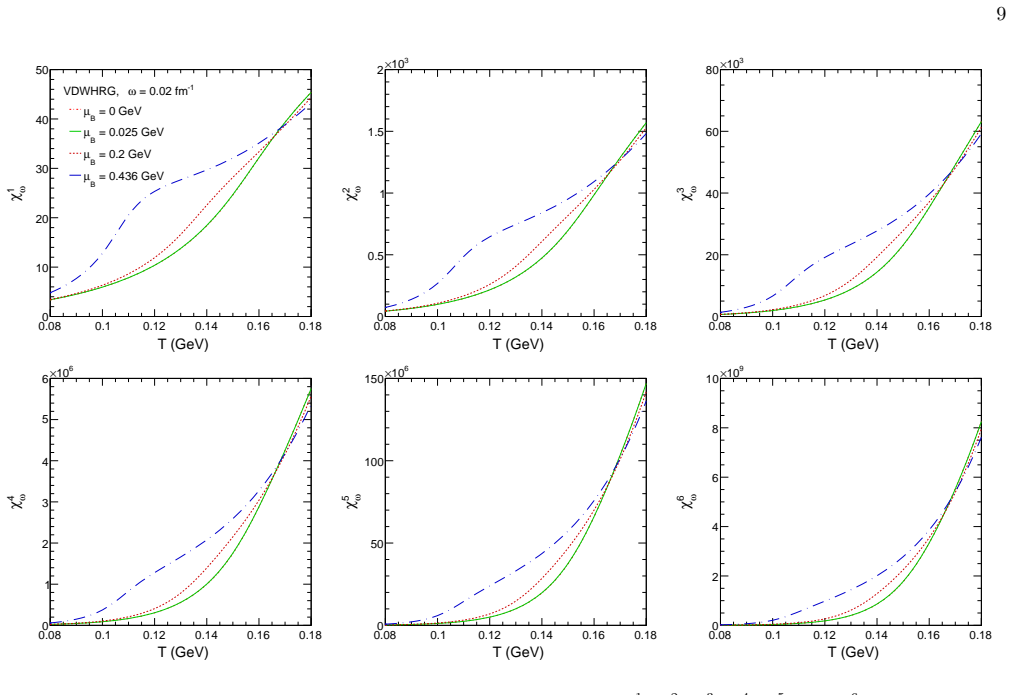
The central claim is that the rotational susceptibility $\chi^n_\omega = \partial^n[P(T,\mu,\omega)/T^4]/\partial(\omega/T)^n$, defined as the pressure response to angular velocity, is a phase-transition probe. In the van der Waals hadron resonance gas, at $\mu_B = 0.436$ GeV all computed orders ($n=1$ through $6$) show a bump structure at intermediate temperatures, which the authors present as a possible signature of the QCD phase transition. The paper also establishes that all susceptibilities grow with temperature and rotation, that hadronic interactions suppress their magnitude, that spin-0 hadrons dominate the second-order response at high temperature, and that the susceptibility ratios obey a fixed ordering between even and odd orders.
Load-bearing premise
The van der Waals attraction and repulsion parameters, fitted to non-rotating matter, are taken to be unchanged when the system rotates; if interaction strengths actually depend on rotation, the predicted bump could be an artifact of that approximation.
Editorial extensions
If this is right
- Angular-momentum fluctuation measurements in beam energy scan experiments could look for a non-monotonic response at the highest baryon densities.
- The even-odd ordering of susceptibility ratios gives a model-specific pattern that can be tested independently of overall normalization.
- The paper argues rotational susceptibilities are less affected by diffusion and smearing than baryon-number susceptibilities, making them a complementary probe.
- The strong sensitivity to the van der Waals parameters suggests the observable could constrain hadronic interaction strengths if measured.
- The increase of the ratios at low $\sqrt{s_{NN}}$ points to the low-energy region as the most promising place to search for the effect.
Reading between the lines
- A natural extension is to compute the same susceptibilities with rotation-dependent $a$ and $b$; if the bump persists, the signal is robust, and if not, the current result is an artifact of that approximation.
- The same formalism could be adapted to the partonic phase, for instance with a rotating Nambu-Jona-Lasinio model, to see whether the bump sharpens or shifts across the crossover.
- The dominance of spin-0 pions in the high-temperature rotational response suggests that measurements of vector-meson versus hyperon polarization might discriminate between the model's spin dependence.
- Since centrality controls the initial orbital angular momentum, a centrality-dependent measurement of rotational susceptibility ratios could be a sharper experimental test than energy dependence alone.
Editorial analysis
A structured set of objections, weighed in public.
Referee Report
Summary. The paper studies rotational susceptibilities χω^n = ∂^n(P/T^4)/∂(ω/T)^n in an ideal hadron resonance gas and in a van der Waals HRG model at zero and finite baryon chemical potential. It reports first estimates of these quantities, studies their dependence on particle spin, system size, rotation rate, and μB, and forms higher-order ratios. At μB = 0.436 GeV the authors find a non-monotonic bump in all rotational susceptibilities and interpret it as a possible signature of the QCD phase transition. The paper also maps some ratios to sqrt(sNN) using a standard freeze-out parametrization.
Significance. If the physical interpretation were established, the paper would provide a new model-based observable for angular momentum fluctuations near the QCD phase boundary. The computations are clearly laid out, the figures are internally consistent, and the comparison with the NJL-model result in Fig. 3 is useful. However, the central claim overreaches: the bump at μB = 0.436 GeV is a feature of the van der Waals liquid-gas transition in a purely hadronic model, not a demonstrated QCD phase-transition signal. In addition, the paper explicitly relies on van der Waals parameters a and b that are assumed to be independent of rotation, an assumption that directly affects the derivatives defining the main observables. These issues make the central conclusion conditional on two untested identifications.
major comments (3)
- [Section III, Fig. 5, Eqs. (12)–(14)] The non-monotonic bump at μB = 0.436 GeV is presented as 'a possible signature of the QCD phase transition.' Since the VDWHRG model contains only hadronic degrees of freedom and no deconfinement mechanism, the only phase transition in the model is the liquid-gas transition generated by the attractive van der Waals term a; the authors' own Ref. [46] identifies this transition in the same model as a liquid-gas transition. The paper neither maps the bump onto the VDW coexistence boundary nor provides a quantitative argument that this mean-field transition represents the QCD transition. The central conclusion therefore overreaches what the model can support; it should be reframed as a signature of the VDW liquid-gas transition, or a concrete connection to QCD must be established.
- [Section II.A, Eqs. (7)–(16), Eq. (21)] The calculation assumes that the van der Waals parameters a and b are independent of rotation. The manuscript explicitly states that 'in principle, these parameters should vary as a function of rotation' but neglects this dependence. This is load-bearing because the observables are derivatives with respect to ω; an ω-dependence of the interaction would introduce additional terms in χω^n, and the bump in Fig. 5 is controlled by the attractive term a. Please test the robustness of the bump and the ratio ordering under a plausible ω-dependent parameterization or under a comparison with a rotating model that allows a and b to vary, or state explicitly that the result is conditional on this untested assumption.
- [Section II.B and Section III, ratio discussion] The statements that χ2ω/χ1ω is related to angular-momentum diffusivity, χ3ω/χ1ω measures skewness, and χ4ω/χ2ω peaks near the phase transition are asserted by analogy with conserved-charge susceptibilities. Angular momentum is not a conserved charge in the same sense as B, Q, or S, and the paper later concedes that 'it is not straightforward to assign a conserved charge associated with the rotational susceptibility' and that measuring angular momentum fluctuations is 'non-trivial.' The experimental relevance of these ratios as a probe therefore remains unsubstantiated; a concrete relation between χω^n and a measurable quantity, for example through spin-vorticity coupling, is needed before the ratios can be called ideal observables.
minor comments (5)
- [Section III, Fig. 4 caption] The caption says the ratios are shown 'as a functions of temperature and rotation,' but each panel is a function of T at fixed ω; please reword the caption to match the plotted quantities.
- [Section III, Fig. 3 and causality discussion] The text states that causality requires ωR<1 and that saturation occurs near ω=0.2 fm^-1 for R=5 fm, but the figure appears to show χω up to larger ω; please clarify the plotted range and mark the causality boundary.
- [Eq. (1)] The rotating distribution function is written with an overall exponential exp[(p·v)/T] multiplying a Fermi/Bose denominator that shows no ω dependence; please check consistency with the standard rotating-frame distribution, e.g., a denominator of the form exp[(E_i−μ_i−ω·J)/T], and with Ref. [46].
- [Section II.A, Eq. (3)] Eq. (3) defines P_i^id using the rotation-dependent f(x,p,ω), but the display does not show the ω dependence explicitly; it would help readers to state how Eqs. (7)–(16) inherit the rotation, given that the VDW parameters themselves do not.
- [Section III, ratio ordering] The text states an ordering χ2ω/χ4ω > χ4ω/χ6ω > χ2ω/χ6ω and χ3ω/χ1ω > χ5ω/χ3ω > χ5ω/χ1ω, but the corresponding panels in Fig. 4 appear to plot the inverse ratios; please reconcile the notation and the ordering statement. Minor typographical issues, including 'as a functions' in captions and the empty PACS number line after the abstract, should also be corrected.
Circularity Check
No significant circularity: the rotational susceptibilities are computed by differentiating an explicit VDWHRG pressure with fixed external parameters, and the reported bump is an emergent model output, not a fitted or self-referential prediction.
full rationale
The derivation chain is self-contained as a model calculation. Equation (1) gives the rotating single-particle distribution function, and Equation (3) derives the ideal pressure from it; the distribution function is taken from the authors' previous Ref. [46], but it is written out explicitly and is a standard rigid-rotation equilibrium form, not a quantity fitted to the paper's target observables. The van der Waals parameters a and b are taken from earlier hadron-gas phenomenology and lQCD-based fits (Refs. [19, 20, 50, 51]) and are not adjusted to reproduce any rotational susceptibility. The rotational susceptibilities are then defined as explicit derivatives of P/T^4 with respect to omega/T (Eq. 21), so all plotted quantities are computed outputs rather than inputs. The non-monotonic bump at mu_B = 0.436 GeV emerges from the attractive van der Waals term in the equation of state; it is not imposed by construction, and whether interpreting this model-internal liquid-gas-like transition as a 'possible signature of the QCD phase transition' is physically justified is a correctness/interprepretation question, not a circularity one. The paper also openly states the limitation that a and b are taken as rotation-independent; that is a modeling caveat, not a circular step. The self-citation to Ref. [46] supplies the phase-space distribution function but does not smuggle in the paper's conclusions: no susceptibility ratio, bump location, or phase-transition signal is equivalent by definition to that citation or to any fitted parameter.
Assumptions & free parameters
free parameters (5)
- van der Waals attractive parameter a =
0.926 GeV fm^3
- hard-core radii rM and rB =
rM = 0.2 fm, rB = 0.62 fm
- system size R =
5 fm, with 1 fm and 0.02 fm used for comparison
- freeze-out parametrization q1 to q5 =
q1 = 0.166 GeV, q2 = 0.139 GeV^-1, q3 = 0.053 GeV^-3, q4 = 1.308 GeV, q5 = 0.273 GeV^-1
- angular velocity values =
ω = 0.01, 0.02, 0.03, 0.04 fm^-1
assumptions (5)
- domain assumption The medium is a rigidly rotating equilibrium gas with constant angular velocity ω and causality bound ωR < 1; the velocity field is v = ω × x.
- domain assumption The single-particle distribution Eq. (1), including the spin factor sinh((s+1/2)ω/T)/sinh(ω/2T), is correct for relativistic rotating hadrons.
- ad hoc to paper The van der Waals parameters a and b are independent of rotation.
- domain assumption Thermodynamic quantities and susceptibilities are isotropic under rotation.
- domain assumption The fluctuation-dissipation relation χω = <(ΔJz)^2>/(kB T V) applies to a non-conserved angular momentum.
Cite this review
Pith. "Pith review of Rotational susceptibility of a hot and dense hadronic matter." pith.science (2026). https://pith.science/paper/OUVZIJ24
@misc{pith2026250703708,
  author       = {Pith},
  title        = {Pith review of: Rotational susceptibility of a hot and dense hadronic matter},
  year         = {2026},
  howpublished = {\url{https://pith.science/paper/OUVZIJ24}},
  note         = {Machine review of arXiv:2507.03708}
}
abstract
We study the effect of global rotation on rotational susceptibilities ($\chi^{(1)}_{\rm \omega}$, $\chi^{2}_{\rm \omega}$, etc.), which quantify how much the system responds to small angular velocities, in a hadron resonance gas produced by ultra-relativistic heavy ion collisions. The higher-order rotational susceptibilities and their ratios are estimated in the presence and absence of baryon chemical potential ($\mu_{\rm B}$) in the system. The effect of particle spin ($s$) and system size ($R$) on the first- and second-order rotational susceptibility is explored. To consider a more realistic scenario, the effect of interactions between hadrons is taken into account by considering van der Waals-like interactions, which include both attractive and repulsive interactions. To validate our results, a comparison with the ideal HRG as a baseline and a 3-flavour NJL model is shown. A nuclear liquid-gas phase transition, which is the characteristic feature of the van der Waals hadron resonance gas model, absent in an ideal hadron gas model, is probed via global rotation.
Figures


Figures from the paper (3 more)


Forward citations
Cited by 2 Pith papers
-
Vorticity-induced modifications of chemical freeze-out in heavy-ion collisions
Global rotation shifts the HRG chemical freeze-out curve to lower T and makes particle yield ratios more sensitive probes of vorticity than conserved-charge cumulant ratios.
-
Probing Rotational Dynamics of Quark Gluon Plasma via Global Vorticity
The paper fits hadron transverse-momentum spectra with a rotating Tsallis distribution to extract 'global vorticity', but never writes down the fitted formula or parameter values.
Reviewed August 6, 2026 · model on record in the stance chip above.
Discussion (0). Continue with ORCID to comment.