REVIEW 4 major objections 5 minor 25 references
FED-PV: A Large-Scale Synthetic Frame/Event Dataset for Particle-Based Velocimetry
T0 review · 4 major / 5 minor · reviewed 2026-08-06 · deepseek-v4-flash
Pith's one-line read This paper claims that the lack of cross-modal datasets combining frame-based particle images and event-camera streams is the main bottleneck for next-generation particle-based velocimetry, and introduces FED-PV, a generator and 350 GB…
desk verdict Useful new multimodal dataset for particle velocimetry, but the event generation needs to specify its threshold-crossing model before I'd trust the slow-flow subsets. read the letter →
The pith
A machine-rendered reading of the paper's core claim, the machinery that carries it, and where it could break.
The reading
What carries the argument
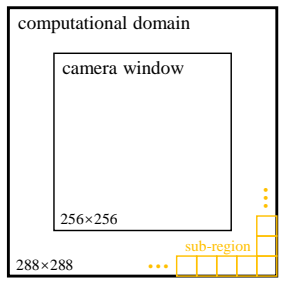
The core machinery is the FED-PV generation pipeline, which couples a particle image generator with an event simulator. Particles are modeled as two-dimensional Gaussian intensity profiles and advected through velocity fields using uniform linear motion over $0.02\,\mathrm{ms}$ micro-steps with bilinear interpolation of local velocity. The computational domain is extended from $256\times256$ to $288\times288$ with edge sub-region repopulation to keep particle density stable, and events are produced by comparing log-brightness changes between $100\,\mu\mathrm{s}$ frames against a fixed 25% threshold.
What would settle it
Take a real event camera and record a printed particle field moving at a known constant velocity on a translation stage, then compare the event rate, spatial distribution, and direction of events with FED-PV's generated events for the same nominal flow; if the real event rate versus contrast relationship or the distribution of inter-event times differs substantially from the 25%-threshold model, the synthetic events would not transfer to physical experiments.
Extended reading notes
Core claim
The central claim of the paper is that FED-PV provides the first large-scale dual-modal dataset for particle-based velocimetry, with synchronized frame and event recordings plus exact ground truth. The dataset is generated by dispersing synthetic Gaussian particles into known CFD flow fields, advecting them with small time steps, and producing events by thresholding log-brightness changes at a 25% contrast threshold. The authors demonstrate the dataset's utility by benchmarking three frame-based PIV methods and three event-based methods, reporting RMSE, AEE, and AAE statistics that show existing algorithms can recover flow structure but still leave room for improvement.
Load-bearing premise
The load-bearing premise is that thresholded log-brightness differences computed from synthetic Gaussian particle images with a fixed 25% contrast threshold and no sensor noise faithfully reproduce what a real event camera would record from a particle-laden flow.
Editorial extensions
If this is right
- Researchers can train and evaluate multimodal fusion networks for velocimetry on a common benchmark with known ground truth.
- Event-based velocimetry methods can be compared against frame-based PIV baselines under identical flow conditions, enabling head-to-head assessment.
- The open-source generator allows custom datasets with different particle densities, thresholds, and velocity fields, supporting domain-specific studies.
- The benchmark numbers (RMSE, AEE, AAE) provide reference points that future PV algorithms can be tested against.
- The dataset's event streams enable studies of event-camera temporal resolution for flows with velocities from 0.1 to 8.3 pixels/ms.
Reading between the lines
- The fixed 25% contrast threshold and noise-free event model may make FED-PV events cleaner than real sensor output; algorithms tuned on this dataset could overfit to noiseless events, so adding realistic sensor noise and threshold variability would be a natural extension.
- Because the event stream is derived from the same simulation as the frames, the two modalities are perfectly registered; this makes FED-PV a strong testbed for estimating the value of fusion, but real experiments with imperfect registration may show less benefit.
- A direct validation of the event model against a physical event camera on a translating particle pattern would strengthen the claim that the dataset transfers to real experiments.
- The dataset's structure could be reused to generate synthetic data for other flow diagnostics, such as predicting pressure fields or doing super-resolution, by adding appropriate ground truth.
Editorial analysis
A structured set of objections, weighed in public.
Referee Report
Summary. The paper introduces FED-PV, a dual-modal synthetic dataset generator and an associated 350 GB dataset for particle-based velocimetry (PV). The generator advects Gaussian-modeled particles through nine flow-field types taken from Cai et al. (2019), extracts event streams by thresholding log-brightness changes, retains four PIV frames per scenario, and provides ground-truth velocity fields. The paper benchmarks three frame-based PIV methods (UnLiteFlowNet-PIV, Cross-correlation-PIV, RAFT-PIV) and three event-based methods (EBIV, E-RAFT, Contrast-Maximization) to demonstrate usability. The central claim is that FED-PV fills the missing cross-modal frame/event data gap for developing fusion-based PV algorithms.
Significance. If the event-stream generation is faithful to real event-camera behavior, FED-PV is a potentially valuable community resource: it is large-scale, includes ground truth, covers diverse flow types, and ships an open-source generator. The benchmark across six algorithms provides a useful point of reference. The main strengths are the scale of the released dataset and the explicit synthetic-ground-truth design. However, the paper's core value depends on the fidelity of the simulated event data, and that fidelity is currently not established because the event-generation mechanism is under-specified; the benchmark metrics are also undefined. These issues are fixable in revision and do not undermine the overall utility of the dataset if addressed.
major comments (4)
- [Sec. 2.3, Eq. (2)] The reference time t2 in Eq. (2) is not defined. If events are generated by comparing only consecutive 100 µs frames, sub-threshold log-intensity increments never accumulate, so slow flows (e.g., the DNS-turbulence and uniform subsets with average velocities as low as 0.1-0.2 px/ms in Table 1) would trigger almost no events even though a real event camera would fire once the accumulated contrast since the last event reaches the threshold. Please specify that the reference is the last-event time at each pixel, and state whether the implementation follows ESIM's threshold-crossing scheme; a comparison of event counts or timestamps against ESIM or a real event recording would substantiate the fidelity claim.
- [Secs. 2.2, 2.3 and Figs. 1, 3] The temporal model is internally inconsistent. Section 2.2 states that PIV image sequences are generated at fixed 1 ms intervals and that the last four frames are retained, while Section 2.3 states that the event inter-frame interval is 100 µs and Fig. 3 labels a frame interval as 100 µs. Please clarify whether the event stream is synthesized from a separate high-frame-rate image stream that is not identical to the retained PIV frames, and how the 15 ms event window aligns with the timestamps of the four retained images shown in Fig. 1.
- [Secs. 3.1-3.2, Tables 2-3] The evaluation metrics RMSE, AEE, and AAE are never defined. Without formulas and units (particularly for the angular error AAE), the benchmark numbers cannot be reproduced or compared. Please also state over how many scenarios each table entry is averaged and report standard deviations or percentiles, since some rows, such as the uniform-flow row in Table 2, show very large differences among methods that would be informative only with aggregation details.
- [Sec. 3.2] The event-based benchmark is not reproducible as described. The paper does not state whether E-RAFT was used with pretrained weights or fine-tuned on the synthetic data, which event representation was fed to the network, or how the grid for Contrast-Maximization was configured. The statement that E-RAFT performs suboptimally 'due to the lack of algorithmic tuning' makes the comparison preliminary. Please report the exact configurations and clarify whether all baseline methods are used strictly off-the-shelf.
minor comments (5)
- [Sec. 2.3, Eq. (2)] The log arguments in Eq. (2) are missing the intensity function I; the expression should read |log I(x,y,t1) - log I(x,y,t2)| >= C.
- [Sec. 2.3] The sentence explaining positive and negative events is imprecise: a negative event should be generated when the log-brightness decreases by at least C, not when the brightness change is 'below the threshold'.
- [Fig. 3] The axes in Fig. 3 are not labeled; the horizontal axis should indicate time with units (ms or µs) and the vertical axis should indicate log-intensity.
- [Sec. 1] The contribution bullet 'making it one dual-modal dataset available' reads awkwardly; it should say 'making it the only dual-modal dataset' or 'one of the first dual-modal datasets' as intended.
- [Sec. 2.4 / Data availability] The paper provides only a GitHub repository link; please include a persistent dataset DOI or archive link and a clear license statement so that the 350 GB release is reproducible and citable.
Circularity Check
No circularity: FED-PV is a forward synthetic data generator; benchmarking against its own ground truth is a standard sanity check, not a fitted prediction.
full rationale
FED-PV is not a derivation-from-first-principles paper; it is a data generator. The pipeline starts from published flow fields (Cai et al., 2019) treated as ground truth, places Gaussian particles, advects them by the prescribed velocity, synthesizes grayscale frames, and generates events by thresholding log-brightness changes (Eq. 2, Sec. 2.3). No parameter is fitted to the benchmark outputs, and no quantity is predicted from the same data that defines it. The benchmark sections (3.1, 3.2) run independent PIV and event-based algorithms on the generated images and events, then compare recovered velocity fields to the ground-truth fields used to create the data. This is a self-consistency check of the generator and the algorithms, not a circular prediction; the algorithms are not constructed from the ground truth, and the ground truth is not derived from the algorithms. The references to the authors' prior work (Lee et al., 2017a, 2017b, 2024; Lee and Mei, 2021; Ai et al., 2025a, 2025b) are motivational or technical (e.g., smoothing, PIV limitations), not load-bearing for the dataset's validity, and no uniqueness theorem or ansatz is imported from those works. Concerns about event-camera fidelity, such as the underspecified reference time in Eq. (2) or the absence of sensor noise, are validation and correctness risks, not circularity. The derivation chain is therefore self-contained, and the dataset's usefulness remains an empirical question for external benchmarks rather than a circularly established result.
Assumptions & free parameters
free parameters (6)
- particle spatial density =
0.06 particles per pixel
- event contrast threshold C =
25% brightness change
- simulation time step =
0.02 ms
- event inter-frame interval =
100 µs
- number of retained PIV frames =
4
- computational domain extension =
288x288
assumptions (5)
- domain assumption The flow fields from Cai et al. (2019) provide accurate and representative ground-truth velocity fields for diverse flow types.
- domain assumption Particle images are adequately represented by 2D Gaussian intensity profiles (Eq. 1) with randomly sampled parameters.
- domain assumption An event camera can be simulated by thresholding log-brightness changes between high-frame-rate images, with linear interpolation between frames.
- standard math Particle motion over a 0.02 ms step is uniform and linear, and velocity is obtained by bilinear interpolation of the local flow field.
- domain assumption The dynamic edge sub-region replenishment preserves a constant particle density and does not bias the flow field.
Cite this review
Pith. "Pith review of FED-PV: A Large-Scale Synthetic Frame/Event Dataset for Particle-Based Velocimetry." pith.science (2026). https://pith.science/paper/MUVBIRPC
@misc{pith2026250706247,
  author       = {Pith},
  title        = {Pith review of: FED-PV: A Large-Scale Synthetic Frame/Event Dataset for Particle-Based Velocimetry},
  year         = {2026},
  howpublished = {\url{https://pith.science/paper/MUVBIRPC}},
  note         = {Machine review of arXiv:2507.06247}
}
read the original abstract
Particle-based velocimetry (PV) is a widely used technique for non-invasive flow field measurements in fluid mechanics. Existing PV measurements typically rely on a single type of particle recording. With advancements in deep learning and information fusion, incorporating multiple different particle recordings presents a promising avenue for next-generation PV measurement techniques. However, we argue that the lack of cross-modal datasets -- combining frame-based recordings and event-based recordings -- represents a significant bottleneck in the development of fusion measurement algorithms. To address this critical gap, we developed a dual-modal data generator FED-PV to synthesize frame-based images and event-based recordings of moving particles, resulting in a 350GB dataset generated using our approach. This generator and dataset will facilitate advancements in novel PV algorithms.
Figures


Figures from the paper (3 more)


Reference graph
Works this paper leans on
-
[1]
" * write output.state after.block = add.period write newline
ENTRY address author booktitle chapter edition editor eid howpublished institution journal key month note number organization pages publisher school series title type volume year label extra.label sort.label short.list INTEGERS output.state before.all mid.sentence after.sentence after.block FUNCTION init.state.consts #0 'before.all := #1 'mid.sentence := ...
-
[2]
" write newline "" before.all 'output.state := FUNCTION n.dashify 't := "" t empty not t #1 #1 substring "-" = t #1 #2 substring "--" = not "--" * t #2 global.max substring 't := t #1 #1 substring "-" = "-" * t #2 global.max substring 't := while if t #1 #1 substring * t #2 global.max substring 't := if while FUNCTION word.in bbl.in " " * FUNCTION format....
-
[3]
Ai J, Chen Z, Li J, and Lee Y (2025 a ) Rethinking asymmetric image deformation with post-correction for particle image velocimetry. Physics of Fluids 37
work page 2025
-
[4]
in 16th International Symposium on Particle Image Velocimetry (ISPIV 2025)
Ai J, Chen Z, Ning W, and Lee Y (2025 b ) A projection concentration maximization method for event-based imaging velocimetry. in 16th International Symposium on Particle Image Velocimetry (ISPIV 2025)
work page 2025
-
[5]
AlSattam O, Mongin M, Grose M, Gunasekaran S, and Hirakawa K (2024) Kf-pev: a causal kalman filter-based particle event velocimetry. Experiments in Fluids 65:141
work page 2024
-
[6]
Experiments in Fluids 60:1--16
Cai S, Zhou S, Xu C, and Gao Q (2019) Dense motion estimation of particle images via a convolutional neural network. Experiments in Fluids 60:1--16
work page 2019
-
[7]
in Proceedings of the IEEE Conference on Computer Vision and Pattern Recognition (CVPR)
Gallego G, Rebecq H, and Scaramuzza D (2018) A unifying contrast maximization framework for event cameras, with applications to motion, depth, and optical flow estimation. in Proceedings of the IEEE Conference on Computer Vision and Pattern Recognition (CVPR)
work page 2018
-
[8]
Computational Statistics & Data Analysis 54:1167--1178
Garcia D (2010) Robust smoothing of gridded data in one and higher dimensions with missing values. Computational Statistics & Data Analysis 54:1167--1178
work page 2010
Show all 25 references
-
[9]
IEEE Robotics and Automation Letters 6:4947--4954
Gehrig M, Aarents W, Gehrig D, and Scaramuzza D (2021 a ) Dsec: A stereo event camera dataset for driving scenarios. IEEE Robotics and Automation Letters 6:4947--4954
2021
-
[10]
in 2021 International Conference on 3D Vision (3DV)
Gehrig M, Millhäusler M, Gehrig D, and Scaramuzza D (2021 b ) E-raft: Dense optical flow from event cameras. in 2021 International Conference on 3D Vision (3DV). pages 197--206
2021
-
[11]
Experiments in fluids 52:1629--1639
K \"a hler CJ, Scharnowski S, and Cierpka C (2012) On the resolution limit of digital particle image velocimetry. Experiments in fluids 52:1629--1639
2012
-
[12]
Physics of Fluids 36
Lee Y, Gu F, Gong Z, Pan D, and Zeng W (2024) Surrogate-based cross-correlation for particle image velocimetry. Physics of Fluids 36
2024
-
[13]
IEEE Transactions on Instrumentation and Measurement 71:1--10
Lee Y and Mei S (2021) Diffeomorphic particle image velocimetry. IEEE Transactions on Instrumentation and Measurement 71:1--10
2021
-
[14]
Measurement Science and Technology 28:035301
Lee Y, Yang H, and Yin Z (2017 a ) Outlier detection for particle image velocimetry data using a locally estimated noise variance. Measurement Science and Technology 28:035301
2017
-
[15]
Experiments in Fluids 58:171
Lee Y, Yang H, and Yin Z (2017 b ) Piv-dcnn: cascaded deep convolutional neural networks for particle image velocimetry. Experiments in Fluids 58:171
2017
-
[16]
Liberzon A, Lasagna D, Aubert M, Bachant P, jakirkham, ranleu, and Borg J (2016) Openpiv/openpiv-python: Updated pyprocess with extended area search method
2016
-
[17]
The International Journal of Robotics Research 36:142--149
Mueggler E, Rebecq H, Gallego G, Delbruck T, and Scaramuzza D (2017) The event-camera dataset and simulator: Event-based data for pose estimation, visual odometry, and slam. The International Journal of Robotics Research 36:142--149
2017
-
[18]
Measurement Science and Technology 11:603
Ohmi K and Li HY (2000) Particle-tracking velocimetry with new algorithms. Measurement Science and Technology 11:603
2000
-
[19]
springer
Raffel M, Willert CE, Scarano F, K \"a hler CJ, Wereley ST, and Kompenhans J (2018) Particle image velocimetry: a practical guide. springer
2018
-
[20]
in Conference on robot learning
Rebecq H, Gehrig D, and Scaramuzza D (2018) Esim: an open event camera simulator. in Conference on robot learning. pages 969--982. PMLR
2018
-
[21]
in Computer Vision--ECCV 2020: 16th European Conference, Glasgow, UK, August 23--28, 2020, Proceedings, Part II 16
Teed Z and Deng J (2020) Raft: Recurrent all-pairs field transforms for optical flow. in Computer Vision--ECCV 2020: 16th European Conference, Glasgow, UK, August 23--28, 2020, Proceedings, Part II 16. pages 402--419. Springer
2020
-
[22]
in Proceedings of the IEEE/CVF International Conference on Computer Vision
Wan Z, Mao Y, Zhang J, and Dai Y (2023) Rpeflow: Multimodal fusion of rgb-pointcloud-event for joint optical flow and scene flow estimation. in Proceedings of the IEEE/CVF International Conference on Computer Vision. pages 10030--10040
2023
-
[23]
Experiments in Fluids 63:101
Willert CE and Klinner J (2022) Event-based imaging velocimetry: an assessment of event-based cameras for the measurement of fluid flows. Experiments in Fluids 63:101
2022
-
[24]
in High Performance Computing: ISC High Performance 2020 International Workshops, Frankfurt, Germany, June 21--25, 2020, Revised Selected Papers 35
Zhang M and Piggott MD (2020) Unsupervised learning of particle image velocimetry. in High Performance Computing: ISC High Performance 2020 International Workshops, Frankfurt, Germany, June 21--25, 2020, Revised Selected Papers 35. pages 102--115. Springer
2020
-
[25]
IEEE Robotics and Automation Letters 3:2032--2039
Zhu AZ, Thakur D, \"O zaslan T, Pfrommer B, Kumar V, and Daniilidis K (2018) The multivehicle stereo event camera dataset: An event camera dataset for 3d perception. IEEE Robotics and Automation Letters 3:2032--2039
2018
Reviewed August 6, 2026 · model on record in the stance chip above.
Discussion (0). Continue with ORCID to comment.