REVIEW 3 major objections 5 minor 65 references
Virtual Laboratories: Domain-agnostic workflows for research
T0 review · 3 major / 5 minor · reviewed 2026-08-06 · deepseek-v4-flash
Pith's one-line read The paper claims that VAILabs, a modular, XML-driven toolbox, can express and run iterative research workflows across scientific domains, and demonstrates this by mapping materials screening, robot co-design, and human-in-the-loop drug…
desk verdict A cleanly written proof-of-concept for a modular virtual-laboratory workflow library, but the feasibility claim rests on block diagrams and an unpinned anonymous repo—no runnable evidence is shown. read the letter →
The pith
A machine-rendered reading of the paper's core claim, the machinery that carries it, and where it could break.
The reading
What carries the argument
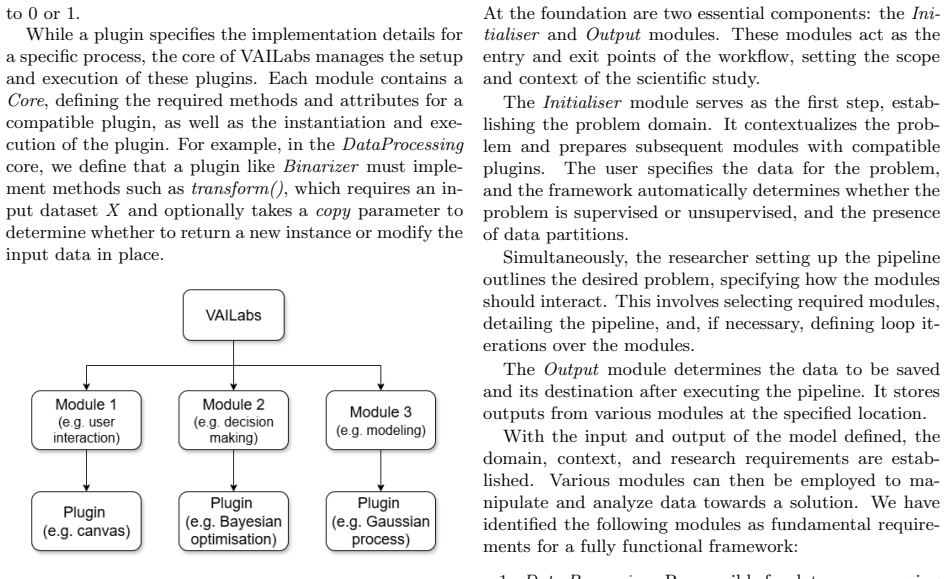
The load-bearing device is the XML-based workflow description executed by a module/plugin/core runtime. Modules are typed containers for generic research steps (Initialiser, Output, Data Processing, Decision Making, Environment, Modeling, User Interaction); each module's Core defines the interface its plugins must implement, and the XML file lists the modules, their data dependencies, loop iterations, and the points where execution pauses for human input. That design makes loops and nested optimization first-class constructs, which the paper identifies as what ordinary workflow managers and LLM-agent frameworks lack.
What would settle it
Run the perovskite workflow end-to-end from the code VAILabs provides and check whether the Bayesian optimization loop recovers a stable composition region after roughly 1.8% of the discretized composition space, matching the original study; if the supplied code has no runnable pipeline or the run diverges from that result, the feasibility demonstration fails.
Extended reading notes
Core claim
The paper's central claim is that VAILabs provides a flexible workbench and toolbox for a broad range of scientific domains, and that the three mapped case studies demonstrate the feasibility of the approach across different scientific fields. The contribution is not a new optimization algorithm or AI model; it is a workflow layer that lets the same modules and interfaces drive research processes as different as a physical materials-screening loop, a fully digital reinforcement-learning co-design loop, and an active-learning loop with a chemist in the loop. The three re-implementations are offered as evidence that iterative loops, nested optimization, and interactive checkpoints—capabilities standard workflow managers and LLM-agent frameworks lack—can be expressed uniformly and reused across domains.
Load-bearing premise
The demonstration rests on the premise that the three workflow diagrams correspond to VAILabs pipelines that actually run and reproduce the original research processes; the paper provides no execution logs, outputs, or quantitative evidence for that, so the feasibility claim is carried by the diagrams and the linked code.
Editorial extensions
If this is right
- A standard Bayesian optimization module can be replaced by a more advanced decision-making plugin, such as Monte Carlo Tree Search, without touching the rest of a pipeline.
- Reusable modules can be transplanted between domains, such as taking the robot-design optimization module into a drug-discovery setting or inserting a materials-science user-feedback interface into another pipeline.
- Published research workflows, when re-encoded as VAILabs instances, become reproducible artifacts that AI researchers can re-run and benchmark without rewriting domain-specific code.
- LLMs and other AI assistants can be embedded inside structured experimental protocols rather than operating as free-floating agents, combining flexible reasoning with reproducibility.
Reading between the lines
- The real test of the advertised modularity would be to take the Bayesian-optimization module from the perovskite case, plug it unchanged into the robot outer loop, and show that it runs; the paper illustrates this transplant but does not execute it.
- A natural extension the paper leaves implicit is to treat VAILabs as a benchmark substrate by re-implementing additional published pipelines from other fields, turning three hand-mapped examples into a growing suite for comparing AI-assistance methods on identical workflow structure.
- The framework's benefits are mostly network effects—shared modules, cross-domain challenges, and benchmarking opportunities—so the case for it strengthens only with broad adoption; a single proof-of-concept cannot by itself establish those benefits.
Editorial analysis
A structured set of objections, weighed in public.
Referee Report
Summary. The paper introduces VAILabs, a modular and domain-agnostic software library intended to implement the Virtual Laboratory (VL) concept for AI-assisted scientific research. The authors argue that existing workflow managers and AI-agent frameworks lack support for iterative, interactive, and human-in-the-loop research processes, and they propose an architecture built from modules, plugins, and cores, orchestrated through an XML-based workflow description. As a proof-of-concept, the paper maps three published research workflows—perovskite materials optimization with Bayesian optimization (Sun et al.), co-adaptation of robot design and behavior (Luck et al.), and human-in-the-loop de novo drug design (Sundin et al.)—into VAILabs block diagrams. The central claim is that these mappings demonstrate the feasibility of a unified framework across heterogeneous scientific domains.
Significance. If the claimed functionality is real, VAILabs would be a useful contribution to the growing ecosystem of AI-assisted research tools: it targets an acknowledged gap (expressing iterative, interactive, and human-in-the-loop workflows in a unified language), and the three case studies span natural-science experimentation, fully digital simulation, and human-in-the-loop generative design, giving the domain-agnostic claim a concrete and diverse test bed. The manuscript also provides a fair and reasonably complete survey of related work, and it explicitly avoids self-fitting by using externally published workflows as benchmarks. However, the proof-of-concept as presented is incomplete: the paper contains no executed pipeline, no runtime logs, no quantitative outputs, and no concrete XML example, so the feasibility claim is currently supported only by design diagrams and an anonymous repository link. The conceptual framing is sound and the architecture is plausible, but the evidence does not yet meet the standard for a demonstrated implementation.
major comments (3)
- [Section 4, Figures 4b, 5b, 6b] The central claim of having 're-implemented' three real research workflows in VAILabs, and thereby having 'demonstrated the feasibility of the approach' (abstract and Section 5), is not supported by any evidence of execution. The paper presents only block-diagram mappings; there are no XML workflow excerpts, console logs, output files, test results, or quantitative outcomes. Section 3.7 refers to example XML files in an anonymous, unpinned repository, but the paper itself does not show that any of the three pipelines actually runs or reproduces any result from Sun et al. [54], Luck et al. [30], or Sundin et al. [55]. Without at least one executed pipeline with observable outputs, the feasibility claim remains a design proposal rather than a demonstrated proof-of-concept.
- [Section 4.2 and the 'Effort and benefits' subsections (4.1, 4.2, 4.3)] The language used to describe the demonstrations is conditional and speculative ('would have been', 'could be tried out', 'could easily be tried'), which is appropriate for hypothetical benefits but inconsistent with the assertion that the processes have been re-implemented. For example, Section 4.2 states that implementation 'requires effectively only the description of the two nested optimization processes,' but this describes expected effort, not an executed result. The manuscript should either provide concrete runtime evidence or clearly label the demonstrations as design mappings rather than executed re-implementations.
- [Sections 3.4 and 3.7] The XML-based workflow description is introduced as 'the cornerstone of our proposal' and 'the essential tool for orchestrating research experiments,' yet no concrete example of a workflow XML document appears in the paper. A minimal but complete XML snippet for one of the three use cases, together with the module/plugin schema or a machine-readable schema definition, would allow readers to assess the domain-agnostic claim and would substantially support the reproducibility argument. Without it, the architecture description remains too abstract to evaluate whether the claimed modularity and interchangeability are actually realized.
minor comments (5)
- [Throughout] The name 'V AILabs' appears with a space in the title, abstract, and Sections 1 and 3.2, while the rest of the paper uses 'VAILabs'; please standardize the spelling.
- [Section 3.7] The sentence 'You can find examples of the XML workflow in the repository' is informal and unspecific; please provide a concrete file name or directory and, ideally, a short explanation of what each example demonstrates.
- [Figure 3 caption] The caption reads 'Material design Robot design Drug design' with no punctuation; please reformat as a list or separate phrases for readability.
- [Section 4.1] The phrase 'V AILab' (last paragraph of Section 4.1) is inconsistent with the 'VAILabs' spelling used elsewhere; please unify.
- [Section 1, reference [46]] Reference [46] is a paper about a virtual machine environment for a real-time systems course; it is not the historical origin of the term 'virtual machine.' Consider citing a more standard reference for the computing concept.
Circularity Check
No significant circularity: the proof-of-concept maps external published workflows, and the only self-citation is non-load-bearing framing.
full rationale
I found no step in which a claimed prediction or result reduces by construction to its input. The three demonstrations are mappings of external published workflows: Sun et al. [54] for materials design, Luck et al. [30] for robot co-adaptation, and Sundin et al. [55] for human-in-the-loop drug design. These source workflows were not produced by VAILabs, and the paper fits no parameters, computes no quantitative output from its own architecture, and invokes no theorem whose conclusion is the feasibility claim. The only self-citation is [24], co-authored by current authors Klami and Kaski, used to define virtual laboratories and to justify 'general recommendations' for VL software in Sections 1, 3.2, and 3.3. That citation is conceptual framing rather than load-bearing inference: the modular architecture, XML workflow description, and the three mappings stand independently of whether [24] is accepted. The paper's own limitations—Section 5 says 'Mapping arbitrary scientific tasks into a modular structure remains a work in progress, and many of the benefits of a unified software architecture would only be seen once the tools are broadly used'—and the absence of execution logs or outputs (Section 3.7 points to an anonymous repository) are evidential gaps about whether the diagrams correspond to runnable pipelines, but an incomplete demonstration is not circular reasoning. Thus the central claim is not equivalent to its inputs by definition or by fit, and the paper receives no circularity score beyond zero.
Assumptions & free parameters
assumptions (3)
- domain assumption The five fundamental modules (Data Processing, Decision Making, Environment, Modeling, User Interaction) are sufficient to express any domain-agnostic research workflow.
- domain assumption Existing workflow managers and AI-agent frameworks cannot express conditional loops, interactive checkpoints, or integration of simulations with hardware.
- domain assumption The three selected workflows are representative enough to establish domain-agnosticism.
Cite this review
Pith. "Pith review of Virtual Laboratories: Domain-agnostic workflows for research." pith.science (2026). https://pith.science/paper/EKNWXJUW
@misc{pith2026250706271,
  author       = {Pith},
  title        = {Pith review of: Virtual Laboratories: Domain-agnostic workflows for research},
  year         = {2026},
  howpublished = {\url{https://pith.science/paper/EKNWXJUW}},
  note         = {Machine review of arXiv:2507.06271}
}
read the original abstract
Many scientific disciplines have traditionally advanced by iterating over hypotheses using labor-intensive trial-and-error, which is a slow and expensive process. Recent advances in computing, digitalization, and machine learning have introduced tools that promise to make scientific research faster by assisting in this iterative process. However, these advances are scattered across disciplines and only loosely connected, with specific computational methods being primarily developed for narrow domain-specific applications. Virtual Laboratories are being proposed as a unified formulation to help researchers navigate this increasingly digital landscape using common AI technologies. While conceptually promising, VLs are not yet widely adopted in practice, and concrete implementations remain limited.This paper explains how the Virtual Laboratory concept can be implemented in practice by introducing the modular software library VAILabs, designed to support scientific discovery. VAILabs provides a flexible workbench and toolbox for a broad range of scientific domains. We outline the design principles and demonstrate a proof-of-concept by mapping three concrete research tasks from differing fields as virtual laboratory workflows.
Figures


Figures from the paper (3 more)


Reference graph
Works this paper leans on
-
[24]
Virtual laboratories: Transforming research with ai
Arto Klami, Theo Damoulas, Ola Engkvist, Patrick Rinke, and Samuel Kaski. Virtual laboratories: Transforming research with ai. Data-Centric Engi- neering, 5:e19, 2024. 16
work page 2024
-
[54]
A data fusion approach to optimize compositional stability of halide perovskites
Shijing Sun, Armi Tiihonen, Felipe Oviedo, Zhe Liu, Janak Thapa, Yicheng Zhao, Noor Titan P Hartono, Anuj Goyal, Thomas Heumueller, Clio Batali, et al. A data fusion approach to optimize compositional stability of halide perovskites. Matter, 4(4):1305– 1322, 2021
work page 2021
-
[30]
Data-efficient co-adaptation of morphol- ogy and behaviour with deep reinforcement learn- ing
Kevin Sebastian Luck, Heni Ben Amor, and Roberto Calandra. Data-efficient co-adaptation of morphol- ogy and behaviour with deep reinforcement learn- ing. In Conference on Robot Learning, pages 854–
-
[55]
Human-in-the-loop assisted de novo molecular design
Iiris Sundin, Alexey Voronov, Haoping Xiao, Kostas Papadopoulos, Esben Jannik Bjerrum, Markus Heinonen, Atanas Patronov, Samuel Kaski, and Ola Engkvist. Human-in-the-loop assisted de novo molecular design. Journal of Cheminformatics, 14 (1):1–16, 2022
work page 2022
-
[1]
Yousri Attia Mohamed Abouelenein, Shaimaa Ab- dul Salam Selim, and Mohamed Ali Nagy Elmaad- away. Impact of a virtual chemistry lab in chemistry teaching on scientific practices and digital compe- tence for pre-service science teachers. Education and Information Technologies, 29(3):2805–2840, 2024
work page 2024
-
[2]
Krishnashree Achuthan, KS Sreelatha, Shone Suren- dran, Shyam Diwakar, Prema Nedungadi, Steven Humphreys, S Sreekala CO, Zeena Pillai, Raghu Ra- man, Ani Deepthi, et al. The value amrita virtual labs project: Using web technology to provide vir- tual laboratory access to students. In 2011 IEEE Global Humanitarian Technology Conference, pages 117–121. IEEE, 2011
work page 2011
-
[3]
Krishnashree Achuthan, Dhananjay Raghavan, Balakrishnan Shankar, Saneesh P Francis, and Vysakh Kani Kolil. Impact of remote experimenta- tion, interactivity and platform effectiveness on lab- oratory learning outcomes. International Journal of Educational Technology in Higher Education, 18:1– 24, 2021
work page 2021
-
[4]
Litllm: A toolkit for scientific literature review
Shubham Agarwal, Gaurav Sahu, Abhay Puri, Is- sam H Laradji, Krishnamurthy DJ Dvijotham, Ja- son Stanley, Laurent Charlin, and Christopher Pal. Litllm: A toolkit for scientific literature review. arXiv preprint arXiv:2402.01788, 2024
arXiv 2024
Show all 65 references
-
[5]
Kedro, April 2024
Sajid Alam, Nok Lam Chan, Laura Couto, Yetunde Dada, Ivan Danov, Deepyaman Datta, Ty- nan DeBold, Jitendra Gundaniya, Yolan Honor´ e- Roug´ e, Stephanie Kaiser, Rashida Kanchwala, Ankita Katiyar, Ravi Kumar Pilla, Huong Nguyen, Juan Luis Cano Rodr ´ ıguez, Joel Schwarzmann, Dm...
2024
-
[6]
Science in the age of large language models
Abeba Birhane, Atoosa Kasirzadeh, David Leslie, and Sandra Wachter. Science in the age of large language models. Nature Reviews Physics, 5(5):277– 280, 2023
2023
-
[7]
Reinvent 2.0: an ai tool for de novo drug design
Thomas Blaschke, Josep Ar´ us-Pous, Hongming Chen, Christian Margreitter, Christian Tyrchan, Ola Engkvist, Kostas Papadopoulos, and Atanas Pa- tronov. Reinvent 2.0: an ai tool for de novo drug design. Journal of chemical information and model- ing, 60(12):5918–5922, 2020
2020
-
[8]
An artificial intelligence model for ballistic performance of thin plates
Ravindranadh Bobbili, B Ramakrishna, and Vemuri Madhu. An artificial intelligence model for ballistic performance of thin plates. Mechanics Based Design of Structures and Machines, 51(1):327–338, 2023
2023
-
[9]
The role of experimentation in artificial intelligence
Bruce G Buchanan. The role of experimentation in artificial intelligence. Philosophical Transactions of the Royal Society of London. Series A: Physical and Engineering Sciences, 349(1689):153–166, 1994
1994
-
[10]
LangChain, 2022
Harrison Chase. LangChain, 2022. URL https:// github.com/langchain-ai/langchain
2022
-
[11]
What are the benefits of a virtual laboratory for student learning? In HERDSA Annual Interna- tional conference, Melbourne, pages 12–15
K Chiu. What are the benefits of a virtual laboratory for student learning? In HERDSA Annual Interna- tional conference, Melbourne, pages 12–15. Citeseer, 1999
1999
-
[12]
Pybullet, a python module for physics simulation for games, robotics and machine learning
Erwin Coumans and Yunfei Bai. Pybullet, a python module for physics simulation for games, robotics and machine learning. http://pybullet.org, 2016– 2023
2016
-
[13]
Nextflow enables reproducible compu- tational workflows
Paolo Di Tommaso, Maria Chatzou, Evan W Floden, Pablo Prieto Barja, Emilio Palumbo, and Cedric Notredame. Nextflow enables reproducible compu- tational workflows. Nature biotechnology, 35(4):316– 319, 2017
2017
-
[14]
Lab-on-a-chip: microfluidics in drug discovery.Nature Reviews Drug Discovery, 5(3):210–218, 2006
Petra S Dittrich and Andreas Manz. Lab-on-a-chip: microfluidics in drug discovery.Nature Reviews Drug Discovery, 5(3):210–218, 2006
2006
-
[15]
Do people engage cognitively with ai? impact of ai assistance on incidental learning
Krzysztof Z Gajos and Lena Mamykina. Do people engage cognitively with ai? impact of ai assistance on incidental learning. In 27th international confer- ence on intelligent user interfaces, pages 794–806, 2022
2022
-
[16]
Virtual reality laboratories: a review of experiences
Marcela Hern´ andez-de Men´ endez, Antonio Vallejo Guevara, and Ruben Morales-Menendez. Virtual reality laboratories: a review of experiences. International Journal on Interactive Design and Manufacturing (IJIDeM), 13:947–966, 2019
2019
-
[17]
Knowledge-integrated machine learn- ing for materials: lessons from gameplaying and robotics
Kedar Hippalgaonkar, Qianxiao Li, Xiaonan Wang, John W Fisher III, James Kirkpatrick, and Tonio Buonassisi. Knowledge-integrated machine learn- ing for materials: lessons from gameplaying and robotics. Nature Reviews Materials, 8(4):241–260, 2023
2023
-
[18]
Applications of natural language processing and large language mod- els in materials discovery
Xue Jiang, Weiren Wang, Shaohan Tian, Hao Wang, Turab Lookman, and Yanjing Su. Applications of natural language processing and large language mod- els in materials discovery. npj Computational Mate- rials, 11(1):79, 2025
2025
-
[19]
Bayesian optimi- sation for efficient material discovery: a mini review
Yimeng Jin and Priyank V Kumar. Bayesian optimi- sation for efficient material discovery: a mini review. Nanoscale, 15(26):10975–10984, 2023
2023
-
[20]
The malmo platform for arti- ficial intelligence experimentation
Matthew Johnson, Katja Hofmann, Tim Hutton, and David Bignell. The malmo platform for arti- ficial intelligence experimentation. In Ijcai, pages 4246–4247, 2016
2016
-
[21]
Highly accurate protein structure prediction with alphafold
John Jumper, Richard Evans, Alexander Pritzel, Tim Green, Michael Figurnov, Olaf Ronneberger, Kathryn Tunyasuvunakool, Russ Bates, Anna Zidek, Anna Potapenko, et al. Highly accurate protein structure prediction with alphafold. Nature, 596 (7873):583–589, 2021
2021
-
[22]
Labber Instrument Control and Lab Automation Software, 2024
Keysight Technologies. Labber Instrument Control and Lab Automation Software, 2024. https: //www.keysight.com/us/en/products/software/ application-sw/labber-software.html
2024
-
[23]
Functional genomic hypothesis generation and ex- perimentation by a robot scientist
Ross D King, Kenneth E Whelan, Ffion M Jones, Philip G K Reiser, Christopher H Bryant, Stephen H Muggleton, Douglas B Kell, and Stephen G Oliver. Functional genomic hypothesis generation and ex- perimentation by a robot scientist. Nature, 427 (6971):247–252, 2004
2004
-
[25]
Combining laboratory experiments with digital tools to do scientific inquiry
Anders Kluge. Combining laboratory experiments with digital tools to do scientific inquiry. Interna- tional Journal of Science Education, 36(13):2157– 2179, 2014
2014
-
[26]
Challenges in high-throughput inorganic ma- terials prediction and autonomous synthesis
Josh Leeman, Yuhan Liu, Joseph Stiles, Scott B Lee, Prajna Bhatt, Leslie M Schoop, and Robert G Pal- grave. Challenges in high-throughput inorganic ma- terials prediction and autonomous synthesis. PRX Energy, 3(1):011002, 2024
2024
-
[27]
Scilitllm: How to adapt llms for scientific literature understanding, 2025
Sihang Li, Jin Huang, Jiaxi Zhuang, Yaorui Shi, Xiaochen Cai, Mingjun Xu, Xiang Wang, Linfeng Zhang, Guolin Ke, and Hengxing Cai. Scilitllm: How to adapt llms for scientific literature understanding, 2025
2025
-
[28]
LlamaIndex, 11 2022
Jerry Liu. LlamaIndex, 11 2022. URL https:// github.com/jerryjliu/llama_index
2022
-
[29]
Reinvent 4: Modern ai–driven generative molecule design
Hannes H Loeffler, Jiazhen He, Alessandro Tibo, Jon Paul Janet, Alexey Voronov, Lewis H Mervin, and Ola Engkvist. Reinvent 4: Modern ai–driven generative molecule design. Journal of Cheminfor- matics, 16(1):20, 2024
2024
-
[31]
What is missing in autonomous discovery: open challenges for the com- munity
Phillip M Maffettone, Pascal Friederich, Sterling G Baird, Ben Blaiszik, Keith A Brown, Stuart I Camp- bell, Orion A Cohen, Rebecca L Davis, Ian T Fos- ter, Navid Haghmoradi, et al. What is missing in autonomous discovery: open challenges for the com- munity. Digital Discovery...
2023
-
[32]
Online laboratories and virtual experimentation in higher education from a sociotechnical-pedagogical design perspective
Dominik May, Isa Jahnke, and Stephanie Moore. Online laboratories and virtual experimentation in higher education from a sociotechnical-pedagogical design perspective. Journal of Computing in Higher Education, 35(2):203–222, 2023
2023
-
[33]
Scaling deep learning for ma- terials discovery
Amil Merchant, Simon Batzner, Samuel S Schoen- holz, Muratahan Aykol, Gowoon Cheon, and Ekin Dogus Cubuk. Scaling deep learning for ma- terials discovery. Nature, 624(7990):80–85, 2023
2023
-
[34]
Semantic Kernel: Model-agnostic SDK for AI agents and multi-agent systems
Microsoft. Semantic Kernel: Model-agnostic SDK for AI agents and multi-agent systems. https:// github.com/microsoft/semantic-kernel, 2023
2023
-
[35]
Sustainable data analysis with snakemake
Felix M¨ older, Kim Philipp Jablonski, Brice Letcher, Michael B Hall, Christopher H Tomkins-Tinch, Vanessa Sochat, Jan Forster, Soohyun Lee, Sven O Twardziok, Alexander Kanitz, et al. Sustainable data analysis with snakemake. F1000Research, 10, 2021
2021
-
[36]
Boss: Bayesian optimization over string spaces
Henry Moss, David Leslie, Daniel Beck, Javier Gon- zalez, and Paul Rayson. Boss: Bayesian optimization over string spaces. Advances in neural information processing systems, 33:15476–15486, 2020
2020
-
[37]
Molecular de-novo design through deep reinforcement learning
Marcus Olivecrona, Thomas Blaschke, Ola Engkvist, and Hongming Chen. Molecular de-novo design through deep reinforcement learning. Journal of cheminformatics, 9(1):1–14, 2017
2017
-
[38]
Deep generative models in de novo drug molecule generation
Chao Pang, Jianbo Qiao, Xiangxiang Zeng, Quan Zou, and Leyi Wei. Deep generative models in de novo drug molecule generation. Journal of Chemical Information and Modeling, 64(7):2174–2194, 2024
2024
-
[39]
Phet: Interactive simulations for teaching and learning physics
Katherine Perkins, Wendy Adams, Michael Dubson, Noah Finkelstein, Sam Reid, Carl Wieman, and Ron LeMaster. Phet: Interactive simulations for teaching and learning physics. The physics teacher, 44(1):18– 23, 2006
2006
-
[40]
Evaluating chatgpt as an adjunct for radiologic decision-making
Arya Rao, John Kim, Meghana Kamineni, Michael Pang, Winston Lie, and Marc D Succi. Evaluating chatgpt as an adjunct for radiologic decision-making. MedRxiv, pages 2023–02, 2023
2023
-
[41]
Workflow data patterns: Identification, representation and tool sup- port
Nick Russell, Arthur HM Ter Hofstede, David Ed- mond, and Wil MP Van der Aalst. Workflow data patterns: Identification, representation and tool sup- port. In Conceptual Modeling–ER 2005: 24th Inter- national Conference on Conceptual Modeling, Kla- genfurt, Austria, October 24-...
2005
-
[42]
Parkin, Chris A
Riko Safaric, Rob M. Parkin, Chris A. Czarnecki, and David W. Calkin. Virtual environment for teler- obotics. Integrated Computer-Aided Engineering, 8 (2):95–104, 2001
2001
-
[43]
The effect of virtual laboratories on im- proving students’ srl: an umbrella systematic review
Amalia Sapriati, Astri Dwi Jayanti Suhandoko, Audi Yundayani, Rafidah Abdul Karim, Udan Kusmawan, Airil Haimi Mohd Adnan, and Ardiansyah Azhary Suhandoko. The effect of virtual laboratories on im- proving students’ srl: an umbrella systematic review. Education sciences, 13(3):...
2023
-
[44]
Agent laboratory: Using llm agents as research assistants, 2025
Samuel Schmidgall, Yusheng Su, Ze Wang, Ximeng Sun, Jialian Wu, Xiaodong Yu, Jiang Liu, Zicheng Liu, and Emad Barsoum. Agent laboratory: Using llm agents as research assistants, 2025
2025
-
[45]
Ibm rxn for chemistry: Unveiling the grammar of the organic chemistry lan- guage, 2021
Philippe Schwaller, Hendrik Strobelt, Teodoro Laino, and Benjamin Hoover. Ibm rxn for chemistry: Unveiling the grammar of the organic chemistry lan- guage, 2021
2021
-
[46]
A virtual ma- chine environment for real time systems laboratories
Mukul Shirvaikar and Nikhil Satyala. A virtual ma- chine environment for real time systems laboratories. In 2007 Annual Conference & Exposition, pages 12– 152, 2007
2007
-
[47]
AutoGPT, 2023
Significant Gravitas. AutoGPT, 2023. URL https: //github.com/Significant-Gravitas/AutoGPT
2023
-
[48]
Large language models encode clinical knowledge
Karan Singhal, Shekoofeh Azizi, Tao Tu, S Sara Mahdavi, Jason Wei, Hyung Won Chung, Nathan Scales, Ajay Tanwani, Heather Cole-Lewis, Stephen Pfohl, et al. Large language models encode clinical knowledge. Nature, 620(7972):172–180, 2023
2023
-
[49]
Computational meth- ods in drug discovery
Gregory Sliwoski, Sandeepkumar Kothiwale, Jens Meiler, and Edward W Lowe. Computational meth- ods in drug discovery. Pharmacological reviews, 66 (1):334–395, 2014
2014
-
[50]
Towards robot scientists for au- tonomous scientific discovery
Andrew Sparkes, Wayne Aubrey, Emma Byrne, Amanda Clare, Muhammed N Khan, Maria Li- akata, Magdalena Markham, Jem Rowland, Lar- isa N Soldatova, Kenneth E Whelan, Michael Young, and Ross D King. Towards robot scientists for au- tonomous scientific discovery. Automated Experi- m...
2010
-
[51]
Autonomous exper- imentation systems for materials development: A community perspective
Eric Stach, Brian DeCost, A Gilad Kusne, Ja- son Hattrick-Simpers, Keith A Brown, Kristofer G Reyes, Joshua Schrier, Simon Billinge, Tonio Buonassisi, Ian Foster, et al. Autonomous exper- imentation systems for materials development: A community perspective. Matter, 4(9):2702–...
2021
-
[52]
Labster Virtual Lab Experiments: Basic Biology
Sarah Stauffer, Aaron Gardner, Dewi Ayu Kencana Ungu, Ainara L´ opez-C´ ordoba, and Matthias Heim. Labster Virtual Lab Experiments: Basic Biology . Springer, 2018
2018
-
[53]
Organic synthesis in a modular robotic system driven by a chemical pro- gramming language
Sebastian Steiner, Jakob Wolf, Stefan Glatzel, Anna Andreou, Jaros law M Granda, Graham Keenan, Trevor Hinkley, Gerardo Aragon-Camarasa, Philip J Kitson, Davide Angelone, et al. Organic synthesis in a modular robotic system driven by a chemical pro- gramming language. Science,...
2019
-
[56]
Bulaong, John E
Kyle Swanson, Wesley Wu, Nash L. Bulaong, John E. Pak, and James Zou. The virtual lab: Ai agents design new sars-cov-2 nanobodies with exper- imental validation. bioRxiv, 2024
2024
-
[57]
An autonomous labo- ratory for the accelerated synthesis of novel materi- als
Nathan J Szymanski, Bernardus Rendy, Yuxing Fei, Rishi E Kumar, Tanjin He, David Milsted, Matthew J McDermott, Max Gallant, Ekin Dogus Cubuk, Amil Merchant, et al. An autonomous labo- ratory for the accelerated synthesis of novel materi- als. Nature, 624(7990):86–91, 2023
2023
-
[58]
A survey of generative ai for de novo drug design: new frontiers in molecule and protein generation
Xiangru Tang, Howard Dai, Elizabeth Knight, Fang Wu, Yunyang Li, Tianxiao Li, and Mark Gerstein. A survey of generative ai for de novo drug design: new frontiers in molecule and protein generation. Brief- ings in Bioinformatics, 25(4):bbae338, 2024
2024
-
[59]
Genesis: Towards the automation of systems biology research
Ievgeniia A Tiukova, Daniel Brunns ˚ aker, Erik Y Bjurstr¨ om, Alexander H Gower, Filip Kronstr¨ om, Gabriel K Reder, Ronald S Reiserer, Konstantin Ko- rovin, Larisa B Soldatova, John P Wikswo, et al. Genesis: Towards the automation of systems biology research. arXiv preprint ...
2024 arXiv
-
[60]
Ai feyn- man: A physics-inspired method for symbolic regres- sion
Silviu-Marian Udrescu and Max Tegmark. Ai feyn- man: A physics-inspired method for symbolic regres- sion. Science advances, 6(16):eaay2631, 2020
2020
-
[61]
Scientific discovery in the age of ar- tificial intelligence
Hanchen Wang, Tianfan Fu, Yuanqi Du, Wenhao Gao, Kexin Huang, Ziming Liu, Payal Chandak, Shengchao Liu, Peter Van Katwyk, Andreea Deac, 18 Anima Anandkumar, Karianne Bergen, Carla P Gomes, Shirley Ho, Pushmeet Kohli, Joan Lasenby, Jure Leskovec, Tie-Yan Liu, Arjun Manrai, Deb-...
2023
-
[62]
Inverse design of materials by machine learning
Jia Wang, Yingxue Wang, and Yanan Chen. Inverse design of materials by machine learning. Materials, 15(5):1811, 2022
2022
-
[63]
Recent advances in bayesian op- timization
Xilu Wang, Yaochu Jin, Sebastian Schmitt, and Markus Olhofer. Recent advances in bayesian op- timization. ACM Computing Surveys, 55(13s):287, 2023
2023
-
[64]
Cheaper faster drug development validated by the reposition- ing of drugs against neglected tropical diseases.Jour- nal of the Royal society Interface, 12(104):20141289, 2015
Kevin Williams, Elizabeth Bilsland, Andrew Sparkes, Wayne Aubrey, Michael Young, Larisa N Soldatova, Kurt De Grave, Jan Ramon, Michaela De Clare, Worachart Sirawaraporn, et al. Cheaper faster drug development validated by the reposition- ing of drugs against neglected tropical...
2015
-
[65]
The chem- collective—virtual labs for introductory chemistry courses
David Yaron, Michael Karabinos, Donovan Lange, James G Greeno, and Gaea Leinhardt. The chem- collective—virtual labs for introductory chemistry courses. Science, 328(5978):584–585, 2010. 19
2010
Reviewed August 6, 2026 · model on record in the stance chip above.
Discussion (0). Sign in to comment.