REVIEW 3 major objections 5 minor 67 references
Low-rank Momentum Factorization for Memory Efficient Training
T0 review · 3 major / 5 minor · reviewed 2026-08-06 · deepseek-v4-flash
Pith's one-line read MoFaSGD compresses the optimizer's first-order momentum into a low-rank SVD that is updated every step, and proves this costs nothing in asymptotic convergence while cutting memory to LoRA levels.
desk verdict MoFaSGD is a genuinely new low-rank momentum optimizer with a plausible empirical story, but the central O(1/sqrt(T)) convergence proof has a load-bearing subspace-inclusion error and an unjustified noise scaling, so the theory does not hold as submitted. read the letter →
The pith
A machine-rendered reading of the paper's core claim, the machinery that carries it, and where it could break.
The reading
What carries the argument
The load-bearing object is the tangent space $T_t$ of the low-rank momentum manifold at $(U_t, \Sigma_t, V_t)$: the collection of matrices $U_t M V_t^T + U_p V_t^T + U_t V_p^T$ with $U_p$ and $V_p$ orthogonal to the current factors. Projecting the gradient onto this tangent space yields the closed form $\hat{G}_t = U_t U_t^T G_t + G_t V_t V_t^T - U_t U_t^T G_t V_t V_t^T$, which Theorem 4.3 shows is the minimal-residual two-sided sketch. Because $\hat{G}_t$ is rank $r$, the sum $\hat{G}_t + \beta \hat{M}_{t-1}$ has rank at most $2r$; after a QR factorization of $[U_t, G_t V_t]$ and $[V_t, G_t^T U_t]$, a rank-$r$ SVD of a $2r \times 2r$ matrix updates the factors in $O((m+n)r^2 + r^3)$ time. This machinery carries the argument by letting the optimization subspace adapt continuously at low cost, while Theorem 4.5 uses the controlled projection residual to keep the momentum-factorization error from spoiling the descent rate.
What would settle it
Run MoFaSGD on a small model and, at several consecutive iterations, compute the largest principal angle between the subspace $\mathrm{Range}([U_{t-1}, G_{t-1} V_{t-1}])$ and $\mathrm{Range}(U_t)$. The proof of Lemma D.5 requires the former to be a subset of the latter; any iteration where the containment fails, which the rank-$2r$ SVD update does not prevent, invalidates the monotone-residual step. Alternatively, track $\|(I - U_t U_t^T) G_t (I - V_t V_t^T)\|_*$ across iterations: if it ever increases, the recursive compression bound that Theorem 4.5 depends on does not hold as written.
Extended reading notes
Core claim
The paper claims that the full-rank first-order momentum of an optimizer can be replaced by a rank-$r$ SVD factorization without sacrificing the asymptotic convergence rate. The key move is to project each incoming gradient onto the tangent space of the current momentum factors; because that projection is optimal among a natural class of two-sided sketches (Theorem 4.3), the residual of the low-rank momentum approximation stays controlled. The update of the factors themselves is cheap: since the projected gradient and the old momentum are each rank $r$, their sum lies in a $2r$-dimensional space and a small SVD of a $2r \times 2r$ matrix produces the new $U, \Sigma, V$. The same factors define the parameter update $W_{t+1} = W_t - \eta U_{t+1} V_{t+1}^T$, bypassing the subspace moment accumulation used by GaLore and making MoFaSGD a low-rank, memory-efficient variant of Muon. Theorem 4.5 then bounds the averaged nuclear-norm gradient by $O(\Delta/(\eta T) + \eta L + \sigma/\sqrt{T})$, which is optimal for smooth non-convex stochastic optimization.
Load-bearing premise
The proof of the convergence theorem assumes that the optimization subspace only grows at each step, meaning the new subspace must contain the previous subspace together with the projected gradient, so that the momentum compression error never increases. The algorithm's actual update rule guarantees the opposite inclusion, so the monotonicity the proof relies on is not assured.
Editorial extensions
If this is right
- Optimizer-state memory for a weight matrix of size $m \times n$ shrinks from $O(mn)$ (AdamW) or $O(mr + nr)$ with full gradients (GaLore) to $O((m+n)r + r^2)$ for the stored factors, the same order as LoRA, while parameters are still updated in full.
- Because the subspace is refined every iteration, there is no periodic full-matrix SVD and no staleness window; the ablation shows that increasing GaLore's update frequency degrades its performance, while MoFaSGD's per-step adaptation does not suffer this effect.
- The method inherits the spectral-normalization behavior of Muon- and Shampoo-type preconditioners without storing second moments or computing matrix roots, so the per-iteration cost stays at the level of a standard optimizer.
- The convergence guarantee is not degraded by the factorization: under nuclear-norm smoothness and a bounded-variance oracle, the averaged gradient norm reaches $O(1/\sqrt{T})$, matching the known lower bound for non-convex stochastic optimization.
- As a low-rank variant of Muon, MoFaSGD offers a drop-in replacement for hidden-layer optimizers in transformer training with comparable quality to full-rank methods in the tested regimes.
Reading between the lines
- Applying the same tangent-space factorization to second-moment statistics would turn MoFaSGD into a fully adaptive (Adam-like) preconditioner at similar memory; the paper leaves this extension open.
- The per-layer projection residual that the analysis controls suggests a concrete rule for adaptive rank allocation: give more rank to layers where $\|G_t - \hat{G}_t\|_F$ stays large.
- Because the optimizer state is already a short list of factors, the low-rank gradient-buffer trick used for gradient accumulation could be extended to shard factors across devices in distributed fine-tuning, potentially cutting communication volume as well as memory.
- The method's per-step subspace adaptation could also serve as a drop-in momentum module inside other low-rank subspace or PEFT pipelines, since it only consumes gradients and produces $(U, V)$ directions.
Editorial analysis
A structured set of objections, weighed in public.
Referee Report
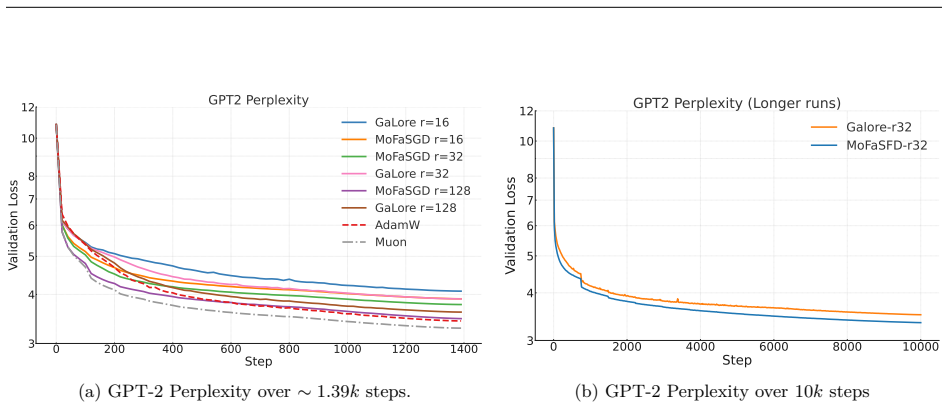
Summary. The paper proposes MoFaSGD, a memory-efficient optimizer that maintains a low-rank SVD factorization of the first-order momentum and updates it online via tangent-space projections. The factors U_{t+1}, V_{t+1} are used directly in the parameter update W_{t+1}=W_t-η U_{t+1}V_{t+1}^T, yielding a LoRA-level memory footprint with per-iteration online subspace adaptation. The central theoretical claim is Theorem 4.5, which asserts an optimal O(1/√T) convergence rate for non-convex stochastic optimization under nuclear-norm smoothness and a first-moment noise bound. Empirically, the paper evaluates MoFaSGD on NanoGPT pre-training, GLUE fine-tuning, and Tulu3 instruction tuning, reporting competitive or better performance than GaLore and LoRA with comparable memory usage. The paper includes a memory profiling study, an ablation on GaLore's subspace update frequency, and a spectral analysis of AdamW momentum buffers that supports the low-rank momentum conjecture.
Significance. If the theoretical result were valid, the paper would make a significant contribution: it combines online low-rank momentum factorization with spectrally normalized updates, achieving a memory footprint comparable to LoRA while providing a provably optimal stochastic non-convex rate. The algorithmic idea is original and the empirical evaluation is unusually thorough for a memory-optimizer paper: it includes per-category memory breakdowns, wall-clock convergence curves, rank ablations, and a direct test of the low-rank momentum conjecture. The code is provided. However, the main theoretical guarantee is not established by the submitted proof. The proof of Lemma D.5 relies on a false subspace inclusion, and the stochastic noise scaling used throughout the analysis is not supported by the stated assumptions. These are load-bearing gaps, not presentation issues. The empirical results remain interesting, but the paper's central claim of an optimal convergence rate is unproven in the current form.
major comments (3)
- [Appendix D.3.1, Lemma D.5, Eq. (46)] The proof asserts that, from the update rule of Eq. (7)-(8), Range([U_{t-1}, G_{t-1}V_{t-1}]) is contained in Range(U_t). This inclusion is reversed. The update defines U_t = U'_{t-1}U''_{t-1} with U'_{t-1} = QR([U_{t-1}, G_{t-1}V_{t-1}]), so only Range(U_t) ⊆ Range([U_{t-1}, G_{t-1}V_{t-1}]) holds. The bracketed matrix spans up to 2r directions while U_t has only r columns, so the asserted reverse inclusion is dimensionally impossible unless the new gradient columns lie in the old range. This inclusion is exactly what lets Eq. (46) bound the current tangent-space residual by the previous residual; without it, the recursion in Eq. (47) and the bound in Eq. (50) do not follow, and Theorem 4.5 is unproven.
- [Appendix D.3.1, Lemma D.5, Eqs. (43)-(44)] The proof replaces M̂_t with Ĝ_t + βM̂_{t-1}, but M̂_t is the rank-r SVD of that 2r-rank matrix, not the matrix itself. The step from Eq. (43) to Eq. (44) omits the rank-r truncation error ∥M̂_t - (Ĝ_t + βM̂_{t-1})∥_*, which is not generally zero and is not bounded by the projection residual in the argument. Even if the subspace inclusion in Eq. (46) were corrected, the compression-error recursion would still need an additional term; the current proof does not account for it.
- [Assumption 4.2 and Lemmas D.4-D.5] Assumption 4.2 only bounds the first moment of the stochastic noise, E[∥∇L(W,ξ)-∇L(W)∥_*] ≤ σ, yet the proofs of Lemma D.4 (Eq. 39) and Lemma D.5 (Eq. 50) introduce a √B scaling, e.g., Tσ/((1-β)√B). With only a first-moment bound, summing T noise terms gives Tσ, not Tσ/√B; the √B factor requires a second-moment or sub-Gaussian condition that is neither stated nor derived. This is an independent gap that prevents the claimed O(1/√T) rate under the stated assumptions.
minor comments (5)
- [Lemma D.4 statement] The lemma says 'Under Assumptions 4.1 and 4.1'; the second reference should be Assumption 4.2.
- [Equation (7) and following text] The text says 'the inner matrix has rank at most r'; the 2r×2r matrix [βΣ_t-U_t^T G_t V_t, I; I, 0] generically has rank up to 2r, so this statement is unclear and should be corrected or clarified.
- [Theorem 4.3 proof] The notation U_{L,R} is used for different block matrices in Eq. (18), Eq. (24), and Eq. (27), which makes the proof hard to follow; the minimization over L and R is stated only implicitly. A clearer presentation of the SVD decomposition of L and R and the achievability of the lower bound would improve readability.
- [Figure 6b] The caption reads 'GaLore Update Frequency (τ) Ablation' but the legend and axis labels contain stray symbols (e.g., '= 300', '= 75'); these should be cleaned up.
- [Section 5.1] The phrase 'the 0.73B token budget, optimized for Muon's convergence speed' is a bit ambiguous; consider rewording to clarify that the budget is the standard NanoGPT speedrun budget.
Circularity Check
No circularity detected; the convergence proof is self-contained, though it contains a non-circular proof gap in Lemma D.5.
full rationale
MoFaSGD's central derivation chain is self-contained: the algorithm is defined by Equations 7–9, and Theorem 4.5 is proved from Assumptions 4.1–4.2 via Lemmas D.3–D.5 plus a standard descent argument. The low-rank momentum conjecture is justified by external prior work (Feinberg et al. 2024; Zhao et al. 2024a) and independently validated on AdamW first-moment buffers from the Tulu3 run, which is external to MoFaSGD's own trajectory. No fitted parameter is renamed as a prediction, and no cited result by the present authors is load-bearing; the paper cites Shampoo, Muon, and GaLore only for motivation and positioning. Theorem 4.3's optimality claim is proven directly rather than assumed. The proof does contain a serious correctness gap: Lemma D.5 asserts Range([U_{t-1}, G_{t-1}V_{t-1}]) is contained in Range(U_t) 'based on Equation 7', but Equations 7–8 give the reverse containment Range(U_t) ⊆ Range([U_{t-1}, G_{t-1}V_{t-1}]), and the asserted inclusion fails in general. Separately, Assumption 4.2 bounds E‖G − ∇L‖_∗ by σ while Lemmas D.4 and D.5 introduce σ/√B without an explicit batch-size assumption. These are proof errors, not circular reductions: the theorem does not assume its conclusion, and no equation is defined in terms of the quantity it is used to predict. Accordingly, the circularity score is 0; the flagged issues belong in a correctness review, not a circularity analysis.
Assumptions & free parameters
free parameters (3)
- rank r =
16, 32, 128 (pretraining); 4, 8 (GLUE); 8 (Tulu3)
- momentum decay beta =
0.85 (NanoGPT), 0.95 (GLUE and Tulu3)
- learning rate eta =
1e-3 to 1e-5 depending on task
assumptions (5)
- domain assumption L-smoothness with respect to nuclear norm (Assumption 4.1)
- domain assumption Stochastic oracle satisfies E[||nabla L(W,xi)-nabla L(W)||_*] <= sigma (Assumption 4.2)
- domain assumption Gradient EMA exhibits low-rank structure (Section 4.1)
- ad hoc to paper rank(G0) <= r (Theorem 4.5)
- ad hoc to paper Monotone subspace inclusion: Range([U_{t-1}, G_{t-1}V_{t-1}]) is contained in Range(U_t), and analogously for V (Eq. 46 of Lemma D.5)
Cite this review
Pith. "Pith review of Low-rank Momentum Factorization for Memory Efficient Training." pith.science (2026). https://pith.science/paper/U7SHXPZN
@misc{pith2026250708091,
  author       = {Pith},
  title        = {Pith review of: Low-rank Momentum Factorization for Memory Efficient Training},
  year         = {2026},
  howpublished = {\url{https://pith.science/paper/U7SHXPZN}},
  note         = {Machine review of arXiv:2507.08091}
}
read the original abstract
Fine-tuning large foundation models presents significant memory challenges due to stateful optimizers like AdamW, often requiring several times more GPU memory than inference. While memory-efficient methods like parameter-efficient fine-tuning (e.g., LoRA) and optimizer state compression exist, recent approaches like GaLore bridge these by using low-rank gradient projections and subspace moment accumulation. However, such methods may struggle with fixed subspaces or computationally costly offline resampling (e.g., requiring full-matrix SVDs). We propose Momentum Factorized SGD (MoFaSGD), which maintains a dynamically updated low-rank SVD representation of the first-order momentum, closely approximating its full-rank counterpart throughout training. This factorization enables a memory-efficient fine-tuning method that adaptively updates the optimization subspace at each iteration. Crucially, MoFaSGD leverages the computed low-rank momentum factors to perform efficient spectrally normalized updates, offering an alternative to subspace moment accumulation. We establish theoretical convergence guarantees for MoFaSGD, proving it achieves an optimal rate for non-convex stochastic optimization under standard assumptions. Empirically, we demonstrate MoFaSGD's effectiveness on large language model alignment benchmarks, achieving a competitive trade-off between memory reduction (comparable to LoRA) and performance compared to state-of-the-art low-rank optimization methods. Our implementation is available at https://github.com/pmahdavi/MoFaSGD.
Figures


Figures from the paper (11 more)


Reference graph
Works this paper leans on
-
[1]
Memory efficient adaptive optimization
Rohan Anil, Vineet Gupta, Tomer Koren, and Yoram Singer. Memory efficient adaptive optimization. Advances in Neural Information Processing Systems, 32, 2019
work page 2019
-
[2]
Lower bounds for non-convex stochastic optimization
Yossi Arjevani, Yair Carmon, John C Duchi, Dylan J Foster, Nathan Srebro, and Blake Woodworth. Lower bounds for non-convex stochastic optimization. Mathematical Programming, 199 0 (1): 0 165--214, 2023
2023
-
[3]
Modular duality in deep learning
Jeremy Bernstein and Laker Newhouse. Modular duality in deep learning. arXiv preprint arXiv:2410.21265, 2024 a
arXiv 2024
-
[4]
Old optimizer, new norm: An anthology
Jeremy Bernstein and Laker Newhouse. Old optimizer, new norm: An anthology. arXiv.org, 2024 b . doi:10.48550/arxiv.2409.20325
-
[5]
signsgd: Compressed optimisation for non-convex problems
Jeremy Bernstein, Yu-Xiang Wang, Kamyar Azizzadenesheli, and Animashree Anandkumar. signsgd: Compressed optimisation for non-convex problems. In International Conference on Machine Learning, pp.\ 560--569. PMLR, 2018
work page 2018
-
[6]
Automatic gradient descent: Deep learning without hyperparameters
Jeremy Bernstein, Chris Mingard, Kevin Huang, Navid Azizan, and Yisong Yue. Automatic gradient descent: Deep learning without hyperparameters. arXiv preprint arXiv:2304.05187, 2023
arXiv 2023
-
[7]
Symbolic discovery of optimization algorithms
Xiangning Chen, Chen Liang, Da Huang, Esteban Real, Kaiyuan Wang, Hieu Pham, Xuanyi Dong, Thang Luong, Cho-Jui Hsieh, Yifeng Lu, et al. Symbolic discovery of optimization algorithms. Advances in neural information processing systems, 36, 2024
work page 2024
-
[8]
8-bit optimizers via block-wise quantization
Tim Dettmers, Mike Lewis, Sam Shleifer, and Luke Zettlemoyer. 8-bit optimizers via block-wise quantization. arXiv preprint arXiv:2110.02861, 2021
arXiv 2021
Show all 67 references
-
[9]
Qlora: Efficient finetuning of quantized llms
Tim Dettmers, Artidoro Pagnoni, Ari Holtzman, and Luke Zettlemoyer. Qlora: Efficient finetuning of quantized llms. Advances in Neural Information Processing Systems, 36, 2024
2024
-
[10]
Adaptive subgradient methods for online learning and stochastic optimization
John Duchi, Elad Hazan, and Yoram Singer. Adaptive subgradient methods for online learning and stochastic optimization. Journal of Machine Learning Research, 12: 0 2121--2159, 2011
2011
-
[11]
Combining axes preconditioners through kronecker approximation for deep learning
Sai Surya Duvvuri, Fnu Devvrit, Rohan Anil, Cho-Jui Hsieh, and Inderjit S Dhillon. Combining axes preconditioners through kronecker approximation for deep learning. In The Twelfth International Conference on Learning Representations, 2024
2024
-
[12]
Sketchy: Memory-efficient adaptive regularization with frequent directions
Vladimir Feinberg, Xinyi Chen, Y Jennifer Sun, Rohan Anil, and Elad Hazan. Sketchy: Memory-efficient adaptive regularization with frequent directions. Advances in Neural Information Processing Systems, 36, 2024
2024
-
[13]
Fast approximate natural gradient descent in a kronecker factored eigenbasis
Thomas George, C \'e sar Laurent, Xavier Bouthillier, Nicolas Ballas, and Pascal Vincent. Fast approximate natural gradient descent in a kronecker factored eigenbasis. Advances in neural information processing systems, 31, 2018
2018
-
[14]
Improving neural network training in low dimensional random bases
Frithjof Gressmann, Zach Eaton-Rosen, and Carlo Luschi. Improving neural network training in low dimensional random bases. Advances in Neural Information Processing Systems, 33: 0 12140--12150, 2020
2020
-
[15]
A kronecker-factored approximate fisher matrix for convolution layers
Roger Grosse and James Martens. A kronecker-factored approximate fisher matrix for convolution layers. In International Conference on Machine Learning, pp.\ 573--582. PMLR, 2016
2016
-
[16]
Olmes: A standard for language model evaluations
Yuling Gu, Oyvind Tafjord, Bailey Kuehl, Dany Haddad, Jesse Dodge, and Hannaneh Hajishirzi. Olmes: A standard for language model evaluations. arXiv preprint arXiv:2406.08446, 2024
2024 arXiv
-
[17]
Shampoo: Preconditioned stochastic tensor optimization
Vineet Gupta, Tomer Koren, and Yoram Singer. Shampoo: Preconditioned stochastic tensor optimization. In International Conference on Machine Learning, pp.\ 1842--1850. PMLR, 2018
2018
-
[18]
Gradient descent happens in a tiny subspace
Guy Gur-Ari, Daniel A Roberts, and Ethan Dyer. Gradient descent happens in a tiny subspace. arXiv preprint arXiv:1812.04754, 2018
2018 arXiv
-
[19]
Flora: Low-rank adapters are secretly gradient compressors
Yongchang Hao, Yanshuai Cao, and Lili Mou. Flora: Low-rank adapters are secretly gradient compressors. arXiv preprint arXiv:2402.03293, 2024
2024 arXiv
-
[20]
Topics in matrix analysis
Roger A Horn and Charles R Johnson. Topics in matrix analysis. Cambridge university press, 1994
1994
-
[21]
Parameter-efficient transfer learning for nlp
Neil Houlsby, Andrei Giurgiu, Stanislaw Jastrzebski, Bruna Morrone, Quentin De Laroussilhe, Andrea Gesmundo, Mona Attariyan, and Sylvain Gelly. Parameter-efficient transfer learning for nlp. In International conference on machine learning, pp.\ 2790--2799. PMLR, 2019
2019
-
[22]
Lora: Low-rank adaptation of large language models
Edward J Hu, Yelong Shen, Phillip Wallis, Zeyuan Allen-Zhu, Yuanzhi Li, Shean Wang, Lu Wang, and Weizhu Chen. Lora: Low-rank adaptation of large language models. arXiv preprint arXiv:2106.09685, 2021
2021 arXiv
-
[23]
modded-nanogpt: Speedrunning the nanogpt baseline, 2024 a
Keller Jordan, Jeremy Bernstein, Brendan Rappazzo, @fernbear.bsky.social, Boza Vlado, You Jiacheng, Franz Cesista, Braden Koszarsky, and @Grad62304977. modded-nanogpt: Speedrunning the nanogpt baseline, 2024 a . URL https://github.com/KellerJordan/modded-nanogpt
2024
-
[24]
Muon: An optimizer for hidden layers in neural networks, 2024 b
Keller Jordan, Yuchen Jin, Vlado Boza, You Jiacheng, Franz Cecista, Laker Newhouse, and Jeremy Bernstein. Muon: An optimizer for hidden layers in neural networks, 2024 b . URL https://kellerjordan.github.io/posts/muon/
2024
-
[25]
A rank stabilization scaling factor for fine-tuning with lora
Damjan Kalajdzievski. A rank stabilization scaling factor for fine-tuning with lora. arXiv preprint arXiv:2312.03732, 2023
2023 arXiv
-
[26]
Scaling laws for neural language models
Jared Kaplan, Sam McCandlish, Tom Henighan, Tom B Brown, Benjamin Chess, Rewon Child, Scott Gray, Alec Radford, Jeffrey Wu, and Dario Amodei. Scaling laws for neural language models. arXiv preprint arXiv:2001.08361, 2020
2001 arXiv
-
[27]
Accelerating neural network training: An analysis of the algoperf competition
Priya Kasimbeg, Frank Schneider, Runa Eschenhagen, Juhan Bae, Chandramouli Shama Sastry, Mark Saroufim, Boyuan Feng, Less Wright, Edward Z Yang, Zachary Nado, et al. Accelerating neural network training: An analysis of the algoperf competition. arXiv preprint arXiv:2502.15015, 2025
2025 arXiv
-
[28]
Kingma and Jimmy Ba
Diederik P. Kingma and Jimmy Ba. Adam : A method for stochastic optimization. In 3rd International Conference on Learning Representations (ICLR), 2015
2015
-
[29]
Vera: Vector-based random matrix adaptation
Dawid J Kopiczko, Tijmen Blankevoort, and Yuki M Asano. Vera: Vector-based random matrix adaptation. arXiv preprint arXiv:2310.11454, 2023
2023 arXiv
-
[30]
T " ulu 3: Pushing frontiers in open language model post-training
Nathan Lambert, Jacob Morrison, Valentina Pyatkin, Shengyi Huang, Hamish Ivison, Faeze Brahman, Lester James V Miranda, Alisa Liu, Nouha Dziri, Shane Lyu, et al. T " ulu 3: Pushing frontiers in open language model post-training. arXiv preprint arXiv:2411.15124, 2024
2024 arXiv
-
[31]
Scalable optimization in the modular norm
Tim Large, Yang Liu, Jacob Huh, Hyojin Bahng, Phillip Isola, and Jeremy Bernstein. Scalable optimization in the modular norm. Advances in Neural Information Processing Systems, 37: 0 73501--73548, 2025
2025
-
[32]
The power of scale for parameter-efficient prompt tuning
Brian Lester, Rami Al-Rfou, and Noah Constant. The power of scale for parameter-efficient prompt tuning. arXiv preprint arXiv:2104.08691, 2021
2021 arXiv
-
[33]
Memory efficient optimizers with 4-bit states
Bingrui Li, Jianfei Chen, and Jun Zhu. Memory efficient optimizers with 4-bit states. Advances in Neural Information Processing Systems, 36: 0 15136--15171, 2023
2023
-
[34]
Prefix-tuning: Optimizing continuous prompts for generation
Xiang Lisa Li and Percy Liang. Prefix-tuning: Optimizing continuous prompts for generation. arXiv preprint arXiv:2101.00190, 2021
2021 arXiv
-
[35]
Relora: High-rank training through low-rank updates
Vladislav Lialin, Sherin Muckatira, Namrata Shivagunde, and Anna Rumshisky. Relora: High-rank training through low-rank updates. In The Twelfth International Conference on Learning Representations, 2023
2023
-
[36]
On the limited memory bfgs method for large scale optimization
Dong C Liu and Jorge Nocedal. On the limited memory bfgs method for large scale optimization. Mathematical programming, 45 0 (1): 0 503--528, 1989
1989
-
[37]
Muon is scalable for llm training
Jingyuan Liu, Jianlin Su, Xingcheng Yao, Zhejun Jiang, Guokun Lai, Yulun Du, Yidao Qin, Weixin Xu, Enzhe Lu, Junjie Yan, et al. Muon is scalable for llm training. arXiv preprint arXiv:2502.16982, 2025
2025 arXiv
-
[38]
Dora: Weight-decomposed low-rank adaptation
Shih-Yang Liu, Chien-Yi Wang, Hongxu Yin, Pavlo Molchanov, Yu-Chiang Frank Wang, Kwang-Ting Cheng, and Min-Hung Chen. Dora: Weight-decomposed low-rank adaptation. arXiv preprint arXiv:2402.09353, 2024
2024 arXiv
-
[39]
Fixing weight decay regularization in adam
Ilya Loshchilov, Frank Hutter, et al. Fixing weight decay regularization in adam. arXiv preprint arXiv:1711.05101, 5, 2017
2017 arXiv
-
[40]
Badam: A memory efficient full parameter training method for large language models
Qijun Luo, Hengxu Yu, and Xiao Li. Badam: A memory efficient full parameter training method for large language models. arXiv preprint arXiv:2404.02827, 2024
2024 arXiv
-
[41]
Came: Confidence-guided adaptive memory efficient optimization
Yang Luo, Xiaozhe Ren, Zangwei Zheng, Zhuo Jiang, Xin Jiang, and Yang You. Came: Confidence-guided adaptive memory efficient optimization. arXiv preprint arXiv:2307.02047, 2023
2023 arXiv
-
[42]
Adalomo: Low-memory optimization with adaptive learning rate
Kai Lv, Hang Yan, Qipeng Guo, Haijun Lv, and Xipeng Qiu. Adalomo: Low-memory optimization with adaptive learning rate. arXiv preprint arXiv:2310.10195, 2023 a
2023 arXiv
-
[43]
Full parameter fine-tuning for large language models with limited resources
Kai Lv, Yuqing Yang, Tengxiao Liu, Qinghui Gao, Qipeng Guo, and Xipeng Qiu. Full parameter fine-tuning for large language models with limited resources. arXiv preprint arXiv:2306.09782, 2023 b
2023 arXiv
-
[44]
Swan: Preprocessing sgd enables adam-level performance on llm training with significant memory reduction
Chao Ma, Wenbo Gong, Meyer Scetbon, and Edward Meeds. Swan: Preprocessing sgd enables adam-level performance on llm training with significant memory reduction. arXiv preprint arXiv:2412.13148, 2024
2024 arXiv
-
[45]
New insights and perspectives on the natural gradient method
James Martens. New insights and perspectives on the natural gradient method. Journal of Machine Learning Research, 21 0 (146): 0 1--76, 2020
2020
-
[46]
Optimizing neural networks with kronecker-factored approximate curvature
James Martens and Roger Grosse. Optimizing neural networks with kronecker-factored approximate curvature. In International conference on machine learning, pp.\ 2408--2417. PMLR, 2015
2015
-
[47]
Microadam: Accurate adaptive optimization with low space overhead and provable convergence
Ionut-Vlad Modoranu, Mher Safaryan, Grigory Malinovsky, Eldar Kurtic, Thomas Robert, Peter Richtárik, and Dan Alistarh. Microadam: Accurate adaptive optimization with low space overhead and provable convergence. arXiv.org, 2024. doi:10.48550/arxiv.2405.15593
-
[48]
A new perspective on shampoo's preconditioner
Depen Morwani, Itai Shapira, Nikhil Vyas, Eran Malach, Sham Kakade, and Lucas Janson. A new perspective on shampoo's preconditioner. arXiv preprint arXiv:2406.17748, 2024
2024 arXiv
-
[49]
Training language models to follow instructions with human feedback
Long Ouyang, Jeffrey Wu, Xu Jiang, Diogo Almeida, Carroll Wainwright, Pamela Mishkin, Chong Zhang, Sandhini Agarwal, Katarina Slama, Alex Ray, et al. Training language models to follow instructions with human feedback. Advances in neural information processing systems, 35: 0 2...
2022
-
[50]
The fineweb datasets: Decanting the web for the finest text data at scale
Guilherme Penedo, Hynek Kydl \' c ek, Anton Lozhkov, Margaret Mitchell, Colin A Raffel, Leandro Von Werra, Thomas Wolf, et al. The fineweb datasets: Decanting the web for the finest text data at scale. Advances in Neural Information Processing Systems, 37: 0 30811--30849, 2025
2025
-
[51]
Zero: Memory optimizations toward training trillion parameter models
Samyam Rajbhandari, Jeff Rasley, Olatunji Ruwase, and Yuxiong He. Zero: Memory optimizations toward training trillion parameter models. In SC20: International Conference for High Performance Computing, Networking, Storage and Analysis, pp.\ 1--16. IEEE, 2020
2020
-
[52]
Adarankgrad: Adaptive gradient-rank and moments for memory-efficient llms training and fine-tuning
Yehonathan Refael, Jonathan Svirsky, Boris Shustin, Wasim Huleihel, and Ofir Lindenbaum. Adarankgrad: Adaptive gradient-rank and moments for memory-efficient llms training and fine-tuning. arXiv preprint arXiv:2410.17881, 2024
-
[53]
Ldadam: Adaptive optimization from low-dimensional gradient statistics
Thomas Robert, Mher Safaryan, Ionut-Vlad Modoranu, and Dan Alistarh. Ldadam: Adaptive optimization from low-dimensional gradient statistics. arXiv.org, 2024
2024
-
[54]
Gradient multi-normalization for stateless and scalable llm training
Meyer Scetbon, Chao Ma, Wenbo Gong, and Edward Meeds. Gradient multi-normalization for stateless and scalable llm training. arXiv preprint arXiv:2502.06742, 2025
2025 arXiv
-
[55]
Adafactor: Adaptive learning rates with sublinear memory cost
Noam Shazeer and Mitchell Stern. Adafactor: Adaptive learning rates with sublinear memory cost. In International Conference on Machine Learning, pp.\ 4596--4604. PMLR, 2018
2018
-
[56]
Tieleman and G
T. Tieleman and G. Hinton. Lecture 6.5 - rmsprop: Divide the gradient by a running average of its recent magnitude. Coursera: Neural Networks for Machine Learning, 2012
2012
-
[57]
Practical low-rank communication compression in decentralized deep learning
Thijs Vogels, Sai Praneeth Karimireddy, and Martin Jaggi. Practical low-rank communication compression in decentralized deep learning. Advances in Neural Information Processing Systems, 33: 0 14171--14181, 2020
2020
-
[58]
Soap: Improving and stabilizing shampoo using adam
Nikhil Vyas, Depen Morwani, Rosie Zhao, Mujin Kwun, Itai Shapira, David Brandfonbrener, Lucas Janson, and Sham Kakade. Soap: Improving and stabilizing shampoo using adam. arXiv preprint arXiv:2409.11321, 2024
2024 arXiv
-
[59]
Glue: A multi-task benchmark and analysis platform for natural language understanding
Alex Wang. Glue: A multi-task benchmark and analysis platform for natural language understanding. arXiv preprint arXiv:1804.07461, 2018
2018 arXiv
-
[60]
How far can camels go? exploring the state of instruction tuning on open resources
Yizhong Wang, Hamish Ivison, Pradeep Dasigi, Jack Hessel, Tushar Khot, Khyathi Chandu, David Wadden, Kelsey MacMillan, Noah A Smith, Iz Beltagy, et al. How far can camels go? exploring the state of instruction tuning on open resources. Advances in Neural Information Processing...
2023
-
[61]
A spectral condition for feature learning
Greg Yang, James B Simon, and Jeremy Bernstein. A spectral condition for feature learning. arXiv preprint arXiv:2310.17813, 2023
2023 arXiv
-
[62]
Bitfit: Simple parameter-efficient fine-tuning for transformer-based masked language-models
Elad Ben Zaken, Shauli Ravfogel, and Yoav Goldberg. Bitfit: Simple parameter-efficient fine-tuning for transformer-based masked language-models. arXiv preprint arXiv:2106.10199, 2021
2021
-
[63]
Adalora: Adaptive budget allocation for parameter-efficient fine-tuning
Qingru Zhang, Minshuo Chen, Alexander Bukharin, Nikos Karampatziakis, Pengcheng He, Yu Cheng, Weizhu Chen, and Tuo Zhao. Adalora: Adaptive budget allocation for parameter-efficient fine-tuning. arXiv preprint arXiv:2303.10512, 2023
2023 arXiv
-
[64]
Galore: Memory-efficient llm training by gradient low-rank projection
Jiawei Zhao, Zhenyu Zhang, Beidi Chen, Zhangyang Wang, Anima Anandkumar, and Yuandong Tian. Galore: Memory-efficient llm training by gradient low-rank projection. arXiv preprint arXiv:2403.03507, 2024 a
2024 arXiv
-
[65]
Adapprox: Adaptive approximation in adam optimization via randomized low-rank matrices
Pengxiang Zhao, Ping Li, Yingjie Gu, Yi Zheng, Stephan Ludger K \"o lker, Zhefeng Wang, and Xiaoming Yuan. Adapprox: Adaptive approximation in adam optimization via randomized low-rank matrices. arXiv preprint arXiv:2403.14958, 2024 b
2024 arXiv
-
[66]
Apollo: Sgd-like memory, adamw-level performance
Hanqing Zhu, Zhenyu Zhang, Wenyan Cong, Xi Liu, Sem Park, Vikas Chandra, Bo Long, David Z Pan, Zhangyang Wang, and Jinwon Lee. Apollo: Sgd-like memory, adamw-level performance. arXiv preprint arXiv:2412.05270, 2024
2024 arXiv
-
[67]
write newline
" write newline "" before.all 'output.state := FUNCTION n.dashify 't := "" t empty not t #1 #1 substring "-" = t #1 #2 substring "--" = not "--" * t #2 global.max substring 't := t #1 #1 substring "-" = "-" * t #2 global.max substring 't := while if t #1 #1 substring * t #2 gl...
Reviewed August 6, 2026 · model on record in the stance chip above.
Discussion (0). Sign in to comment.